Web Developer Resume Examples and Templates for 2026



Engineering managers hiring Android developers look for shipped apps, the architecture pattern, and crash-free session rates on the first page, because that combination shows whether you can own production code without supervision.
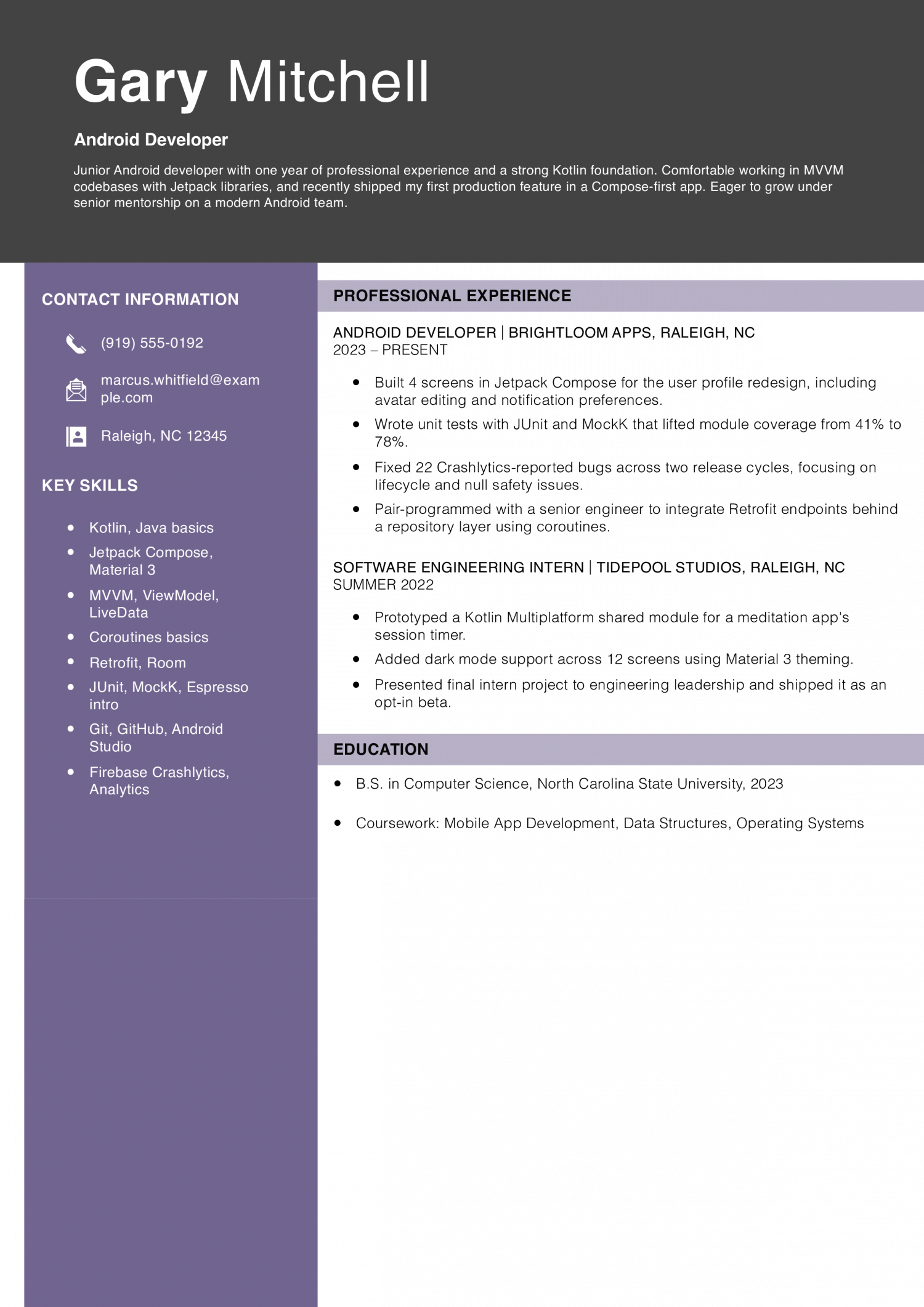
The junior Android developer has one to three years of production experience, often from a bootcamp, CS degree, or first engineering job. This resume needs to prove you ship Kotlin code, write tests, and own features end to end.
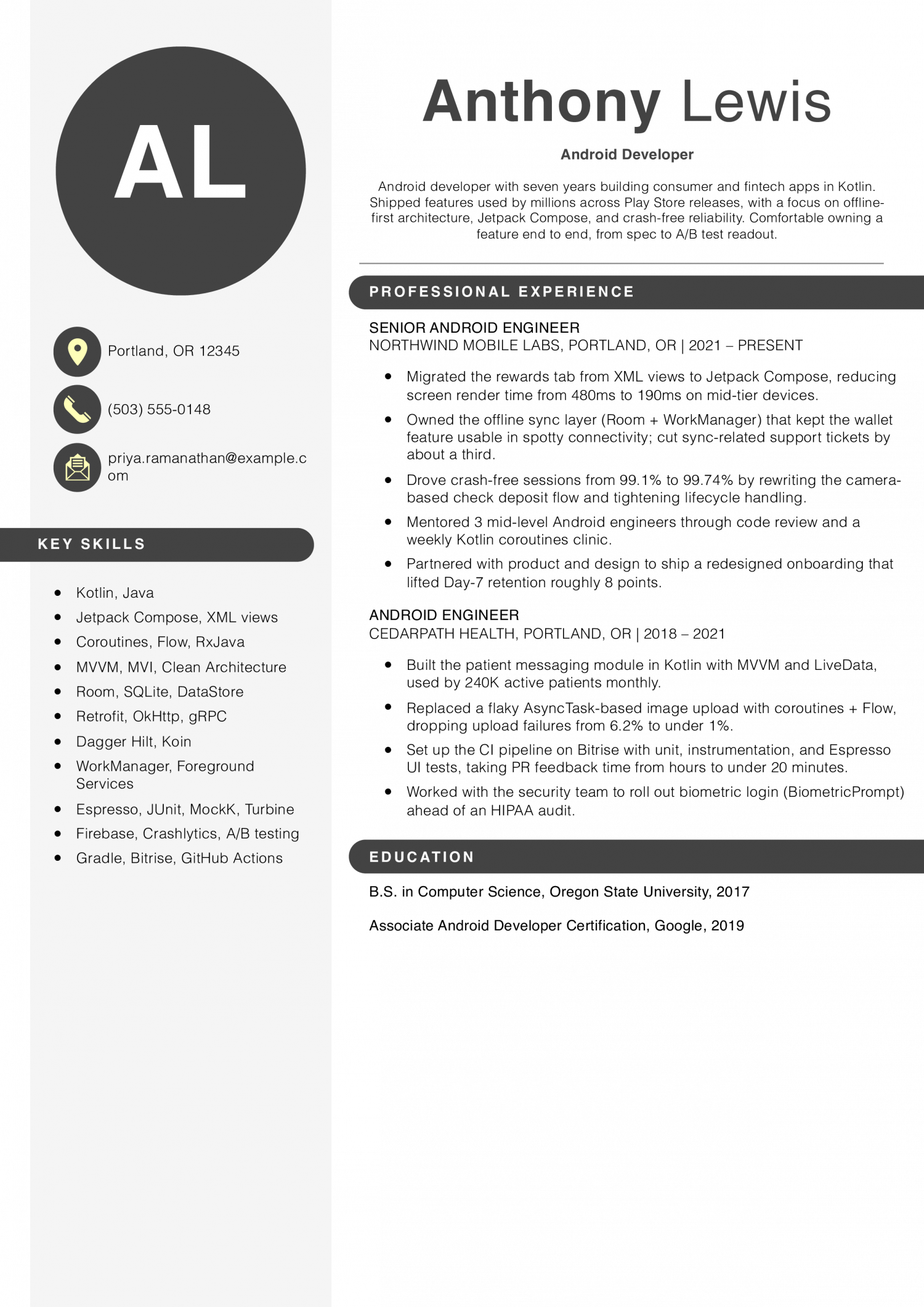
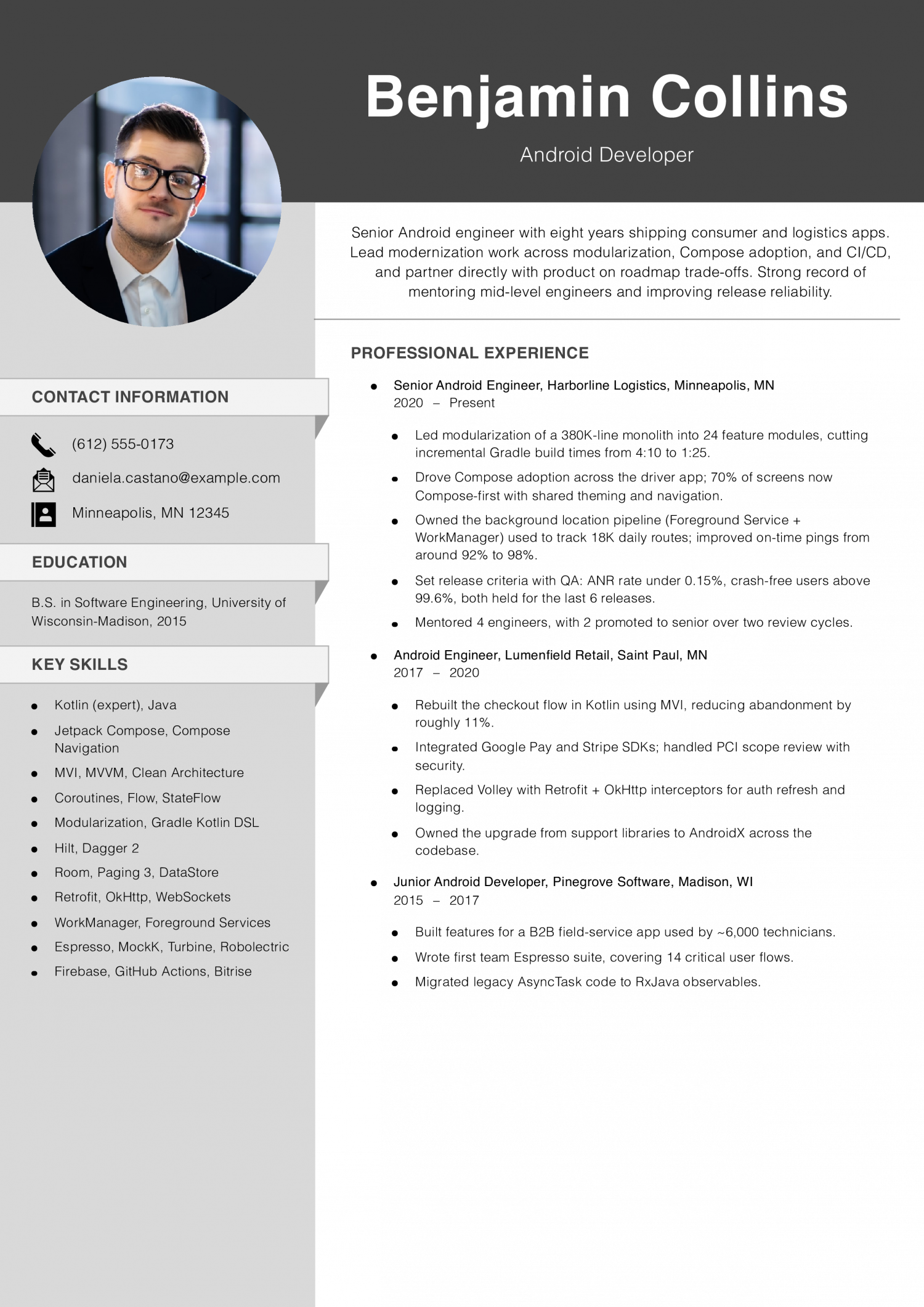
The senior Android developer owns features across the stack, mentors juniors, and drives release quality. This resume needs to prove architectural judgment, measurable performance wins, and a track record of Play Store releases without rollbacks.
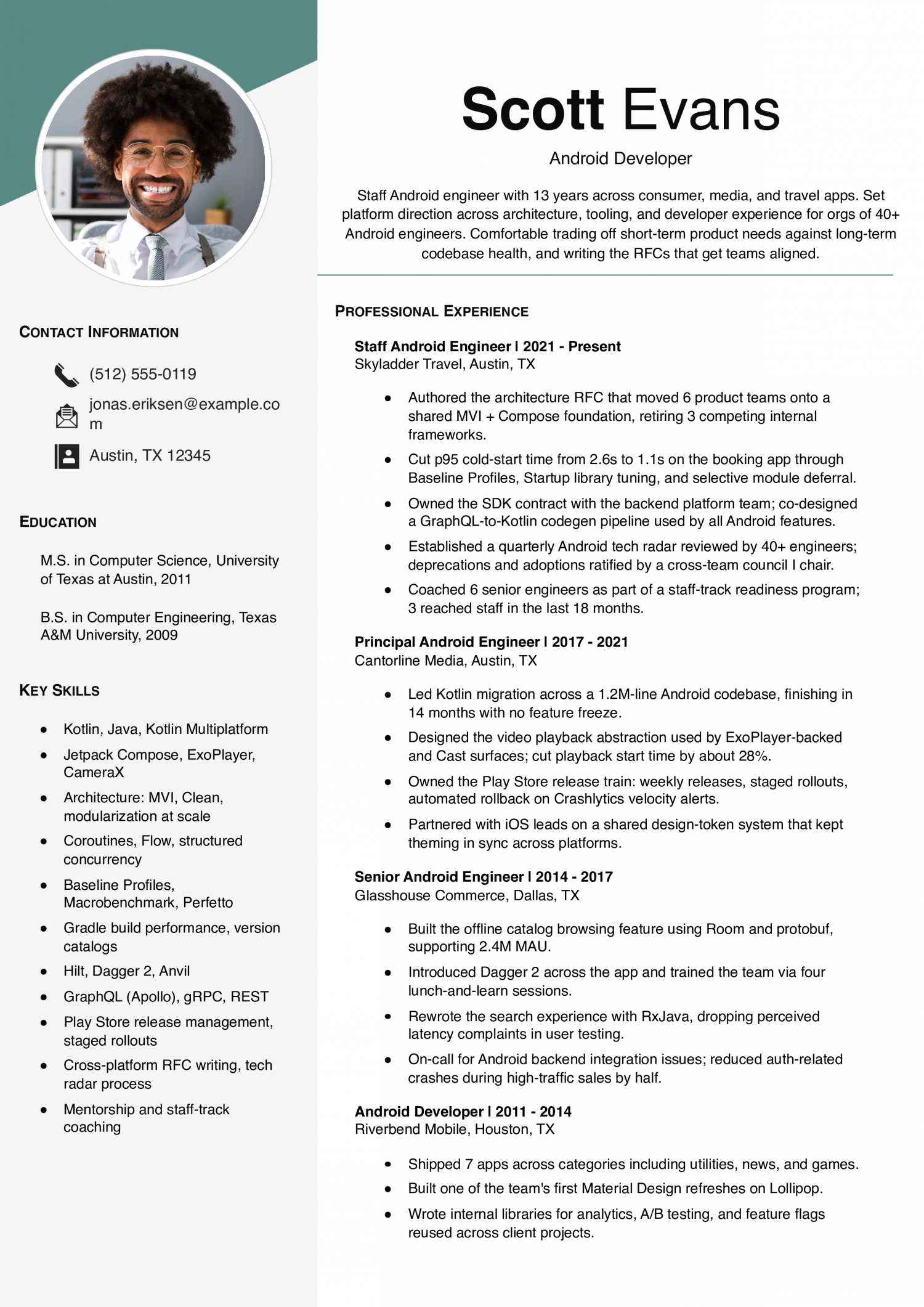
The staff Android developer sets technical direction across multiple teams or a major surface area. This resume needs to prove platform-level decisions, modularization or SDK work, hiring contributions, and influence beyond your own pull requests.
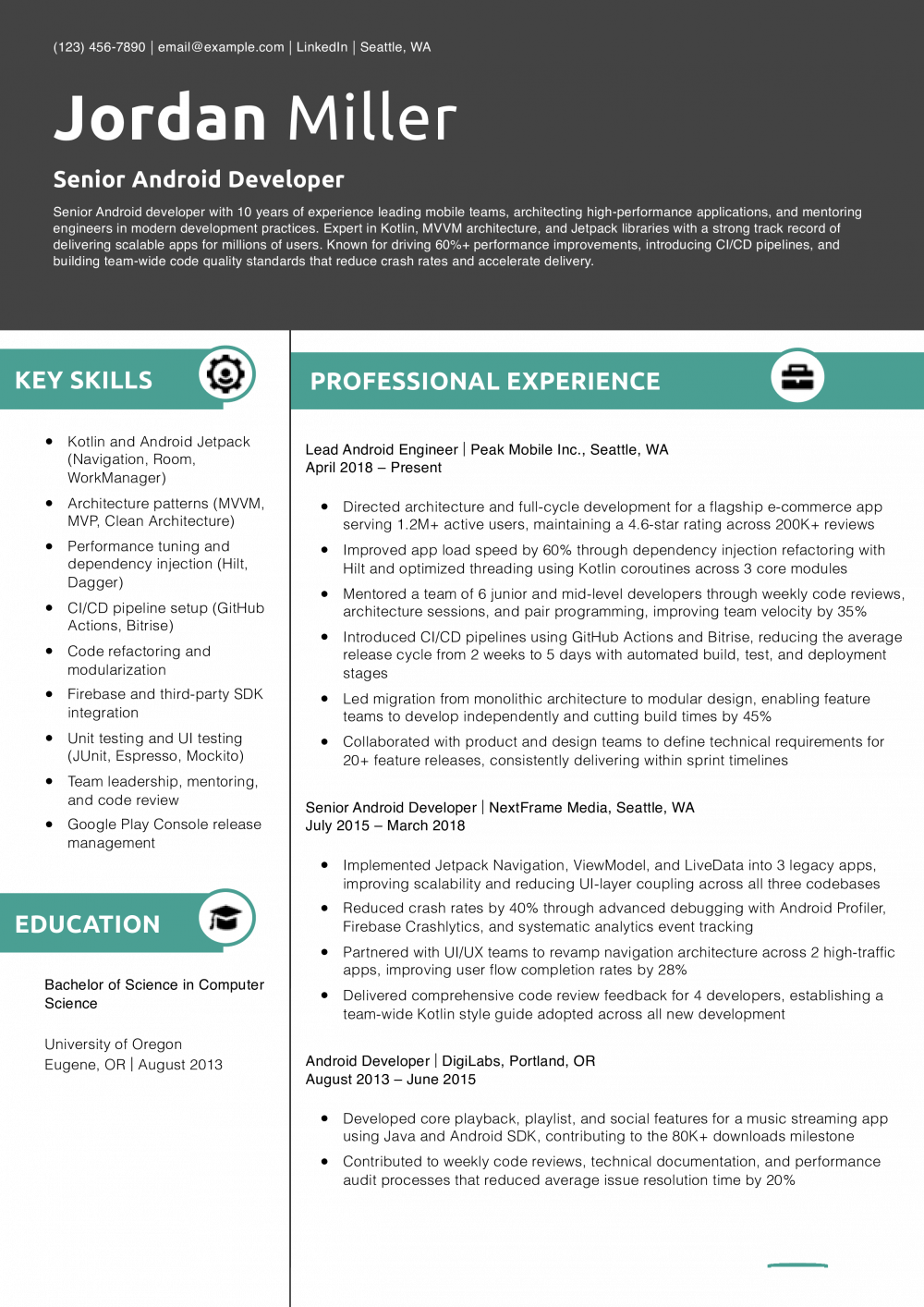
Android developer with nine years across fitness, fintech, and IoT apps. Strong in Kotlin, Jetpack Compose, and modular architecture, with a record of improving release reliability and onboarding new engineers. Comfortable owning a feature from product spec through staged rollout and post-launch metrics review.
Add a single line a tech lead cannot pull from your GitHub profile. That might be a Play Store app with named download volume, a modularization effort that cut build time, or a Jetpack Compose migration you led.
Put it in your summary or the first bullet of your top role. The signal should be specific to Android, not generic engineering.
A staff candidate might lead with SDK ownership or a platform team they built. A senior might lead with a feature shipped to millions of users and the crash-free rate held.
Most strong Android resumes carry numbers tied to release health and user impact. Bullets without a metric tend to read as task lists.
Name two or three of these per role: crash-free session rate, ANR rate, cold-start time in milliseconds, APK or AAB size reduction, build-time cuts, or downloads and active users for the surface you owned.
If you cannot share product metrics, use engineering metrics: test coverage moved from 40 to 75 percent, CI pipeline cut from 22 to 9 minutes, or 60 percent reduction in legacy Java files.
Senior Android engineers scan bullets in clusters. Help them by organizing work into four categories across your roles.
Those categories are: feature delivery (Compose UI, navigation, state management), architecture (MVVM, MVI, dependency injection with Hilt or Koin, coroutines and Flow), platform and performance (modularization, Baseline Profiles, R8, memory and startup work), and release engineering (Play Console, staged rollouts, Firebase Crashlytics, A/B testing).
Hit at least three of the four in your bullets. The mix tells a tech lead what kind of Android engineer you are.
Engineering managers want to confirm your stack in under a minute. Put a Technical Skills block on page one, right under your summary, before your work history.
List languages (Kotlin, Java), UI (Jetpack Compose, XML views), architecture (MVVM, Hilt, coroutines, Flow), testing (JUnit, Espresso, Compose UI testing, Turbine), and tooling (Gradle, Android Studio, Firebase, GitHub Actions or Bitrise).
If you hold the Associate Android Developer certification or completed Google’s Android Developer Nanodegree, place it in a short Credentials line in the same header zone.
End with a Shipped Apps section that links to your Play Store listings or a portfolio site. For each app, name the role you played, the stack, and one outcome metric.
Then list education: degree, school, and graduation year if within the last 10 years. Drop graduation year for older degrees.
Open-source contributions to AndroidX, Compose, or major libraries belong here too, with a link and the PR or feature you contributed. Keep this section tight, four to six lines.
Android hiring is tight in 2026. Engineering teams are running leaner and the bar to clear a screen is higher, with Kotlin and Jetpack Compose now table stakes. Engineering managers weight hard skills heavily on the first pass: stack, architecture, and release tooling.
Soft skills earn weight in the panel loop, where code review judgment and cross-team communication get tested. Match the hard skills below against the target job posting, then use the soft skills as evidence anchors inside your bullets.
| Soft Skills | % of resumes with this skill |
|---|---|
| Problem solving | 79% |
| Communication | 62% |
| Collaboration | 44% |
| Attention to detail | 39% |
| Adaptability | 33% |
And here are the top hard skills showing up most often.
| Hard Skills | % of resumes with this skill |
|---|---|
| Kotlin and Java | 67% |
| Android SDK | 57% |
| MVVM architecture | 48% |
| RESTful API integration | 39% |
| Git version control | 35% |
Based on data from thousands of Android developers’ resumes built on ResumeTemplates.com, May 2026.
Before an android developer resume gets a closer read, hiring teams check for a short list of essentials.
Engineering managers expect to see niche keywords that match their product domain and stack depth. Pick the rows that fit the posting you’re targeting and weave the terms into your bullets, not just your skills list.
| Niche | Keywords ATS scans for |
|---|---|
| Modern Android UI | jetpack compose, material 3, compose navigation, accompanist |
| Architecture and async | mvvm, coroutines, kotlin flow, hilt |
| Release and quality | play console, firebase crashlytics, staged rollout, baseline profiles |
| Testing | espresso, compose ui testing, junit, turbine |
| Performance and platform | anr rate, cold start optimization, r8 shrinking, modularization |
Android teams are split between leads who want Copilot and Cursor in the workflow and leads who worry about generated code shipping without review. Name the tools you use, describe how you check the output, and skip claims that AI ‘writes your features’ if you’re actually editing scaffolds.
Compose previews, ViewModel scaffolds, and DI modules get drafted by LLMs and refined by the engineer.
Test scaffolds for JUnit, Espresso, and Compose tests are drafted by Copilot, then tightened against real edge cases.
Engineers use Cursor to summarize diffs and surface risky changes before opening a pull request for human review.
ML Kit, MediaPipe, and Gemini Nano are showing up in feature work, raising expectations that Android devs can ship inference code.
An Android developer portfolio has two jobs: prove you ship to the Play Store and prove your code holds up to review. Both matter, and one without the other reads as incomplete.
Public listing of at least one app, with screenshots, download count, and current ratings.
Public repos for your shipped apps or sample projects, with clean commit history and a real README.
One page linking your Play Store apps, GitHub, and a short writeup of architecture decisions per app.
Optional. Two or three posts on a Compose migration, a performance win, or a library tradeoff signal senior judgment.
Link your Play Store listing in the resume header. A URL next to your email cuts the recruiter’s verification step to one click and proves the app is live.
Keep one GitHub repo polished. A clean repo with a real README, tests, and a CI badge beats five half-finished side projects. Engineering managers do open the code.
The stack you name signals which generation of Android engineer you are. Lead with current tools; mention legacy ones only when they prove migration experience.
Beyond a CS degree or bootcamp credential, the certifications below tell engineering managers which Android-specific depth you’ve validated outside your day job. List the issuing body and completion date for each, no ID numbers.
Android developer pay clusters in markets with deep mobile product economies, not always the headline tech metros you’d expect. States with strong fintech, gaming, or platform-team hiring often outpace general software averages because the talent pool is thinner and competition for senior Android specialists is fiercer.
If you’re geographically flexible, your resume should foreground the product domains you’ve shipped in (fintech, health, media, commerce) and the platform-scale signals (millions of users, multi-module codebases) that justify the top-paying tier rather than relying on city alone.
| # | State | Avg. Annual |
|---|---|---|
| 1 | California | $170,910 |
| 2 | Washington | $166,910 |
| 3 | Virgin Islands | $162,820 |
| 4 | New York | $161,260 |
| 5 | Massachusetts | $150,520 |
| 6 | Maryland | $137,890 |
| 7 | District of Columbia | $136,040 |
| 8 | Oregon | $135,260 |
| 9 | Delaware | $135,160 |
| 10 | Colorado | $134,540 |
| # | State | Workers | Median | ||
|---|---|---|---|---|---|
| 1 | California | 292,630 | $170,910 | ||
| 2 | Texas |
|
$130,500 | ||
| 3 | New York | 104,130 | $161,260 | ||
| 4 | Washington | 91,470 | $166,910 | ||
| 5 | Virginia | 83,290 | $134,470 |
Resume Templates offers HR approved resume templates to help you create a professional resume in minutes. Choose from several template options and even pre-populate a resume from your profile.
Personal projects count when you treat them like shipped work. Publish at least one app to the Play Store, even at internal testing tier.
Name the download count, crash-free rate, and stack in your bullets. Link the Play Store listing and the GitHub repo so reviewers can verify the code quality.
A project section beats a hobby line. Title it 'Shipped Apps' or 'Projects' and give each entry the same bullet structure as a job.
Yes, if you've worked in a codebase with Java still present. Most production Android apps carry legacy Java.
Engineering managers want to know you can read and maintain it. List Kotlin first, then Java, and mention any Java-to-Kotlin migrations you led in a bullet.
Compose is now the default UI toolkit for new Android work. Resumes without it tend to read as behind.
If your recent experience is XML-only, name one Compose project or course to show you're current. A side project shipped in Compose carries more weight than a tutorial.
Only if you can describe the workflow honestly. Vague 'AI-powered development' lines hurt more than they help.
Saying 'used Copilot to accelerate boilerplate and unit test scaffolding, reviewed all generated code against the codebase style guide' reads as credible. Engineering managers want to see you stay accountable for what ships.
For an Android developer, a tech template is the safest pick, because it keeps your stack, tools, and impact easy to scan. An ATS-friendly template is a solid alternative. Whichever you choose, keep the formatting clean and easy to parse: clear section headings, a standard font, and no graphics a parser can choke on.
Executive Resume Writer and Career Coach
Andrew Stoner is an executive career coach and resume writer with 17 years of experience as a hiring manager and operations leader at two Fortune 500 Financial Services companies, and as the career services director at two major university business schools.
Customize this template in our builder in under 10 minutes.