Accountant Resume Examples
Lead the summary with one line stating the close outcome and the conditions that produced it. A pattern that works: ‘Closed a four-entity consolidation in six business days on NetSuite, $180M in annual revenue, clean…
Every resume example is written and reviewed by our team of Certified Professional Resume Writers to ensure top-quality content and formatting.
Your invoice volume, error rate, and cycle time tell a hiring story. Accounting managers and controllers screen for proof you can run a three-way match and close a period on time. They want to see the ERP you used, whether that is SAP, Oracle, or NetSuite.
Show how many invoices you processed each month and how you cut duplicate payments. A strong accounts payable resume ties your daily output to real dollar savings or faster close cycles. To compare layouts before you start, browse our resume templates.
Controllers decide whether to keep reading by the summary section; if invoice volume, ERP software, and month-end close experience are not obvious by then, the resume moves to the rejection pile.
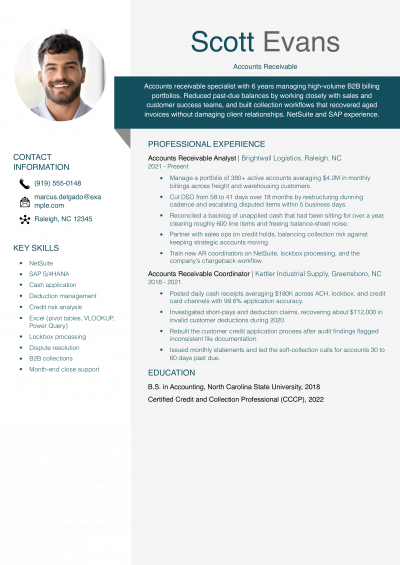
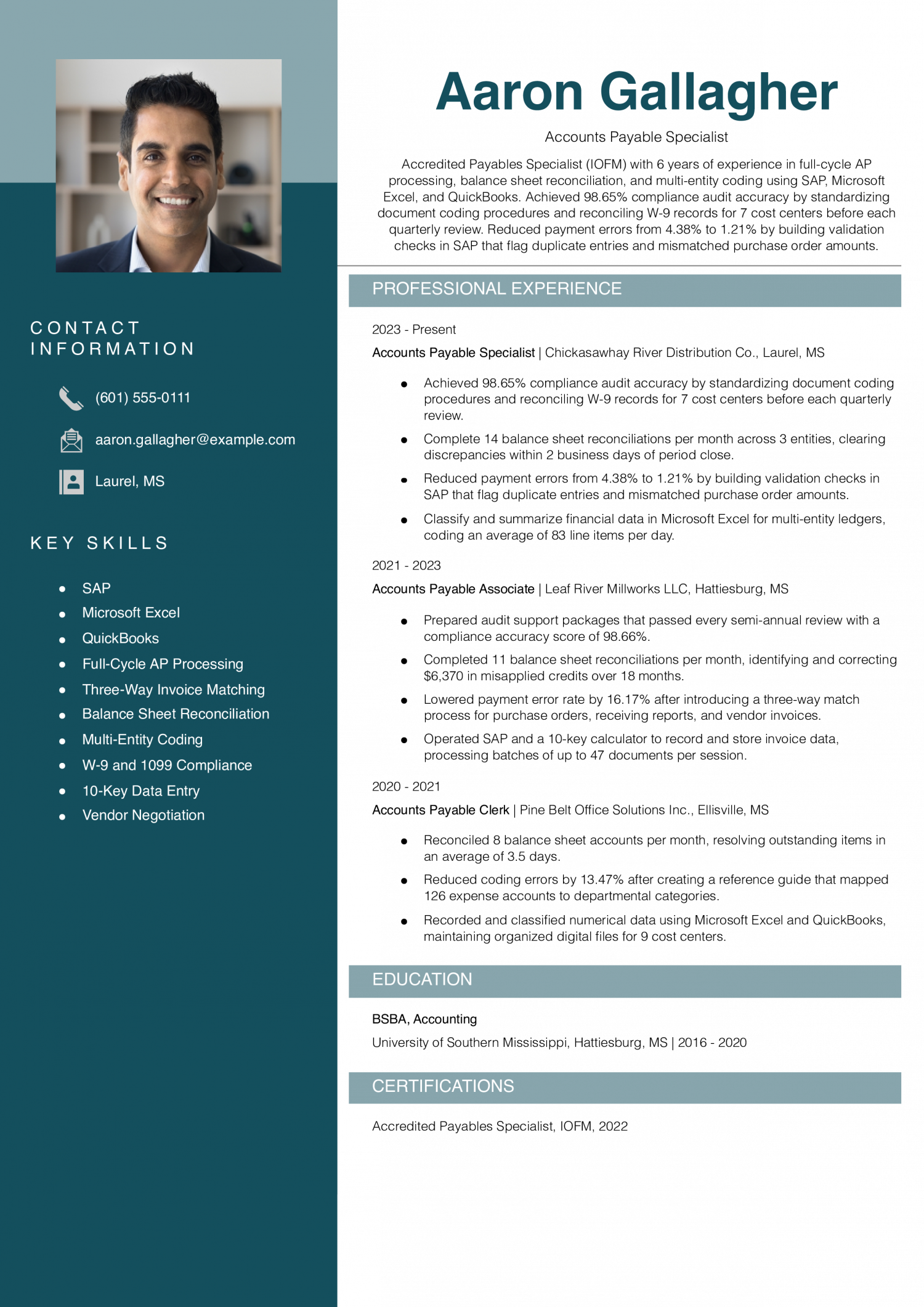
Pick this resume if you are a mid-level Accounts Payable Specialist with around six years of invoice processing and reconciliation work. Lead with compliance accuracy figures earned across multiple audit cycles so reviewers see sustained precision.
Controllers hiring an accounts payable specialist look for fewer payment mistakes and a clean audit trail. The SAP checks on this resume are tied to a drop in payment errors. When you name a system on your own resume, say what you set up in it and how far the error rate fell.
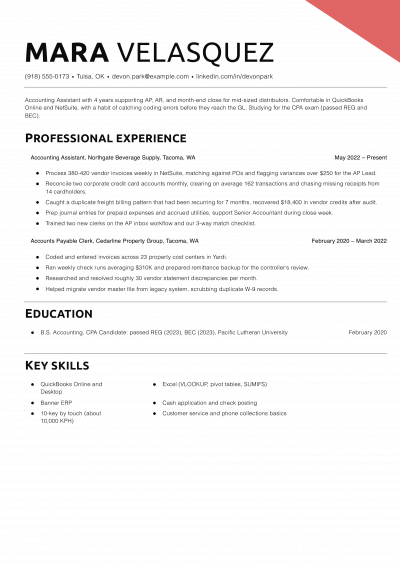
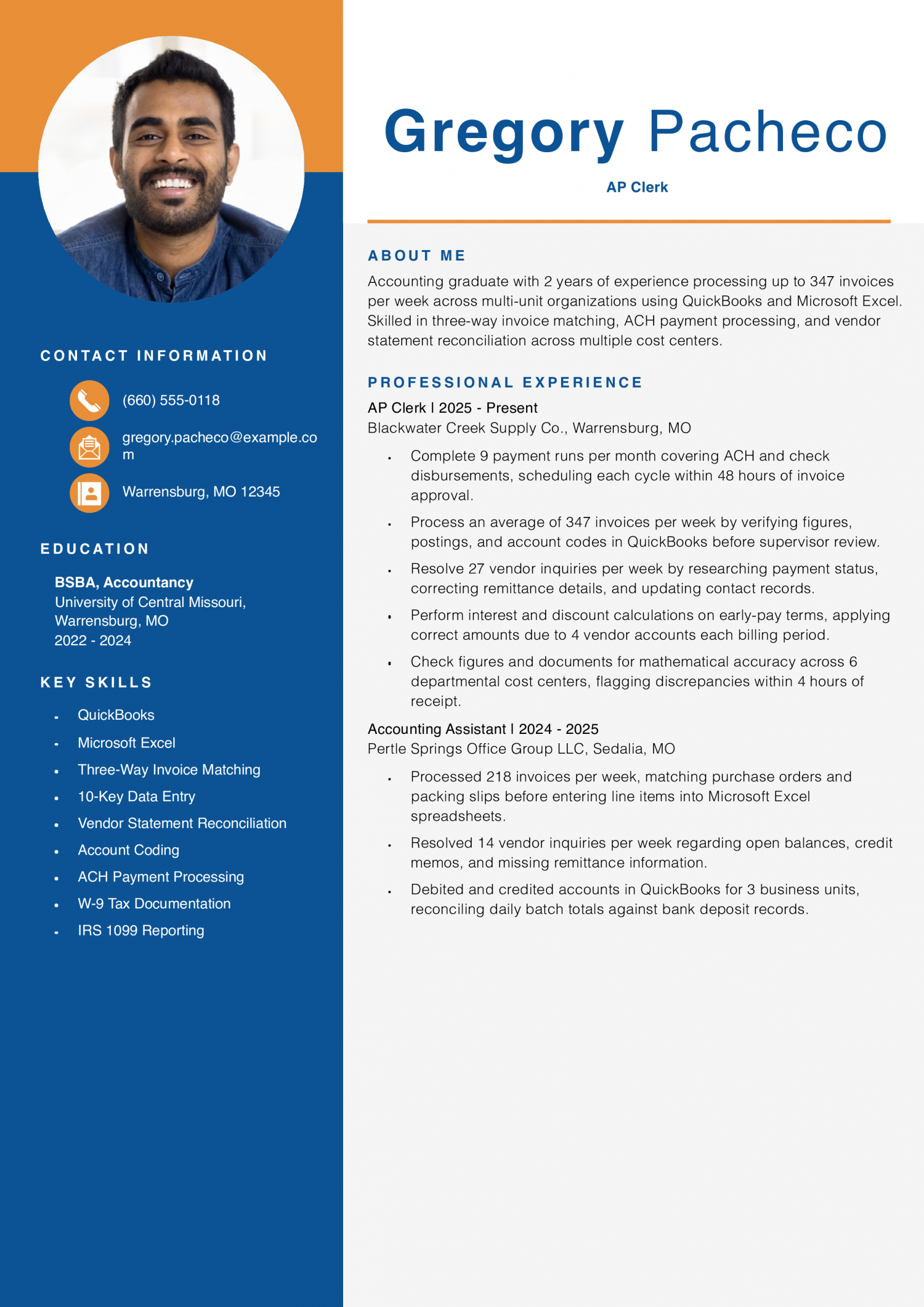
Start with this resume if you are an entry-level AP Clerk building a career from internship or first-job experience. Lead with weekly invoice volume to give each processing bullet a measurable scope.
Accounting managers hiring an AP clerk want steady volume and fast, careful checking. This resume gives the invoices handled each week and a time limit for flagging mismatches. On your own resume, state your weekly invoice count and how soon you raised a problem after you found it.
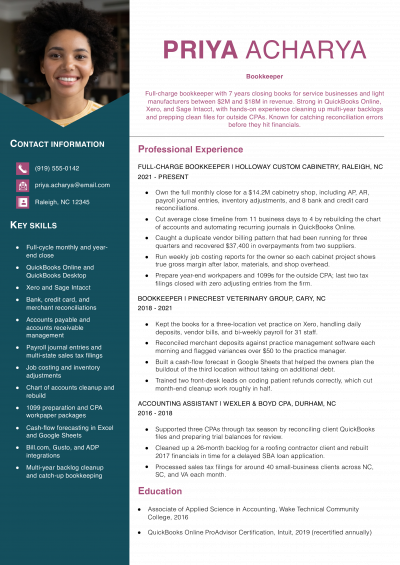
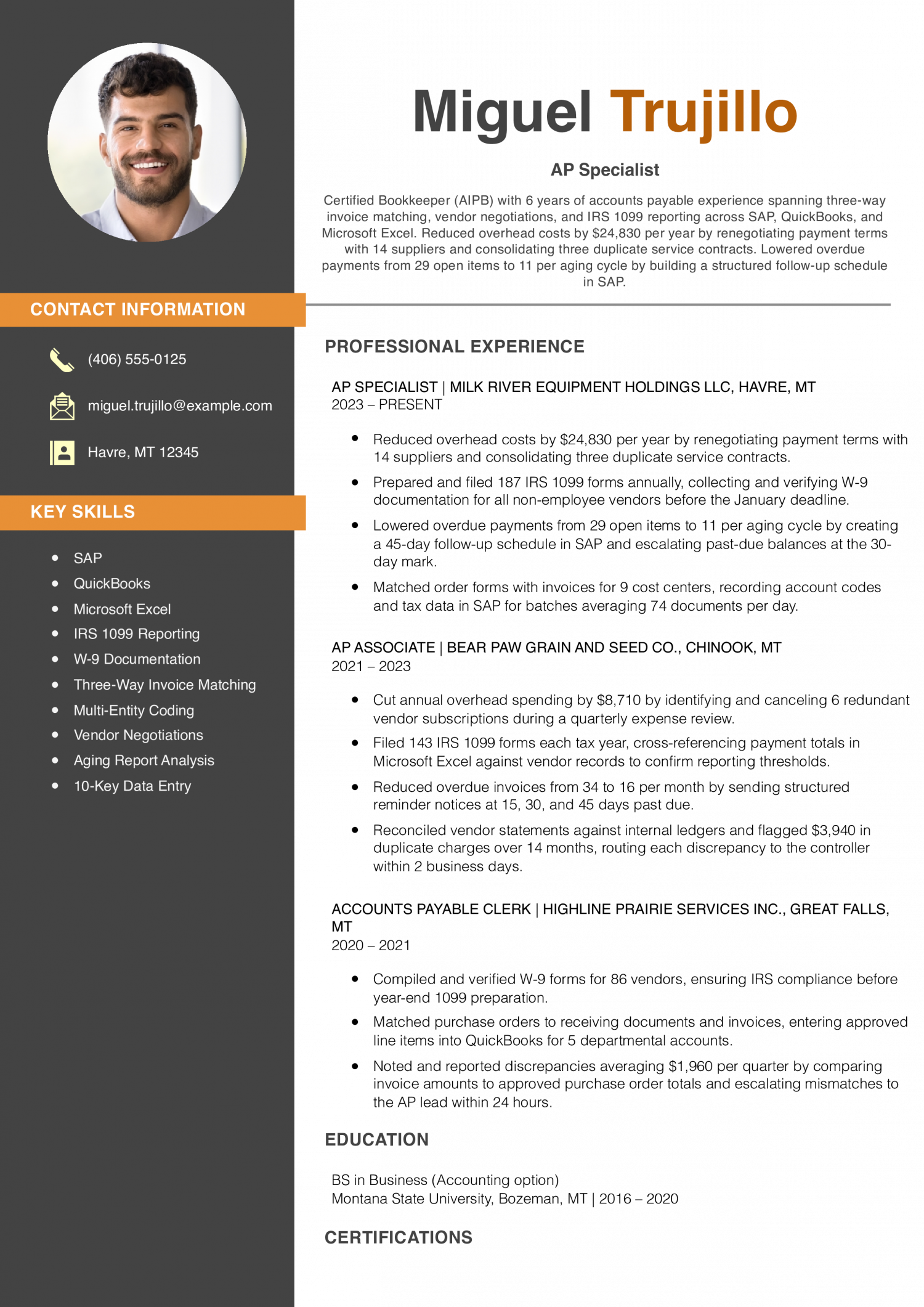
Try this resume if you are a mid-level AP Specialist with about six years of payables work and a bookkeeping credential. Start each job with the savings you won from vendors, then add the daily processing counts.
Paying bills on time and saving the company money is what AP hiring managers look for. This resume gives the overdue count before and after the follow-up schedule, plus the savings from supplier talks. If you chase late invoices, write the count you started with and the count you reached.
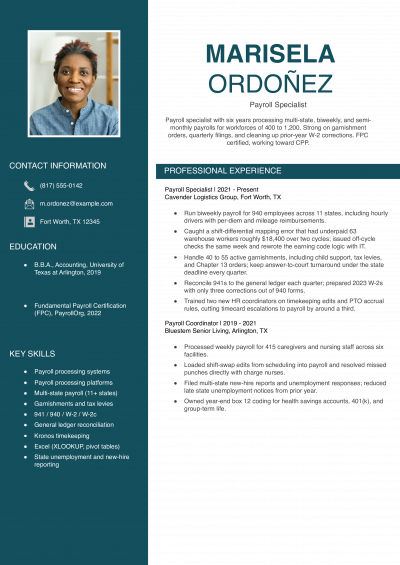
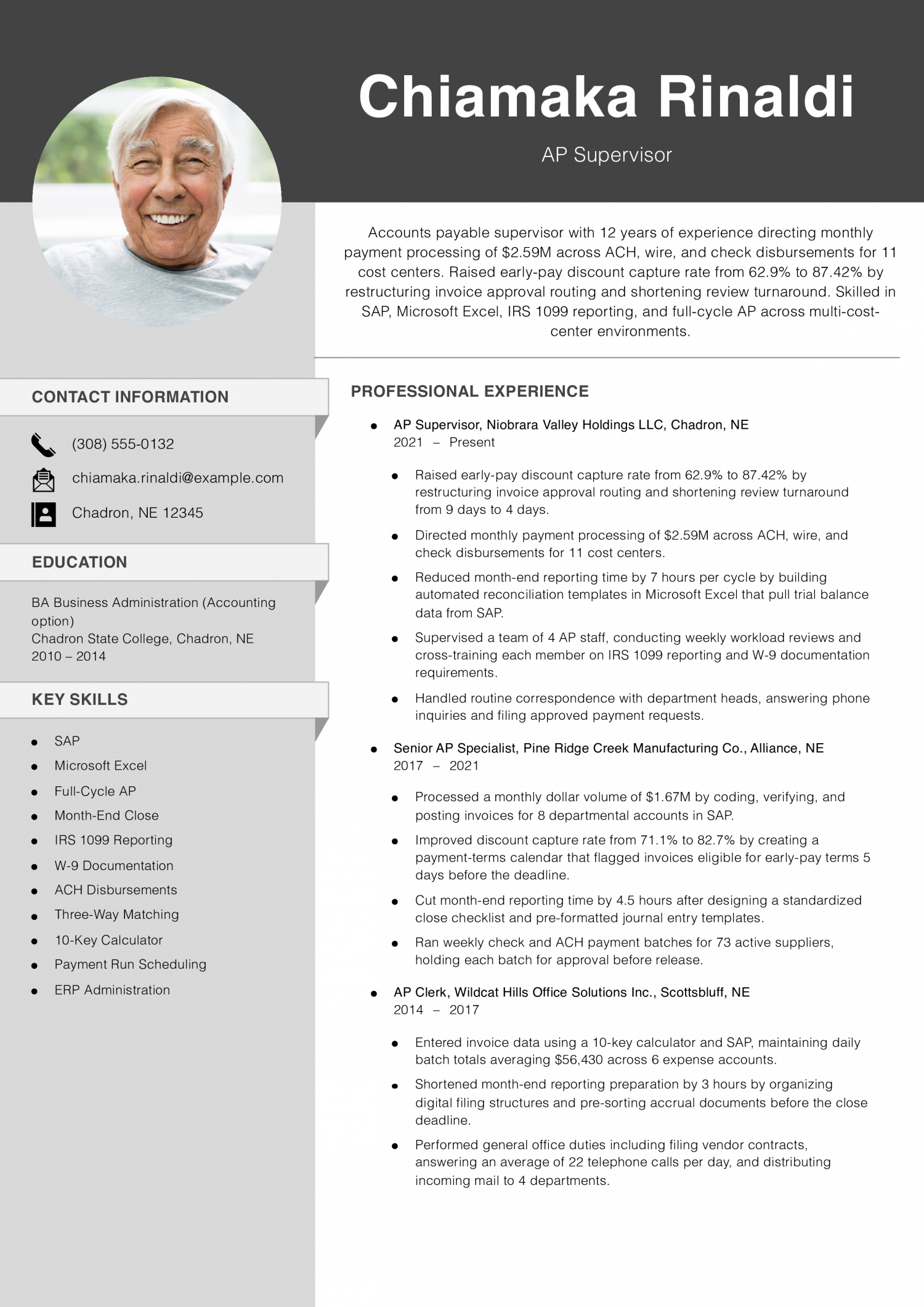
Lean on this resume if you are a senior AP Supervisor with over a decade of payables leadership and multi-cost-center oversight. Lead with discount capture improvements that show before-and-after rates rather than listing routine payment duties.
Finance leaders hiring an AP supervisor want to see the team gain skills and the discount rate rise. This resume names the training topics, contractor tax reporting and vendor tax forms, and the approval change that lifted early-pay discounts. When you describe leading a team, name what you taught and the number that moved.
Accounts payable coordinator with 6 years of experience processing invoices, reconciling deposits, and managing vendor payment cycles in SAP and Microsoft Excel. Maintained a 98.74% invoice accuracy rate by enforcing three-way matching on every batch before posting to the ledger. Converted 73 vendor accounts from check to ACH disbursement and negotiated extended net terms with 23 vendors to improve cash flow timing.
Your profile should state your years in payables and the volume you handle. Name the invoice count you process each month. Note the company size or industry you know best.
A controller reviewing your resume wants to see this scope right away, because it determines whether your background aligns with the organizational structure. State whether you work in a shared services center or a single-site office. Mention if you support one entity or dozens across a parent company.
Say which ERP you work in, such as SAP or Oracle. Two or three lines are sufficient for this introductory section. Keep every claim tied to a fact you can prove in your bullet points below.
A clear scope statement helps accounting managers and controllers sort your fit in seconds.
Accounting managers and controllers scan for volume and accuracy first, so quantifiable metrics should dominate your professional experience section. State the number of invoices you process per week or month. Note your match rate for three-way purchase order matching.
Name the dollar value of the disbursements you manage each cycle. If you cut cycle time, give the days saved and the old baseline. If you reduced duplicate payments, state the dollar amount recovered.
Early payment discounts you captured are strong proof of impact. Error rates you lowered belong in your bullets too. Even a small percentage drop demonstrates considerable attention to detail.
Pair each action verb with one of these figures so your work reads as a result, not a task.
Sort your bullet points into the core areas of payables work. Invoice processing is the first group. Cover invoice receipt, general ledger coding, and approval routing here.
The second group is payment execution. Include check runs, ACH batches, and wire transfers. Vendor management is a third group.
Add new vendor setup, W-9 collection, and 1099 reporting. Month-end close tasks form a fourth group. Cover accruals, reconciliations, and aging reports there.
This organizational structure lets accounting managers and controllers find the competencies they need fast. Two to four bullets per group keeps each section tight and readable. Arrange groups in the order the posting lists its duties so the reviewer sees alignment immediately.
Credentials go in a short block high on page one. If you hold the Accredited Payables Specialist from IOFM, list it first. The Certified Bookkeeper from AIPB also belongs in this block.
Accounting managers and controllers look for these credentials early in a review, so prominent placement increases your chances of advancing.
Below this block, add a dedicated tools line for your daily software. Name your ERP platform and any add-ons you run. Include intermediate spreadsheet competencies such as pivot tables or VLOOKUP formulas.
Expense platforms like Concur or Coupa belong here too.
An associate’s or bachelor’s degree in accounting or finance is common for accounts payable roles in most organizations. If you studied a different field, highlight any coursework in bookkeeping or business.
Place your education section after your work history on page one, because recruiters prioritize professional accomplishments over academic credentials. One page works well when you have fewer than ten years in payables. Add a training line if you completed courses in fraud prevention or internal controls.
Continuing education from IOFM or AIPB fits here as well. Skip high school once you hold a college degree. Keep this section brief so your professional experience stays the prominent focus of the page.
Invoice coding, three-way matching, and month-end close are the skills that earn callbacks. Compare the ERP tools below against the ones each posting names. Accounting managers and controllers scan for these patterns first, not generic bookkeeping labels.
Hard skills prove you can process volume without errors. Soft skills show you can hold vendors and internal teams to deadlines. Both groups matter, but they serve different parts of your resume.
Keep the hard skills together in one block near the top of page one. Weave soft skills into your bullet points as proof of real results. A line like “resolved 40 vendor disputes per month” shows problem solving in action.
That approach gives each soft skill a number to anchor it. Pull every matching term from the posting into your resume.
| Soft Skills | AI-estimated % |
|---|---|
| Accuracy under deadlines | 74% |
| Vendor relationship management | 64% |
| Detail orientation | 43% |
| Cross-department communication | 40% |
| Discretion with financials | 27% |
And here are the top hard skills showing up most often.
| Hard Skills | AI-estimated % |
|---|---|
| Invoice processing | 71% |
| Accounts payable reconciliation | 50% |
| Vendor payment management | 42% |
| General ledger coding | 40% |
| Expense report auditing | 35% |
Skill names and rankings come from an AI model grounded in U.S. Department of Labor occupation data for accounts payable specialists, not from a count of accounts payable specialists’ resumes built on ResumeTemplates.com.
Accounting managers and controllers sort accounts payable resumes by invoice processing and accounts payable reconciliation, which is why the items below put them where a reader finds them.
Accounting managers and controllers scan for task-specific terms. Generic phrases like “detail-oriented” do not count here. Each group below covers a distinct AP area. Invoice processing terms show you handle volume coding. Payment execution terms cover how you release funds. Accrual and close terms prove you support month-end. Vendor management terms show you own supplier records. Compliance and audit terms signal you track internal controls. Pick the groups that match your actual duties. Add the exact terms from each row. Swap out any term you have not performed.
| Niche | Keywords ATS scans for |
|---|---|
| Invoice Processing | three-way match, purchase order reconciliation, invoice coding |
| Payment Execution | ACH payments, payment runs, early-pay discounts |
| Accruals and Close | month-end accruals, journal entries, AP aging reports |
| Vendor Management | vendor onboarding, W-9 compliance, vendor master file |
| Controls and Audit | internal audit support, 1099 reporting, segregation of duties |
Listing only manual three-way matching now reads as incomplete in many postings. Naming the AI tools you use, plus the human checks you run, reads as current. Start with the tool, then state how you verify its output. A one-line workflow is better than a vague claim. Keep each entry tied to a real task you have done. If you coded a rule or built a bot, say so. If you only reviewed AI-flagged exceptions, say that instead.
Automated extraction tools now pull header and line data, but a clerk still verifies vendor names and amounts.
AI flags likely duplicate invoices across vendors, and you confirm or override each flag before posting.
Machine learning suggests account codes based on past entries, yet you review every suggestion before approval.
Automated workflows route mismatched invoices to you for research, cutting the time spent searching for errors.
Predictive tools recommend optimal payment dates for early-pay discounts, and you approve the final schedule.
Accounting managers and controllers scan for proof of AP knowledge. A credential signals you know payment cycles and controls. Two credentials apply to most AP roles today.
Accounting managers and controllers read your credentials list as a map of where your work is heading. They want to see which part of the payables cycle you have studied most. A credential in invoice processing tells a different story than one in full-cycle bookkeeping.
Each one signals how deep your skills go. It also hints at the roles you want next. Not every posting will ask for a credential by name.
Some teams still value them when they see one. Others treat them as a tiebreaker between two close candidates. One credential per line, each with its issuer and year.
That format is easy to scan and keeps the section tight.
BLS groups accounts payable roles with all bookkeeping, accounting, and auditing clerks. That wider pool shapes every number you see here. Reaching the 90th percentile means earning about 47 percent more than the median.
That gap tells you the market pays more for ERP depth and invoice volume than for years on the job alone. The 10th percentile sits roughly 29 percent below the median, and national employment across the broader group is large. A wide spread like this means your resume needs to name the systems you run and the dollar volume you process each month.
Lead with your ERP platform and your monthly invoice count in the first two bullets of each role.
| # | State | Median Annual |
|---|---|---|
| 1 | District of Columbia | $65,180 |
| 2 | Connecticut | $59,970 |
| 3 | Massachusetts | $59,830 |
| 4 | California | $59,230 |
| 5 | Washington | $58,620 |
| 6 | New Jersey | $58,300 |
| 7 | New York | $58,160 |
| 8 | Alaska | $56,430 |
| 9 | Vermont | $54,720 |
| 10 | Minnesota | $54,600 |
| # | State | Workers | Median |
|---|---|---|---|
| 1 | California | 151,870 | $59,230 |
| 2 | Texas | 122,400 | $48,910 |
| 3 | Florida | 88,670 | $49,330 |
| 4 | New York | 84,280 | $58,160 |
| 5 | Illinois | 51,470 | $49,560 |
Resume Templates offers HR approved resume templates to help you create a professional resume in minutes. Choose from several template options and even pre-populate a resume from your profile.
List each accounts payable role in your work history with the company name and dates. Under each role, write bullets that pair a task with a measurable result.
For example, write "Processed 400+ invoices per week with a 99.5% accuracy rate." This format shows both your daily volume and your attention to detail.
Write "Accounts Payable" in full the first time it appears, usually in your profile. After that, you can use "AP" in bullet points where space is tight.
Accounting managers and controllers recognize both forms, so either is fine after the first mention.
Attach a dollar amount or volume figure to every bullet you write. A line like "Reconciled $2.3M in monthly vendor payments" carries more weight than a vague duty statement.
Also note any process improvements, such as cutting invoice cycle time by a specific percentage.
Pull keywords directly from the job posting and mirror them in your bullets. Common terms include invoice processing and three-way match. Purchase orders and vendor reconciliation are also strong choices.
Use the exact phrasing the posting uses so applicant tracking systems can match your resume to the role.
Reference the standards in the context of a task you performed, not as a standalone skill entry. For example, write "Applied accrual standards to code $1.8M in quarterly expenses."
This tells accounting managers and controllers you understand the rules and have applied them at scale.
Use a profile line that names both functions, such as "AP/AR Specialist with five years in full-cycle processing." Then organize your bullets so payable and receivable tasks each have their own cluster.
This layout helps a reader scan your strengths in each area without guessing which side you handled.
With fewer than ten years in payables, one page is usually enough. If you have held senior or supervisor-level roles across multiple companies, a second page is reasonable.
Keep every bullet tied to a metric so nothing on page two reads as filler.
Many employers run resumes through software, so an ATS-friendly template helps your accounts payable specialist resume get read. A basic template helps too. Give sections plain names, pick one standard font, and skip graphics.
Accounts Payable Resume
4.4/5 stars with 151 reviews

Executive Resume Writer and Career Coach
Andrew Stoner is an executive career coach and resume writer with 17 years of experience as a hiring manager and operations leader at two Fortune 500 Financial Services companies, and as the career services director at two major university business schools.
© 2026 Resumetemplates.com All rights reserved.