Software Engineer Resume Examples and Templates for 2026



Engineering managers decide whether to forward a junior resume by the projects section on page one; if a real tech stack and a working link aren't visible there, the resume drops out of the pile.
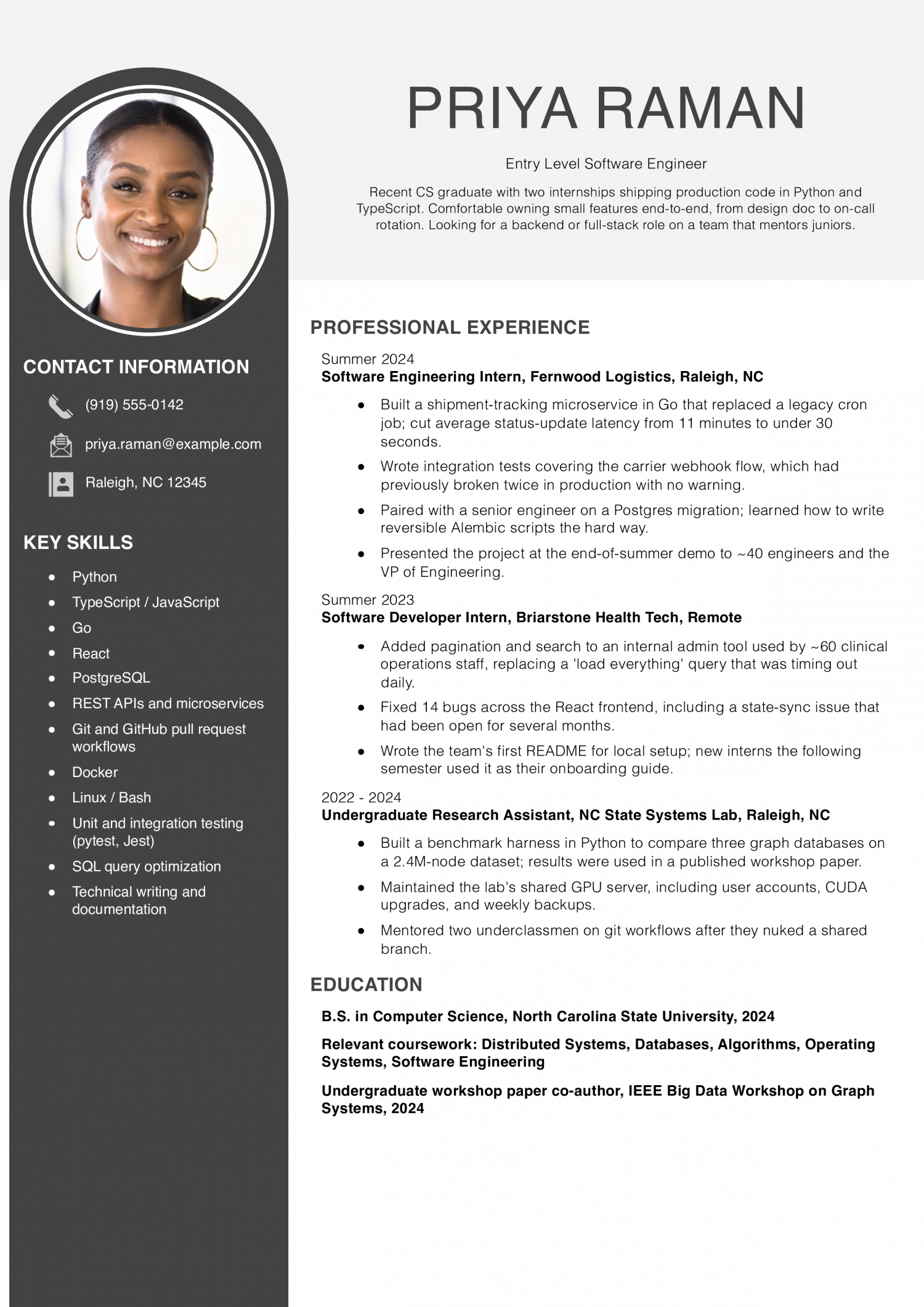
This resume targets new graduates, bootcamp finishers, and self-taught engineers with one to two internships or strong capstone work. It needs to prove you can read a codebase, ship a feature, and push commits without supervision.
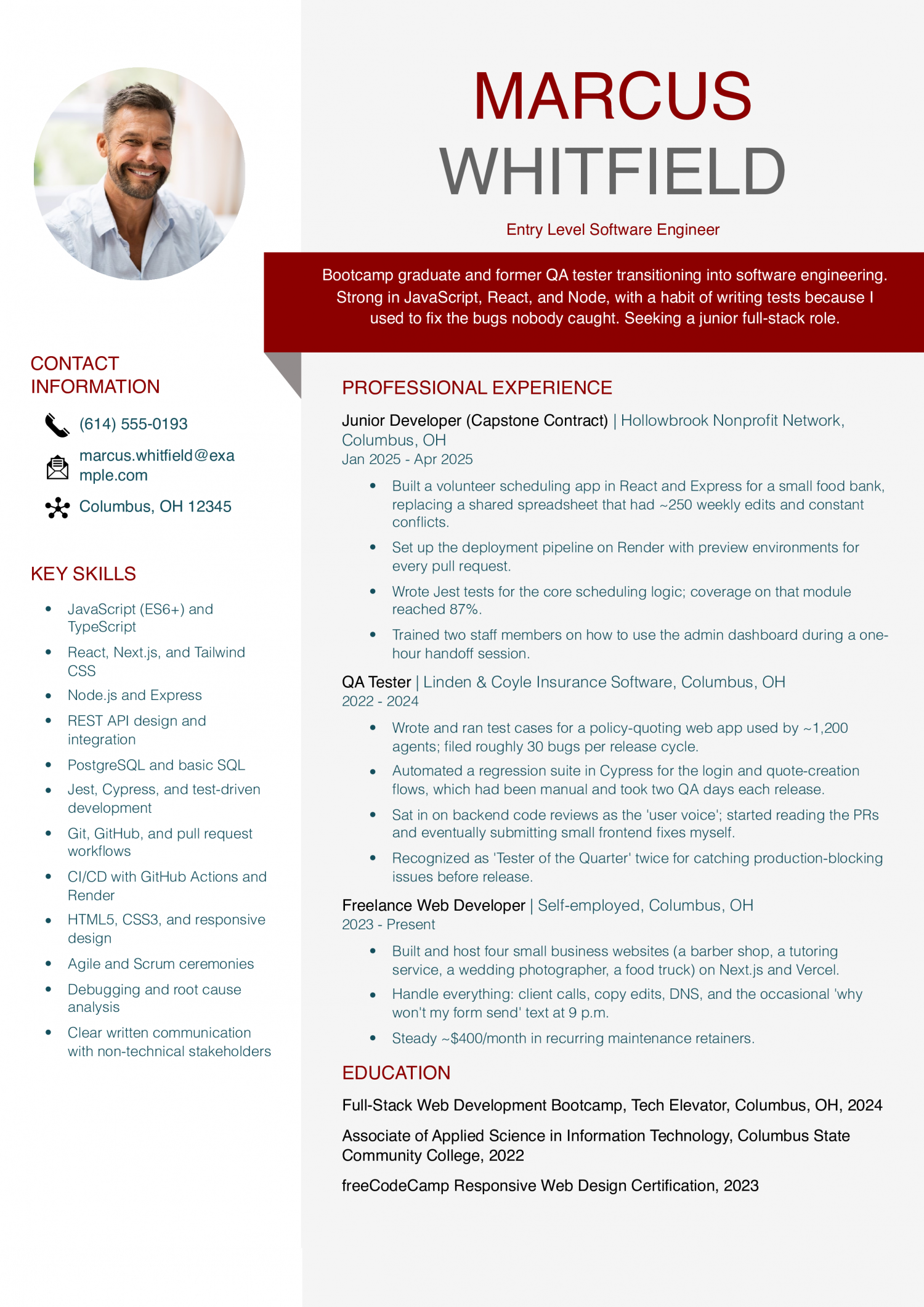
Elena Vasquez
Minneapolis, MN | (612) 555-0178 | [email protected] | linkedin.com/in/elenavasquez | github.com/elenavasquez
Computer science graduate (Dec 2024) with internship experience in backend Python and one published mobile app on the Play Store. Comfortable reading unfamiliar codebases, asking questions in standup, and writing the kind of documentation I wish had existed when I started. Looking for a junior backend or platform engineering role with structured mentorship.
Software Engineering Intern
Kestrel Analytics | Minneapolis, MN | Summer 2024
Backend Developer Intern
Wrenfield Civic Tech | Remote | Summer 2023
Teaching Assistant, Data Structures
University of Minnesota CS Dept. | Minneapolis, MN | 2023-2024
Independent Project: ‘TrailLog’ Android App
Side Project | 2022-Present
IT Help Desk Student Worker
University of Minnesota IT Services | Minneapolis, MN | 2021-2023
The first line of your summary should name a concrete artifact, not a self-description. Lead with a shipped project, a language stack, and any production users or pull requests merged.
Engineering managers and senior engineers read this as your readiness to contribute on day one. A line like ‘CS new grad with a Go and Postgres side project serving 400 weekly users’ beats any version of ‘motivated software engineer seeking growth.’
Bullets without a number tend to read as coursework. Strong junior resumes name something measurable: weekly active users, request volume, pull requests merged, test coverage, or latency improvements.
Pick two or three real metrics per project. ‘Reduced API p95 from 800ms to 220ms,’ ’40 PRs merged across two semesters,’ or ’85 percent unit test coverage’ all give a senior engineer something concrete to react to.
Sort substantive work into three to four categories: production language and framework, data layer and infrastructure, projects with links, and open-source or team contributions.
Name the real tools: Python, Go, TypeScript, React, Postgres, Redis, Docker, GitHub Actions, AWS. Skip ‘familiar with’ language. If you used it in a project that runs, list it as a working skill with the project as proof.
Put your GitHub URL, portfolio link, and degree in the header block, not buried at the bottom. Recruiters and ATS parsers both look there first for proof you write code outside class.
If you hold AWS Cloud Practitioner, Azure Fundamentals, or a relevant Coursera or freeCodeCamp specialization, list it in a short credentials line under education. Senior engineers want to see the link clickable, not the cert number.
Education sits at the bottom for junior resumes with internship experience and near the top for new grads with no work history. Name your degree, school, graduation date, and relevant coursework: data structures, algorithms, operating systems, databases.
Add one extracurricular signal that maps to engineering: hackathon placement, ACM officer role, teaching assistant work, or a sustained open-source contribution. Skip unrelated clubs.
Software hiring is tight in 2026. Engineering teams are running leaner and the bar to clear a screen is higher. The skills below come from our user-built entry level software engineer resumes.
Engineering managers weigh hard skills first on junior resumes. They want Python, Git, and a framework named in a real project before they read about your collaboration style. Match each hard skill against the target job posting.
Treat soft skills as evidence backing your bullets, not as a standalone list.
| Soft Skills | % of resumes with this skill |
|---|---|
| Problem solving | 71% |
| Communication | 61% |
| Team collaboration | 40% |
| Attention to detail | 38% |
| Adaptability | 29% |
And here are the top hard skills showing up most often.
| Hard Skills | % of resumes with this skill |
|---|---|
| Programming languages (Python, Java) | 66% |
| Data structures and algorithms | 60% |
| SQL and databases | 49% |
| Version control (Git) | 36% |
| HTML and CSS | 32% |
Based on data from thousands of entry-level software engineers’ resumes built on ResumeTemplates.com, May 2026.
These are the must-haves hiring teams look for when scanning an entry level software engineer resume.
Engineering managers and senior engineers expect a niche keyword section to mirror the language of the posting. Group exact-match terms by sub-specialty so the parser scores them and the human reader recognizes them.
| Niche | Keywords ATS scans for |
|---|---|
| New grad and student profiles | new grad software engineer, software engineering student, computer engineering resume, cs new grad |
| No-experience and fresher angle | software engineer no experience, software engineer fresher, entry level software developer, junior software engineer |
| Backend and API work | rest api, python backend, node.js, postgres, sql, microservices |
| Front-end and full-stack | react, typescript, javascript, html css, responsive design, next.js |
| DevOps and cloud exposure | docker, aws, ci cd, github actions, linux, git workflow |
AI use on an entry level software engineer resume can go three ways: lead with ‘AI-powered developer’ (which engineering managers screen out), leave it off entirely (which reads as evasive in 2026), or describe the workflow as it actually runs. The third is what senior engineers can validate in a code review.
Copilot and Cursor are now baseline for boilerplate. Juniors are expected to review, test, and rewrite generated code, not paste it.
ChatGPT and Claude shorten the time spent on stack-trace diagnosis. Hiring teams care that you still understand the root cause.
AI-assisted self-review catches lint and obvious bugs before you open a pull request. Senior engineers notice the cleaner diffs.
READMEs and inline comments are faster to draft with AI. Reviewers want the docs to match what the code actually does.
For a junior resume, the portfolio is the work sample. Recruiters click your GitHub before they read your bullets, and engineering managers click a deployed link before they schedule a screen. Pick two or three projects you can defend in a 30-minute conversation, and put them on platforms a senior engineer will recognize.
Non-negotiable. Pin three to six repos with READMEs, commit history, and tests.
Deploy front-end projects with a live URL. Static demos beat screenshots every time.
One-page site linking projects, resume PDF, and a short about section.
Optional. Link only if you have a streak or contest ranking worth showing.
Pin three to six repos on GitHub and write a real README for each. The README should explain what the project does, the stack, how to run it locally, and what you would build next. A senior engineer reading your repo for 90 seconds should leave knowing the scope and the trade-offs you made.
If you have a deployed app, put the live URL in your resume header next to your GitHub. Make sure it loads on mobile and does not show a broken database connection. A dead link is worse than no link.
Junior postings in 2026 ask for a specific stack rather than ‘a programming language.’ Name the languages, frameworks, and tools you actually used in projects, and skip the ones you only touched in a single homework assignment.
A CS degree, bootcamp completion, or equivalent project portfolio keeps you eligible. The credentials below move an entry level software engineer resume from the qualified-but-typical stack into a shortlist that engineering managers and senior engineers actually call. List the issuing body, completion date, and a clickable verification link.
The 90th-percentile software engineer out-earns the median by a wide spread, which tells you the market rewards a specific tech stack and shipped scale far more than years on the bench. For junior roles, that spread shows up early: candidates with one strong production project clear screens that resumes full of coursework do not.
Lead the resume with the language stack and the project metrics, not the GPA or the course list.
| # | State | Avg. Annual |
|---|---|---|
| 1 | California | $170,910 |
| 2 | Washington | $166,910 |
| 3 | Virgin Islands | $162,820 |
| 4 | New York | $161,260 |
| 5 | Massachusetts | $150,520 |
| 6 | Maryland | $137,890 |
| 7 | District of Columbia | $136,040 |
| 8 | Oregon | $135,260 |
| 9 | Delaware | $135,160 |
| 10 | Colorado | $134,540 |
| # | State | Workers | Median |
|---|---|---|---|
| 1 | California | 292,630 | $170,910 |
| 2 | Texas | 151,460 | $130,500 |
| 3 | New York | 104,130 | $161,260 |
| 4 | Washington | 91,470 | $166,910 |
| 5 | Virginia | 83,290 | $134,470 |
Resume Templates offers HR approved resume templates to help you create a professional resume in minutes. Choose from several template options and even pre-populate a resume from your profile.
Replace the work history section with a Projects section that reads like work history. Each project gets a name, a date range, a tech stack, and three bullets with metrics.
Treat your capstone, internship, and any open-source contribution the same way you would treat a job. List the repo URL on every project so a senior engineer can verify the code in one click.
List your GPA if it is 3.5 or higher and you are within two years of graduation. Below 3.5, drop the number and lead with coursework, projects, and any teaching assistant work.
After two years of full-time experience, GPA stops mattering on any engineering resume.
The two most common reasons are a missing GitHub link and project bullets that describe coursework without metrics. Recruiters scan for a clickable repo and a measurable outcome within the first 10 seconds.
Rewrite your top three projects with user counts, request volume, or performance numbers. Add the GitHub URL to the header next to your email.
One page. Engineering managers and senior engineers expect junior resumes to fit on a single page through your first three to five years.
If you are spilling onto a second page as a new grad, you are listing too much coursework or padding with unrelated jobs. Cut high school content, generic 'proficient in MS Office' lines, and clubs that do not map to engineering.
For an entry-level software engineer, a tech template is the safest pick, because it keeps your stack, tools, and impact easy to scan. An ATS-friendly template is a solid alternative. Whichever you choose, keep the formatting clean and easy to parse: clear section headings, a standard font, and no graphics a parser can choke on.
Executive Resume Writer and Career Coach
Andrew Stoner is an executive career coach and resume writer with 17 years of experience as a hiring manager and operations leader at two Fortune 500 Financial Services companies, and as the career services director at two major university business schools.
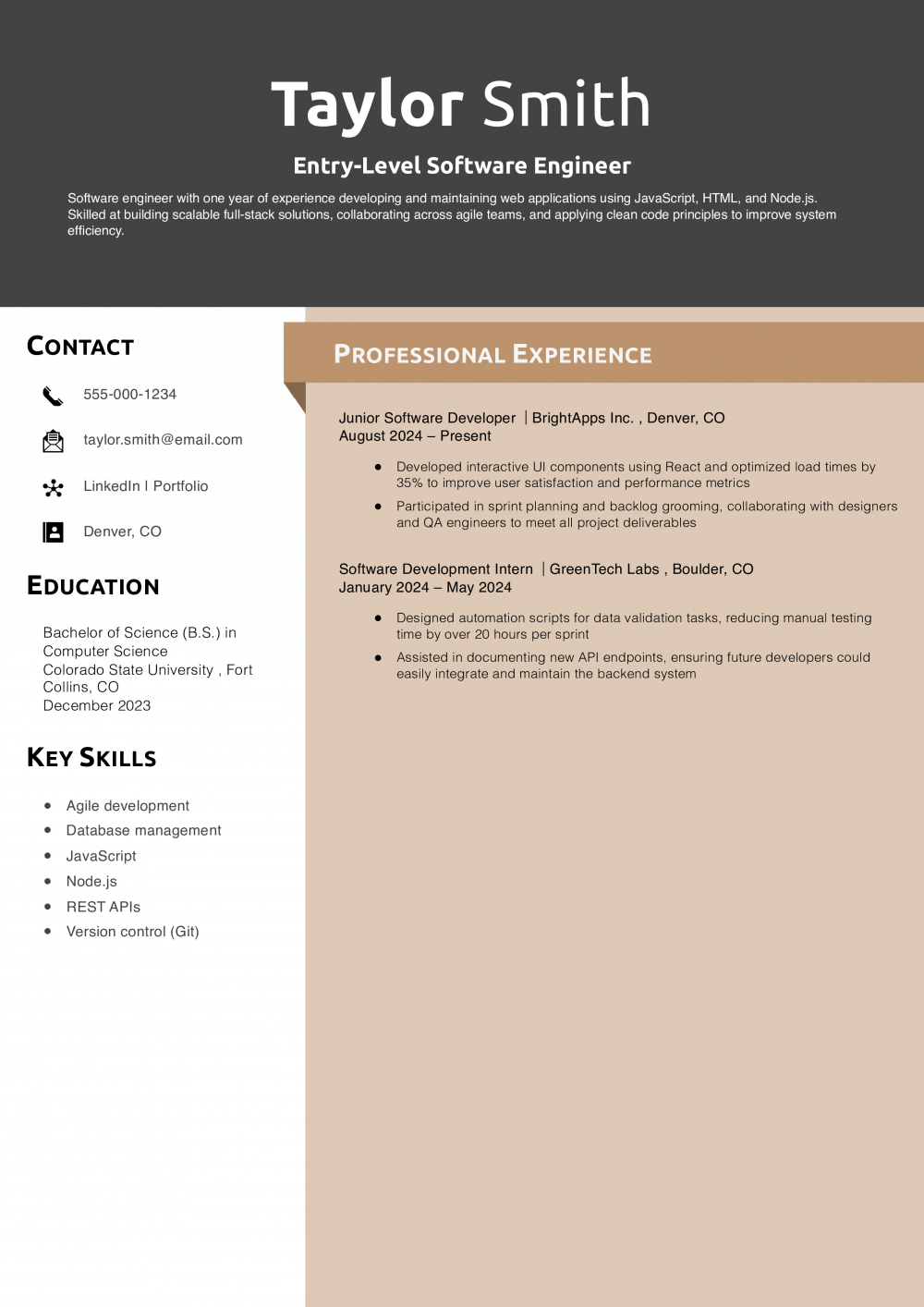
Customize this template in our builder in under 10 minutes.