4 Best Animator Resume Examples and Templates for 2026

By Andrew Stoner
, Executive Resume Writer and Career Coach
Andrew Stoner

Last Updated:
June 19, 2026
Tip !
Hiring animators want to see a reel link, software stack, and shipped credits on the first page, because that tells them in 15 seconds whether your work fits their pipeline and shot style.
Featured Example
Why this resume works
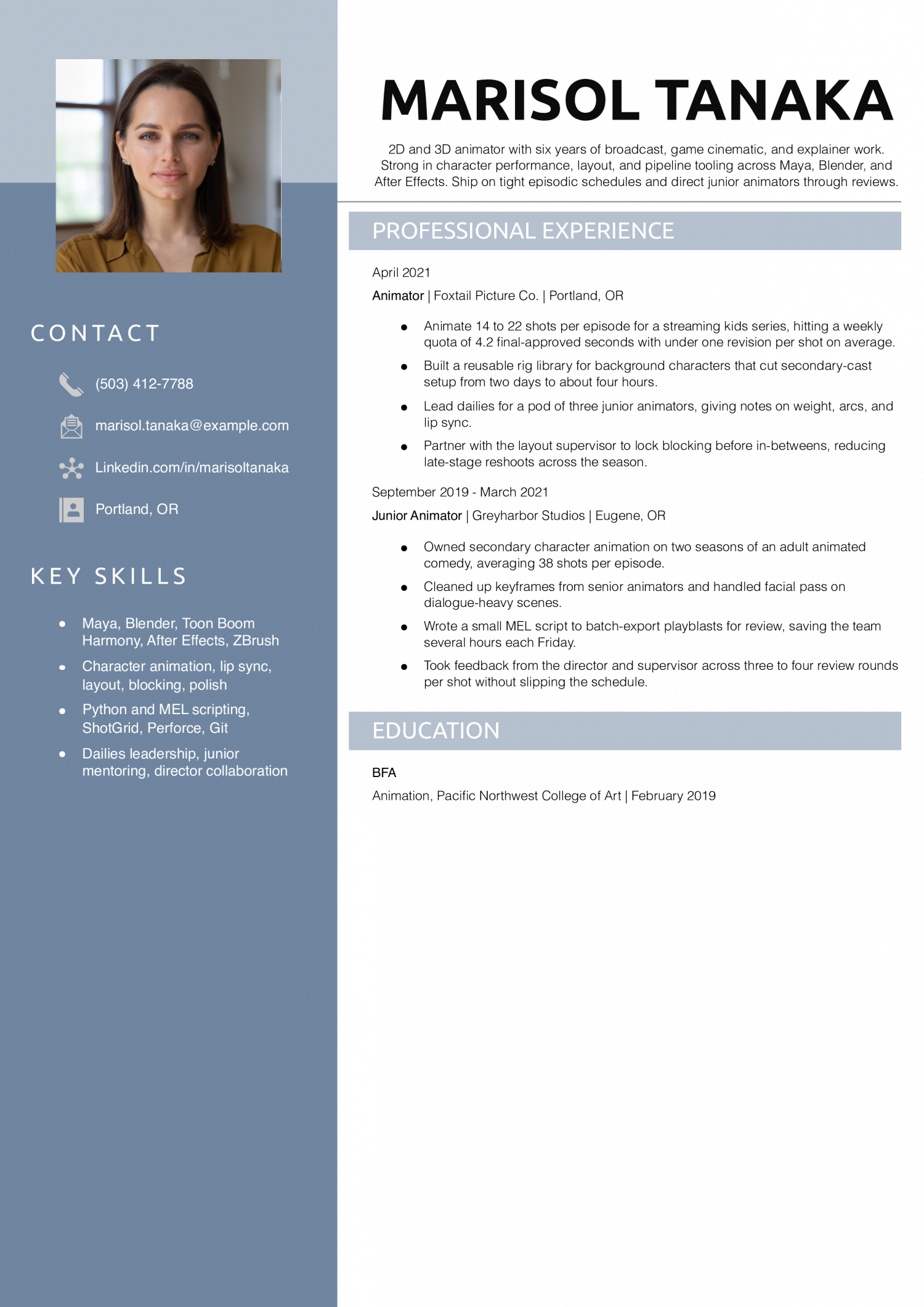
- Production Rate: The 4.2 seconds-per-week metric is the kind of number animation leads recognize as a real production rate.
- Pipeline Contribution: Mentioning the rig library and the playblast script shows technical chops beyond raw shot-making.
- Review Cycle Literacy: Calling out revision counts and dailies signals comfort with how studios actually run.
Junior Example
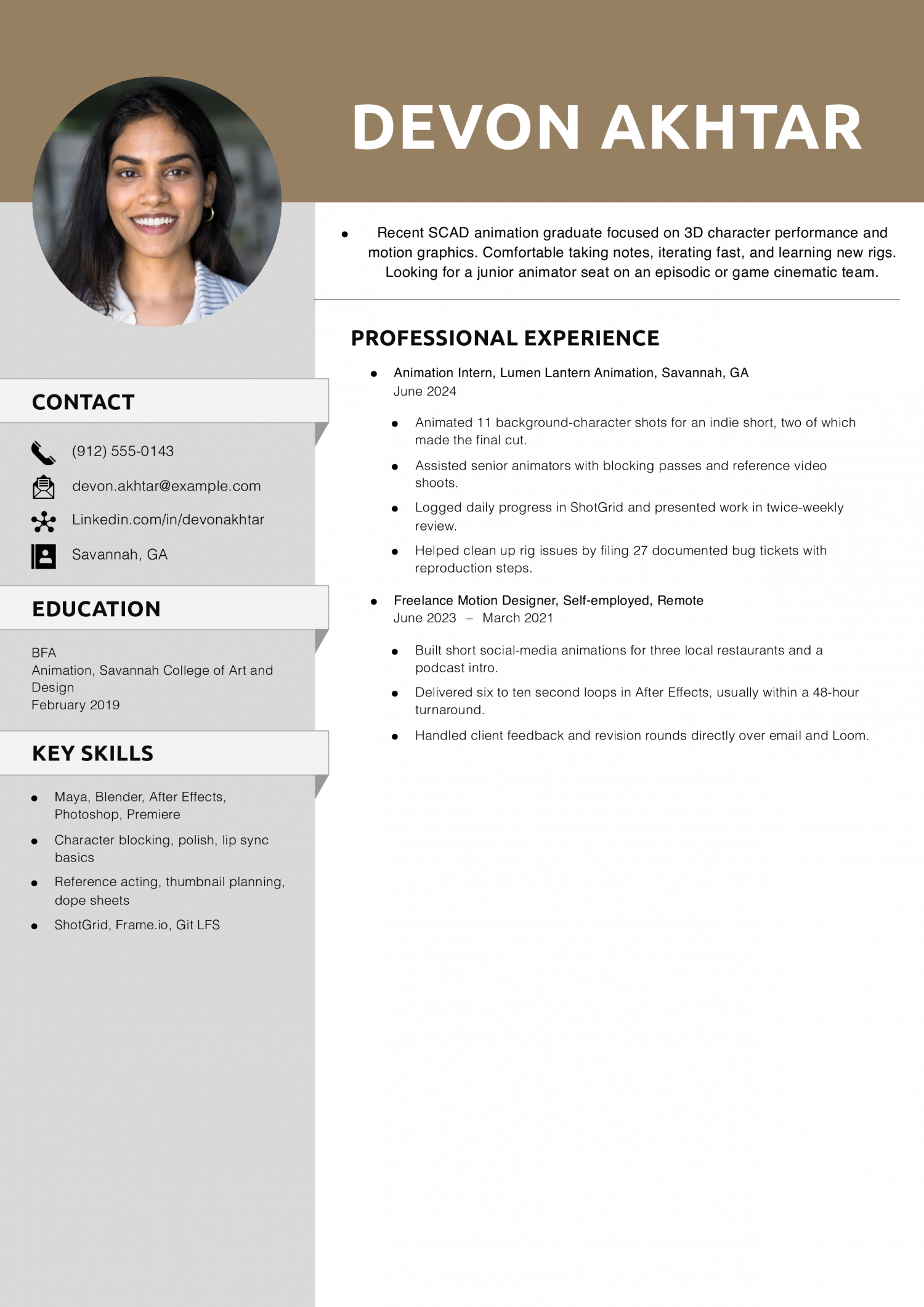
The junior animator is in the first three years out of school or self-taught, working on shorts, indie games, or social content. The resume needs to prove craft fundamentals, a reel that holds up, and any production pipeline exposure.
Why this resume works
- Real Shipped Shots: Calling out two background shots that made the final cut is the right scale of brag for a junior animator.
- Believable Freelance Scope: Restaurants and a podcast intro feel believable, not inflated, which builds trust with the recruiter.
- Tooling Literacy: ShotGrid plus a 27-ticket QA contribution signals readiness to plug into a studio pipeline.
Mid Level Example
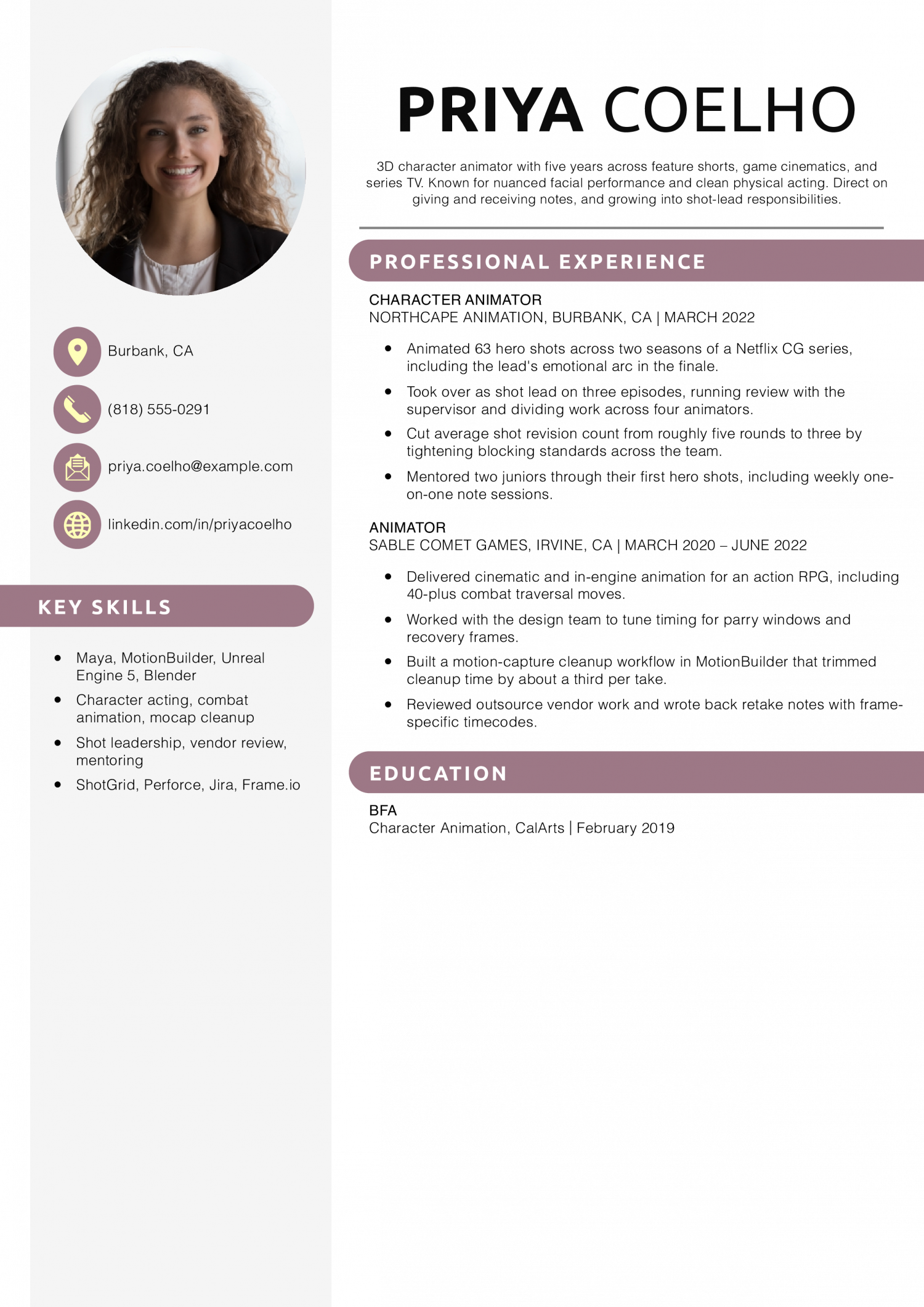
The mid-level animator owns shots end to end on a team, hits weekly quotas, and takes director notes without supervision. The resume needs to prove shipped credits, shot counts, and the software pipelines you have worked inside.
Why this resume works
- Hero Shot Count: 63 hero shots and a named final-episode arc give a recruiter a concrete sense of scope and trust level.
- Game and Film Range: Combat tuning at a game studio plus CG series work shows portability across two different production cultures.
- Lead Track Signal: Shot-lead stints and junior mentoring map cleanly to the next promotion conversation.
Senior Example
The senior animator leads sequences, mentors juniors, and shapes pipeline decisions across departments. The resume needs to prove lead credits, scope of work on tentpole projects, and the directors or supervisors who trust your eye.
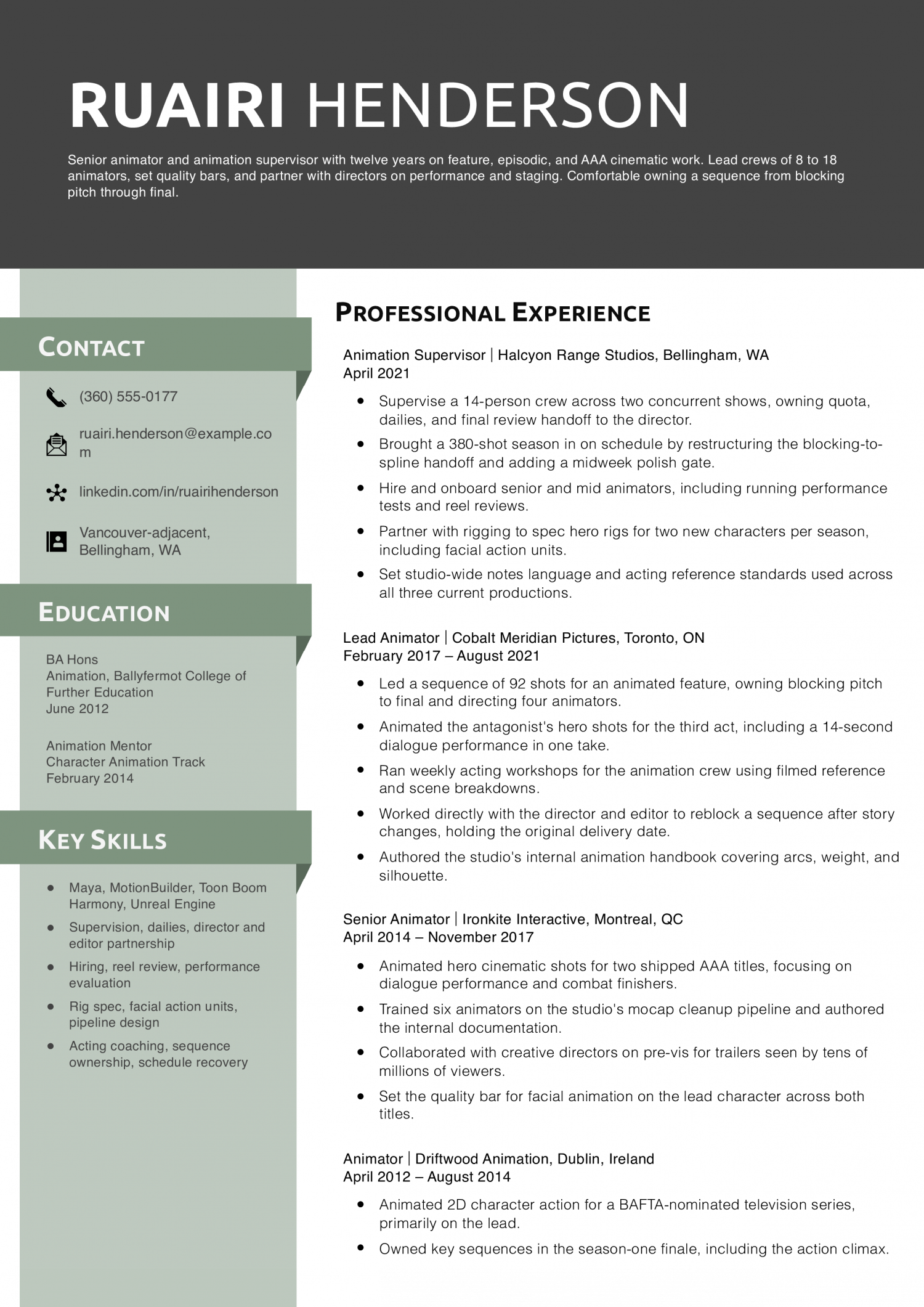
Why this resume works
- Crew Size And Show Count: Naming a 14-person crew across two concurrent shows tells hiring directors exactly what scope this candidate can hold.
- Schedule Recovery Story: Bringing a 380-shot season in on schedule by changing the handoff gate is the kind of operational win that defines an animation supervisor.
- Craft Plus Leadership: Calling out a 14-second dialogue performance alongside supervision work proves the candidate hasn’t lost the craft chops.
Text Version Animator
Adaeze Whitfield
Atlanta, GA | (404) 555-0188 | [email protected] | linkedin.com/in/adaezewhitfield
PROFESSIONAL SUMMARY
Animator with eight years of experience across broadcast, advertising, and game cinematics. Comfortable on both 2D and 3D pipelines, with a strong character performance background and growing supervisory experience. Recent work includes shot leadership on a primetime adult animated series and cinematic work on a shipped console title.
EXPERIENCE
Senior Animator
Halftide Animation | Atlanta, GA | 2022-Present
- Animate hero shots for a 13-episode adult animated series on a major streamer, averaging 9 final-approved seconds per week.
- Run shot reviews as acting lead for a six-person pod, giving notes on timing, weight, and silhouette.
- Helped lock the season’s lip-sync workflow by piloting a phoneme-driven approach that cut facial pass time by roughly 40 percent.
- Mentor two mid-level animators with weekly one-on-ones and shot walkthroughs.
- Partner with the rigging lead on hero character updates, including facial control redesigns.
Animator
Vermillion Atlas Games | Raleigh, NC | 2020-2022
- Delivered 110-plus cinematic shots for a shipped console RPG, including the lead’s introduction sequence.
- Cleaned up performance-capture sessions and worked directly with on-set actors during three shoot weeks.
- Built a Maya tool that batched ShotGrid status updates across selected shots, saving the team an estimated four hours per week.
- Helped author the cinematic animation style guide adopted across two follow-up DLC packs.
Animator
Brightreef Studio | Asheville, NC | 2018-2020
- Animated character and prop shots for a preschool series on PBS Kids, averaging 28 shots per episode.
- Took ownership of the lead character’s signature walk cycles and emotional reactions.
- Helped onboard four interns over two summer cohorts, running short workshops on arcs and overlap.
- Hit every episodic delivery date across two production seasons.
Junior Animator
Pinegrove Motion | Charlotte, NC | 2017-2018
- Animated secondary characters for explainer videos and product demos for fintech and healthcare clients.
- Iterated on motion-design boards in After Effects across three to five client revision rounds per project.
- Supported senior animators with cleanup, in-betweens, and tracking fixes.
Animation Intern
Cardinal Drift Animation | Charlotte, NC | Summer 2016
- Completed an internal training short with three other interns, animating a 22-second character scene.
- Shadowed the supervising animator on dailies and pickup sessions.
- Wrote and presented a final critique deck on the studio’s lip-sync conventions.
EDUCATION
- BFA, Animation, Ringling College of Art and Design, 2017
- iAnimate Workshop, Advanced Acting for Animators, 2021
SKILLS
- Maya, Blender, Toon Boom Harmony, After Effects
- Character performance, lip sync, walk cycles, combat
- Mocap cleanup, performance capture set support
- Python and MEL scripting, ShotGrid tooling
- Shot leadership, dailies, mentoring, style guide authoring
- Perforce, Git, Frame.io, Jira
Use this in our builder
Copied
How to Write an Animator Resume
01 Open with a profile that names your animation scope
Your profile should name the type of animation you do, the pipeline you work in, and your shot range. State whether you focus on character, creature, cinematic, game, or motion graphics work.
Name the software stack you own (Maya, Blender, Unreal, Houdini) and the studios or project types behind your reel. Animation directors and studio recruiters use the profile to route your reel link to the right supervisor in under a minute.
02 Quantify shots, sequences, and shipped projects
Translate your work into shot counts, sequence length, and shipped titles. Strong bullets name the number of finished shots per quota cycle, average shot length, and the credit type (lead, animator, junior).
Recruiters scan for volume signals like “animated 45 shots across two cinematics” or “delivered 12 seconds of polished character animation per week.” Bullets without a number tend to read as duties rather than craft proof.
03 Group your work by project type and craft
Group bullets into three to five buckets that mirror how studios assign work: character animation, creature or quadruped, cinematic and cutscene, gameplay loops, and motion graphics or mograph.
Inside each bucket, name the rig type, the director or supervisor you worked under, and the deliverable format. This structure helps animation directors map your reel against the open shot list on their slate.
04 Place software, reel link, and credits up top
Put your reel link, password (if needed), and software stack in the header block beside your name. Animation directors and studio recruiters open the reel before reading bullets, so the link cannot live on page two.
List shipped credits with title, studio, year, and your role. If you work in games, name the engine (Unreal, Unity) and whether you handled gameplay, cinematics, or both.
05 Cut stock phrases and irrelevant gigs
Trim early-career retail or service jobs once you have two shipped credits. Cut generic lines like “passionate about storytelling” and replace them with the rig types, shot styles, or director notes you have absorbed.
Drop software you touched once in school. Keep the stack tight to what you can sit down and animate inside today, because supervisors will test it.
Most Popular Skills on Animator Resumes for 2026
The animator resumes that get callbacks share a specific skill mix. The lists below come from our user-built animator resumes. Animation directors and studio recruiters scan for these patterns first, not generic creative platitudes.
Hard skills carry the routing decision, naming your pipeline tools and shot specialties. Soft skills matter, but they read as evidence backing your shipped credits and director notes. Match the lists against the target job posting before you submit, and treat soft skills as supporting context inside your bullets.
| Soft Skills | % of resumes with this skill |
|---|---|
| Creative problem-solving | 55% |
| Art direction collaboration | 51% |
| Deadline management | 43% |
| Constructive feedback reception | 22% |
| Cross-team communication | 21% |
And here are the top hard skills showing up most often.
| Hard Skills | % of resumes with this skill |
|---|---|
| 3D character modeling | 55% |
| Motion graphics creation | 27% |
| Storyboard development | 22% |
| Visual effects compositing | 21% |
| Animation rigging | 19% |
Based on data from thousands of animators’ resumes built on ResumeTemplates.com, May 2026.
Must Have on an Animator Resume
These are the credentials, software, and compliance signals hiring teams look for when scanning an animator resume.
Niche Keyword Cheat Sheet
Animation directors expect a niche section that mirrors the shot type and pipeline on their slate. Group keywords by sub-specialty so supervisors can route your reel to the right team.
| Niche | Keywords ATS scans for |
|---|---|
| Character animation (feature/episodic) | gameplay animation, cinematic animator, Unreal Engine, locomotion sets |
| Game animation | gameplay animation, cinematic animator, Unreal Engine, locomotion sets |
| 3D pipeline craft | Maya animator, Blender animator, Houdini, rigging and skinning |
| Motion capture and creature | mocap cleanup, creature animation, quadruped, retargeting |
| Motion graphics and 2D | After Effects animator, Toon Boom, 2D character animation, motion graphics |
AI Skills to Add
What animation directors expect on an animator resume has shifted: silence on AI tools now reads as evasive on many pipelines; an honest workflow naming where you use AI for reference, blocking pass support, or mocap cleanup reads as current. The list below names what to add.
What AI is actually changing for this role
Motion capture cleanup
AI-assisted mocap retargeting and cleanup tools now shave hours off the first pass, freeing time for acting polish.
Blocking and layout
AI layout tools generate rough camera and staging options that animators then refine inside Maya, Blender, or Unreal.
Reference gathering
Animators use generative tools to assemble acting reference and pose libraries faster, then film their own video reference for nuance.
Lip sync and facial
Audio-driven facial animation tools handle the first lip-sync pass, with animators owning the acting and emotional beats.
AI tools to name
- Cascadeur: Physics-assisted keyframe animation that speeds blocking and weight pass on action shots.
- Move.ai or Rokoko AI: Markerless motion capture cleanup and retargeting from video reference into your rig of choice.
How to phrase AI on your resume
Do
- Used Cascadeur for physics blocking on 18 action shots, then hand-polished arcs and timing in Maya.
- Cleaned 6 hours of markerless mocap with Move.ai, retargeted to production rig, and delivered 42 finished gameplay loops.
Skip
- Used AI-powered animation tools to speed up the creative pipeline.
- AI-driven character animation expert with cutting-edge generative workflow.
#1 for reels
Vimeo
Industry standard for animation reels; supports password gating, frame scrubbing, and clean embedding.
Best for indexing
ArtStation
Strong for character animators, riggers, and creature artists; recruiters search it directly for talent.
Best for breakdowns
YouTube
Useful for longer shot breakdowns, tutorial credibility, and embedding playblasts beside the polished pass.
Personal site
Custom domain
Hosts your reel, shot list, breakdowns, and contact in one place; signals you take the craft seriously.
Keep the reel under 90 seconds. Open with your strongest shot in the first five seconds. Supervisors close the tab if the opening shot is weak.
Include a shot breakdown. Below the reel, list each shot with the software, rig, your responsibility (full animation, polish, mocap cleanup), and the project it came from.
Update the reel every six months. An old reel signals you have not shipped recently. Pull weaker shots as stronger ones replace them.
Software Stack to Show
The software block is the second thing animation directors read after the reel link. Keep it tight, current, and grouped so they can match your stack against the production pipeline.
- Animation: Maya, Blender, Cascadeur, Motionbuilder.
- Real-time: Unreal Engine 5, Unity, Sequencer.
- 2D and compositing: Toon Boom Harmony, TVPaint, After Effects, Nuke.
- Pipeline and scripting: Python, MEL, Shotgun or ShotGrid, Perforce.
- Mocap and AI-assist: Move.ai, Rokoko, Cascadeur physics.
How to List Credits and Awards
Shipped credits and festival selections carry more weight than self-described accomplishments. Format them so supervisors can verify each credit in under a minute.
- Project title, studio, year, your role, and credit type on one line per credit.
- Group game titles separately from feature and episodic credits, since the pipelines differ.
- List unreleased projects under NDA as "Unannounced feature, [Studio], 2024" with the role.
- Festival selections: name the festival, year, and whether you were director, animator, or co-creator.
- Skip self-awarded school honors once you have two professional credits on the list.
Animation Credentials That Get You the Job
Beyond your reel and shipped credits, the certifications below tell animation directors which pipelines you can plug into and which mentors have signed off on your craft. List the issuing program, completion year, and any mentor or supervisor credit beside each item.
- Animation Mentor Character Animation Track: Signals you trained with working studio mentors and can take notes in the language working supervisors use.
- Autodesk Maya Certified Professional: Useful for pipeline TD-adjacent roles and studios that want proof you can troubleshoot scenes beyond animating.
- iAnimate Workshops (Feature, Games, or Creature): Tells games and feature recruiters which track you trained in and which industry mentors reviewed your shots.
- Unreal Authorized Instructor or Unreal Fellowship: Carries weight for real-time, virtual production, and cinematic roles where Unreal is the primary engine.
Latest BLS Statistics for Animators
Animator pay clusters tightly around a handful of production hubs where film, episodic, and game studios concentrate their staff pipelines. The spread between top-paying states and median states is wider for animators than for most creative roles, because tentpole studios drive the ceiling.
If you live outside the top hub states, the resume should foreground remote pipeline experience, shipped credits with recognizable studios, and time-zone overlap with the studios you want to target.
Where you stand
Entry tier
$57,220-$99,800 At the entry tier, lead with your reel link, school or mentor track, and any shipped indie or student credits with shot counts.Mid band
$99,800-$174,630 At the mid band, your resume needs to show shipped studio credits, shot quotas hit, and the software pipelines you own end to end.Top decile
$174,630+ At the top decile, lead with lead animator credits on tentpole titles, the supervisors who hired you back, and sequences you owned.Top-paying states
| # | State | Avg. Annual |
|---|---|---|
| 1 | California | $128,360 |
| 2 | New Jersey | $124,300 |
| 3 | Oregon | $108,630 |
| 4 | New York | $102,170 |
| 5 | Colorado | $95,130 |
| 6 | Texas | $88,620 |
| 7 | Nevada | $86,290 |
| 8 | Ohio | $83,530 |
| 9 | Kansas | $83,210 |
| 10 | Maryland | $81,700 |
Highest-employment states
| # | State | Workers | Median |
|---|---|---|---|
| 1 | California | 7,690 | $128,360 |
| 2 | Washington | 2,510 | N/A |
| 3 | New York | 1,820 | $102,170 |
| 4 | Florida | 1,430 | $73,820 |
| 5 | Georgia | 860 | $79,040 |
Written by professional resume writers and loved by hiring managers
Resume Templates offers HR approved resume templates to help you create a professional resume in minutes. Choose from several template options and even pre-populate a resume from your profile.
Frequently Asked Questions
What order should an animator resume go in?
Header with reel link first, then a short profile naming your specialty and pipeline.
Follow with software stack, shipped credits (title, studio, year, role), professional experience, education, and training programs or workshops at the bottom.
How do I format a 3D animator resume differently from a 2D one?
Lead with the 3D pipeline software (Maya, Blender, Houdini, Unreal) and rig types you handle.
Name shot counts and whether you work in feature, episodic, or games. A 2D resume foregrounds frame-by-frame tools (Toon Boom, TVPaint, Procreate Dreams) and the show style instead.
Where does the reel link go on the resume?
In the header block beside your name and email.
Recruiters open the reel before reading bullets, so the link cannot live on page two or inside a portfolio section halfway down. Include the password on the resume if the reel is gated.
Should I list every project I have worked on?
No. List shipped credits and the unshipped projects where you can name the studio, director, and your specific shot work. Cut student exercises once you have two professional credits. Keep the credit list tight enough that a supervisor can scan it in 20 seconds.

Executive Resume Writer and Career Coach
Andrew Stoner is an executive career coach and resume writer with 17 years of experience as a hiring manager and operations leader at two Fortune 500 Financial Services companies, and as the career services director at two major university business schools.