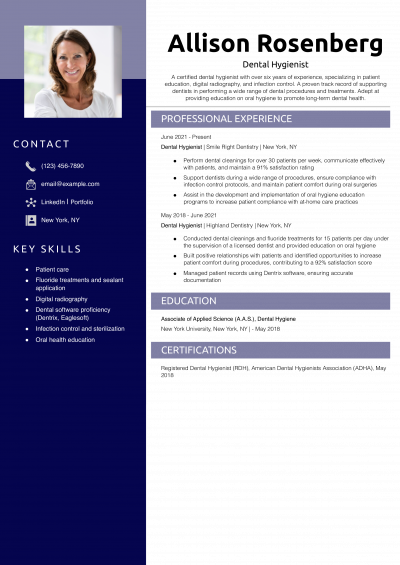
4 Best Dental Hygienist Resume Examples and Templates for 2026


“Dentists and office managers scan the first half of page one for the state credential, radiography certification, and the procedures you've assisted, because that combination signals whether you can step into the operatory without weeks of shadowing.”
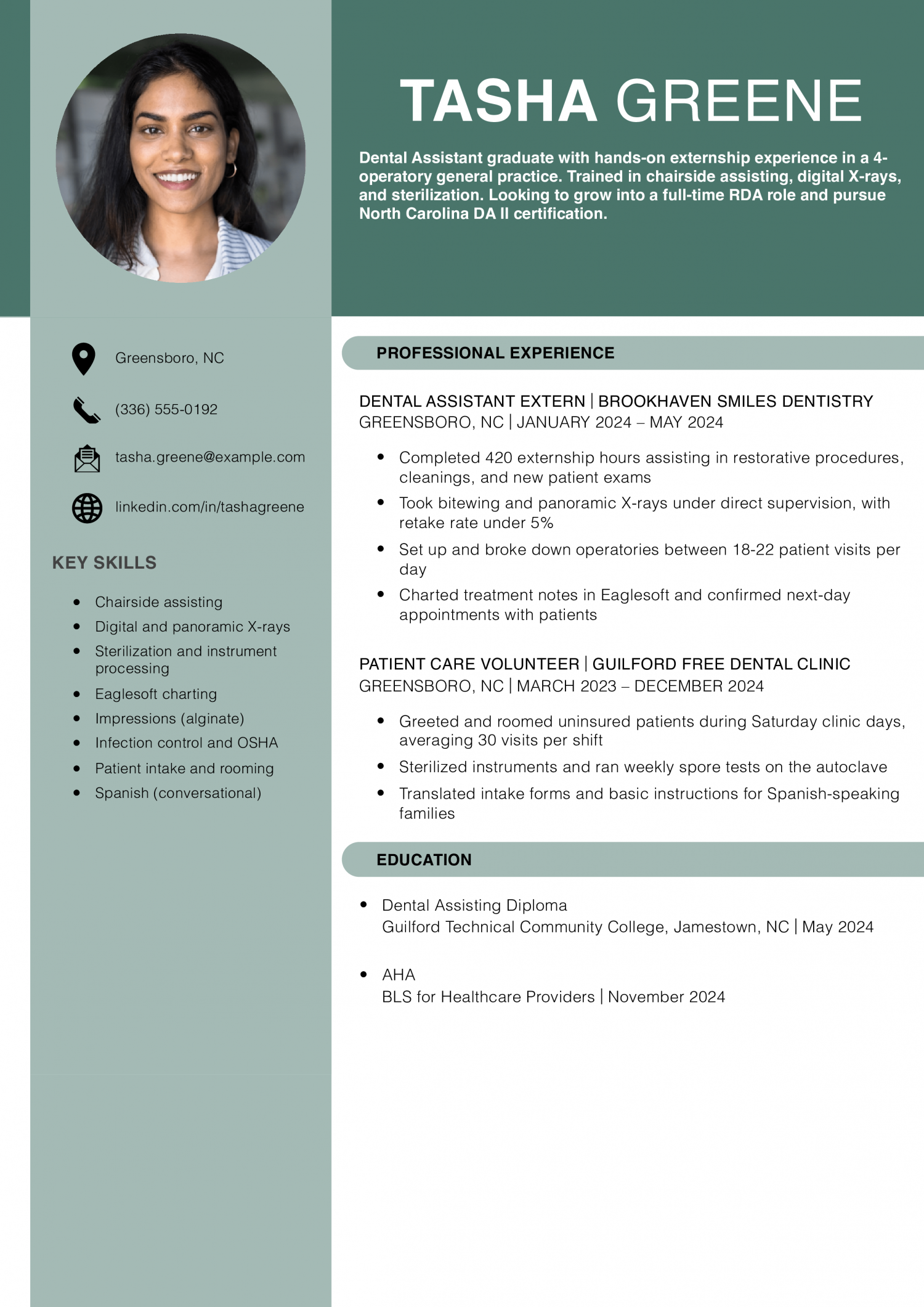
Entry-level dental assistants are recent program graduates or chairside trainees with under two years at the chair. This resume needs to prove your radiography certification, infection control fluency, and the procedures you assisted during externship.
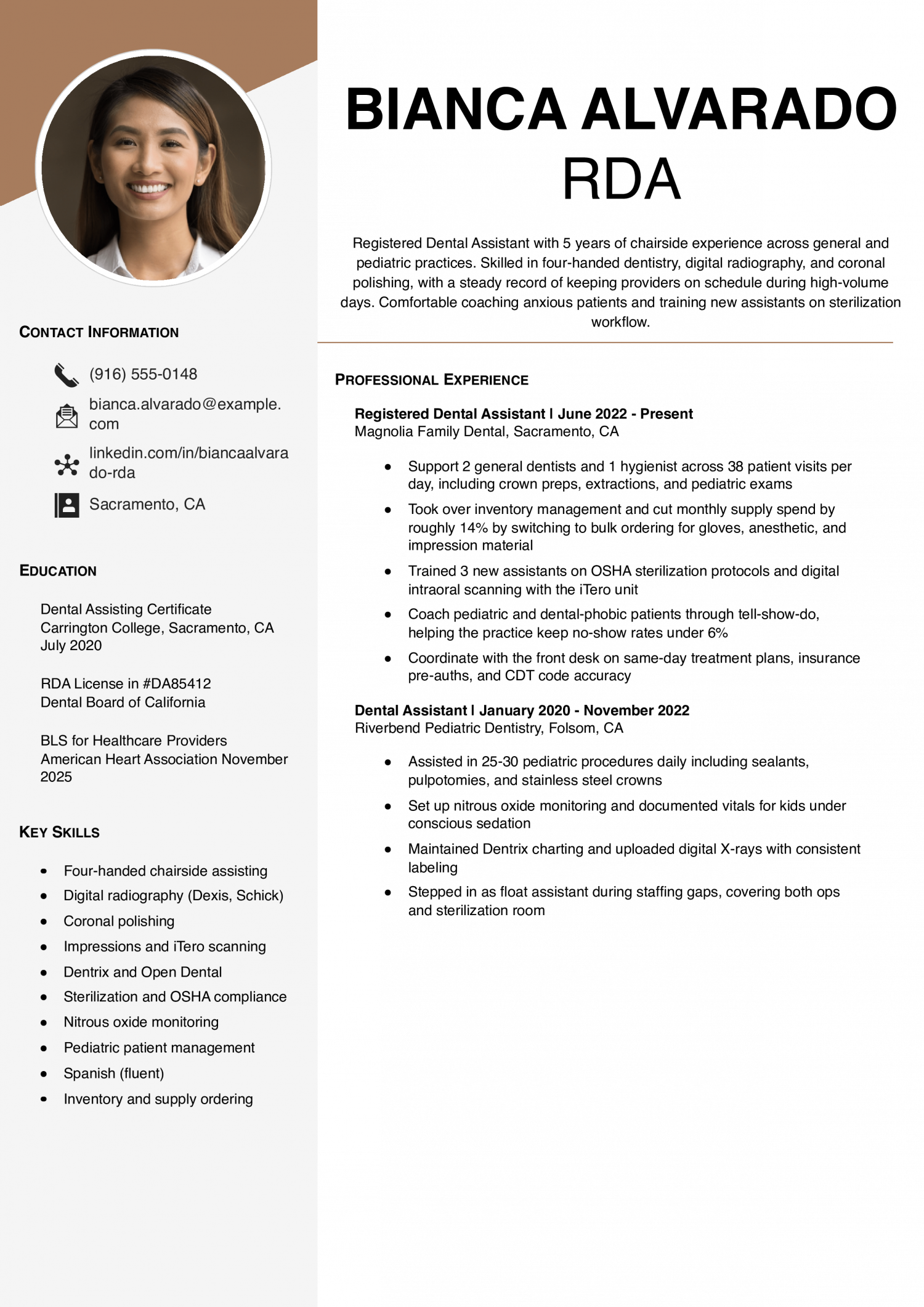
Experienced dental assistants have three or more years across general or specialty practices and often hold an expanded-functions credential. This resume needs to prove your procedure range, your practice software depth, and the patient volume you support per day.
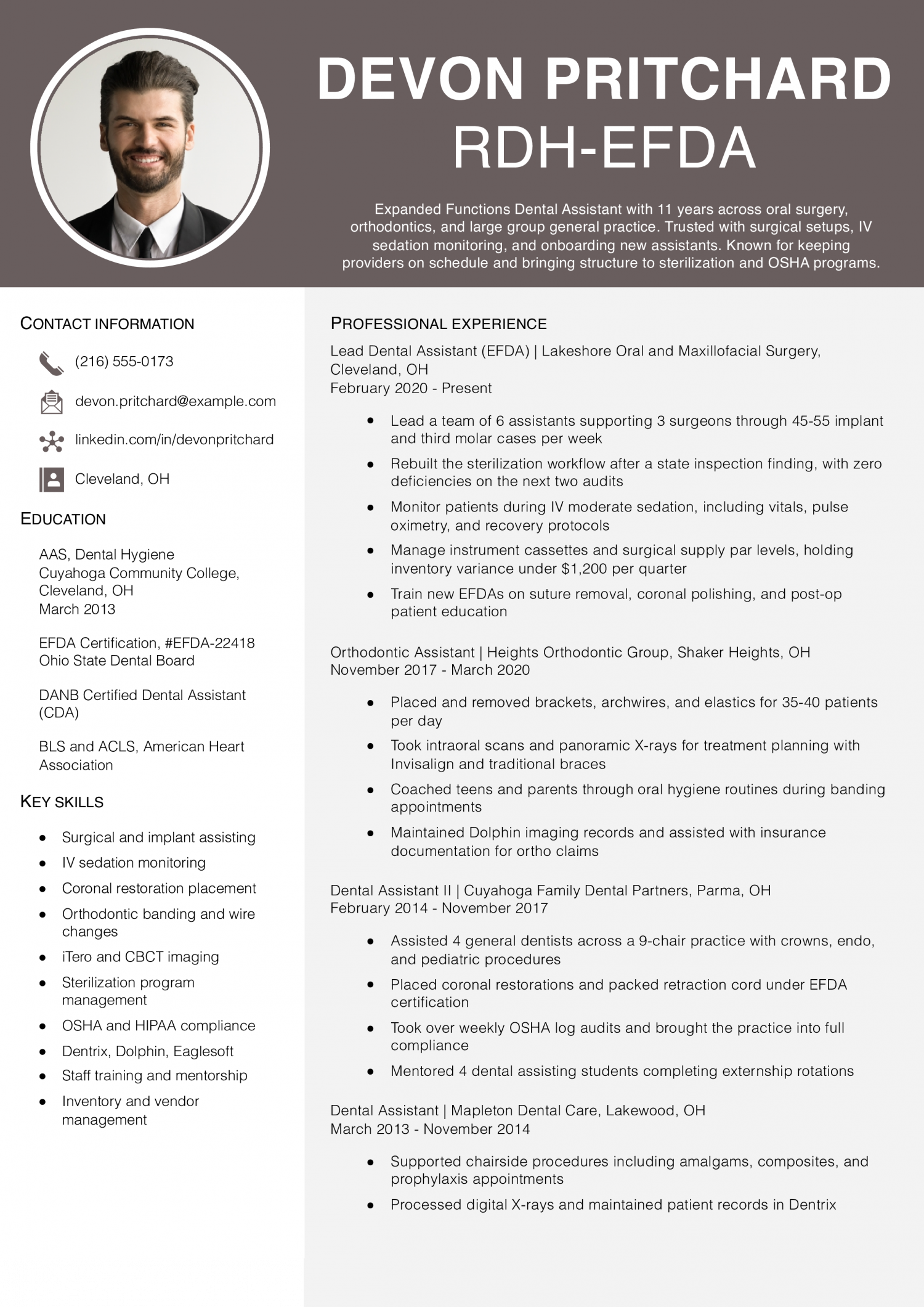
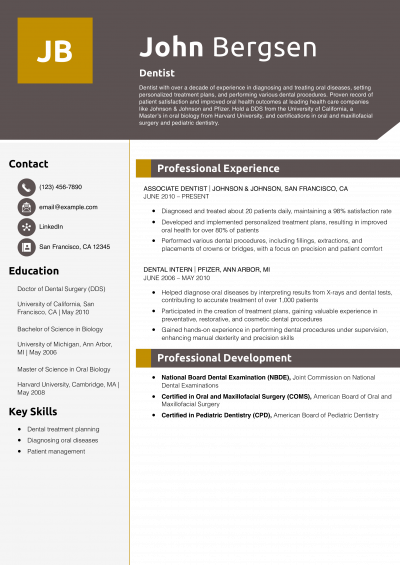
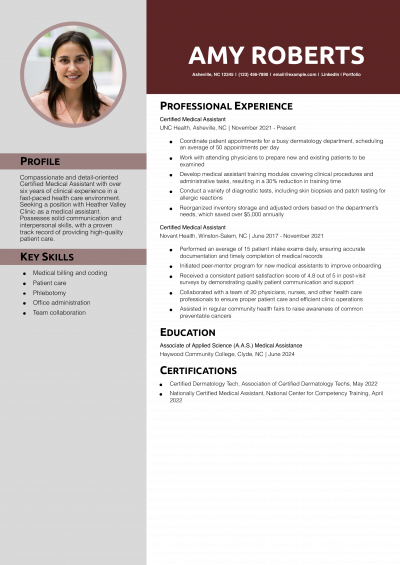
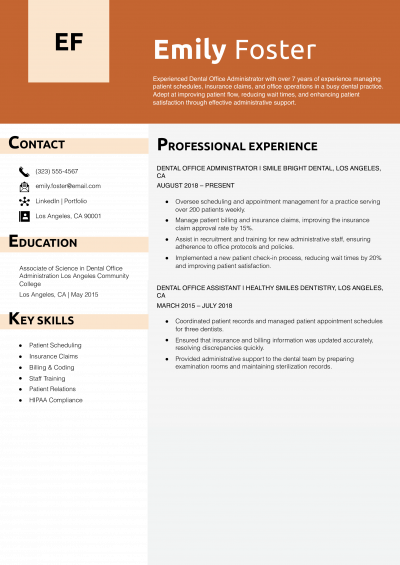
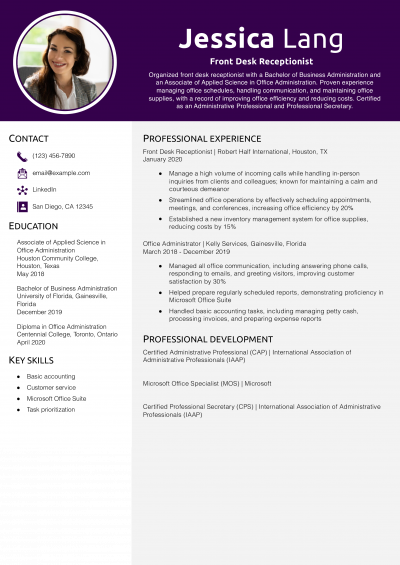
Certified Dental Assistant with 7 years of experience across general, cosmetic, and endodontic practices. Strong chairside skills paired with a knack for patient education and treatment plan presentation. Bilingual in English and Mandarin, comfortable training new team members and improving day-to-day office systems.
Your profile belongs at the top of page one. State your years chairside, the practice setting you’ve worked in, and the procedures you assist on a typical day.
Name the credential (RDA, CDA, EFDA) and the radiography certification in the same block. Add the practice software you use, such as Dentrix or Eaglesoft.
Two or three sentences are enough. A pediatric assistant with three years at a group practice reads very differently from a surgical assistant in an oral surgery clinic, and your profile should make that clear before the office manager reaches your bullets.
Bullets without numbers read as duty lists. Strong dental assistant resumes name patient volume, operatory count, and procedure frequency.
Aim for two or three figures per role: patients per day (for example, 24 to 30), operatories you turn over, and the share of restorative versus hygiene support you cover.
If you handle sterilization for the practice, name the instrument volume per shift. If you take radiographs, name the type (bitewings, PA, panoramic, CBCT) and the weekly count. Numbers turn vague experience into something an office manager can map to their own schedule.
Walls of dental jargon lose readers. Group your chairside work into three or four categories so the page scans fast.
Useful buckets: restorative support (composite, amalgam, crown and bridge prep, impressions and digital scans), endodontic and surgical assisting (root canals, extractions, implant placement), preventive and diagnostic (radiographs, coronal polishing, sealants), and patient flow (intake, charting, post-op instructions).
Under each bucket, name the specific procedures and the instruments or materials you handle. This structure also doubles as an ATS keyword grid for the practice software and procedure terms office managers search.
Office managers verify credentials before reading bullets. Put your state RDA or CDA, radiography certification, BLS, and any expanded-functions permit in a credentials block under your name or in the top right of page one.
List the state and “license in good standing” rather than the license number. The number goes on the application form, not the resume.
Add a short tools line: Dentrix, Eaglesoft, Open Dental, Dexis or Carestream imaging, iTero or Trios scanners. These are ATS keywords and a fast trust signal for the practice.
End with your dental assisting program, the institution, and graduation year. Add the accrediting body (CODA) if your program holds accreditation.
Below that, list continuing education clock hours from the last two years and the topics. CE in nitrous oxide monitoring, coronal polishing, or implant assisting signals an assistant who has expanded scope since graduation.
If you completed an externship at a notable practice, name it as a one-line entry under education. Skip high school. Skip generic CPR if BLS already appears in your credentials block.
ATS filters catch more dental assistant resumes than ever in 2026. The skills below come from our user-built dental assistant resumes. Procedure names and software like Dentrix clear the first cut, and chairside language decides whether the resume advances.
Dentists and office managers weigh hard skills first (credential, radiography, procedure range), then read soft skills as evidence that backs each bullet. Match this list against the practice’s posting, and treat soft skills as proof points to weave into your procedure bullets.
| Soft Skills | % of resumes with this skill |
|---|---|
| Patient communication | 71% |
| Attention to detail | 68% |
| Empathy | 48% |
| Teamwork | 39% |
| Calm under pressure | 27% |
And here are the top hard skills showing up most often.
| Soft Skills | % of resumes with this skill |
|---|---|
| Chairside assisting | 70% |
| Instrument sterilization | 68% |
| Dental radiography | 48% |
| Patient record management | 38% |
| Dental practice software | 27% |
Based on data from thousands of dental assistants’ resumes built on ResumeTemplates.com, May 2026.
These are the must-haves hiring teams look for when scanning a dental assistant resume.
CE clock hours tell office managers which procedures you’ve grown into since your program. List the topic, the issuing provider, and the year. Skip the certificate number.
Most state boards require ongoing CE hours to renew your RDA or CDA. Track them per your state board’s requirements and surface the most relevant ones on the resume.
Lead with CE that maps to the practice you’re applying to. An oral surgery practice cares about implant assisting and IV sedation monitoring; a pediatric office cares about behavior guidance and nitrous oxide.
Dental practices run on a small set of practice management systems and imaging platforms. Name the ones you’ve used by their product names, not as “dental software.”
Dentrix (Henry Schein One): the most common system in private practices.
Eaglesoft (Patterson Dental): widespread in mid-size and group practices.
Open Dental: common in independent and community health practices.
Curve Dental and Denticon: cloud-native systems showing up in newer DSOs.
Dexis, Carestream, and Romexis: imaging platforms paired with the systems above.
iTero and 3Shape Trios: intraoral scanners increasingly required for crown and ortho workflows.
Your bullets describe patient care without identifying patients. That sounds obvious; it’s the single most common reason a clinical resume gets flagged in compliance review.
Use aggregate numbers (patients per day, operatory count, weekly radiograph volume) rather than case details that could identify a patient.
Skip practice patient names, photos, and chart snippets. If you’ve worked on a notable case, describe the procedure category and outcome category in general terms.
Dentists and office managers read this list as a map of where your chairside work is heading. The certifications below tell them which track you’ve invested in, whether expanded functions, sedation monitoring, or surgical assisting. List the issuing body and the year of completion next to each one.
Certified Dental Assistant (CDA), DANB: The national-board credential most multistate practices and DSOs recognize, covering general chairside, radiography, and infection control.
Registered Dental Assistant (RDA), state board: Required in roughly a dozen states for expanded duties; list the state and good-standing status without the registration number.
Certified Dental Assistant in Expanded Functions (EFDA or CDA-EF): Signals you can place restorations, fabricate temporaries, or perform coronal polish, which raises your billable scope in the operatory.
Nitrous Oxide Monitoring Certification: State-specific permit that opens pediatric and oral surgery roles where sedation monitoring sits inside the assistant's daily duties.
These credentials sit alongside your core dental assisting license and signal added scope inside the operatory. Office managers in specialty practices use them to sort candidates for expanded duties.
Coronal Polishing Certification: state-issued permit that lets you provide polishing as part of hygiene support, common in pediatric and group practices.
Sealant Placement Certification: expanded duty in many states, often paired with coronal polishing for pediatric and community health roles.
Dental Radiology Certification (state-specific): required to expose radiographs in most states; list the state and certifying body.
BLS for Healthcare Providers (American Heart Association): standard requirement; list the issue date so the office manager sees it's current.
OSHA Bloodborne Pathogens Training: annual refresher most practices require for chairside staff.
The 90th-percentile dental assistant out-earns the median by a wide margin, which tells you the market rewards specialty setting and expanded-functions scope more than years at the chair. Oral surgery, periodontics, and orthodontic practices pay above general dentistry for the same tenure.
Lead the resume with the specialty procedures you assist on and the expanded credentials you hold, not the number of years you’ve been chairside.
| # | State | Avg. Annual |
|---|---|---|
| 1 | Minnesota | $64,630 |
| 2 | Massachusetts | $57,960 |
| 3 | Oregon | $57,720 |
| 4 | Washington | $57,040 |
| 5 | District of Columbia | $56,500 |
| 6 | Alaska | $55,950 |
| 7 | Maine | $51,340 |
| 8 | North Dakota | $51,310 |
| 9 | Vermont | $51,020 |
| 10 | Connecticut | $50,820 |
| # | State | Workers | Median |
|---|---|---|---|
| 1 | California | 54,580 | $48,910 |
| 2 | Texas | 31,360 | $42,270 |
| 3 | Florida | 23,020 | $47,060 |
| 4 | New York | 19,700 | $47,020 |
| 5 | Illinois | 15,620 | $47,430 |
Resume Templates offers HR approved resume templates to help you create a professional resume in minutes. Choose from several template options and even pre-populate a resume from your profile.
According to the Bureau of Labor Statistics, jobs for dental assistants are projected to grow by 7% from 2022 to 2032, faster than average for most occupations. This growth is primarily driven by attrition but also because research linking oral health and overall health is driving increased demand for preventive dental services. And as Baby Boomers enter older age, more dental care is required.
Although these projections are highly optimistic, you must align your resume with the job description to secure interviews for the most attractive opportunities. Tailor your dental assistant resume to individual job postings to significantly increase your chances of landing your next job opportunity.
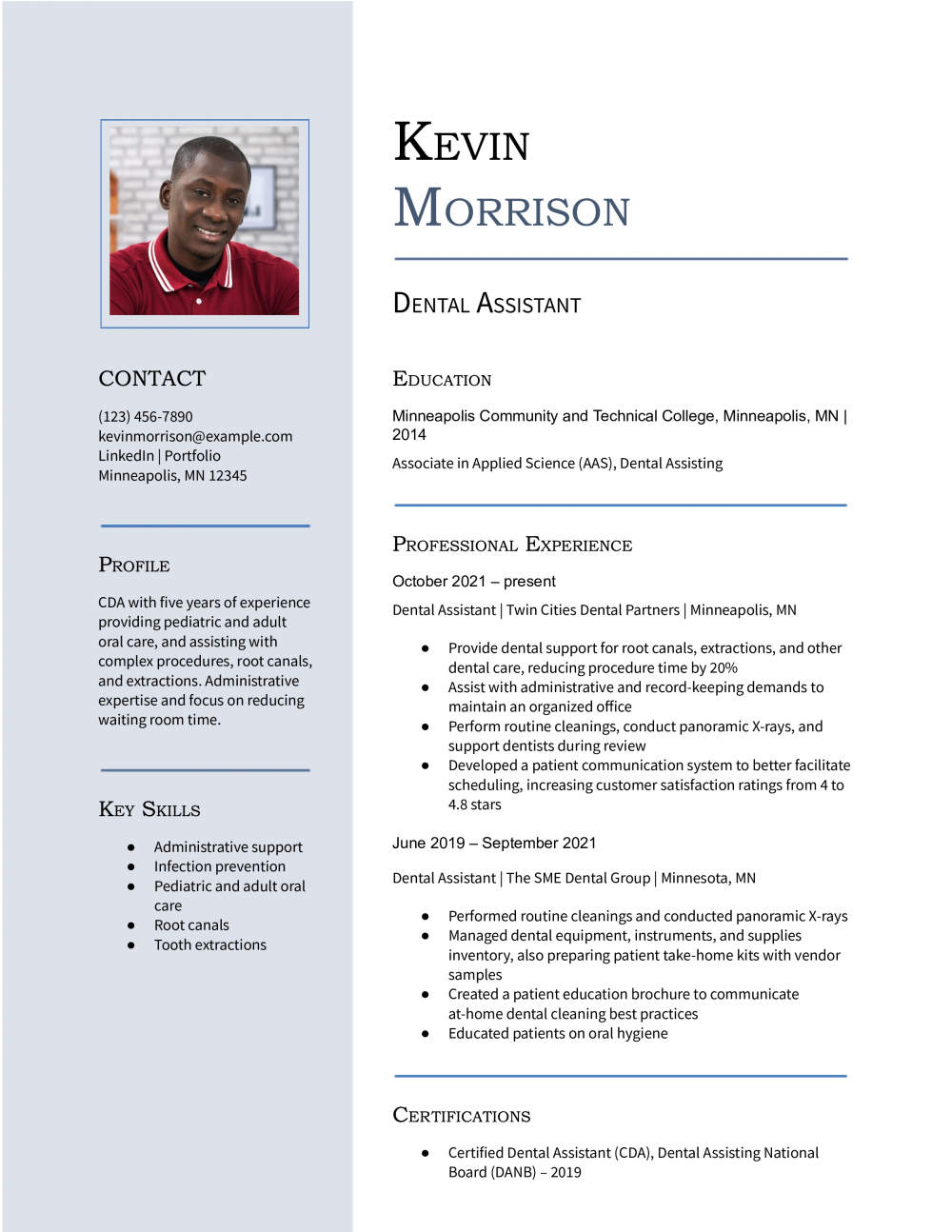
For example, suppose a dental practice is looking for a dental assistant who specializes in complex procedures, root canals, and tooth extractions. Highlight your experience in these areas while noting measurable success, such as reducing patient discomfort and improving efficiency.
Reverse chronological format is ideal for most resumes, including those for dental assistants. This approach ensures that your most recent and relevant experience is featured at the top of your document. Even at the entry level, avoid functional resume formats. If you lack hands-on experience, instead illustrate your academic projects rather than only listing technical skills.
A well-rounded Dental Assistant CV should include the following sections: a profile summary that highlights your experience and strengths, a skills section that aligns with the job description, a professional experience section that outlines key roles and responsibilities, and education and certifications. Adding a section for key achievements or quantifiable results can also give your CV a competitive edge.
Crafting a strong cover letter to accompany your dental assistant resume will improve your chances of landing an interview. The key to creating a compelling cover letter is to customize the document for the dental practice where you’re seeking employment.
Executive Resume Writer and Career Coach
Andrew Stoner is an executive career coach and resume writer with 17 years of experience as a hiring manager and operations leader at two Fortune 500 Financial Services companies, and as the career services director at two major university business schools.
Customize this template in our builder in under 10 minutes.