Dental Assistant Resume Examples and Templates for 2026



The dentist resumes that get scheduled for working interviews share three things: a daily production figure in the summary, a procedure mix with case counts from the last 12 months, and a state license line that stops short of the number itself.

The associate dentist tab fits new graduates and dentists in their first three years out of school. The resume needs to prove residency or AEGD/GPR procedures handled solo, daily patient volume, and a clean license in the state of practice.

The established dentist tab fits clinicians with four to ten years of chairside experience in a group or DSO. The resume needs to show daily production numbers, the procedure mix you own, and continuing education in restorative, endo, or implants.

The practice owner tab fits dentists running their own office or leading a multi-doctor group. The resume needs to prove year-over-year production growth, hygiene recall metrics, team size managed, and the clinical tracks (Spear, Kois, Dawson) you've completed.
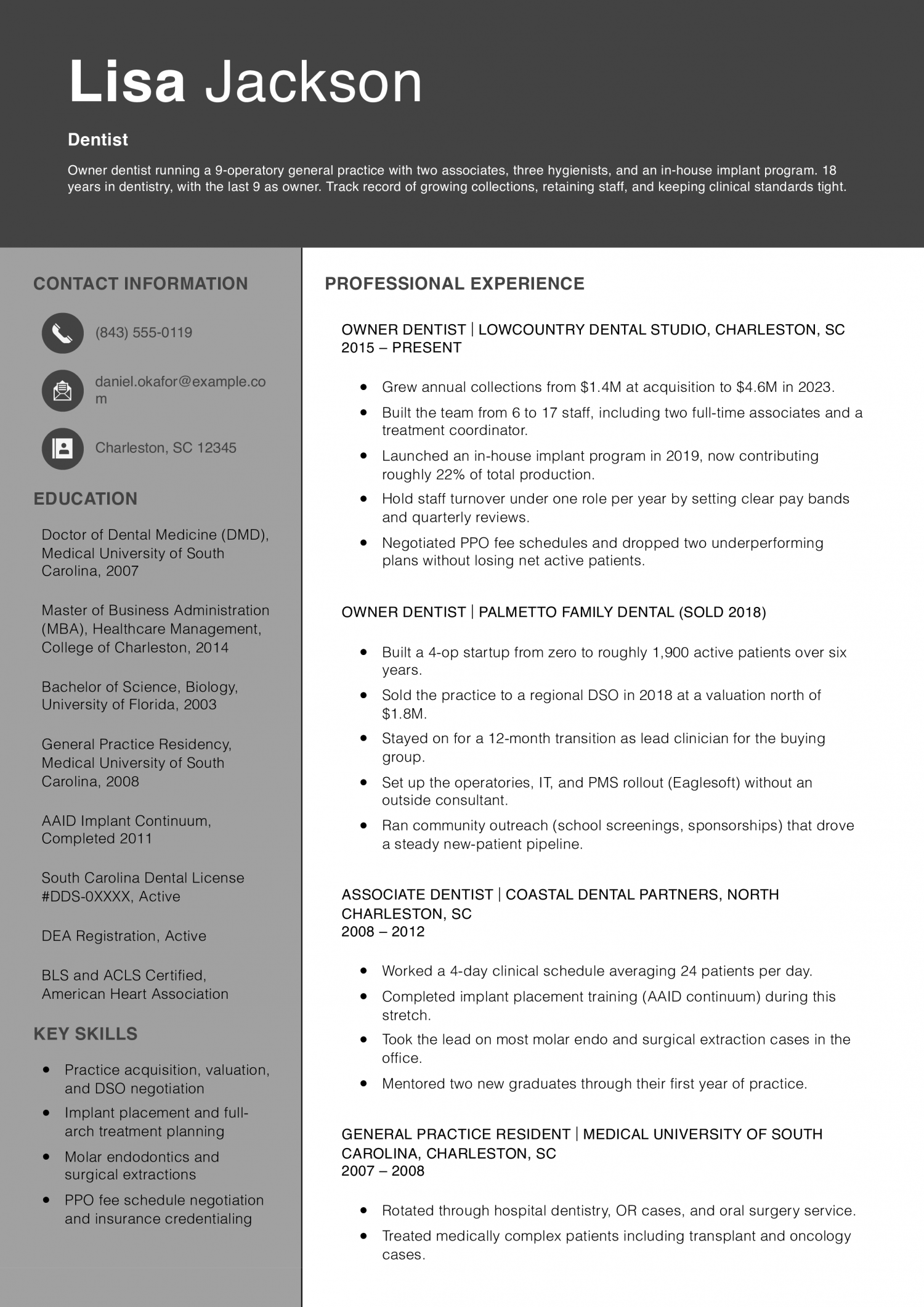
General dentist with 13 years of experience across community health, private practice, and a partner role at a multi-doctor group. Strong clinical range in restorative, endo, and implant restoration, with a steady hand on team building and case presentation. Bilingual in English and Spanish.
The first line of your summary should name your daily production, your patients per day, and the procedure mix you handle without a referral.
Practice owners and DSO regional directors read this as your readiness to keep their chairs full from week one.
Skip the vague ‘compassionate clinician’ opener. Lead with the number that proves you can produce, then add your years of chairside experience and the practice setting you’ve worked in.
Bullets without a number tend to read as duties, not outcomes. Most strong dentist resumes name two or three metrics per role.
Use case counts (crowns placed, root canals completed, implants restored), production per visit, and recall or treatment-acceptance rates.
If a metric isn’t tracked at your practice, pivot to volume language: ‘restored 12 to 15 crowns per week’ beats ‘performed crown work.’ Recruiters scan for these first.
Break your procedure mix into three to five buckets so a reviewer can scan it in a few seconds.
Common groupings: restorative (composites, crowns, bridges), endodontics (anterior and molar root canals), oral surgery (simple and surgical extractions, third molars), prosthodontics (dentures, implant restorations), and preventive or pediatric work.
Under each bucket, list the case volume and any specialty cases you take instead of referring out. This tells a clinical director where your hands are strongest.
Put your DDS or DMD, state license status, DEA registration, BLS, and malpractice-clean status in a credentials block under your header.
List the state and ‘license in good standing’ without the license number itself; provide the number on the application form when requested.
Practice owners need to see these early because verification gates every other read. Add board certification or specialty board status (ABGD, ABE, ABOMS) on the same line if you hold it.
The education section names your dental school, graduation year, and any residency (GPR, AEGD) with the institution and dates.
Add a short continuing education block listing Spear, Kois, Dawson, Pankey, or AAID tracks with hours completed and year finished.
These signal which clinical track you’ve invested in and where your case complexity is heading. Keep the list tight: four to six entries from the last five years.
The dentist resumes that get callbacks share a specific skill mix. The lists below come from our user-built dentist resumes. Practice owners and DSO recruiters scan for these patterns first, not generic ‘compassionate care’ language or chairside-manner platitudes.
Hard skills carry the credential check; soft skills back up your patient retention and team bullets. Match the list below against the job posting, then use each soft skill as evidence behind a specific bullet, not a standalone claim.
| Soft Skills | % of resumes with this skill |
|---|---|
| Communication | 72% |
| Attention to detail | 50% |
| Patient empathy | 43% |
| Problem-solving | 38% |
| Time management | 31% |
And here are the top hard skills showing up most often.
| Hard Skills | % of resumes with this skill |
|---|---|
| Clinical patient care | 72% |
| Diagnosis and treatment planning | 56% |
| Restorative dentistry | 50% |
| Dental radiography | 40% |
| Oral surgery and extractions | 29% |
Based on data from thousands of dentists’ resumes built on ResumeTemplates.com, May 2026.
The items below are what separate a dentist resume from one that gets put back in the pile.
Practice owners verify license status before they read your bullets. List the credentials below in a block directly under your contact header so the credential check clears on the first pass.
List the state of licensure and ‘in good standing’ status, not the license number. The same goes for your DEA registration and NPI: name that you hold them, omit the number.
If you hold licenses in multiple states, list each state on its own line. Note any state-board sedation or anesthesia permits separately, since those carry their own scope.
CE coursework tells a clinical director where your case complexity is heading. List four to six recent tracks with the program, hours, and year completed.
State dental boards set their own CE clock-hour requirements, so list hours per the standard your state uses. Group entries by clinical track instead of running a single chronological list.
Lean on tracks that match the procedures you want more of. A new graduate aiming at restorative-heavy work should show Spear or Kois hours; a dentist moving toward implants should show AAID or ICOI courses.
Name the practice management and imaging software you’ve used by product name. The ATS scan flags these as keywords, and a practice owner reads them as a signal of onboarding speed.
Practice management: Dentrix, Eaglesoft, Open Dental, Curve Dental, Denticon
Imaging: Dexis, Carestream, Planmeca Romexis, Sirona Sidexis
CBCT: i-CAT, Carestream 9600, Planmeca ProMax 3D
CAD/CAM: CEREC Primescan, iTero, 3Shape TRIOS
Treatment planning: Invisalign ClinCheck, SureSmile, Blue Sky Plan
Resume bullets that reference patient outcomes must never include identifying details. Practice owners read PHI slips as a hiring risk.
Use case counts, procedure types, and aggregate metrics. Drop patient names, dates of service, photos, and any combination of details that could re-identify a patient.
If you ran a process improvement around scheduling, recall, or treatment acceptance, frame it in aggregate (recall rate, no-show rate, acceptance percentage) without naming individuals.
Board status tells a clinical director the depth of your case work in a discipline. List specialty boards with the full name of the certifying body and the year of certification.
American Board of General Dentistry (ABGD) Fellowship or Mastership
American Board of Endodontics (ABE) Diplomate
American Board of Oral and Maxillofacial Surgery (ABOMS) Diplomate
American Board of Periodontology (ABP) Diplomate
American Board of Prosthodontics Diplomate
American Board of Orthodontics (ABO) Diplomate
Practice owners and DSO clinical directors read this list as a map of where your work is heading. The certifications below tell them which procedure tracks and case complexity you’ve invested in. List each one with the issuing body and the year you earned it, stacked under a ‘Continuing Education’ header.
Invisalign Provider Certification: Signals you can take clear-aligner cases in-house instead of referring out, a high-margin add for general practices.
American Board of General Dentistry (ABGD) Mastership: Marks you as a clinician who has documented case work across all major disciplines, valuable for group and DSO leadership tracks.
AAID Associate Fellow or Fellow: Tells implant-heavy practices you place and restore, not just restore, which directly affects your production ceiling.
IV or Oral Conscious Sedation Permit: Expands the case mix you can handle in-house and is often state-permit gated, so name your state alongside the credential.
The top-paying states for dentists cluster in lower-population markets with thin clinician supply, not the dense coastal metros where most dental schools sit. Rural and small-metro practices pay up because the patient demand outruns the local dentist count, and DSOs use signing bonuses to fill those chairs.
If you’re open to relocation or already hold a license in one of those states, name it in your header and add any state license compact or reciprocity endorsement to your credentials block.
| # | State | Avg. Annual |
|---|---|---|
| 1 | Vermont | $230,990 |
| 2 | Alaska | $230,830 |
| 3 | Delaware | $224,690 |
| 4 | Minnesota | $209,820 |
| 5 | Maine | $208,860 |
| 6 | Arizona | $206,660 |
| 7 | Wisconsin | $206,650 |
| 8 | North Dakota | $201,280 |
| 9 | Washington | $197,950 |
| 10 | Georgia | $195,820 |
| # | State | Workers | Median |
|---|---|---|---|
| 1 | California | 14,760 | $178,540 |
| 2 | Florida | 8,400 | $162,870 |
| 3 | Texas | 7,690 | $157,370 |
| 4 | New York | 7,460 | $164,060 |
| 5 | Illinois | 4,820 | $180,420 |
Resume Templates offers HR approved resume templates to help you create a professional resume in minutes. Choose from several template options and even pre-populate a resume from your profile.
Use a reverse-chronological format with a credentials block under your header.
Practice owners want to see your license status, school, and most recent role within the first read. A functional or skills-first layout hides your chair time, which is the thing being hired.
No. List the state and 'license in good standing' without the number.
Most state dental boards advise against publishing license numbers on documents that circulate widely. Provide the number on the application form or credentialing packet when the practice requests it.
Add a short CE block after education. List the program name, issuing body, hours completed, and year.
Keep it to four to six entries from the last five years. Prioritize tracks tied to the procedures you want to do more of, since clinical directors read CE as a forecast of your case mix.
Only if you have less than two years of clinical work and the shadowing was substantial.
List it under a separate 'Clinical Experience' header with hours and the supervising dentist's practice type. Drop it once you have a residency or associate role to lead with.
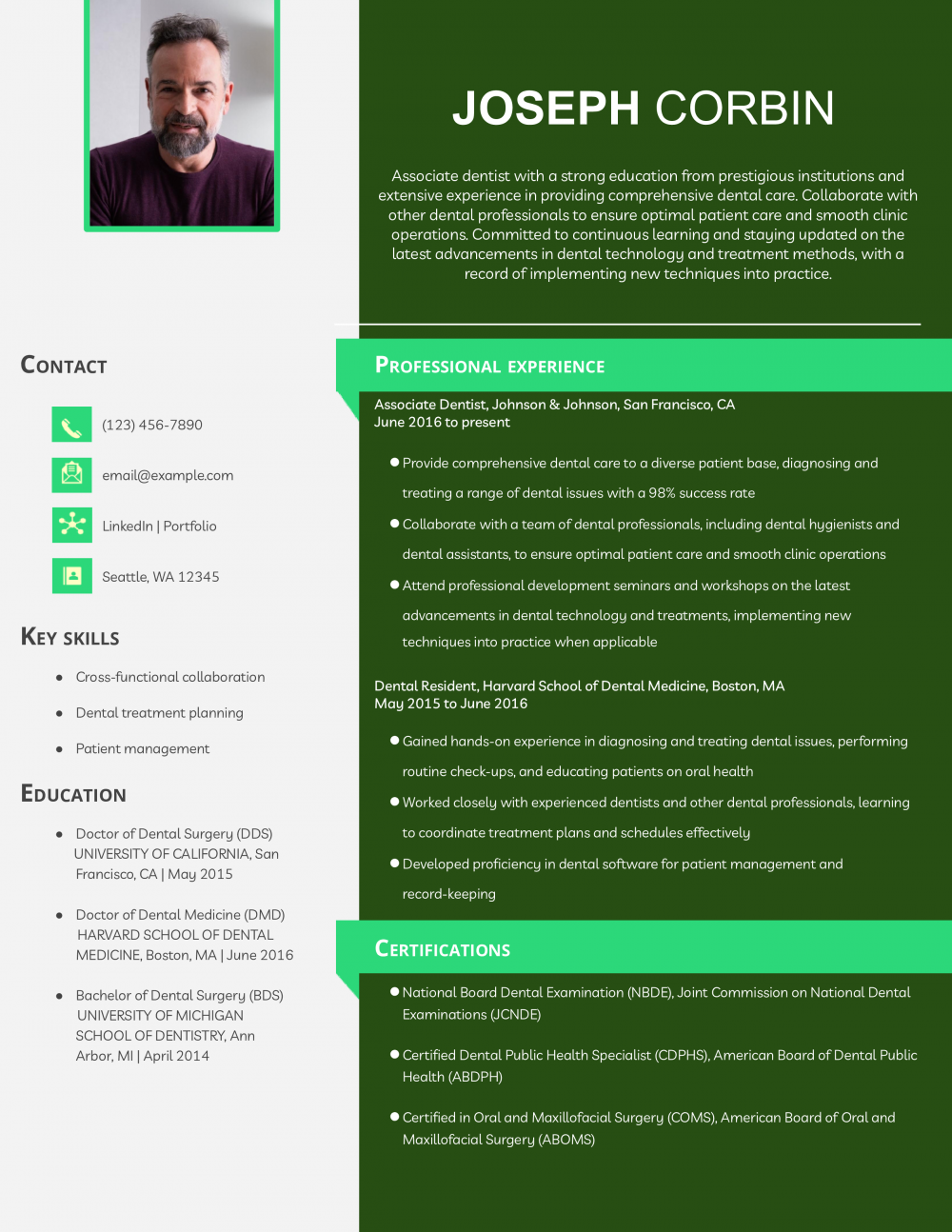
For a dentist, an ATS-friendly template is the safest pick, because it puts your certifications and experience where a hiring manager scans first. A basic template is a solid alternative. Whichever you choose, keep the formatting clean and easy to parse: clear section headings, a standard font, and no graphics a parser can choke on.
Executive Resume Writer and Career Coach
Andrew Stoner is an executive career coach and resume writer with 17 years of experience as a hiring manager and operations leader at two Fortune 500 Financial Services companies, and as the career services director at two major university business schools.
Customize this template in our builder in under 10 minutes.