Dental Assistant Resume Examples and Templates for 2026



Practice owners decide whether to bring a hygienist in for a working interview by the credentials block on page one; if the active license, BLS, and local anesthesia permit aren't visible there, the resume slides to the bottom of the stack.
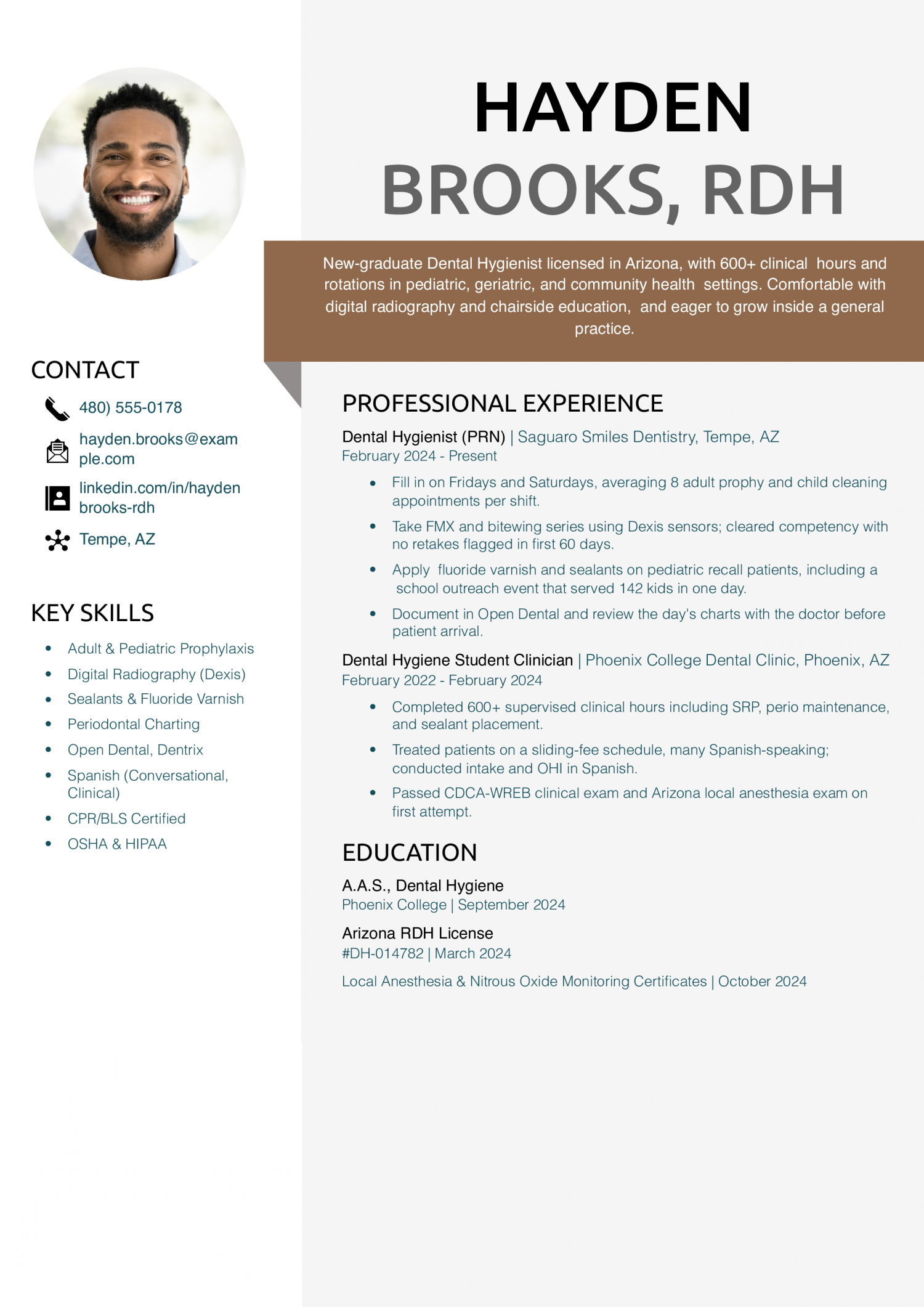
Recent graduates of CODA-accredited programs with a fresh NBDHE pass and a regional clinical exam (CRDTS, WREB, or CITA) behind them. The entry resume needs to prove clinical readiness through externship rotations, patient counts, and any expanded-function permits earned during school.
Associate-degree RDHs with 2 to 5 years chairside in private practice or group settings. The experienced resume needs to prove a steady recall column, periodontal case acceptance, and fluency with the operatory software the target practice already runs.

Bachelor's-prepared hygienists moving into lead, public-health, or treatment-coordinator tracks. The lead resume needs to prove mentorship of newer hygienists, hygiene-department production growth, and ownership of recall protocols or perio program rollouts.
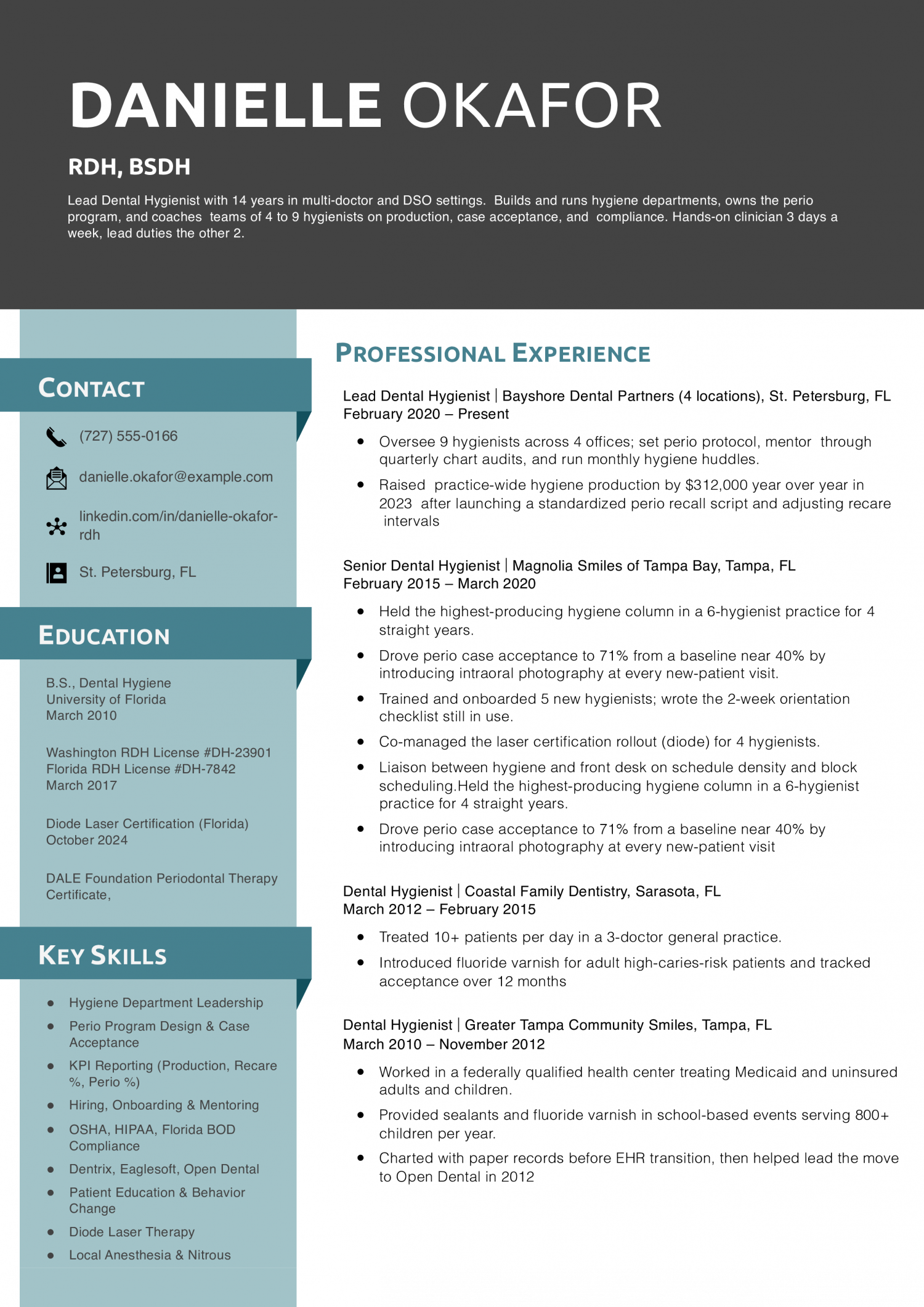
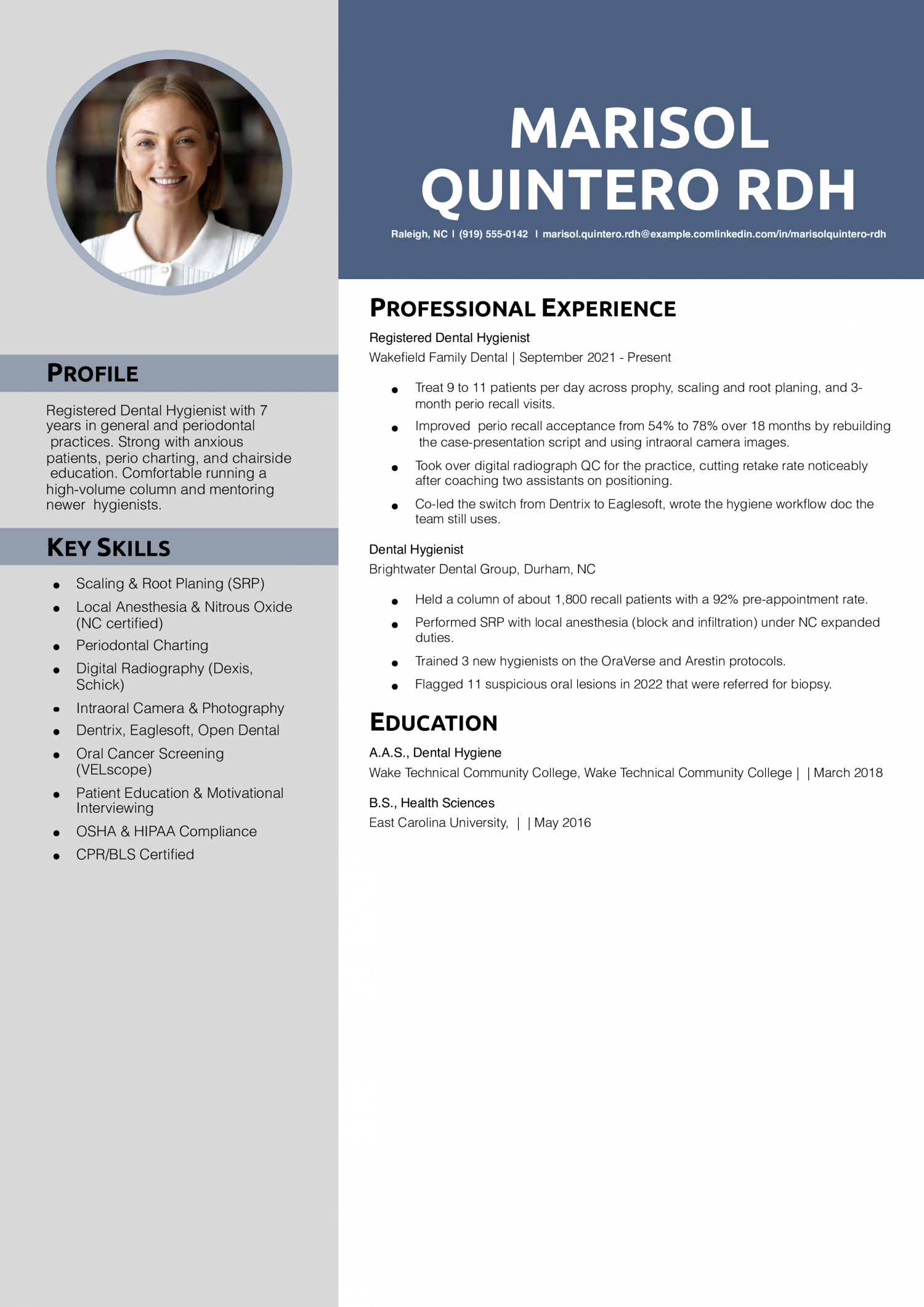
Registered Dental Hygienist with 9 years of clinical experience across general, pediatric, and periodontal practices. Builds long-term recall relationships, runs a steady 10-patient-per-day column, and has helped two offices rework their perio programs. Comfortable mentoring new hygienists and assistants.
Add a line a practice owner cannot read off your state license. That might be a laser certification, a pediatric residency rotation, or fluency in Spanish with a bilingual patient panel.
Lead the summary with the differentiator, not the years. A bachelor’s-prepared RDH with periodontal therapy depth reads sharper than another generic three-line summary. Practice owners scan for that single distinguishing item before they read further.
Bullets without a number tend to read as job duties. Strong RDH bullets carry patients per day, recall retention rate, and perio case acceptance percentage.
Name two or three real metrics: 10 to 12 patients per day, a 78 percent recall return rate, or a hygiene column producing a set share of practice revenue. Those numbers separate a working RDH from a license.
Cluster your clinical work so a dentist reads scope in seconds. Use four buckets: preventive, periodontal, imaging, and expanded functions.
Preventive covers prophylaxis, sealants, and fluoride varnish. Periodontal covers SRP, periodontal charting (PSR and 6-point), and ultrasonic instrumentation. Imaging covers digital bitewings, panoramic, and periapical.
Expanded functions cover local anesthesia and nitrous oxide where state law permits.
Practice owners verify licensure before they read bullets. Put a credentials block under your name with RDH license state and status, BLS expiration, local anesthesia and nitrous permits, and radiography certification.
Add software in the same band: Dentrix, Eaglesoft, Open Dental, Curve, or Carestream imaging. List the state license as in good standing without the license number, then provide the number on the application itself.
End with your CODA-accredited program, graduation date, and NBDHE pass. Add the regional clinical exam you sat for (CRDTS, WREB, CITA, SRTA, or NERB).
Below education, list current CE hours toward your state board’s renewal cycle. Name the courses that map to expanded functions or specialty tracks: laser therapy, advanced periodontics, or pediatric behavior management.
The dental hygienist resumes that get callbacks share a specific skill mix. The lists below come from our user-built RDH resumes. Dentists and practice owners scan for these patterns first, not generic compassion language.
Hard skills carry the credential and procedure verification. Soft skills back the bullets that show recall retention and chairside rapport. Match the hard skills against the procedure vocabulary in the posting, and use the soft skills as evidence woven into bullets, not as a standalone list.
| Soft Skills | % of resumes with this skill |
|---|---|
| Patient communication | 73% |
| Empathy | 54% |
| Attention to detail | 43% |
| Time management | 39% |
| Teamwork | 35% |
And here are the top hard skills showing up most often.
| Hard Skills | % of resumes with this skill |
|---|---|
| Teeth cleaning and scaling | 78% |
| Periodontal assessment | 70% |
| Dental radiography | 41% |
| Dental charting | 39% |
| Infection control | 32% |
Based on data from thousands of dental hygienists’ resumes built on ResumeTemplates.com, May 2026.
The items below are what separates a dental hygienist resume that clears credentialing from one that gets put back in the pile.
The RDH credential ladder is the same nationally, but expanded-function scope varies by state. Spell out the full ladder on your resume so practice owners read scope in one pass.
The base requirement is graduation from a CODA-accredited dental hygiene program, a passing score on the National Board Dental Hygiene Examination (NBDHE), and a regional clinical exam.
Regional clinical exams include CRDTS, WREB, CITA, SRTA, and the former NERB (now CDCA-WREB-CITA). Name the one you sat for, since some state boards accept specific exams only.
Beyond the base license, list state-permitted expanded functions separately: local anesthesia, nitrous oxide monitoring, pit and fissure sealants, and laser therapy where applicable.
State boards set CE clock-hour requirements on a 2-year or 3-year renewal cycle. List CE on your resume to show you are current and to map specialty depth.
Check your state board for the exact CE hour requirement and any mandated topics, since cycles vary by state.
Group CE by theme on the resume: periodontal therapy, expanded functions, pediatric behavior, infection control, and medical emergencies.
Software fluency is the second screen after the license check. Name the practice management system and the imaging system by brand, since ATS scans match brand names, not categories.
Dentrix (charting, perio chart, recall scheduling)
Eaglesoft (clinical notes, treatment planning)
Open Dental (open-source, common in independent practices)
Curve Dental and Denticon (cloud-based, common in DSO groups)
Carestream and Dexis imaging (digital bitewing, panoramic, periapical)
Schick and Planmeca sensors
Practice owners assume HIPAA awareness, so a one-line mention beats a paragraph. Show compliance through the artifacts on the resume, not adjectives.
Never name patients or include identifying details in bullet points. Aggregate numbers (patients per day, recall return rate) are fine.
Add a short line in the credentials block on your most recent HIPAA training date and any infection control certification.
Beyond your RDH license and BLS, the certifications below tell a dentist or practice owner which procedures you can bill and how deep your specialty exposure runs. List the certifying body and the current expiration date for each.
Local Anesthesia Permit: Expands your billable scope in states that permit RDH-administered anesthesia and removes a chairside bottleneck for the dentist.
Nitrous Oxide Monitoring Certification: Signals you can manage sedation cases independently, which matters in pediatric and high-anxiety adult practices.
Laser Certification (Diode or Nd:YAG): Maps to laser-assisted periodontal therapy, a procedure many practices want hygienists trained on before purchase.
Pit and Fissure Sealant Certification: Required in some states for independent sealant placement and useful in public-health and pediatric resume tracks.
For dental hygienists, the 10th-percentile floor sits well below the top-decile ceiling, and that spread reflects geography, expanded-function scope, and practice type more than tenure. Metro DSO groups and periodontal specialty practices pay closer to the ceiling, while rural private practices and public-health roles sit closer to the floor. Lead the resume with the expanded functions your state permits and the procedure mix you actually run.
That moves a reader from reading a license to reading a clinician.
| # | State | Avg. Annual |
|---|---|---|
| 1 | Alaska | $129,760 |
| 2 | District of Columbia | $127,900 |
| 3 | Washington | $125,370 |
| 4 | California | $121,080 |
| 5 | Oregon | $118,280 |
| 6 | Colorado | $106,730 |
| 7 | Maryland | $105,140 |
| 8 | Nevada | $103,160 |
| 9 | New Jersey | $102,600 |
| 10 | Massachusetts | $100,790 |
| # | State | Workers | Median |
|---|---|---|---|
| 1 | California | 22,940 | $121,080 |
| 2 | Texas | 16,010 | $94,490 |
| 3 | Florida | 13,860 | $81,090 |
| 4 | New York | 10,350 | $95,560 |
| 5 | Illinois | 8,740 | $96,490 |
Resume Templates offers HR approved resume templates to help you create a professional resume in minutes. Choose from several template options and even pre-populate a resume from your profile.
No. List your state, RDH credential, and license status as in good standing, then provide the number on the application form when asked.
State boards warn against publishing license numbers on documents you share broadly. The same rule applies to DEA-style identifiers and any expanded-function permit numbers.
Lead the summary with the software systems you can walk into cold: Dentrix, Eaglesoft, Open Dental, and the imaging brand. Temp agencies and offices need to know you can pick up a column on day one.
Add a short line on the operatory setups you've worked (Cavitron, piezo, Nomad imaging).
List your state license, BLS, local anesthesia, and nitrous permits in a top credentials block so a staffing coordinator clears you in one pass.
Use a reverse-chronological format with a credentials block under your name. Page one should carry credentials, a 3-line summary, and your most recent practice.
Save the functional or skills-first format for career changers leaving another field for hygiene. Practices want to see your last operatory before they read anything else.
Write your current state license in the credentials block, then add a one-line note that you have applied for licensure by credentials or by exam in the target state. Name the target state board and the expected date.
Practice owners need to know whether you can chair patients on your start date or whether they wait through a board review. Hiding the mismatch slows the process more than naming it.
For a dental hygienist, an ATS-friendly template is the safest pick, because it puts your certifications and experience where a hiring manager scans first. A basic template is a solid alternative. Whichever you choose, keep the formatting clean and easy to parse: clear section headings, a standard font, and no graphics a parser can choke on.
Executive Resume Writer and Career Coach
Andrew Stoner is an executive career coach and resume writer with 17 years of experience as a hiring manager and operations leader at two Fortune 500 Financial Services companies, and as the career services director at two major university business schools.
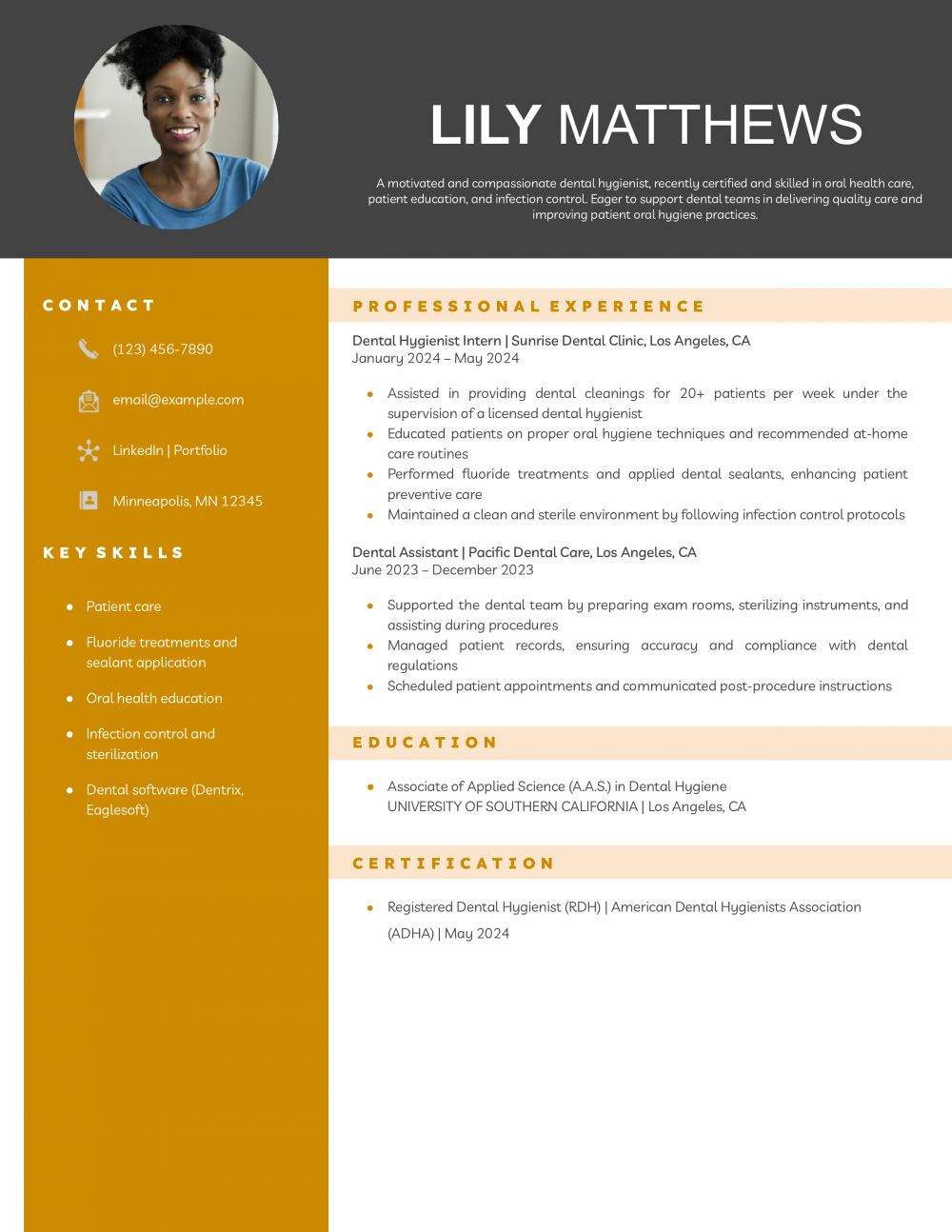
Customize this template in our builder in under 10 minutes.