Tip !

A clear ordination and denominational fit line is what gets pastor resumes past the search committee's first read; concrete shepherding outcomes are what make them readable enough to advance to a candidating weekend.

Andrew Stoner , Executive Resume Writer and Career Coach

Why this resume works

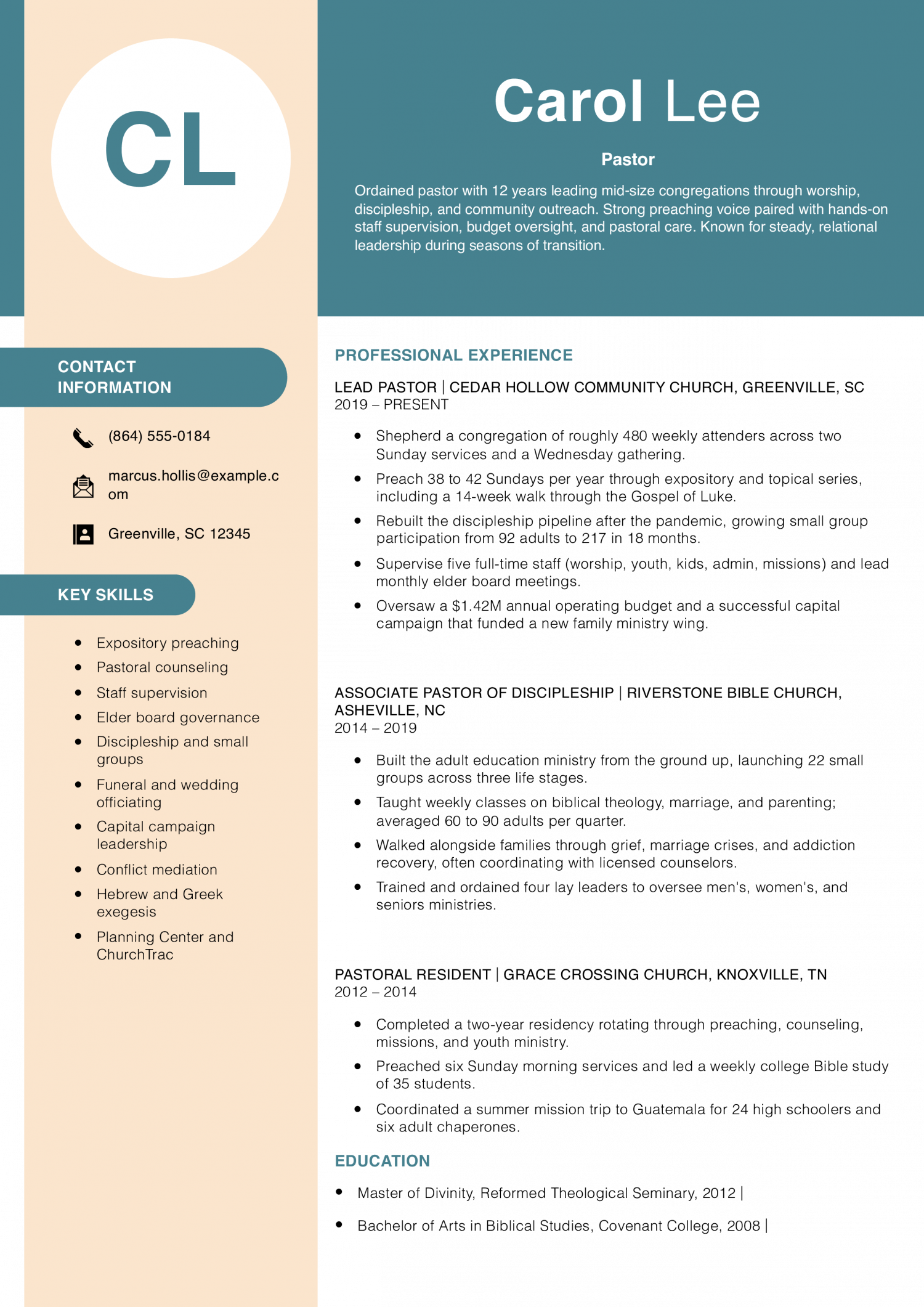
  • Real attendance and budget numbers: Specific figures like 480 weekly attenders and a $1.42M budget give hiring committees a clear picture of scope.
  • Preaching detail beyond a buzzword: Naming the 14-week Luke series shows actual teaching range instead of just claiming strong preaching.
  • Growth tied to a real ministry: Going from 92 to 217 small group adults in 18 months proves discipleship results, not just activity.

Associate Pastor Example

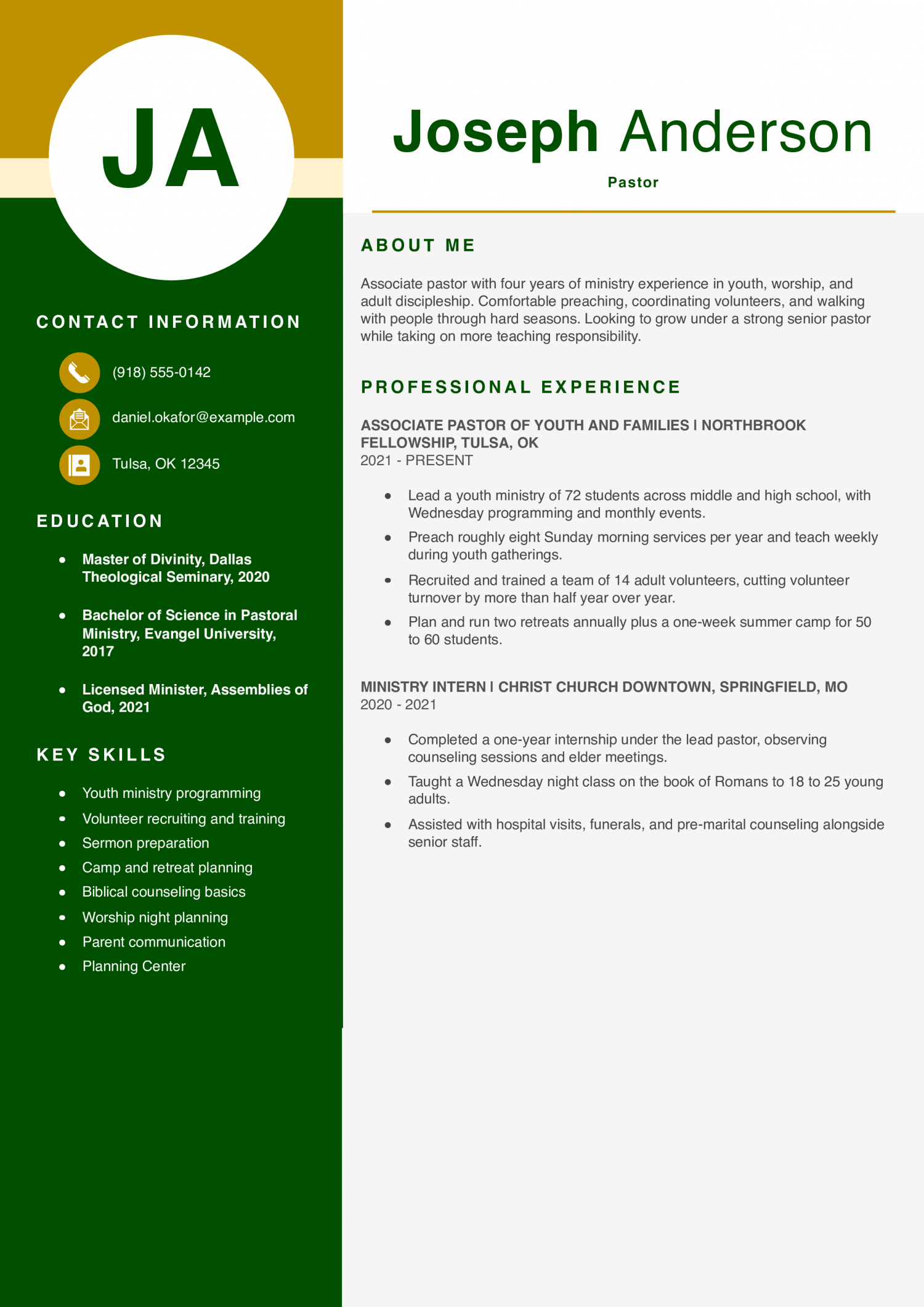
The associate pastor archetype is three to seven years into ministry, often leading a ministry vertical like youth, worship, or discipleship. This resume needs to prove ordination status, the ministry area you owned, and measurable congregation engagement under a senior pastor.

Why this resume works

  • Honest about the career stage: The summary names a desire to grow under a senior pastor, which sounds like a real associate candidate rather than an overstated lead.
  • Volunteer team result you can verify: Cutting volunteer turnover by more than half shows the candidate can keep a team together, which matters more than headcount at this stage.
  • Preaching frequency is realistic: Saying eight Sundays a year matches what associates actually preach and avoids inflating the role.

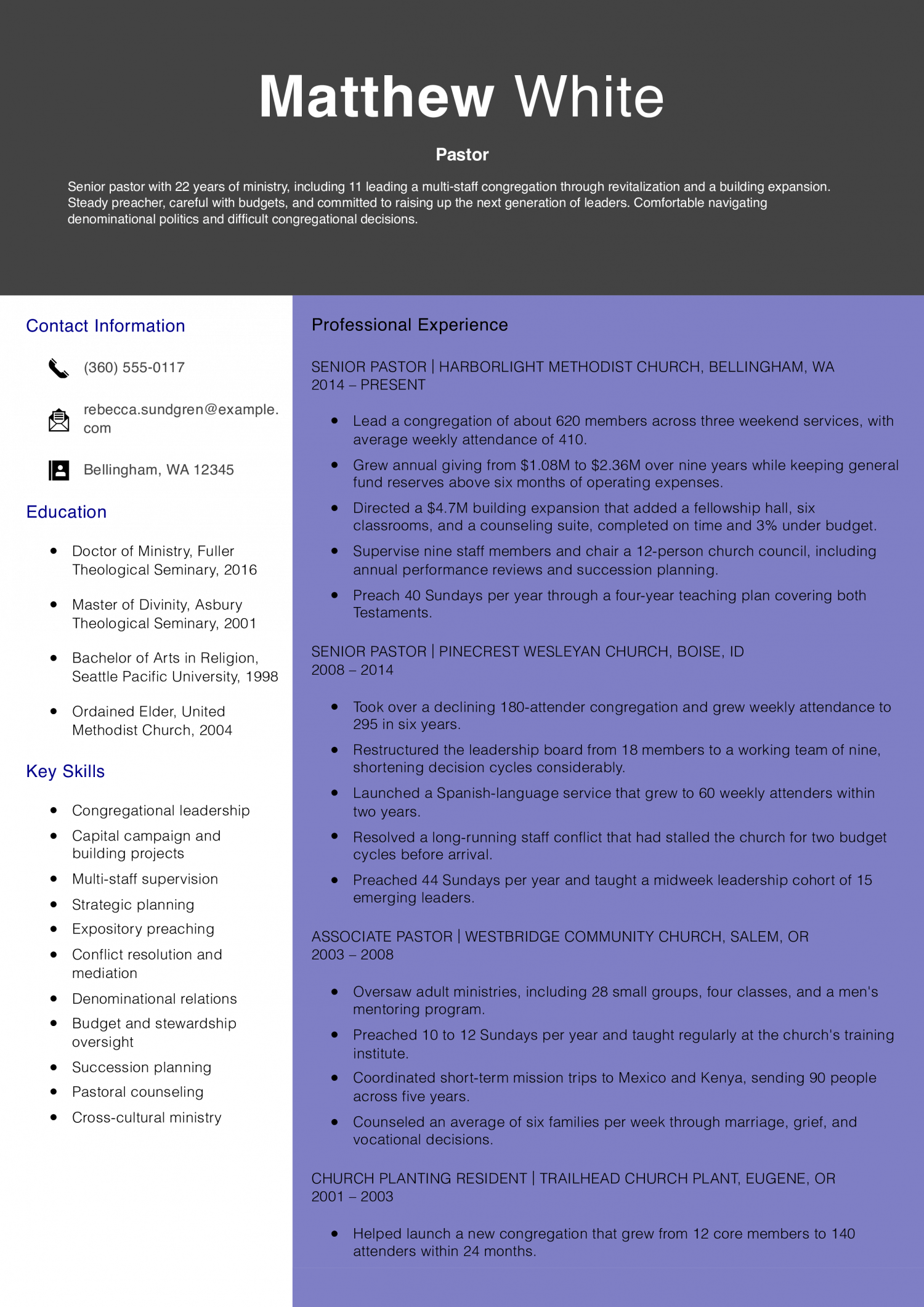
Senior Pastor Example

The senior pastor archetype carries primary preaching, vision, and staff oversight across a multi-staff church. This resume needs to prove pulpit tenure, congregation growth or stability through a transition, and elder-board level leadership across budget and staffing.

Why this resume works

  • Numbers show real church health: Tying giving growth from $1.08M to $2.36M alongside six months of reserves tells a search committee the church was financially stable, not stretched.
  • Building project finished well: Saying the $4.7M expansion came in 3% under budget is the kind of concrete proof committees look for in a senior leader.
  • Honest about hard situations: Naming a staff conflict that had stalled the church shows the candidate can handle conflict, not just growth seasons.

How to Write a Pastor Resume

01 Open with a profile that names your ministry scope

Your profile should state your years in ordained ministry, your denominational affiliation, and the church size and setting you have served. Name whether you have led a single-site, multisite, church plant, or revitalization context.

List the ministry areas you have owned: preaching rotation, pastoral care, discipleship, missions, youth, or executive oversight. Search committees scan the top third of page one for fit before they read anything else, so the scope statement does the heaviest lifting on your resume.

02 Translate ministry work into scope and outcomes

Ministry is not a sales floor, so lean on scope and outcome language over revenue metrics. Strong bullets name the congregation size you preached to, the small-group network you grew, baptisms led, or the discipleship cohorts you launched.

Bullets without any scope tend to read as duties, so attach a number where it exists honestly. A bullet like grew the young adult ministry from 25 to 90 over three years reads stronger than led young adult ministry.

03 Group your ministry work by category

Cluster your bullets under three to five categories the search committee already expects: preaching and teaching, pastoral care, discipleship and small groups, worship and sacraments, and staff or volunteer leadership. This makes the resume scannable on a phone.

Name the cadence where you can: weekly preaching rotation, monthly elder meetings, weddings and funerals officiated per year, or counseling hours per week. Specifics turn a generic ministry bullet into evidence of real pastoral load.

04 Place ordination and credentials on page one

Put ordination, denominational standing, and seminary degree in a credentials block near the top, under your contact line. Church elder boards and senior pastors check ordination and denominational alignment before they read a single bullet.

List your MDiv or equivalent, ordaining body, and any denominational endorsements or fellowship memberships. Add CPE units if you have them, and note marriage and family counseling training. Keep credential numbers off the resume; provide them when the application asks.

05 Close with education and continuing formation

End the resume with seminary, undergraduate degree, and ongoing formation: cohorts, doctoral work, Acts 29 or denominational residencies, and preaching workshops you have completed. This signals you are still being shaped, not coasting on a degree from a decade ago.

Add languages you read for exegesis, missions experience, and any teaching adjunct work. Keep the section tight so the ministry experience above stays the centerpiece of the resume.

The skills below come from pastor resumes our users built on ResumeTemplates.com. Search committees and senior pastors read dozens of resumes per opening, and these terms surface most often. Hard skills like expository preaching and pastoral counseling carry the credentialing weight.

Soft skills like shepherding and conflict mediation only work when a bullet below shows them in action. Match this list against the church’s pastoral profile, and treat the soft skills as headers the bullets need to back up with real stories.

Soft Skills % of resumes with this skill
Public speaking 67%
Compassionate leadership 61%
Active listening 41%
Conflict resolution 40%
Empathy 31%

And here are the top hard skills showing up most often.

Hard Skills % of resumes with this skill
Sermon preparation 80%
Pastoral care 50%
Biblical theology 44%
Pastoral counseling 35%
Church administration 33%

Based on data from thousands of pastors’ resumes built on ResumeTemplates.com, May 2026.

Must Have on a Pastor Resume

These are the must-haves hiring teams look for when scanning a pastor resume.

Niche Keywords for ATS Checkers

Search committees and denominational placement offices scan for niche terms that match their pastoral profile. Group these into a niche section near your skills so the right bullets get found.

Niche Keywords ATS scans for
Senior pastor leadership senior pastor, lead pastor, pulpit ministry, elder board leadership
Youth and student ministry youth pastor, student ministry, confirmation, retreat leadership
Preaching and teaching expository preaching, sermon series, biblical exegesis, adult discipleship
Pastoral care and counseling pastoral counseling, hospital visitation, premarital counseling, grief care
Church planting and revitalization church planting, church revitalization, multisite launch, missional community

Pastoral Ministry Credentials That Get You the Job

Beyond ordination and your seminary degree, the credentials below tell search committees and senior pastors which pastoral situations you are trained to handle and how seriously you take ongoing formation. List the granting body and the year completed for each item.

  • Master of Divinity (MDiv): The standard preaching and pastoral degree most denominations expect for senior or solo pastor roles; list the seminary and concentration.
  • Clinical Pastoral Education (CPE): Signals you have supervised pastoral care training in a hospital or hospice setting; list the number of units completed.
  • Denominational ordination credentials: Name the ordaining body, year ordained, and current standing so the committee can verify alignment with their polity.
  • Premarital and marriage counseling certification (Prepare/Enrich or similar): Tells the committee you can run premarital sessions and couples care without referring every case out to a counselor.

Latest BLS Statistics for Pastors

For pastors, the 10th-percentile floor and the top-decile ceiling sit far apart because church size, denominational scale, and metro cost of living drive compensation more than tenure alone. That spread tells you a 200-seat rural plant and a 2,000-seat suburban multisite read as different roles to a search committee.

Lead the resume with the church sizes you have served, the ministry areas you owned, and the denominational context, so the committee can place you on the right band before reading a single bullet.

$60,820 National median annual
$67,160 National mean annual
$37,140 Entry-tier floor (10th percentile)
$99,720 Top-decile ceiling (90th percentile)
58,080 Pastors in the U.S.
Where you stand

Entry tier

$37,140 to $60,820 At the entry tier, lead with your MDiv, ordination track status, and the ministry area you owned as an associate or resident.

Mid band

$60,820 to $99,720 At the mid band, your resume needs to show preaching frequency, the congregation size you served, and discipleship or small-group outcomes you own.

Top decile

$99,720+ At the top decile, lead with senior pastor tenure, multisite or large-church oversight, staff size led, and budget responsibility.

Top-paying states

# State Avg. Annual
1 California $77,850
2 Washington $77,530
3 Virgin Islands $75,600
4 Nevada $70,150
5 Massachusetts $67,830
6 Vermont $66,860
7 New Hampshire $66,670
8 Georgia $65,510
9 Minnesota $65,350
10 Connecticut $65,040

Highest-employment states

# State Workers Median
1 New York 9,210 $58,980
2 California 6,390 $77,850
3 Oregon 4,340 $63,370
4 Florida 3,370 $59,430
5 Pennsylvania 2,660 $56,540
Source: U.S. Bureau of Labor Statistics, OEWS 2024 release (SOC 21-2011).
Written by professional resume writers and loved by hiring managers

Resume Templates offers HR approved resume templates to help you create a professional resume in minutes. Choose from several template options and even pre-populate a resume from your profile.

Frequently Asked Questions

How long should a senior pastor resume be?

Two pages is the working norm for a senior pastor with 10 or more years in ministry. Search committees expect to see preaching tenure, staff leadership, and denominational standing without the resume bloating into a CV.

If you have published, taught at seminary, or led at the denominational level, add a one-page addendum for those credentials. Keep the core resume focused on pastoral work.

What does a youth pastor resume look like compared to a senior pastor resume?

A youth pastor resume leads with student ministry scope: weekly attendance, retreat and camp leadership, parent communication, and volunteer team size.

A senior pastor resume leads with preaching rotation, elder-board work, staff supervision, and church-wide outcomes. Both should name ordination status and denominational fit on page one.

How do I show pastor skills on a resume when most of my work feels intangible?

Anchor each skill to a concrete artifact. Pastoral care becomes hospital visits per month or counseling hours per week. Preaching becomes sermons delivered per year and series taught.

Shepherding becomes the number of small groups you launched or leaders you raised up. Search committees trust scope numbers more than adjectives.

Should I list my ordination credential number on my resume?

No. List the ordaining body, the year ordained, and current standing, but keep the credential number off the document.

Provide the number on the church's application form or background-check paperwork when they ask. This protects you against resume copies that get forwarded beyond the committee.

What's the best resume template for a pastor?

For a pastor, an ATS-friendly template is the safest pick, because it puts your certifications and experience where a hiring manager scans first. A basic template is a solid alternative. Whichever you choose, keep the formatting clean and easy to parse: clear section headings, a standard font, and no graphics a parser can choke on.

Rate this article

Pastor Resume

Average Rating

4.3/5 stars with 128 reviews

You have given 0 Star(s)
4.3/5 stars with 128 reviews
Andrew Stoner

Executive Resume Writer and Career Coach

Andrew Stoner is an executive career coach and resume writer with 17 years of experience as a hiring manager and operations leader at two Fortune 500 Financial Services companies, and as the career services director at two major university business schools.