
Tip !

Lab managers look for first-stick success rates, daily draw volume, and the patient populations you've handled on the first page, because those numbers signal whether you can hold a busy draw room without specimen rejections.

Andrew Stoner , Executive Resume Writer and Career Coach

Why this resume works

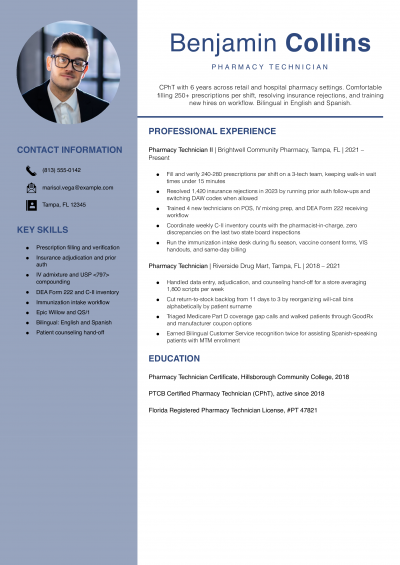
  • Specimen quality tied to a number: A 0.42% rejection rate across 11,200 draws shows quality with proof, not just a claim.
  • Shows volume she can actually handle: Naming 60 to 75 morning collections gives the hiring manager a realistic picture of throughput.
  • Grew into more responsibility: Moving from Phlebotomist II to Lead, including training new hires, signals trust and progression.

Entry Level Example

Entry-level phlebotomists are usually fresh from a certificate program with externship hours and a new CPT. Your resume needs to prove clinical hours, sticks completed, and the patient types you handled during training.

Why this resume works

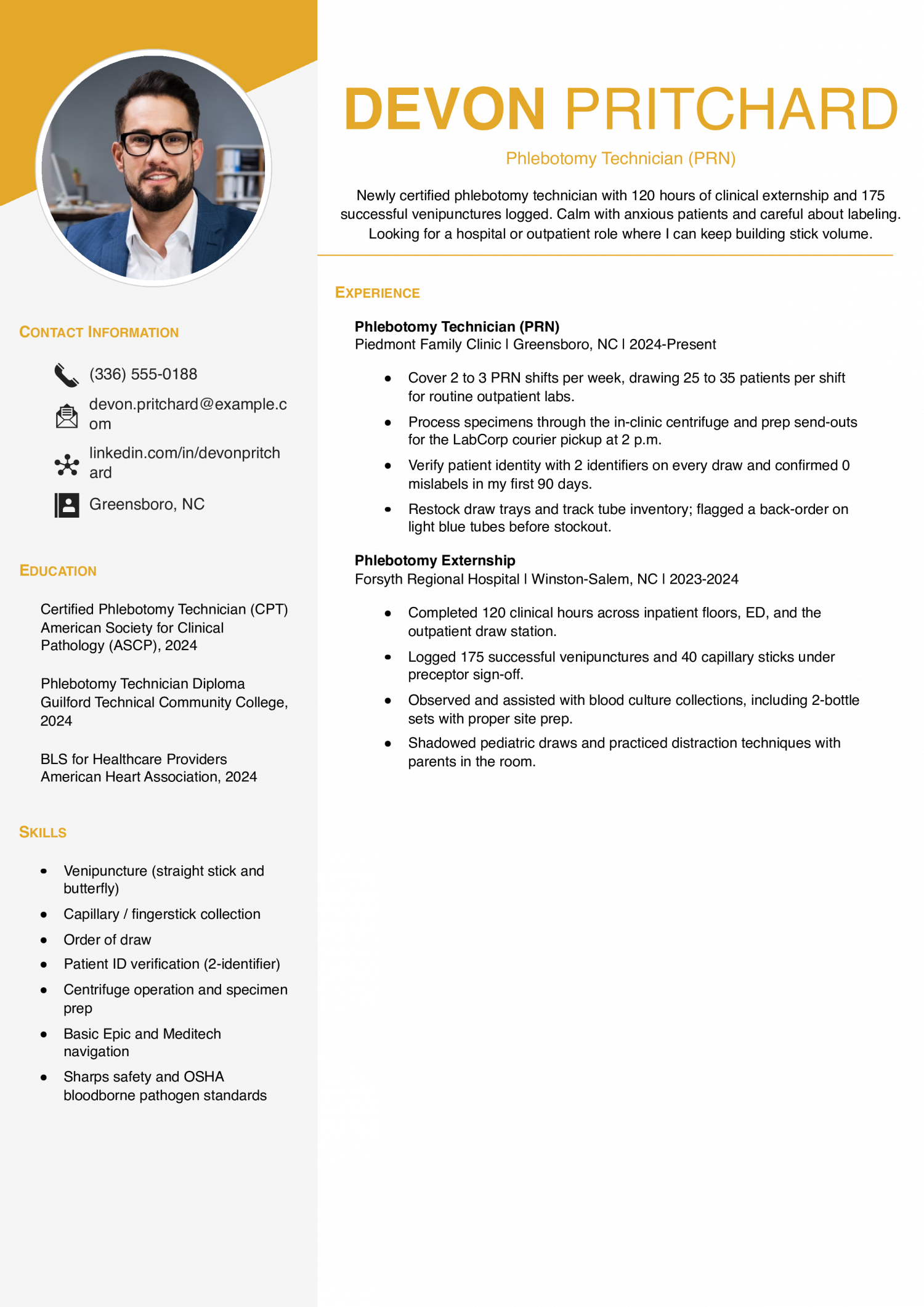
  • Real stick counts from training: 175 venipunctures and 40 capillary sticks tell a manager exactly how much hands-on practice he has.
  • Shows quality from day one: Zero mislabels in 90 days proves she can be trusted with labels before she has volume.
  • Two real settings already: Hospital externship plus a PRN clinic role gives more range than most entry candidates.

Experienced Example

Experienced phlebotomists run high-volume draw rooms or float across units with minimal supervision. Your resume needs to prove daily draw counts, difficult-stick success rates, and the EHR and LIS systems you label and route specimens through.

Why this resume works

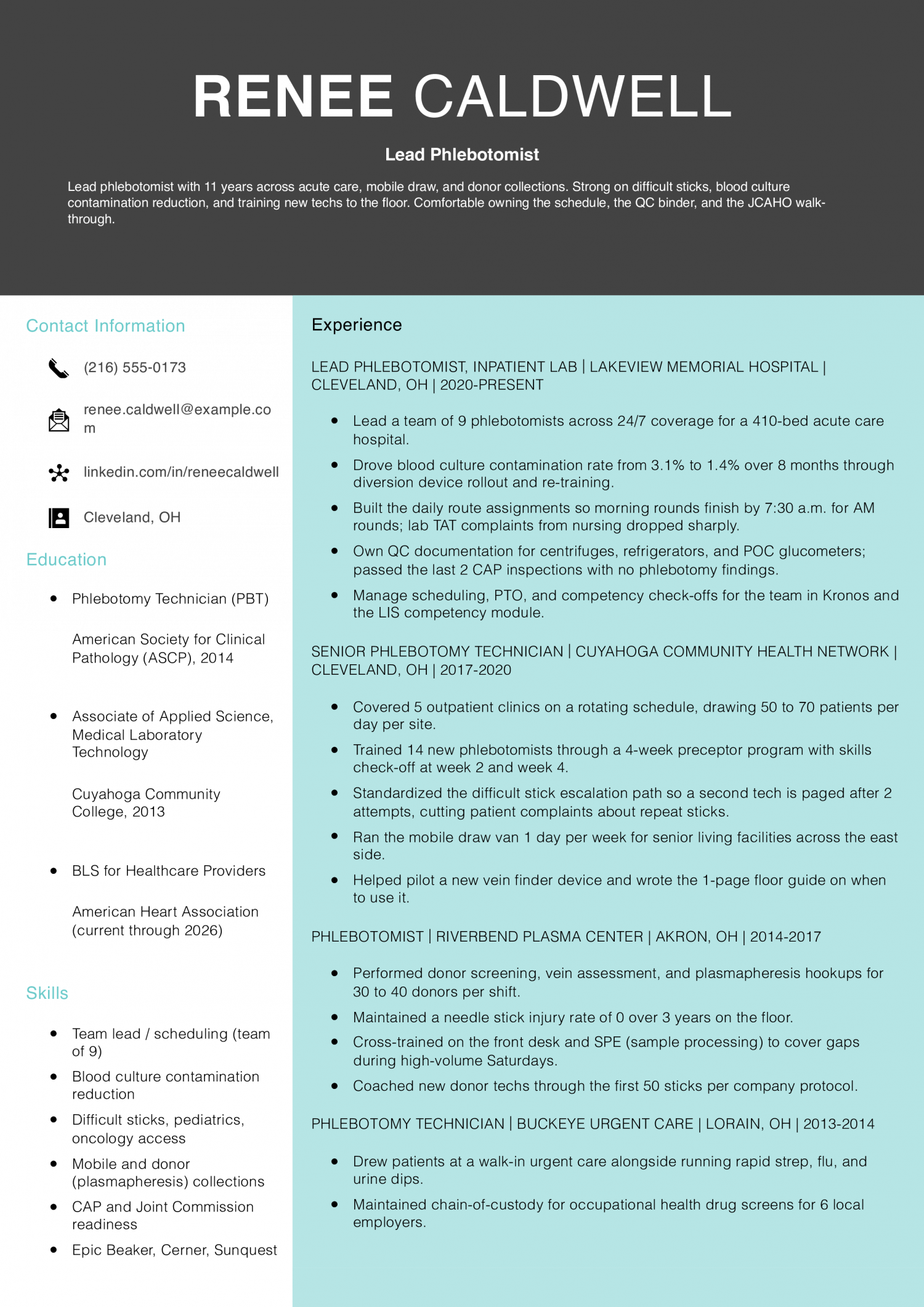
  • Fixed a real quality problem: Cutting blood culture contamination from 3.1% to 1.4% is the kind of metric lab directors notice on page one.
  • Owns inspections, not just sticks: Naming clean CAP inspections shows she handles the regulatory side a lead actually owns.
  • Range across care settings: Inpatient, outpatient, plasma donor, and urgent care give her credibility for almost any phlebotomy lead opening.

How to Write a Phlebotomist Resume

01 Open with a profile that names your draw scope

Your profile should state your years on the floor, the setting you draw in, and the patient population you handle weekly. Hospital inpatient, outpatient draw station, plasma center, and mobile blood drive are all different jobs.

Name your certification (CPT, RPT, or PBT), your average daily draw count, and your first-stick success rate in two or three lines. Lab managers reading the top of page one want to know if you can step into their workflow without a long ramp.

02 Quantify draws, sticks, and specimen quality

Phlebotomy is a numbers job, and bullets without numbers read as task lists. Most strong resumes name daily draw volume, first-stick success rate, and specimen rejection or recollection rate.

Aim for two or three concrete metrics per role: 80 to 120 draws per shift, 95 percent first-stick success on routine venipunctures, under 1 percent hemolysis or QNS rate. If you floated, name the units you covered and the shift mix you held.

03 Group procedures by draw type and patient

Cluster your work into three or four buckets so a reviewer can scan it fast. Venipuncture and capillary technique, difficult draws (pediatric, geriatric, oncology, dialysis), specialty collections (blood cultures, glucose tolerance, therapeutic drug monitoring), and point-of-care testing each deserve their own bullet.

Within each bucket, name the patient acuity and any line you supported, such as PICC or port draws under nursing supervision. Specifics here separate a trained tech from someone who only ran routine outpatient draws.

04 Place credentials and tools above the fold

Put your CPT, RPT, or PBT credential and BLS on page one in a credentials line under your name. List the issuing body and the year, then state your state license as in good standing without printing the number.

Below that, name the EHR and LIS systems you use to label and route specimens (Epic Beaker, Cerner, Sunquest, Meditech). Lab managers and clinical supervisors confirm credentials and system fluency before they read bullets, so visible placement shortens the screen.

05 Close with education and clinical hours

End with your phlebotomy program, the externship site, and the supervised clinical hours and stick count you logged. For new techs, this section carries the resume; name the hospital or clinic, the unit mix, and the patient types you drew during training.

Add high school or any allied-health coursework if relevant, and list any volunteer blood drives or donor center work. Continuing education in pediatric draws, IV insertion, or specimen processing also belongs here.

The skills below come from phlebotomist resumes our users built on ResumeTemplates.com. Lab managers and clinical supervisors scan dozens of resumes a week, and these are the skills that show up most often. Hard skills like venipuncture technique and Epic Beaker get weighted first, because they prove you can work the bench.

Soft skills like patient rapport back up the bullets where you drew anxious or pediatric patients. Match this list against the posting you want, then use the soft skills as evidence anchors inside your work bullets.

Soft Skills % of resumes with this skill
Attention to detail 70%
Patient communication 52%
Compassion and empathy 50%
Working under pressure 37%
Teamwork 26%

And here are the top hard skills showing up most often.

Hard Skills % of resumes with this skill
Venipuncture techniques 70%
Specimen collection and labeling 50%
Infection control protocols 41%
EHR and LIS systems 40%
HIPAA compliance 25%

Based on data from thousands of phlebotomists’ resumes built on ResumeTemplates.com, May 2026.

Must Have on a Phlebotomist Resume

The items below are what separate a phlebotomist resume from one that gets put back in the pile.

Continuing Education That Matters

Continuing education shows lab managers you’re keeping current with technique, safety standards, and patient population shifts. List CE hours under a ‘Continuing Education’ section with the provider and year.

Focus your hours on areas that map to the role you want next. Pediatric draws, oncology and chemo port support, difficult-vein technique, and donor reaction management each open different doors.

  • Pediatric and neonatal heelstick and venipuncture technique
  • Geriatric draw and fragile-vein management
  • Blood culture collection and contamination reduction
  • OSHA bloodborne pathogen annual refresher
  • CLIA waived testing and point-of-care quality control
  • Donor reaction recognition and response for blood center work

HIPAA and OSHA Compliance

Phlebotomists handle protected health information every shift, and your resume should signal that you know the rules without spilling any of it.

Keep PHI Off the Page

Never include patient names, medical record numbers, or identifying details in your bullets. Refer to volume, acuity, and population (pediatric oncology unit, dialysis center, outpatient draw station) instead.

Add a short line under skills or credentials confirming HIPAA training and OSHA bloodborne pathogen compliance, with the year of your last refresher.

  • Reference patient populations, not individuals
  • Cite specimen volume and rejection rates, not case details
  • Confirm annual HIPAA and OSHA training under credentials
  • Name LIS and EHR systems by product, not by patient record

Phlebotomy Credentials That Get You the Job

Lab managers and clinical supervisors read your certifications as a map of where your bench work is heading. The list below tells them which patient population, draw type, or lab track you’ve invested in beyond entry credentials. List the issuing body and the year of completion on one line.

  • Certified Phlebotomy Technician (CPT) – NHA or ASCP: The baseline credential most hospitals and reference labs require; name the issuing body since CPT abbreviations differ across organizations.
  • Registered Phlebotomy Technician (RPT) – AMT: Signals a second-tier credential that some outpatient and specialty labs prefer for float and lead roles.
  • Basic Life Support (BLS) – American Heart Association: Required at most hospital draw stations and many outpatient sites; list the expiration year so reviewers see it as current.
  • Donor Phlebotomy Technician (DPT) – ASCP: Marks you for blood bank and donor center roles where collection volume and donor reaction handling matter more than routine venipuncture.

Allied Health Credentials Worth Adding

A second allied-health credential signals you can move beyond the draw chair into specimen processing, point-of-care testing, or patient care support. Lab managers use these to flag candidates for float, lead, or cross-trained roles.

  • Medical Assistant (CMA or RMA) for clinics that cross-train front and back office
  • EKG Technician (CET) through NHA for outpatient and cardiology settings
  • Patient Care Technician (CPCT) through NHA for hospital float pools
  • Specimen Processor or Medical Laboratory Assistant (MLA) for reference lab tracks
  • IV Insertion certification where state scope allows

Latest BLS Statistics for Phlebotomists

The 90th-percentile phlebotomist out-earns the median by a wide margin, which tells you the market rewards setting, shift mix, and specialty draws more than years on the bench alone. Hospital inpatient, oncology infusion centers, and blood donor leads sit higher than outpatient draw stations. Geographic concentration matters too: a handful of states carry most of the employment, and pay tracks cost of living more than tenure.

Lead your resume with the setting, shift, and patient population that match the band you’re targeting.

$43,660 National median annual $44,390 National mean annual
$34,860 Entry-tier floor (10th percentile)
$57,750 Top-decile ceiling (90th percentile)
138,880 Phlebotomists in the U.S.
Where you stand

Entry tier

$34,860 to $43,660 At the entry tier, lead with your CPT credential, externship hours, total sticks logged, and the patient types you drew in training.

Mid band

$43,660 to $57,750 At the mid band, your resume needs to show daily draw volume, first-stick success rate, and the EHR or LIS systems you label specimens in.

Top decile

$57,750+ At the top decile, lead with lead-tech or float roles, specialty draws (oncology, pediatric, donor), and the QA or training work you own.

Top-paying states

# State Avg. Annual
1 California $55,460
2 New York $49,080
3 Massachusetts $48,270
4 Washington $47,700
5 Rhode Island $47,650
6 Oregon $47,510
7 District of Columbia $47,110
8 Maryland $47,100
9 Colorado $47,020
10 New Jersey $46,840

Highest-employment states

# State Workers Median
1 Texas 13,410 $39,770
2 California 13,150 $55,460
3 Florida 9,760 $38,570
4 Illinois 7,640 $45,620
5 Georgia 5,470 $43,340
Source: U.S. Bureau of Labor Statistics, OEWS 2024 release (SOC 31-9097).
Written by professional resume writers and loved by hiring managers

Resume Templates offers HR approved resume templates to help you create a professional resume in minutes. Choose from several template options and even pre-populate a resume from your profile.

Frequently Asked Questions

What should a phlebotomist job description look like on a resume?

Lead each role with the setting, shift, and daily draw volume. A hospital inpatient float at 100 draws a shift reads differently than an outpatient station at 40.

Group bullets by draw type, patient population, and specimen handling, with numbers attached. Name first-stick success rate and rejection rate where you have them.

Close the role with any lead, training, or QA work you owned, such as onboarding new techs or auditing specimen labels.

What should an entry-level phlebotomist resume include without paid experience?

Lead with your CPT credential, your phlebotomy program, and the supervised stick count from your externship. Programs usually log a minimum number of successful venipunctures and capillary sticks; put that number on the resume.

Name the hospital or clinic where you trained, the units you covered, and the patient types you drew. Add BLS, OSHA bloodborne pathogen training, and any volunteer blood drives or donor center shifts.

Should I list my CPT certification number on my resume?

No. List the credential name, issuing body (NHA, ASCP, AMT), and year, then write that your state license is in good standing.

Provide the actual certification or license number on the application form when the employer asks for it. Printing it on a public resume creates a verification and privacy risk you don't need to take.

How do I write a phlebotomist resume objective or summary?

Skip a generic objective. A line like 'motivated phlebotomist seeking a role' tells the reviewer nothing and burns the top of page one.

Write a three-line summary that names your credential, your years on the floor, your setting, and one or two numbers (daily draws, first-stick rate). End with the type of role you're targeting next, such as hospital float or oncology infusion.

What resume template should a phlebotomist use?

For a phlebotomist, an ATS-friendly template is the safest pick, because it puts your certifications and experience where a hiring manager scans first. A basic template is a solid alternative. Whichever you choose, keep the formatting clean and easy to parse: clear section headings, a standard font, and no graphics a parser can choke on.

Rate this article

Phlebotomist Resume

Average Rating

4.8/5 stars with 111 reviews

You have given 0 Star(s)
4.8/5 stars with 111 reviews
Andrew Stoner

Executive Resume Writer and Career Coach

Andrew Stoner is an executive career coach and resume writer with 17 years of experience as a hiring manager and operations leader at two Fortune 500 Financial Services companies, and as the career services director at two major university business schools.