Tip !

A clean credentials line with ASCP status and CLIA scope is what gets lab assistant resumes past the supervisor's first 30-second scan; named instruments and specimen volumes are what make them readable enough to advance.

Andrew Stoner , Executive Resume Writer and Career Coach

Why this resume works

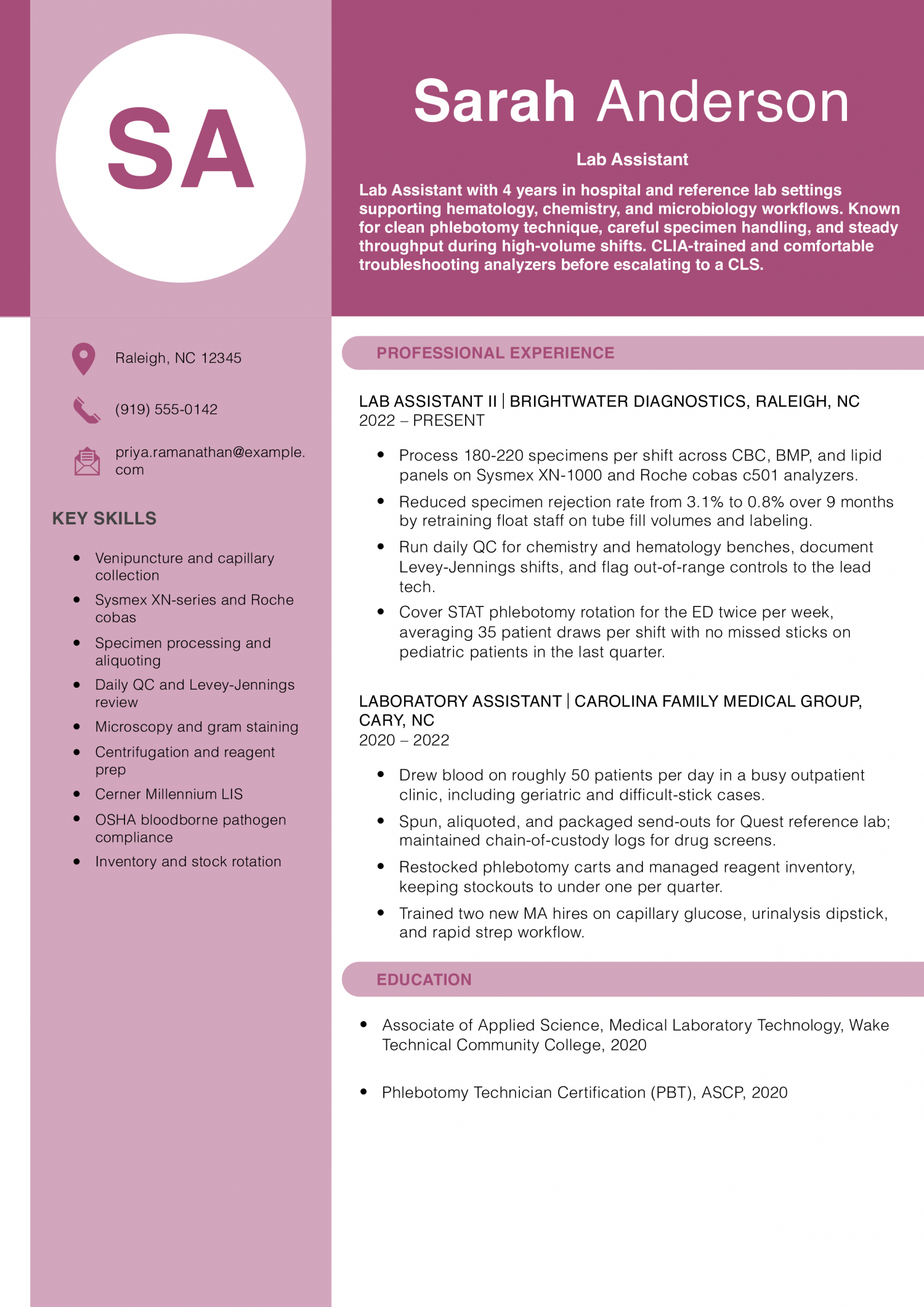
  • Cut specimen rejection by a real number: Showing the drop from 3.1% to 0.8% with a clear cause (retraining) tells a hiring lab manager exactly how the candidate improves quality.
  • Names the actual analyzers used: Listing Sysmex XN-1000 and Roche cobas c501 lets the reader confirm hands-on experience instead of guessing.
  • Shows steady volume per shift: The 180-220 specimens and 35 patient draws numbers prove the candidate can handle the pace a real hospital lab runs at.

Entry Level Example

Entry-level lab assistants are usually six months to two years in, often with a phlebotomy or MLA certificate. Your resume needs to prove clean specimen handling, accurate documentation, and named bench techniques from coursework or internships.

Why this resume works

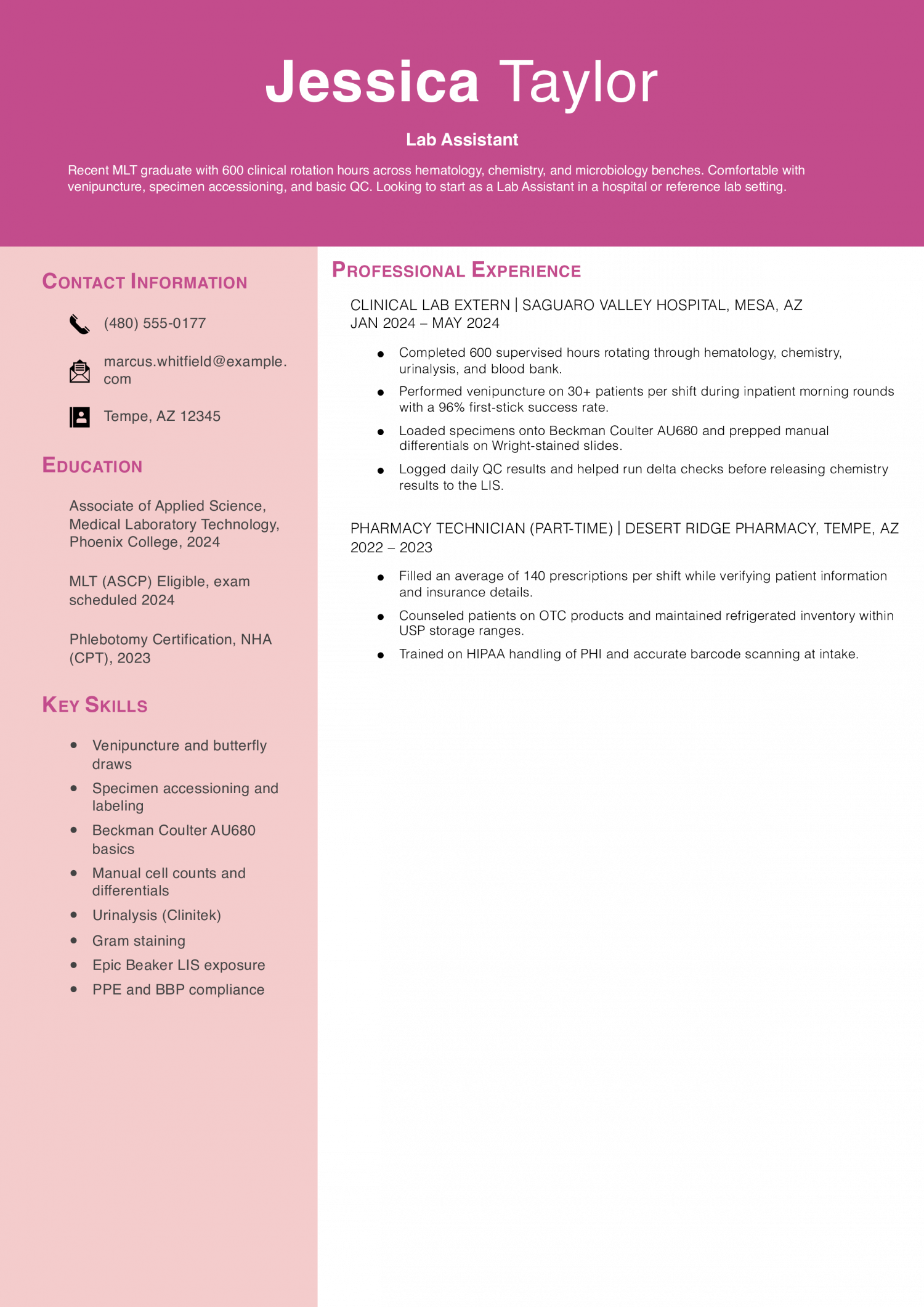
  • Lists clinical hours up front: Stating 600 supervised hours answers the first question a lab manager asks an entry-level candidate.
  • Includes a real success rate: A 96% first-stick rate during the externship is the kind of concrete proof point that beats vague claims of being a fast learner.
  • Shows the certification path: Listing MLT (ASCP) Eligible with a scheduled exam date tells the reader credentials are on the way, not maybe.

Experienced Example

Experienced lab assistants run sample workflows independently and train newer staff on instruments. Your resume needs to show specimen throughput per shift, the analyzers you operate, and your CLIA-compliant QC and proficiency-testing record.

Why this resume works

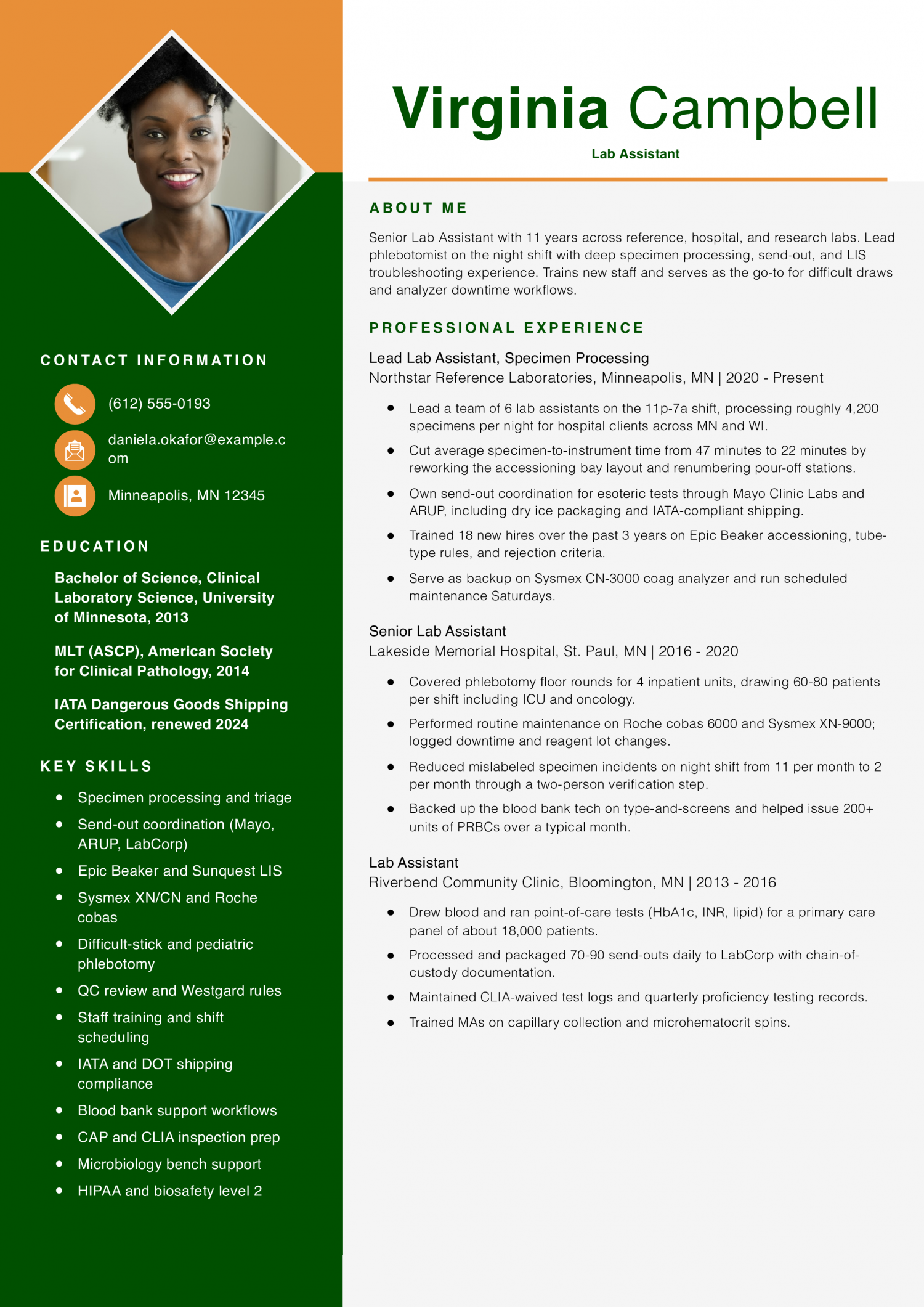
  • Lead role is clear, not implied: Stating they lead 6 lab assistants on a specific shift gives the title weight.
  • Cut turnaround time by half: Going from 47 to 22 minutes specimen-to-instrument is the kind of process win a lab director can quote in their own metrics review.
  • Names the instruments and reference labs: Listing Sysmex CN-3000, cobas 6000, Mayo, and ARUP signals real depth instead of generic experience.

How to Write a Lab Assistant Resume

01 Open with a profile that names your lab scope

Your profile should name the lab setting you work in. That means hospital core lab, reference lab, research core, biotech QC, or academic teaching lab.

State your years on the bench and the specimen types you handle daily. Blood, urine, tissue, microbiology cultures, or molecular samples all signal different scope.

Add the instruments and the regulatory environment in one line. A profile that names a Sysmex XN analyzer, LIMS use, and CLIA-waived testing scope tells a lab supervisor more than any adjective. Skip resume-slop openers like detail-oriented or hardworking.

Lead with scope, not sentiment.

02 Quantify the bench work you actually did

Bullets without a number tend to read as duties, not contributions. Lab supervisors scan for throughput, accuracy, and turnaround time first.

Name two or three real metrics per role. Specimens processed per shift, average TAT for STAT samples, QC pass rate, and proficiency testing scores all carry weight.

A strong bullet reads: processed 180 to 220 specimens per 8-hour shift with 99 percent acceptance rate on accessioning. If you trained others, name the headcount. If you reduced rejected samples, name the percentage drop.

Round numbers honestly. Lab directors will ask in the interview, so the figure on the page should match what you can defend out loud.

03 Group your bench work into clear categories

Walls of jargon tank scannability. Sort your bullets into three or four buckets so a reviewer sees scope at a glance.

Useful categories include specimen processing and accessioning, instrument operation and maintenance, quality control and proficiency testing, and safety and compliance.

Under each, name the real work. Centrifugation and aliquoting, Gram staining, PCR setup, plating cultures, daily QC on chemistry analyzers, reagent prep, autoclave loads, and biohazard waste handling all belong in their proper bucket. Avoid stacking 12 verbs in one bullet.

Two or three concrete actions plus a measurable outcome reads faster than a kitchen-sink sentence.

04 Put credentials and compliance up top

Lab directors verify credentials before they read bullets. Build a credentials block under your contact info on page one.

List your ASCP MLA certification, phlebotomy certification, BLS, and any state lab personnel license by name and status. Show the state and good standing without the license number.

Name the regulatory frameworks you have worked under: CLIA, CAP, OSHA bloodborne pathogens, and any GLP exposure for research roles. Add the LIMS platforms you have used by name, such as Epic Beaker, Sunquest, Cerner Millennium, or LabWare. Front-loading this block clears the credentialing screen so your experience bullets get read.

05 Close with education and training that fits the lane

Your education section should match the lab type you target. Clinical labs weigh medical lab assistant programs and clinical rotations.

Research cores weigh biology, chemistry, or biochem degrees and named coursework like analytical chemistry, microbiology, or molecular techniques.

List your degree or certificate, the school, and the graduation year. Add clinical rotation hours, the rotation site, and the test menu you ran during training. If you completed a NAACLS-accredited program, name it.

For career changers, place a short training block above older unrelated work so the lab credentials lead the page.

The lab assistant resumes that get callbacks share a specific skill mix. The lists below come from our user-built lab assistant resumes, pulled from real submissions. Lab directors and senior scientists scan for instrument names, LIMS fluency, and CLIA scope first, not generic teamwork language or compassion phrasing.

Match this list against your target posting, then use the soft skills as evidence backing your bullets rather than standalone claims.

Soft Skills % of resumes with this skill
Attention to detail 68%
Communication 56%
Teamwork 43%
Time management 37%
Problem solving 31%

And here are the top hard skills showing up most often.

Hard Skills % of resumes with this skill
Sample preparation 75%
Lab equipment operation 50%
Laboratory safety protocols 45%
Data recording 36%
Microscopy 32%

Based on data from thousands of lab assistants’ resumes built on ResumeTemplates.com, May 2026.

Must Have on a Lab Assistant Resume

Before a lab assistant resume gets a closer read, hiring teams check for a short list of essentials.

Continuing Education That Keeps a Lab Assistant Resume Current

Lab science moves fast, and lab directors look for CE that tracks the technology in their lab. List CE hours by topic and the year completed, not just a total count.

ASCP-certified lab assistants need CE through the Credential Maintenance Program. Track hours in molecular diagnostics, point-of-care testing, blood banking basics, and lab safety to keep your credential active and your resume current.

State-specific CE rules apply in California, New York, Florida, and a handful of others. Confirm your CE clock hours per your state board and list completed coursework with the provider name.

  • ASCP CMP credit hours, listed by topic and year
  • Point-of-care testing operator training
  • LIMS platform training (Epic Beaker, Sunquest, LabWare)
  • Specimen integrity and pre-analytical error reduction courses
  • Biosafety level 2 refresher training

Niche Keywords for ATS Checkers

Lab directors and senior scientists expect to see sub-niche vocabulary that matches the lab type they run. Group your keywords by the specialty you are targeting so the ATS and the human reviewer find them fast.

Niche Keywords ATS scans for
Clinical chemistry and hematology chemistry analyzer, hematology analyzer, CBC processing, serum separation
Microbiology bench gram staining, culture plating, sensitivity testing, biosafety cabinet
Molecular and PCR lab PCR setup, nucleic acid extraction, qPCR, molecular diagnostics
Specimen processing and phlebotomy venipuncture, accessioning, chain of custody, centrifugation
Quality, compliance, and LIMS CLIA compliance, CAP inspection, LIMS, proficiency testing

Laboratory Support Credentials That Get You the Job

Lab directors read the certifications list as a map of where your bench work is heading. The list below tells them which track you have invested in: clinical, molecular, microbiology, or research support. List the issuing body and the year earned on one clean line.

  • ASCP Medical Laboratory Assistant (MLA): The baseline certification most clinical labs prefer; signals you can accession, process, and handle specimens to CLIA standards.
  • ASCP Phlebotomy Technician (PBT): Pairs naturally with the MLA when the role includes draws; many outpatient labs require it before hire.
  • AMT Medical Laboratory Assistant (CMLA): An accepted alternative to ASCP, often recognized at smaller hospitals and physician office labs.
  • BLS for Healthcare Providers (American Heart Association): Required by most hospital labs and outpatient draw sites; renew every two years and list the expiration.

Allied Health Certifications That Matter for Lab Assistants

Allied health credentials signal that you can stand in a clinical workflow, not only at a bench. Lab supervisors at hospitals and outpatient draw sites screen for these before reading your work history.

  • ASCP Medical Laboratory Assistant (MLA) certification
  • ASCP or NHA Phlebotomy Technician certification
  • AMT Medical Laboratory Assistant (CMLA) as an accepted alternative
  • BLS for Healthcare Providers from the American Heart Association
  • OSHA bloodborne pathogens training, renewed annually

Latest BLS Statistics for Lab Assistants

The top-paying states for lab assistants cluster in markets with strong union representation and large academic medical center networks, not the warm-weather metros most jobseekers target first. Pay tracks closely with employer type: reference labs and research institutions tend to pay above community hospital scales.

If you are open to relocation, foreground the lab settings you have worked in and the test menu you can run on day one, so a recruiter in a higher-paying state can see transferable bench scope.

$61,890 National median annual
$65,320 National mean annual
$38,020 Entry-tier floor (10th percentile)
$97,990 Top-decile ceiling (90th percentile)
343,040 Lab Assistants in the U.S.
Where you stand

Entry tier

$38,020 to $61,890 At the entry tier, lead with your ASCP MLA or phlebotomy certification, clinical rotation hours, and the analyzers you trained on.

Mid band

$61,890 to $97,990 At the mid band, your resume needs to show specimen volume per shift, the LIMS you run, and QC pass rates you own.

Top decile

$97,990+ At the top decile, lead with lead-tech scope, instrument validation projects, training headcount, and CAP inspection support.

Top-paying states

# State Avg. Annual
1 New York $84,660
2 Rhode Island $81,220
3 New Hampshire $80,220
4 Oregon $79,640
5 District of Columbia $78,630
6 Vermont $76,430
7 Connecticut $75,200
8 Minnesota $74,840
9 California $71,920
10 Massachusetts $69,760

Highest-employment states

# State Workers Median
1 Texas 29,910 $54,840
2 California 29,460 $71,920
3 Florida 26,340 $57,940
4 New York 18,500 $84,660
5 Ohio 13,160 $62,890
Source: U.S. Bureau of Labor Statistics, OEWS 2024 release (SOC 29-2010).
Written by professional resume writers and loved by hiring managers

Resume Templates offers HR approved resume templates to help you create a professional resume in minutes. Choose from several template options and even pre-populate a resume from your profile.

Frequently Asked Questions

Can you write a lab assistant resume with no experience?

Yes. Anchor the resume on clinical rotation hours, named bench techniques from coursework, and certifications you hold or test for soon.

List the NAACLS-accredited program by name and the test menu you ran during rotations. Add lab volunteer hours, work-study positions in campus labs, and any LIMS exposure.

Put a short skills summary near the top that names the instruments and protocols you ran. Recruiters at community hospitals hire entry-level lab assistants regularly when the credentials lead the page.

Does lab assistant work count as clinical experience for medical school?

It depends on the lab setting. Hospital labs with patient draws, ER specimen handling, or pathology support count as clinical experience for most admissions committees.

Research-only bench roles count as research experience, not clinical. On your medical school resume, separate the two with clear section headers.

Use patient-contact verbs (drew, collected, identified patients) for clinical hours and technique verbs (ran, validated, optimized) for research hours.

How do you add metrics to a lab assistant role on your resume?

Use throughput, accuracy, and turnaround time. Specimens processed per shift, accessioning accuracy rate, average TAT for STAT samples, QC pass rate, and proficiency testing scores all work.

Pull the numbers from your LIMS reports or ask your supervisor for shift averages before you leave. Round honestly to figures you can defend in the interview.

If you cannot get exact numbers, use range bands (150 to 200 specimens per shift) rather than vague verbs like processed many samples.

Should you list your lab personnel license number on the resume?

No. List the state and good standing only, not the actual license number.

State lab boards generally advise keeping the number off public documents. Provide the number on the application form or during background verification.

A clean line reads: California Clinical Laboratory Scientist license, active and in good standing. That clears the credentialing scan without exposing the number.

What's the best resume template for a lab assistant?

For a lab assistant, an ATS-friendly template is the safest pick, because it puts your certifications and experience where a hiring manager scans first. A basic template is a solid alternative. Whichever you choose, keep the formatting clean and easy to parse: clear section headings, a standard font, and no graphics a parser can choke on.

Rate this article

Lab Assistant Resume

Average Rating

4.7/5 stars with 174 reviews

You have given 0 Star(s)
4.7/5 stars with 174 reviews
Andrew Stoner

Executive Resume Writer and Career Coach

Andrew Stoner is an executive career coach and resume writer with 17 years of experience as a hiring manager and operations leader at two Fortune 500 Financial Services companies, and as the career services director at two major university business schools.