
Tip !

Lab managers and medical directors look for the analyzer list and CLIA-complexity experience near the top of page one, because that section signals whether a tech can cover a bench without retraining from scratch.

Andrew Stoner , Executive Resume Writer and Career Coach

Why this resume works

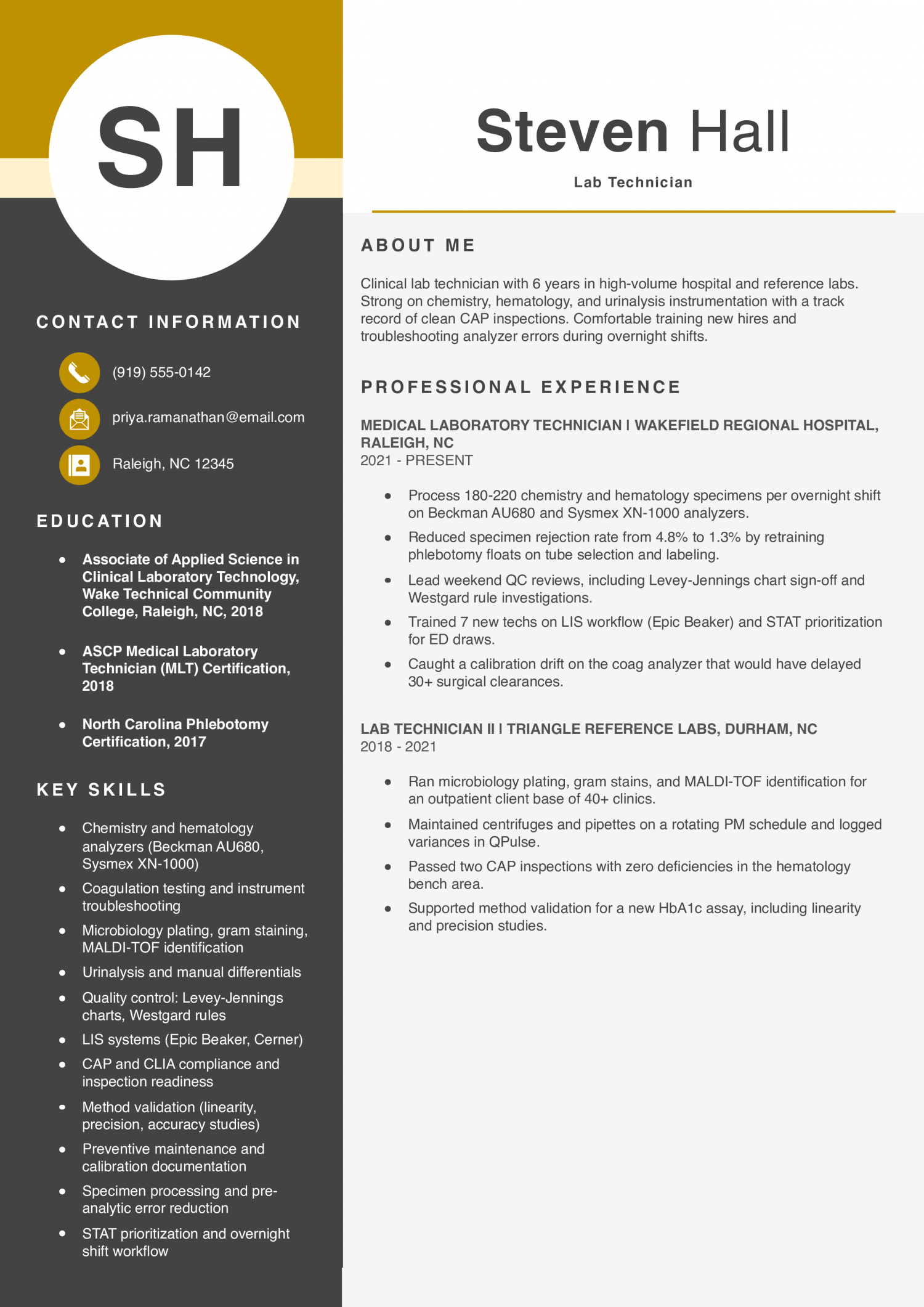
  • Real instruments by name: Naming Beckman AU680, Sysmex XN-1000, and Epic Beaker proves hands-on time on equipment the hiring lab actually runs.
  • A specific error she caught: The coag analyzer drift bullet shows judgment under pressure, which is what overnight supervisors are screening for.
  • Numbers tied to quality: Dropping specimen rejection from 4.8% to 1.3% is the kind of QA metric that lab managers can defend to their own directors.

Entry Level Example

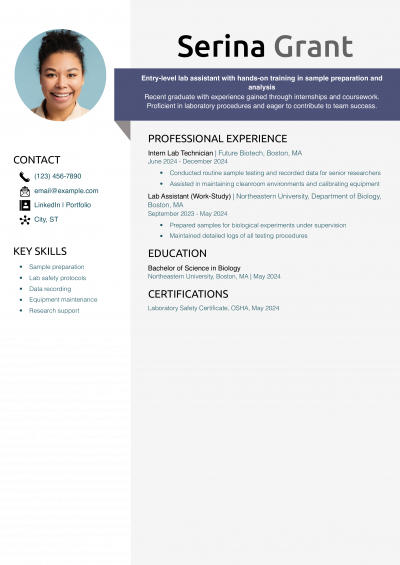
Entry-level lab technicians are recent MLT graduates or career changers with clinical rotations under CLIA-regulated supervision. Your resume needs to prove certification status, rotation hours, and the analyzers and assays you handled solo.

Why this resume works

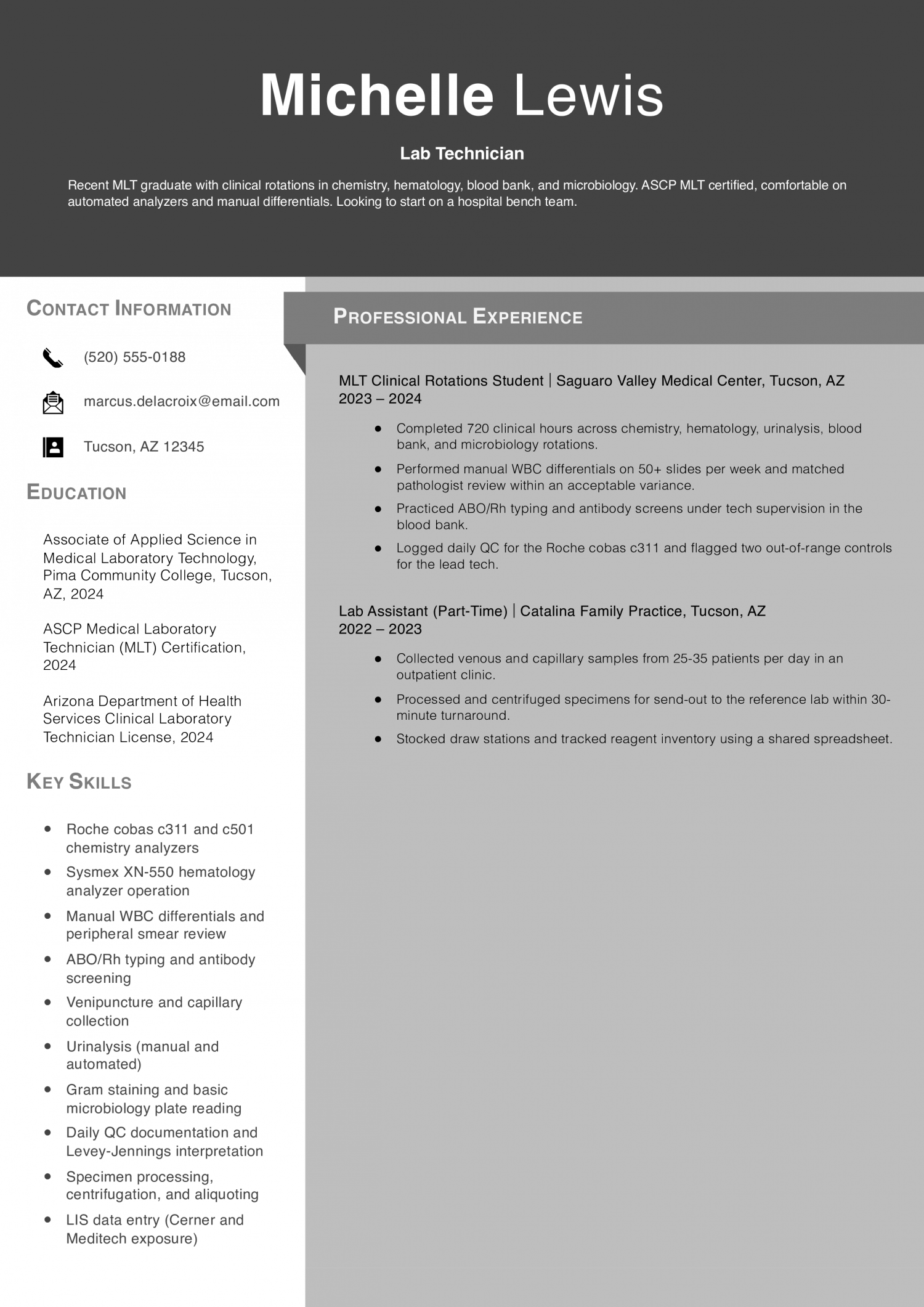
  • Rotation hours are spelled out: 720 clinical hours across five rotations tells a hiring lab exactly where this candidate has hands-on time.
  • Certification is upfront: ASCP MLT in the summary answers the first question every clinical lab recruiter asks.
  • Real patient volume in a side job: 25-35 draws a day at a clinic shows the candidate can keep pace, not just complete coursework.

Experienced Example

Experienced lab technicians own a bench independently across two or more departments and run QC without prompting. Your resume needs to prove daily specimen throughput, the analyzers you maintain, and proficiency testing performance.

Why this resume works

  • Covers more than one bench: Listing chemistry, hematology, coag, UA, and blood bank backup shows the flexibility mid-size labs hire for.
  • Downtime number is concrete: A 22% drop in analyzer downtime through a rebuilt PM schedule shows operational impact, not just task completion.
  • Critical-access experience reads well: Solo third-shift work at a 60-bed hospital signals the candidate can run a bench without a supervisor in the room.

Lead Example

Lead lab technicians train new staff, write SOPs, and serve as the bench point person during CAP inspections. Your resume needs to prove staff supervised, inspection outcomes, and ownership of method validations or LIS workflow changes.

Why this resume works

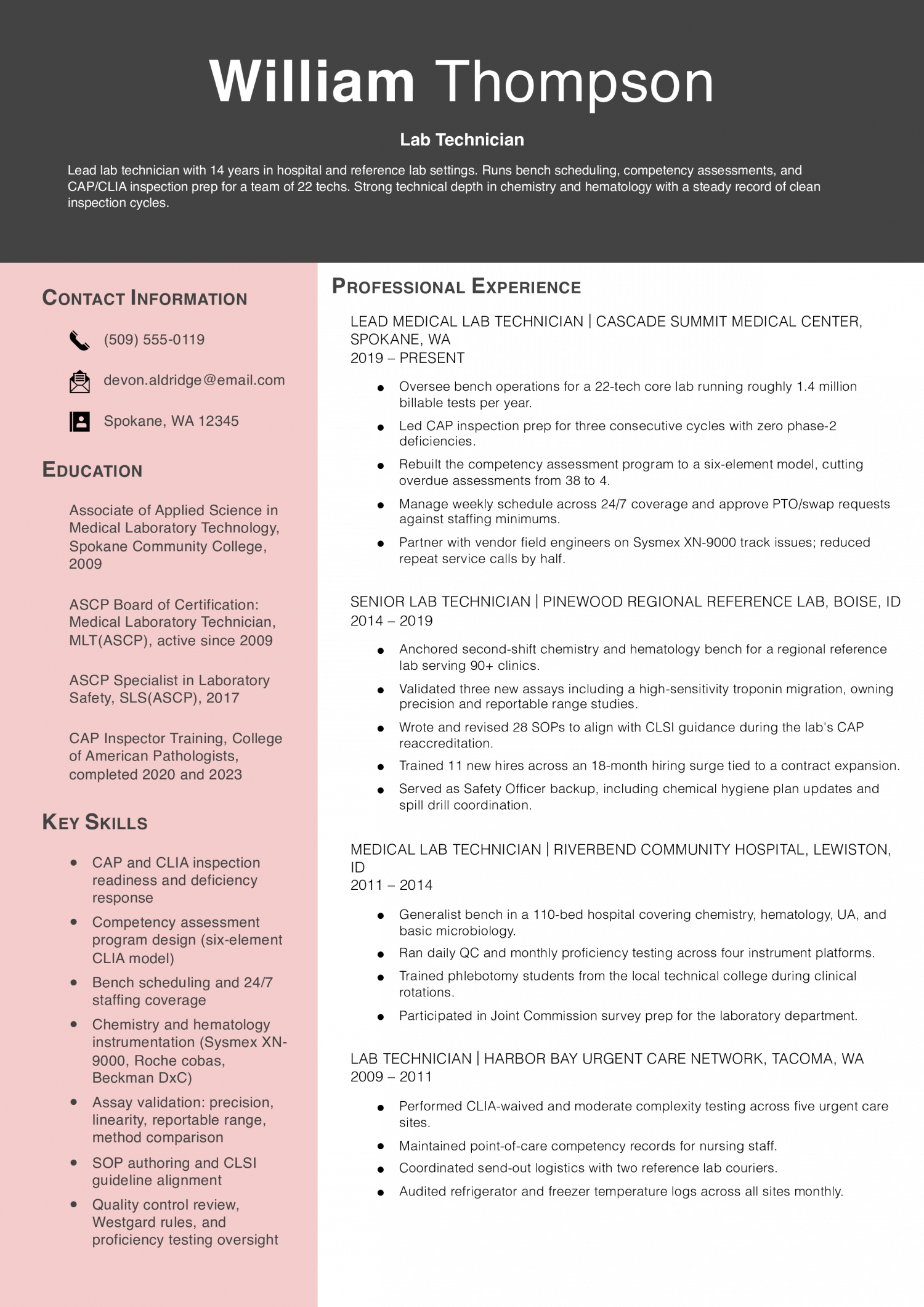
  • Inspection record is the headline: Three CAP cycles with zero phase-2 deficiencies is the single strongest signal a lead tech can put on a resume.
  • Scope is sized in volume: Anchoring a 22-tech team and 1.4 million tests per year tells hiring managers the candidate operates at their scale.
  • Fixed a real compliance problem: Cutting overdue competency assessments from 38 to 4 shows the candidate can clean up the kind of backlog that triggers findings.

How to Write a Lab Technician Resume

01 Open with the metric a lab manager would use to size you up

Lead the summary with daily specimen volume and the complexity tier you handled. Lab managers read that line as your readiness to cover a bench from day one.

Name your certification, the CLIA complexity (waived, moderate, or high), and the departments you covered alone. A summary that opens with “ASCP-certified MLT processing 180 chemistry and hematology specimens per shift” beats a paragraph about being detail-oriented.

Skip the objective. Save the second sentence for the analyzer family you know best, since that is the next thing a hiring lead scans.

02 Quantify throughput, QC, and turnaround

Bullets without a number tend to read as duties, not contributions. Most strong lab tech bullets name specimens per shift, QC pass rate, or stat turnaround time.

Pick two or three numbers you can defend: daily accession count, proficiency testing scores, or critical-value callback time. “Maintained 99 percent QC pass rate across Sysmex XN-550 and Beckman AU480” reads stronger than “performed quality control.”

If your lab tracks TAT in minutes, use minutes. Match the unit your next employer uses on their dashboards.

03 Group your work by department and assay

Cluster bullets into the bench areas you actually covered: hematology, chemistry, urinalysis, microbiology, blood bank, and molecular. Lab managers scan for department fit before they read prose.

Under each cluster, name the analyzers and the assay menu. “Hematology: Sysmex XN-1000, manual differentials, reticulocyte counts” gives a reviewer enough to picture you at their bench.

Add specimen-processing and phlebotomy work as its own group if you logged real hours there. Mixing pre-analytic and analytic work in one bullet hides both.

04 Put credentials and CLIA experience on page one

Build a credentials block under the summary listing ASCP, AMT, or state license status, plus CLIA complexity and any CAP or Joint Commission inspection cycles you worked through.

List the state and “license in good standing” rather than the license number itself. State boards prefer numbers on the application, not the resume.

Add your LIS experience (Epic Beaker, Cerner Millennium, SoftLab) in the same block. Lab managers screen for LIS fit almost as hard as for certification.

05 Close with education and continuing competency

End with your MLT or MLS program, the accrediting body (NAACLS), and your clinical rotation sites if you graduated within the last three years.

Add a short continuing competency line: ASCP CMP credits earned, recent CE courses, or method validations you assisted on. That tells a lab manager you keep current between recertification cycles.

Drop high school, unrelated retail roles, and any certifications older than the current recert window. Keep the closing tight.

Five years ago, a lab technician resume read like a job description copied from the lab manual. The skills below come from the resumes our users built in 2026. The mix has shifted toward named analyzers, LIS platforms, and CLIA-complexity tags.

Lab managers weigh hard skills first (Sysmex, Beckman, Epic Beaker, ASCP) because those map straight to bench coverage. Soft skills like QC discipline and stat-load composure only land when a bullet underneath proves them. Match the hard skills against the job posting word for word, then use the soft skills as the angle for two or three of your strongest bullets.

Soft Skills % of resumes with this skill
Attention to detail 71%
Communication 56%
Time management 44%
Problem-solving 40%
Teamwork 27%

And here are the top hard skills showing up most often.

Hard Skills % of resumes with this skill
Specimen collection and processing 75%
Laboratory equipment operation 62%
Quality control and compliance 42%
LIMS data entry 38%
Aseptic technique 32%

Based on data from thousands of lab technicians’ resumes built on ResumeTemplates.com, May 2026.

Must Have on a Lab Technician Resume

These are the must-haves hiring teams look for when scanning a lab technician resume.

Continuing Education That Belongs on the Resume

ASCP-certified techs maintain credentials through the Credential Maintenance Program (CMP), and most state licenses carry their own CE clock-hour requirements. Show that work, do not bury it.

Add a short “Continuing Competency” line under education listing CMP cycle status and CE hours earned in the current period.

Name specific courses when they map to the posting: molecular diagnostics, transfusion medicine, lab safety, or LIS upgrades. Generic “40 hours of CE” reads as filler.

  • Current ASCP CMP cycle status (in progress or completed, with year).
  • State CE clock hours earned in the current renewal period.
  • Vendor training on new analyzers (Sysmex, Beckman, Roche, Abbott).
  • LIS upgrade training (Epic Beaker, Cerner Millennium, SoftLab).
  • Lab safety and bloodborne pathogen refreshers tied to your current role.

Niche Keywords for ATS Checkers

Lab managers and clinical directors expect to see the department, analyzer family, and certification language they use internally. Group these into a skills block and weave them into bullets where the work backs them up.

Niche Keywords ATS scans for
Hematology bench cbc with differential, sysmex xn-550, manual differential, reticulocyte count
Clinical chemistry beckman au480, roche cobas, electrolyte panel, troponin assay
Microbiology gram stain, culture and sensitivity, maldi-tof, vitek 2
Molecular and PCR rt-pcr, nucleic acid extraction, cepheid genexpert, sars-cov-2 testing
Compliance and QC clia high complexity, cap inspection, proficiency testing, levey-jennings charts

Laboratory Technology Credentials That Get You the Job

Lab managers read the certifications list as a map of where your bench work is heading. The list below tells them which department track (generalist, molecular, microbiology, blood bank) you have invested in. List the issuing body and the year earned or last recertified.

  • ASCP Medical Laboratory Technician (MLT): The default generalist credential most hospital and reference labs require; list certification year and most recent CMP cycle.
  • AMT Medical Laboratory Technician (MLT(AMT)): Accepted in most states as an ASCP alternative; name it when the posting lists either pathway as acceptable.
  • ASCP Specialist in Molecular Biology (SMB): Signals molecular and PCR bench readiness; list it if you are targeting reference labs, oncology, or infectious disease testing.
  • ASCP Specialist in Blood Banking (SBB): Marks you for transfusion services roles; pair with a bullet on antibody workups or component preparation volume.

Allied Health Credentials Lab Managers Recognize

Beyond the core ASCP or AMT track, a handful of allied health credentials tell a lab manager you can cover pre-analytic work and step into cross-functional shifts.

  • ASCP Phlebotomy Technician (PBT) for techs who cover draw stations or outpatient collections.
  • AMT Registered Phlebotomy Technician (RPT) as an accepted alternative in most hospital systems.
  • ASCP Donor Phlebotomy Technician (DPT) for blood bank and donor center roles.
  • American Heart Association BLS for techs working bedside or in stat labs.
  • ASCP Histotechnician (HT) for techs cross-training into anatomic pathology.

Latest BLS Statistics for Lab Technicians

The spread between the 90th-percentile lab technician and the median is wide enough to signal that the market rewards bench breadth, CLIA high-complexity hours, and specialty certifications more than raw years on the job. A generalist who logs hematology, chemistry, and microbiology coverage out-earns a long-tenured single-bench tech in most regions. Lead the resume with the departments and analyzers you cover independently, then the certifications that unlock the higher-complexity work.

That ordering matches how lab managers price candidates.

$61,890 National median annual
$65,320 National mean annual
$38,020 Entry-tier floor (10th percentile)
$97,990 Top-decile ceiling (90th percentile)
343,040 Lab Technicians in the U.S.
Where you stand

Entry tier

$38,020 to $61,890 At the entry tier, lead with ASCP or AMT certification, your NAACLS program, and the analyzers you ran solo during clinical rotations.

Mid band

$61,890 to $97,990 At the mid band, your resume needs to show daily specimen volume, the LIS you use, and independent coverage across two or more departments.

Top decile

$97,990+ At the top decile, lead with specialty certifications (SMB, SBB, SM), CAP inspection ownership, and method validations or SOPs you authored.

Top-paying states

# State Avg. Annual
1 New York $84,660
2 Rhode Island $81,220
3 New Hampshire $80,220
4 Oregon $79,640
5 District of Columbia $78,630
6 Vermont $76,430
7 Connecticut $75,200
8 Minnesota $74,840
9 California $71,920
10 Massachusetts $69,760

Highest-employment states

# State Workers Median
1 Texas 29,910 $54,840
2 California 29,460 $71,920
3 Florida 26,340 $57,940
4 New York 18,500 $84,660
5 Ohio 13,160 $62,890
Source: U.S. Bureau of Labor Statistics, OEWS 2024 release (SOC 29-2010).
Written by professional resume writers and loved by hiring managers

Resume Templates offers HR approved resume templates to help you create a professional resume in minutes. Choose from several template options and even pre-populate a resume from your profile.

Frequently Asked Questions

What should the objective or summary on a lab technician resume say?

Skip the objective. Lab managers read it as filler.

Use a three-line summary instead. Name your ASCP or AMT credential, the analyzers you run, and your daily specimen volume.

Close the summary with the CLIA complexity tier you have worked under. That signals bench readiness without padding.

Should I list my license or certification number on my resume?

No. Listing license or ASCP certification numbers on a resume is a privacy risk and most state boards advise against it.

Write "ASCP MLT, certified 2022" and "Texas clinical laboratory personnel license, in good standing." Save the number for the application form when the employer asks.

How do I write a lab technician resume with no paid experience yet?

Lean on your NAACLS clinical rotations. Treat each rotation site like a job entry.

List the hospital, hours logged, departments covered, and the analyzers you operated under supervision. Add proficiency testing or capstone projects if your program ran them.

Move certification status to the top, even if you are still scheduled to sit for the ASCP exam.

What is the difference between a lab technician and medical lab scientist resume?

The MLT resume centers on bench execution: throughput, QC, instrument coverage, and CLIA complexity.

The MLS or MT resume adds method validation, deeper troubleshooting, and often supervisory scope. If you are bridging from MLT to MLS, add a validations or training-led bullet under each role to signal the next tier.

What's the best resume template for a lab technician?

For a lab technician, an ATS-friendly template is the safest pick, because it puts your certifications and experience where a hiring manager scans first. A basic template is a solid alternative. Whichever you choose, keep the formatting clean and easy to parse: clear section headings, a standard font, and no graphics a parser can choke on.

Rate this article

Lab Technician Resume

Average Rating

4.8/5 stars with 111 reviews

You have given 0 Star(s)
4.8/5 stars with 111 reviews
Andrew Stoner

Executive Resume Writer and Career Coach

Andrew Stoner is an executive career coach and resume writer with 17 years of experience as a hiring manager and operations leader at two Fortune 500 Financial Services companies, and as the career services director at two major university business schools.