
Tip !

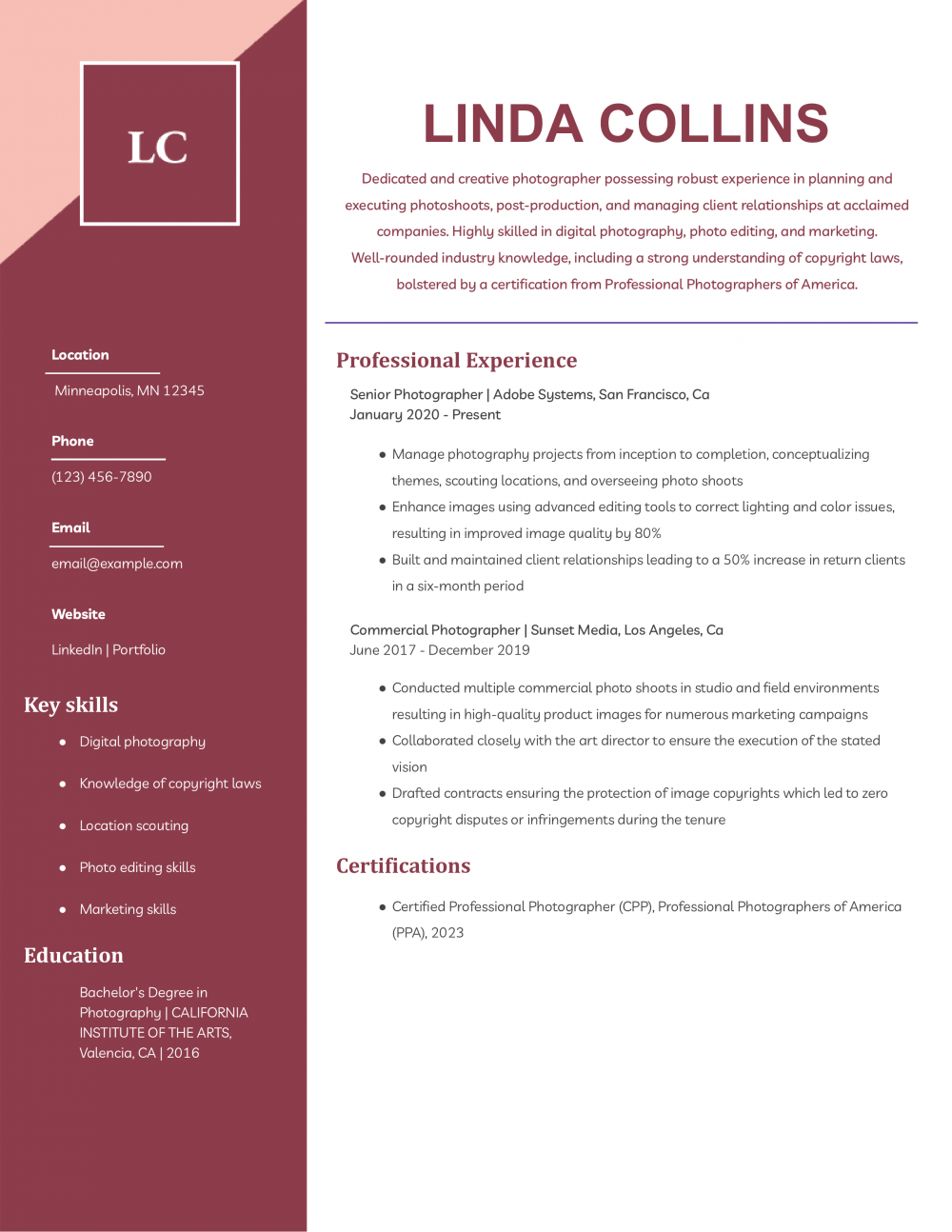
Photo editors decide whether to keep reading inside the first 10 seconds by clicking the portfolio link in the header; if the link is missing, broken, or buries the relevant category, the resume gets closed.

Andrew Stoner , Executive Resume Writer and Career Coach

Why this resume works

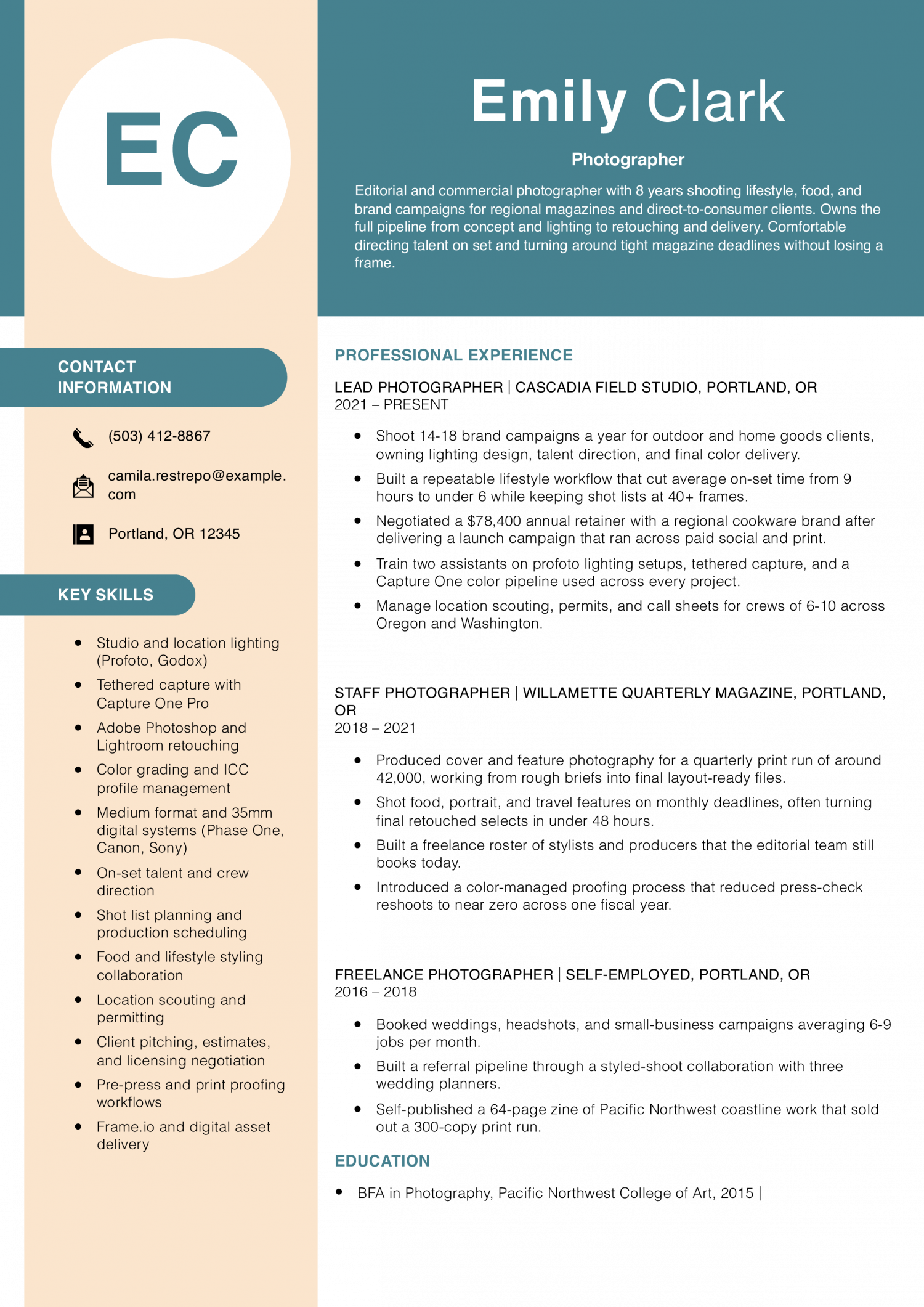
  • Real dollar figure on a retainer: The $78,400 retainer ties the work to revenue a client would actually pay for, which is rare on creative resumes.
  • Speed numbers from actual shoots: Cutting set time from 9 hours to under 6 while still hitting 40+ frames shows efficiency without sounding vague.
  • Clear range of work shown: Editorial, commercial, and freelance jobs appear in order, so a hiring editor can see how the portfolio grew.

Emerging Example

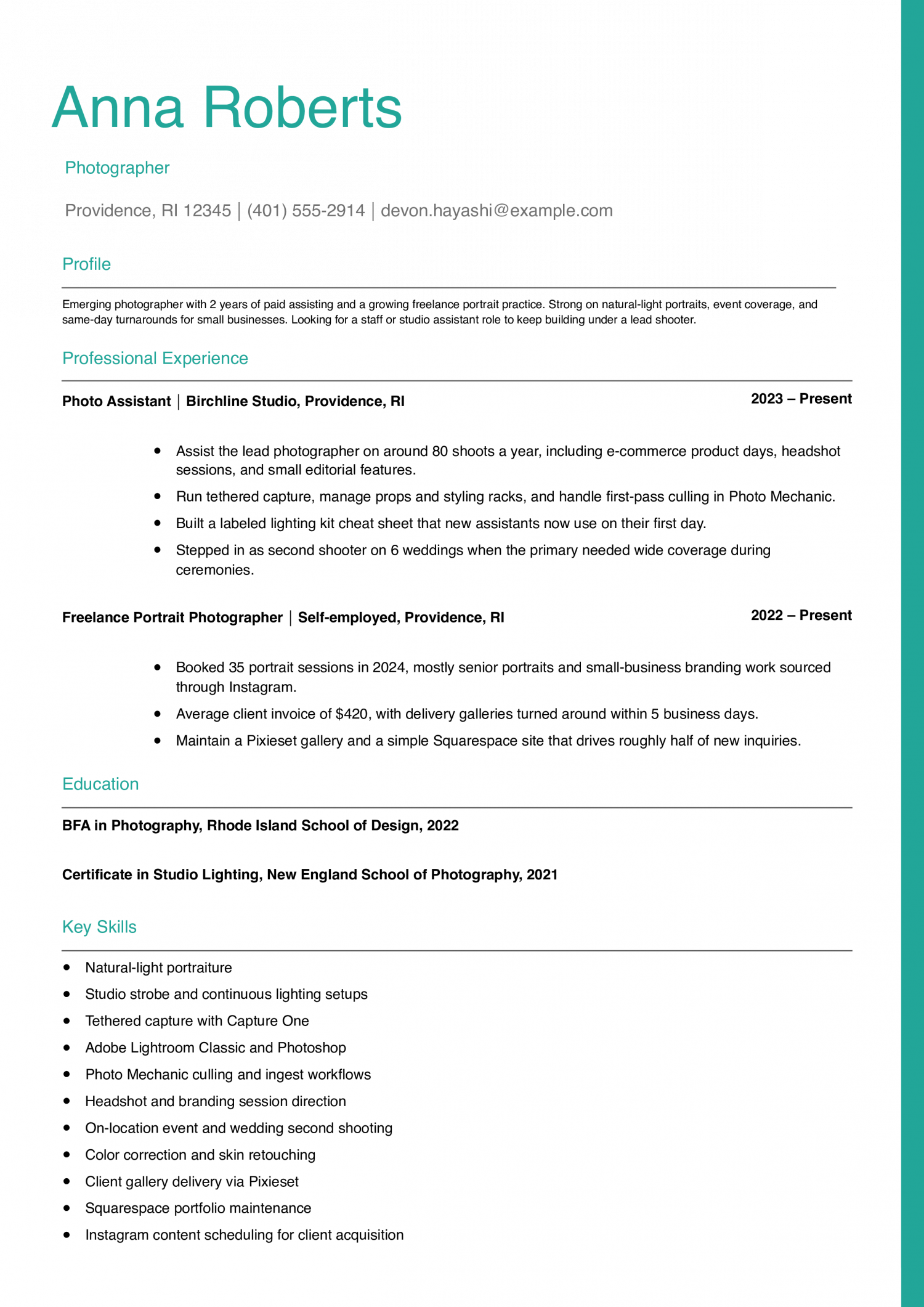
You are an emerging photographer with assistant credits, second-shooter days, or a year or two of paid solo work. Your resume needs to prove technical command, a focused portfolio niche, and reliable turnaround on client deliverables.

Why this resume works

  • Real volume from a junior role: 80 shoots a year as an assistant gives a hiring lead an honest sense of how much time Devon has spent on set.
  • A real invoice number: Naming a $420 average invoice shows a working freelance practice, not just a hobby.
  • Skills built on the job: Tethered capture and Photo Mechanic culling are concrete tools a studio manager looks for in an assistant.

Established Example

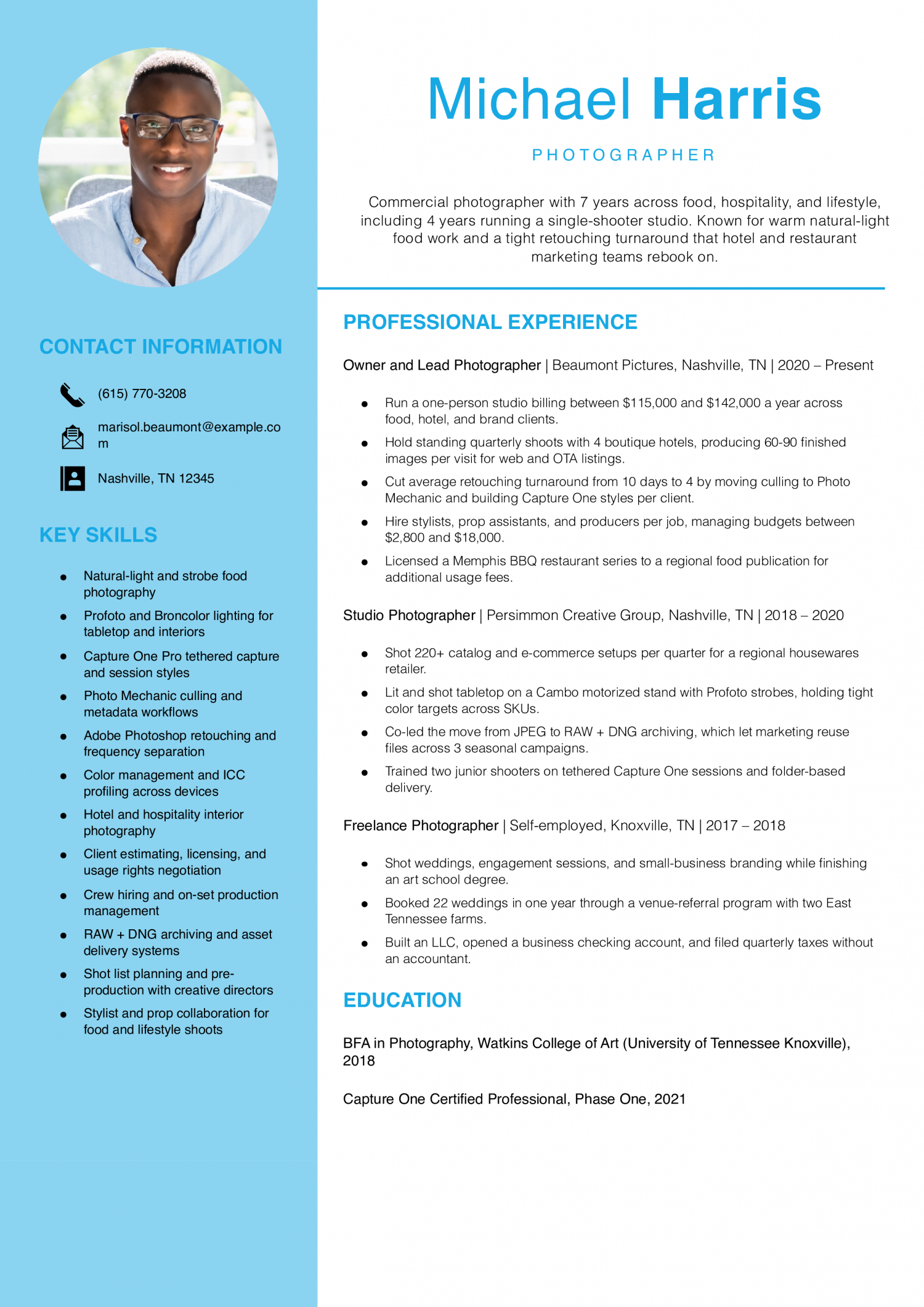
You are an established photographer running your own client list or holding a staff seat at a studio or publication. Your resume needs to prove a defined specialty, repeat-client revenue, and ownership of the full shoot-to-delivery workflow.

Why this resume works

  • Honest revenue range: Showing a $115,000 to $142,000 annual billing range is more credible than a single round number on a solo studio.
  • Turnaround time clients actually care about: Going from a 10-day to 4-day retouch turnaround is the kind of detail a marketing manager remembers.
  • Both sides of the business shown: Bullets cover the creative work and the business side, which matches what an owner-operator job actually looks like.

Senior Example

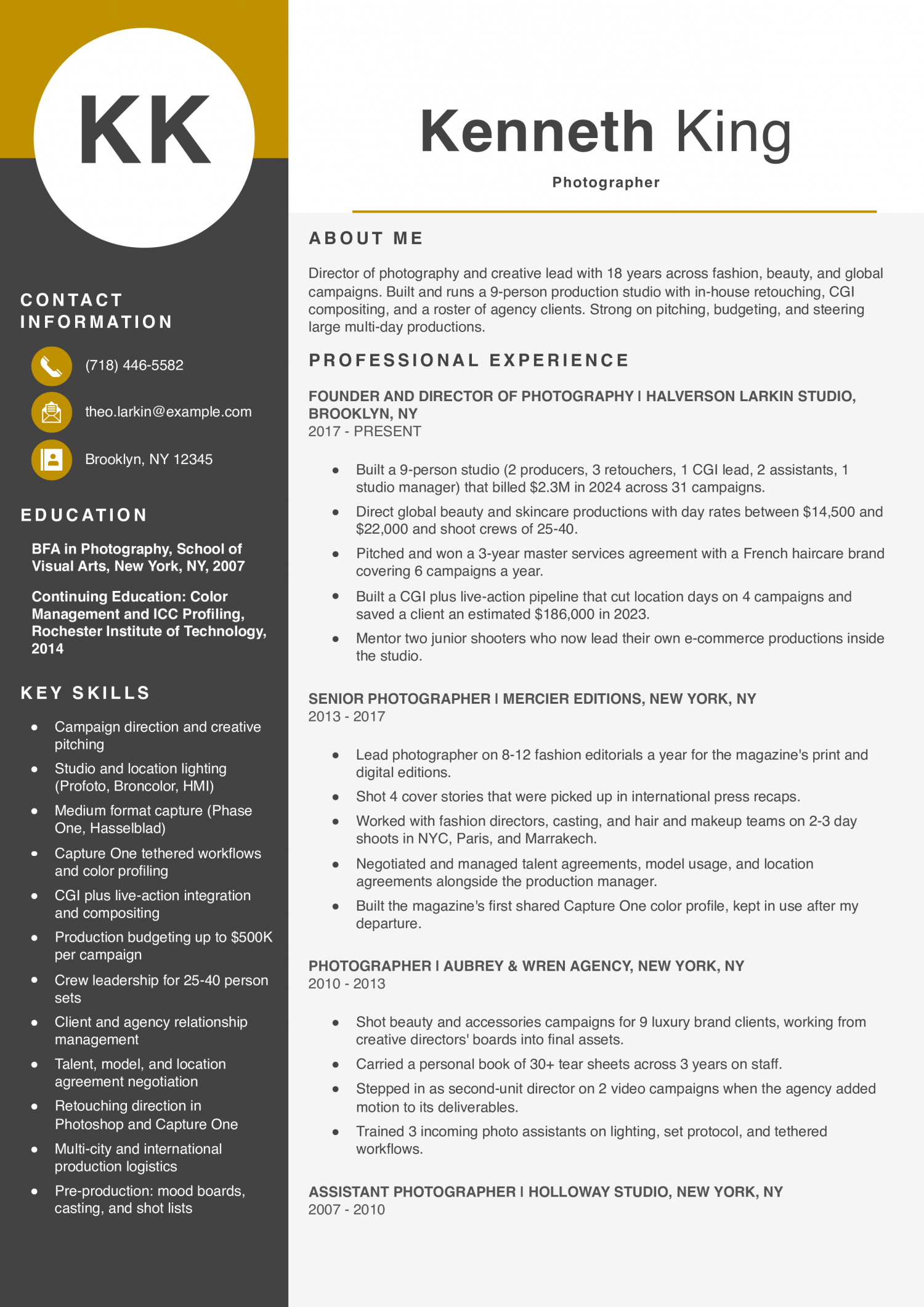
You are a senior photographer with art-direction credits, agency rosters, or published editorial bylines. Your resume needs to prove crew leadership, budget scope, and named brands or publications that ran your work.

Why this resume works

  • Real studio revenue and headcount: Naming $2.3M in billing with a 9-person team gives a clear picture of the size of the operation.
  • A dollar savings tied to a workflow choice: The $186,000 location-day savings shows that creative decisions paid off on a client’s budget, not just on the page.
  • Career path that builds logically: Assistant to staff photographer to studio founder reads like a real career, not a list of unrelated gigs.

How to Write a Photographer Resume

01 Open with the metric a photo editor would use to size you up

The first line of your summary should name shoots delivered per year, repeat-client rate, or the publications and brands that have run your work.

Photo editors and creative directors read this as your billing readiness. A line like “Editorial portrait photographer with 90-plus published shoots across Vogue, GQ, and Rolling Stone” tells them your scope in one read.

Skip the “passionate visual storyteller” opener. Lead with the number, the niche, and the client tier, then let the portfolio link in your header do the rest of the talking.

02 Quantify shoots, turnaround, and client outcomes

Strong photographer bullets carry numbers. Shoots completed per month, edited frames delivered per shoot, turnaround time from capture to gallery, and repeat-booking rates all read as proof.

Bullets without a number tend to read as duties. “Shot weddings” is a duty; “Delivered 35 weddings per season with a 48-hour preview gallery and a 72% rebooking rate from referrals” is a track record.

If the work is editorial or commercial, name the deliverable count, the publication or brand, and the campaign reach where you have it.

03 Group shoot work by category

Sort your experience into three to five shoot categories so a photo editor can scan for fit. Common splits: portrait and headshot, wedding and event, commercial and product, editorial, and lifestyle or brand content.

Inside each category, name the lighting setups (natural, strobe, continuous), the formats you shoot (medium format, 35mm, tethered capture), and the deliverables (retouched gallery, raw handoff, social cutdowns).

This structure also helps recruiters at agencies map you against a specific account or vertical they are staffing.

04 Place gear, software, and credentials up top

Put your camera bodies, lens kit, lighting gear, and post-production stack in a Technical block on page one, directly under the summary.

Creative directors need to see Canon R5 or Sony A1, your prime range, your strobe brand (Profoto, Godox), and your edit stack (Lightroom Classic, Photoshop, Capture One, Frame.io) before they scroll.

Drone pilots should list the FAA Part 107 certification in the same block. A live portfolio URL belongs in the contact header, not buried in a projects section three pages down.

05 Close with credits, education, and what to cut

Close the resume with published credits, awards, exhibitions, and education. List the publication or gallery, the year, and the project title. A BFA in photography or a workshop with a named mentor (Magnum, Santa Fe, Maine Media) belongs here too.

Cut the headshot of yourself, the soft-skill word cloud, and any bullet that does not name a client, a deliverable, or a number.

If you are senior, cut assistant credits older than eight years to keep the focus on lead shooter work.

The photographer resumes that get callbacks share a specific skill mix. The lists below come from our user-built photographer resumes. Creative directors and photo editors scan for these patterns first, not generic “creative eye” language.

Hard skills carry the screen at agencies and studios, where Lightroom, Capture One, and tethered capture are gate items. Soft skills back up the bullets, where client direction and on-set composure separate solo shooters from crew leads. Match this list against your target posting, then make every soft skill provable in a bullet below.

Soft Skills % of resumes with this skill
Client communication 69%
Attention to detail 61%
Creativity 40%
Patience 36%
Time management 27%

And here are the top hard skills showing up most often.

Hard Skills % of resumes with this skill
Photo editing software 74%
Camera operation 50%
Lighting techniques 44%
Composition and framing 39%
Color correction 33%

Based on data from thousands of photographers’ resumes built on ResumeTemplates.com, May 2026.

Must Have on a Photographer Resume

Before a photographer resume gets a closer read, hiring teams check for a short list of essentials.

Niche Keywords for ATS Checkers

Creative directors and photo editors expect to see niche-specific vocabulary, not a generic “photography” bucket. Group keywords by the shoot category that matches your actual paid work.

Niche Keywords ATS scans for
Freelance and self-employed freelance photographer, sole proprietor, client acquisition, day-rate billing
Wedding and event wedding photography, second shooter, engagement session, gallery delivery
Commercial and product commercial photography, tethered capture, product still life, e-commerce shoot
Editorial and portrait editorial photography, environmental portrait, magazine assignment, on-location shoot
Post-production Lightroom Classic, Capture One, color grading, high-end retouching

AI Skills to Add

AI use on a photographer resume can go three ways: lead with “AI-powered visual artist” (which photo editors screen out), leave it off entirely (which reads as evasive in 2026), or describe the post-production workflow as it actually runs. The third is what creative directors can validate against your portfolio.

What AI is actually changing for this role
Retouching speed

Generative fill and AI masking in Photoshop cut background cleanup and skin work from hours to minutes per frame.

Client briefs

Brand and agency clients now arrive with Midjourney mood boards, so reading and matching AI references is part of the brief.

Editorial guardrails

News and documentary outlets enforce no-AI policies, so the resume should signal which lanes you keep AI out of.

Culling and selects

Tools like Aftershoot and Imagen pre-cull and pre-edit weddings and events, which reshapes turnaround promises clients expect.

AI tools to name
  • Adobe Photoshop generative fill and Firefly: Background extension, object removal, and composite cleanup on commercial and portrait deliverables.
  • Aftershoot or Imagen: AI culling and style-trained pre-edits for high-volume wedding and event galleries.
How to phrase AI on your resume
Do
  • Use Photoshop generative fill for background extension on product shoots, cutting retouch time per image by roughly half.
  • Train Imagen on personal edit style to deliver 800-image wedding galleries within 72 hours of capture.
Skip
  • AI-powered visual storyteller redefining the future of photography.
  • Leverage generative AI to revolutionize the creative process.

Portfolio Strategy

#1 for editorial and commercial Format

Clean, fast templates built for photographers with client-proofing and password-protected galleries.

Best for full control Squarespace

Custom domain, blog integration, and built-in commerce for prints or session booking.

Best for weddings and events Pixieset or ShootProof

Client galleries with print sales, favorites, and download tracking built in.

Best discovery surface Behance and Instagram

Secondary surfaces for agency scouts; link from your portfolio, not in place of it.

Split the site into three to five clear categories that match the shoot types you want booked next. A photo editor staffing an editorial portrait will not dig through wedding galleries to find the one frame that fits.

Show 12 to 18 images per category, not 60. Cut anything that does not represent the work you want to be hired for, even if you love the frame.

Put your contact, day rate range, and booking calendar one click from the homepage. The slowest part of the booking funnel is the photographer who takes two days to reply with a quote.

Software and Gear Stack

Creative directors scan a Technical block for the exact tools and bodies they shoot with. Name the gear and software a posting calls out, in the order the posting lists them.

  • Capture: Sony A1, Sony A7R V, 24mm, 35mm, 50mm, 85mm, 70-200mm primes and zooms
  • Lighting: Profoto B10X and B1X strobes, Aputure 600d continuous, modifier kit (octa, strip, beauty dish)
  • Post-production: Adobe Lightroom Classic, Photoshop, Capture One Pro 23, Frame.io, Imagen AI
  • Aerial: DJI Mavic 3 Pro, FAA Part 107 certified
  • Tethering and delivery: Capture One tethered capture, Pixieset client galleries, WeTransfer Pro

Awards, Credits, and Published Work

A credits section turns claims into proof. Photo editors recognize the names of competitions, publications, and galleries, and the year tells them whether your tier-one work is current or a decade old.

  • Award: Communication Arts Photography Annual, Editorial category winner, 2024
  • Publication: The New York Times Magazine, cover portrait, March 2024
  • Exhibition: Aperture Gallery, group show "New Documents," 2023
  • Selection: PDN 30 New and Emerging Photographers to Watch, 2022

Photography Credentials That Get You the Job

Creative directors and photo editors read this list as a map of where your work is heading. The credentials below tell them which track you have invested in: aerial, certified studio, retouching, or print production. List each item with the issuing body and the year of completion, on one line.

  • FAA Part 107 Remote Pilot Certificate: Required for any paid drone work in the U.S. Lead with this if aerial is part of your client mix or commercial offer.
  • Certified Professional Photographer (CPP), Professional Photographers of America: Signals tested technical competence to portrait, wedding, and commercial clients who vet vendors before booking.
  • Adobe Certified Professional, Photoshop or Lightroom: Useful when applying to in-house brand studios or production houses where post-production volume is part of the role.
  • Master Photographer, Professional Photographers of America: Earned through merit points; list it if you are pursuing senior studio or print-competition tracks.

Latest BLS Statistics for Photographers

Photographer pay spreads wider than most BLS occupations because the field mixes salaried staff seats at publications and studios with self-employed shooters who set their own day rates. The top-paying states cluster around media and ad-agency hubs and a few low-supply markets, not every coastal metro candidates assume. Frame your location on the resume to match the market you actually serve.

If you travel for shoots, name the regions you cover so recruiters in higher-rate markets do not screen you out on a ZIP code alone.

$42,520 National median annual
$55,650 National mean annual
$29,610 Entry-tier floor (10th percentile)
$94,760 Top-decile ceiling (90th percentile)
51,230 Photographers in the U.S.
Where you stand

Entry tier

$29,610 to $42,520 At this tier, your resume needs to show assistant credits, gear ownership, and a portfolio URL with one focused shoot category.

Mid band

$42,520 to $94,760 At this tier, your resume needs to show repeat-client revenue, named brands or publications, and full ownership of the edit-to-delivery workflow.

Top decile

$94,760+ At this tier, lead with art-direction credits, agency rosters, campaign budgets you have led, and published bylines in tier-one outlets.

Top-paying states

# State Avg. Annual
1 District of Columbia $110,530
2 Massachusetts $60,610
3 New York $57,700
4 Oregon $55,640
5 Minnesota $54,650
6 New Jersey $50,760
7 California $50,610
8 Delaware $50,040
9 Rhode Island $49,770
10 Louisiana $49,740

Highest-employment states

# State Workers Median
1 California 7,300 $50,610
2 Florida 4,450 $38,230
3 Texas 3,780 $36,760
4 New York 3,620 $57,700
5 Illinois 2,530 $34,600
Source: U.S. Bureau of Labor Statistics, OEWS 2024 release (SOC 27-4021).
Written by professional resume writers and loved by hiring managers

Resume Templates offers HR approved resume templates to help you create a professional resume in minutes. Choose from several template options and even pre-populate a resume from your profile.

Frequently Asked Questions

Should I put a photo of myself on a photographer resume?

No. Hiring teams want to see your work, not your face. Put a portfolio URL in the contact header instead.

U.S. employers also screen out resumes with applicant photos to avoid bias-claim exposure. Keep the page text-only and let the portfolio do the visual work.

How do I list freelance photography on a resume?

Treat your freelance practice as one employer entry. Use a business or trading name, the city, and the year range.

Then list bullets with named clients, shoot volume, and repeat-client or revenue figures. "Freelance Photographer, Jane Doe Studio, Brooklyn, NY, 2021 to Present" reads cleanly to both recruiters and ATS parsers.

Group the client names by category (editorial, commercial, wedding) so a photo editor can scan for the work that matches their brief.

What format works best for a photographer resume?

Use a reverse-chronological, single-column PDF, one to two pages. Save the visual creativity for the portfolio.

The resume is parsed by software at agencies and skimmed by humans on phones. Two-column layouts, color blocks behind text, and icon fonts all break ATS reads.

Name the file "FirstName-LastName-Photographer-Resume.pdf" so it sorts cleanly in a recruiter's downloads folder.

Do I need to disclose AI tools I use in post-production?

Yes, when those tools shape the final image. Name generative fill, AI masking, or Topaz upscaling as part of your post-production workflow.

Editorial and news clients have strict policies on AI-generated content, so being explicit about where you use it (and where you do not) protects the booking.

A line like "Use Photoshop generative fill for background cleanup on commercial work; shoot editorial assignments straight" signals you understand the line.

What's the best resume template for a photographer?

For a photographer, a modern template is the safest pick, because it shows visual polish while keeping your work the focus. A creative template is a solid alternative. Whichever you choose, keep the formatting clean and easy to parse: clear section headings, a standard font, and no graphics a parser can choke on.

Rate this article

Photographer Resume

Average Rating

4.8/5 stars with 172 reviews

You have given 0 Star(s)
4.8/5 stars with 172 reviews
Andrew Stoner

Executive Resume Writer and Career Coach

Andrew Stoner is an executive career coach and resume writer with 17 years of experience as a hiring manager and operations leader at two Fortune 500 Financial Services companies, and as the career services director at two major university business schools.