Tip !

The research assistant resumes that get callbacks share three things: a methods and tools block a PI can scan in 10 seconds, named projects with the lead investigator, and outputs like posters, publications, or datasets.

Andrew Stoner , Executive Resume Writer and Career Coach

Why this resume works

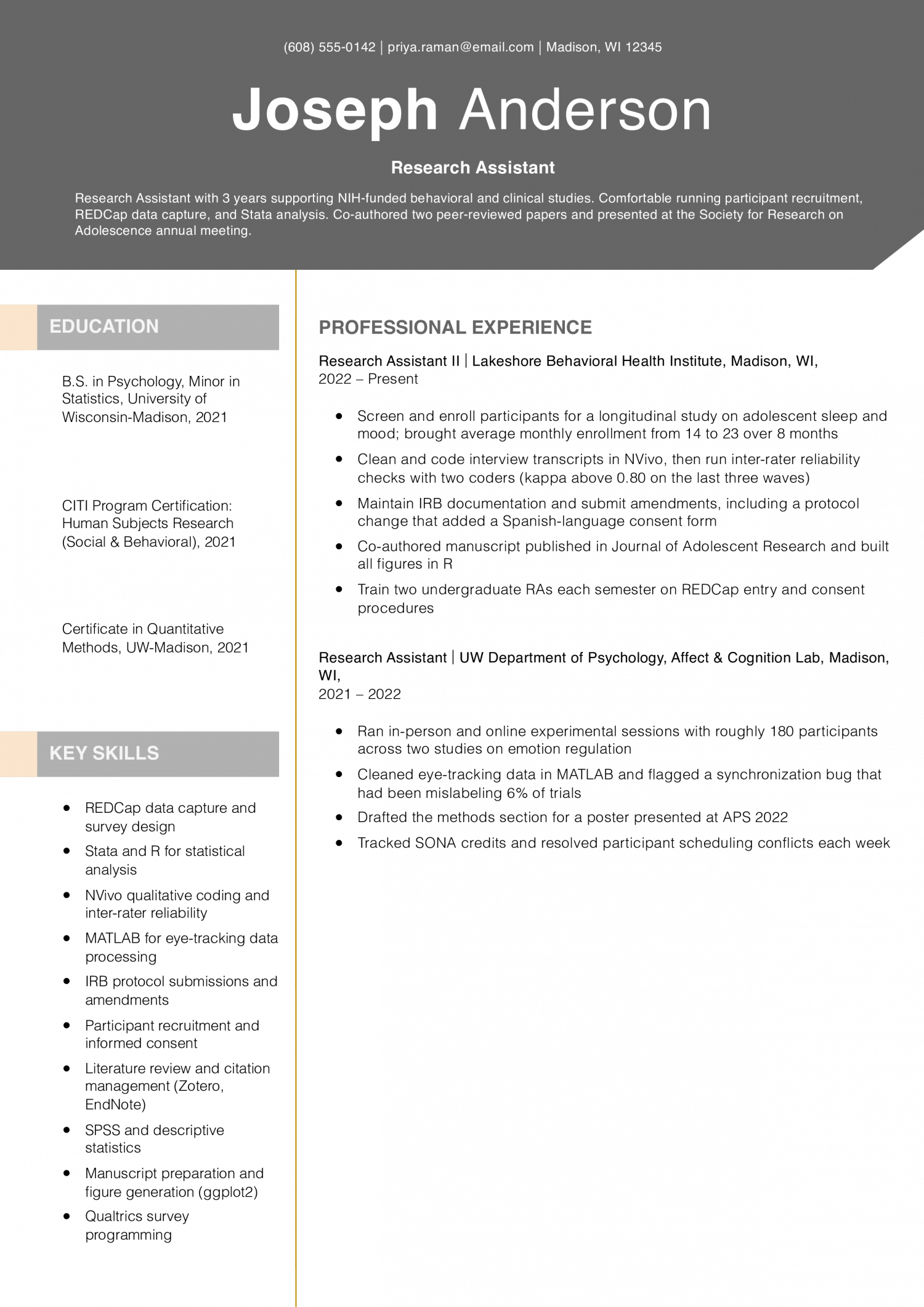
  • Caught a real data bug: Finding the eye-tracking sync error shows hands-on attention that PIs actually rely on, not generic ‘detail oriented’ language.
  • Numbers tied to study work: Enrollment growth, kappa values, and participant counts all map to things hiring labs measure when reviewing RAs.
  • Authorship is named, not implied: Listing the specific journal and conference gives reviewers something verifiable instead of vague ‘contributed to publications.’

Entry Level Example

Undergrads, recent grads, and post-bacs with one or two semesters of lab or field work. The entry-level resume needs to prove you ran specific techniques, handled data without hand-holding, and contributed to a named project or PI.

Why this resume works

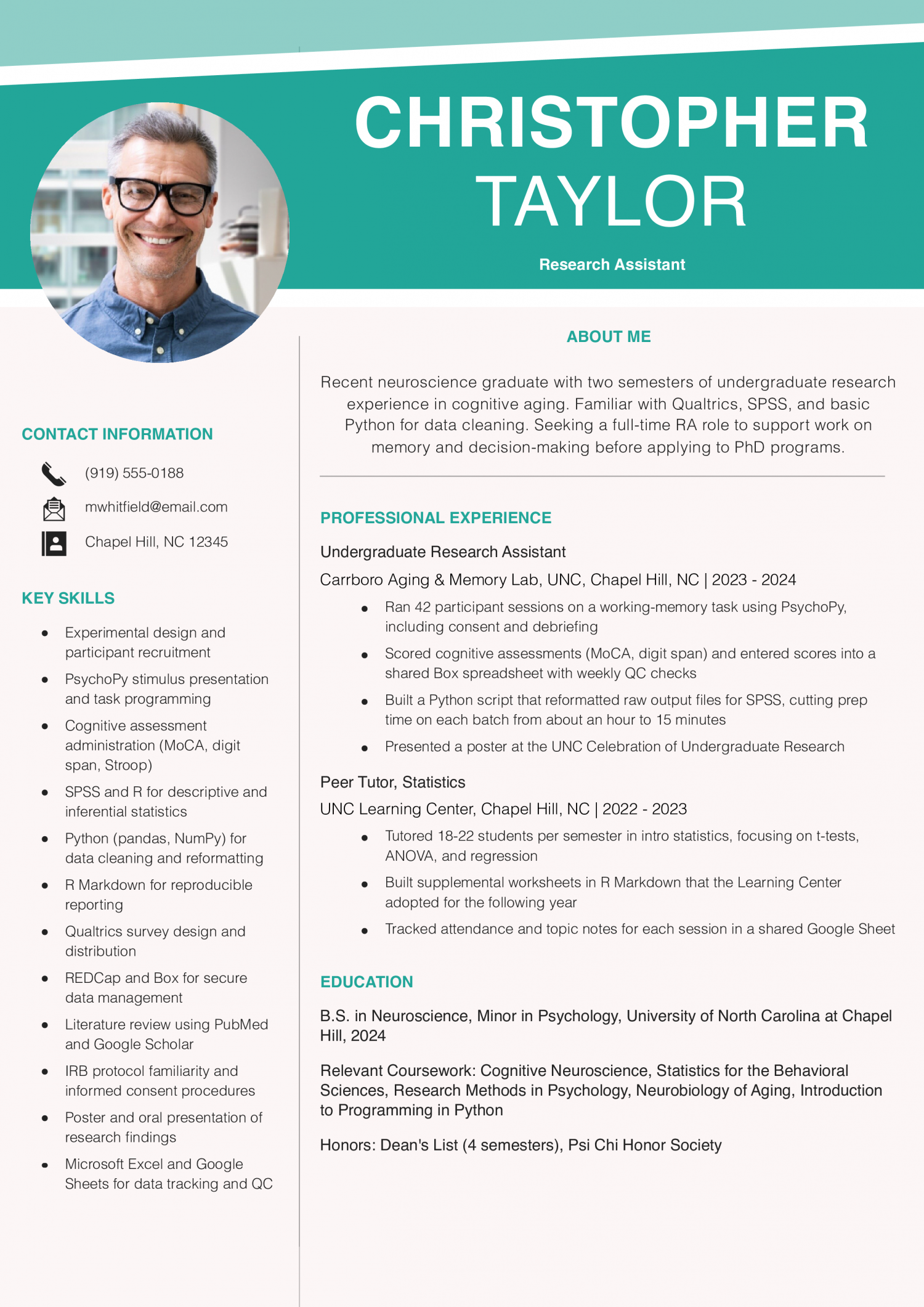
  • Shows real lab tasks: Running PsychoPy sessions and scoring MoCA are concrete duties a PI can picture, not vague ‘assisted with research.’
  • One specific time savings: The Python script with a clear before-and-after gives a measurable contribution without overclaiming for an undergrad role.
  • Stats tutoring backs up the methods skills: Tutoring statistics signals that the candidate can actually explain analyses, which matters for an RA who codes data.

Experienced Example

RAs with two or more years on funded studies, often pre-PhD or career research staff. The experienced resume needs to prove method ownership, authorship or acknowledgment credits, and protocol or compliance work you led.

Why this resume works

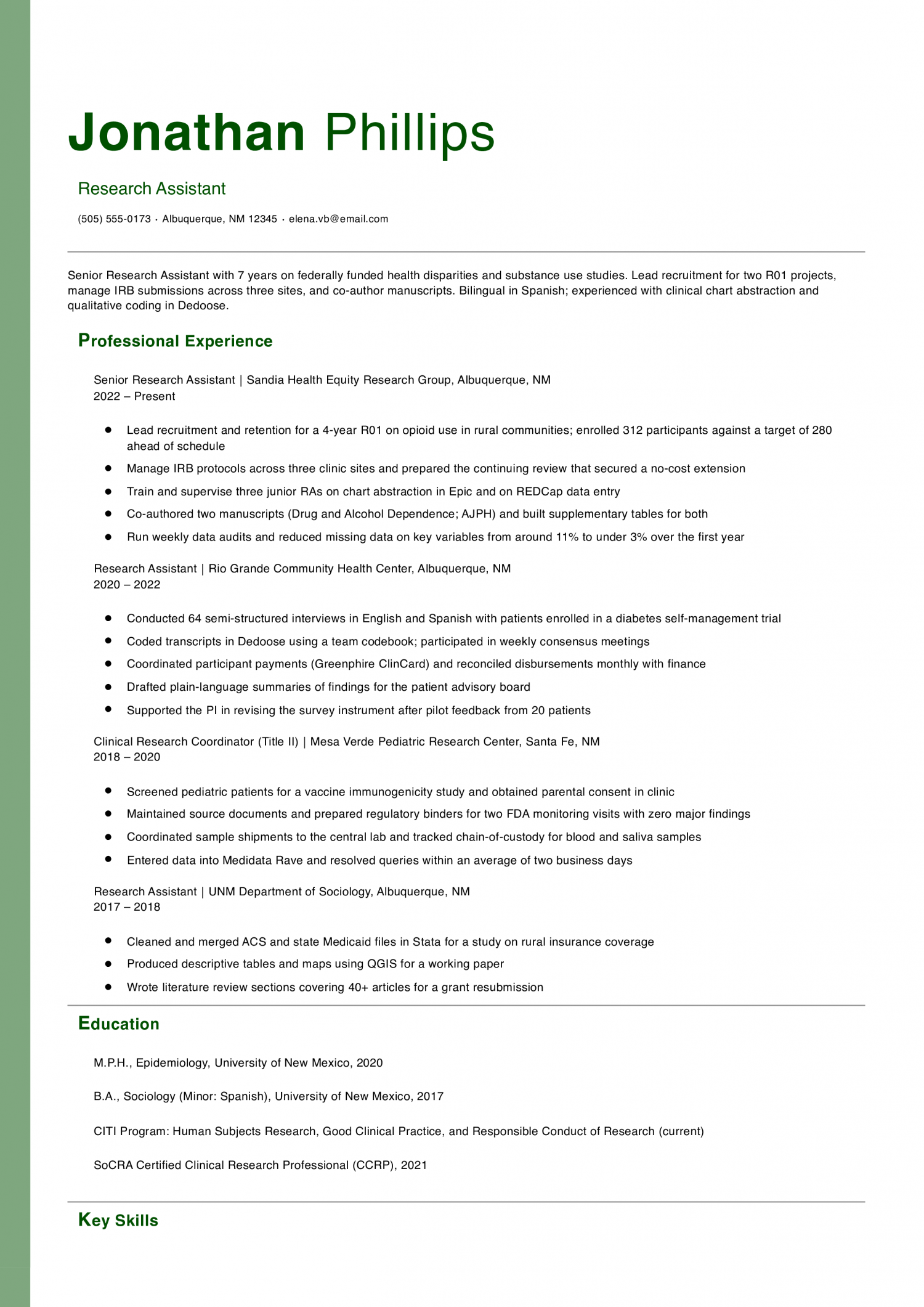
  • Recruitment numbers a PI cares about: Hitting 312 against a 280 target on an R01 is the kind of metric grant reviewers and labs use to judge a senior RA.
  • Grew into supervisory work: The progression from RA to senior RA who trains three juniors shows clear advancement instead of lateral moves.
  • Bilingual interviewing is named: Listing 64 Spanish and English interviews backs up the bilingual claim with a concrete count, not just a checkbox on the skills line.

How to Write a Research Assistant Resume

01 Open with the metric a PI would use to size you up

Lead your summary with a verifiable number, not a scope statement. Name the studies you supported, the sample size you handled, or the hours you logged at the bench.

Principal investigators read the first line for proof you can carry weight on a funded project. A line like “Research assistant supporting two R01-funded studies, 40 hours weekly on PCR and Western blot workflows for 18 months” tells a PI more than “motivated researcher seeking lab role.”

Name the domain (neuroscience, public health, materials science), the methods you ran solo, and the PI or lab if you have permission. Save coursework and GPA for the education block.

02 Quantify the work a PI actually funds

Research bullets read as duties without numbers. Strong resumes name sample sizes, hours, throughput, or outputs.

Push for specifics: “Processed 240 mouse brain samples for immunohistochemistry,” “Coded 1,800 qualitative interview transcripts in NVivo,” or “Cleaned and merged 12 survey waves covering 8,400 respondents in R.” These read as bench-ready signals.

If your work is harder to count, lean on scope: number of subjects screened, protocols followed, instruments operated, or grant cycles supported. Recruiters scan for one number per bullet first.

03 Group your work by methods, data, and compliance

Cluster bullets into three or four categories a PI recognizes. Most strong RA resumes separate wet-lab or field methods, data and analysis, literature and writing, and compliance or coordination.

Under methods, name techniques: PCR, ELISA, flow cytometry, cell culture, fMRI prep, ethnographic fieldwork, structured interviews. Under data, name tools: R, SPSS, Stata, Python, MATLAB, REDCap, NVivo, ATLAS.ti.

Under writing, name outputs: literature reviews, poster presentations, manuscript drafts, IRB submissions. Under compliance, name IRB, IACUC, GCP, or HIPAA training and any protocol amendments you drafted.

04 Put credentials and tools where a PI scans first

Build a page-one block with your methods, software, and compliance training. PIs and lab managers scan this region before they read bullets.

Include CITI training modules (Human Subjects, GCP, IACUC), Bloodborne Pathogens, lab safety certifications, and any IRB or grant-writing workshops. List the issuing body and year completed.

If you have a poster, publication, or preprint, give it a short “Publications and Presentations” section with full citations. A PI weighing two candidates often picks the one whose authorship and conference credits are visible without a search.

05 Close with education, funding, and outputs

For entry and mid-tier RAs, education carries real weight. List your degree, major, GPA if 3.5 or higher, honors thesis title, and the PI who advised it.

Add a fellowships and funding block if you’ve won research grants, travel awards, or summer programs (REU, SURP, McNair, Fulbright). Name the funder and amount when you can.

End with publications, posters, and conferences in standard citation format. A research-track resume that hides outputs in a paragraph loses to one that lists them line by line, with the venue and year a PI can verify.

The research assistant resumes that get callbacks share a specific skill mix. The lists below come from our user-built research assistant resumes. Principal investigators and lab directors scan for these patterns first, not generic eager-to-learn framing.

They want named techniques, named software, and named compliance training before they read your bullets. Match the tables against the methods section of the posting. Treat the soft skills as the behaviors your bullets need to back up with evidence.

Soft Skills % of resumes with this skill
Attention to detail 71%
Critical thinking 53%
Written and verbal communication 44%
Time management 38%
Organization 33%

And here are the top hard skills showing up most often.

Hard Skills % of resumes with this skill
Data collection and analysis 73%
Research methodology 61%
Statistical analysis software 41%
Academic and technical writing 40%
Data visualization 27%

Based on data from thousands of research assistants’ resumes built on ResumeTemplates.com, May 2026.

Must Have on a Research Assistant Resume

These are the must-haves hiring teams look for when scanning a research assistant resume.

Niche Keywords for ATS Checkers

Group your keywords by the sub-niche of research you’re targeting. Principal investigators and lab managers expect the methods, tools, and compliance terms native to their corner of the field.

Niche Keywords ATS scans for
Clinical research coordination research coordinator resume sample, IRB protocol, GCP, REDCap, clinical research assistant
Wet-lab biomedical research PCR, Western blot, cell culture, IACUC, BSL-2
Social science and qualitative research NVivo, qualitative coding, structured interviews, ATLAS.ti, mixed methods
Quantitative data and statistics R, SPSS, Stata, regression analysis, data cleaning
Academic writing and outputs literature review, manuscript preparation, poster presentation, grant writing, PubMed

Research Credentials That Get You the Job

Coursework and a degree-in-progress keep you eligible for most RA roles. The certifications below move a research assistant resume from the qualified-but-typical stack into a principal investigator’s shortlist. List the issuing body, module name, and completion year for each.

  • CITI Human Subjects Research: Signals you can be added to an IRB protocol without delay; many labs require it before your first day on a study.
  • CITI Good Clinical Practice (GCP): Required for federally funded clinical research; lists you as ready for NIH-funded trial work without retraining.
  • CITI IACUC or Working with Animals: Critical for wet labs running mouse, rat, or non-human primate models; PIs read it as protocol-ready.
  • Bloodborne Pathogens and Lab Safety: Standard for clinical and biomedical settings; pairs well with any BSL-2 lab experience you list.

Latest BLS Statistics for Research Assistants

The top-paying states for research assistants tend to cluster around high-NIH-funding hubs and federal lab regions, not the metros where most applicants concentrate. Concentrated grant funding and a thicker tier of senior research staff lift the pay ceiling in those states.

If you’re geographically flexible, the resume should foreground the funding mechanisms you’ve worked under (R01, R21, F31, NSF grants) and the methods that move with you across institutions.

$60,130 National median annual
$64,640 National mean annual
$37,310 Entry-tier floor (10th percentile)
$101,870 Top-decile ceiling (90th percentile)
71,400 Research Assistants in the U.S.
Where you stand

Entry tier

$37,310 to $60,130 At the entry tier, lead with your degree, GPA, CITI modules, and the specific techniques you ran during coursework or your honors thesis.

Mid band

$60,130 to $101,870 At the mid band, your resume needs to show named projects with PIs, authorship credits, and the methods and software you own end-to-end.

Top decile

$101,870+ At the top decile, lead with first-author or co-author publications, grant-writing contributions, and the junior RAs or students you've trained.

Top-paying states

# State Avg. Annual
1 California $75,780
2 Oklahoma $73,940
3 Connecticut $72,090
4 District of Columbia $70,680
5 Washington $70,650
6 Alaska $68,600
7 Maryland $67,040
8 North Carolina $66,090
9 North Dakota $65,800
10 Georgia $65,070

Highest-employment states

# State Workers Median
1 California 10,120 $75,780
2 Texas 7,670 $48,550
3 New York 7,220 $62,500
4 Pennsylvania 3,100 $58,590
5 Maryland 3,080 $67,040
Source: U.S. Bureau of Labor Statistics, OEWS 2024 release (SOC 19-4099).
Written by professional resume writers and loved by hiring managers

Resume Templates offers HR approved resume templates to help you create a professional resume in minutes. Choose from several template options and even pre-populate a resume from your profile.

Frequently Asked Questions

Does a graduate research assistant role count as work experience?

Yes. List your graduate research assistantship under Experience, not under Education, when the work was funded and you carried real responsibilities.

Use the lab or department as the employer, the PI as your supervisor, and bullets that name methods, sample sizes, and outputs. PIs reading your resume treat funded RA work the same as a research staff role.

Can I list an unpaid research assistant role under Experience?

Yes, if the work was substantive and supervised by a faculty PI. Label it "Research Assistant (Volunteer)" or "Undergraduate Research Assistant" so you're transparent.

The bullets should still name the study, the methods you ran, and the hours per week you logged. Unpaid RA work that produced a poster or publication carries the same weight as paid work for most academic hiring panels.

Can I apply for research assistant roles with no prior research experience?

Yes, especially for entry-level posts in clinical coordination, social science, or undergraduate labs. Lead with coursework that involved data collection or analysis, any honors thesis or capstone, and CITI Human Subjects training if you've completed it.

Name the software you've used in class (R, SPSS, Excel, Qualtrics) and any volunteer or class-project work that maps to the posting. PIs hiring first-time RAs read for trainability and basic methods literacy more than prior titles.

How should I list publications and posters on a research assistant resume?

Create a dedicated "Publications and Presentations" section near the bottom of page one or top of page two. Use the citation style your field expects: APA for psychology and social sciences, AMA for biomedical, Chicago for humanities.

Bold your name in the author list so a PI can find it without counting commas. Include posters, preprints, conference talks, and manuscripts under review, with the venue and year for each.

Which resume template works best for a research assistant?

For a research assistant, a professional template is the safest pick, because it signals the polish hiring managers in this field expect. An ATS-friendly template is a solid alternative. Whichever you choose, keep the formatting clean and easy to parse: clear section headings, a standard font, and no graphics a parser can choke on.

Rate this article

Research Assistant Resume

Average Rating

4.7/5 stars with 139 reviews

You have given 0 Star(s)
4.7/5 stars with 139 reviews
Andrew Stoner

Executive Resume Writer and Career Coach

Andrew Stoner is an executive career coach and resume writer with 17 years of experience as a hiring manager and operations leader at two Fortune 500 Financial Services companies, and as the career services director at two major university business schools.