

Tip !

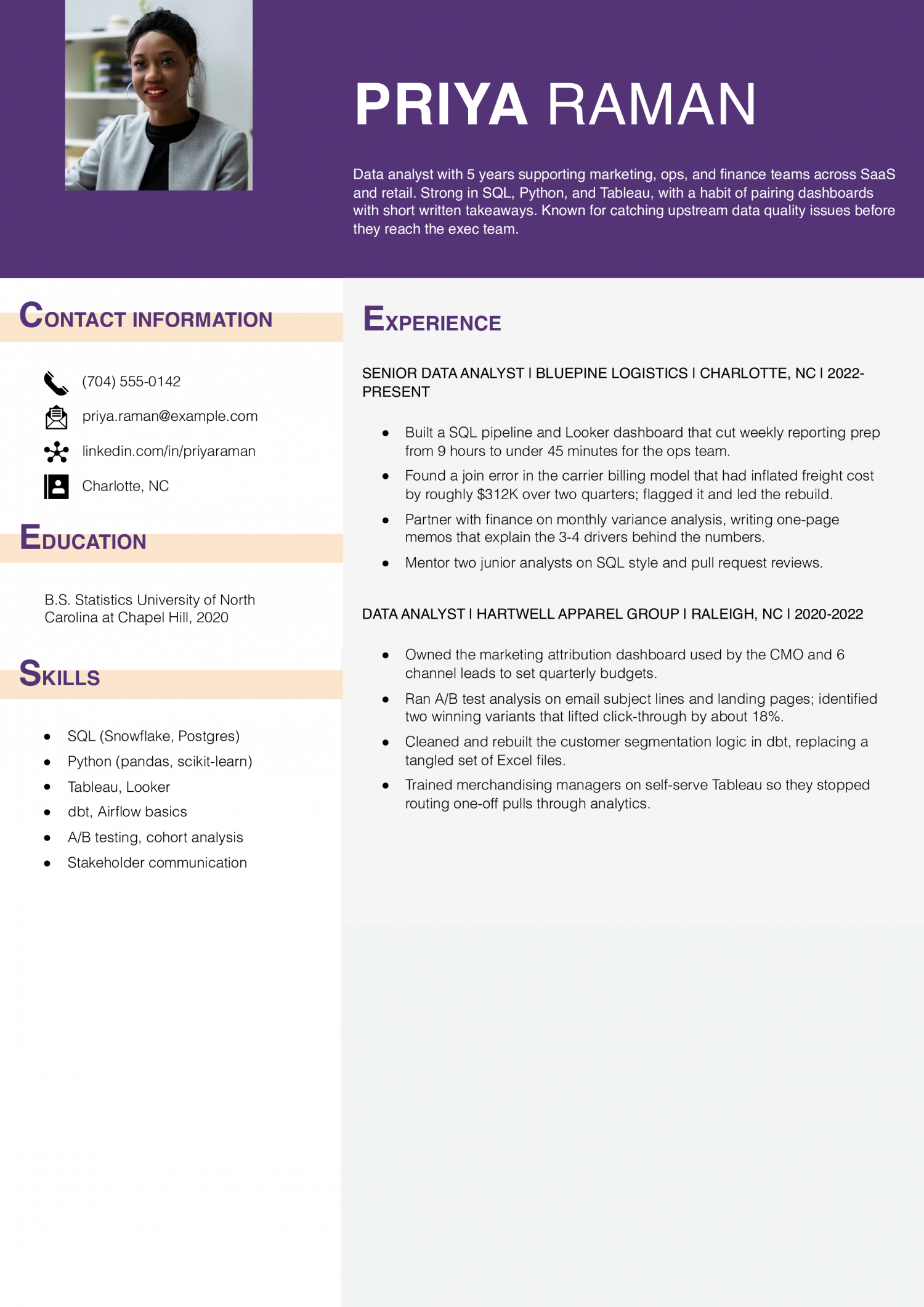
Hiring analytics managers want to see SQL fluency, a named BI tool, and one quantified business outcome on page one, because that tells them within a 30-second scan whether you can ship insight without a babysitter.

Andrew Stoner , Executive Resume Writer and Career Coach

Why this resume works

  • Caught a costly data error: The freight cost catch shows real business impact, not just dashboard volume.
  • Cut reporting time with numbers: 9 hours to 45 minutes is the kind of concrete before-and-after hiring managers remember.
  • Writes for the people reading it: Mentioning one-page memos and CMO-facing dashboards signals comfort with non-technical audiences.

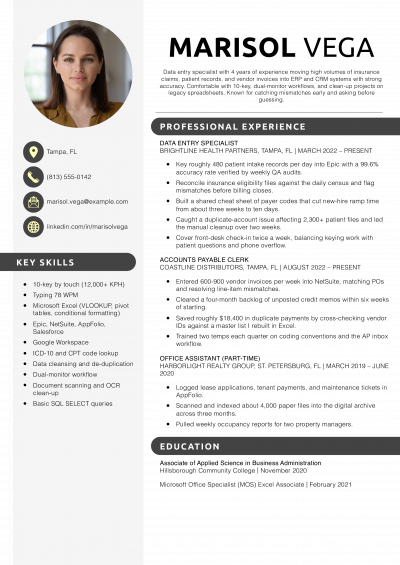
Junior Example

The junior data analyst is one to three years in, often from a bootcamp, analytics rotation, or adjacent reporting role. This resume needs to prove you can write SQL, build a dashboard, and explain findings without hand-holding.

Why this resume works

  • Real work, not just coursework: Ad hoc SQL volume and a rebuilt churn report show day-one usefulness.
  • Honest about the Python level: Saying ‘learning Python on the job’ reads more credible than overstating it.
  • Caught a real bug early: Finding the duplicate-policy issue signals attention to data quality, which juniors rarely show.

Senior Example

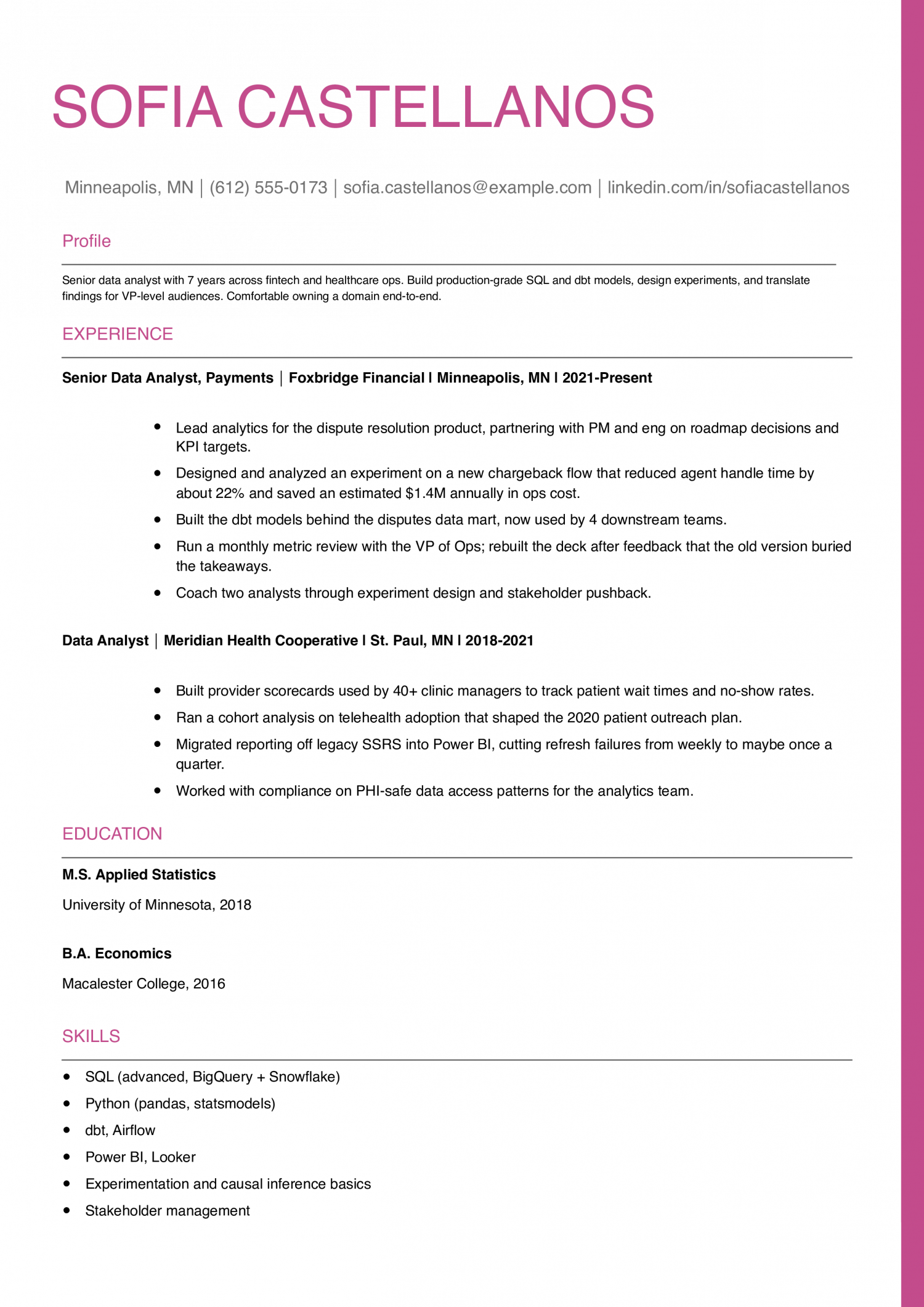
The senior data analyst owns end-to-end analyses for a product line or business unit. This resume needs to show stakeholder ownership, experimentation work, and dollar or percentage impact tied to decisions the business actually made.

Why this resume works

  • Owns a product area, not tickets: Framing the role as ‘lead analytics for the dispute resolution product’ shows senior-level scope.
  • Numbers tied to real savings: Experiment results paired with dollar impact is what mid-career analysts get hired on.
  • Two domains, one clean story: Fintech plus healthcare reads as breadth without feeling scattered.

Lead Example

The lead data analyst sets standards across a team and mentors analysts on craft. This resume needs to prove analytics strategy, data model ownership, and a track record of moving executive decisions with your work.

Why this resume works

  • Manages people and metrics: Team size, hiring, and CEO-facing reviews show this is a leadership role, not a senior IC role.
  • Cleans up instead of just adding: Retiring 140+ duplicate fields and 9 unused dashboards signals maturity most analysts skip.
  • Career arc makes sense: Consulting to analyst to lead reads as steady growth, with scope expanding at each stop.

How to Write a Data Analyst Resume

01 Open with the one thing a LinkedIn search cannot show

Lead with the proof that separates you from the other 400 SQL-and-Tableau resumes in the pile. That might be a specific business outcome you owned, a domain like fintech fraud or marketing attribution, or a rare stack like dbt plus Snowflake plus Looker.

Put this in the summary line and again in your top role’s first bullet. Analytics managers and BI directors read the first six lines, then decide. A line like ‘built the retention model that informed the pricing change driving a 14 percent lift in renewals’ beats any skills list.

02 Quantify every bullet with a real business metric

Strong data analyst bullets pair the analysis with the decision it drove. Name the metric, the magnitude, and the audience. ‘Built funnel dashboard in Looker’ reads as a duty.

‘Built funnel dashboard in Looker that surfaced a 22 percent checkout drop-off, prompting the redesign that recovered $1.1M in quarterly revenue’ reads as ownership. Aim for two or three numbers per role: a dollar figure, a percentage change, and a scope marker like dataset size or stakeholder count. Bullets without a number tend to read as task lists.

03 Group your work by analysis type, not task

Cluster your bullets into three or four analytical categories so a skim reads as a portfolio. Useful groupings include experimentation and A/B testing, product or funnel analytics, forecasting and modeling, and stakeholder reporting or executive dashboards.

Within each cluster, name the tools and the methods. Mention LOD calcs in Tableau, window functions in SQL, cohort retention curves, or a logistic regression you shipped. This signals range without forcing a Analytics manager to guess what you actually did day to day.

04 Place tools and credentials where they get scanned

Put a technical skills block at the top of page one, under the summary. Split it into Languages (SQL, Python, R), BI Tools (Tableau, Looker, Power BI), Warehouses (Snowflake, BigQuery, Redshift), and Other (dbt, Git, Airflow).

Certifications like Google Data Analytics, Tableau Desktop Specialist, or the Microsoft Power BI Data Analyst sit in a short block below education. Analytics managers and BI directors use this block as a keyword pass and an experience-tier signal before they read bullets.

05 Close with education and a focused project line

For entry and mid roles, end with education, then one or two portfolio projects with a link. Name the dataset, the question, the method, and the result.

A line like ‘Predicted NYC bike-share demand from 73M trips using XGBoost in Python, deployed to a Streamlit dashboard’ shows initiative outside paid work. Skip coursework lists after your first job. Senior analysts can drop projects and use that space for a Selected Analyses section instead.

The data analyst resumes that get callbacks share a specific skill mix. The lists below come from our user-built data analyst resumes. Analytics managers and BI directors scan for these patterns first, not generic ‘data-driven decision making’ phrasing.

Hard skills carry the ATS pass. SQL, a named BI tool, and Python or R are table stakes. Soft skills only count when a bullet proves them.

Match the hard-skills list against the target job posting, then use the soft skills as evidence anchors for your accomplishment bullets.

Soft Skills % of resumes with this skill
Communication 72%
Attention to detail 69%
Problem solving 43%
Critical thinking 36%
Collaboration 34%

And here are the top hard skills showing up most often.

Hard Skills % of resumes with this skill
SQL 65%
Microsoft Excel 60%
Data visualization 44%
Python 35%
Statistical analysis 26%

Based on data from thousands of data analysts’ resumes built on ResumeTemplates.com, May 2026.

Must Have on a Data Analyst Resume

The items below are what separates a data analyst resume that clears credentialing from one that gets put back in the pile.

Niche Keywords for ATS Checkers

Analytics managers and BI directors expect your resume to mirror the language of the specialty they’re hiring for. Pick the row that matches your target role and weave the keywords into bullets, not a wall of skills.

Niche Keywords ATS scans for
Product analytics funnel analysis, A/B testing, cohort retention, Amplitude
Marketing analytics attribution modeling, LTV/CAC, campaign measurement, GA4
Financial and operations analytics forecasting, variance analysis, KPI reporting, executive dashboards
Analytics engineering dbt, Snowflake, data modeling, Airflow
Business intelligence Tableau LOD calcs, Power BI DAX, Looker LookML, semantic layer

AI Skills to Add

Hiring teams are split between analytics leaders who want AI-assisted speed on SQL and exploration, and leaders who worry about hallucinated joins and unreviewed output. Name the tools you actually use, describe the review workflow, and don’t claim ‘AI-driven analysis’ if your real practice is prompting, editing, and verifying.

What AI is actually changing for this role
SQL drafting

Analysts use Copilot or ChatGPT to draft joins and CTEs, then verify against schema and row counts before shipping.

Exploratory analysis

Notebook AI suggests next charts and statistical tests; the analyst still chooses the framing and validates assumptions.

Stakeholder communication

Generative tools draft executive summaries from dashboard data, with the analyst editing for accuracy and business context.

Documentation and dbt models

AI generates first-pass model documentation and column descriptions, freeing analyst time for review and lineage work.

AI tools to name
  • GitHub Copilot: Drafts SQL, Python, and dbt model code inside the IDE for analyst review.
  • ChatGPT or Claude: Explains unfamiliar SQL, drafts stakeholder summaries, and rubber-ducks analysis framing.
How to phrase AI on your resume
Do
  • Used GitHub Copilot to scaffold dbt models for a 14-table marketing mart, cutting initial build time by 40 percent.
  • Drafted executive readouts with ChatGPT from Looker outputs, then verified each figure against the source query before sending.
Skip
  • AI-powered data analyst driving insights at scale.
  • Leveraged generative AI to revolutionize the analytics function.

Portfolio Strategy

A data analyst portfolio earns interviews when each project shows a real question, a real dataset, and a result a stakeholder could act on. Two or three strong projects beat eight Titanic notebooks.

#1 GitHub

Hosts SQL, Python, and dbt code with README files that frame the business question and result.

Best for dashboards Tableau Public

Shows interactive BI work without a paid license; link directly from the resume header.

Best for narrative Personal site or Medium

Walks a recruiter through your analysis story, embedded charts, and decision impact.

Best for notebooks Kaggle or Hex

Publishes reproducible analyses with version-able notebooks recruiters can run.

Structure each project the same way. Open with the business question, name the dataset and size, summarize the method in one line, and close with the result and what a stakeholder would do with it. Recruiters spend under two minutes per project link.

Pin your strongest work. On GitHub, pin three to six repos and write a README for each. A repo without a README reads as abandoned code.

Data Analyst Tech Stack to List

Analytics managers scan the technical skills block for stack overlap before they read bullets. Group your tools by function so the parser and the human both find what they need.

  • Languages: SQL, Python (pandas, scikit-learn), R
  • BI Tools: Tableau, Looker, Power BI, Mode
  • Warehouses: Snowflake, BigQuery, Redshift, Postgres
  • Workflow: dbt, Git, Airflow, Jupyter, Hex

Data Analysis Credentials That Get You the Job

Analytics managers read this list as a map of where your work is heading. The certifications below tell them which track you’ve invested in, whether that’s BI tooling, cloud warehousing, or statistical depth. List the issuing body and the year you completed it.

  • Google Data Analytics Professional Certificate: Signals foundational SQL, R, and Tableau coverage; strongest for career changers and entry-level analysts breaking in.
  • Tableau Desktop Specialist or Tableau Certified Data Analyst: Validates BI tool depth beyond a self-rated skill line; useful when the posting names Tableau as a core requirement.
  • Microsoft Certified: Power BI Data Analyst Associate (PL-300): Carries weight at Microsoft-shop employers; pairs well with DAX, Power Query, and warehouse-modeling bullets.
  • SnowPro Core Certification: Shows warehouse and SQL performance fluency; helpful when you're moving toward analytics engineering or a dbt-heavy stack.

Latest BLS Statistics for Data Analysts

The top-paying states for data analysts cluster around tech hubs and finance corridors, not the lower-cost remote markets many analysts assume pay competitively. That spread reflects employer concentration: big tech, hedge funds, and consultancies push the ceiling, while regional employers anchor the median. The employment data tells a different story, with the highest analyst headcounts in states that host enterprise data teams across multiple industries.

If you’re geographically flexible, position your resume around the metro that matches your specialty rather than the one closest to home.

$98,309 National median annual
$69,000 Entry-tier floor (10th percentile)
$140,000 Top-decile ceiling (90th percentile)
233,440 Data Analysts in the U.S.
Where you stand

Entry tier

$69,000–$98,309 At the entry tier, lead with SQL fluency, one BI tool, and a portfolio project with a dataset, method, and quantified result.

Mid band

$98,309–$140,000 At the mid band, your resume needs to show end-to-end ownership of a domain and dollar or percentage impact on a business decision.

Top decile

$140,000+ At the top decile, lead with team or analytics strategy ownership, experimentation programs you built, and executive decisions your work moved.

Top-paying states

# State Avg. Annual
1 Washington $158,760
2 District of Columbia $137,120
3 California $136,800
4 Massachusetts $132,250
5 New Jersey $130,370
6 Virginia $126,070
7 New York $125,400
8 Maryland $124,340
9 Hawaii $123,880
10 Vermont $120,670

Highest-employment states

# State Workers Median
1 California 36,850 $136,800
2 Texas 23,420 $106,540
3 New York 20,070 $125,400
4 Pennsylvania 10,430 $100,320
5 North Carolina 10,140 $115,380
A note on these numbers. The Bureau of Labor Statistics groups data analysts with data scientists, so its standard figure can overstate pay for data analysts. The title-specific number here is more representative and draws on U.S. Department of Labor visa wage filings, which skew toward large technology employers, so it still reads on the high side for the field. For data analysts, pay swings most with industry, employer size, and the depth of your stack, with fintech, big tech, and consulting paying above generalist roles. Use it as a guide, not a guarantee.

Primary data: U.S. Bureau of Labor Statistics. Title-specific base pay: U.S. Department of Labor (H-1B LCA disclosures). View on bls.gov
Written by professional resume writers and loved by hiring managers

Resume Templates offers HR approved resume templates to help you create a professional resume in minutes. Choose from several template options and even pre-populate a resume from your profile.

Frequently Asked Questions

How long should a data analyst resume be?

One page for analysts with under eight years of experience. Two pages for senior or lead analysts with multiple specialty areas or published work.

Recruiters skim the first half of page one, so put your strongest quantified bullet near the top. Cut coursework, internships from over five years ago, and skill bars.

How do I write a data analyst resume with no direct experience?

Anchor the resume on three or four portfolio projects with public links. Each project should name the dataset, the business question, the method, and the result.

Then translate prior work into analytical bullets. A customer service role becomes 'analyzed 6,200 support tickets in SQL to identify the top three churn drivers, presented to product lead.'

Add Google Data Analytics or a Tableau certification to anchor the credentials block. Skip a summary that says 'aspiring data analyst.'

Should I keep customer service or non-analytics jobs on a data analyst resume?

Keep them if they fill an employment gap or if you can rewrite the bullets to show analytical work. A retail role becomes 'built weekly Excel sales report read by three store managers.'

Drop them once you have two analyst roles to show. A senior analyst resume that still lists a barista job from 2017 burns space the recruiter needs for your impact bullets.

How do I show AI tool use without overclaiming?

Name the tool, describe the workflow, and tie it to time saved or quality gained. 'Used GitHub Copilot to draft SQL boilerplate, cutting query-writing time on routine pulls by 30 percent' reads as honest workflow.

Skip phrases like 'AI-powered analyst' or 'leveraged ChatGPT to drive insights.' Analytics managers read those as bait and assume you don't review the output.

Which resume template works best for a data analyst?

For a data analyst, a tech template is the safest pick, because it keeps your stack, tools, and impact easy to scan. An ATS-friendly template is a solid alternative. Whichever you choose, keep the formatting clean and easy to parse: clear section headings, a standard font, and no graphics a parser can choke on.

Andrew Stoner

Executive Resume Writer and Career Coach

Andrew Stoner is an executive career coach and resume writer with 17 years of experience as a hiring manager and operations leader at two Fortune 500 Financial Services companies, and as the career services director at two major university business schools.