20 Best Electrician Resume Examples and Templates for 2026



Master plumbers decide whether to call you in by the top third of page one; if the license tier, state, and journeyman hours are not visible by then, the resume gets set aside for the next stack.

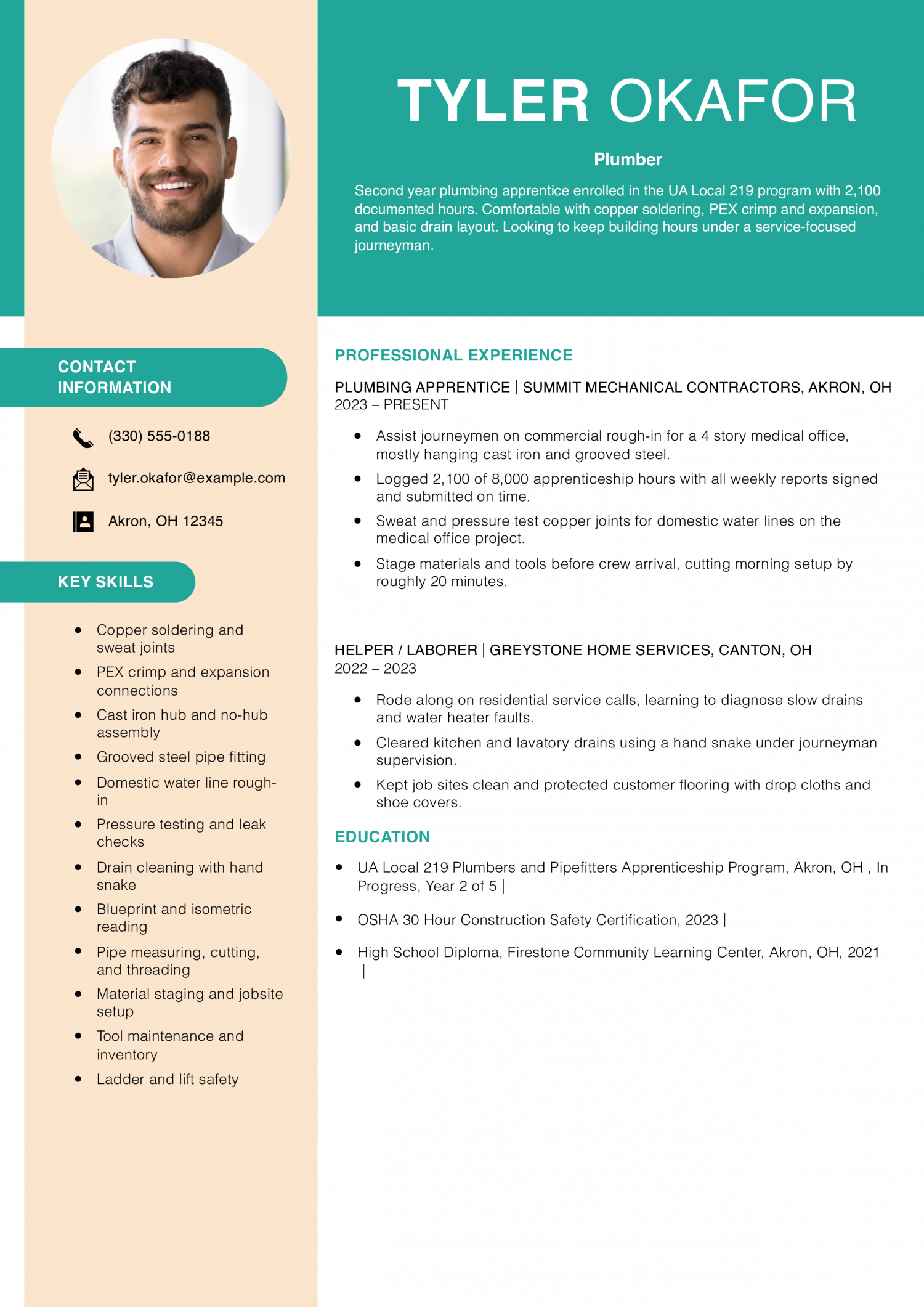
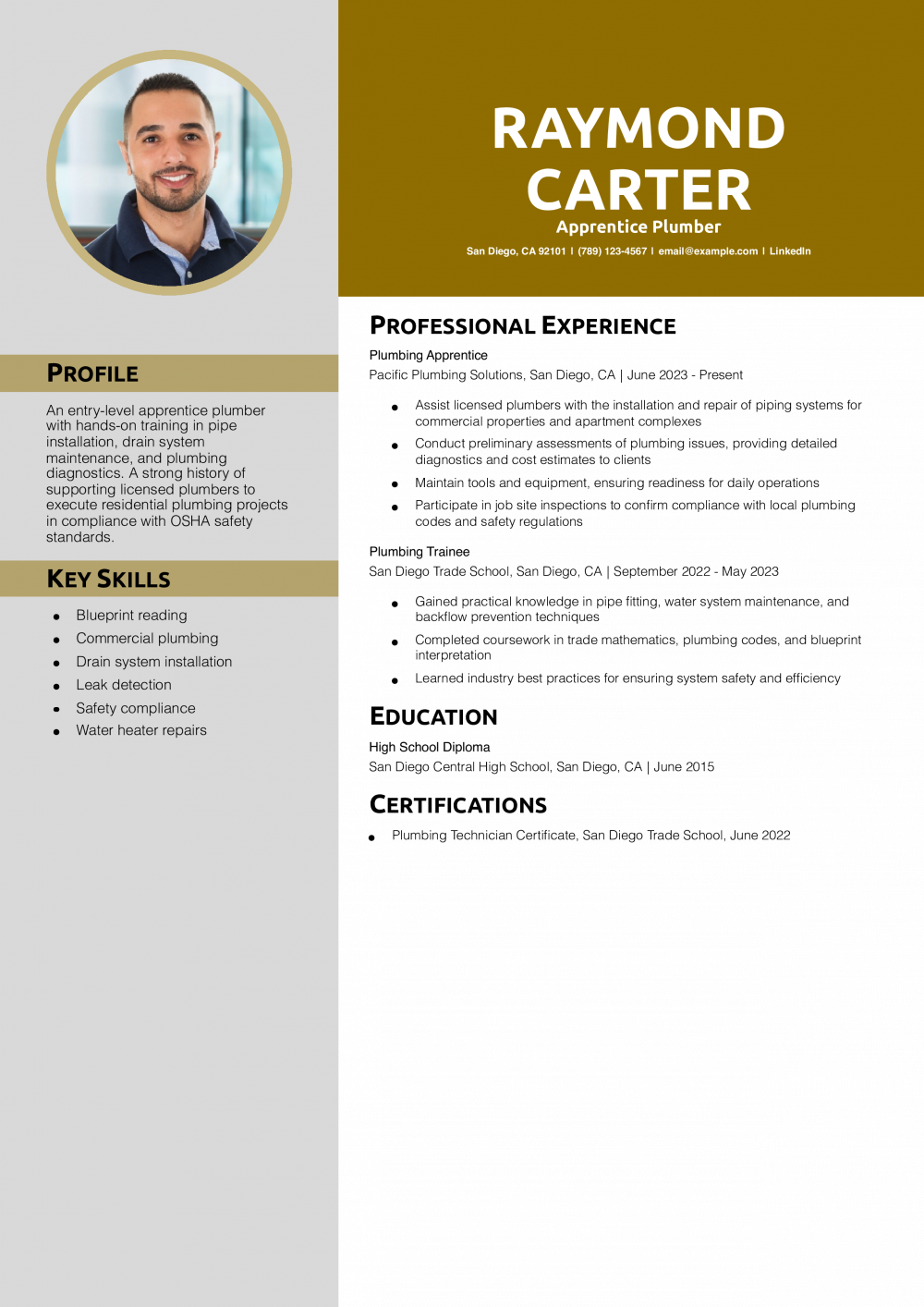
Apprentice plumbers are logging classroom hours and on-the-job training under a licensed journeyman or master. Your resume needs to prove enrolled apprenticeship status, hours accrued, and the tasks you've handled on real job sites.
Journeyman plumbers carry an active state license and run service calls or rough-in work without daily supervision. Your resume needs to prove license number coverage, code fluency, and the systems you install and repair end-to-end.
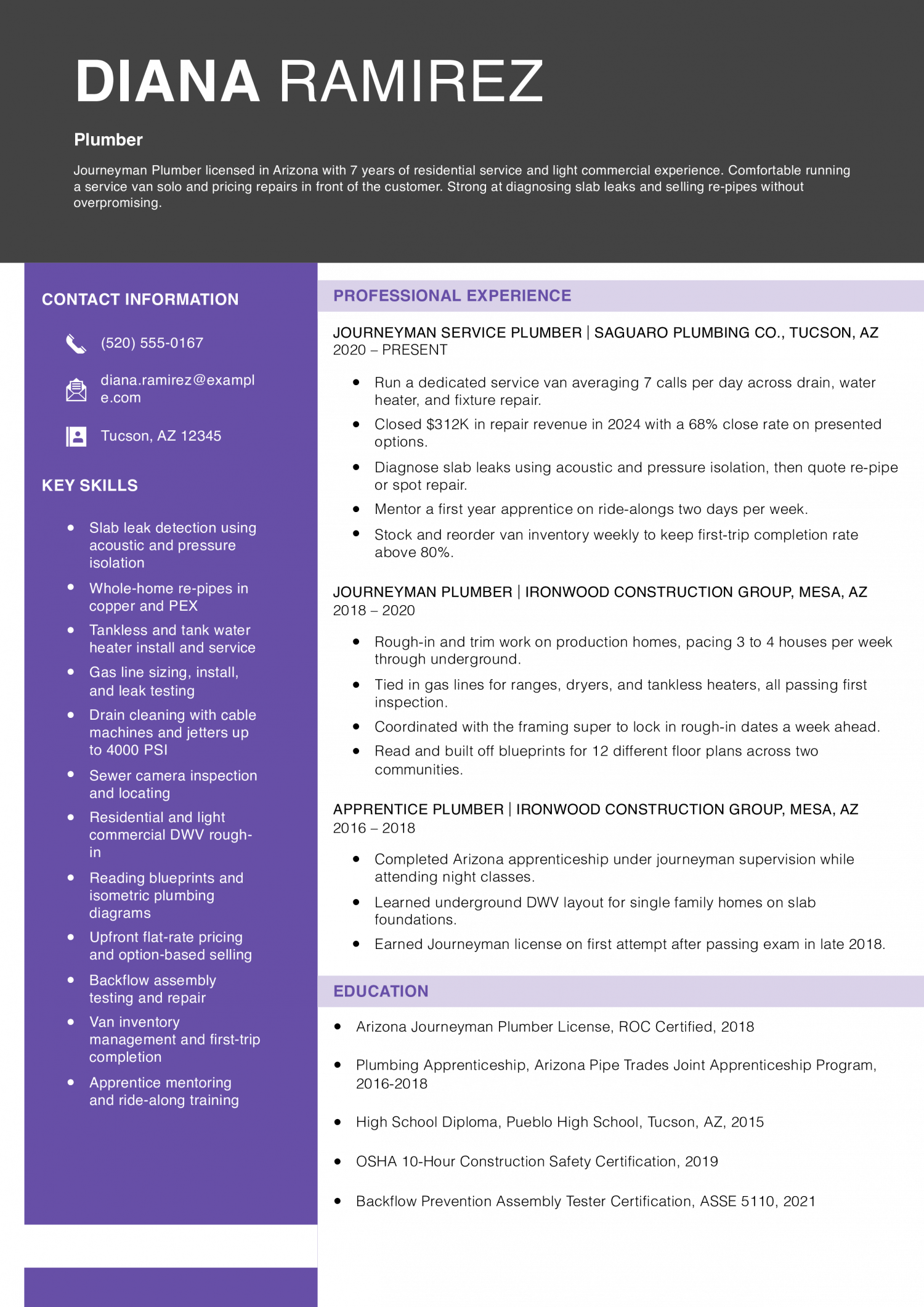
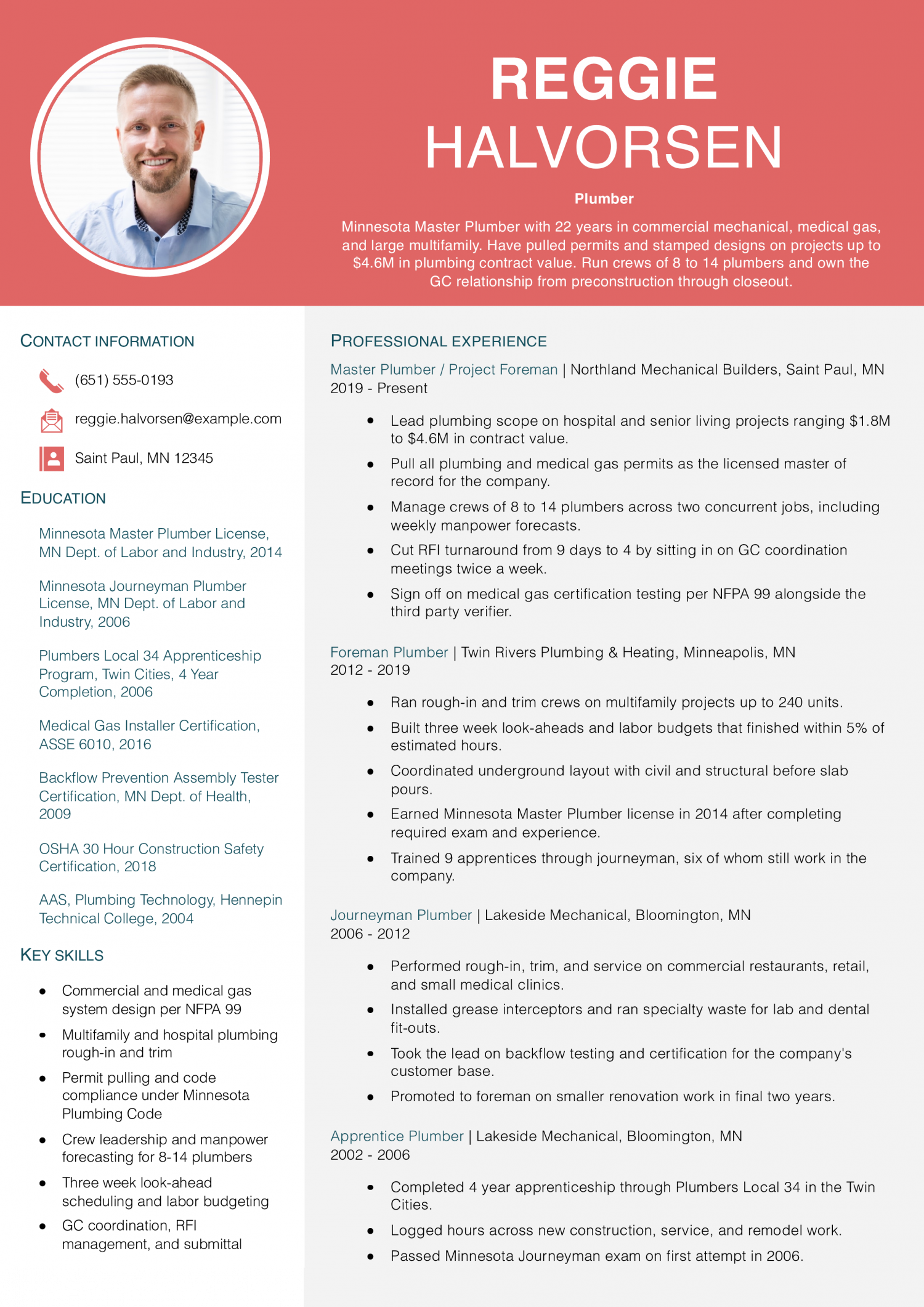
Master plumbers pull permits, sign off on apprentice hours, and often run a truck, crew, or shop. Your resume needs to prove permit authority, supervised crew size, and the commercial or service scope you've delivered.
Marcus Delgado
Raleigh, NC | (919) 555-0142 | [email protected] | linkedin.com/in/marcusdelgado
Licensed Journeyman Plumber with 9 years of mixed residential, multifamily, and light commercial work. Known for clean rough-ins, on-time inspections, and getting new apprentices productive inside their first 90 days. Comfortable owning the GC relationship on jobs under $2M and running my own service van when the work calls for it.
Lead Journeyman Plumber
Cardinal Pipe & Mechanical | Raleigh, NC | 2021-Present
Journeyman Service Plumber
Brookhaven Plumbing Services | Durham, NC | 2017-2021
Apprentice Plumber
Brookhaven Plumbing Services | Durham, NC | 2015-2017
General Laborer
Piedmont Build Group | Cary, NC | 2014-2015
The first line of your summary should name your license tier, years in the trade, and the work mix you run.
Foremen and dispatchers read this as your readiness to roll a truck on day one. A journeyman with eight years on commercial rough-in reads differently than one who runs residential service.
Name the state your license sits in, the work environments you’ve cleared, and the call volume or job throughput you carry on a normal week.
Plumbing bullets without scope read as duty lists. Strong bullets name the system, the volume, and the outcome.
Trade work does not always carry clean dollar metrics, so pivot to volume and scope language. Name the unit count on a multifamily repipe, the linear feet of cast iron you cut and replaced, or the service calls you close per day.
Recruiters scan for the size of the job and the role you played on it. A bullet that names 42 units, four-story, PEX manifold beats one that says assisted with large repipe project.
Master plumbers and plumbing contractors read for the work categories you’ve owned. Build three to five groups and load each with specifics.
Rough-in: PEX, copper, PVC, and cast iron DWV; slab and overhead. Service: water heater swaps, drain clearing, fixture replacements, leak diagnosis. Specialty: gas line installs, backflow testing, hydronic boilers, or commercial grease.
Name the codes you work under (UPC or IPC), the inspection pass rate if you track it, and the brands you service most (Rinnai, Navien, Bradford White, Kohler).
Build a credentials block under your summary, before work history. List your license tier and the state it’s issued in, with a note that it is in good standing.
Do not print the actual license number on your resume. Provide it on the application form when the state board or employer asks for it.
List OSHA 10 or 30, backflow prevention certification, medical gas (NITC or ASSE 6010), and any EPA Section 608 ticket. Master plumbers and plumbing contractors need to see these before they call you in.
End with your apprenticeship program and any trade school coursework. Name the sponsor (UA Local, PHCC, ABC, or state-registered program), the years enrolled, and total on-the-job hours logged.
If you completed a related-instruction program at a community college or vocational school, list the certificate or hours. For master plumbers, swap the apprenticeship detail for continuing education hours that satisfy your state board’s renewal cycle.
Plumbing shops lean less on ATS parsers than corporate employers, but franchise service brands and mechanical contractors do screen on keywords. The skills below come from our user-built plumber resumes. Master plumbers and plumbing contractors weigh hard skills first: license tier, code fluency, and systems you can rough in or service alone.
Soft skills like customer communication back up service-tech bullets where homeowners are involved. Match this list against the posting, then move the terms that fit your real work into your summary, skills block, and bullets.
| Soft Skills | % of resumes with this skill |
|---|---|
| Problem-solving | 73% |
| Customer service | 59% |
| Communication | 47% |
| Time management | 39% |
| Attention to detail | 35% |
And here are the top hard skills showing up most often.
| Hard Skills | % of resumes with this skill |
|---|---|
| Pipe installation and repair | 80% |
| Leak detection | 51% |
| Drain cleaning | 49% |
| Water heater installation | 38% |
| Plumbing code compliance | 27% |
Based on data from thousands of plumbers’ resumes built on ResumeTemplates.com, May 2026.
These are the must-haves hiring teams look for when scanning a plumber resume.
Plumbing licensure is set at the state level, and a journeyman ticket in one state does not always transfer to the next. Some states (Texas, California, Massachusetts) license through a dedicated plumbing board; others (Pennsylvania, New York) license at the municipal level.
On your resume, name the state your license sits in and the tier (apprentice, journeyman, or master). Note reciprocity if you’ve cleared the endorsement process into a neighboring state.
When applying across state lines, add a one-line note about your willingness to sit for the local exam. Master plumbers and plumbing contractors read this as a sign you’ve thought through the move.
Plumbing apprenticeships run four to five years and combine on-the-job training with related classroom instruction. Sponsors include UA Local unions, PHCC chapters, ABC chapters, and state-registered non-union programs.
On the resume, name the sponsor, the years enrolled, and total on-the-job hours logged. If you’ve completed related-instruction coursework, list the school and the certificate.
Apprentices should put the program at the top of the resume, above work history. Once you pass the journeyman exam, the apprenticeship moves to the education section and the license takes the lead.
Most commercial general contractors require OSHA 10 for trade workers and OSHA 30 for foremen and leads. Service-only residential plumbers can often clear with OSHA 10, but commercial work expects the 30.
Naming the tools you run signals fluency to a shop owner reading your resume. Stick to brand and model categories the trade actually uses, not a generic hand-tool list.
If you’re a UA member, name the local number and the book status (Book 1, Book 2) where it applies. List the years of membership and any travel-card work you’ve done out of jurisdiction.
If you’re non-union, do not flag that. Lead with the contractor associations (PHCC, ABC) and the state-registered apprenticeship that sponsored you instead.
Beyond your state plumbing license, the certifications below tell a master plumber or shop owner which work you can bill for and which jobsites you can clear. List the certifying body and the issue or expiration year next to each item, grouped in a credentials block under your summary.
Plumber is a mid-size occupation in BLS, which means the median absorbs apprentices and helpers alongside licensed journeymen and masters. The spread between the 10th and 90th percentile is wide because license tier, union status, and metro cost of living all pull pay in different directions. The top-paying states cluster around dense union markets and high-wage metros, while the highest-employment states track population and new construction volume.
Position your resume by leading with the license tier and work mix that pull you toward the upper half of the band.
| # | State | Avg. Annual |
|---|---|---|
| 1 | Illinois | $96,200 |
| 2 | Oregon | $93,110 |
| 3 | Minnesota | $83,280 |
| 4 | Massachusetts | $83,260 |
| 5 | Alaska | $83,090 |
| 6 | District of Columbia | $81,950 |
| 7 | Washington | $79,070 |
| 8 | Hawaii | $78,540 |
| 9 | Wisconsin | $78,510 |
| 10 | New York | $78,460 |
| # | State | Workers | Median |
|---|---|---|---|
| 1 | California | 45,460 | $68,390 |
| 2 | Texas | 42,290 | $58,560 |
| 3 | Florida | 26,730 | $50,540 |
| 4 | New York | 22,630 | $78,460 |
| 5 | Illinois | 18,730 | $96,200 |
Resume Templates offers HR approved resume templates to help you create a professional resume in minutes. Choose from several template options and even pre-populate a resume from your profile.
Lead with your apprenticeship program, sponsor (UA Local, PHCC, ABC, or state-registered), and hours logged so far.
Follow with a skills block naming the tasks you handle on site: PEX runs, fixture sets, drain rough-in, water heater swaps. Close with the journeyman or master who supervised you and any trade school coursework with the school and certificate.List the license tier (journeyman or master) and the state it's issued in. Add a short note that it is in good standing.
Do not print the actual license number on a public resume. State boards and contractors expect to see it on the application form, not in a file you upload to a job board.Name the systems you touched (PEX manifolds, cast iron DWV, gas piping) and the role you played, even as a helper.
Quantify scope: 42-unit repipe, four-story commercial rough-in, 18 service calls per week assisting the journeyman. Pair each bullet with the journeyman or master you worked under so a foreman can verify the work fast.Use reverse-chronological format. One page works for apprentices and journeymen under 10 years. Two pages fit master plumbers with crew oversight and commercial scope.
Put a credentials block under the summary listing license tier, state, OSHA card, backflow, and medical gas if applicable.
Skip the functional or skills-based format. Shop owners want to see steady job history and who signed off on your hours.
For a plumber, an ATS-friendly template is the safest pick, because it puts your certifications and experience where a hiring manager scans first. A basic template is a solid alternative. Whichever you choose, keep the formatting clean and easy to parse: clear section headings, a standard font, and no graphics a parser can choke on.
Executive Resume Writer and Career Coach
Andrew Stoner is an executive career coach and resume writer with 17 years of experience as a hiring manager and operations leader at two Fortune 500 Financial Services companies, and as the career services director at two major university business schools.
Customize this template in our builder in under 10 minutes.