
4 Best Construction Worker Resume Examples and Templates for 2026



Construction foremen decide whether to call a carpenter in for a walk-through inside the top third of page one; if OSHA cards, tool list, and recent project scope aren't visible there, the resume gets set aside.
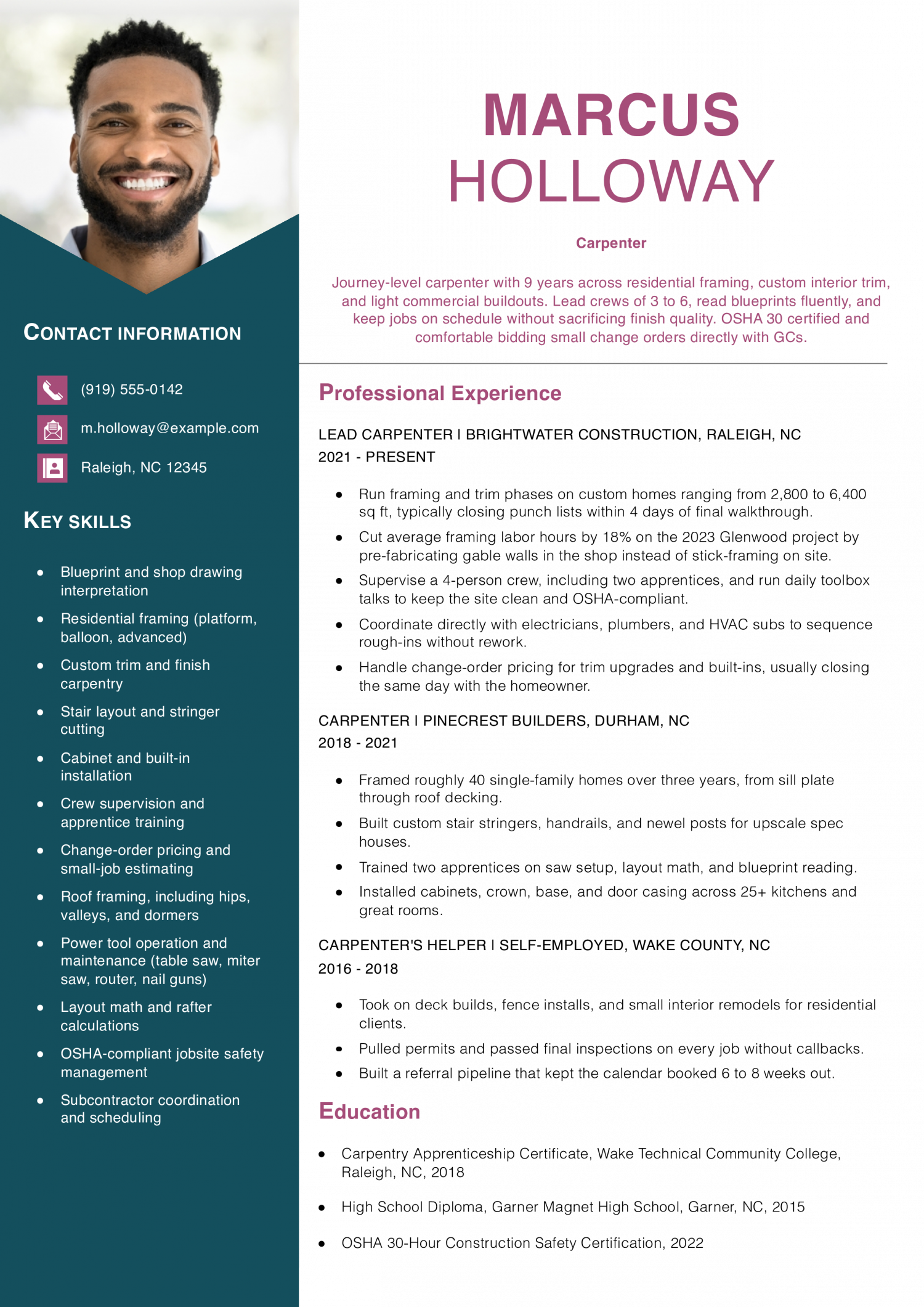
Apprentices are still logging on-the-job hours toward journeyman status, usually through a union local or a non-union training program. The apprentice resume needs to prove safety-card currency, tool familiarity, and steady attendance on a crew.
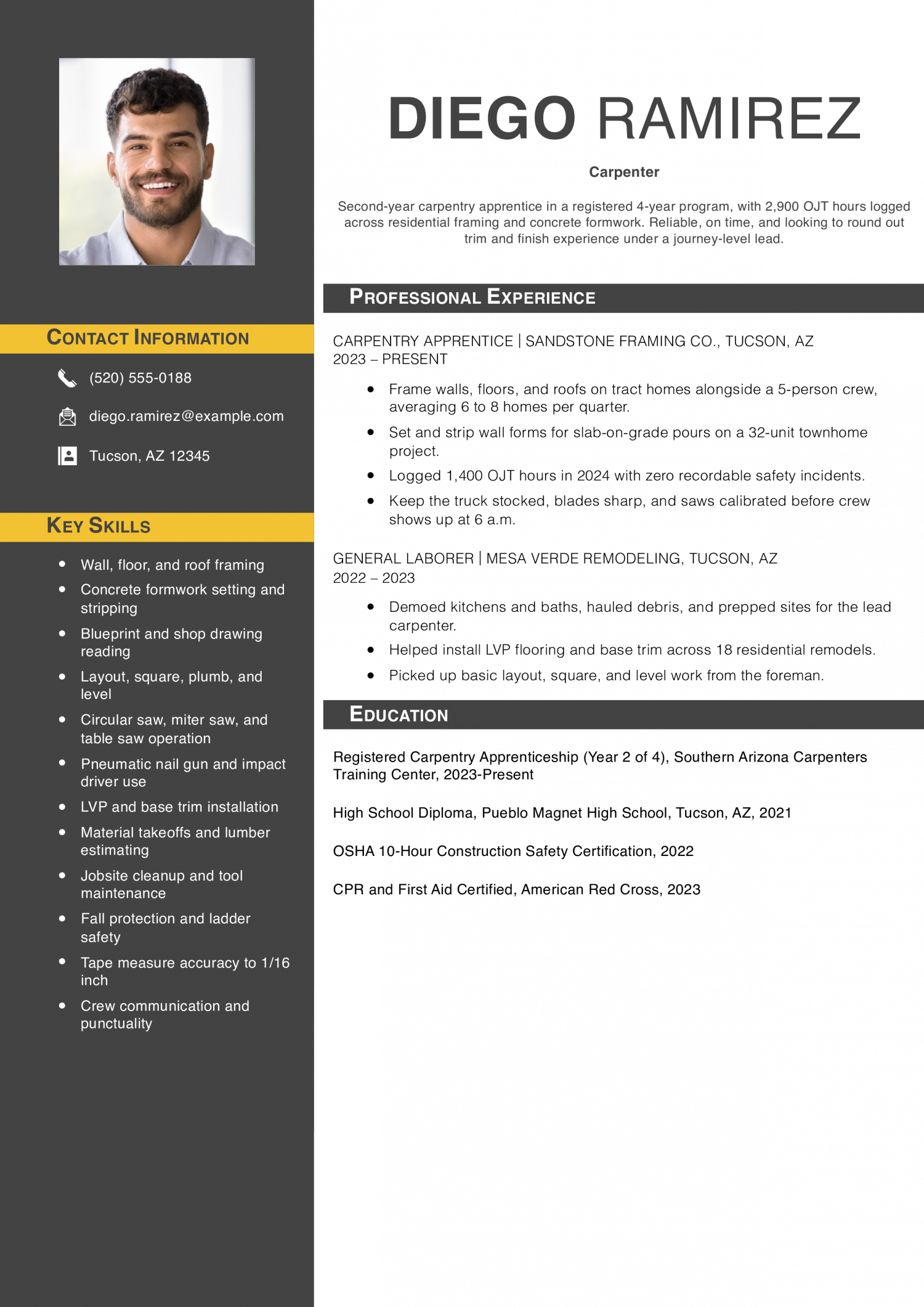
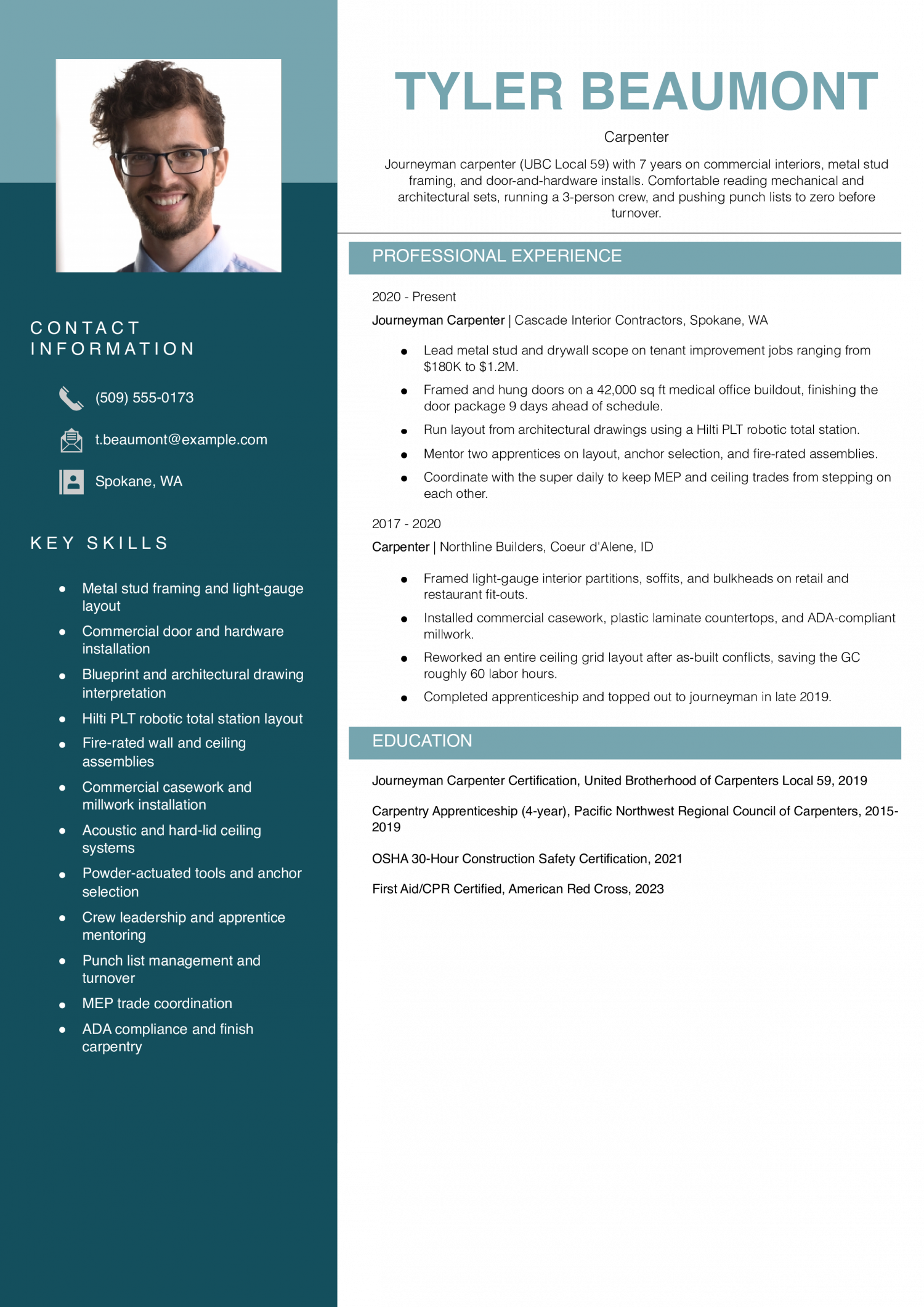
Journeymen run their own piece of the build with minimal supervision, reading prints and setting layout for the crew around them. The journeyman resume needs to prove blueprint accuracy, finished square footage, and clean inspection history across project types.
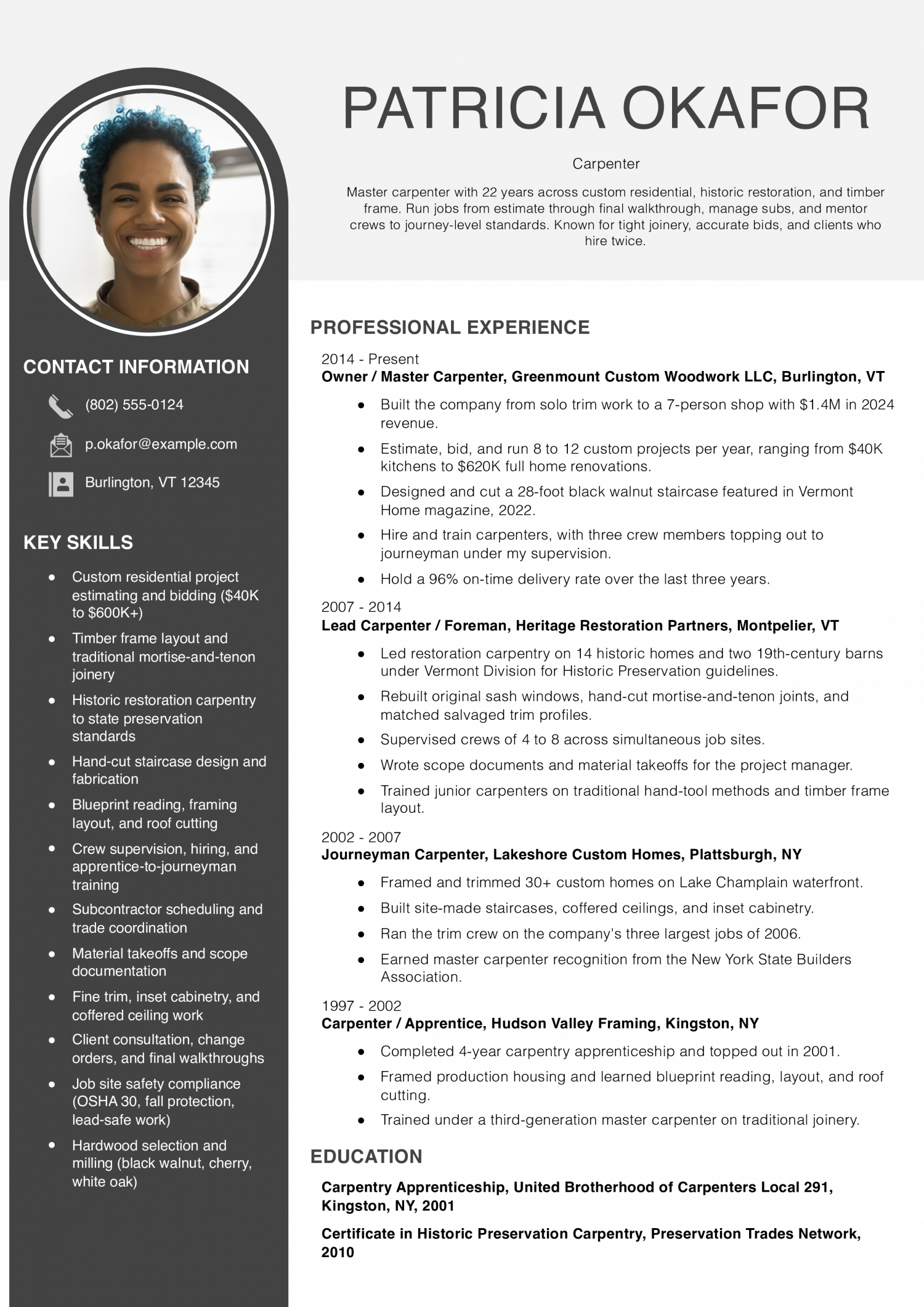
Masters lead crews, run jobs, or own the shop, and they price work as well as build it. The master resume needs to prove crew size led, project budgets delivered, and the specialty work (stairs, timber frame, historic restoration) that commands a premium.
Jonas Whitfield
Kansas City, MO | (816) 555-0167 | [email protected] | linkedin.com/in/jonaswhitfield
Carpenter with 12 years across residential framing, custom finish carpentry, and light commercial work. Skilled at running a crew, holding a $0.50-per-square-foot finish tolerance, and keeping the jobsite safe and clean. OSHA 30, forklift certified, and comfortable in front of homeowners and GCs alike.
Lead Finish Carpenter
Stonebridge Custom Homes | Kansas City, MO | 2020-Present
Carpenter
Crossroads Commercial Group | Overland Park, KS | 2016-2020
Framing Carpenter
Heartland Residential Builders | Independence, MO | 2014-2016
Carpentry Apprentice
Riverside Building Trades Council | St. Joseph, MO | 2012-2014
Your profile belongs at the top of page one and should read like a foreman’s shorthand. State your years in the trade, your classification (apprentice, journeyman, master, foreman), and the work you do week to week.
Name the build types you handle: rough framing, finish and trim, cabinetry, concrete forms, commercial metal stud, or millwork install. Add the project settings you’ve worked, such as single-family, multifamily, light commercial, or tenant improvement. A foreman scanning the top of the page wants to know within five seconds whether your scope matches the job on the board.
Trades resumes lean on volume and scope language more than percentages. Name the square footage you framed, the number of units topped out, or the linear feet of trim you ran on a typical project.
Strong bullets also name the crew size you worked in or led, the project budget, and the build duration. A bullet that reads ‘framed 38 single-family homes across two subdivisions, 1,800 to 2,400 sq ft each, on a four-carpenter crew’ tells a foreman more than ‘responsible for framing duties.’
Most carpenter resumes read better when bullets cluster by category instead of running as one long list. Sort your bullets into three or four buckets that match the job you want.
Common groupings: layout and blueprint reading, rough framing and structural, finish and trim or cabinetry, concrete forms and shoring, and safety or QC. Under each, lead with the verb that describes the work (framed, set, hung, plumbed, shimmed, scribed) and follow with the material, the spec, and the volume.
General contractors and construction foremen need to see your safety cards before they read your work history. Put a credentials block under the profile on page one with OSHA 10 or OSHA 30, first aid and CPR, scaffold user, fall protection, and any forklift or aerial lift tickets.
List the issuing body and the month and year of issue for each card. Union members should name the local and current book status. State journeyman cards and apprenticeship completion certificates go in the same block, not buried under education.
Education on a carpenter resume is short and load-bearing. List your apprenticeship program (UBC, ABC, or a state-approved non-union track) with start year, completion year, and total OJT hours logged.
Add any trade school or community college coursework in construction technology, blueprint reading, or CAD. A high-school diploma or GED is enough at the bottom if you completed an apprenticeship. Continuing education hours through the local or NCCER stack here too, with the most recent at the top.
Based on data from our user-built carpenter resumes, the skills below are the ones foremen and shop leads scan for first. Hard skills get weighted heaviest on trades resumes; soft skills earn their place when a bullet shows them in action on a job site. Match this list against the posting, then point a bullet at each soft skill you claim.
| Soft Skills | % of resumes with this skill |
|---|---|
| Attention to detail | 75% |
| Communication | 56% |
| Problem-solving | 46% |
| Time management | 38% |
| Teamwork and crew coordination | 30% |
And here are the top hard skills showing up most often.
| Hard Skills | % of resumes with this skill |
|---|---|
| Blueprint reading | 70% |
| Framing and structural carpentry | 58% |
| Finish and trim carpentry | 47% |
| Power tool operation | 35% |
| Measurement and material estimation | 33% |
Based on data from thousands of carpenters’ resumes built on ResumeTemplates.com, May 2026.
The items below are what separate a carpenter resume from one that gets put back in the pile.
An apprenticeship is the spine of an entry-level carpenter resume, and it earns its own block above work history. Foremen want to see the program, the year you started, and the OJT hours you’ve banked toward journeyman status.
List the program by full name (United Brotherhood of Carpenters Local 157, Associated Builders and Contractors of Central Texas, etc.) with the city and start year. Add your current year of apprenticeship (first, second, third, fourth) and total OJT hours logged against the 8,000-hour target most programs use.
If you’ve completed related classroom instruction (RCI) blocks, name the topics: blueprint reading, layout, concrete forms, interior systems, or rigging. This is also the place to flag any inter-local transfers, military-to-trades programs (Helmets to Hardhats), or pre-apprenticeship coursework you completed before signing the book.
Safety cards live in their own credentials block on page one, under the profile. Foremen scan this block before the work history, and missing cards can end the read before it starts.
A tight tools list signals you arrive job-site ready and know the kit each scope calls for. Keep it to one or two lines under skills, sorted by category, and skip anything a first-year apprentice owns.
List your local (United Brotherhood of Carpenters and Joiners Local 22, for example), your classification (apprentice year, journeyman, foreman), and your current book status (Book 1, Book 2, out of work list date). Add the regional council and the years you’ve held the card.
If you’ve worked through multiple locals via travel cards, name the locals and the contractors that staffed you. For non-union carpenters with ABC, Independent Electrical Contractors, or merit-shop training, list the program the same way and name any NCCER credentials earned through it.
Beyond your OSHA 10 or 30 card and state journeyman classification, the certifications below tell general contractors and construction foremen which scopes you can run and which crews you can lead. List each item with the issuing body and the month and year of issue or expiration.
The 90th-percentile carpenter out-earns the median by a wide margin, which tells you the market rewards specialty scope and crew leadership more than years swinging a hammer. Finish carpentry, stair building, concrete forms, and union foreman roles sit at the top of the band. Generalist framers cluster around the middle.
Lead your resume with the specialty work and the crew sizes you’ve run, not the total years in the trade.
| # | State | Avg. Annual |
|---|---|---|
| 1 | Hawaii | $85,970 |
| 2 | Illinois | $76,410 |
| 3 | California | $74,820 |
| 4 | Washington | $73,260 |
| 5 | Massachusetts | $71,110 |
| 6 | District of Columbia | $66,100 |
| 7 | Alaska | $65,150 |
| 8 | Minnesota | $64,650 |
| 9 | New York | $63,660 |
| 10 | Connecticut | $63,510 |
| # | State | Workers | Median |
|---|---|---|---|
| 1 | California | 106,500 | $74,820 |
| 2 | New York | 44,500 | $63,660 |
| 3 | Florida | 44,130 | $48,080 |
| 4 | Texas | 34,400 | $48,150 |
| 5 | Pennsylvania | 29,900 | $59,240 |
Resume Templates offers HR approved resume templates to help you create a professional resume in minutes. Choose from several template options and even pre-populate a resume from your profile.
Describe carpentry in concrete builds, not duties. Lead each bullet with the verb (framed, set, hung, scribed), then name the material, the spec, and the volume.
Add the project type and crew size so a foreman can picture the job. 'Framed 2,200 sq ft single-family, 16-inch on center, three-carpenter crew' beats 'performed framing duties.'
A strong summary is three lines: classification and years, build types, and one proof point.
Example: Journeyman carpenter with seven years in residential framing and finish. Run rough and trim scopes on three- to five-carpenter crews across single-family and townhome builds. OSHA 30 and current first aid.
Yes, when the posting names them or the role expects you to show up tooled out. Add a short 'Tools' line under skills with your framing nailer, track saw, miter saw, router, and any specialty kit (Festool Domino, laser level).
Skip basics like a tape measure and a speed square. Foremen assume you have those; what they want to know is whether you arrive ready to run a piece of the job on day one.
Treat seasonal and project-based work the way construction itself treats it. Group short stints under the GC or shop that staffed you, list the dates, and roll up the projects underneath as bulleted line items.
If you worked through the union hall, list the local as the employer and the contractors as the projects. Weather and slow-season gaps under three months don't need a note; longer gaps can read 'apprenticeship classroom hours' or 'CE coursework' if that's where the time went.
For a carpenter, an ATS-friendly template is the safest pick, because it puts your certifications and experience where a hiring manager scans first. A basic template is a solid alternative. Whichever you choose, keep the formatting clean and easy to parse: clear section headings, a standard font, and no graphics a parser can choke on.
Executive Resume Writer and Career Coach
Andrew Stoner is an executive career coach and resume writer with 17 years of experience as a hiring manager and operations leader at two Fortune 500 Financial Services companies, and as the career services director at two major university business schools.
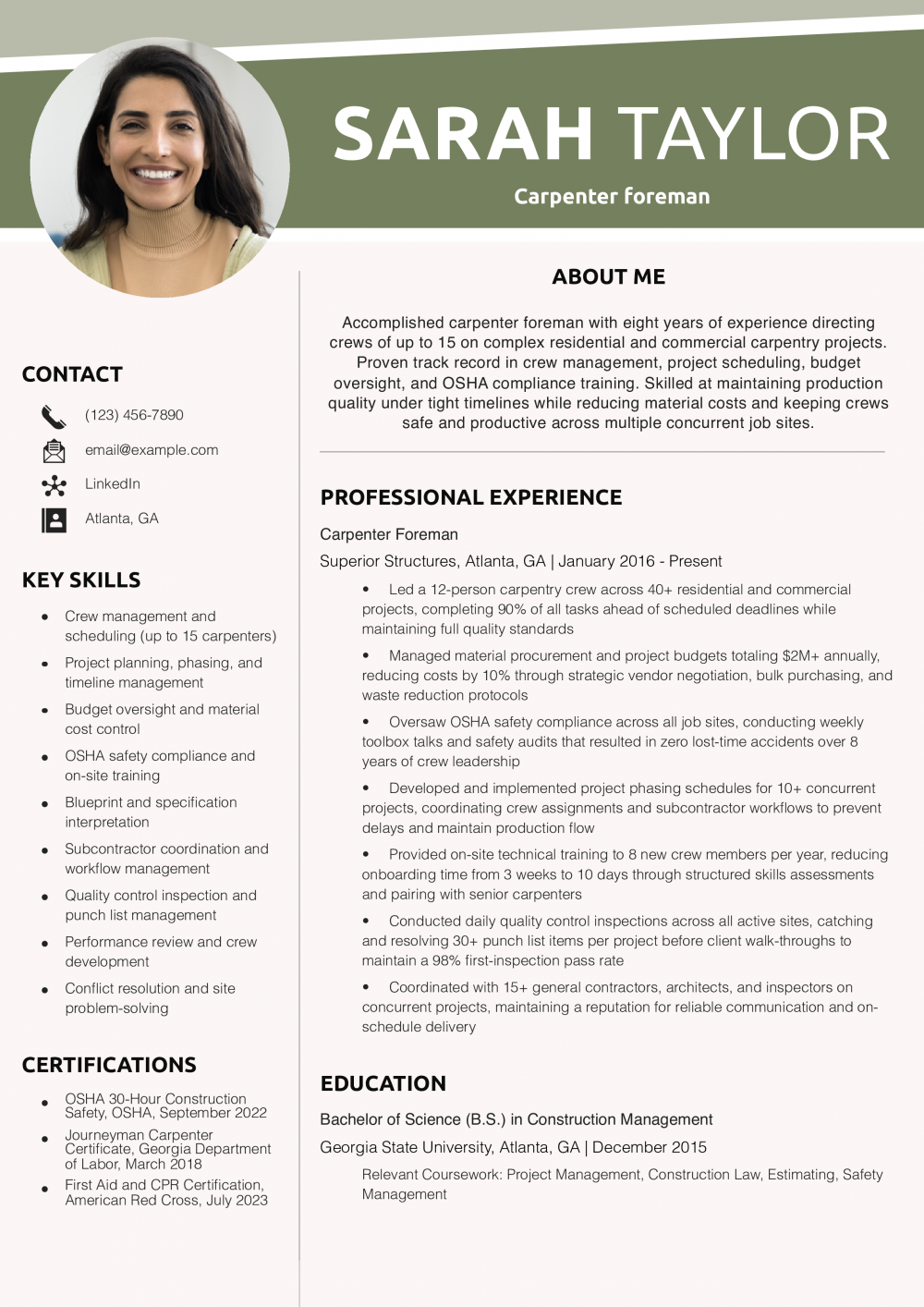
Customize this template in our builder in under 10 minutes.

![19 Best Plumber Resume Examples and Templates for [y]](/wp-content/uploads/2025/01/Plumber-Resume-Example.x400.pdf.jpeg)