
Tip !

Shop foremen and welding contractors look for your process list, code qualifications, and pipe diameter range on the first page, because it shows whether you can pass their weld test and bill out by Friday.

Andrew Stoner , Executive Resume Writer and Career Coach

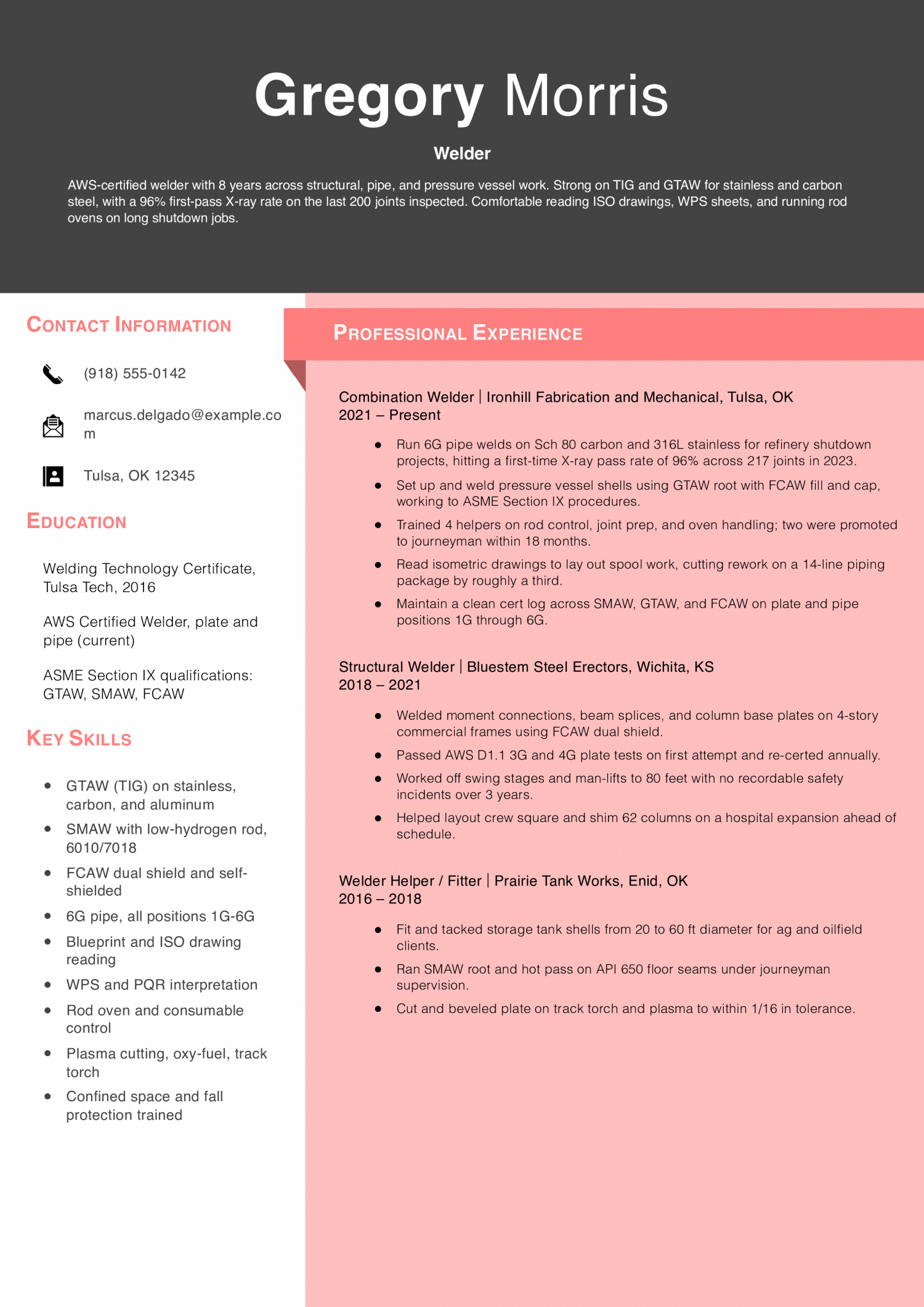
Why this resume works

  • Hard numbers on weld quality: The 96% X-ray pass rate on 217 joints tells a shop foreman exactly how clean this welder’s work is.
  • Shows real code knowledge: Mentions of ASME Section IX, AWS D1.1, and API 650 prove he can work on jobs that require qualified procedures.
  • Grew into more responsibility: The path from tank helper to combination welder training others is easy to follow and signals he can lead a small crew.

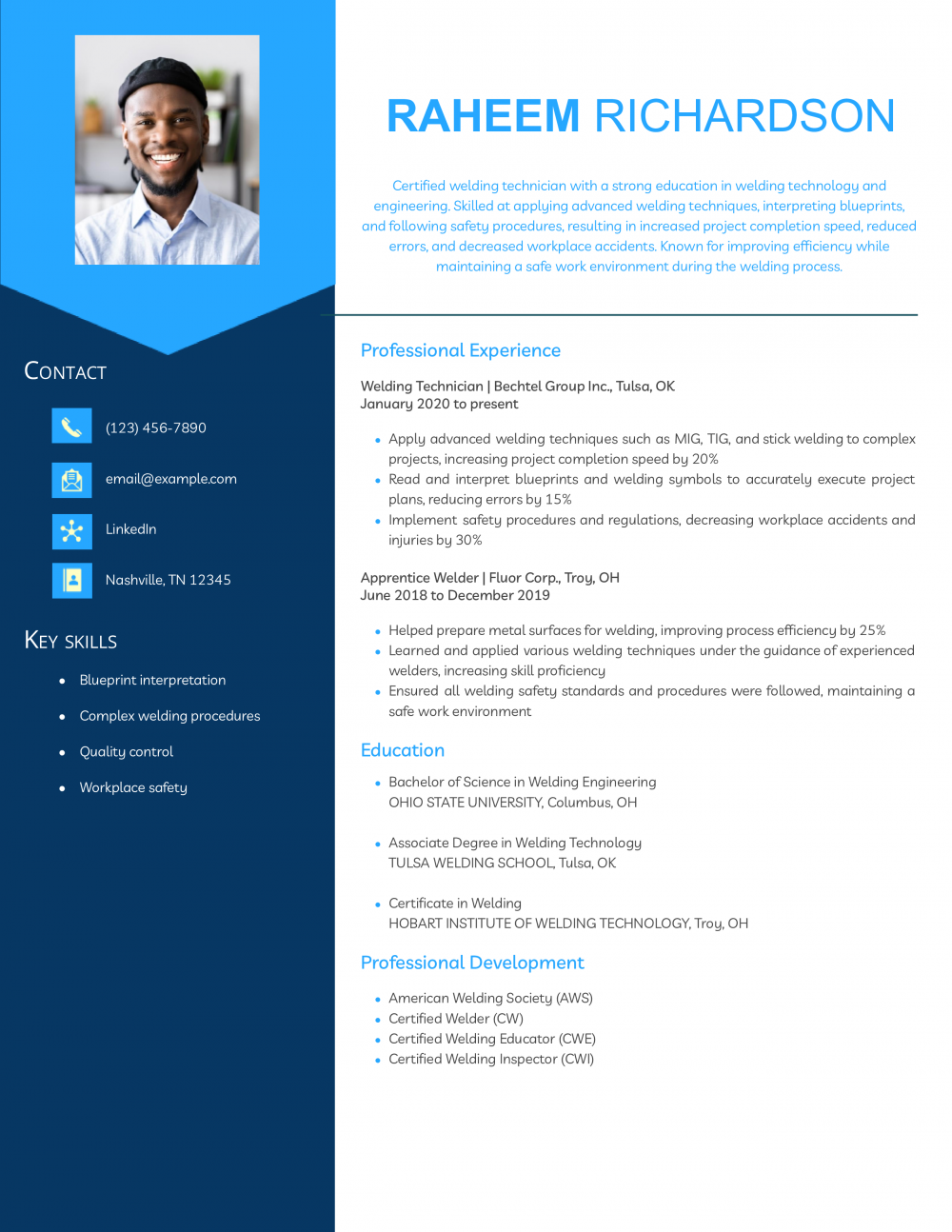
Apprentice Example

The apprentice tier covers welders with two years or less of shop time, often coming out of a trade school or union apprenticeship. Your resume needs to prove process exposure, AWS Entry Welder status, and any weld test passes on coupons.

Why this resume works

  • Shows the hours, not just talk: Listing 1,432 supervised arc hours tells a hiring foreman exactly how much real time he has on the hood.
  • Names the right processes: MIG short-circuit and spray transfer, plus 7018 and 6010 rod, are the exact terms shop leads scan for.
  • Honest about role: He calls himself an apprentice and lists the helper job underneath, which builds trust instead of overselling.

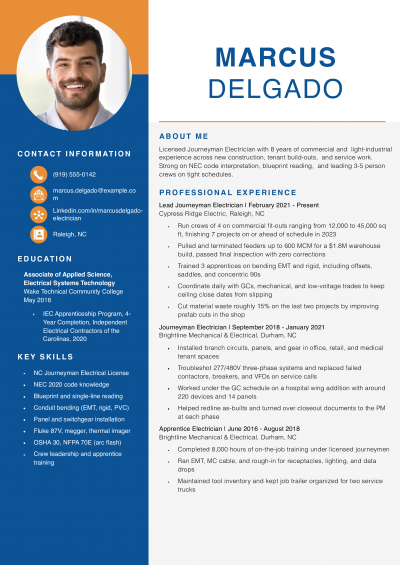
Journeyman Example

The journeyman tier covers welders running production solo on structural or pipe work, with three to eight years in the trade. Your resume needs to prove code qualifications, position range (1G through 6G), and consistent radiographic pass rates.

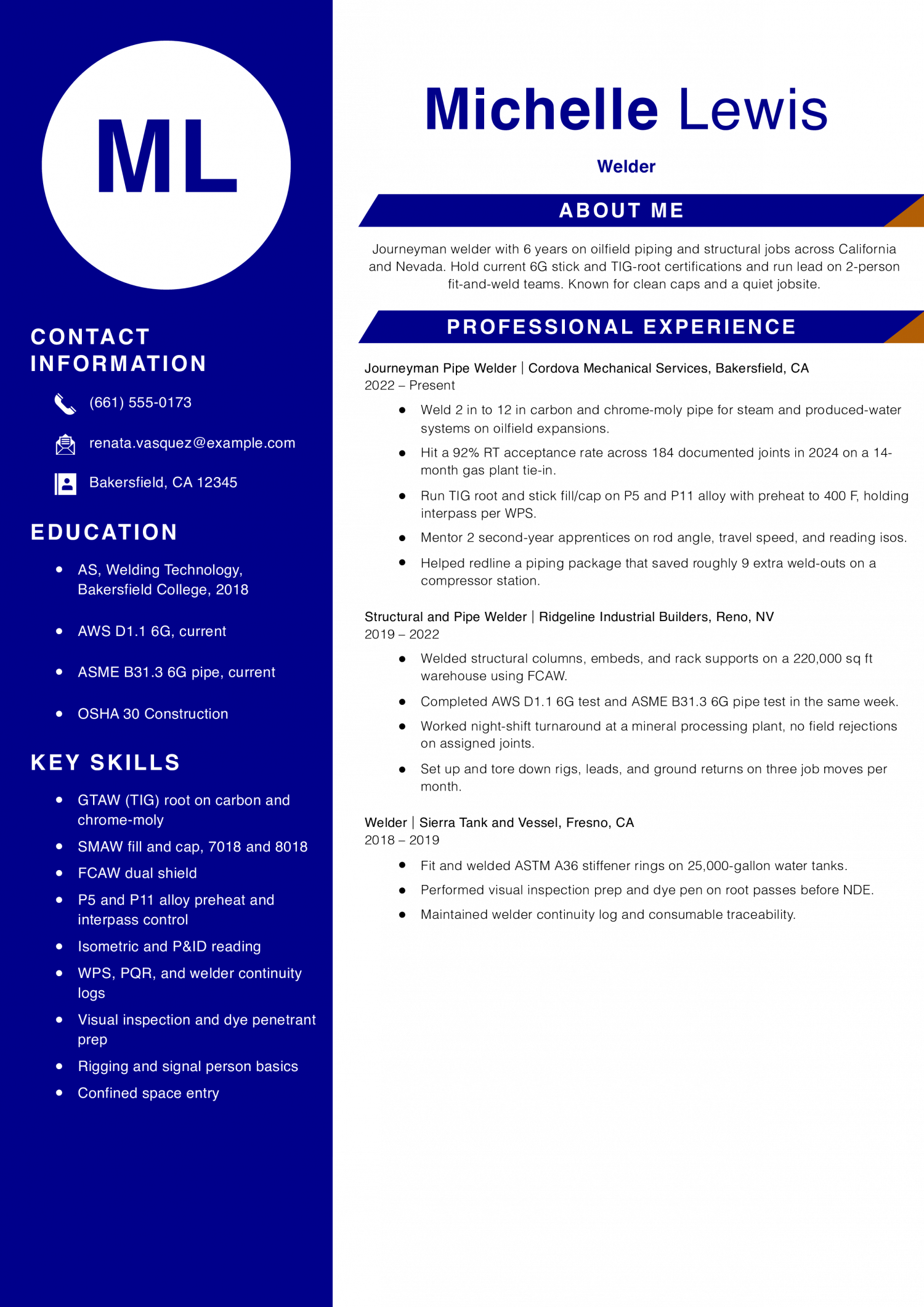
Why this resume works

  • Names the metals and codes: P5, P11, ASME B31.3, and preheat numbers show this welder can be dropped into refinery or power work without retraining.
  • Quality number on the work: 92% RT acceptance across 184 joints is the kind of stat a QC manager actually wants to see.
  • Mentoring is on the page: Coaching two apprentices signals she is ready for a lead-hand role on the next job.

Master Example

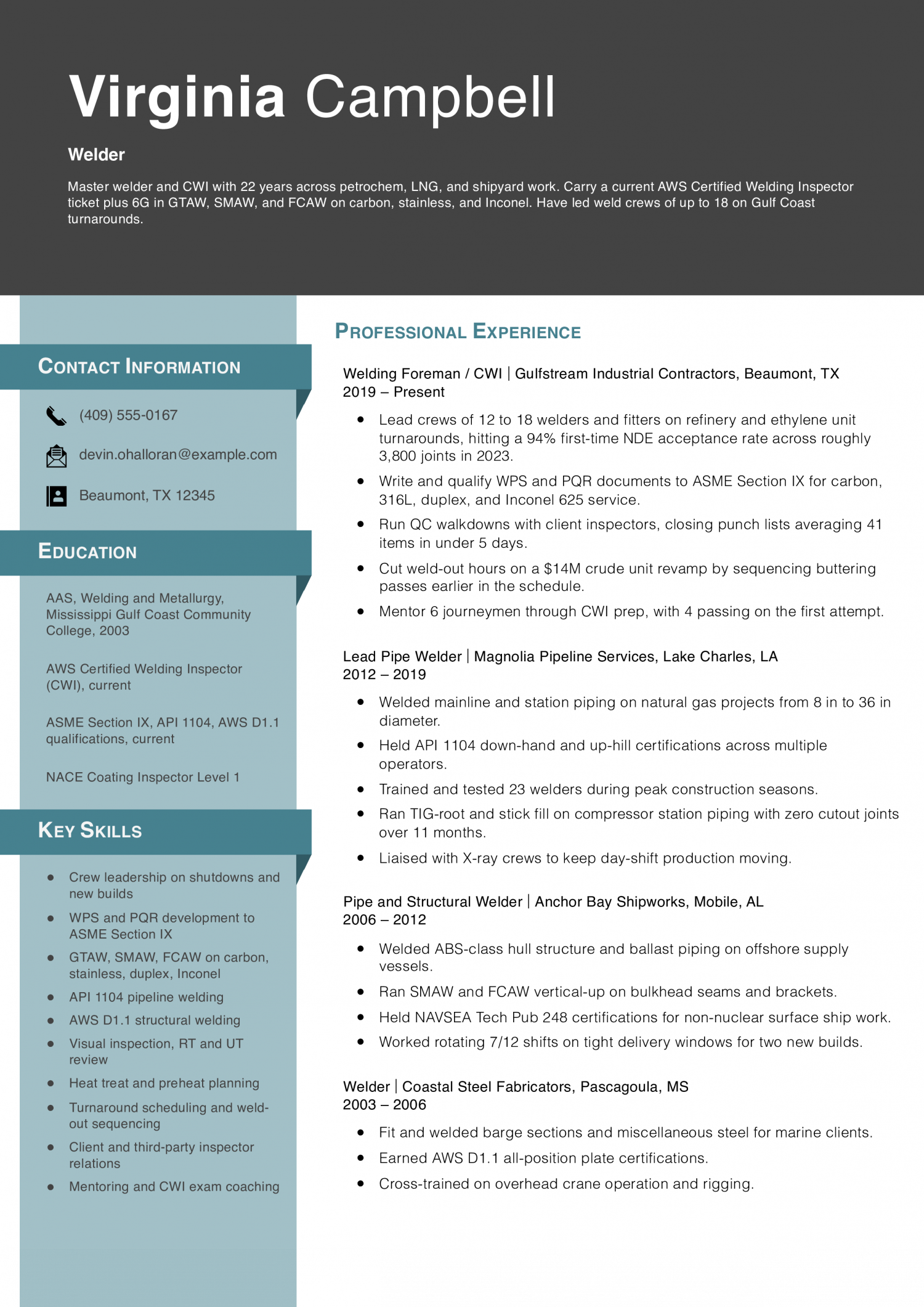
The master tier covers certified welding inspectors, welding supervisors, and pipe foremen with a decade or more on tools. Your resume needs to prove CWI status, crew leadership, code-section knowledge, and project scope in dollar or weld-count terms.

Why this resume works

  • Owns both the hood and the clipboard: Holding the CWI plus active welder certs is rare and lets him run a crew and stamp the paperwork.
  • Tied numbers to dollars and joints: 94% NDE acceptance across roughly 3,800 joints and a $14M revamp give scale to the work.
  • Career path covers heavy industries: Refinery, pipeline, and shipyard time tells hiring managers he has seen the codes, metals, and inspectors they care about.

How to Write a Welder Resume

01 Open with a profile that names your process scope

Your profile should state your years on the torch, the processes you run daily (SMAW, GMAW, GTAW, FCAW), and the materials you weld (carbon steel, stainless, aluminum, Inconel).

Name the codes you qualify under, such as AWS D1.1, ASME Section IX, or API 1104. Include your position range, from 1G flat through 6G pipe, so foremen can match you to the work order on their desk.

02 Quantify weld output and pass rates

Bullets without a number tend to read as job duties. Strong welder bullets cite radiographic pass rates, linear feet of weld per shift, or pipe joints completed on a spool.

Name the inspection method: RT, UT, MT, or PT. A line like “Held a 98% RT pass rate across 240 6-inch carbon steel pipe joints on a refinery turnaround” gives a foreman three data points in one sentence.

03 Group your work by process and project

Cluster bullets under each role by what you actually welded: structural steel erection, pressure pipe, sanitary tube, sheet metal fabrication, or repair and maintenance.

Inside each cluster, name the project type (refinery shutdown, bridge deck, food-grade tank, pressure vessel), the material thickness range, and the joint configurations. This shows scope without forcing the reader to guess.

04 Place credentials and tickets up top

Welder qualifications belong in a credentials block on page one, directly under your profile. List each AWS or ASME qualification by process, position, material, and thickness range, plus the date last welded.

Add your OSHA 10 or 30 card, confined space training, rigging certification, and forklift license. Shop foremen and welding contractors need to confirm you can step onto the job site without a hold.

05 Close with apprenticeship and continuing education

Education sits at the bottom. List your apprenticeship local (UA Local 290, Ironworkers Local 7), the completion year, and the hour count if you finished.

Add trade school programs, manufacturer training on welding power sources (Miller, Lincoln, ESAB), and any CWI or CWE coursework. This signals you keep your tickets current and invest in the trade.

The welder resumes that get callbacks share a specific skill mix. The lists below come from our user-built welder resumes. Shop foremen and welding contractors scan for these patterns first, not generic “hard worker” framing.

Hard skills are non-negotiable: a foreman either trusts you on 6G pipe or moves on. Soft skills back the bullets, showing you read prints, work safe, and hand off cleanly between shifts. Match the hard-skill list against the job posting, then use the soft skills as evidence threaded through your bullet points.

Soft Skills % of resumes with this skill
Attention to detail 69%
Teamwork and collaboration 68%
Problem-solving skills 42%
Communication abilities 38%
Safety compliance 31%

And here are the top hard skills showing up most often.

Hard Skills % of resumes with this skill
MIG welding 80%
TIG welding 67%
Blueprint reading 45%
Stick welding 39%
Metal fabrication 25%

Based on data from thousands of welders’ resumes built on ResumeTemplates.com, May 2026.

Must Have on a Welder Resume

Before a welder resume gets a closer read, hiring teams check for a short list of essentials.

Apprenticeship Routes

Union and non-union apprenticeships carry weight with foremen because they signal logged hours, supervised tickets, and a known training standard. List your local, completion status, and hour count.

Apprentices: Lead With Hours, Not Years

Most welders break in through a UA, Ironworkers, Boilermakers, or Sheet Metal local, or through a non-union program at a trade school or community college. Each route produces a different signal on the resume.

Put apprenticeship details in a dedicated block under education. Name the local number, the program length, your completion year, and any specialty endorsements you earned during the program.

  • Local name and number (e.g., UA Local 290, Ironworkers Local 433)
  • Program length in years and total OJT hours logged
  • Related instruction hours completed in welding theory and code
  • Specialty endorsements: rigging, signaling, instrument fitting
  • Final journeyman test date and process tested

OSHA Certifications

OSHA cards and site-safety credentials confirm you can step onto a job site without a hold. List them in your credentials block with the issue date.

  • OSHA 10 or OSHA 30 (Construction or General Industry)
  • Confined Space Entry and Attendant training
  • NCCER Rigger and Signal Person certification
  • Hot work permit and fire watch training
  • TWIC card for port, refinery, and chemical plant access
  • Forklift, scissor lift, and aerial work platform operator cards

Tools of the Trade

Naming the specific power sources, consumables, and fit-up tools you have run gives foremen a quick read on shop fit. List brands and model families, not every serial number.

  • Power sources: Miller XMT, Dynasty, PipePro; Lincoln Power Wave, Idealarc; ESAB Rebel
  • Wire feeders and suitcase units: Miller SuitCase, Lincoln LN-25
  • Plasma and oxy-fuel cutting: Hypertherm Powermax, Victor torch sets
  • Fit-up and layout: pipe wraps, levels, squares, flange aligners, chain falls
  • Grinding and finishing: 4.5-inch and 7-inch angle grinders, needle scalers
  • Inspection tools: fillet weld gauges, undercut gauges, pyrometers for preheat

How to List Union Membership on a Welder Resume

On union jobs, your local and book status decide whether you get the call. Non-union shops read union experience as a signal of structured training and travel readiness.

Add a one-line “Union Affiliation” entry near your credentials block. Name the international, local number, member status (journeyman, apprentice), and travel-card history if you have worked out of other locals.

  • UA (United Association) for plumbers, pipefitters, welders, HVACR
  • Ironworkers (IW) for structural, reinforcing, and ornamental
  • Boilermakers (IBB) for pressure vessel, power generation, shipyard
  • Sheet Metal Workers (SMART) for HVAC and architectural sheet metal
  • Operating Engineers (IUOE) for stationary welding on heavy equipment

Welding Credentials That Get You the Job

A current AWS qualification record and OSHA 10 card keep you eligible. The certifications below are what move a welder resume from the qualified-but-typical stack into the shortlist for high-bid pipe and code work. List each one with the issuing body, level, and date last welded or expiration.

  • AWS Certified Welder: The portable third-party qualification foremen recognize across state lines, tied to specific process, position, and material.
  • AWS Certified Welding Inspector (CWI): Opens supervisor, QC, and weld-test administrator roles; signals you can read codes and reject bad welds, not just lay them.
  • ASME Section IX Procedure Qualification: Required for pressure vessel, boiler, and refinery pipe work; list the WPS number, process, and base metal P-number.
  • API 1104 Pipeline Qualification: The ticket for cross-country gas and oil pipeline work; pair it with your 6G position and downhill SMAW experience.

Latest BLS Statistics for Welders

For welders, the 10th-percentile floor sits at the entry shop-hand tier and the top-decile ceiling sits with code-qualified pipe welders, CWIs, and underwater or aerospace specialists. That spread tells you process specialty, code qualification, and willingness to travel for shutdowns and pipeline work move a candidate from floor to ceiling more than tenure alone.

Lead your resume with the processes, codes, and position range that map to the higher band, not generic “welder with X years of experience” framing.

$51,000 National median annual
$55,100 National mean annual
$38,130 Entry-tier floor (10th percentile)
$75,850 Top-decile ceiling (90th percentile)
424,040 Welders in the U.S.
Where you stand

Entry tier

$38,130 to $51,000 At the entry tier, lead with your AWS Entry Welder status, apprenticeship hours logged, and the processes you have tested on.

Mid band

$51,000 to $75,850 At the mid band, your resume needs to show AWS D1.1 or ASME IX qualifications, position range through 6G, and radiographic pass rates.

Top decile

$75,850+ At the top decile, lead with CWI credentials, crew size supervised, pipeline or pressure scope, and turnaround project dollar value.

Top-paying states

# State Avg. Annual
1 Hawaii $76,970
2 Alaska $75,140
3 Wyoming $66,070
4 Connecticut $64,520
5 Washington $61,730
6 Massachusetts $61,710
7 North Dakota $60,270
8 Louisiana $59,860
9 New Jersey $59,630
10 Nevada $59,370

Highest-employment states

# State Workers Median
1 Texas 56,650 $49,830
2 California 26,100 $57,940
3 Ohio 20,110 $49,410
4 Illinois 17,340 $49,730
5 Wisconsin 16,820 $55,630
Source: U.S. Bureau of Labor Statistics, OEWS 2024 release (SOC 51-4121).
Written by professional resume writers and loved by hiring managers

Resume Templates offers HR approved resume templates to help you create a professional resume in minutes. Choose from several template options and even pre-populate a resume from your profile.

Frequently Asked Questions

Is welding a good career to put on a resume right now?

Welding holds steady demand across infrastructure, energy, and shipbuilding. Code-qualified pipe welders and CWIs see the strongest call-back rates.

Frame your resume around the niche with the most hiring pressure in your region. Refinery turnarounds, LNG buildouts, and structural steel on data center projects all read well to recruiters right now.

What should a welder resume objective or summary say?

Skip the objective statement. It wastes prime real estate at the top of page one.

Use a three-line profile instead. Name your years in the trade, your top two processes (GTAW and SMAW), your material range, and the codes you qualify under.

How do I list welding certifications without writing the certification numbers?

List the certifying body, process, position, material, and date last welded. For example: "AWS D1.1, GMAW, 3G, carbon steel, last welded March 2026."

Hold the actual qualification record numbers for the application form. Most shops will pull your CR through the AWS database or run their own weld test anyway.

What format works best for a welder resume?

Use a reverse-chronological format on one page. Put your profile, credentials block, and process list above the fold.

Save as a PDF unless the posting asks for a Word document. Keep the layout single-column so ATS parsers and shop office managers can both read it cleanly.

Which resume template works best for a welder?

For a welder, an ATS-friendly template is the safest pick, because it puts your certifications and experience where a hiring manager scans first. A basic template is a solid alternative. Whichever you choose, keep the formatting clean and easy to parse: clear section headings, a standard font, and no graphics a parser can choke on.

Rate this article

Welder Resume

Average Rating

4.8/5 stars with 180 reviews

You have given 0 Star(s)
4.8/5 stars with 180 reviews
Andrew Stoner

Executive Resume Writer and Career Coach

Andrew Stoner is an executive career coach and resume writer with 17 years of experience as a hiring manager and operations leader at two Fortune 500 Financial Services companies, and as the career services director at two major university business schools.