General Laborer Resume Examples and Templates for 2026



Electrical contractors decide whether to call within the first third of the resume; if the state license, classification, and OSHA cards aren't visible by then, the foreman moves to the next stack.
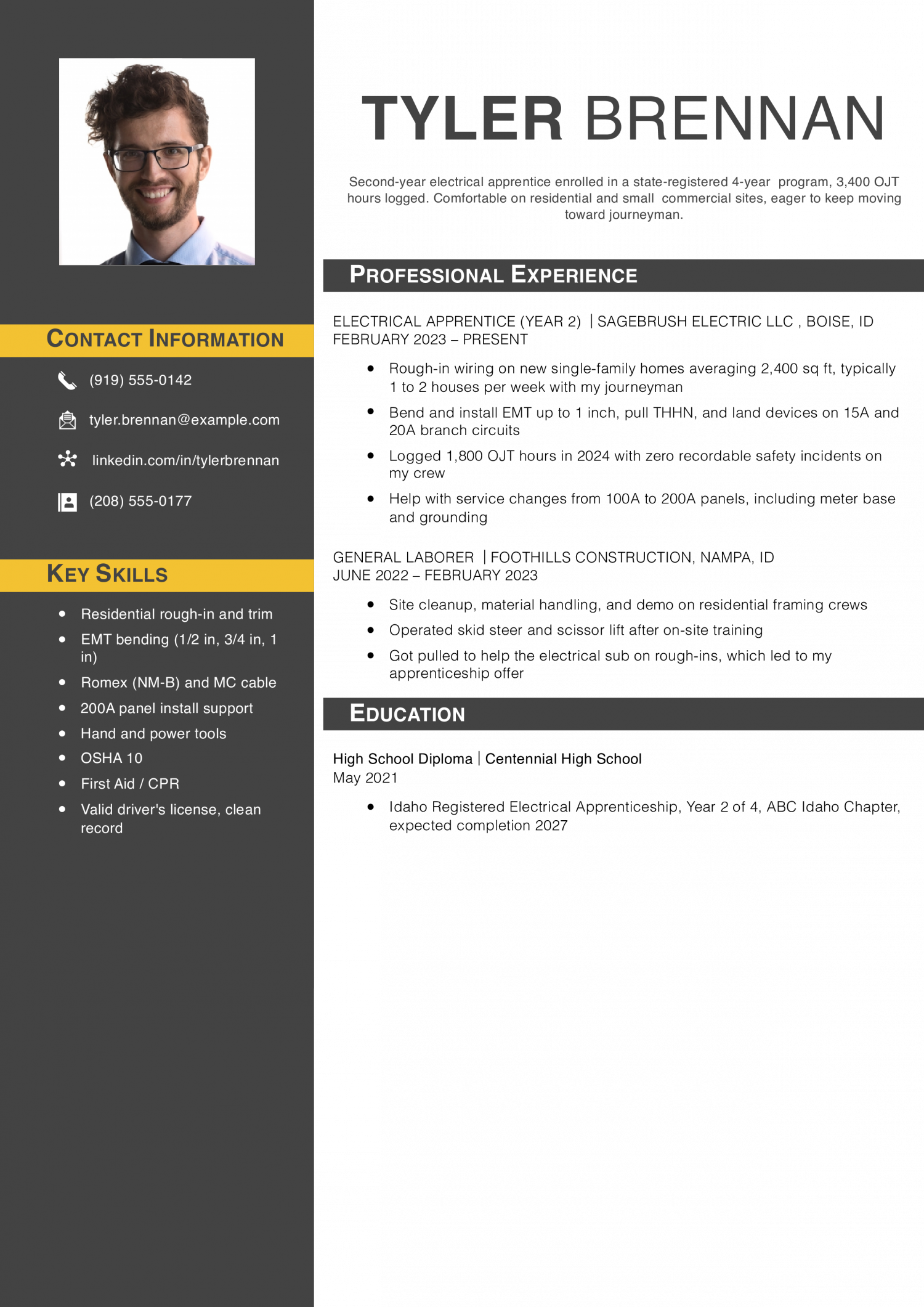
The apprentice tab fits readers logging hours toward a journeyman card, often through an IBEW/NECA or state-registered program. This resume needs to prove enrolled hours, classroom progress, and the hand tools you already run safely on a jobsite.
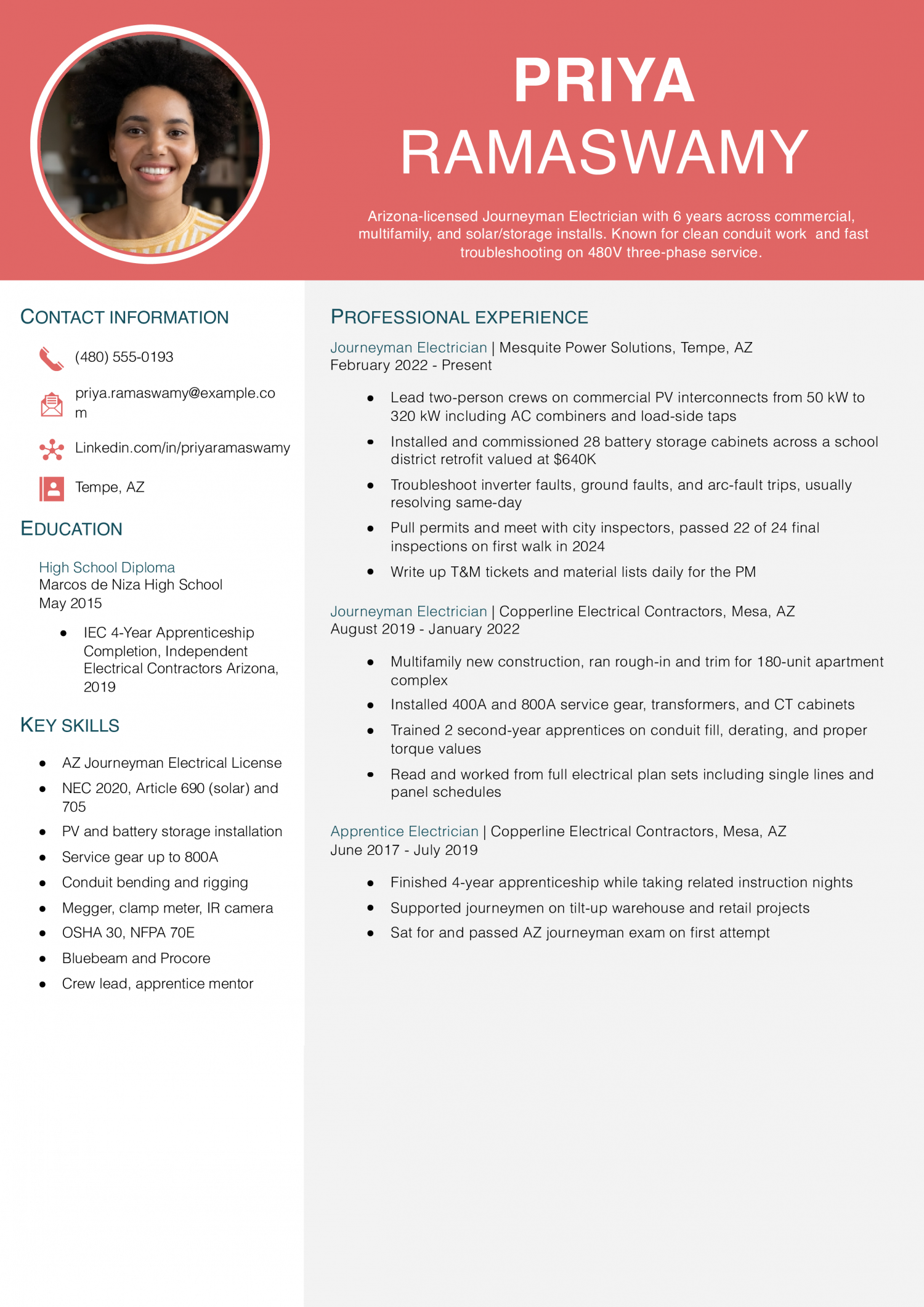
The journeyman tab fits licensed electricians running circuits, panels, and service work without daily supervision. This resume needs to prove your state license, code knowledge across NEC chapters you actually pull from, and the project types you've closed out.
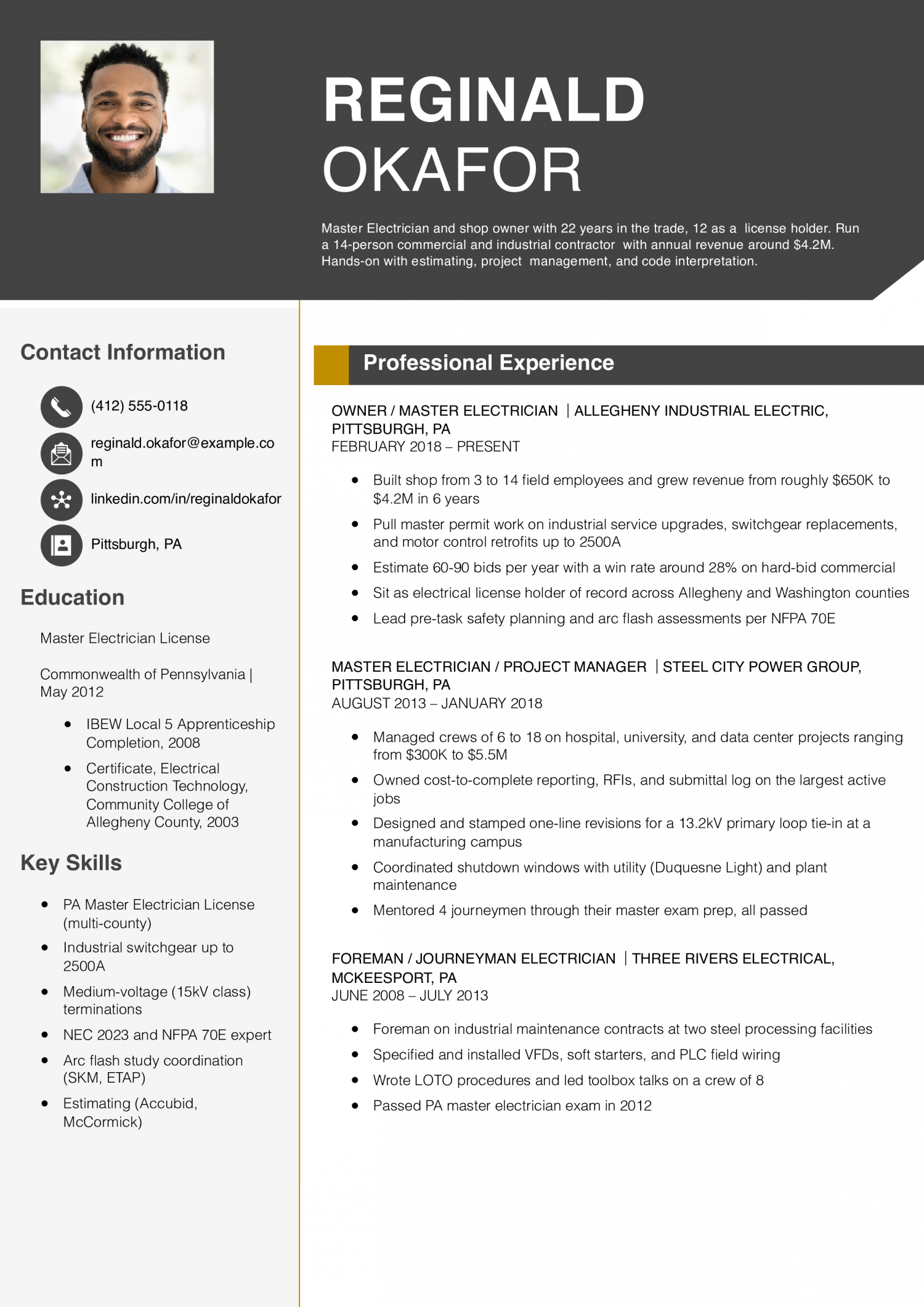
The master tab fits electricians who pull permits, sign off on inspections, and run crews or a shop. This resume needs to prove your master license, the dollar scope of jobs you've supervised, and the contractor or PE relationships you carry.
Daniel Whitlock
Greenville, SC | (864) 555-0166 | [email protected] | linkedin.com/in/danielwhitlock-electrician
Licensed Journeyman Electrician with 9 years across commercial new construction, industrial maintenance, and service work. Strong on conduit layout, gear installation, and troubleshooting under live conditions. Comfortable leading crews of 3 to 6 and coaching apprentices on code and safe work practices.
Lead Journeyman Electrician
Palmetto Voltage Group | Greenville, SC | 2022-Present
Journeyman Electrician
Upstate Industrial Services | Spartanburg, SC | 2019-2022
Journeyman Electrician
Carolina Bright Electric | Anderson, SC | 2017-2019
Apprentice Electrician
Carolina Bright Electric | Anderson, SC | 2015-2017
Your profile should state your license classification, the state you hold it in, and the work you handle in a typical week.
Name your years in the trade, the settings you’ve worked in (residential, commercial, industrial, line, controls), and the systems you touch most. A journeyman who pulls feeders, sets panels, and troubleshoots motor controls reads very differently from one who runs MC cable in track homes. Add your OSHA 10 or 30 status and any arc-flash training in the same block so the contractor sees it in the first six lines.
Electrical work measures cleanly, so put numbers on it. Most strong bullets name amp service sizes, panel counts, conduit runs, square footage, or crew size.
Write 200-amp residential service upgrades by the count, commercial tenant fit-outs by square footage, and industrial work by horsepower or voltage class. Bullets without a number tend to read as duties. Recruiters and foremen scan for service size, conduit type, and voltage class before they read the verb.
Sort your bullets into the categories the trade actually uses. Service and feeders, branch circuits and devices, conduit and raceway, motor controls and VFDs, and low-voltage or fire alarm each signal a different skill set.
Name the methods inside each group: EMT, rigid, and PVC bending; MC and AC cable; 277/480V three-phase service; PLC troubleshooting; and Megger testing. A foreman reading this can place you on a crew before the interview.
Master electricians and contractors need to see your credentials before they read your job history. Build a credentials block under the profile that lists your state journeyman or master license (state plus status, not the number), OSHA 10 or 30, NFPA 70E arc-flash, CPR/first aid, and any EVITP, fire alarm, or low-voltage endorsements.
Add apprenticeship completion (IBEW/NECA JATC or state-registered) with the program name and year. Tickets buried on page two cost callbacks because the foreman never gets there. If you are working toward running job sites, see our construction superintendent resume examples for ways to present your credentials.
End the resume with apprenticeship classroom hours, code update classes, and any trade school coursework. Name the program (a JATC local, an ABC chapter, or a community college electrical technology track) and the completion year.
List continuing education hours toward license renewal by topic: NEC 2023 updates, grounding and bonding, motor controls, or solar PV. This signals you keep your card current and you stay sharp on code cycles, which matters to inspectors and permit-pulling masters.
The skills below come from electrician resumes our users built on ResumeTemplates.com. Master electricians and electrical contractors scan dozens of resumes a week, and these are the terms that show up most often. Contractors weigh hard skills first because the license, NEC chapters, and voltage classes decide whether you can do the job at all.
Soft skills like crew coordination and customer communication get weighed once the technical floor is clear. Match this list against the posting you’re applying to, and use soft skills as evidence backing your bullets, not standalone claims.
| Soft Skills | % of resumes with this skill |
|---|---|
| Problem solving | 75% |
| Attention to detail | 57% |
| Communication | 41% |
| Teamwork | 40% |
| STime management | 26% |
And here are the top hard skills showing up most often.
| Hard Skills | % of resumes with this skill |
|---|---|
| Electrical wiring installation | 66% |
| Blueprint reading | 52% |
| NEC code compliance | 49% |
| Electrical troubleshooting | 38% |
| Preventive maintenance | 28% |
Based on data from thousands of electricians’ resumes built on ResumeTemplates.com, May 2026.
These are the must-haves hiring teams look for when scanning an electrician resume.
Electrical licensing is a state matter, and the classifications, hour requirements, and reciprocity rules vary widely. Your resume should match the language the licensing board in your state uses.
Most states issue at three tiers: apprentice (or trainee), journeyman, and master. A few states (Illinois, New York, Pennsylvania) license at the city or county level instead of the state, so list the jurisdiction that issued your card.
Reciprocity exists between some states (the NEC-based agreements among Arkansas, Colorado, Idaho, Iowa, Maine, Montana, Nebraska, New Hampshire, North Dakota, Oklahoma, South Dakota, Utah, and Wyoming are the most common). If you’re applying across state lines, name your current state plus any reciprocal states you can pull a card in.
Apprenticeship hours are the currency of the trade. Document them the way the licensing board counts them.
Name the program (IBEW/NECA JATC Local 26, ABC Greater Houston, or a state-registered program), the start year, and the year of completion or expected completion. Add total on-the-job hours and classroom hours separately.
Inside the work history, write bullets that show what you ran without direct supervision by your final year: device trim-out on rough-in jobs, panel feeds under 200 amps, EMT bends to 1-1/4 inch. That’s what the journeyman test, and the next foreman, want to see.
Safety tickets get scanned before the work history on most commercial and industrial postings. Group them in the credentials block on page one.
Listing tools by brand and model is overkill, but naming the categories you run signals what kind of work you’ve done.
Place union membership in the credentials block or in a single line under your name and contact information. Write ‘IBEW Local 11, Los Angeles’ or similar, with your book status if you’re between calls.
Inside the work history, name the signatory contractor and the project if it’s notable (a data center build, a hospital expansion, a refinery turnaround). For travelers, list the locals you’ve worked out of in the past five years.
Electrical contractors read this list as a map of where your work is heading. The certifications below tell them which track (industrial controls, solar, EV, fire alarm) you’ve invested in beyond the journeyman card. List the issuing body and the year completed on one line each.
For electricians, the 10th-percentile floor sits well below the median, and the top-decile ceiling stretches into territory most journeymen don’t see without a specialty or a master card. That spread tells you license classification, sector (industrial and utility over residential), and union signatory status move a candidate from floor to ceiling more than tenure alone. Geography matters too: high-employment states pay differently than top-paying states, and the gap shows up in the tables below.
Lead your resume with the license class, the sector, and the systems (controls, service, solar, EV) that map to the ceiling.
| # | State | Avg. Annual |
|---|---|---|
| 1 | Oregon | $97,320 |
| 2 | Washington | $96,530 |
| 3 | Illinois | $96,360 |
| 4 | Hawaii | $83,200 |
| 5 | Massachusetts | $82,120 |
| 6 | District of Columbia | $81,950 |
| 7 | Alaska | $81,860 |
| 8 | Minnesota | $81,430 |
| 9 | New York | $77,460 |
| 10 | Connecticut | $76,790 |
| # | State | Workers | Median |
|---|---|---|---|
| 1 | California | 73,420 | $76,540 |
| 2 | Texas | 71,880 | $56,920 |
| 3 | Florida | 47,980 | $53,100 |
| 4 | New York | 40,380 | $77,460 |
| 5 | Ohio | 27,150 | $63,560 |
Resume Templates offers HR approved resume templates to help you create a professional resume in minutes. Choose from several template options and even pre-populate a resume from your profile.
Lead with NEC code work, conduit bending (EMT, rigid, PVC), service and panel installation, and the voltage classes you handle (120/240V residential, 277/480V three-phase commercial).
Add motor controls, VFDs, PLC troubleshooting, and Megger testing if you've touched them. Round out with safety tickets: OSHA 30 and NFPA 70E arc-flash.
Skip generic terms like 'hard working' or 'team player.' Contractors scan for code cycles, voltage, and ticket acronyms first.
Open with your apprenticeship enrollment: the program (IBEW/NECA JATC Local, ABC chapter, or state-registered), your year in the program, and total on-the-job hours logged.
Then list the work you've assisted on by category: rough-in, device trim-out, conduit runs, panel feeds. Name the tools you run without supervision (benders, fish tape, multimeter).
Close with OSHA 10 and any CPR or first aid cards. A foreman reading this can place you on a crew on day one.
Write something like 'Journeyman Electrician, Texas, in good standing' or 'Master Electrician, Ohio.' That tells the contractor what they need to know.
Save the license number for the application form or background check stage. Most state boards advise against publishing the number on a public document because it can be misused.
For commercial work, name square footage of fit-outs, the service size in amps, and the GCs you ran feeders for. A 40,000-square-foot tenant fit-out with a 1,200-amp service reads very differently from a strip mall.
For industrial work, name horsepower of motors wired, voltage class, and the controls platform (Allen-Bradley, Siemens). Add any work in classified or hazardous locations under NEC Article 500.
For an electrician, an ATS-friendly template is the safest pick, because it puts your certifications and experience where a hiring manager scans first. A basic template is a solid alternative. Whichever you choose, keep the formatting clean and easy to parse: clear section headings, a standard font, and no graphics a parser can choke on.
Executive Resume Writer and Career Coach
Andrew Stoner is an executive career coach and resume writer with 17 years of experience as a hiring manager and operations leader at two Fortune 500 Financial Services companies, and as the career services director at two major university business schools.
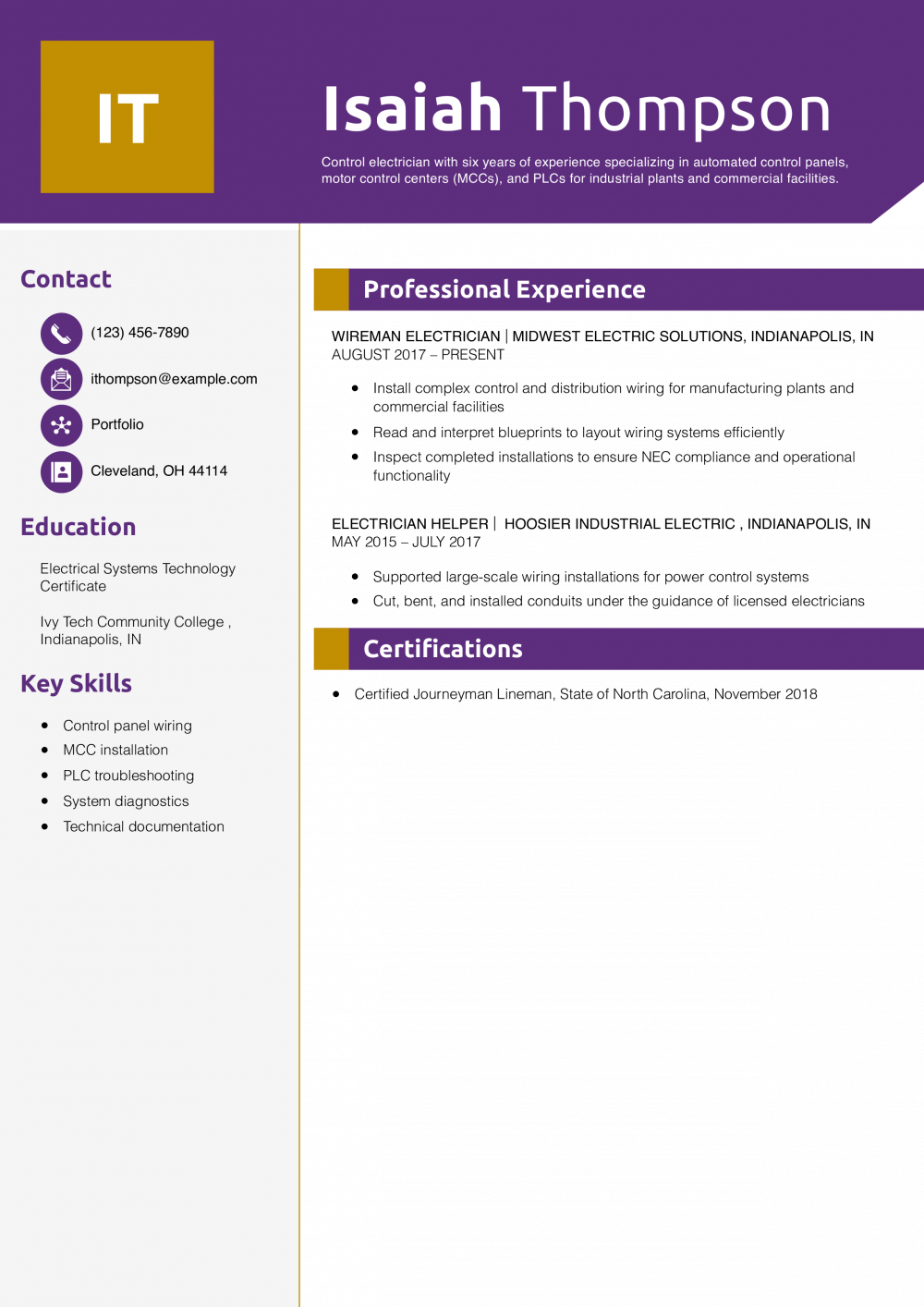
Customize this template in our builder in under 10 minutes.