
Tip !

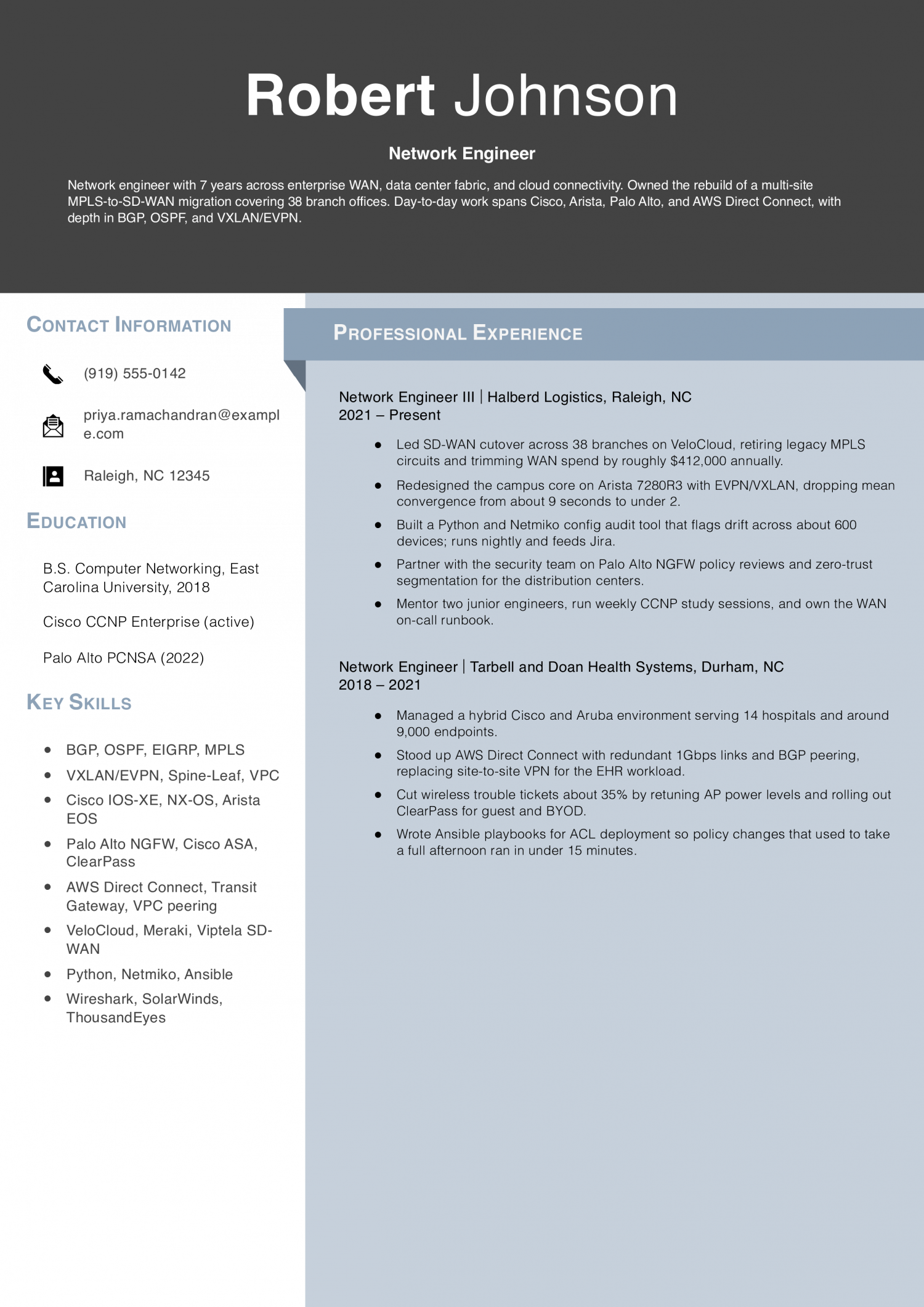
A clear protocol and vendor stack in the top third is what gets network engineer resumes past the ATS keyword parse; quantified scope on sites, users, and uptime is what makes them readable enough to advance to a technical screen.

Andrew Stoner , Executive Resume Writer and Career Coach

Why this resume works

  • Real dollars tied to a real project: The $412,000 WAN savings sits on a named SD-WAN migration with a vendor and a site count, so the number reads as earned rather than rounded.
  • Shows both routing depth and code: Bullets mix protocol work (EVPN/VXLAN, BGP peering) with automation (Python, Netmiko, Ansible), which is the combination most mid-level network roles now expect.
  • Growth from one job to the next: Scope expands from hospital LAN/wireless work into multi-site WAN redesign and team mentoring, which signals readiness for a Senior title.

Junior Example

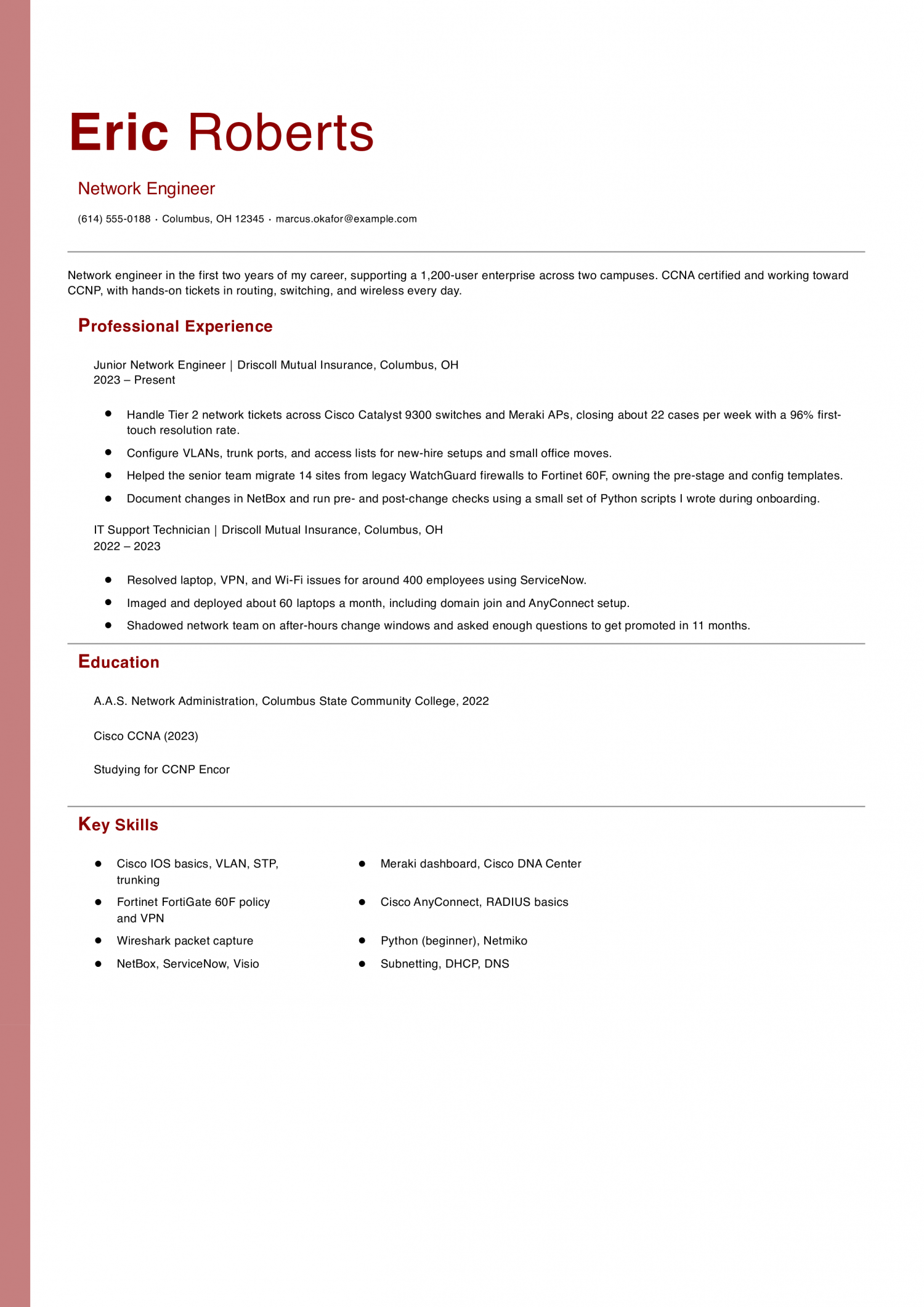
Junior network engineers are one to three years in, often promoted from NOC or help desk roles. The resume needs to prove CCNA-level fluency, ticket volume, and hands-on Layer 2/3 troubleshooting on real production gear.

Why this resume works

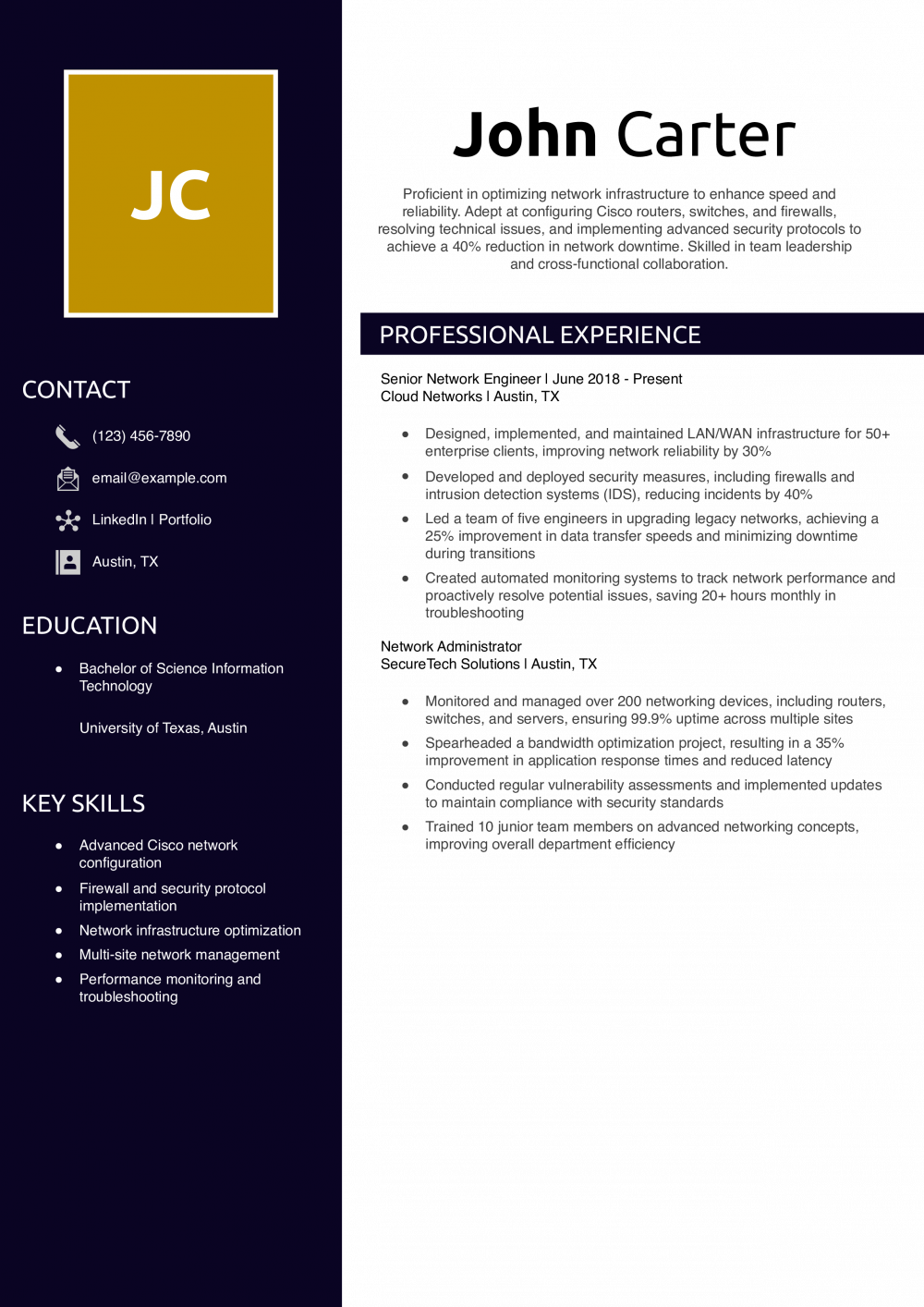
  • Promotion shows growth: Moving from IT support to junior network engineer in under a year tells the hiring manager this candidate has already proven they can handle more.
  • Real numbers even at entry level: Ticket volume, first-touch rate, and laptop counts give concrete evidence of workload without overclaiming senior-level wins.
  • Certification path is clear: CCNA earned plus CCNP in progress signals the candidate is investing in the next role, not coasting.

Senior Example

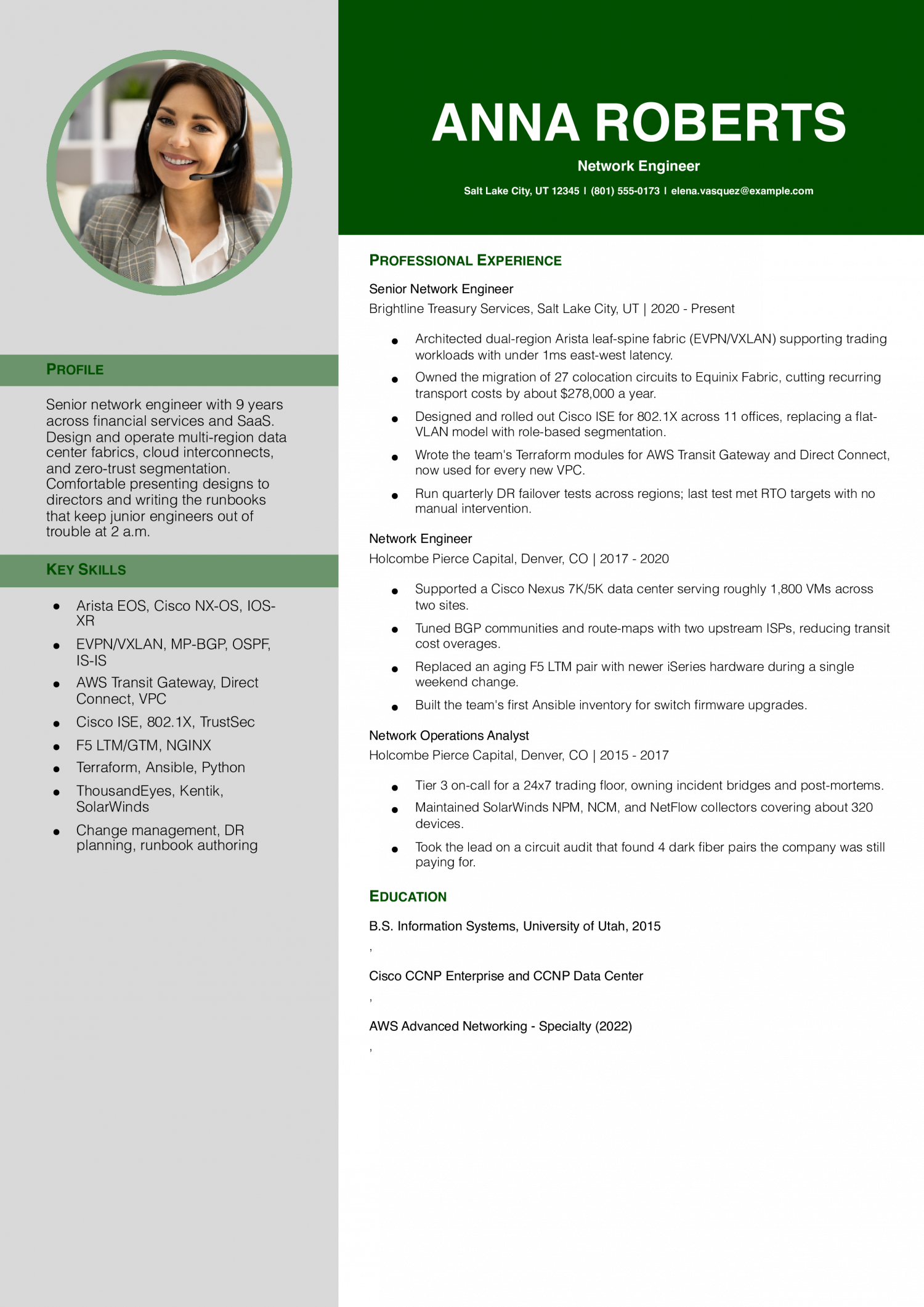
Senior network engineers own multi-site routing, switching, and security stacks across a vendor mix. The resume needs to prove BGP and OSPF design choices, change-window leadership, and measurable uptime across the sites and users you supported.

Why this resume works

  • Money saved is specific: The $278,000 colo savings is tied to a named project (Equinix Fabric migration) and a circuit count, so it survives an interview follow-up question.
  • Mix of hardware and cloud: Arista fabrics, Cisco Nexus, F5, and AWS Transit Gateway all appear, which matches what senior network roles ask for in 2024.
  • Career arc points up: From NOC analyst to senior engineer across two employers, with each role adding scope (DR ownership, Terraform, multi-region design).

Lead Example

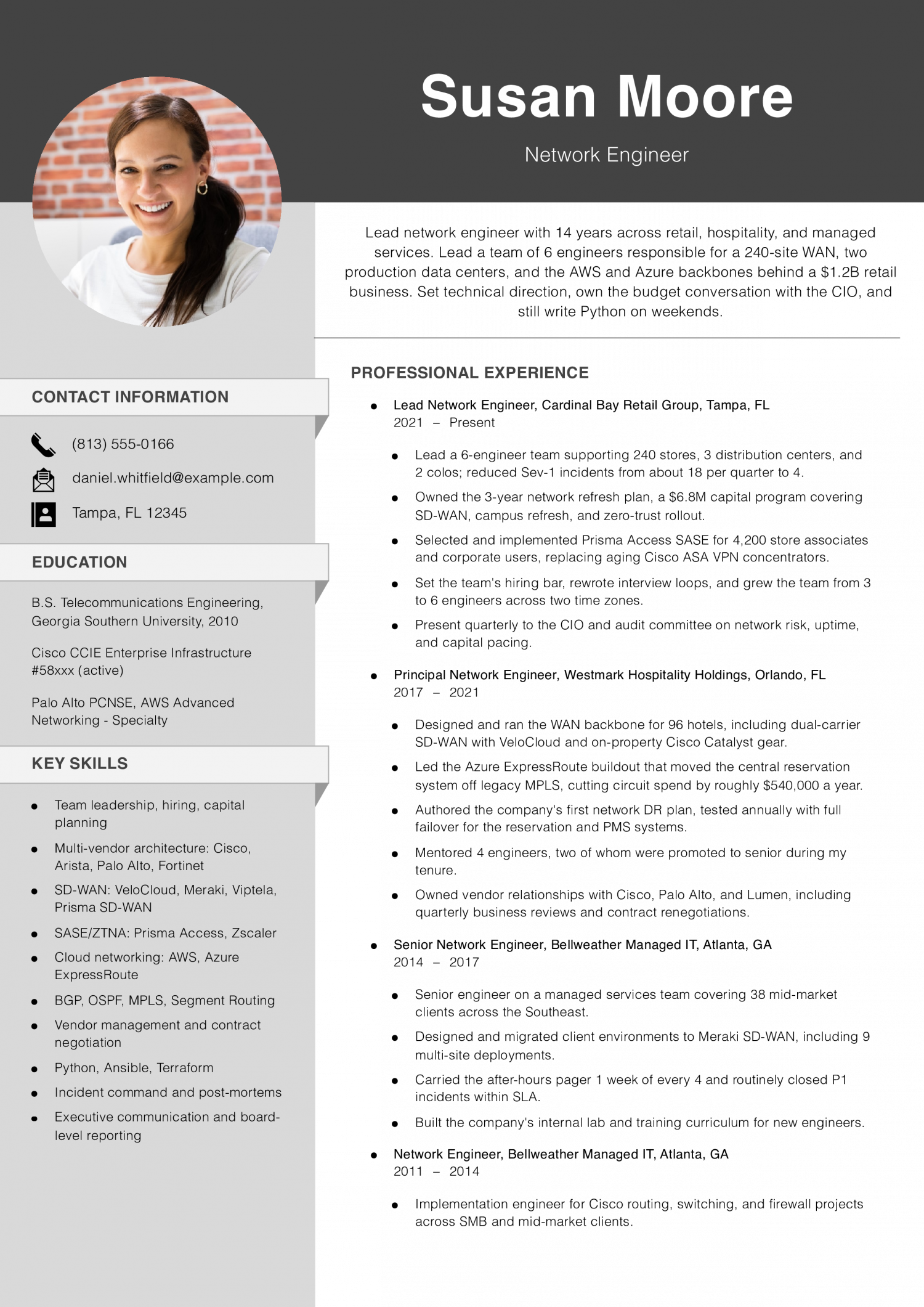
Lead and principal network engineers set architecture standards and mentor the team. The resume needs to prove SD-WAN or data center fabric design decisions, vendor selection calls, and the scope dimensions (sites, throughput, budget) you owned.

Why this resume works

  • Owns budget, not just packets: Naming a $6.8M capital program and quarterly CIO updates shows this candidate operates at the level a lead role actually requires.
  • Team growth is named: Bullets cite hiring, mentoring, and specific promotions, which is what hiring managers look for when filling a people-leader seat.
  • Still technical: Active CCIE and hands-on SASE selection show the candidate has not drifted into pure management, which matters for working-lead network roles.

How to Write a Network Engineer Resume

01 Open with the one thing a cert lookup won't show

A CCNP on your resume tells an infrastructure director you passed an exam. It does not tell them what you’ve actually run.

Add a single line under your name that names the differentiator a vendor cert cannot show: the SD-WAN migration you led across 40 sites, the BGP peering with three carriers, the Arista EVPN-VXLAN fabric you stood up, or the Palo Alto and Cisco mixed environment you administer daily.

Pick the one signal another CCNP holder is unlikely to match. That line decides whether your resume gets the 30 more seconds it needs.

02 Quantify scope, uptime, and throughput

Bullets without a number tend to read as duties, not impact. Infrastructure directors scan for scale first.

Strong network engineer bullets name three things: the scope (sites, users, devices, throughput), the uptime or SLA you held, and the project dollars or hours you saved.

Write ‘Maintained 99.98% uptime across 27 sites and 4,200 users on a Cisco and Meraki stack’ instead of ‘Responsible for network uptime.’ Add the change-window count or ticket volume where it strengthens the bullet.

03 Group work by routing, security, and ops

Walls of acronyms lose readers. Cluster your bullets into three or four categories the screener already scans for.

Use routing and switching (BGP, OSPF, EIGRP, MPLS, VLANs, STP), security and edge (firewall rules, VPN, NAC, zero trust segmentation), wireless and SD-WAN (Meraki, Aruba, Viptela, Versa), and monitoring and automation (SolarWinds, Wireshark, Ansible, Python scripts).

Under each role, lead with the category that matches the job posting’s first three requirements. That alignment is what the recruiter looks for on the second pass.

04 Put credentials and vendor stack on page one

Infrastructure directors and IT managers need to see CCNA, CCNP, JNCIA, PCNSA, or AWS Advanced Networking before they reach your second job.

Build a credentials block under the summary with active certs, the issuing vendor, and the year passed. Add a one-line vendor stack: Cisco IOS-XE and NX-OS, Juniper Junos, Palo Alto PAN-OS, Arista EOS, Fortinet FortiOS.

Keep the block tight. Five lines is enough to clear the keyword parse and give the recruiter the vendor coverage signal they need before scheduling a technical screen.

05 Cut what hides the senior signal

Senior and lead network engineer resumes lose ground when they keep early-career filler. Drop the NOC ticket counts from a job you held eight years ago.

Cut generic bullets like ‘troubleshot network issues’ and ‘monitored network performance.’ Cut the CompTIA Network+ once you hold a CCNP or higher.

Replace that space with architecture decisions, vendor selection calls, team size you mentored, and the budget you influenced. That is what separates a senior bullet from a staff-engineer bullet on the same screen.

Five years ago, a network engineer resume read like a CLI command reference. The skills below come from the resumes our users built in 2026, and the mix has shifted toward SD-WAN, cloud networking, and automation scripting. Infrastructure directors weight hard skills first for the keyword parse, then read soft skills as evidence behind change-management and incident bullets.

The hard list has to match the posting’s vendor stack. Use the tables to match against your target job description, and treat each soft skill as a claim your bullets need to back with a specific incident or project.

Soft Skills % of resumes with this skill
Problem-solving 77%
Communication 69%
Analytical thinking 47%
Teamwork 40%
Time management 29%

And here are the top hard skills showing up most often.

Hard Skills % of resumes with this skill
Network configuration and troubleshooting 75%
Routing and switching protocols 55%
Firewall and VPN administration 49%
TCP/IP and network protocols 37%
Cloud networking 29%

Based on data from thousands of network engineers’ resumes built on ResumeTemplates.com, May 2026.

Must Have on a Network Engineer Resume

The items below are what separate a network engineer resume from one that gets put back in the pile.

Niche Keywords for ATS Checkers

Infrastructure directors expect to see the exact vendor and protocol terms from the posting reflected back in your resume. Group your keywords by sub-niche so the ATS parser catches the cluster, not just one term.

Niche Keywords ATS scans for
Routing and switching bgp, ospf, eigrp, mpls
Vendor platforms cisco ios-xe, juniper junos, arista eos, palo alto pan-os
SD-WAN and edge viptela, meraki sd-wan, versa, fortinet secure sd-wan
Cloud networking aws transit gateway, azure virtual wan, direct connect, vpc peering
Automation and monitoring ansible, python netmiko, solarwinds, wireshark

AI Skills to Add

Infrastructure teams are split between shops piloting LLMs for runbook generation and config review and shops blocking ChatGPT entirely over data-handling concerns. Name the tools, describe the workflow honestly, and don’t claim you ‘automate the network with AI’ if your actual practice is using Copilot to draft Python scripts you then review.

What AI is actually changing for this role
Config drafting

LLMs draft baseline router and firewall configs faster, but production push still requires human review against the change ticket.

Log and packet triage

AI summarizes Wireshark captures and syslog floods, surfacing anomalies that used to take an hour to spot by eye.

Runbook generation

Teams use Copilot to convert tribal knowledge into versioned runbooks, cutting onboarding time for new NOC staff.

Automation scripting

Python and Ansible scripts get drafted by Copilot, then engineers tune them for idempotency and error handling before merging.

AI tools to name
  • GitHub Copilot: Drafts Python, Ansible, and Terraform modules for network automation, reviewed before merging to main.
  • ChatGPT (Enterprise tier): Parses syslog excerpts and drafts post-incident summaries when data-handling policy allows it.
How to phrase AI on your resume
Do
  • Drafted Ansible playbooks for VLAN provisioning with GitHub Copilot, then validated against lab topology before production rollout, cutting build time per site by half a day.
  • Used ChatGPT Enterprise to summarize 400-line syslog excerpts during incident triage, then verified findings in Wireshark before escalating.
Skip
  • AI-powered network optimization expert
  • Leveraged AI to revolutionize network operations

Tech Stack to Name on a Network Engineer Resume

Recruiters and infrastructure directors scan for the vendor and tool names that match their environment. List the platforms you’ve touched in production, not what you read about in a study guide.

  • Routing and switching: Cisco Catalyst 9000, Nexus 9000, ASR 1000, Juniper MX and EX, Arista 7050
  • Firewalls and edge: Palo Alto PA-series, Fortinet FortiGate, Cisco Firepower, Check Point
  • SD-WAN and WAN optimization: Cisco Viptela, Meraki MX, Versa, Silver Peak, Fortinet Secure SD-WAN
  • Wireless: Cisco Catalyst 9800 and Meraki MR, Aruba CX and Central, Juniper Mist
  • Automation and IaC: Ansible, Terraform, Python (netmiko, NAPALM), Git
  • Monitoring and analysis: SolarWinds NPM, PRTG, LibreNMS, Wireshark, Grafana, Splunk
  • Cloud networking: AWS (Transit Gateway, Direct Connect, VPC), Azure (Virtual WAN, ExpressRoute)

Network Engineering Credentials That Get You the Job

Beyond the baseline CCNA most postings expect, the certifications below tell infrastructure directors which vendor stacks you can administer in production and which architecture tier you’re ready for. List the issuing body, the cert name, and the year passed or expiration for each.

  • CCNP Enterprise (Cisco): Signals routing, switching, and SD-WAN depth past the CCNA tier and is the most-requested cert in mid-level enterprise postings.
  • JNCIP-SP or JNCIS-ENT (Juniper): Names you as a Juniper specialist for service provider or enterprise roles where Junos is the primary platform.
  • PCNSE (Palo Alto Networks): Tells SecOps-adjacent hiring teams you can design and administer Palo Alto firewalls, not just configure rules.
  • AWS Advanced Networking Specialty: Signals hybrid cloud fluency (Direct Connect, Transit Gateway, VPC peering) for roles bridging on-prem and AWS.

Latest BLS Statistics for Network Engineers

The top-paying states for network engineers cluster around finance, defense, and hyperscaler hubs, not the legacy telecom metros most candidates target. Pay tracks the density of data center build-outs and the scale of the networks being run, which is why mid-size states with concentrated employer demand often outpay larger markets on a per-engineer basis.

If you’re geographically flexible, foreground the vendor stacks and scale dimensions that match those high-density employers rather than your current zip code.

$130,390 National median annual
$135,890 National mean annual
$79,520 Entry-tier floor (10th percentile)
$198,030 Top-decile ceiling (90th percentile)
177,010 Network Engineers in the U.S.
Where you stand

Entry tier

$79,520 to $130,390 At the entry tier, lead with your CCNA, ticket volume from NOC work, and the Cisco or Meraki gear you touched hands-on.

Mid band

$130,390 to $198,030 At the mid band, your resume needs to show CCNP-level work, BGP or OSPF production changes, and the site count and uptime you held.

Top decile

$198,030+ At the top decile, lead with SD-WAN or data center fabric architecture, vendor selection calls, team size mentored, and budget owned.

Top-paying states

# State Avg. Annual
1 Washington $155,890
2 South Dakota $149,300
3 Virginia $148,080
4 New Jersey $147,650
5 Maryland $143,260
6 District of Columbia $140,050
7 California $138,350
8 Massachusetts $136,930
9 New York $136,230
10 Colorado $134,680

Highest-employment states

# State Workers Median
1 California 19,800 $138,350
2 Texas 16,160 $129,110
3 Colorado 12,720 $134,680
4 Virginia 9,340 $148,080
5 New York 9,180 $136,230
Source: U.S. Bureau of Labor Statistics, OEWS 2024 release (SOC 15-1241).
Written by professional resume writers and loved by hiring managers

Resume Templates offers HR approved resume templates to help you create a professional resume in minutes. Choose from several template options and even pre-populate a resume from your profile.

Frequently Asked Questions

How do I write a network engineer resume with no experience?

Lead with a home lab and your CCNA. Build a three or four router topology in GNS3, EVE-NG, or Cisco Packet Tracer running BGP, OSPF, and a site-to-site VPN.

Document the topology with a diagram and a short write-up on what you configured. List it under a Projects section on page one.

Add any NOC, help desk, or MSP ticket work, even part-time, and quantify the ticket volume.

What projects should I add to a network engineer resume?

Pick projects that show production-grade decisions, not tutorials. Strong examples include an SD-WAN migration from MPLS, a campus refresh from Catalyst 2960s to 9300s, a multi-site BGP peering with two ISPs, or a zero trust segmentation rollout on Palo Alto.

For each project, name the scope (sites, users, throughput), the vendors and protocols, and one measurable outcome (uptime, ticket reduction, cost saved).

How long should a senior network engineer resume be?

Two pages is the working ceiling for senior and lead roles. Use page one for the summary, credentials block, vendor stack, and the current and most recent roles.

Use page two for older roles compressed to three or four bullets each, plus certifications and education.

Cut anything older than 12 to 15 years unless it carries a vendor or protocol the posting still asks for.

Should I list expired certifications on my resume?

Drop expired Cisco and Palo Alto certs from the credentials block. Those vendors require recertification every three years, and an expired CCNP signals you stopped tracking the stack.

If the expired cert covers a vendor you still administer daily, move it to a 'Prior Certifications' line at the bottom of the certs section with the expiration year.

Otherwise, cut it and let your current work speak for the skill.

Which resume template works best for a network engineer?

For a network engineer, a tech template is the safest pick, because it keeps your stack, tools, and impact easy to scan. An ATS-friendly template is a solid alternative. Whichever you choose, keep the formatting clean and easy to parse: clear section headings, a standard font, and no graphics a parser can choke on.

Rate this article

Network Engineer Resume

Average Rating

4.3/5 stars with 170 reviews

You have given 0 Star(s)
4.3/5 stars with 170 reviews
Andrew Stoner

Executive Resume Writer and Career Coach

Andrew Stoner is an executive career coach and resume writer with 17 years of experience as a hiring manager and operations leader at two Fortune 500 Financial Services companies, and as the career services director at two major university business schools.