Software Developer Resume Examples
Add a single line a recruiter cannot find on your GitHub: the production scale you’ve shipped to, the on-call rotation you carry, or the regulated domain you work in. Most software developer summaries read like…
Every resume example is written and reviewed by our team of Certified Professional Resume Writers to ensure top-quality content and formatting.
Engineering managers and technical recruiters screen your resume for real output first. They want to see production code you shipped, not a list of libraries you once imported. A strong python developer resume leads with measurable work, like cutting API response times or building data pipelines at scale.
The median salary for this field sits at $135,980, so the bar is high. Show your command of frameworks like Django or Flask alongside cloud tools such as AWS. The examples below break down how to present that proof on your own resume. To compare layouts before you start, browse our resume templates.
Show measurable production results, your Python frameworks, and any deployment experience relevant to the role.
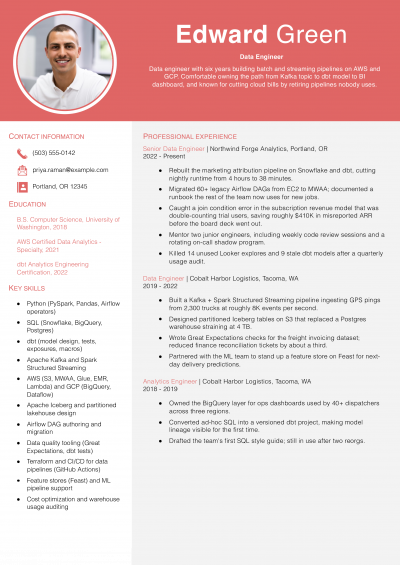
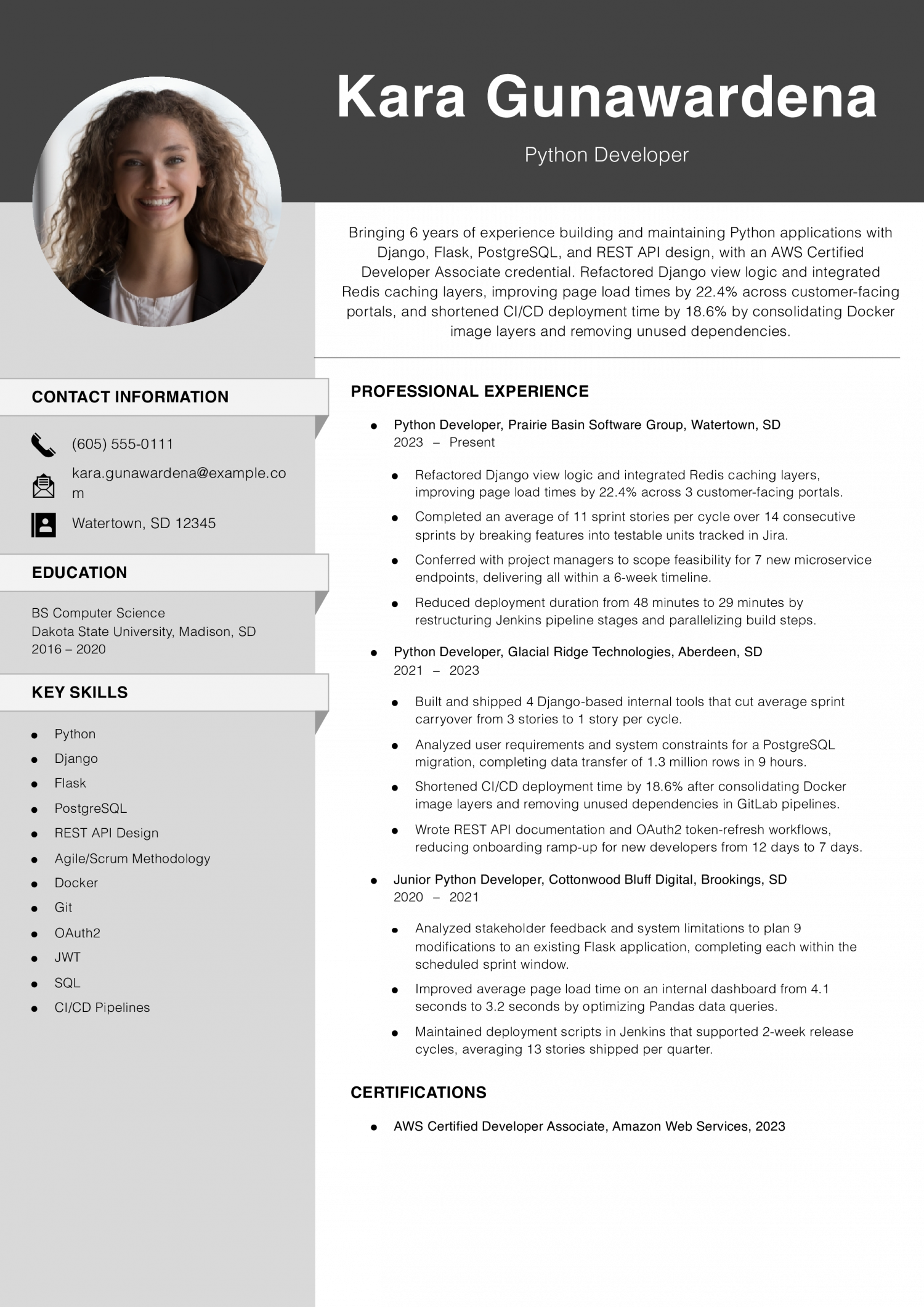
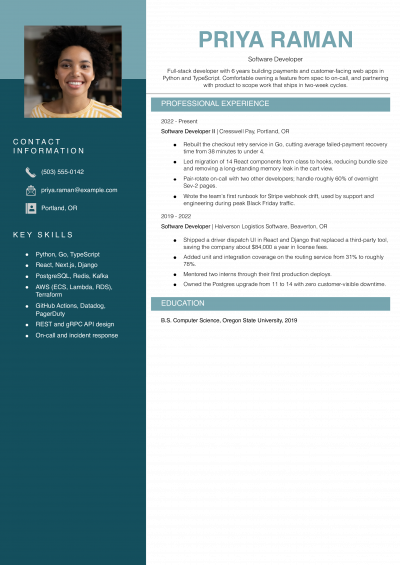
Pick this sample if you are a mid-level Python developer with 6 years of experience strengthening backend performance and CI/CD workflows. Drop vague claims and instead pair each pipeline or caching change with the exact time or percentage it saved.
Many Python developer resumes claim they improved CI/CD pipelines but only give a percentage, leaving the reader to guess how meaningful the change actually was. This resume sidesteps that problem with “Reduced deployment duration from 48 minutes to 29 minutes by restructuring Jenkins pipeline stages and parallelizing build steps.” When you describe a pipeline or process improvement on your own resume, include the original duration and the final duration so the hiring manager can feel the real size of the time saved without reaching for a calculator.
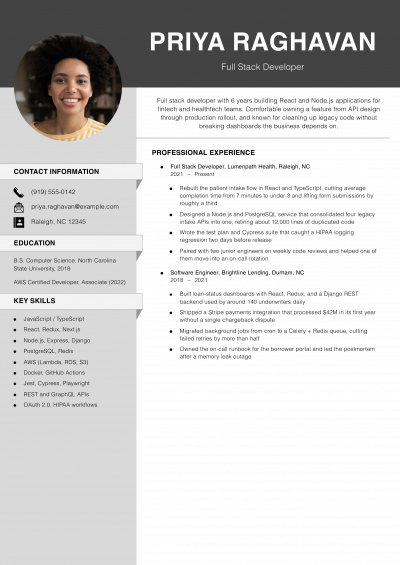
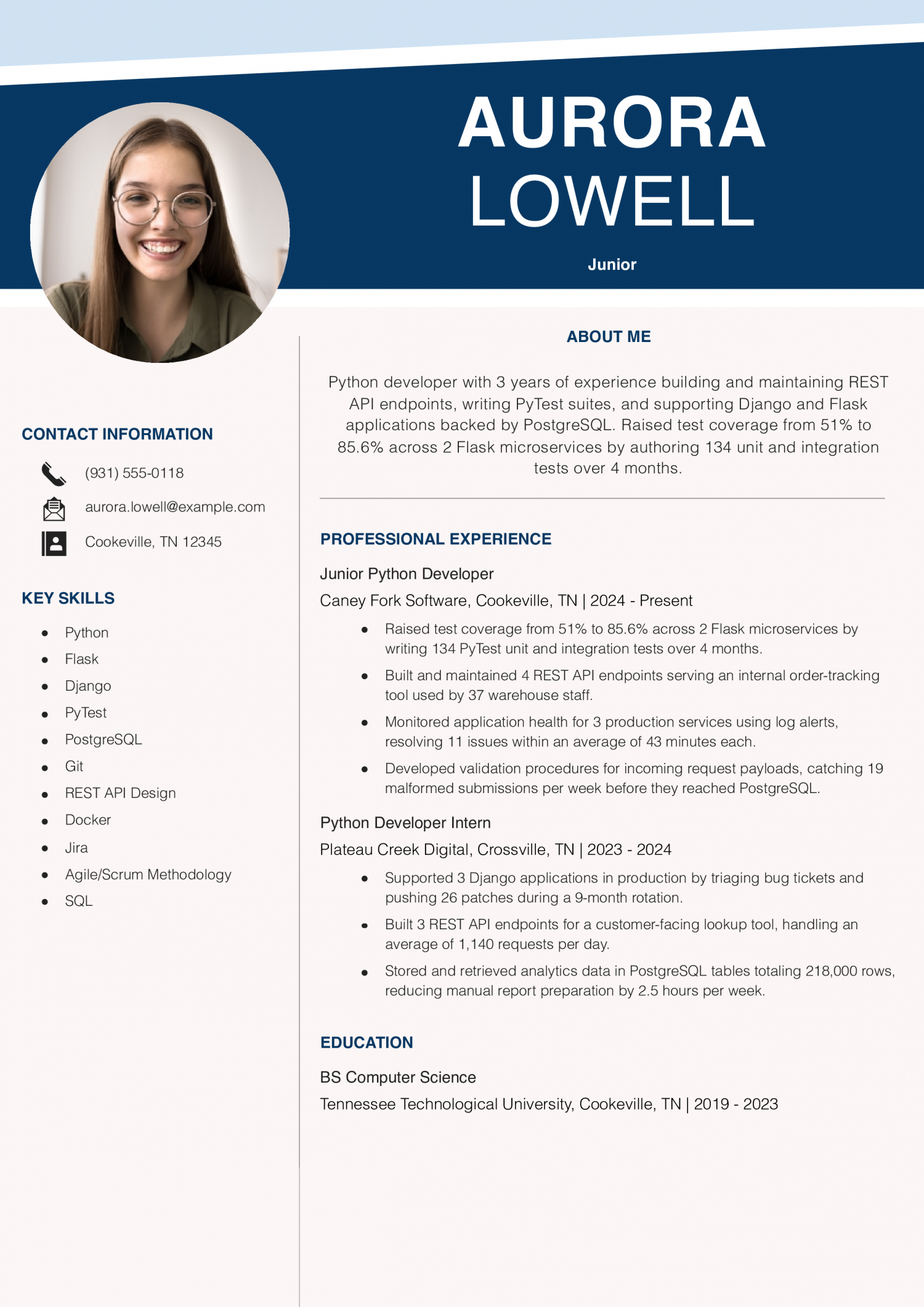
Use this sample if you are a junior Python developer with about 3 years of experience seeking your next backend role. Fit a before-and-after coverage percentage into each testing bullet so reviewers can measure your direct contribution.
Many Python developer resumes mention fixing bugs during an internship but leave out how many fixes shipped and over what span of time, making the contribution sound vague. This resume adds both numbers in one line: “triaging bug tickets and pushing 26 patches during a 9-month rotation.” If you held an internship or early role where you resolved issues, pair the total count of fixes with the time window so a hiring manager can gauge your pace and consistency without having to ask.
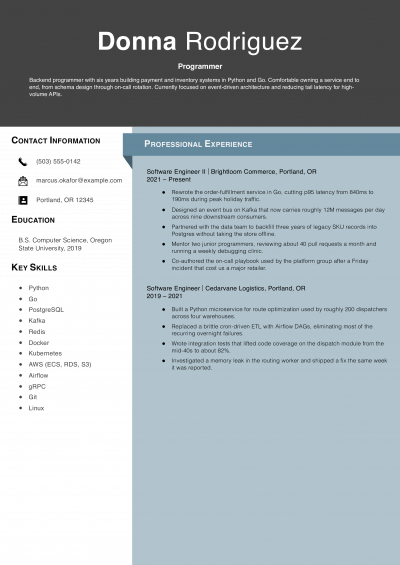
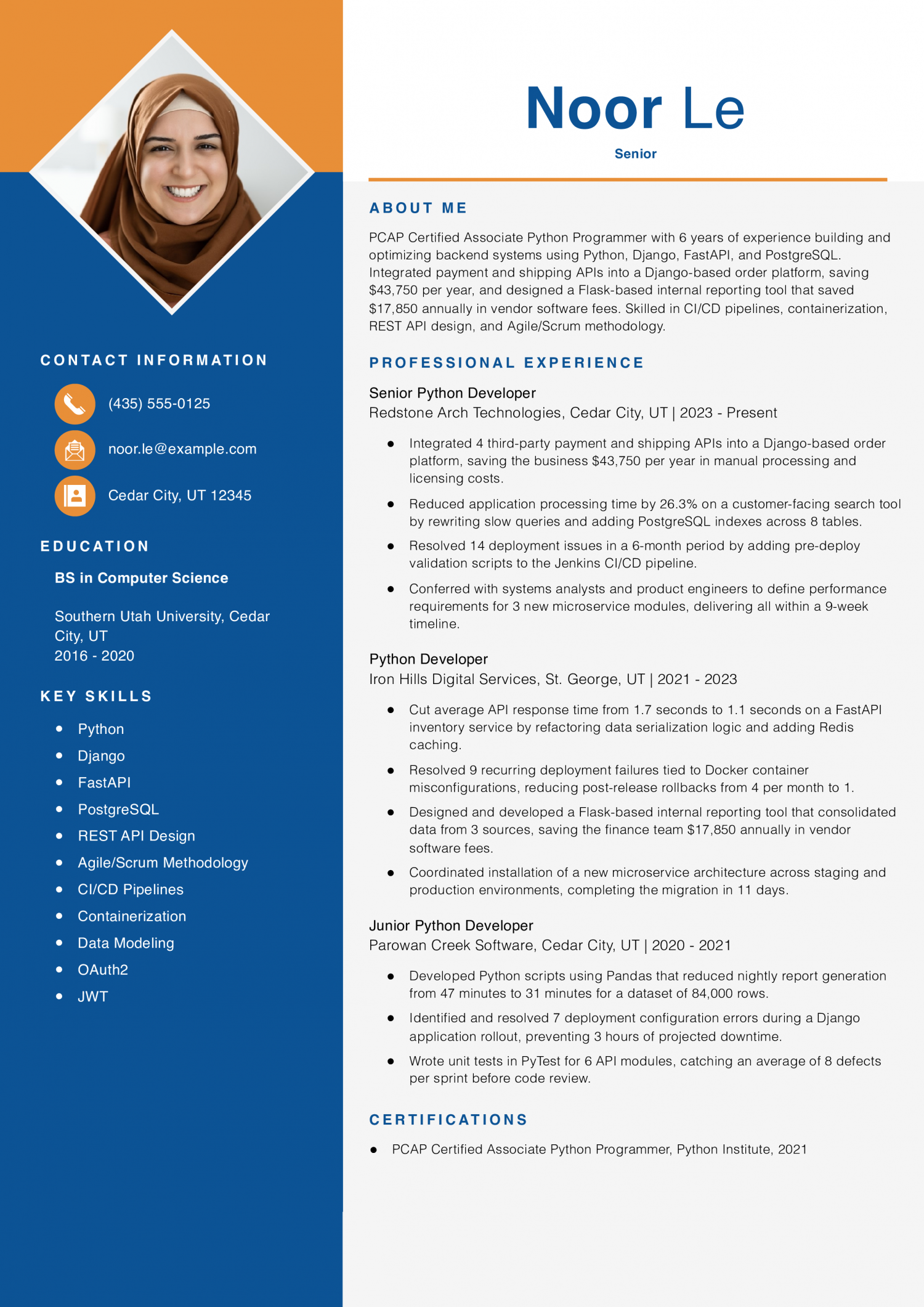
Try this resume if you are a senior-level Python developer with about six years of experience ready to lead backend platform work. Frame each cost-saving bullet by naming the specific vendor fee or manual process your code replaced.
Many Python developer resumes say they built an internal tool but never quantify what it replaced or how much money it freed up, so the reader has no way to weigh the contribution. This resume closes that gap with “consolidated data from 3 sources, saving the finance team $17,850 annually in vendor software fees.” When you build a tool that replaces paid software or manual work, name the number of systems it replaced and the yearly dollar amount the team no longer spends so the cost savings feel concrete.
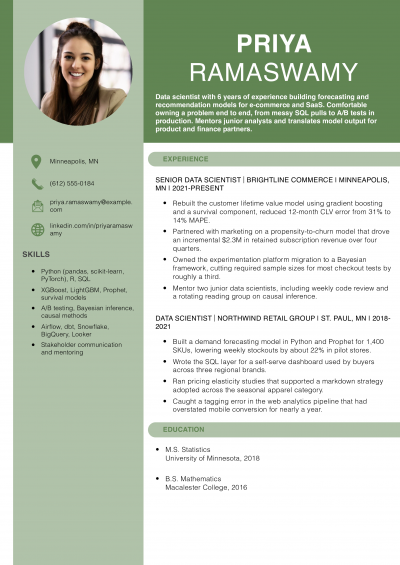
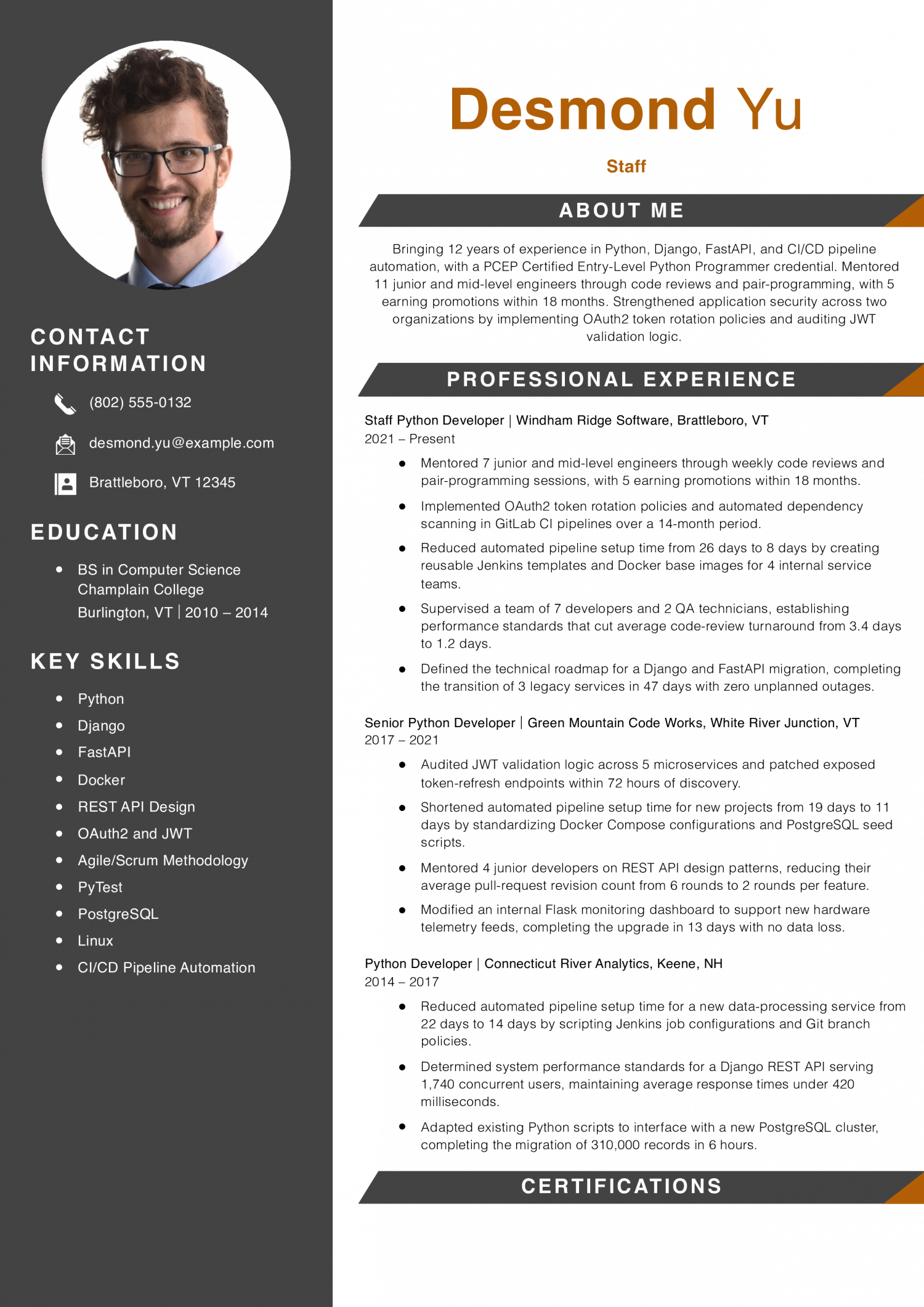
Lean on this resume if you are a senior Python developer with about 12 years of experience pursuing staff-level engineering positions. Group recurring wins across multiple roles so reviewers see a pattern of repeated impact rather than isolated achievements.
Many Python developer resumes list team leadership duties but never attach a measurable change to how the team actually worked day to day. This resume ties supervision directly to a workflow metric with “establishing performance standards that cut average code-review turnaround from 3.4 days to 1.2 days.” When you describe a management or team lead responsibility on your own resume, pair it with a before-and-after number from a process your team followed so the reader can see the operational difference your leadership made.
Experienced in building batch data pipelines and optimizing PostgreSQL databases across 6 years of Python development, including improving database query retrieval speed by 37.4% by rewriting slow queries and adding composite indexes. Skilled in Pandas, PySpark, Django, and REST API design, with a consistent record of automating manual processes and coordinating cross-functional technical deliverables.
Start your summary with the one detail that sets you apart. A PCAP credential or Django expertise appears on many resumes. Name the narrow skill another candidate is unlikely to share, something specific to the infrastructure or domain you worked in.
That could be real-time data pipeline work in Apache Kafka. It could be a migration that cut cloud costs by 30 percent. Engineering managers and technical recruiters skim dozens of profiles per role.
They stop on a line that signals a clear fit. Put that line first, before your years of experience. Follow it with your primary framework and one deployment context.
Two sentences in your summary should do more than a full paragraph of generic claims. Keep the language plain and let the detail carry the weight.
Most strong Python developer resumes lead each bullet with a quantifiable metric that conveys scope. Name the size of the dataset you processed or the latency you reduced. State the percentage by which your refactor improved test coverage.
Bullets without a number tend to read as duty lists. Technical recruiters scan for scale first, so raw numbers help your bullet stand out in a long list of candidates. Write the number of API endpoints you built and maintained.
Note the request volume your service handled per second. If you improved deploy frequency, state the before and after. Pair each metric with the tool or library you used, such as Celery or SQLAlchemy.
Keep the metric at the front of the sentence. The verb and the context follow it. This pattern gives each line a clear anchor that is easy to skim.
Organize bullets under the type of work they describe. Backend development covers REST APIs and microservices. Data engineering covers ETL pipelines and warehouse queries.
Testing and quality includes unit tests, integration suites, and CI runs. DevOps work includes Docker containers and deployment scripts. A fifth category could cover machine learning model serving.
Engineering managers read for depth in one or two of these areas, and they want to see which category holds your strongest results. Place your deepest category first under each job title. Give it three or four bullets, including at least one with a measurable outcome.
Give lighter categories one or two bullets each. This structure shows range without hiding your core strength behind unrelated tasks, and it helps an engineering manager see where you add the most value on a team.
Create a credentials block on page one, right below your summary. List the PCEP or PCAP from the Python Institute there. Add the AWS Certified Developer Associate if you hold it.
Engineering managers and technical recruiters check these before reading your job history. Below the credentials block, add a tools row. Name your primary frameworks, such as Flask and Django.
Name your databases, such as PostgreSQL and Redis. List version control and CI tools on a separate line. Keep each entry to the tool name and version if relevant.
Do not bury a certification at the bottom of page two, because a reviewer who cannot find it in five seconds may assume it is missing. Visibility matters as much as the credential itself.
List your degree, school name, and graduation year. A computer science or related degree goes first. If you hold a degree in another field, add relevant coursework beneath it.
Name two or three courses such as algorithms, data structures, or operating systems. Technical recruiters look for this when your degree title does not signal programming depth. Place bootcamp credentials here too, with the program name and date.
Add a projects subsection if your work history is under three years. Name one personal or open source project with its GitHub link. State what the project does in one sentence.
Note the stack it uses in a second sentence. This section supports your experience bullets without repeating them. Keep it to four or five lines so it stays on one page.
The Python Developer resumes that earn callbacks share a specific skill mix. Match the lists below against the posting you want. Engineering managers and technical recruiters scan for these patterns first.
Hard skills like Django and REST APIs prove you can build real products. SQL and Git show you can work with data and version control. Docker signals you can deploy code in modern setups. Each keyword should appear in your skills section and your bullet points.
Soft skills carry weight too. Problem solving and collaboration tell a team lead how you handle daily work. Add them as proof inside your experience bullets, not as a bare list.
Compare each table to your target job posting. Drop any skill that the posting does not mention. Then add every match to both your skills section and your work history. This approach helps your resume pass the filter before a person reads it.
| Soft Skills | AI-estimated % |
|---|---|
| Cross-functional collaboration | 77% |
| Analytical problem-solving | 63% |
| Deadline management | 42% |
| Technical communication | 35% |
| Adaptability to change | 31% |
And here are the top hard skills showing up most often.
| Hard Skills | AI-estimated % |
|---|---|
| Python application development | 71% |
| RESTful API design | 64% |
| Code review | 50% |
| Unit test writing | 39% |
| Database query optimization | 25% |
Skill names and rankings come from an AI model grounded in U.S. Department of Labor occupation data for Python developers, not from a count of Python developers’ resumes built on ResumeTemplates.com.
Before a python developer resume gets a closer read, hiring teams check for a short list of essentials.
Engineering managers are split on AI code generation. Some teams want developers who ship faster with Copilot. Others worry about code quality and hidden bugs.
Name the tools you use in your daily work. Describe the real workflow behind each one. Do not claim AI writes your code for you.
Be clear about what you prompt, review, and edit. Mention how you verify AI output with tests and linting. Engineering managers and technical recruiters check for honest framing.
They want to see that you own the final code.
What AI is actually changing for this role
Code drafting: AI assistants generate boilerplate functions and class stubs, but you still review every line for logic errors.
Debugging: AI tools suggest fixes for stack traces, though you must confirm each patch against your test suite.
Documentation: AI can draft docstrings and inline comments, but you edit them to match your project’s style guide.
Test writing: Copilot and similar tools propose unit tests, yet you decide which edge cases actually matter for coverage.
Code review: AI linters flag style issues and potential vulnerabilities before a human reviewer sees the pull request.
AI tools to name
How to phrase AI on your resume
Do
Skip
Engineering managers scan your tech stack first. They want to match it to their own. A clear list helps them decide in seconds. Group your tools by category for fast reading.
Python developers do not need a state license to work. But certifications still matter. They tell engineering managers and technical recruiters how deep your skills run.
A strong cert shows you can write clean code and build on cloud platforms. It can set you apart when two resumes look alike. Some teams weigh certs more than others.
Startups may care less, while large firms often filter for them. List the issuing body and your year of completion for each cert on your resume. Put them in a short section near the top so they are easy to spot.
About These Numbers
The Bureau of Labor Statistics does not publish a wage code for Python Developer specifically. The numbers below are a proxy: the closest published match is Software Developers (SOC 15-1252), so use them as an estimate for this role, not an exact figure.
BLS groups Python Developers under Software Developers, a broader category. Keep that in mind when reading the figures below. The 90th percentile out-earns the median by about 58 percent.
That wide gap tells you the market pays a steep premium for depth in a specific stack or domain. The spread from the 10th percentile to the median is narrower, sitting at roughly 39 percent. National employment across this broader group is large, so competition runs deep at every pay band.
On your resume, lead with the exact frameworks, cloud platforms, and production systems you have built and shipped.
| # | State | Median Annual |
|---|---|---|
| 1 | California | $174,410 |
| 2 | Washington | $166,540 |
| 3 | New York | $166,180 |
| 4 | Massachusetts | $165,210 |
| 5 | Oregon | $142,720 |
| 6 | New Hampshire | $139,720 |
| 7 | Maryland | $138,680 |
| 8 | Colorado | $138,390 |
| 9 | District of Columbia | $136,880 |
| 10 | Virginia | $136,460 |
| # | State | Workers | Median |
|---|---|---|---|
| 1 | California | 284,390 | $174,410 |
| 2 | Texas | 163,880 | $132,150 |
| 3 | New York | 113,510 | $166,180 |
| 4 | Washington | 107,030 | $166,540 |
| 5 | Virginia | 88,280 | $136,460 |
Resume Templates offers HR approved resume templates to help you create a professional resume in minutes. Choose from several template options and even pre-populate a resume from your profile.
Start with a short summary that names your years of experience and your strongest frameworks. Include one measurable outcome in that opening line.
List each role in reverse order, leading every bullet with a metric. Engineering managers and technical recruiters scan for impact first and tool names second.
Choose projects that mirror the work described in the job posting. A REST API, a data pipeline, or an automation tool each shows a different strength.
For each project, state the problem it solved and the libraries you used. Link to a public repository when the code is yours to share.
Place Python in your skills section and note the context in which you used it. Scripting for test automation or building internal tools both count as real use.
Add a bullet under the relevant job showing what you built in Python. That concrete example carries more weight than a bare skill listing.
One page works well if you have fewer than eight years of experience. A second page is reasonable beyond that point, as long as every bullet ties to a result.
Cut older roles down to a title, company, and date line. That keeps the focus on your most recent and relevant work.
Yes. A CV lists your full publication and research history, while a resume highlights only relevant experience. Most industry positions in the United States call for a resume of one to two pages.
Academic or research positions may ask for a CV instead. Check the posting before you submit to make sure you send the right format.
Note what you did during the gap that kept your skills current. Contributing to open-source projects or completing a course both show continued growth.
Place that entry in a section labeled Projects or Professional Development. Engineering managers and technical recruiters care more about current ability than a gap in dates.
For a Python developer, an ATS-friendly template is the safest pick, because it puts your certifications and experience where a hiring manager scans first. A basic template is a solid alternative. Whichever you choose, keep the formatting clean and easy to parse: clear section headings, a standard font, and no graphics a parser can choke on.
Python Developer Resume
4/5 stars with 119 reviews

Executive Resume Writer and Career Coach
Andrew Stoner is an executive career coach and resume writer with 17 years of experience as a hiring manager and operations leader at two Fortune 500 Financial Services companies, and as the career services director at two major university business schools.
© 2026 Resumetemplates.com All rights reserved.