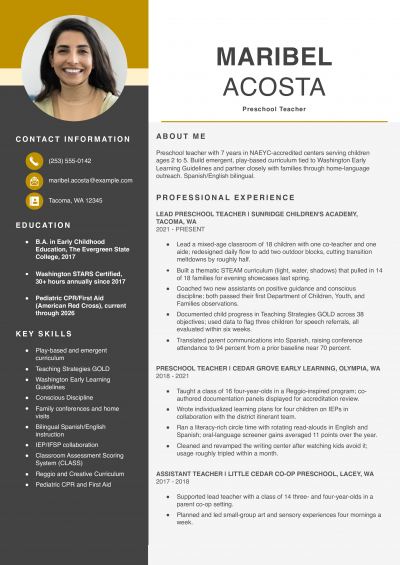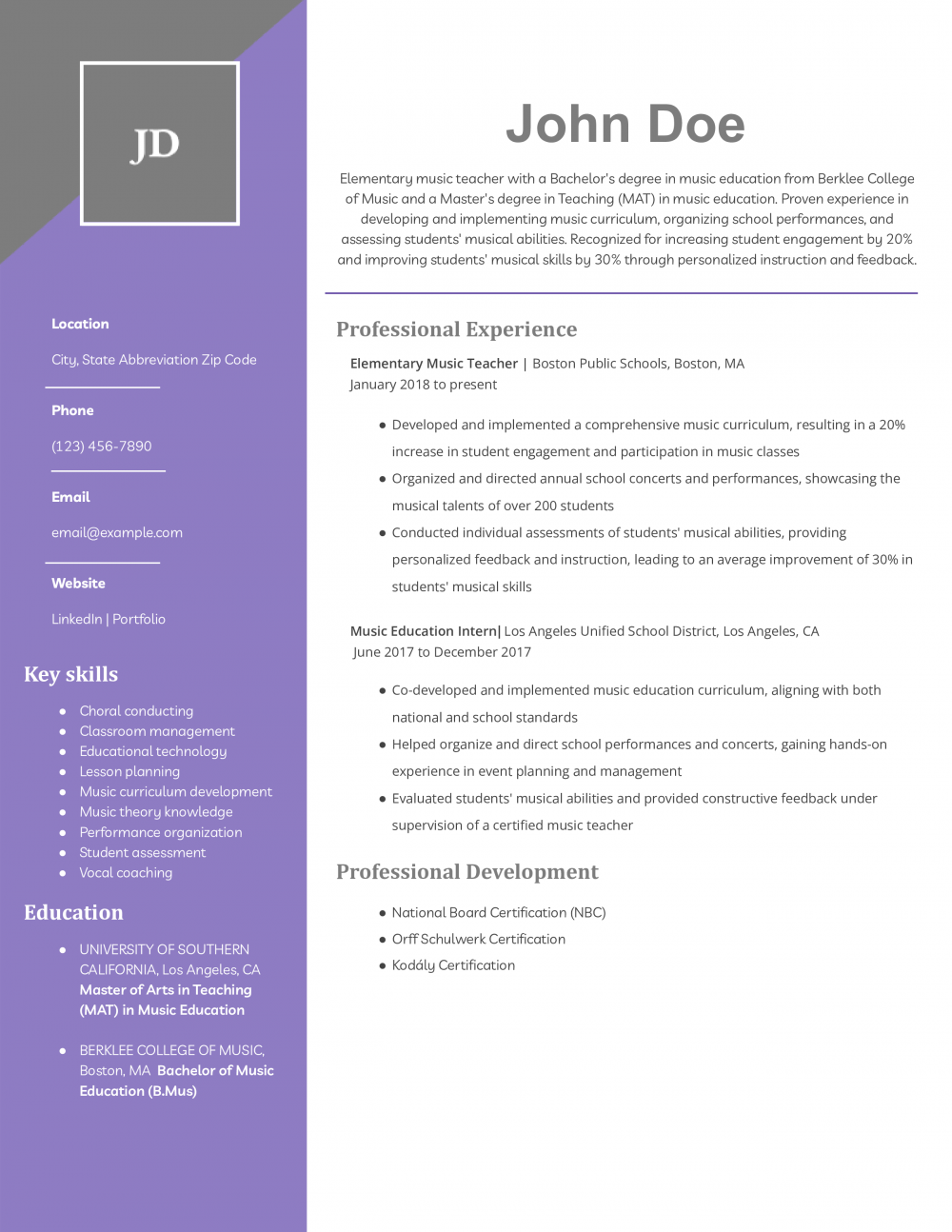
Hiring principals scan an elementary teacher resume for grade-band fit, assessment gains, and classroom management language within the first half of page one, because that combination signals whether you can run a productive room from week one.
Featured Example
Why this resume works
- Reading growth tied to a real benchmark: The 47% to 81% jump on i-Ready is the kind of concrete result hiring principals look for.
- Bilingual work shows up in numbers: Translating conferences and doubling Class Dojo engagement makes the language skill feel useful, not decorative.
- Leadership without inflating the title: PLC lead and new-teacher mentor signal readiness for lead teacher roles while still listed under a classroom job.
New Teacher Example
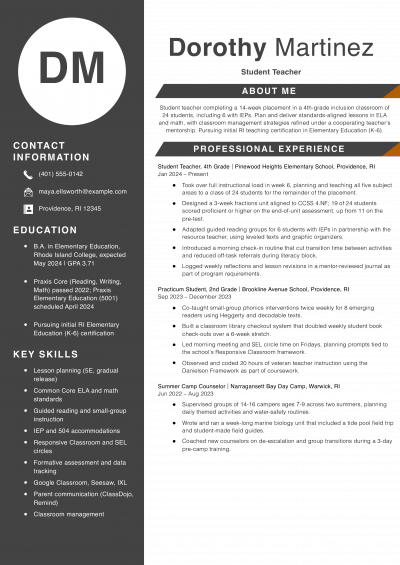
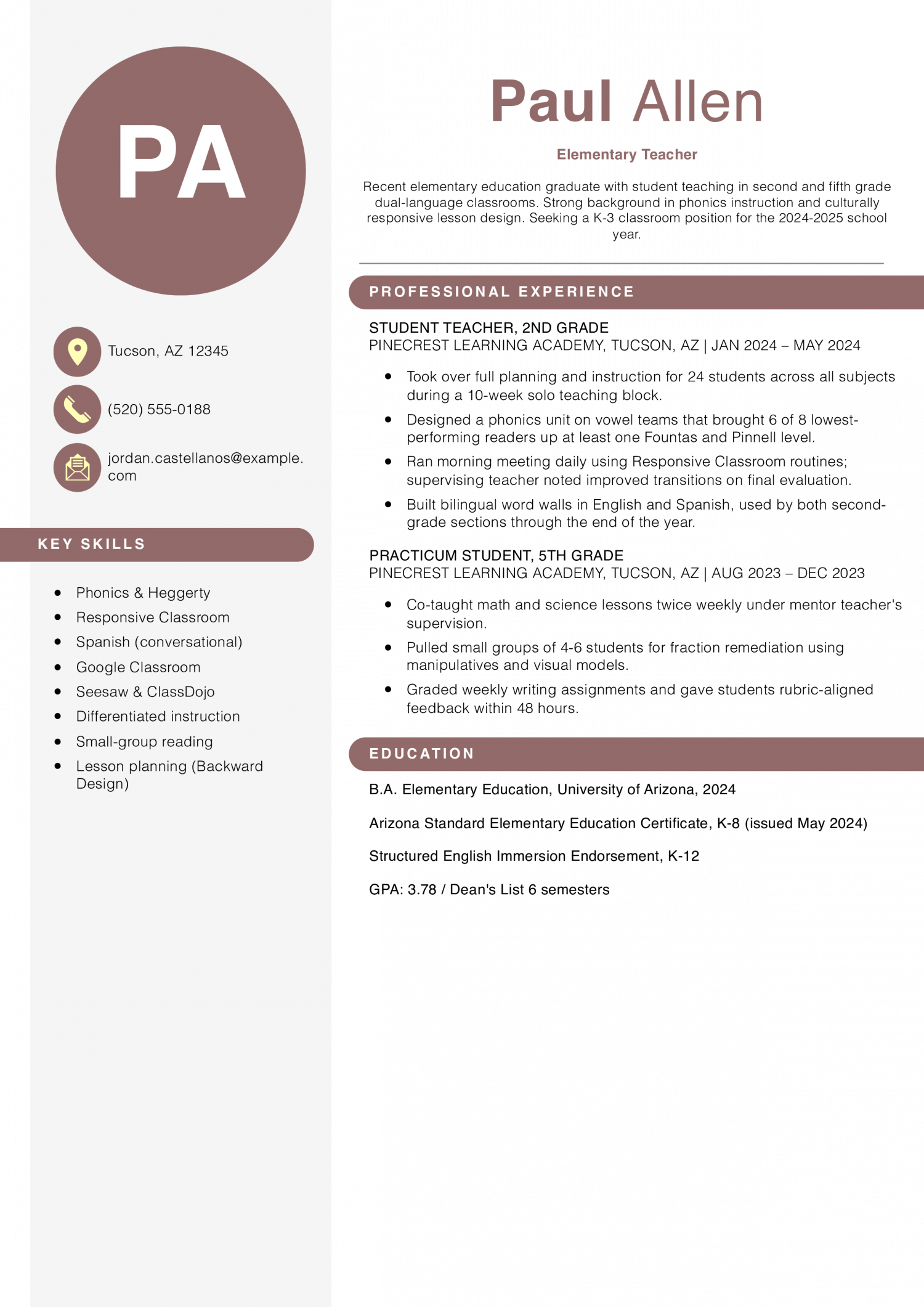
The new teacher archetype covers student teaching, residency, and first-year roles. This resume needs to prove your license, your cooperating teacher placements, and the grade bands and curricula you've already taught.
Why this resume works
- Student teaching reads like a real job: Taking over the full load and tracking student growth makes a first-year candidate look classroom-ready.
- Names the literacy programs schools actually use: UFLI, Heggerty, and DIBELS are searchable keywords that match what elementary principals are buying right now.
- Certification is clear and current: Listing the Idaho cert and Praxis subtests up front removes guesswork for HR.
Experienced Teacher Example
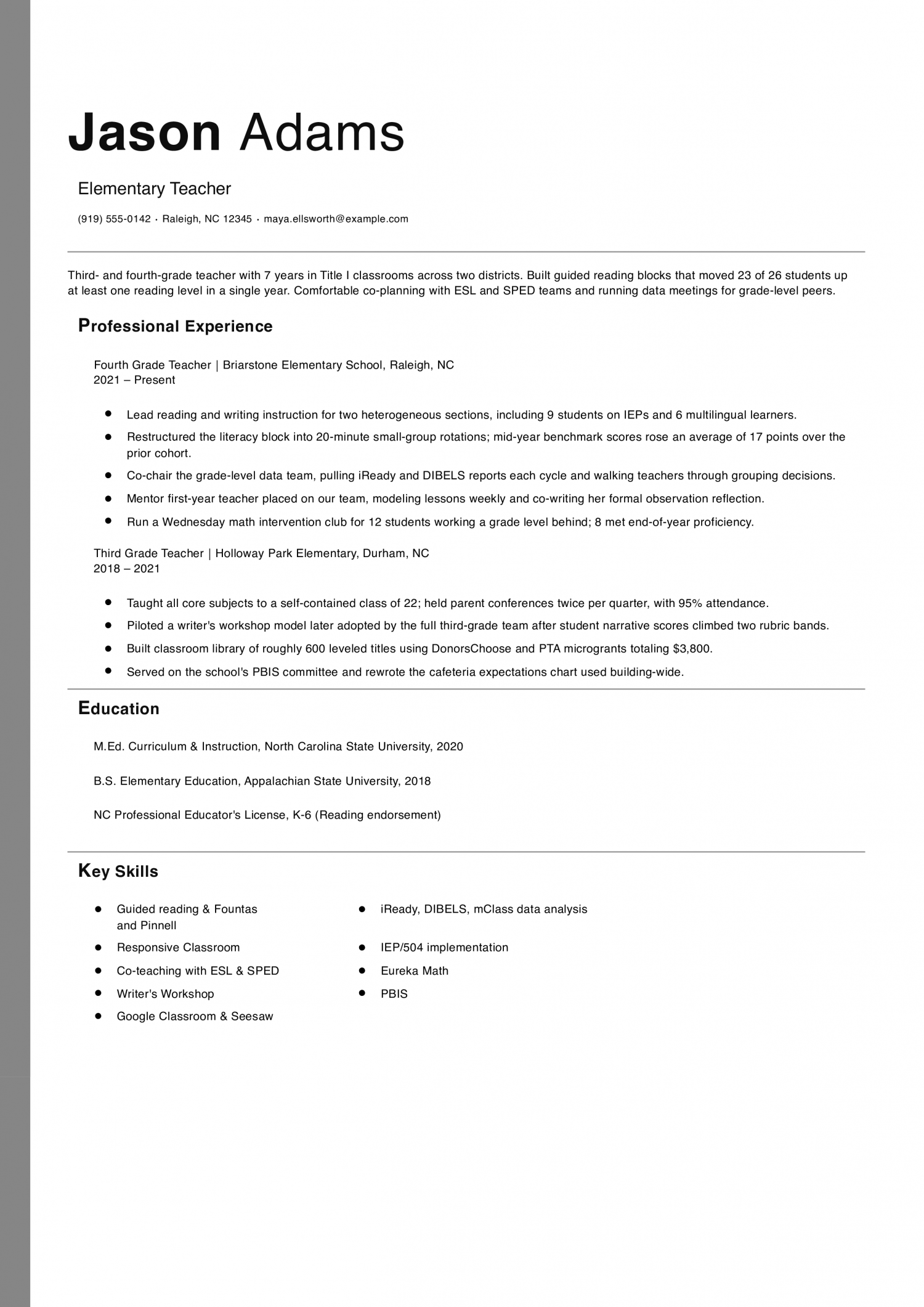
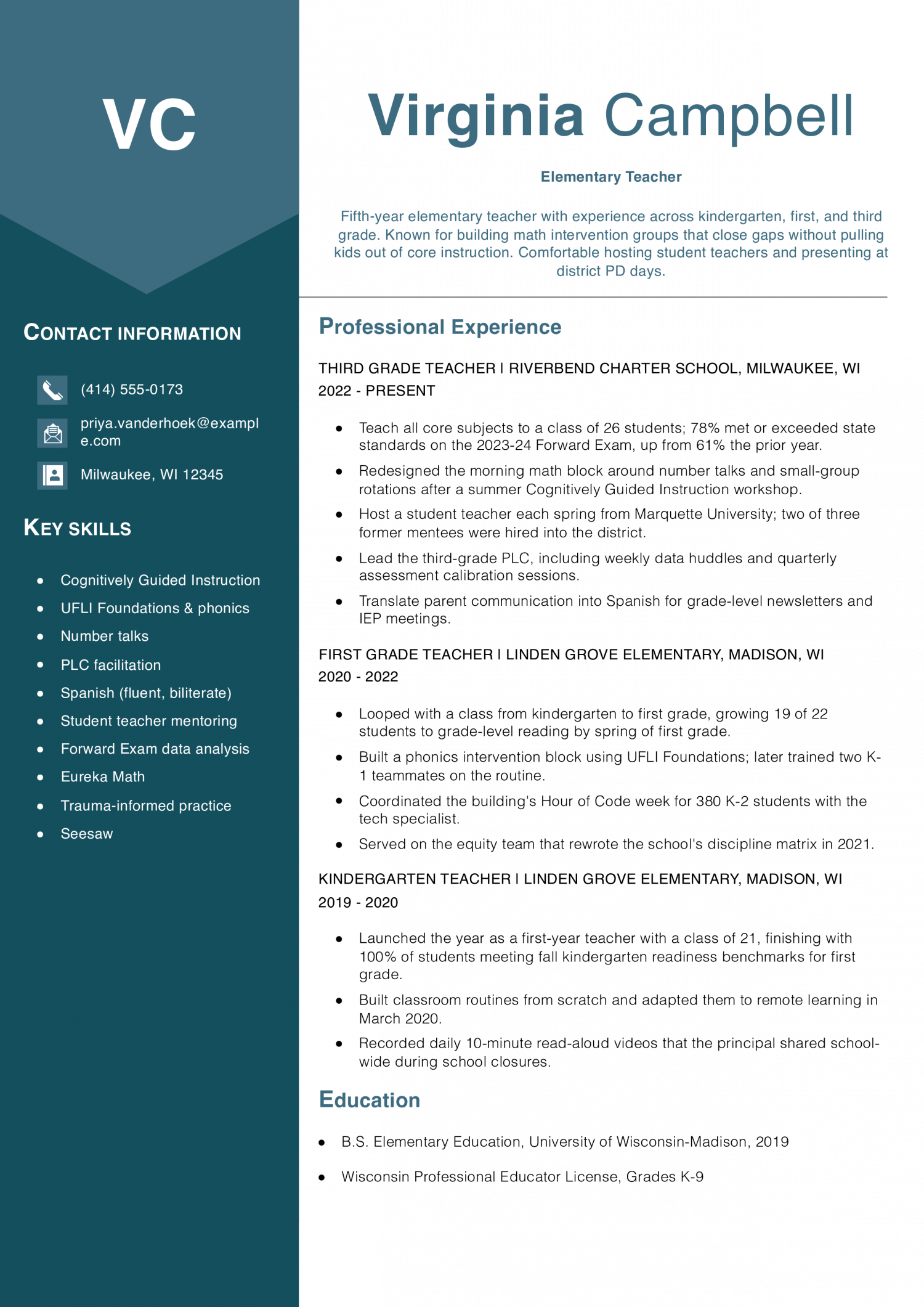
The experienced teacher archetype covers three to ten years in the classroom with a full caseload. This resume needs to prove repeatable student growth on DIBELS, MAP, or state assessments and a clear classroom management approach.
Why this resume works
- Test score growth tied to a state assessment: Moving EOG proficiency 22 points and beating the school average is a concrete result NC principals know how to read.
- Shows steady leadership without leaving the classroom: Grade-level chair, mentor, and pilot lead all signal a teacher ready for a lead or instructional coach role.
- Skills list matches the job posting language: iReady, mClass, AIG, and PLC are the exact terms NC postings use, which helps with ATS screening.
Lead Teacher Example
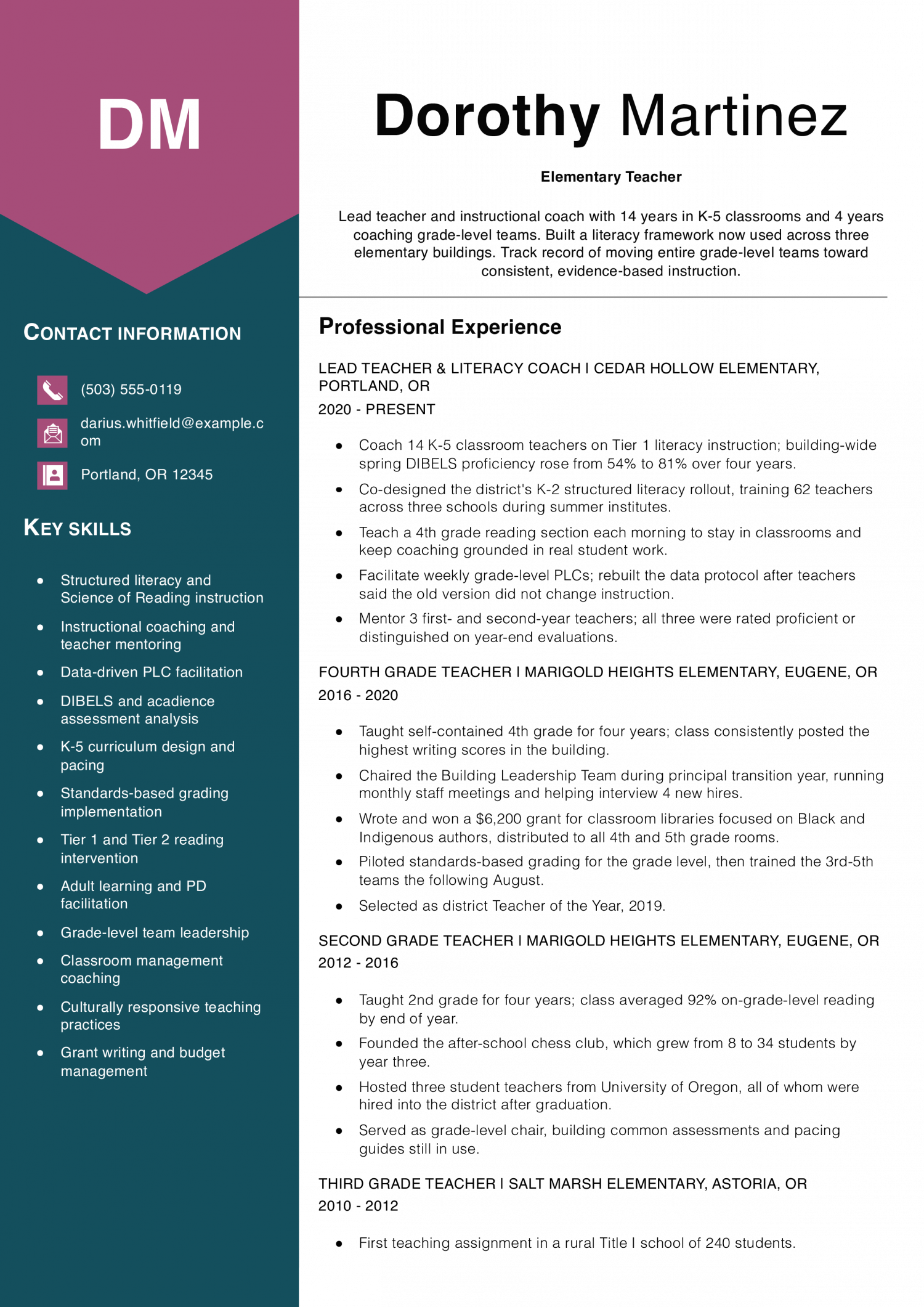
The lead teacher archetype covers grade-level chairs, instructional coaches, and mentor teachers. This resume needs to prove team leadership, curriculum work, and measurable impact across more than your own classroom.
Why this resume works
- Coaching impact is measured at the building level: Moving MCA reading from 58% to 79% across a whole school shows the candidate’s effect beyond a single classroom.
- Career arc points clearly at leadership: Classroom teacher to grade lead to coach is the path principals look for when hiring a lead teacher or assistant principal.
- Lists the curricula and assessments districts actually use: CKLA, LETRS, FastBridge, and MTSS are the specific terms that show up in Minnesota lead teacher postings.
Text Version Elementary Teacher
Aisha Berenger-Mott
Tucson, AZ | (520) 555-0136 | [email protected] | linkedin.com/in/aishabm
PROFESSIONAL SUMMARY
Elementary teacher with 9 years in grades 1-5 and 3 years as a grade-level lead. Strong in structured literacy, dual-language classrooms, and using formative data to drive small-group instruction. Comfortable mentoring new teachers and leading PD.
EXPERIENCE
Second Grade Lead Teacher
Saguaro Vista Elementary | Tucson, AZ | 2022-Present
- Lead a team of four second-grade teachers, including weekly PLCs and co-written common assessments.
- Class moved from 54% to 86% proficient on the AzM2 reading benchmark across two years.
- Designed the grade’s phonics scope and sequence using UFLI Foundations and Heggerty.
- Coach a first-year teacher through the district induction program; mentee earned a continuing contract.
- Translate parent conferences and family nights in Spanish for around 30 families per year.
Third Grade Teacher
Ocotillo Ridge Elementary | Tempe, AZ | 2019-2022
- Taught self-contained third grade in a dual-language program (50/50 Spanish/English).
- Built a guided reading library of around 600 Spanish and English titles, leveled by GRL.
- Served on the school MTSS team, writing Tier 2 plans for 8-10 students per cycle.
- Co-led the school’s family literacy night, which grew from 40 to 130 attendees.
Fourth Grade Teacher
Mesquite Hollow Elementary | Mesa, AZ | 2017-2019
- Taught math and science to two sections of fourth grade on a departmentalized team.
- Built a project-based unit on the Sonoran Desert ecosystem now used across the grade.
- Raised math AzMERIT proficiency by roughly 15 points across two cohorts.
- Served as building rep on the district curriculum committee.
First Grade Teacher
Cottonwood Bend Elementary | Glendale, AZ | 2015-2017
- Taught first grade with class sizes of 25-28, including about a third of students classified as MLL.
- Used Heggerty phonemic awareness daily; 22 of 26 students met end-of-year DIBELS benchmark.
- Built classroom routines around Responsive Classroom morning meeting.
- Mentored a student teacher from Arizona State University during the spring semester.
EDUCATION
- M.Ed., Bilingual Education, University of Arizona, 2018
- B.A., Elementary Education, Northern Arizona University, 2015
- Arizona Standard Professional Teaching Certificate, K-8; Bilingual and SEI endorsements; LETRS Volume 1 complete
SKILLS
- Structured literacy (UFLI, Heggerty, LETRS)
- Dual-language and SEI instruction
- Guided reading and small-group rotations
- DIBELS, AzM2, and Galileo data analysis
- MTSS and Tier 2 planning
- Responsive Classroom
- PLC facilitation
- Spanish/English bilingual communication
- Mentoring and induction support
- Family engagement and conference translation
How to Write an Elementary Teacher Resume
01 Open with a profile that names your teaching scope
Your profile should state your years in the classroom, the grade bands you’ve taught, and the school settings you’ve worked in (Title I, dual-language, charter, suburban public).
Name your active state license, the core curricula you’ve delivered (Wonders, Eureka, Wit and Wisdom, Fundations), and the student population you serve.
Principals scan this block to decide if you fit the open grade level and the school’s demographic in the first few seconds of the read.
02 Translate teaching into student-outcome language
Teaching doesn’t carry sales-style metrics, so lean on volume and growth language. Name the class size, the number of IEPs and 504s on your caseload, and the percentage of students who hit grade-level benchmarks.
A strong bullet reads: “Moved 18 of 22 first graders from below benchmark to on or above on DIBELS by spring.” Bullets without a number tend to read as duties, not impact.
03 Group your work by instruction, assessment, and management
Cluster bullets into three or four categories so principals can scan fast. Instruction covers your curricula, small-group rotations, and differentiation moves.
Assessment covers the data you collect and act on (DIBELS, MAP, Fountas and Pinnell, state tests) and how you adjust groups based on it. Classroom management covers your routines, behavior framework (PBIS, Responsive Classroom, CHAMPS), and family communication cadence.
Add a fourth category for collaboration if you’ve led PLCs, co-taught with a SPED teacher, or mentored a student teacher.
04 Put your license and endorsements on page one
Principals and district HR officers need to confirm you’re eligible to teach the open grade in their state before they read further.
Add a credentials line near the top: state of licensure, license type (initial, professional, standard), grade-band endorsement (K-6, 1-6), and any add-ons (ESL, reading, SPED, gifted).
List the state and “in good standing” rather than the license number. List Praxis or state exam pass status, and any micro-credentials (Orton-Gillingham, LETRS) in the certifications block.
05 Close with education and continuing development
Below your experience, list your degree, the institution, and your teaching credential program. Name your student teaching placement, the grade and school, and your cooperating teacher’s content area if relevant.
Add a short professional development line covering recent coursework in the science of reading, math instruction, or trauma-informed practice.
If you’re a career changer, lead this section with the transferable skills (curriculum design, public speaking, working with children) that made the switch viable.
Most Popular Skills on Elementary Teacher Resumes for 2026
Five years ago, an elementary teacher resume read like a list of subjects taught and bulletin boards built. The skills below come from the resumes our users built in 2026. The mix has shifted toward assessment data, structured literacy, and named behavior frameworks.
Elementary school principals and district HR officers weight hard skills like Fundations and DIBELS first, then look to soft skills like classroom management and family communication as evidence behind your bullets. Match the table against your target posting, and treat each soft skill as a claim you need to back with a specific story in your experience section.
| Soft Skills | % of resumes with this skill |
|---|---|
| Communication | 80% |
| Patience | 70% |
| Empathy | 44% |
| Adaptability | 40% |
| Creativity | 31% |
And here are the top hard skills showing up most often.
| Hard Skills | % of resumes with this skill |
|---|---|
| Lesson planning | 73% |
| Classroom management | 53% |
| Curriculum development | 50% |
| Student assessment | 38% |
| Educational technology | 35% |
Based on data from thousands of elementary teachers’ resumes built on ResumeTemplates.com, May 2026.
Must Have on an Elementary Teacher Resume
The items below are what separates an elementary teacher resume that advances from one that gets put back in the pile.
Licensure Requirements
Principals confirm license eligibility before they read your experience, so this block goes near the top of page one.
Where to place this block
Build a short credentials block under your contact line. Name your state, license type, grade-band endorsement, and “in good standing” status.
Add each add-on endorsement on its own line so the ATS parses each one. Common add-ons include ESL, bilingual, reading, special education, and gifted.
- State of [State], Professional Educator License, Grades K-6, in good standing
- ESL Endorsement, [State] Department of Education
- Reading Specialist Endorsement (in progress, expected [month/year])
- Praxis Elementary Education: Multiple Subjects (5001), passed 2026
Classroom Management
Principals read this section to predict your first month in a new building. Name the framework and the caseload.
- Implemented Responsive Classroom morning meeting and logical consequences across a class of 24, including five students with IEPs
- Co-taught reading block with SPED teacher using a station-teaching model for six students on IEPs and three on 504 plans
- Wrote weekly progress notes for IEP goals in [district platform] and presented data at annual review meetings
- Adjusted small-group instruction every two weeks based on DIBELS progress monitoring and IEP goal data
Niche Keywords for ATS Checkers
Principals and district HR officers expect a niche section that mirrors the posting’s grade band, curriculum, and specialty endorsements. Cluster keywords by sub-area so the screen flags your fit on the first pass.
| Niche | Keywords ATS scans for |
|---|---|
| Grade-band general education | elementary teacher, K-6 teacher, classroom teacher, grade-level teacher |
| Literacy and reading | structured literacy, science of reading, guided reading, phonics instruction |
| Math instruction | Eureka math, enVision math, math intervention, small-group math |
| Special populations | IEP implementation, 504 accommodations, ESL endorsement, inclusion teacher |
| Classroom culture | PBIS, Responsive Classroom, restorative practices, trauma-informed teaching |
AI Skills to Add
AI drafts daily lesson skeletons in minutes, shifting your prep time toward standards alignment and small-group differentiation.
Tools rewrite reading passages at multiple Lexile bands, so the workflow is selecting and vetting outputs rather than writing them.
AI translates newsletters and behavior notes into home languages, expanding reach in dual-language and immigrant-heavy schools.
Generators produce rubric drafts and exit-ticket banks, freeing time for one-on-one conferring and small-group reteach.
- MagicSchool AI: Used for lesson plans, IEP-aligned scaffolds, differentiated passages, and parent communication drafts.
- Khanmigo: Used for student-facing math support and teacher-facing standards-aligned question banks.
Do
- Use MagicSchool AI to draft tiered reading passages, then edit against the unit standard and student reading levels.
- Translate weekly family newsletters with AI, then have a bilingual aide verify tone before sending.
Skip
- Leverage AI to revolutionize student learning outcomes.
- AI-powered classroom innovator.
Background Check and Mandated Reporter Notes
Elementary teaching is a fingerprint-cleared, mandated-reporter role. Districts assume you’ll clear a background check; the resume should not raise unnecessary flags.
Do not list your Social Security number, date of birth, home address, or driver’s license number on the resume. Districts collect those on the application form after a conditional offer.
If you have a gap in teaching, name it briefly and honestly in the cover letter rather than the resume. Address career changes and breaks for caregiving in your profile statement.
- List city and state only for your contact line, not a full street address
- Note mandated reporter training completion in your certifications block if your state requires it
- List child abuse and neglect recognition training (e.g., Mandt, CANRA) with year completed
- Disclose any required clearances (FBI fingerprint, state child abuse clearance) by name and date
Elementary Education Credentials That Get You the Job
Hiring principals read this list as a map of where your instructional practice is heading. The certifications below signal which track you’ve invested in: structured literacy, math intervention, English learner support, or special education. List the issuing body and the year of completion.
- LETRS (Language Essentials for Teachers of Reading and Spelling): Signals science-of-reading fluency that most districts now require for K-3 hires.
- Orton-Gillingham Associate Level: Shows you can deliver structured literacy intervention to students with dyslexia and reading delays.
- ESL or Bilingual Endorsement: Adds the credential most urban and Title I districts list as preferred or required on K-6 postings.
- National Board Certification (Generalist: Middle Childhood): Carries pay-lane weight in many districts and signals reflective practice for lead and mentor roles.
Latest BLS Statistics for Elementary Teachers
The top-paying states for elementary teachers cluster in high-cost coastal markets and a handful of strong-union states, not the large Sun Belt districts most new teachers apply to first. Pay ladders are set by district salary schedules, so step and lane placement drive the spread more than negotiation.
If you have a master’s degree, a reading endorsement, or National Board status, the resume should foreground those credentials on page one so HR places you on the correct lane during the offer build.
Entry tier
$46,440 to $62,340 At the entry tier, lead with your state license, student teaching placements, and the curricula and assessments you've already used.Mid band
$62,340 to $102,010 At the mid band, show three or more years of student growth data, your behavior framework, and any grade-level lead or PLC work.Top decile
$102,010+ At the top decile, lead with National Board status, instructional coaching or mentor work, and measurable impact beyond your own classroom.Top-paying states
| # | State | Avg. Annual |
|---|---|---|
| 1 | Washington | $99,110 |
| 2 | California | $98,190 |
| 3 | District of Columbia | $94,730 |
| 4 | Rhode Island | $86,900 |
| 5 | Massachusetts | $83,260 |
| 6 | New York | $82,480 |
| 7 | Connecticut | $78,740 |
| 8 | New Jersey | $77,150 |
| 9 | Alaska | $76,290 |
| 10 | Oregon | $75,800 |
Highest-employment states
| # | State | Workers | Median |
|---|---|---|---|
| 1 | California | 141,650 | $98,190 |
| 2 | Texas | 124,430 | $61,380 |
| 3 | New York | 103,920 | $82,480 |
| 4 | Florida | 78,630 | $55,550 |
| 5 | Illinois | 61,000 | $64,160 |
Resume Templates offers HR approved resume templates to help you create a professional resume in minutes. Choose from several template options and even pre-populate a resume from your profile.
Frequently Asked Questions
Lead with your student teaching placement as your first experience entry. Name the school, grade, cooperating teacher's program, and the curricula you delivered solo.
Add a second entry for your practicum, after-school tutoring, or summer camp work. Quantify class size, weeks taught, and any assessment data you collected.
Put your license status, Praxis pass, and degree near the top so principals confirm eligibility before they reach the experience section.
No. List your state, license type, grade-band endorsement, and "in good standing" status.
Provide the actual number on the district application form when requested. Most state boards advise against publishing license numbers on a public document.
Use class-level percentages and benchmark movement rather than naming students or sharing identifiable scores.
Phrasing like "moved 82 percent of first graders to on or above DIBELS benchmark by spring" stays within FERPA norms.
Avoid screenshots, individual scores, or names. Principals and HR understand aggregate data and prefer it.
State your current license, then add a line noting your reciprocity application status or eligibility for the target state.
Many states honor interstate compacts for licensed teachers in good standing. Naming the pathway shows the principal you've already checked.
If you've taken the target state's required exams, list those pass dates in your certifications block.
For an elementary teacher, a professional template is the safest pick, because it signals the polish hiring managers in this field expect. An ATS-friendly template is a solid alternative. Whichever you choose, keep the formatting clean and easy to parse: clear section headings, a standard font, and no graphics a parser can choke on.