20 Best Business Resume Examples and Templates for 2026



BA team leads decide whether to keep reading by the top third of page one; if a named system, a requirements artifact, and a quantified outcome are not visible there, the resume gets routed to the maybe pile.
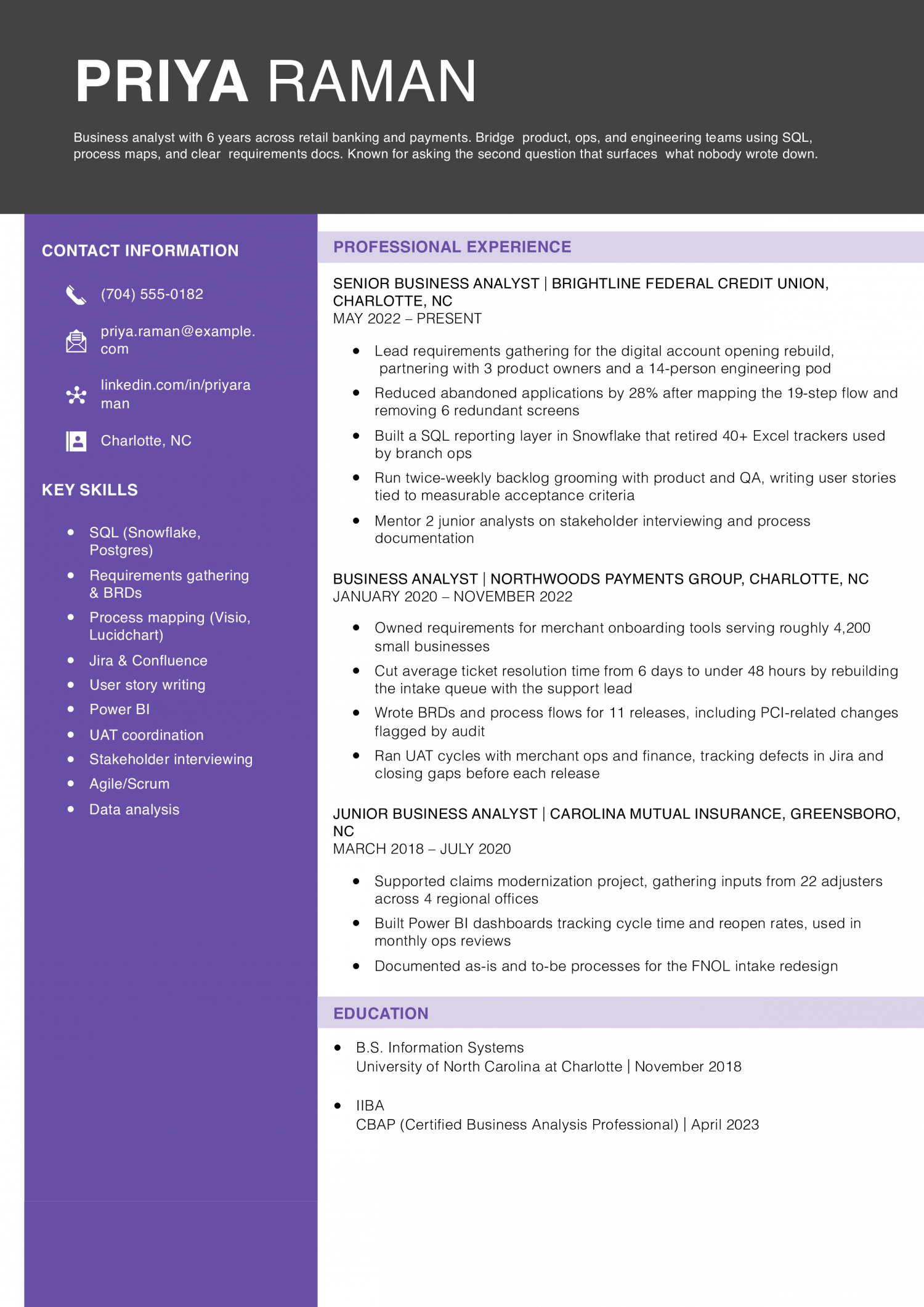
Junior BAs with one to three years showing requirements work on a real product team. The resume needs to prove you wrote user stories, ran SQL pulls, and shipped at least one documented requirement to production.
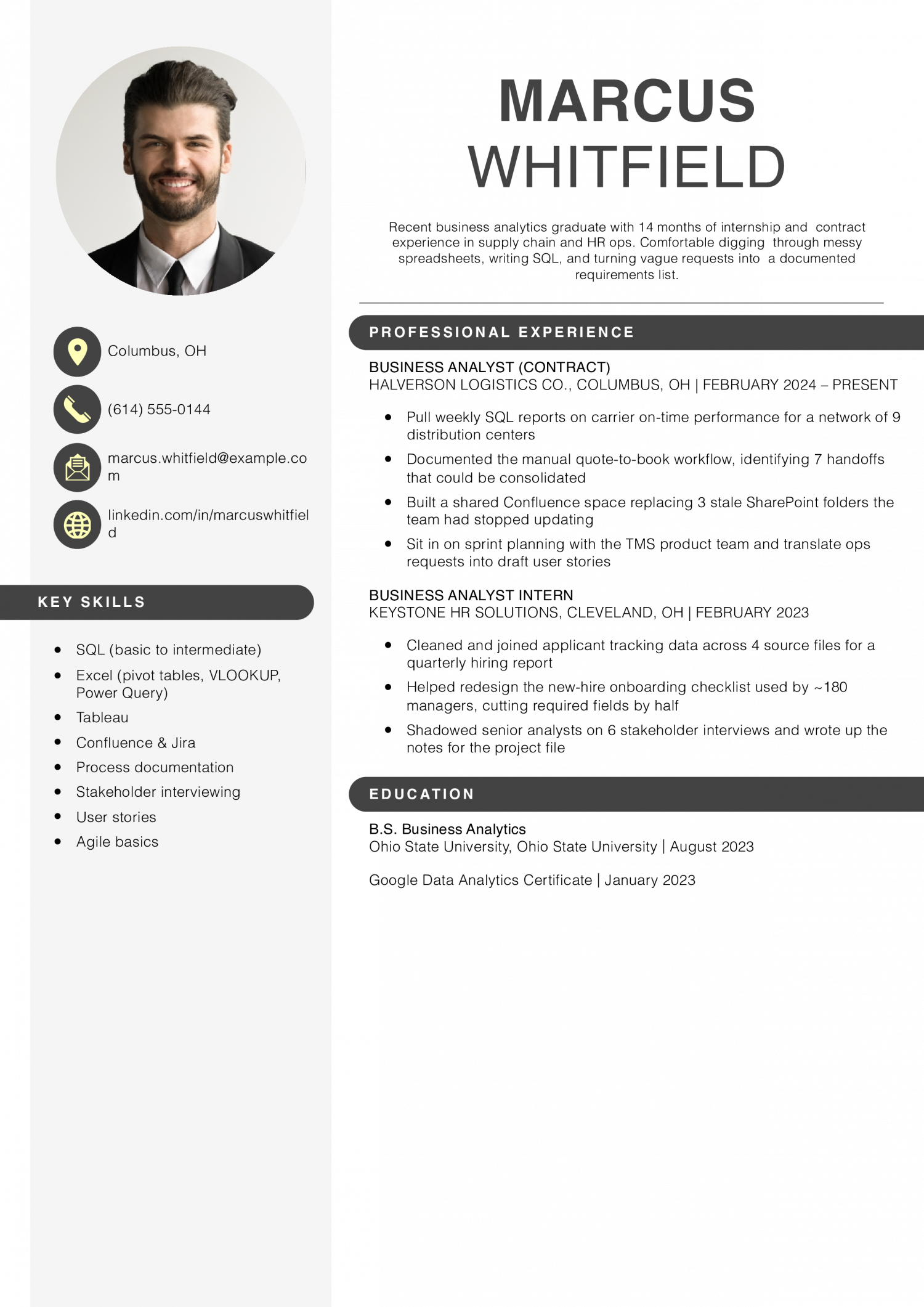
Senior BAs owning a workstream or product domain end to end. The resume needs to prove stakeholder facilitation across business and IT, measurable process or revenue impact, and fluency in BRDs, process maps, and SQL or Tableau.

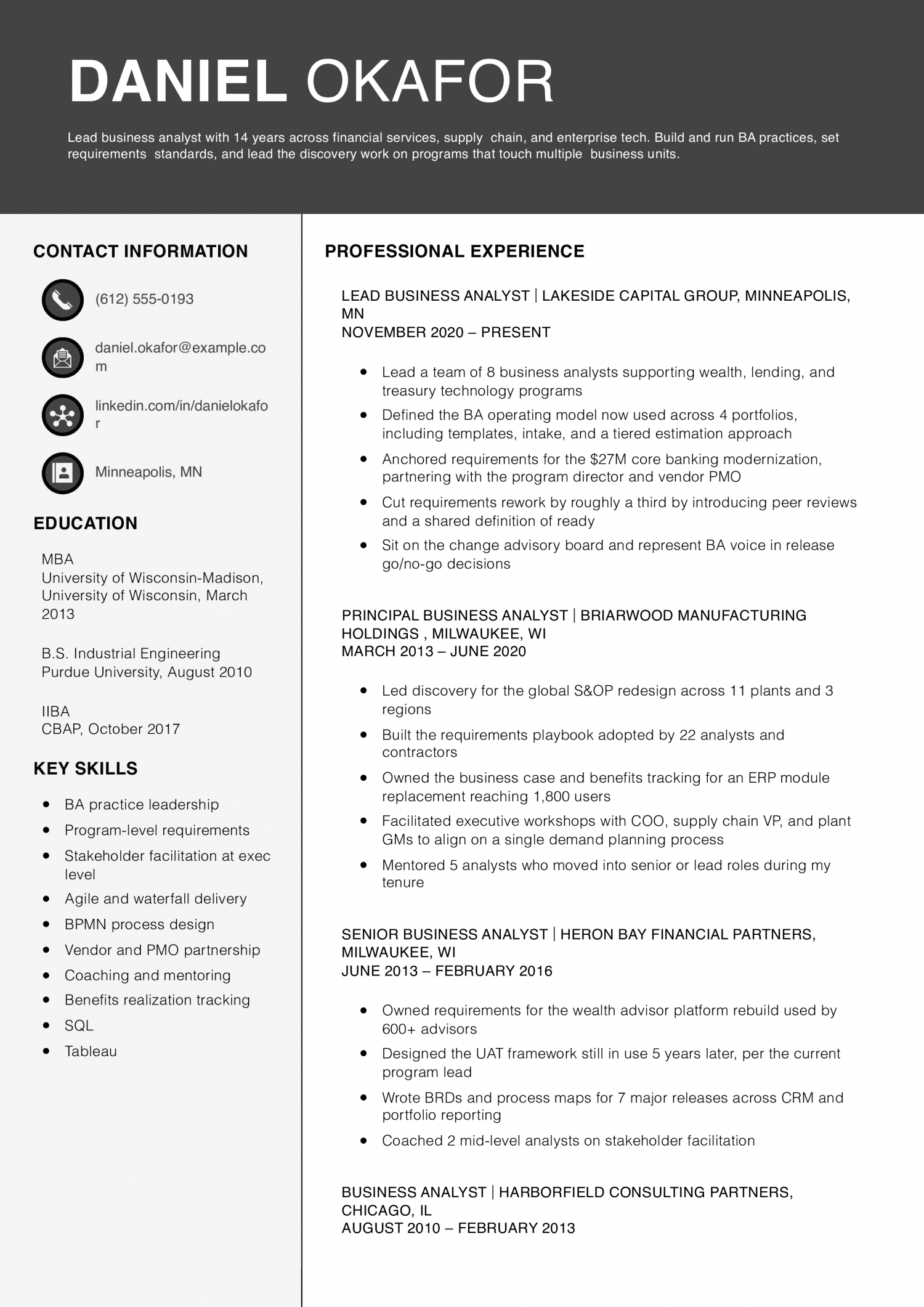
Lead BAs guiding a team of analysts or a multi-system program. The resume needs to prove portfolio-level scope, the methodology you set (SAFe, Agile, hybrid), and outcomes tied to revenue, cost, or cycle time.
Business analyst with 7 years across e-commerce, logistics, and B2B SaaS. Translate fuzzy stakeholder asks into requirements engineering can build and ops can run. Strong SQL, process mapping, and facilitation skills, with a habit of writing things down so nobody has to ask twice.
Lead with the one signal another BA cannot copy from a LinkedIn search. That might be a domain (claims, payments, supply chain), a system (Salesforce, SAP S/4HANA, Workday), or a methodology depth like SAFe RTE or POPM.
Put it in the summary line and the headline title. A BA who writes “Senior Business Analyst, claims platform modernization, SAFe POPM” beats a generic “Business Analyst with proven track record.” Name the data sources you query and the stakeholder layer you operate at, so a reader knows in five seconds where you fit on their team.
Most strong BA bullets carry a number tied to scope or outcome. Recruiters scan for three metric types first: requirements volume (BRDs, user stories, epics), system scope (integrations, data sources, user counts), and business impact (cycle time, revenue, defect rate).
A bullet without a number tends to read as a duty. Write “Authored 47 user stories across three sprints for a Salesforce CPQ rollout serving 1,200 sales reps” instead of “Gathered requirements for CPQ project.” Pick two or three realistic metrics per role and keep them honest.
Cluster your work so a reader can place you fast. Four buckets cover most BA resumes: requirements artifacts (BRDs, user stories, acceptance criteria), process and data work (process maps, SQL pulls, Tableau or Power BI dashboards), stakeholder facilitation (workshops, JAD sessions, steering committee updates), and delivery (UAT plans, defect triage, release notes).
Inside each cluster, name the system. “Built 12 Tableau dashboards on a Snowflake warehouse for finance ops” beats “Built dashboards.” That structure signals you understand the BA lifecycle, not just one phase of it.
BA team leads filter for tools and frameworks before they read bullets. Build a page-one skills strip with your SQL flavor, BI tool, requirements platform (Jira, Azure DevOps, Confluence), and methodology (Agile, SAFe, Waterfall).
List certifications in a short block under education: CBAP, PMI-PBA, CSPO, or SAFe POPM. Spell out the issuing body and the year. These signal you have invested past on-the-job learning, which matters for senior BA roles where teams expect a shared vocabulary across discovery, elaboration, and delivery.
Senior BA resumes that get pulled forward read tight. Cut bullets that describe meetings attended, status reports written, or generic “liaised between business and IT” language. Those are table stakes.
Keep bullets that show ownership: the requirement you wrote, the workshop you ran, the dashboard you shipped, the process change you measured. Trim early-career roles to two or three bullets and let your last two positions carry the weight. If a line could appear on any BA resume, it is taking space from one that could not.
The business analyst resumes that get callbacks share a specific skill mix. The lists below come from our user-built BA resumes. BA team leads and product managers scan for these patterns first, not generic “bridge between business and IT” framing.
Hard skills carry the keyword parse: SQL, Tableau, Jira, BRD, and a domain noun. Soft skills earn the second read when each one is backed by a bullet showing the behavior in action. Match the lists below against your target job posting and let your bullets prove the soft-skill claims.
| Soft Skills | % of resumes with this skill |
|---|---|
| Communication | 68% |
| Critical thinking | 51% |
| Problem solving | 41% |
| Stakeholder management | 40% |
| Attention to detail | 32% |
| Hard Skills | % of resumes with this skill |
|---|---|
| Requirements gathering | 79% |
| Data analysis | 50% |
| SQL | 49% |
| Business process modeling | 36% |
| Data visualization | 35% |
Based on data from thousands of business analysts’ resumes built on ResumeTemplates.com, May 2026.
These are the must-haves hiring teams look for when scanning a business analyst resume.
BA team leads and product managers expect to see a niche cluster that matches the posting. Group your keywords by specialty so the parser and the human reader both find them fast.
| Niche | Keywords ATS scans for |
|---|---|
| IT business analyst | it business analyst resume, systems analyst, sdlc, integration requirements |
| Data and analytics BA | business analytics resume, sql, tableau, power bi |
| Agile and product BA | user stories, acceptance criteria, scrum business analyst, product backlog |
| Senior and lead BA | senior business analyst resume sample, cbap, safe popm, program backlog |
| Entry-level BA | entry level business analyst resume, business analyst resume summary, ba resume examples, business analyst sample resume |
AI use on a business analyst resume can go three ways: lead with “AI-driven requirements expert” (which BA team leads screen out), leave it off entirely (which reads as evasive in 2026), or describe the workflow as it actually runs. The third is what BA team leads and product managers can validate in a working session.
AI tools draft a first-pass user story or BRD section from interview notes, which you edit for accuracy and acceptance criteria.
Copilot-style tools generate SQL from plain-English questions, which shifts the BA skill toward validating output against the data model.
Meeting transcripts run through ChatGPT or similar produce decision logs, which you verify and route into Confluence or Jira.
AI generates BPMN diagrams from step descriptions, leaving the BA to confirm swim lanes, exceptions, and handoffs with stakeholders.
ChatGPT: Drafts user stories, summarizes interview transcripts, and reframes requirements for technical and business audiences.
GitHub Copilot: Generates and explains SQL queries for data validation and ad-hoc analysis tied to BA work.
A bachelor’s degree and three to five years of BA work keep you eligible for most postings. The certifications below are what move a business analyst resume from the qualified-but-typical stack into the shortlist. List each one with the issuing body, the credential level, and the year earned.
CBAP (Certified Business Analysis Professional, IIBA): Signals 7,500 hours of BA work and is the standard senior-tier credential for enterprise and consulting roles.
PMI-PBA (Professional in Business Analysis, PMI): Carries weight at PMO-driven shops where program managers screen for PMI-family credentials alongside the PMP.
SAFe POPM (Product Owner / Product Manager): Reads as essential at large enterprises running SAFe; pairs well with a Scrum BA or hybrid BA-PO role.
CSPO (Certified Scrum Product Owner, Scrum Alliance): A strong second credential for BAs who write user stories and own backlog refinement on Agile teams.
Business analyst pay clusters in a tight mid-band for most of the country, then breaks open in a handful of high-cost coastal and tech-hub markets. The top-paying states are not always the largest employers, which means a senior BA in a secondary market can earn close to a coastal salary if the domain (financial services, healthcare payer, large-scale ERP) is right.
If you are geographically flexible, foreground the domain and the systems you have worked in, not the city.
| # | State | Avg. Annual |
|---|---|---|
| 1 | Massachusetts | $131,840 |
| 2 | District of Columbia | $125,500 |
| 3 | Maryland | $121,890 |
| 4 | Washington | $118,730 |
| 5 | Vermont | $115,840 |
| 6 | Illinois | $110,370 |
| 7 | Virginia | $109,650 |
| 8 | New York | $106,930 |
| 9 | New Jersey | $105,100 |
| 10 | Colorado | $104,990 |
| # | State | Workers | Median |
|---|---|---|---|
| 1 | California | 136,200 | $102,110 |
| 2 | Florida | 74,030 | $83,130 |
| 3 | New York | 65,390 | $106,930 |
| 4 | Virginia | 64,710 | $109,650 |
| 5 | Texas | 49,950 | $98,650 |
Resume Templates offers HR approved resume templates to help you create a professional resume in minutes. Choose from several template options and even pre-populate a resume from your profile.
Lead with the systems and data sources you touched. Name a class project, internship, or first-job artifact that shipped.
Examples that work: a SQL query you wrote against a real database, a Tableau dashboard you built for a stakeholder, or a user story that made it into a production sprint.
Skip the objective statement. Use a three-line summary that names your tools (SQL, Excel, Power BI), your methodology exposure (Agile, Scrum), and the domain you want to enter.
Lead with SQL, Tableau or Power BI, Jira, BRD, user stories, and the methodology (Agile, Scrum, SAFe). Add a domain noun like claims, payments, or supply chain.
Mirror the job posting exactly. If the posting says "business requirements document," write it out once and use the BRD abbreviation once. ATS parsers index both forms.
Open with title, years, and domain in one line. Example: "Senior business analyst with 11 years across claims and payments platforms." Add the methodology you set (SAFe RTE, Scrum BA lead), the systems you have shipped in (Guidewire, SAP S/4HANA, Salesforce), and one outcome number that proves portfolio scope. Keep it to three or four lines. Anything longer competes with your bullets for the first scan.
Yes. An IT BA resume needs deeper tool and system detail: the data warehouse, the integration patterns (REST, SOAP, ETL), and the SDLC artifacts you owned.
Lead with that stack in the summary. A general BA resume can stay closer to process and stakeholder language; an IT BA resume earns the second read by proving you can speak to engineers.
For a business analyst, a tech template is the safest pick, because it keeps your stack, tools, and impact easy to scan. An ATS-friendly template is a solid alternative. Whichever you choose, keep the formatting clean and easy to parse: clear section headings, a standard font, and no graphics a parser can choke on.
Executive Resume Writer and Career Coach
Andrew Stoner is an executive career coach and resume writer with 17 years of experience as a hiring manager and operations leader at two Fortune 500 Financial Services companies, and as the career services director at two major university business schools.
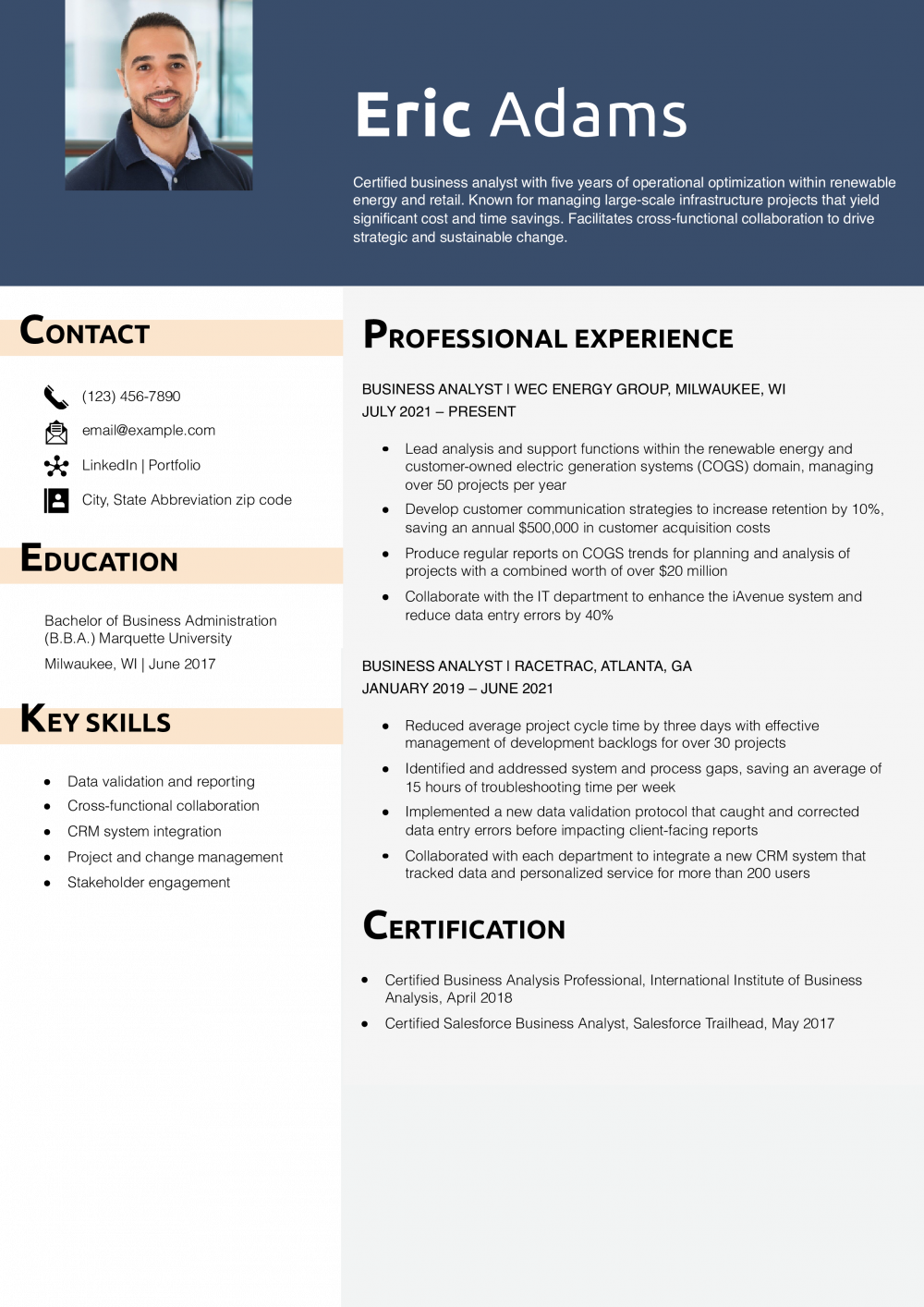
Customize this template in our builder in under 10 minutes.