20 Best Business Analyst Resume Examples and Templates for 2026



A clean scope line with revenue, headcount, and budget is what gets business resumes past a recruiter's six-second scan; named cross-functional wins are what make them readable enough to advance to the hiring manager.
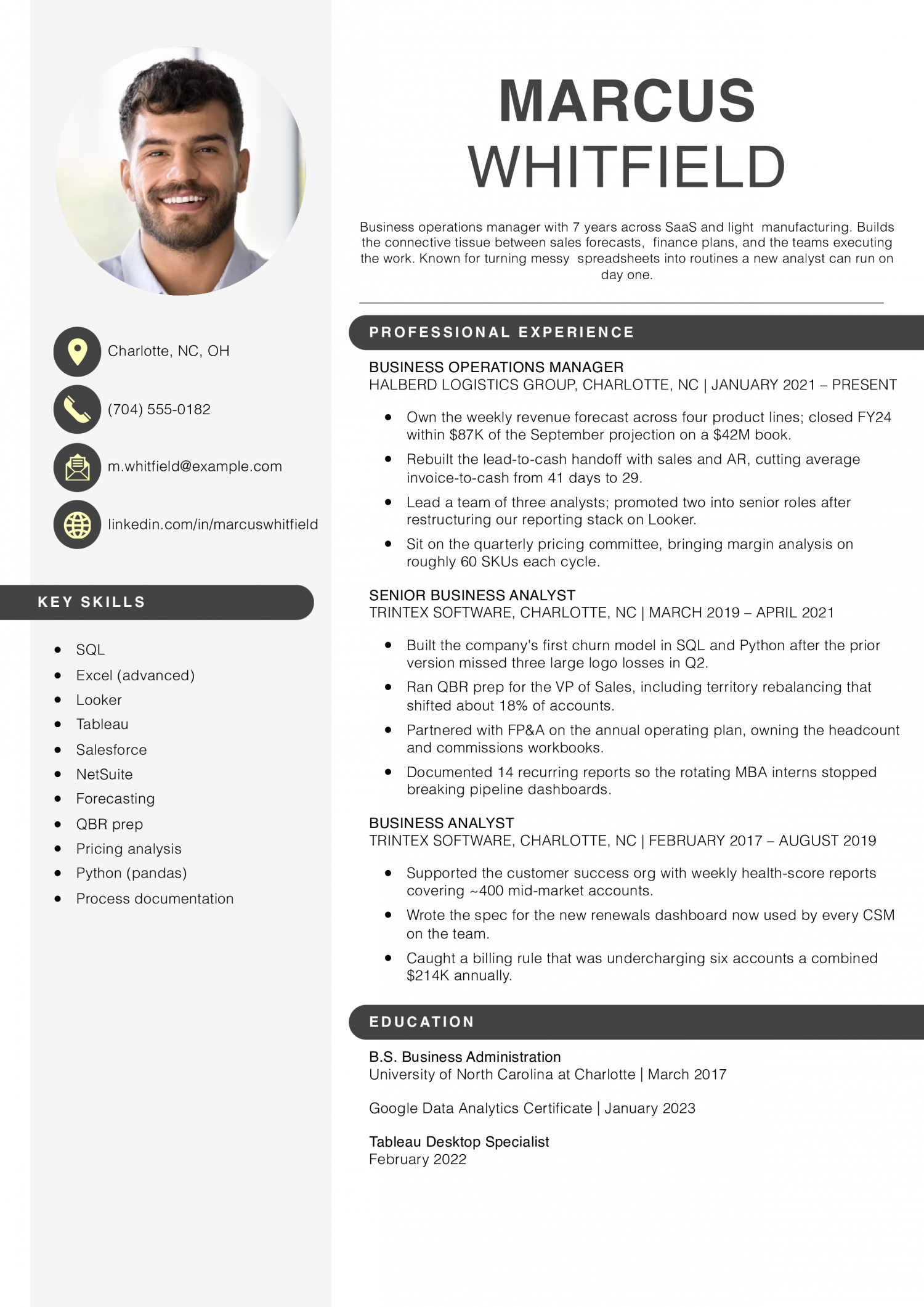
Entry-level business candidates are analysts, coordinators, and rotational program hires within two years of a degree. The resume needs to prove quantitative coursework, internship deliverables with dollar or percent outcomes, and the analytics stack you can use day one.

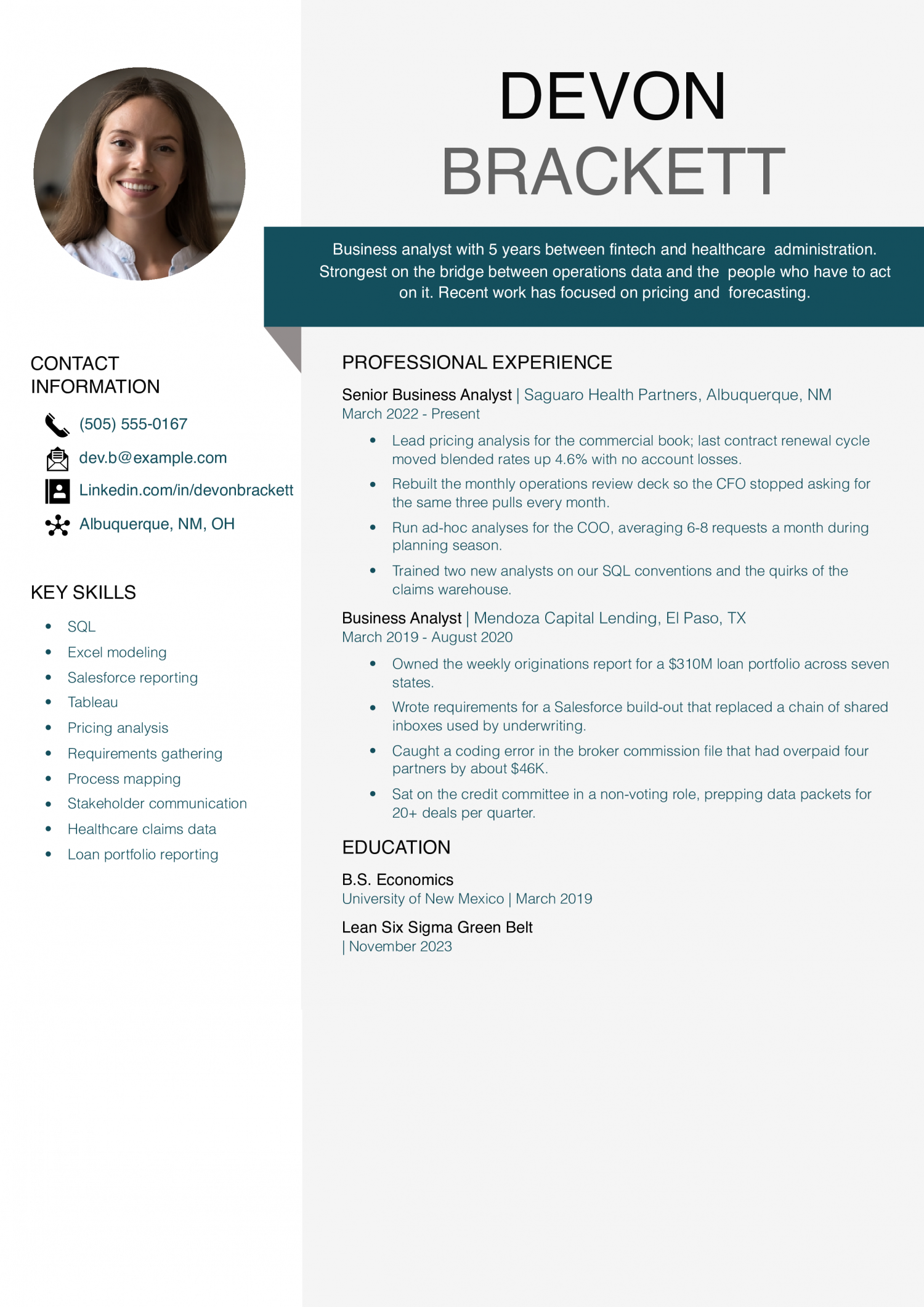
Mid-career business professionals are senior analysts and managers owning a budget, a deal book, or a functional team. The resume needs to prove P&L scope, projects led across functions, and named outcomes in revenue, margin, or retention.
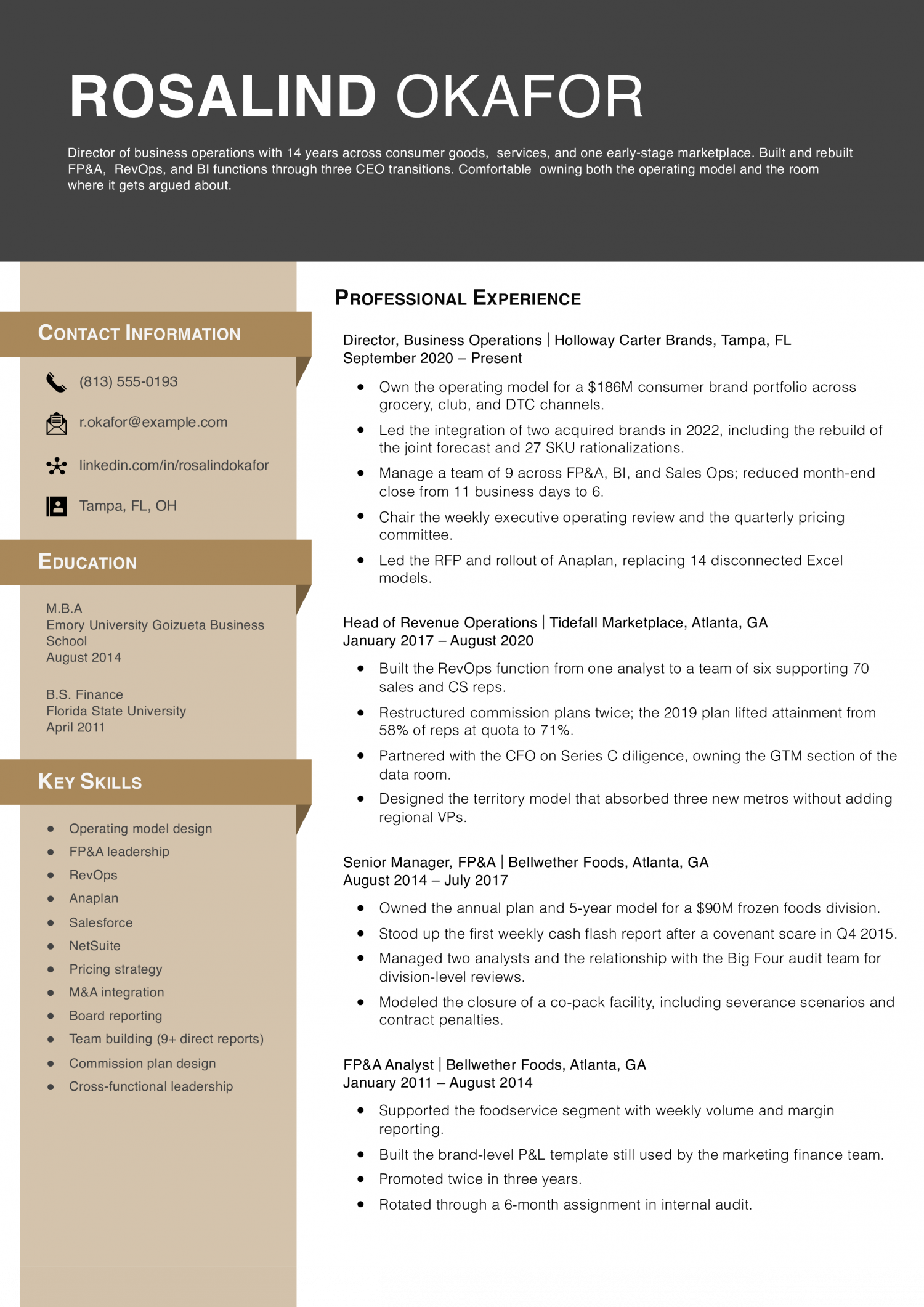
Senior business leaders are directors, VPs, and GMs running a unit or a multi-team function. The resume needs to prove revenue and headcount scope, board or executive-facing wins, and the operating cadence you set across finance, sales, and operations.
Business operations leader with 10 years across e-commerce, B2B services, and a stint in management consulting. Comfortable in the spreadsheet, in front of a board, and on the warehouse floor. Recent work focuses on margin recovery and operating cadence.
Lead the summary with the dollar number that defines your last role. Name P&L owned, deal size closed, budget managed, or revenue influenced in the first line.
Hiring managers and business unit leaders read that number as your operating altitude. A senior analyst running a $40M forecast reads differently than one running a $400M one.
Follow the number with the function (finance, marketing, ops) and the industry, so a recruiter can place you in 10 seconds without scrolling.
Most strong business bullets carry a number. Pick two or three metrics that fit your function: revenue growth, margin lift, retention rate, NPS, cycle time, or cost saved.
Bullets without a number tend to read as duties, not impact. Pair the action with the lever you pulled and the result tied to a business unit.
If you cannot share an exact figure, give the range or scope. Saying you managed a seven-figure marketing budget beats saying you managed a large budget.
Cluster bullets into three or four categories your reader expects. For finance, that is forecasting, variance analysis, capital planning, and stakeholder reporting.
For marketing, that is demand generation, brand, lifecycle, and analytics. For ops, that is process design, vendor management, and KPI rollouts.
Categories help a recruiter scan for the specific skill in the posting. They also force you to drop filler bullets that do not map to a named area of business work.
Put your MBA, CFA level, CPA, PMP, or Six Sigma belt in the header line under your name. Recruiters in finance and consulting check that block before the summary.
List your stack (Excel, SQL, Tableau, Power BI, Salesforce, NetSuite, SAP) in a one-line skills bar near the top. Hiring managers and business unit leaders scan for tool overlap fast.
Save expanded certification descriptions for the credentials section at the bottom. The page-one block is for signal, not paragraphs.
If you are five years in, drop the GPA, the campus club officer roles, and the high school awards. Replace that real estate with named client work or P&L lines.
Trim summary statements that read like LinkedIn bios. A hiring director wants the scope number, the function, and the next role you want, not adjectives.
Cut software you have not touched in three years. Listing stale tools dilutes the stack you actually run today.
Business hiring is tight in 2026. Corporate teams are running leaner and the bar to clear a recruiter screen is higher. The skills below come from our user-built business resumes.
Hiring managers and business unit leaders weight hard skills (Excel modeling, SQL, Tableau) for the screen, then read soft skills as evidence backing your bullets. Match the lists against your target job posting, and use the soft skills as proof points inside your accomplishment bullets, not a standalone block.
| Soft Skills | % of resumes with this skill |
|---|---|
| Communication | 68% |
| Problem solving | 62% |
| Time management | 43% |
| Critical thinking | 38% |
| Adaptability | 25% |
And here are the top hard skills showing up most often.
| Hard Skills | % of resumes with this skill |
|---|---|
| Microsoft Excel | 79% |
| Data analysis | 65% |
| Project management | 44% |
| Financial modeling | 39% |
| SQL | 27% |
Based on data from thousands of business professionals’ resumes built on ResumeTemplates.com, May 2026.
Before a business resume gets a closer read, hiring teams check for a short list of essentials.
Hiring managers and business unit leaders expect to see niche terms that match the function and industry on the posting. Cluster these into your skills bar and bullet language, not a keyword dump.
| Niche | Keywords ATS scans for |
|---|---|
| Finance and FP&A | financial modeling, variance analysis, forecasting, capital planning |
| Marketing and growth | demand generation, ROAS, MQL pipeline, brand lift |
| Consulting and strategy | market sizing, due diligence, executive recommendations, engagement lead |
| Operations and supply chain | process improvement, Six Sigma, vendor management, SLA reporting |
| HR and people operations | talent acquisition, retention rate, workforce planning, HRIS reporting |
Hiring teams are split between leaders who want LLM fluency in every analyst and leaders who forbid generative tools on client data. Name the tools you actually use, describe the workflow honestly, and avoid claiming you build AI models if your real work is prompting and verifying.
LLMs draft executive summaries and board slides; the value you add is the framing, the numbers, and the recommendation.
Copilots write SQL and Python for ad hoc pulls; you still own the question, the join logic, and the sanity check.
LLMs summarize 10-Ks and analyst reports in minutes; you verify sources and pressure-test the synthesis against your own market view.
Transcription tools produce notes and action items; you edit for accuracy and route decisions to the right stakeholders.
ChatGPT or Claude: Drafting memos, summarizing reports, and stress-testing arguments before you bring them to the team.
Microsoft Copilot in Excel and Power BI: Generating formulas, explaining variance, and accelerating dashboard builds inside the corporate stack.
Beyond a degree, the certifications below tell hiring managers and business unit leaders which functional depth you bring and how seriously you have invested in the craft. List the certifying body, the level, and the year earned next to each item.
Chartered Financial Analyst (CFA): Signals deep investment and corporate finance fluency. List the level passed (I, II, or III) and the year; finance recruiters scan for this first.
Project Management Professional (PMP): Signals you can run a cross-functional program with a defined scope, budget, and timeline. Common ask for senior analyst and manager roles in operations.
Six Sigma Green or Black Belt: Signals process improvement chops and quantitative rigor. Strong fit for operations, supply chain, and continuous-improvement roles inside Fortune 500 employers.
Certified Public Accountant (CPA): Signals audit, tax, and controllership readiness. List the state of licensure in good standing; do not put the license number on the resume.
Resume Templates offers HR approved resume templates to help you create a professional resume in minutes. Choose from several template options and even pre-populate a resume from your profile.
Treat it like any other role. Give the venture a clear company name, your title (Founder or Owner), the dates, and three to five bullets.
Quantify it the same way you would a corporate role: revenue earned, customers served, margin, team size, or marketing reach.
Keep it on the resume when the work maps to the target job. Drop it if it reads as unrelated hobby income.
Yes, when the work was real and the scope is verifiable. List the business name, your actual title, dates, and the work you owned.
Use the same bullet structure as other roles: actions tied to revenue, customers, or operations. Avoid vague phrasing like helped with the family business.
Be ready to explain the reporting structure in an interview. Recruiters often ask who you reported to and how performance was measured.
Lead with the pipeline you built or closed. Name the deal size range, the number of new accounts, and the contract value signed.
Pair each bullet with the cycle length, the partner roster, and the function you sold into (procurement, marketing, IT).
If you sourced versus closed, say so. Hiring managers read prospected pipeline and signed revenue as different skills.
They help at the entry tier when they show leadership and quantified outcomes. List the chapter, your officer title, dates, and one or two bullets.
Quantify the work: budget managed, events run, members recruited, sponsors signed. Treat it like a small operations role.
Drop the section once you have two years of full-time work. Senior bullets earn that page-one space.
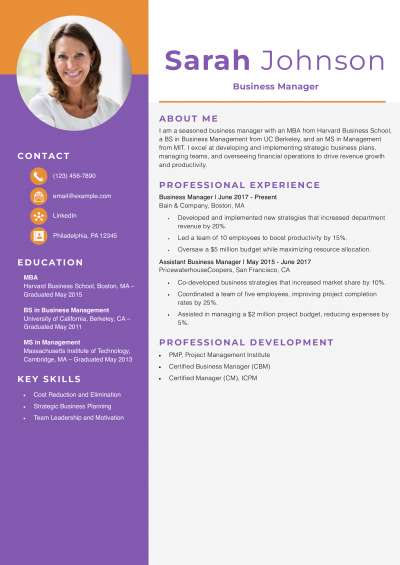
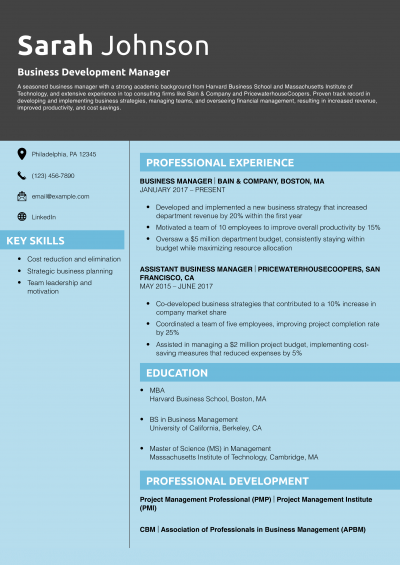
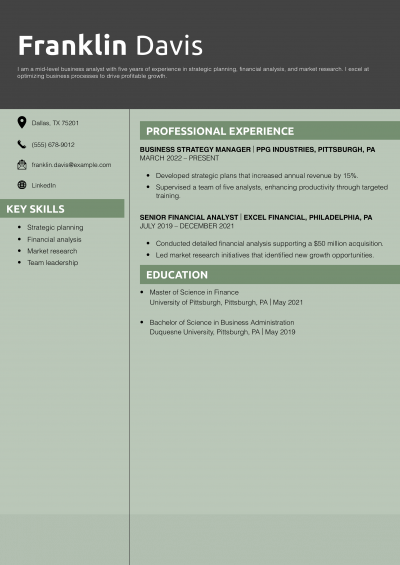
For a business professional, a professional template is the safest pick, because it signals the polish hiring managers in this field expect. An ATS-friendly template is a solid alternative. Whichever you choose, keep the formatting clean and easy to parse: clear section headings, a standard font, and no graphics a parser can choke on.
Executive Resume Writer and Career Coach
Andrew Stoner is an executive career coach and resume writer with 17 years of experience as a hiring manager and operations leader at two Fortune 500 Financial Services companies, and as the career services director at two major university business schools.
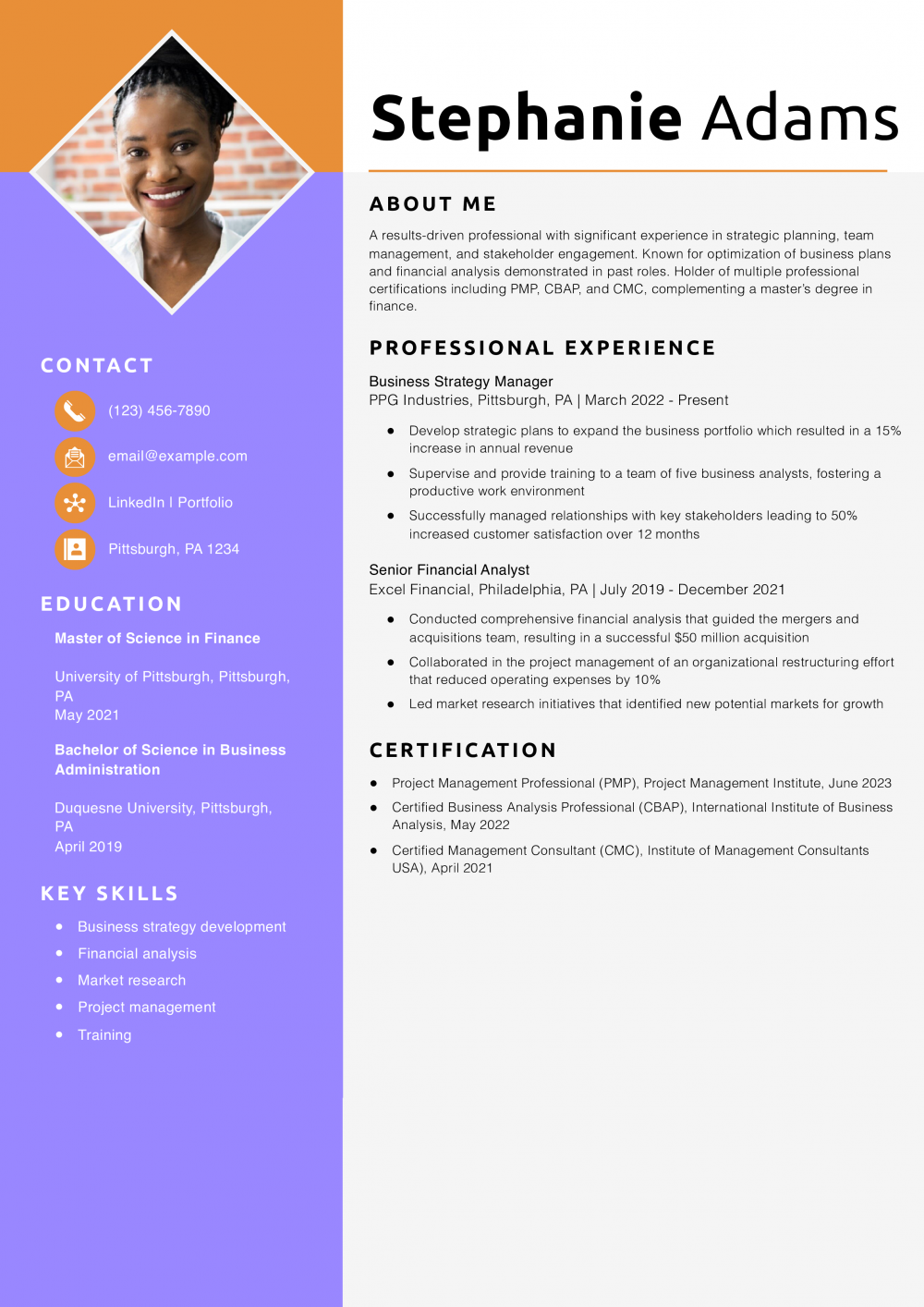
Customize this template in our builder in under 10 minutes.