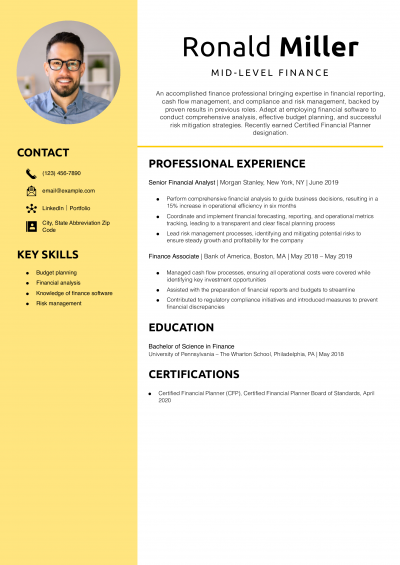
3 Best Finance Resume Examples and Templates for 2026



The financial analyst resumes that get scheduled share three things: a forecast accuracy percentage in the summary, named ERP and BI tools above the experience block, and modeling work tied to a specific P&L outcome.
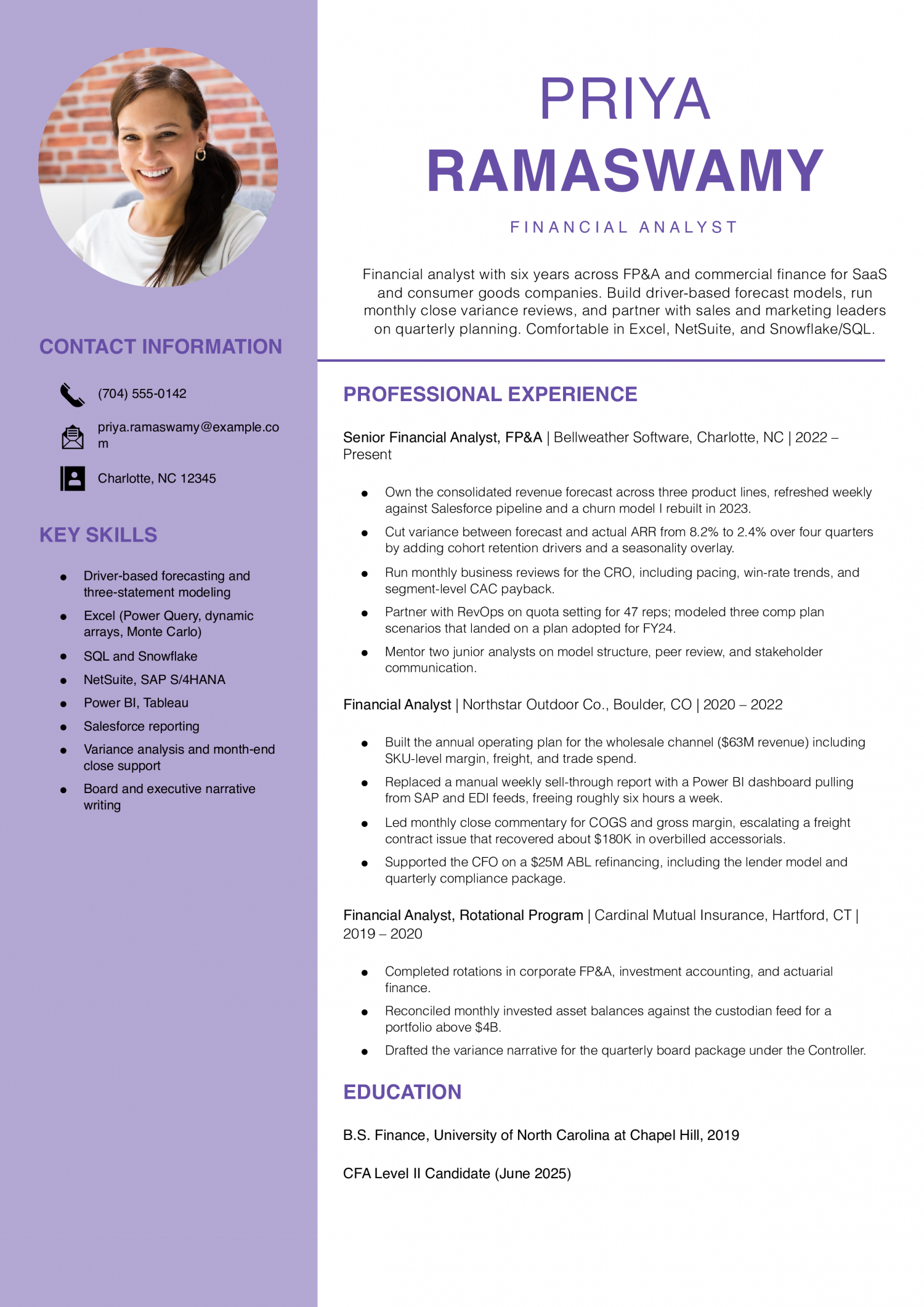
Junior financial analysts are zero to three years in, often post-MBA or post-rotation. Your resume needs to prove modeling fundamentals, Excel and SQL fluency, and one or two variance or forecast cycles you owned end to end.
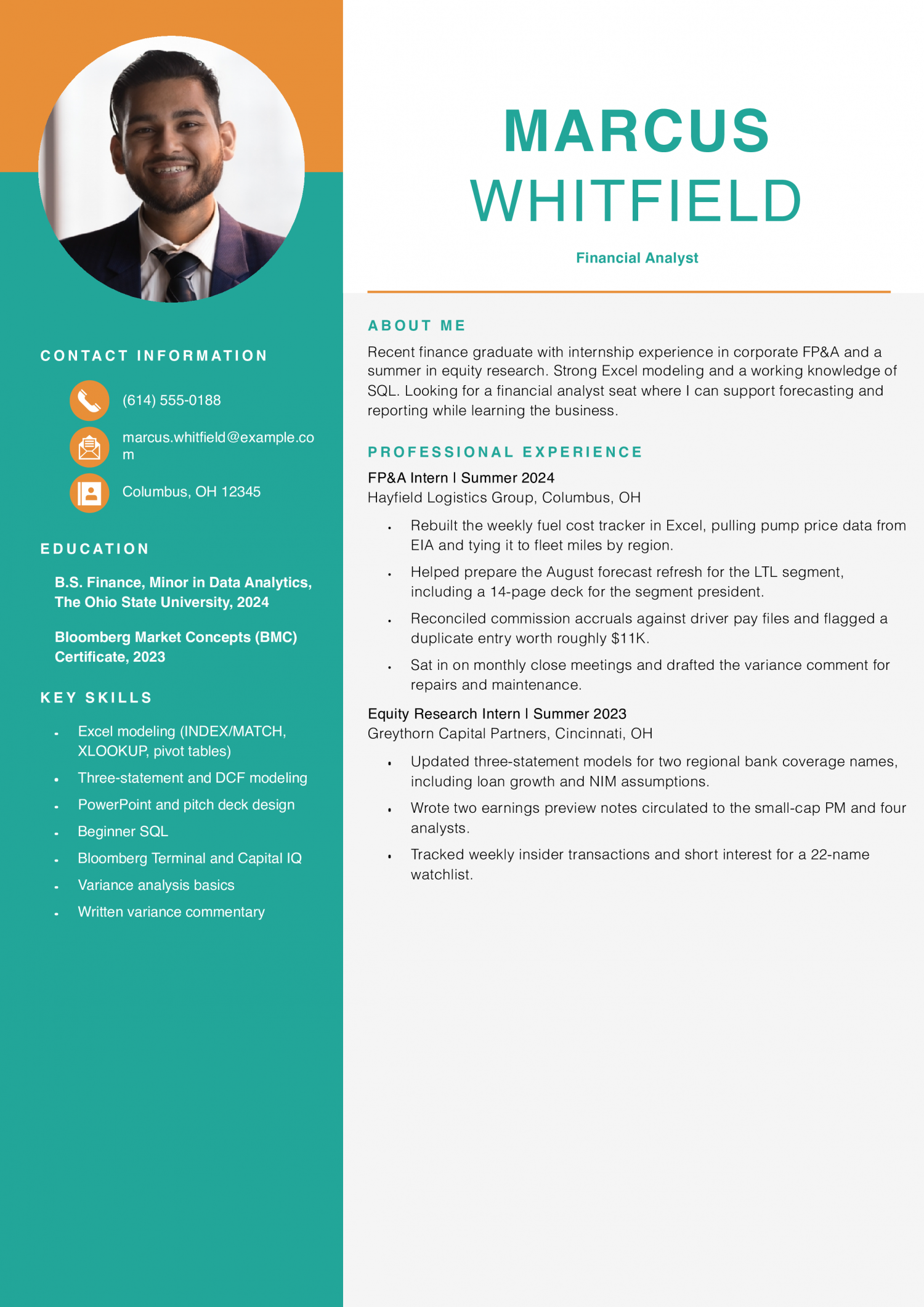
Senior financial analysts run forecast cycles, build the models leadership relies on, and partner with business owners on the numbers. Your resume needs to show forecast accuracy, the P&L size you support, and the decisions your analysis drove.
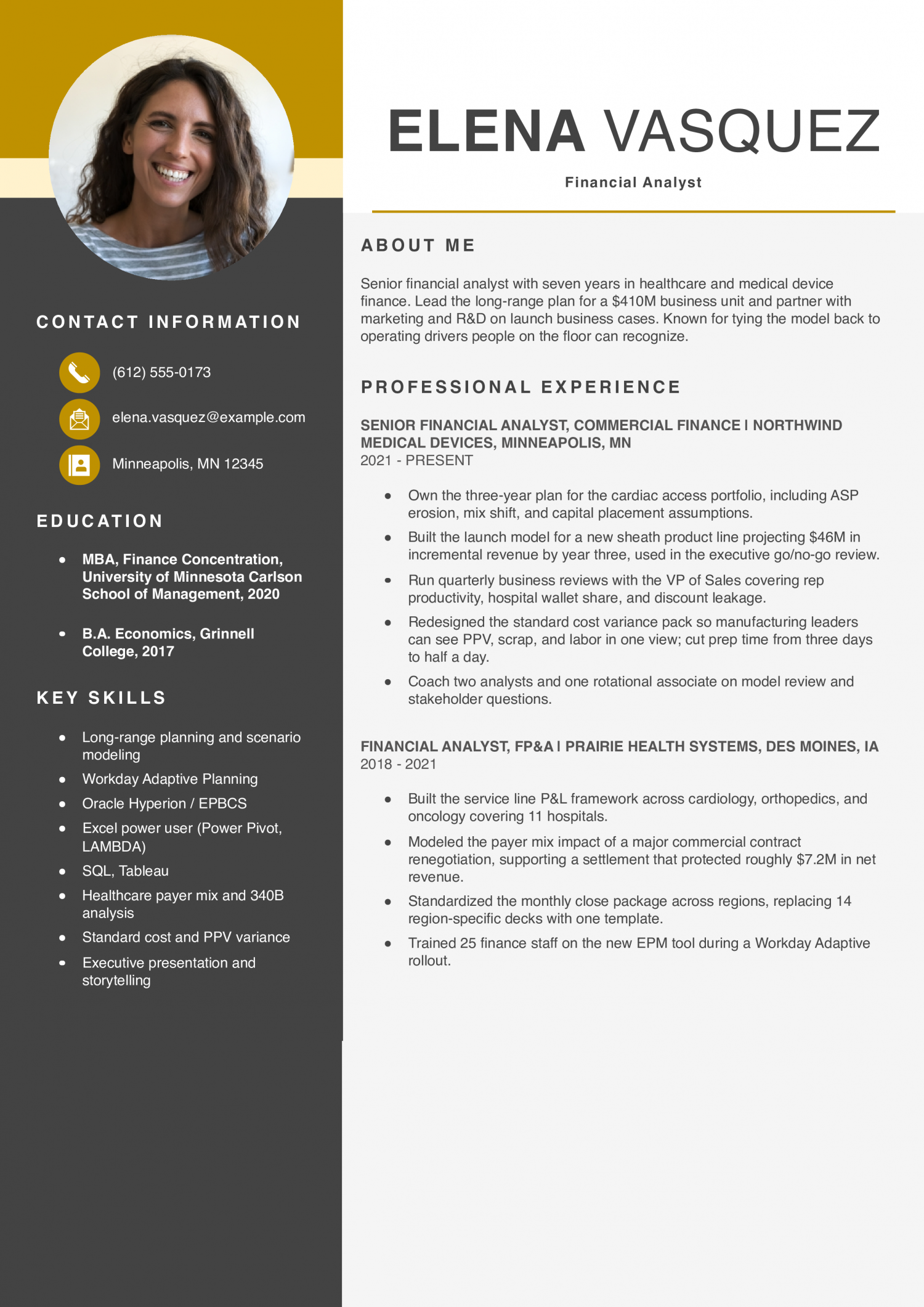
Lead and principal analysts set the methodology, mentor the team, and own the executive narrative behind the numbers. Your resume needs to show budget scope managed, headcount you guide, and strategic decisions tied to your models.
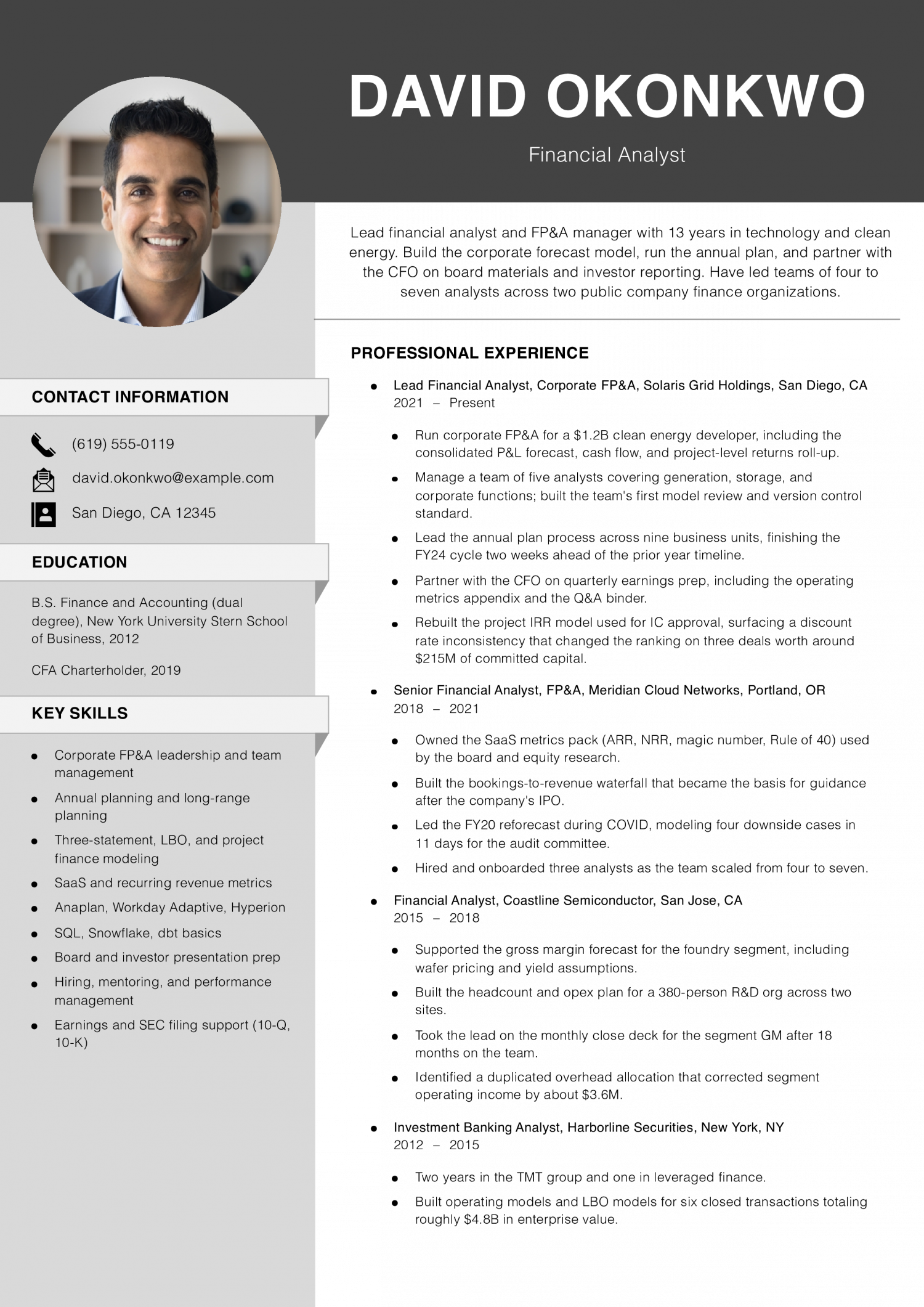
Hannah Liebowitz
Austin, TX | (512) 555-0167 | [email protected] | linkedin.com/in/hannahliebowitz
Financial analyst with eight years across corporate FP&A, commercial finance, and treasury at consumer brands and a fintech. Build forecast and scenario models, run business reviews with sales and operations partners, and handle the analytics behind quarterly board materials. Strong in Excel, SQL, and Anaplan, with hands-on experience in a Workday Adaptive implementation.
Senior Financial Analyst, Corporate FP&A
Lattice Pay Inc. | Austin, TX | 2022-Present
Financial Analyst, Commercial Finance
Juniper Pet Brands | Nashville, TN | 2020-2022
Financial Analyst, Treasury
Foxglove Brewing Co. | Asheville, NC | 2018-2020
Financial Analyst, Rotational
Allegheny Industrial Holdings | Pittsburgh, PA | 2016-2018
The first line of your summary should name your forecast accuracy, the P&L size you supported, or the budget you owned. FP&A managers read that opener as a proxy for whether your work survived an actual close cycle.
If you cut variance from 12 percent to 4 percent, lead with it. If you forecast a $400M revenue line within two points, lead with that. Years in seat goes second, after the number that proves you can hit a forecast.
Bullets without a number tend to read as job duties. Strong financial analyst bullets carry forecast accuracy, cost savings identified, revenue forecasted, or budget size managed.
Name two or three real metrics per role: a forecast variance percentage, a dollar value of savings, the size of the P&L you supported. Recruiters scan for those figures before reading the verb.
Inside each role, cluster bullets into four buckets: forecasting and budgeting, modeling, reporting and analysis, and business partnering. That order tracks how an FP&A team actually scopes the work.
Under forecasting, name the cycle (monthly, quarterly, annual operating plan) and the accuracy. Under modeling, name the type (DCF, three-statement, scenario, sensitivity). Under reporting, name the audience (CFO, business unit lead, board).
Finance directors look for the CPA or CFA status, the ERP, and the BI tool before they read a single bullet. Put a tools-and-credentials block on page one, right under the summary.
List Excel and SQL as a given, then the ERP (SAP, Oracle, NetSuite, Workday) and the BI stack (Tableau, Power BI, Looker). Note CFA level passed or CPA progress with the year, no license numbers.
Lines like “prepared monthly reports” or “supported the FP&A team” describe the chair, not your work. Replace them with the forecast you owned, the model you built, or the decision the analysis drove.
If a bullet would still fit a junior accountant, a treasury analyst, or a business analyst, rewrite it. Each bullet should name a model type, a system, a metric, or a stakeholder by function.
Five years ago, a financial analyst resume read like an Excel function list and a degree. The skills below come from the resumes our users built in 2026. The mix has shifted toward ERP and BI tool fluency, modeling depth, and forecast accuracy.
Finance directors weigh hard skills as gatekeepers and soft skills as the evidence behind your bullets. Stakeholder partnering only counts when a bullet names who and what changed. Match the hard-skill list against your target posting, then use the soft skills as the framing for the bullets that back them up.
| Soft Skills | % of resumes with this skill |
|---|---|
| Analytical thinking | 68% |
| Communication | 50% |
| Attention to detail | 46% |
| Problem solving | 35% |
| Collaboration | 26% |
And here are the top hard skills showing up most often.
| Hard Skills | % of resumes with this skill |
|---|---|
| Financial modeling | 72% |
| Microsoft Excel | 67% |
| Financial forecasting | 44% |
| Financial statement analysis | 36% |
| Budgeting and cost analysis | 29% |
Based on data from thousands of financial analysts’ resumes built on ResumeTemplates.com, May 2026.
These are the must-haves hiring teams look for when scanning a financial analyst resume.
Finance directors and FP&A managers expect a niche section that names the specialty inside finance you’ve actually worked in. Group keywords by sub-niche so parsers index them as related terms.
| Niche | Keywords ATS scans for |
|---|---|
| Corporate FP&A | annual operating plan, monthly forecast, variance analysis, budget vs actual |
| Modeling and valuation | DCF model, three-statement model, scenario analysis, LBO model |
| Tools and systems | SAP, Oracle, NetSuite, Tableau, Power BI |
| Reporting and close | month-end close, management reporting, board deck, KPI dashboard |
| Business partnering | commercial finance, sales finance, operations finance, business case |
What FP&A managers expect on a financial analyst resume has shifted: “proficient in Excel” now reads as table stakes; naming the AI-assisted workflow you use for variance commentary, data cleanup, or model documentation reads as current. The list below names what to add.
AI tools draft the first pass on variance write-ups, freeing analysts to focus on root-cause judgment and the recommendation.
Copilots inside Excel and Power Query speed up data prep, so reviewers expect you to spend more cycles on analysis.
Assistants generate model notes and assumption logs, raising the bar on documentation quality reviewers expect to see.
AI-assisted SQL drafting shortens the loop from question to answer, so analysts are judged on the question more than the syntax.
The CPA and CFA are the two credentials FP&A managers and investment teams index against without thinking. How you list them matters as much as having them.
Finance directors and FP&A managers read this list as a map of where your work is heading. The credentials below tell them which track, corporate finance, investments, or technical analyst, you’ve invested in. List the issuing body and the year completed, with CFA or CPA progress noted by level or sections passed.
The 90th-percentile financial analyst out-earns the median by a wide margin, which tells you the market rewards industry specialization and modeling depth more than years in seat. Investment management, tech, and corporate development pay above generalist FP&A in the same metro. Lead the resume with the industry and the model types you own, not a chronological tour of titles.
Top-band analysts get there by stacking deal exposure, ERP scope, and credential progress, in that order.
| # | State | Avg. Annual |
|---|---|---|
| 1 | Wyoming | $213,940 |
| 2 | New York | $126,580 |
| 3 | California | $111,100 |
| 4 | New Jersey | $109,380 |
| 5 | Oregon | $107,680 |
| 6 | Massachusetts | $107,610 |
| 7 | District of Columbia | $106,840 |
| 8 | Connecticut | $106,250 |
| 9 | Virginia | $104,030 |
| 10 | Minnesota | $102,800 |
| # | State | Workers | Median |
|---|---|---|---|
| 1 | New York | 47,130 | $126,580 |
| 2 | California | 40,570 | $111,100 |
| 3 | Texas | 26,940 | $92,370 |
| 4 | Florida | 21,690 | $83,560 |
| 5 | Massachusetts | 18,020 | $107,610 |
Resume Templates offers HR approved resume templates to help you create a professional resume in minutes. Choose from several template options and even pre-populate a resume from your profile.
Open with a forecast accuracy figure, the P&L size you support, and your credential status.
Then name your industry and the model types you own. Skip the "results-oriented finance professional" line.
Lead with internships, the model types you built in coursework or rotations, and your tool stack (Excel, SQL, one BI tool).
Name the industry of each internship and the deliverable you produced. Add CFA Level I candidacy if relevant, with the test date.
Yes, but group them. "Excel (Power Query, XLOOKUP, dynamic arrays, Power Pivot)" reads better than a long function list.
ATS parsers index the parenthetical terms, and reviewers see modeling depth at a glance. Skip basic functions like SUM or VLOOKUP.
For FP&A, lead bullets with the cycle (AOP, monthly forecast, quarterly reforecast), the variance you cut, and the business partners you support.
For investment-style work, lead with the asset class, the model type (DCF, comps, LBO), and the deal or coverage size. The titles overlap, but the bullets should not.
For a financial analyst, a professional template is the safest pick, because it signals the polish hiring managers in this field expect. An ATS-friendly template is a solid alternative. Whichever you choose, keep the formatting clean and easy to parse: clear section headings, a standard font, and no graphics a parser can choke on.
Executive Resume Writer and Career Coach
Andrew Stoner is an executive career coach and resume writer with 17 years of experience as a hiring manager and operations leader at two Fortune 500 Financial Services companies, and as the career services director at two major university business schools.
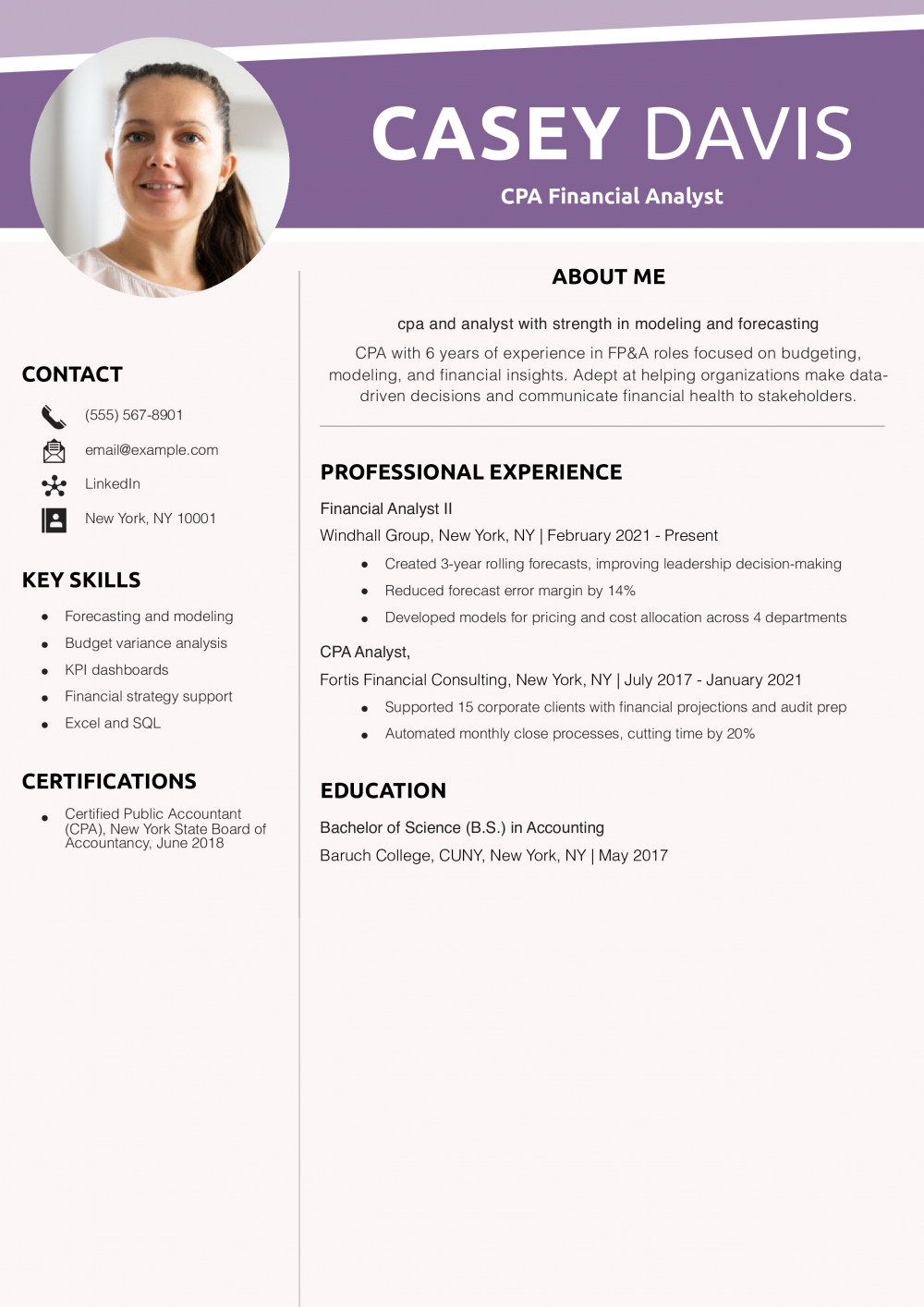
Customize this template in our builder in under 10 minutes.