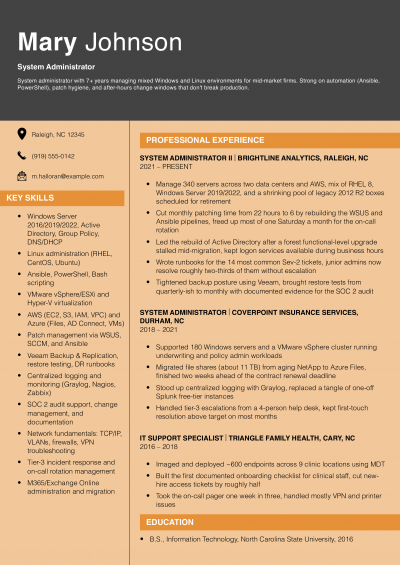
System Administrator Resume Examples and Templates for 2026



Hiring CISOs and SOC managers look for named tools and incident outcomes on the first page, because that combination shows whether a candidate has actually run detections in production or only studied them for a cert.
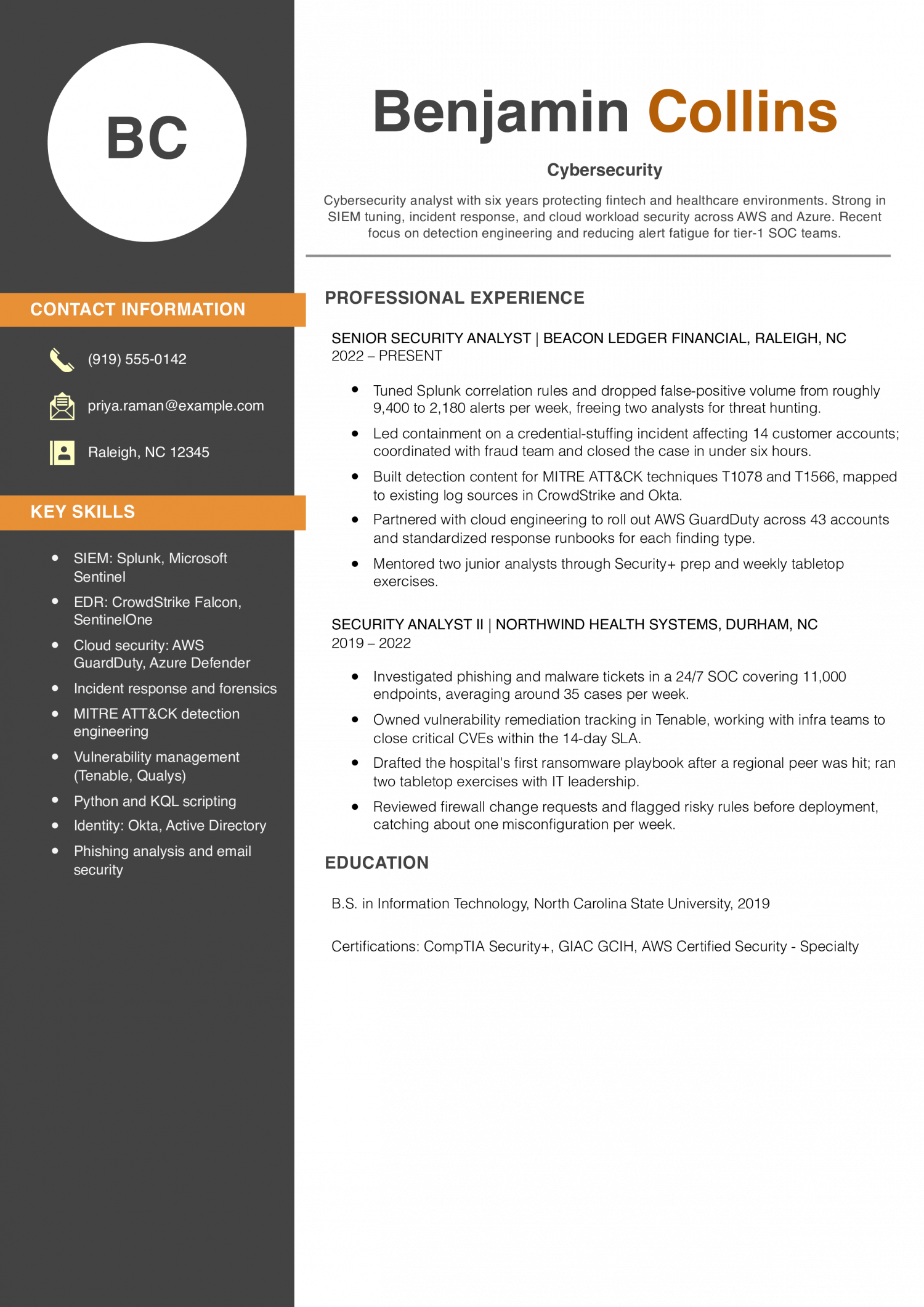
The junior tab fits SOC analyst I roles, recent grads with a Security+ cert, and IT or help-desk pivots. This resume needs to prove hands-on lab work, SIEM exposure, and a clear grasp of the alert-to-ticket lifecycle.
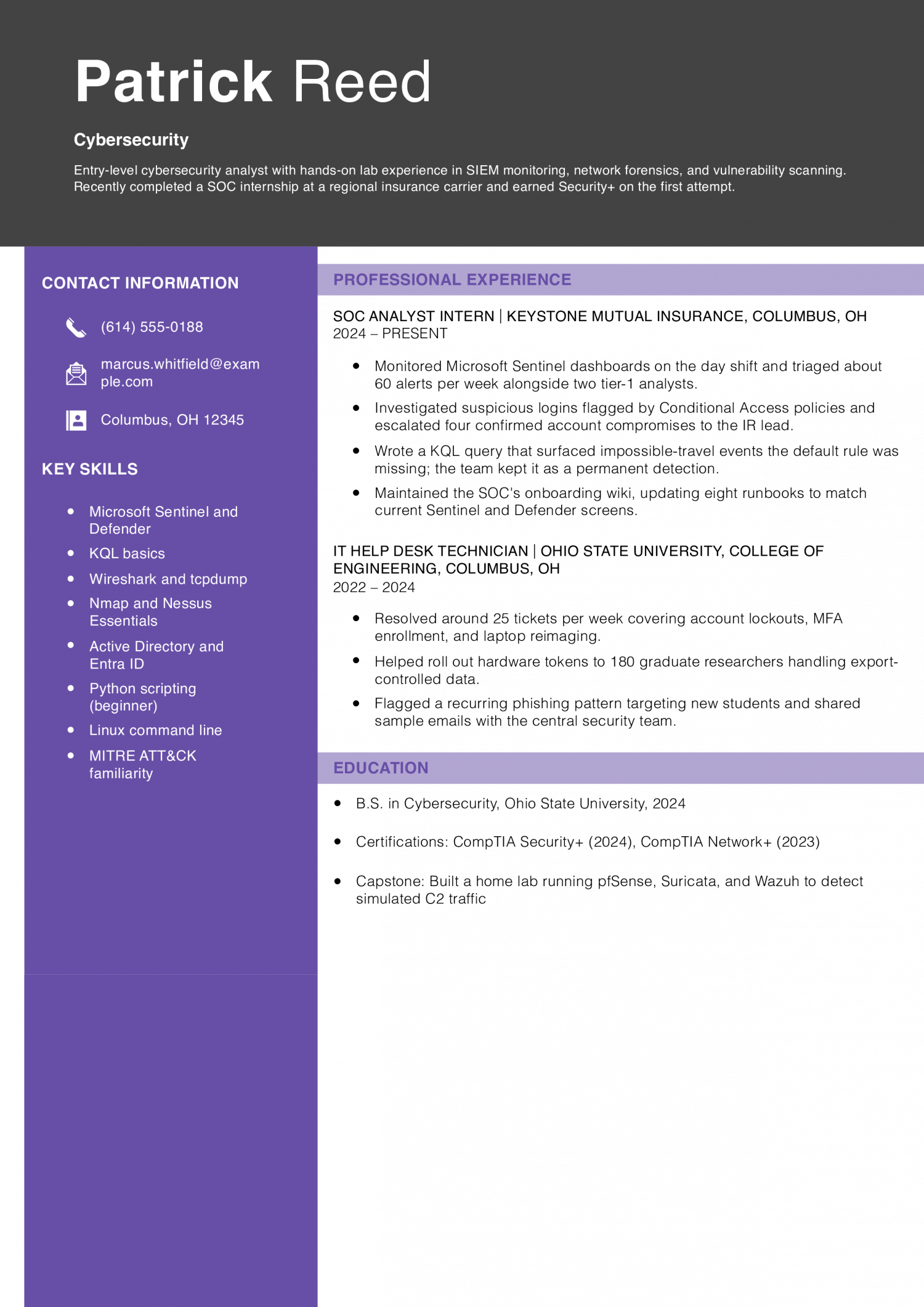
The senior tab fits SOC analyst II or III, incident responders, and security engineers with three to seven years on the job. This resume needs to show owned playbooks, tuned detections, and measurable reductions in MTTR or false-positive rates.
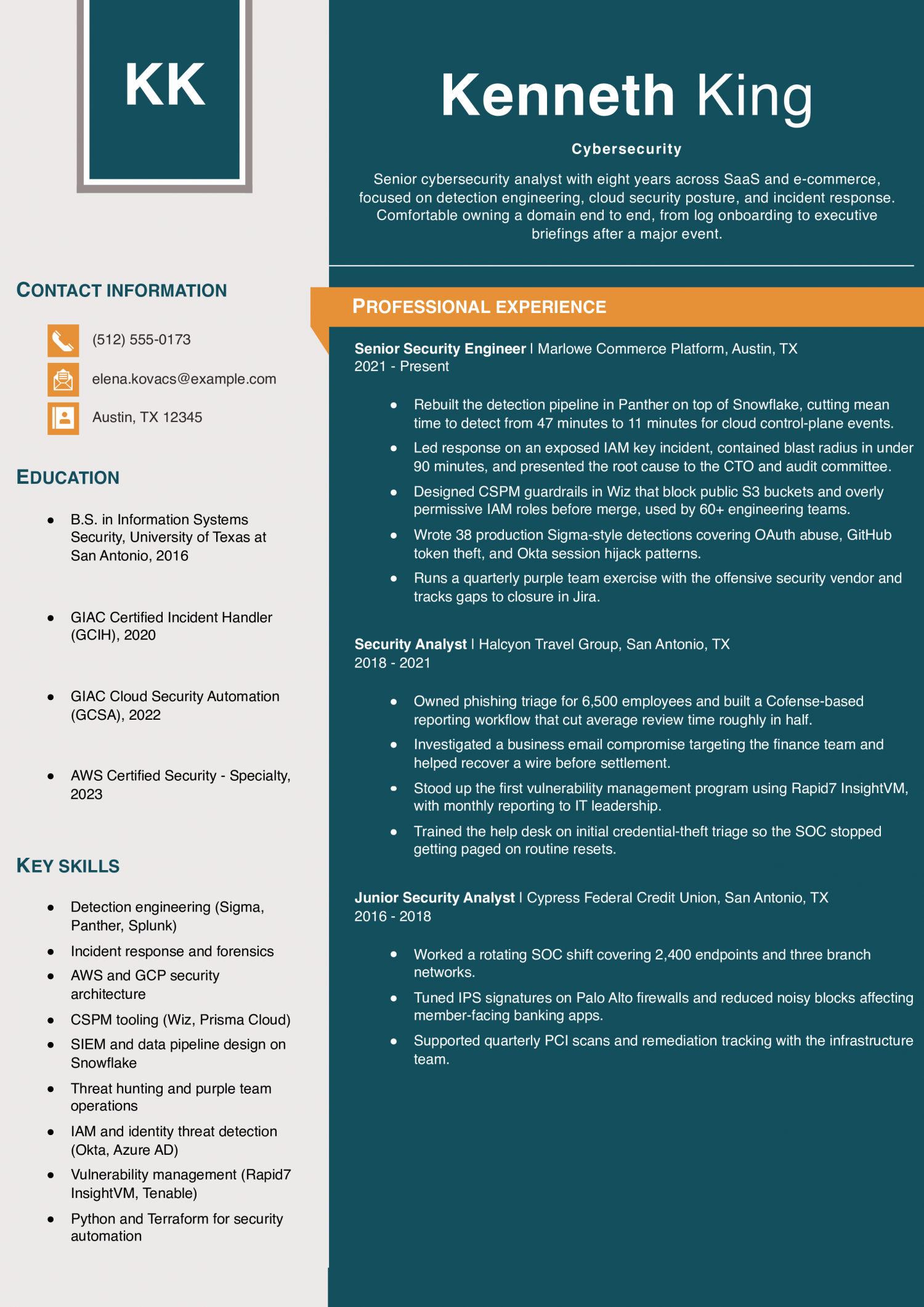
The lead tab fits security leads, principal engineers, and SOC managers running a shift or a program. This resume needs to prove staffing decisions, framework adoption (NIST CSF, ISO 27001), and budget or vendor decisions you owned.
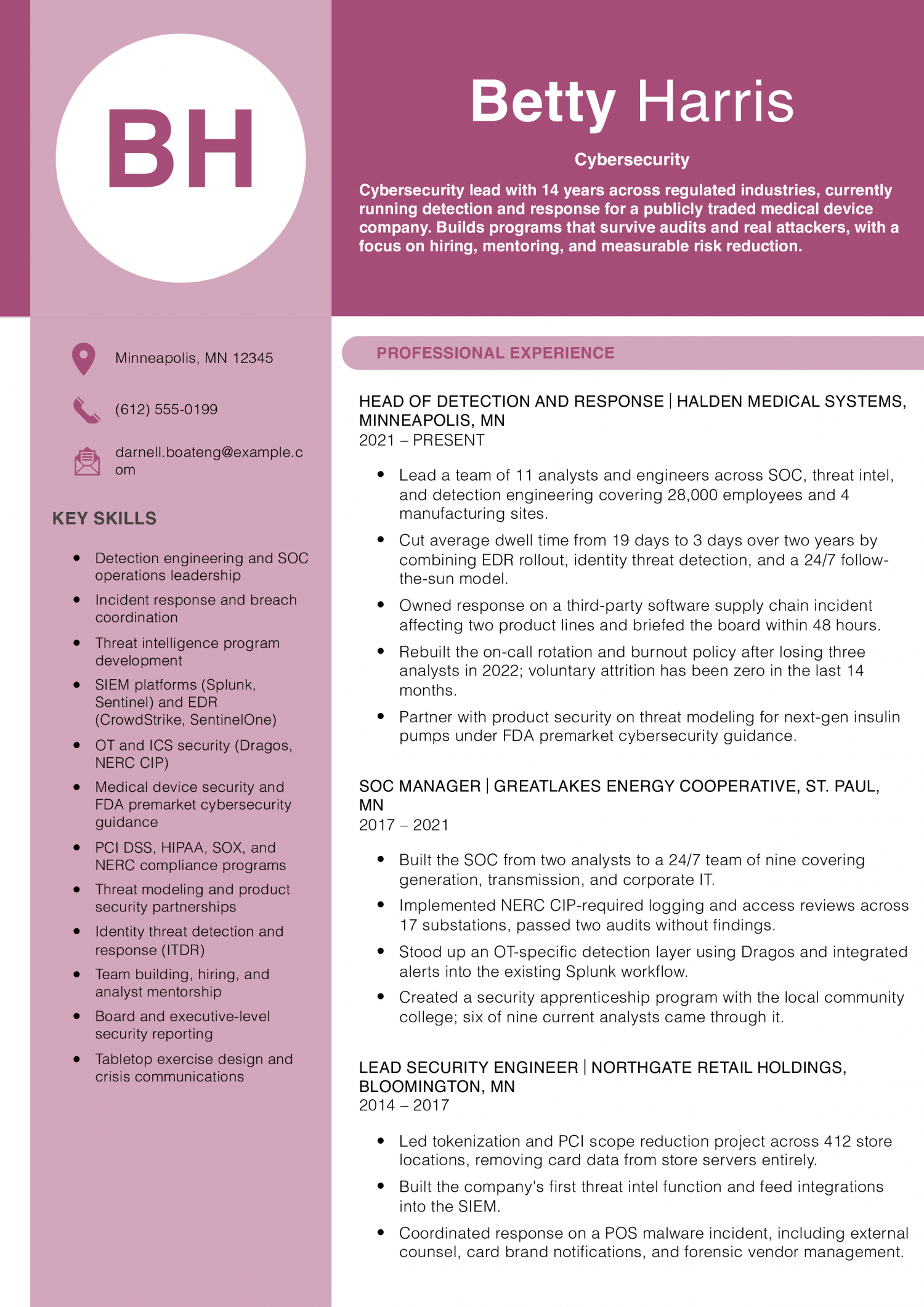
Cybersecurity professional with ten years spanning SOC analysis, cloud security engineering, and security program management. Strong record of building detection capability from scratch, leading high-pressure incident response, and translating technical risk into language executives and auditors can act on.
Lead the summary with a number that sizes your detection work. Name your alert volume per shift, the MTTR you carry, or the percentage of false positives you cut.
SOC managers and CISOs read that line as readiness to plug into their queue. A summary that opens with years of experience and broad skill claims gets skimmed. A summary that opens with 4,000 alerts triaged per quarter, MTTR cut from 38 to 22 minutes, and Splunk plus CrowdStrike in production gets read.
Translate the work into numbers security leaders read. Most strong cybersecurity bullets name three things: volume (alerts, tickets, hosts), outcome (MTTR, dwell time, vulnerabilities closed), and scope (endpoints, users, business units).
Bullets without a number tend to read as duties, not impact. Pair the metric with the tool: Tuned 47 Splunk correlation rules, cutting false positives 31% across a 12,000-endpoint fleet. Recruiters scan for that shape first.
Sort bullets into three or four functions so reviewers can locate your strengths fast. Common groupings: detection and monitoring (SIEM tuning, EDR alerting), incident response (containment, forensics, root-cause writeups), vulnerability management (Nessus or Qualys scans, patch coordination), and controls and compliance (NIST CSF, PCI DSS, SOC 2 evidence).
Name the framework where it applies. Mapping detections to MITRE ATT&CK techniques signals you can speak the language a senior engineer or CISO uses in a postmortem. If detection and monitoring are most of your work, see our cyber security analyst resume examples for ways to present that scope.
Place a credentials block under the summary with your active certifications, clearance status, and the tools you run in production. Recruiters filter on Security+, CISSP, CEH, OSCP, GCIH, and SANS tracks before they read bullets.
List the issuing body and year. State clearance as Active Secret or TS/SCI with poly when applicable, but do not list any clearance numbers or investigation dates. CISOs and security recruiters need this visible early so the resume clears the keyword parse and the recruiter screen.
Senior cybersecurity resumes drown when they keep early help-desk or sysadmin bullets that read as ticket counts and password resets. Cut them or compress that role to one line.
Replace the space with program-level work: detection engineering you led, vendor evaluations you ran, on-call rotations you owned, or junior analysts you mentored. That is what hiring CISOs scan for at the senior and lead tiers.
The skills below come from cybersecurity resumes our users built on ResumeTemplates.com. CISOs and security recruiters scan dozens of resumes a week, and these are the terms that show up most often on the ones that move forward. Hard skills carry the keyword parse: Splunk, SIEM, EDR, and framework names.
Soft skills back the bullets, so they need an artifact behind them, like an incident postmortem or a tabletop you ran. Match the hard skills list against the target job posting, and treat each soft skill as a claim your experience bullets have to prove.
| Soft Skills | % of resumes with this skill |
|---|---|
| Problem solving | 65% |
| Communication | 59% |
| Attention to detail | 44% |
| Analytical thinking | 40% |
| Collaboration | 26% |
And here are the top hard skills showing up most often.
| Hard Skills | % of resumes with this skill |
|---|---|
| Network security | 73% |
| Vulnerability assessment | 57% |
| Incident response | 46% |
| Penetration testing | 36% |
| SIEM monitoring | 29% |
Based on data from thousands of cybersecurity professionals’ resumes built on ResumeTemplates.com, May 2026.
These are the must-haves hiring teams look for when scanning a cybersecurity resume.
CISOs and security recruiters expect to see the sub-niche of security work named in your skills block, not just the word cybersecurity. Group the keywords below by the function you actually do, and mirror the posting’s exact phrasing.
| Niche | Keywords ATS scans for |
|---|---|
| SOC analyst (detection and monitoring) | soc analyst, siem tuning, splunk, mitre att&ck |
| Incident response and forensics | incident response, dfir, mttr, root cause analysis |
| Vulnerability management | nessus, qualys, cvss scoring, patch coordination |
| Cloud security | aws security, azure sentinel, cspm, iam |
| Governance, risk, and compliance | nist csf, iso 27001, soc 2, risk register |
AI use on a cybersecurity resume can go three ways: lead with buzzwords like AI-driven threat hunter (which CISOs screen out), leave it off entirely (which reads as out of touch with how SOCs run in 2026), or describe the workflow as it actually runs in your alert queue. The third is what security leaders can validate in a technical screen.
LLM-assisted summarization compresses log review, so analysts now spend more time on the 10% of alerts the model flagged as ambiguous.
Copilots draft initial Splunk SPL or KQL queries, and analysts refine them against false-positive rates and tune for the environment.
Models extract indicators from email bodies in seconds, and analysts focus on attribution, scope, and user-impact assessment.
Incident writeups and executive summaries get a first draft from an LLM, with analysts owning the technical accuracy and timeline.
Microsoft Security Copilot: Used for incident summarization, KQL query drafting, and prompt-driven investigation in Sentinel and Defender environments.
ChatGPT or Claude (enterprise): Used for detection logic review, regex authoring, and PowerShell or Python scripting for one-off forensic tasks.
Recruiters and SOC managers filter on tool names before they read bullets. Name the exact products you’ve run in production, not the category.
SIEM: Splunk Enterprise, Microsoft Sentinel, IBM QRadar, Elastic Security
EDR and XDR: CrowdStrike Falcon, SentinelOne, Microsoft Defender for Endpoint
Vulnerability scanners: Tenable Nessus, Qualys VMDR, Rapid7 InsightVM
Network and packet: Wireshark, Zeek, Suricata, tcpdump
Cloud security: AWS GuardDuty, Azure Defender, Wiz, Prisma Cloud
Scripting and automation: Python, PowerShell, Bash, Ansible
Clearance is a hard filter for federal, DoD, and intelligence contractor roles. List it in the credentials block under your summary so recruiters can confirm it on the first scan.
Name the level and status only. The standard phrasing is Active Secret, Active Top Secret, or TS/SCI with CI poly or full-scope poly.
Do not list investigation dates, JPAS or DISS identifiers, badge numbers, or the granting agency. Cleared recruiters will verify those through proper channels.
If your clearance has lapsed but is reinstatable, write Inactive TS, eligible for reinstatement. That phrasing is what federal contractor recruiters search for in the ATS.
Hiring CISOs and SOC managers read this list as a map of where your security work is heading. The certifications below tell them which track you’ve invested in: defensive operations, offensive testing, cloud, or governance. List the issuing body and the year of completion, and mark active versus expired status.
CompTIA Security+: The baseline filter for SOC analyst I and IT-to-security pivots, and a required keyword on most federal contractor postings.
CISSP (ISC2): Signals senior or lead readiness, especially for governance, risk, and architecture roles, and unlocks DoD 8570 IAT III and IAM II slots.
GIAC GCIH or GCFA: Marks you as an incident response or forensics specialist, and reads strongly to SOC managers staffing IR teams.
OSCP (Offensive Security): The default credential for penetration testers and red teamers, and a hard signal that you've done hands-on exploitation work.
Cybersecurity sits in a tight band relative to broader IT, with employment concentrated in a handful of metros that host federal contractors, banks, and major SaaS employers. The median pulls up a tier of senior analysts and engineers, not a long tail of entry-level helpdesk work.
To position above the median, lead the resume with the detections you’ve engineered and the incidents you’ve owned end-to-end, not the certifications you’ve stacked.
| # | State | Avg. Annual |
|---|---|---|
| 1 | Washington | $142,920 |
| 2 | California | $140,660 |
| 3 | Maryland | $140,480 |
| 4 | New Jersey | $135,390 |
| 5 | Delaware | $134,050 |
| 6 | New Mexico | $133,780 |
| 7 | Virginia | $132,460 |
| 8 | New York | $131,100 |
| 9 | Colorado | $130,570 |
| 10 | Connecticut | $130,500 |
| # | State | Workers | Median |
|---|---|---|---|
| 1 | Virginia | 18,670 | $132,460 |
| 2 | California | 15,800 | $140,660 |
| 3 | Texas | 14,730 | $124,970 |
| 4 | Florida | 13,770 | $105,990 |
| 5 | New York | 8,860 | $131,100 |
Resume Templates offers HR approved resume templates to help you create a professional resume in minutes. Choose from several template options and even pre-populate a resume from your profile.
Build a credentials block first: Security+, an active TryHackMe or Hack The Box profile, and a home lab with pfSense, Security Onion, or a Splunk free instance.
Then list projects as if they were jobs. Name the tool, the technique, and the outcome. A bullet that reads, Built detection rules for Mimikatz behavior in Splunk and tested against Atomic Red Team, beats a vague claim about passion for cybersecurity.
Cap the resume with any IT, helpdesk, or military signals roles you've held. Those count as adjacent experience.
List it under Education or a Continuing Education block, not under Certifications. The Certifications block is for industry credentials like Security+, CISSP, or OSCP that ATS parsers and recruiters filter on.
Name the program, the institution, and the completion date. Format it as: Cybersecurity Certificate, Harvard Extension School, 2025.
Pair it with one or two project bullets if the program included hands-on labs. The labs are what a SOC manager will ask about in the technical screen.
List the clearance level and status: Active Secret, Active Top Secret, or TS/SCI with CI or full-scope poly. Place it in the credentials block under the summary.
Do not list investigation dates, badge numbers, JPAS or DISS identifiers, or the granting agency. Recruiters cleared to verify will confirm those details through proper channels.
If your clearance has lapsed but is reinstatable, write Eligible for reinstatement and the prior level. That phrasing is what federal contractor recruiters search for.
One page for SOC analysts, junior engineers, and most candidates with under seven years on the job. Recruiters scan it in under a minute, and a tight page reads as discipline.
Two pages for senior engineers, incident response leads, and CISO-track candidates whose scope includes program design, framework adoption, vendor selection, or staff management.
Federal and DoD contractor resumes run longer by convention. If you're targeting cleared roles, three to four pages with a detailed work history is acceptable.
For a cybersecurity professional, a tech template is the safest pick, because it keeps your stack, tools, and impact easy to scan. An ATS-friendly template is a solid alternative. Whichever you choose, keep the formatting clean and easy to parse: clear section headings, a standard font, and no graphics a parser can choke on.
Executive Resume Writer and Career Coach
Andrew Stoner is an executive career coach and resume writer with 17 years of experience as a hiring manager and operations leader at two Fortune 500 Financial Services companies, and as the career services director at two major university business schools.