
Tip !

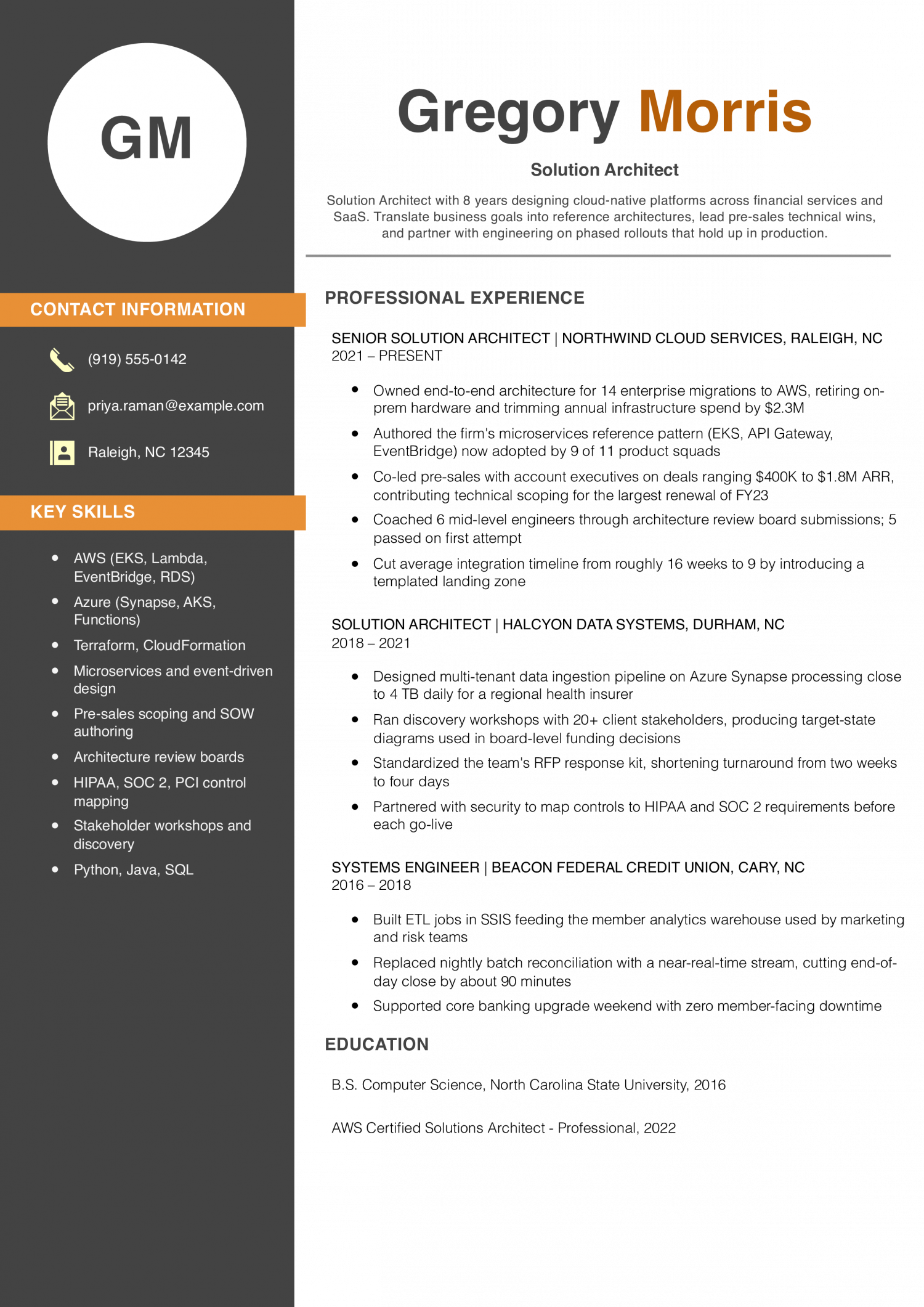
The solution architect resumes that advance to the technical screen share three things: a shipped system named in the summary, scale numbers attached to bullets, and trade-off language the panel can probe in 30 minutes.

Andrew Stoner , Executive Resume Writer and Career Coach

Why this resume works

  • Numbers tied to real spend: The $2.3M infrastructure savings and 14-migration scope tell a hiring manager the cost impact without needing context.
  • Shows both technical and sales work: Mixing pre-sales deal sizes with engineering deliverables signals the candidate can sit in either room.
  • Career grew step by step: Systems Engineer to Solution Architect to Senior reads as a natural arc, not a title jump.

Solution Architect Example

The solution architect tier covers four to seven years of hands-on engineering plus first-chair design work on two or three production systems. This resume needs to prove you have owned architecture decisions end to end, not just contributed to someone else's diagram.

Why this resume works

  • Tied design work to revenue: The $620K services figure shows the workshops were not just documents, they unblocked real money.
  • Built on a real engineering base: The earlier Software Engineer role gives the architecture claims credibility at this seniority.
  • Concrete tech, not buzzwords: Naming Kafka, GitHub Actions, and message retry strategy reads as someone who has done the work.

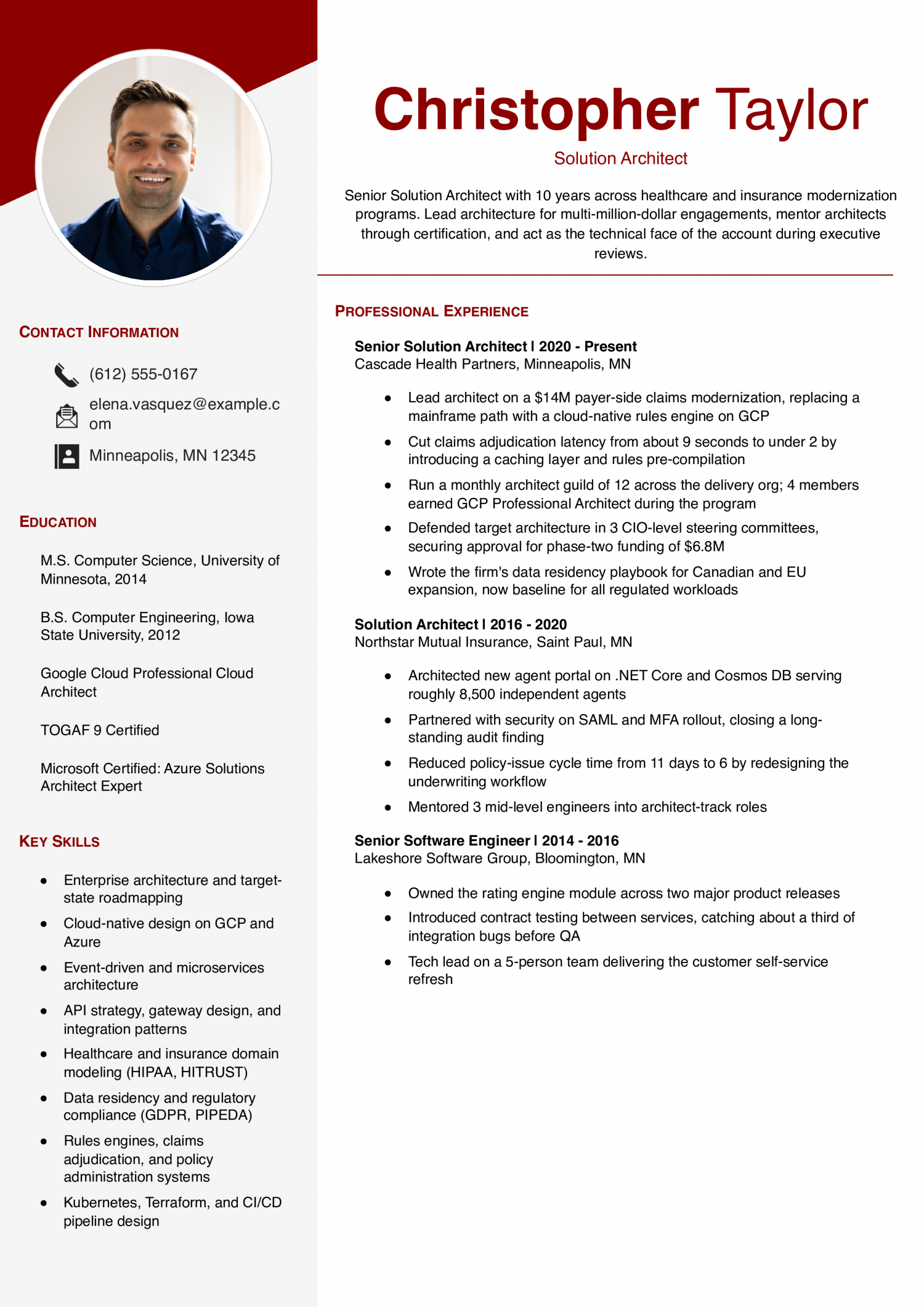
Senior Solution Architect Example

The senior solution architect tier covers eight to twelve years, with cross-team scope and direct exposure to executives or client stakeholders. This resume needs to prove you drove trade-off decisions across multiple squads and defended them in architecture review.

Why this resume works

  • Defended the design to executives: Naming CIO-level steering committees and a $6.8M phase-two approval shows comfort in the room where decisions get made.
  • Mentorship has measurable results: Four guild members earning GCP Professional Architect is a concrete outcome, not a vague claim about coaching.
  • Latency numbers a reviewer can check: Going from 9 seconds to under 2 is the kind of metric a technical interviewer can dig into without it falling apart.

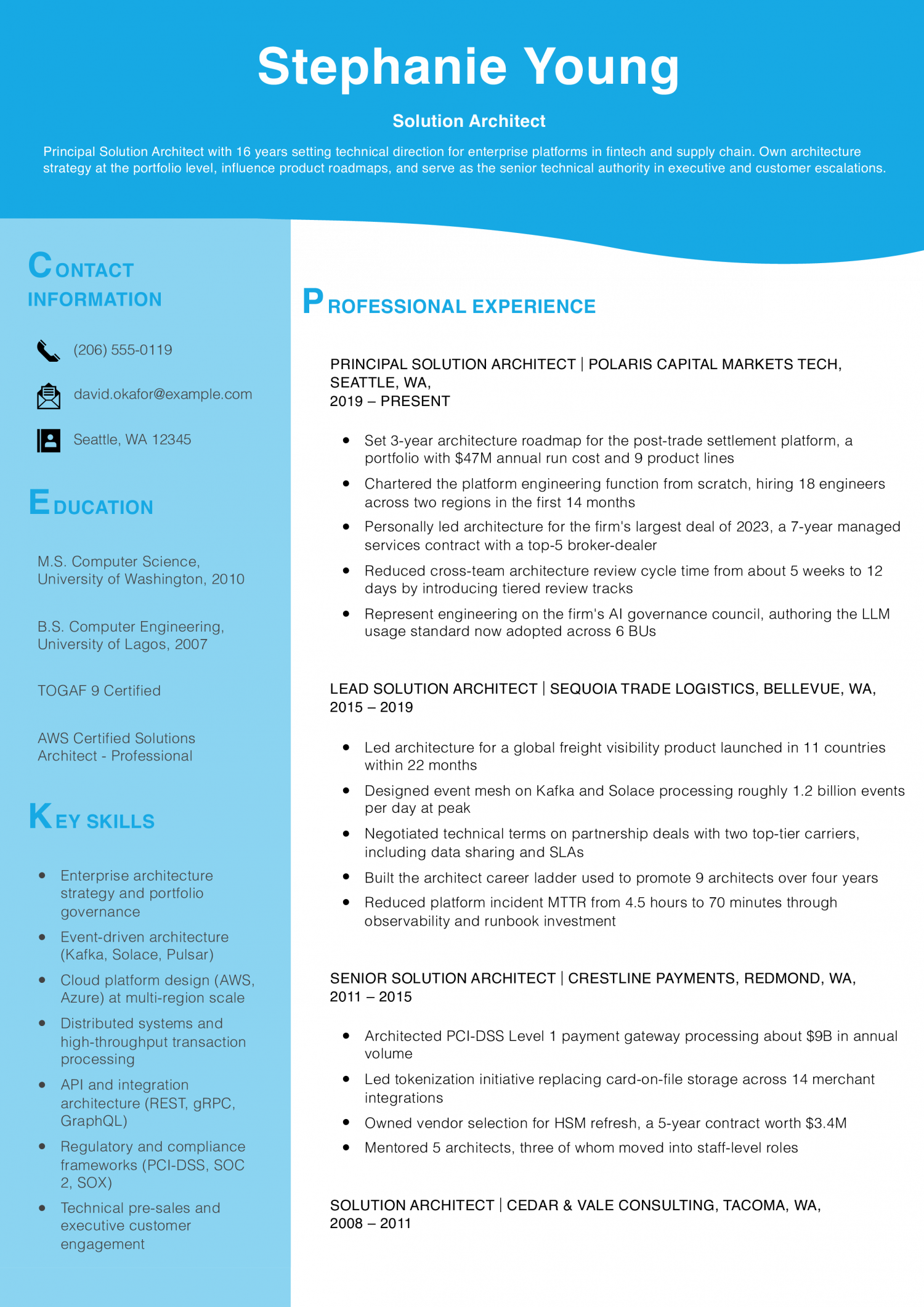
Principal Example

The principal tier covers twelve-plus years, with influence over platform strategy, technology selection, and engineering hiring bars. This resume needs to prove you set direction across a portfolio, mentored staff and senior engineers, and shipped systems at scale.

Why this resume works

  • Scope is set at the portfolio level: Owning a 9-product roadmap with $47M annual run cost reads as Principal, not Senior in a bigger title.
  • Built the function, did not just join it: Chartering platform engineering and hiring 18 engineers shows organizational impact a Principal is expected to drive.
  • Long arc of architect work: Four progressively senior architect roles over 16 years makes the Principal title feel earned rather than handed out.

How to Write a Solution Architect Resume

01 Open with the system only you have shipped

Lead with the one system a director of architecture cannot pull from a generic cloud-certified pool. Name the business problem, the stack, and the outcome in a single line at the top.

Examples: a Kafka-based order pipeline that cut latency by a stated percentage, a multi-region GCP migration completed under a fixed deadline, or an event-driven integration that retired a legacy ESB. This line beats a generic summary because it gives the recruiter and the engineering manager something concrete to match against the open req.

02 Quantify scope, scale, and trade-offs

Bullets without numbers tend to read as duties, not impact. Strong solution architect resumes pin two or three scale signals to each role: transaction volume, user count, data size, integrated systems, or team headcount influenced.

Pair the scale with the trade-off you made. A bullet like “chose DynamoDB over Aurora for a 40k TPS write path, accepting eventual consistency on the read side” tells a panel you can defend a decision. Recruiters scan for cloud spend, latency, and uptime first, so put those numbers in the first half of the bullet.

03 Group your work by architecture category

Cluster bullets under four categories so the reader can find what they need. Most strong resumes use design and decision, delivery and migration, integration and data, and stakeholder leadership.

Under design and decision, list architecture reviews you ran and ADRs you authored. Under delivery, list migrations completed and platforms launched. Under integration and data, name event streams, APIs, and pipelines.

Under stakeholder leadership, list RFPs you led, exec briefings you delivered, and engineers you mentored. This grouping reads cleanly for both pre-sales and enterprise architect roles.

04 Place credentials and stack on page one

Engineering directors check for cloud certifications before they read bullets. Put a credentials block under the summary listing AWS Solutions Architect Professional, Google Professional Cloud Architect, Azure Solutions Architect Expert, or TOGAF, with the year earned.

Add a one-line tech stack next to it: cloud services, Kubernetes, IaC tools, event streaming, and primary languages. This pairing lets a recruiter confirm in 15 seconds that you match the posting on both paper credentials and hands-on tooling, before the resume reaches the hiring manager.

05 Cut what hides your senior signal

Senior solution architects often pad the resume with early developer roles and generic tool lists. Compress anything older than 10 years to a single line, and drop tool names you have not used since.

Cut the objective statement, the soft-skill paragraph, and bullets that describe team activity instead of decisions you owned. Replace them with two or three executive-facing wins: an RFP you led, a board-level architecture review, or a platform call that changed a roadmap. That edit raises the seniority signal on the same page count.

The solution architect resumes that get callbacks share a specific skill mix. The lists below come from our user-built solution architect resumes. Engineering directors scan for these patterns first, not generic platform-agnostic leadership language.

Hard skills name the cloud services, data tools, and design methods the posting will parse. Soft skills back the bullets that show trade-off decisions and stakeholder work. Match both lists against your target job posting and treat soft skills as evidence anchors for your strongest bullets.

Soft Skills % of resumes with this skill
Communication and presentation 75%
Client relationship management 64%
Problem solving and analysis 47%
Strategic thinking 38%
Team leadership and collaboration 35%

And here are the top hard skills showing up most often.

Hard Skills % of resumes with this skill
AWS and cloud platforms 71%
Solution architecture design 70%
Microservices and containerization 41%
Infrastructure as code 40%
System integration 35%

Based on data from thousands of solution architects’ resumes built on ResumeTemplates.com, May 2026.

Must Have on a Solution Architect Resume

The items below are what separate a solution architect resume from one that gets put back in the pile.

Niche Keywords for ATS Checkers

Engineering directors expect the resume to name the sub-discipline you work in, not just the title solution architect. Cluster keywords by the niche that matches your target posting.

Niche Keywords ATS scans for
Cloud platform architecture aws solutions architect, azure solutions architect, gcp cloud architect, multi-cloud architecture
Integration and middleware api gateway, event-driven architecture, kafka, mulesoft integration
Data and analytics architecture snowflake architecture, databricks lakehouse, data mesh, etl pipeline design
Enterprise architecture togaf, archimate, reference architecture, capability mapping
Pre-sales and customer-facing pre-sales solution architect, rfp response, customer architecture workshop, technical account ownership

AI Skills to Add

Engineering directors are split between teams using GitHub Copilot and Cursor as daily tools and teams restricting them for IP or compliance reasons. Name the tools you use, describe the workflow honestly, and avoid claims that you “architect with AI” if your real practice is code review and prompt scaffolding.

What AI is actually changing for this role
Reference architecture drafting

Architects use Claude and ChatGPT to draft ADRs and diagrams faster, then edit for correctness before review.

Code review and IaC scaffolding

Copilot and Cursor accelerate Terraform, CloudFormation, and Helm chart authoring, shifting the architect's time to review and standards.

Vendor and pattern research

Chat-based tools compress build-vs-buy research, but architects still verify pricing, SLAs, and benchmark claims directly with vendors.

Generative AI workload design

Architects now design RAG pipelines, vector stores, and model-routing layers as a standard part of platform work.

AI tools to name
  • GitHub Copilot: Used in IDEs for IaC, sample services, and review of generated diffs against architecture standards.
  • Claude or ChatGPT (enterprise): Used for ADR drafts, vendor comparisons, and stakeholder-facing summaries of trade-off decisions.
How to phrase AI on your resume
Do
  • Used GitHub Copilot to scaffold Terraform modules for a 30-service AWS landing zone, cutting initial authoring time by a stated percentage.
  • Designed a RAG architecture on Bedrock and OpenSearch serving a stated query volume, with guardrails for PII redaction.
Skip
  • AI-powered architect leveraging generative AI to revolutionize cloud strategy.
  • Synergized GenAI to drive transformational outcomes across the enterprise.

Tech Stack Keywords for Your Solution Architect Resume

Engineering directors expect a one-line tech stack near the top of the resume, paired with bullets that show how you used each item. The list below covers the categories most postings parse for in 2026.

  • Cloud: AWS, Azure, GCP, Oracle Cloud Infrastructure
  • Containers and orchestration: Kubernetes, EKS, GKE, AKS, Docker
  • Infrastructure as code: Terraform, Pulumi, CloudFormation, Ansible
  • Event streaming and messaging: Kafka, Kinesis, Pub/Sub, RabbitMQ
  • Data platforms: Snowflake, Databricks, BigQuery, Redshift
  • Observability: Datadog, New Relic, Grafana, OpenTelemetry
  • Languages: Python, Java, Go, TypeScript
  • Architecture methods: TOGAF, C4 model, ADRs, ArchiMate

Solution Architecture Credentials That Get You the Job

Beyond a computer science degree or equivalent experience, the certifications below tell engineering directors which cloud you are fluent in and how recently you have validated it. List the certifying body, the exact credential name, and the year earned for each item.

  • AWS Certified Solutions Architect – Professional: The default credential for AWS-shop postings; signals you can defend multi-account, multi-region designs at the principal level.
  • Google Professional Cloud Architect: Strongest signal for GCP-first employers and data-heavy roles built on BigQuery and Pub/Sub.
  • Microsoft Certified: Azure Solutions Architect Expert: Required reading at enterprise IT shops, financial services, and any employer running heavy Microsoft 365 and Azure integration.
  • TOGAF 9 or 10 Certified: Signals enterprise architecture fluency for roles that touch capability mapping, reference architectures, and steering committees.

Latest BLS Statistics for Solution Architects

The top-paying states for solution architects cluster around finance, defense, and hyperscaler corridors, not the assumed coastal tech hubs alone. Pay tends to follow employer concentration in regulated industries and government-contracting work, where the architecture spend per program is highest. Employment counts, in contrast, spread broadly across states with large enterprise IT footprints and consulting offices.

If you are geographically flexible, lead the resume with the cloud platform that matches the target market’s dominant employers.

$126,838 National median annual
$80,371 Entry-tier floor (10th percentile)
$179,476 Top-decile ceiling (90th percentile)
497,800 Solution Architects in the U.S.
Where you stand

Entry tier

$80,371 to $126,838 At the entry tier, lead with one shipped cloud workload, your associate-level certification, and the specific AWS, Azure, or GCP services you used.

Mid band

$126,838 to $179,476 At the mid band, your resume needs to show two or three production systems you designed and lead with a professional-level cloud certification.

Top decile

$179,476+ At the top decile, lead with platform-level decisions you owned, RFPs or executive briefings you ran, and the engineers you mentored or hired.

Top-paying states

# State Avg. Annual
1 California $127,660
2 Washington $127,420
3 Colorado $124,010
4 New Jersey $123,640
5 Massachusetts $121,580
6 District of Columbia $114,110
7 Virginia $113,500
8 Rhode Island $112,980
9 Oregon $111,140
10 Minnesota $106,740

Highest-employment states

# State Workers Median
1 California 55,460 $127,660
2 Texas 48,150 $104,970
3 Florida 35,660 $100,770
4 North Carolina 25,350 $104,940
5 Virginia 22,730 $113,500
A note on these numbers. The Bureau of Labor Statistics groups solution architects with professional systems engineers, so its standard figure can understate pay for solution architects in technology. The title-specific number here is higher and draws on U.S. Department of Labor visa wage filings, which skew toward large technology employers, so treat it as the upper end. For solution architects, pay swings most with the cloud platform you specialize in, the industry vertical (finance and defense pay highest), and your years of post-certification design work. Use it as a guide, not a guarantee.

Primary data: U.S. Bureau of Labor Statistics. Title-specific base pay: U.S. Department of Labor (H-1B LCA disclosures). View on bls.gov
Written by professional resume writers and loved by hiring managers

Resume Templates offers HR approved resume templates to help you create a professional resume in minutes. Choose from several template options and even pre-populate a resume from your profile.

Frequently Asked Questions

How long should a solution architect resume be?

Two pages is the working standard for solution architect resumes with five or more years of design experience. One page works only for early-career architects moving up from senior engineer.

Principal and chief architect resumes can run to a third page if you add a published-work, patents, or speaking section. Keep page one heavy on the summary, credentials, and most recent role.

Should I list every AWS or Azure service I've used?

List the services tied to a real design decision in your bullets, not every service you have touched. A dump of 40 service names reads as inexperience to a reviewer.

A tight stack line of eight to twelve services, paired with bullets that show how you used them, beats a 30-item tag cloud. Match the list to the posting first.

How do I show pre-sales or RFP work on a solution architect resume?

Treat pre-sales as a category of bullets, not a separate role. Name the deal size influenced, the win rate, and the customer segment.

A bullet like "led architecture workstream on six enterprise RFPs, supporting a stated total contract value" gives a hiring director the scope they need without violating client confidentiality.

What if my last role was solution architect at a consultancy with many short engagements?

Group the consultancy under one heading and list the engagements as sub-bullets with client industry, not client name, plus the design outcome.

Format: "Global retailer, North America: led re-architecture of order management onto event-driven AWS, cut peak-day incident count." This protects NDA boundaries while showing range across industries and stacks.

What's the best resume template for a solution architect?

For a solution architect, a tech template is the safest pick, because it keeps your stack, tools, and impact easy to scan. An ATS-friendly template is a solid alternative. Whichever you choose, keep the formatting clean and easy to parse: clear section headings, a standard font, and no graphics a parser can choke on.

Rate this article

Solution Architect Resume

Average Rating

4.3/5 stars with 198 reviews

You have given 0 Star(s)
4.3/5 stars with 198 reviews
Andrew Stoner

Executive Resume Writer and Career Coach

Andrew Stoner is an executive career coach and resume writer with 17 years of experience as a hiring manager and operations leader at two Fortune 500 Financial Services companies, and as the career services director at two major university business schools.