Tip !

The ER nurse resumes that get scheduled for interviews within a week share three things: a credentials block above experience, acuity and patient-load numbers per shift, and trauma certifications with current expiration dates.

Andrew Stoner , Executive Resume Writer and Career Coach

Why this resume works

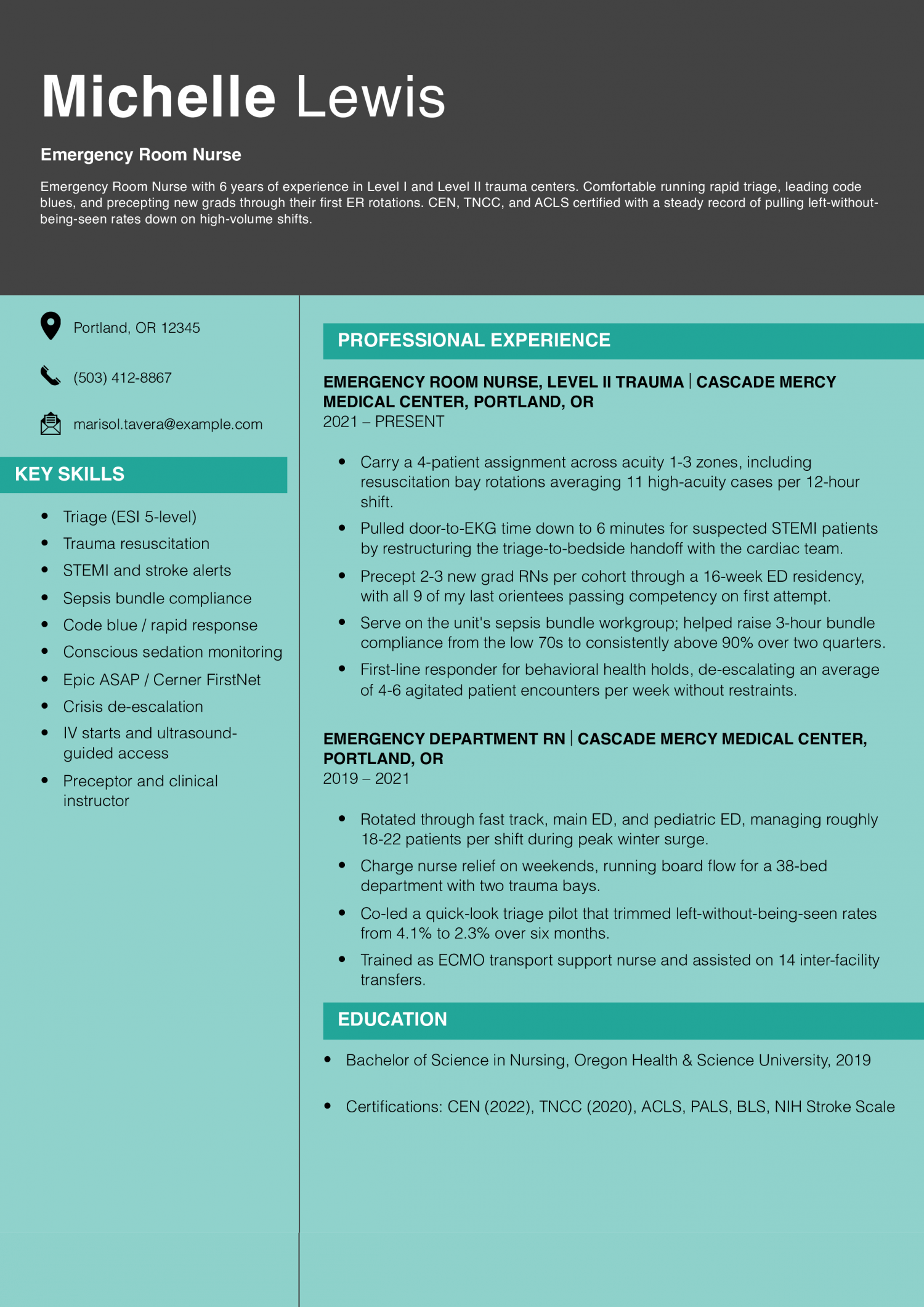
  • Numbers tied to patient care: Specific times like 6-minute door-to-EKG and a left-without-being-seen drop from 4.1% to 2.3% give hiring managers proof, not adjectives.
  • Shows trauma and triage range: Resuscitation bay, fast track, pediatric ED, and ECMO transport together signal someone who can flex across any ER assignment.
  • Leadership without the title: Precepting nine successful orientees and serving on the sepsis workgroup reads as charge-ready, even though the title is still staff nurse.

New Grad RN Example

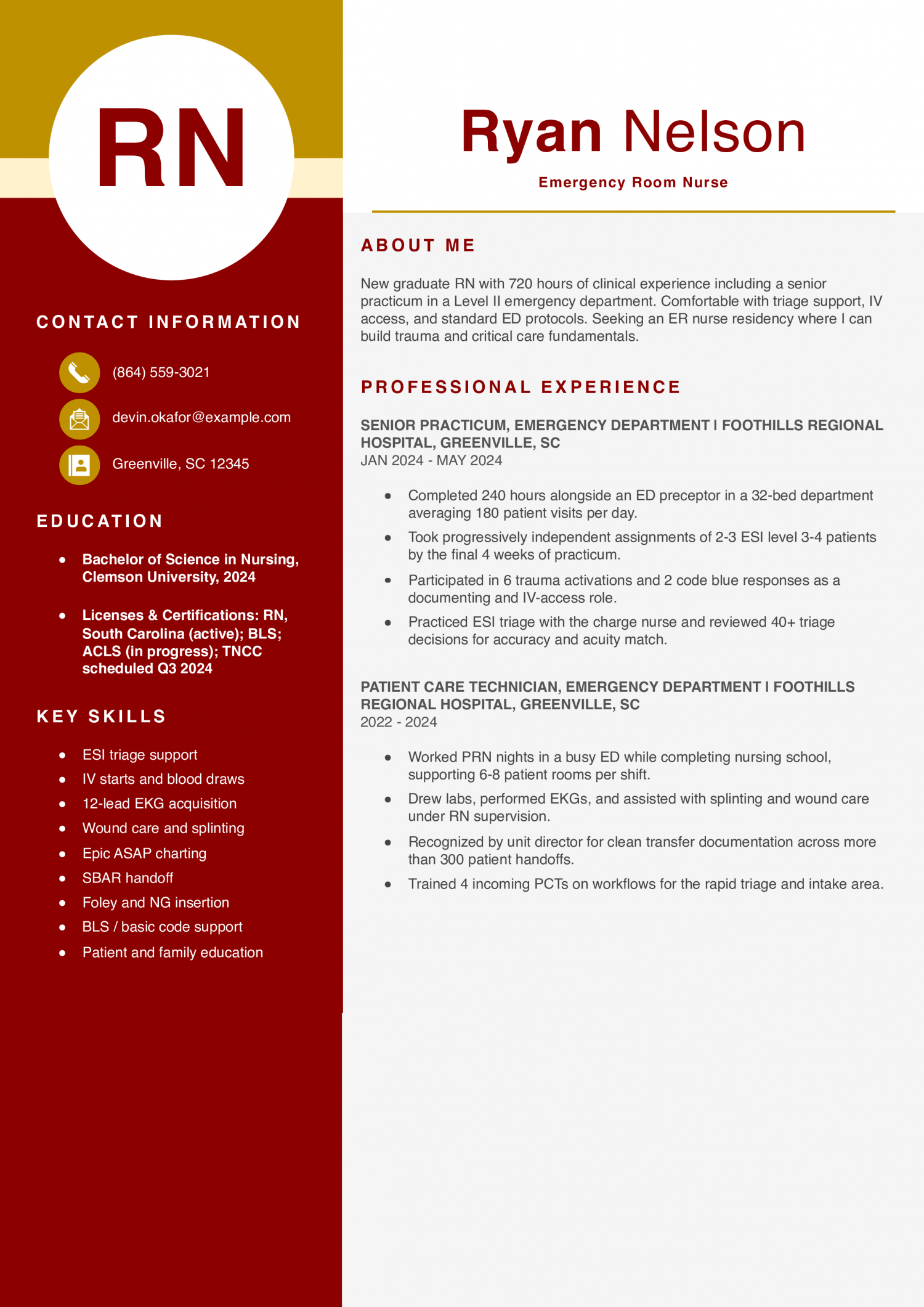
The new grad RN tab fits nurses inside their first 12 months who completed an ER preceptorship or capstone. Your resume needs to prove your license is active and your clinical hours map to ER acuity.

Why this resume works

  • Real ED hours, not just classroom: Listing 240 practicum hours plus PCT work in the same emergency department shows a hiring manager this candidate already knows the unit culture.
  • Honest about scope: Phrases like ‘documenting and IV-access role’ during trauma activations are believable for a new grad and avoid overstating what they did.
  • Certifications are dated and planned: Showing ACLS in progress and TNCC scheduled tells ED nurse managers this applicant is already on the residency timeline they expect.

Staff Nurse Example

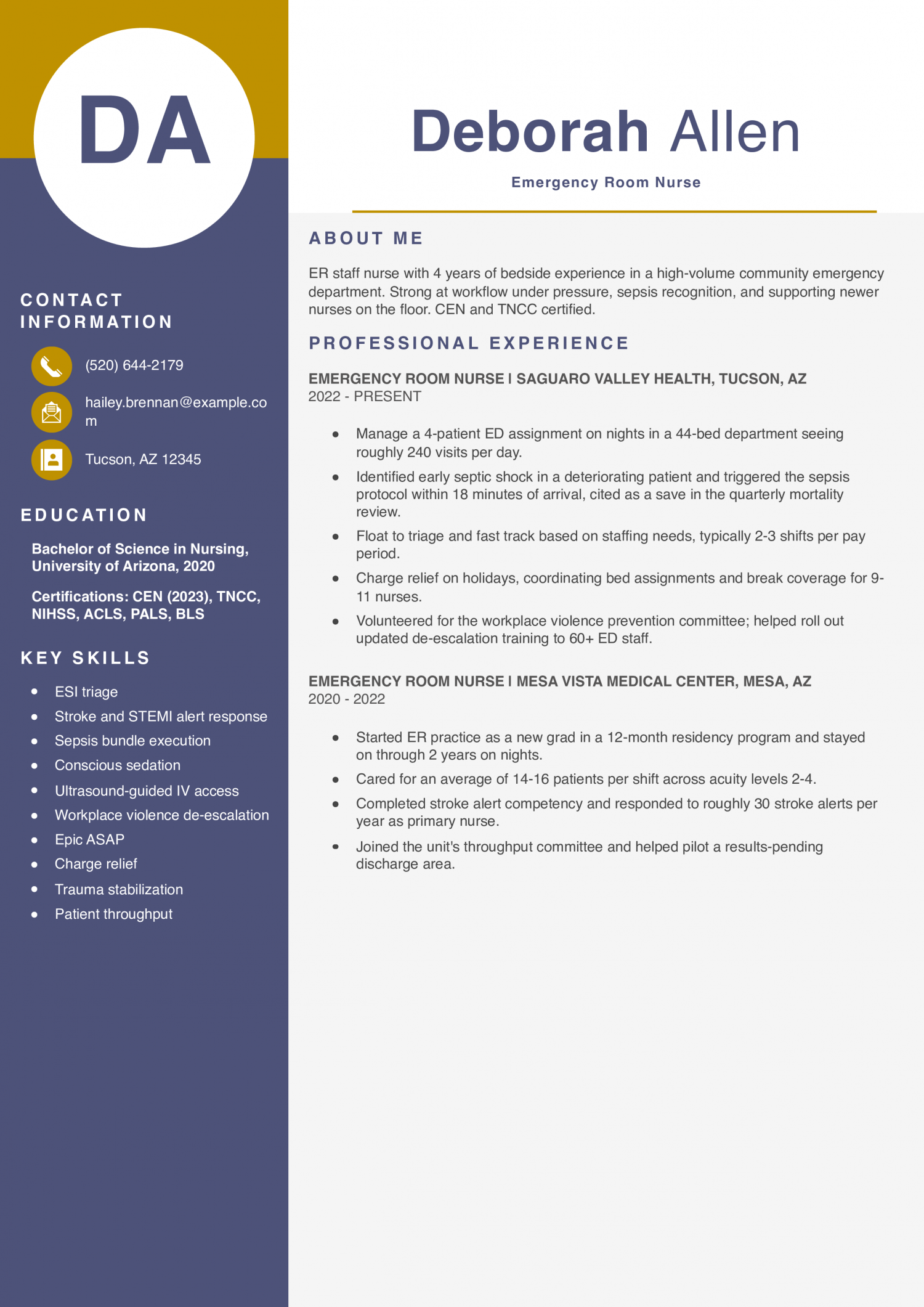
The staff nurse tab fits RNs with two to seven years on the floor working across ESI levels and trauma activations. Your resume needs to prove your patient load, acuity mix, and the procedures you own without supervision.

Why this resume works

  • One specific clinical save: The 18-minute sepsis recognition story gives a concrete example of judgment, which is what ED hiring managers want from a mid-career nurse.
  • Range without job-hopping: Two employers across four years, with triage, fast track, and charge relief, signals breadth and stability at the same time.
  • Committee work shows initiative: Throughput and workplace violence committees tell a manager this nurse will help fix unit problems, not just clock in and out.

Charge Nurse Example

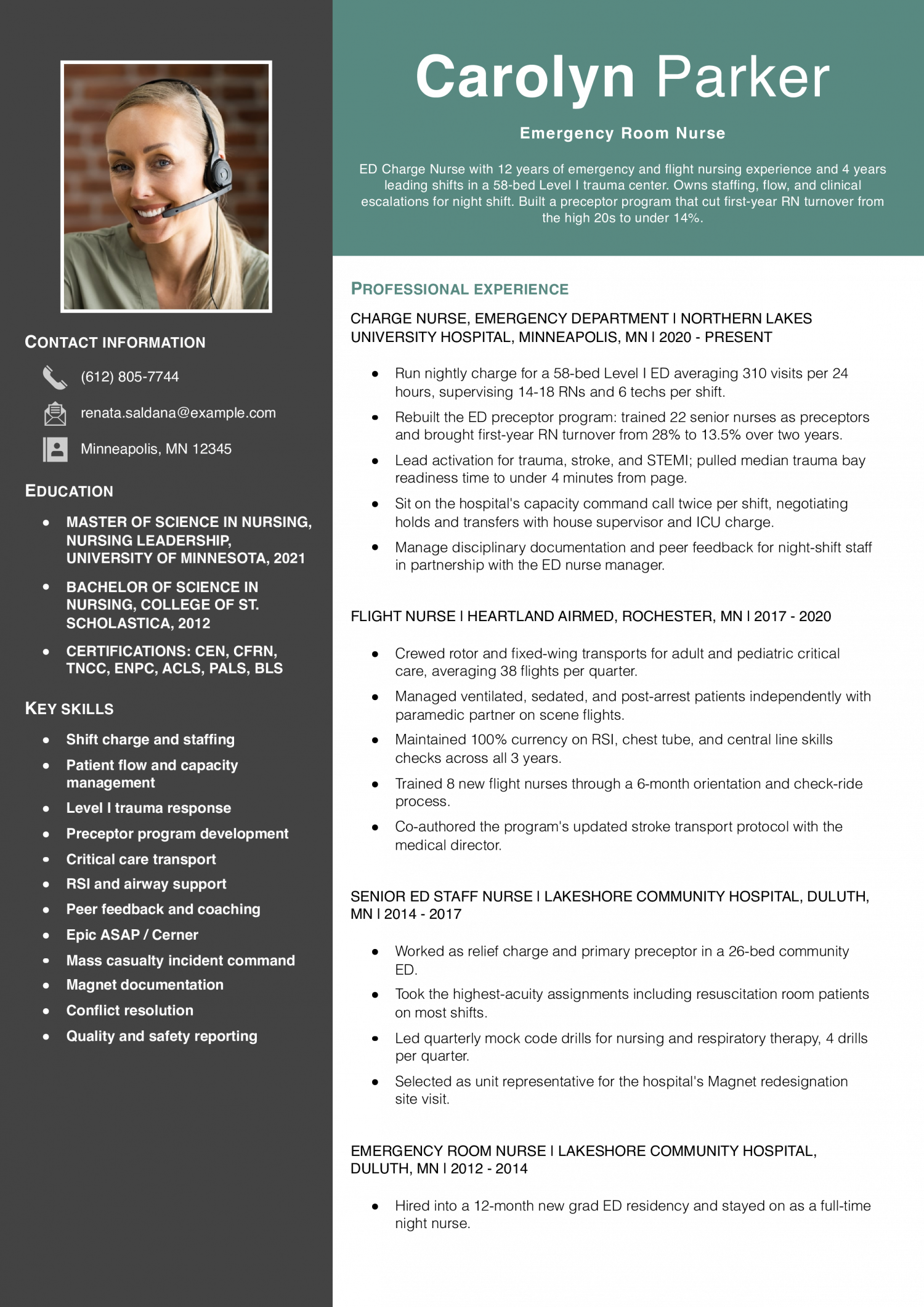
The charge nurse tab fits RNs running shift assignments, triage flow, and code response across a department. Your resume needs to prove staffing decisions, throughput metrics, and the certifications you hold beyond the staff floor.

Why this resume works

  • Leadership backed by a turnover number: Cutting first-year RN turnover from 28% to 13.5% is the kind of result an ED director can put in front of a CNO.
  • Career path makes sense: Staff RN, flight nurse, then charge in a Level I ED tells a clean story of escalating responsibility without random jumps.
  • Operational details, not buzzwords: Capacity command calls, mock code drills, and trauma bay readiness times show real charge nurse work instead of generic leadership claims.

How to Write an Emergency Room Nurse Resume

01 Open with a profile that names your clinical scope

Your profile should state your years as an RN, the ED setting you’ve worked in, and the acuity range you handle.

Name the trauma designation (Level I, II, III), average daily census, and the ESI levels you triage. Add the patient population if it narrows your fit, such as adult, pediatric, or mixed. ER nurse managers and hospital recruiters scan this block for setting match before reading bullets.

Close with one line on the certifications you carry beyond BLS, since trauma and pediatric credentials shift you out of the general RN pool.

02 Quantify acuity, volume, and throughput

Bullets without a number tend to read as duties. Recruiters scan for three figures: patients per shift, acuity mix, and a throughput or outcome metric.

Name your average patient load (for example, four to six patients per 12-hour shift), the share of high-acuity (ESI 1 and 2) cases you carried, and door-to-provider or door-to-EKG times you helped move.

If you precepted, name the number of new hires you trained. A strong bullet pairs the action with the volume and the acuity, not the action alone.

03 Group procedures by clinical category

Cluster your skills into categories ER nurse managers recognize at a glance. Four groupings work for most resumes.

Triage and assessment (ESI leveling, primary and secondary surveys, focused neuro and cardiac exams). Resuscitation and codes (ACLS algorithms, defibrillation, intubation assist, compressions, rapid response).

Procedures and access (IV starts, central line assist, NG and Foley placement, splinting, wound closure assist, 12-lead EKG). Documentation and handoff (Epic ED module, SBAR, charge nurse reports, EMTALA-compliant transfers).

04 Place credentials in a page-one block

Build a credentials block directly under your profile with your RN license state and status, plus BLS, ACLS, PALS, and TNCC with expiration months.

Do not print your license number on the resume. List the state and “license in good standing,” then supply the number on the application form when requested.

ER nurse managers and hospital recruiters need this visible early because staffing decisions and trauma assignments depend on which cards you carry. CEN, CPEN, TCRN, and SANE belong here too if you hold them.

05 Close with education and clinical hours

List your BSN or ADN, the school, and graduation month. If you’re a new grad or within two years of NCLEX, add your ER preceptorship or capstone with hours and the facility.

Name the clinical instructor or charge RN only if you have permission. Pin any ED externship or tech experience here too, since recruiters count those hours toward acuity exposure.

Skip high school. Skip GPA after your first nursing role.

Five years ago, an ER nurse resume read like a task list of IV starts and vital signs. The skills below come from the resumes our users built in 2026. The mix has shifted toward acuity metrics, Epic ED module proficiency, and trauma certifications named by acronym.

ER nurse managers weigh hard skills like ACLS and triage as gates. Soft skills like rapid decision-making back up specific bullets, not stand-alone claims. Match the hard-skill list against the job posting, then use soft skills as the evidence layer inside your bullets.

Soft Skills % of resumes with this skill
Critical thinking 69%
Composure under pressure 63%
Communication 41%
Teamwork 39%
Empathy 27%

And here are the top hard skills showing up most often.

Hard Skills % of resumes with this skill
Patient triage 73%
Advanced cardiac life support 59%
Trauma and emergency care 48%
IV therapy and medication administration 37%
EKG interpretation 33%

Based on data from thousands of emergency room nurses’ resumes built on ResumeTemplates.com, May 2026.

Must Have on an Emergency Room Nurse Resume

The items below are what separate an emergency room nurse resume from one that gets put back in the pile.

Licensure Requirements

Every ED hire starts with license verification. Put your license block on page one, above your experience.

List your active RN license by state, status, and expiration month. If you hold a multistate license under the Nurse Licensure Compact, write “multistate RN license” next to your home state.

Do not print the license number on the resume itself. Recruiters verify the number through the state board’s Nursys lookup or the employer’s onboarding form.

  • State of issue and “license in good standing”
  • Expiration month and year
  • Multistate (NLC) status if applicable
  • Any second-state endorsement and its filing date

Continuing Education for ER Nurses

State boards set CE clock-hour requirements on a renewal cycle that varies by state. Track your hours and the topic categories, since EDs prefer trauma and pediatric CE over general nursing topics.

List CE only when it sharpens your fit for the target role. Pediatric CE for a children’s hospital, trauma CE for a Level I bid, sepsis CE for a sepsis coordinator track.

Name the provider, the topic, the contact hours, and the year. Skip CE older than three years unless it’s a major specialty course.

  • ENA trauma and pediatric courses (TNCC, ENPC)
  • Sepsis recognition and bundle compliance
  • Stroke care (NIHSS certification)
  • Workplace violence and de-escalation training
  • ECG and dysrhythmia interpretation refreshers

EMR Systems to Name on Your Resume

EDs run on a small set of charting platforms, and ER nurse managers filter for the one their facility uses. Name the system and the specific ED module you charted in.

  • Epic (ASAP ED module, Rover, Haiku)
  • Cerner (FirstNet, PowerChart)
  • Meditech Expanse (Emergency Department)
  • Allscripts Sunrise (Emergency Care)
  • Pyxis MedStation and Omnicell for medication dispensing

HIPAA and OSHA Compliance

Your resume should prove you handle PHI correctly without printing any of it. ER nurse managers read carelessness with patient details as a hiring risk.

Quick HIPAA Check Before You Send

Never name a patient, a room number, or a case identifier in a bullet. Aggregate the work: “managed four to six patients per shift across ESI 1-3” reads clean.

If a bullet describes a specific case (a mass casualty event, a high-profile code), keep it to the clinical action and the outcome at the population level.

Emergency Nursing Credentials That Get You the Job

Beyond your active RN license and BLS, the certifications below tell ER nurse managers which patient populations you can take without backup and how ready you are for trauma activations. List the certifying body and current expiration month for each.

  • Advanced Cardiac Life Support (ACLS): Required by most EDs before you take adult resuscitation assignments, so list it directly under BLS with the expiration month.
  • Trauma Nursing Core Course (TNCC): Signals you've completed the ENA trauma framework and can staff trauma bays at Level I, II, and III centers.
  • Pediatric Advanced Life Support (PALS): Needed for any ED that sees pediatric volume, which is most general EDs, and unlocks pediatric code roles.
  • Certified Emergency Nurse (CEN): BCEN's specialty cert that moves your resume out of the general RN pool and is the standard credential for charge tracks.

Latest BLS Statistics for Emergency Room Nurses

Registered nursing is one of the larger occupations tracked by BLS, which means the published median pulls in a long tail of med-surg, clinic, and lower-acuity roles. ER pay sits above that median in most metros because of acuity, shift differentials, and trauma designation.

To position above the median on paper, lead your resume with trauma level, acuity mix, and specialty certifications, not the generic “registered nurse” title.

$93,600 National median annual
$98,430 National mean annual
$66,030 Entry-tier floor (10th percentile)
$135,320 Top-decile ceiling (90th percentile)
3,282,010 Emergency Room Nurses in the U.S.
Where you stand

Entry tier

$66,030 to $93,600 At the entry tier, lead with your BSN, NCLEX pass date, BLS, and the ER preceptorship hours you completed.

Mid band

$93,600 to $135,320 At the mid band, your resume needs to show patient load per shift, ESI 1-2 share, and ACLS, PALS, and TNCC.

Top decile

$135,320+ At the top decile, lead with charge experience, CEN or TCRN, trauma level worked, and throughput metrics you moved.

Top-paying states

# State Avg. Annual
1 California $140,330
2 Hawaii $136,320
3 Oregon $123,990
4 Washington $112,180
5 Alaska $110,690
6 New York $105,600
7 District of Columbia $104,550
8 New Jersey $102,730
9 Nevada $101,990
10 Massachusetts $101,970

Highest-employment states

# State Workers Median
1 California 326,720 $140,330
2 Texas 261,050 $90,010
3 Florida 218,100 $82,850
4 New York 204,120 $105,600
5 Pennsylvania 146,840 $87,610
Source: U.S. Bureau of Labor Statistics, OEWS 2024 release (SOC 29-1141).
Written by professional resume writers and loved by hiring managers

Resume Templates offers HR approved resume templates to help you create a professional resume in minutes. Choose from several template options and even pre-populate a resume from your profile.

Frequently Asked Questions

How long should an ER nurse resume be?

One page for new grads and nurses with under five years on the floor. Two pages once you've added charge experience, preceptor work, or committee roles.

Recruiters skim the credentials block and the most recent role first. A clean two-page resume beats a cramped one-page resume if you have the content.

Should I list my RN license number on my resume?

No. List the state and "RN, license in good standing" with the expiration month.

State boards advise against printing license numbers on documents you email or post online. Provide the number on the employer's application form when it asks.

How do I write an ER nurse resume with no ER experience yet?

Lead with your ER preceptorship, capstone, or externship hours and the facility's trauma level.

Pull any med-surg, tele, or ICU acuity into bullets that map to ED skills: rapid assessment, code response, IV access, and high patient load. Add TNCC or ENPC before applying if you can.

What if I'm moving to a new state and my license is pending?

Name the compact state license you hold and the state you've applied in, with "endorsement pending" and the month filed.

Recruiters need the timeline to pace the start date. If you're using the Nurse Licensure Compact, write "multistate RN license" next to your home state.

What resume template should an emergency room nurse use?

For an emergency room nurse, an ATS-friendly template is the safest pick, because it puts your certifications and experience where a hiring manager scans first. A basic template is a solid alternative. Whichever you choose, keep the formatting clean and easy to parse: clear section headings, a standard font, and no graphics a parser can choke on.

Rate this article

Emergency Room Nurse Resume

Average Rating

4.8/5 stars with 182 reviews

You have given 0 Star(s)
4.8/5 stars with 182 reviews
Andrew Stoner

Executive Resume Writer and Career Coach

Andrew Stoner is an executive career coach and resume writer with 17 years of experience as a hiring manager and operations leader at two Fortune 500 Financial Services companies, and as the career services director at two major university business schools.