Teacher Resume Examples
Your profile should state your years in the classroom, the grade band or subject you teach, and the school setting you’ve worked in (Title I, charter, magnet, independent, or rural district). Name your state license…
Every resume example is written and reviewed by our team of Certified Professional Resume Writers to ensure top-quality content and formatting.
School principals and department heads look past generic teaching claims. They want to see how you raised reading scores, built curriculum, or coached students through AP exams. Top earners in this field reach above $107,600 a year, and strong resumes reflect that level of impact.
Lead with measurable student outcomes, not a list of courses you taught. Show the standards you taught to, the texts you chose, and how you tracked growth. To compare layouts before you start, browse our resume templates.
A valid state teaching license with the correct English endorsement gets your resume past the initial credentialing screen; measurable student growth data is what compels department heads to advance it.
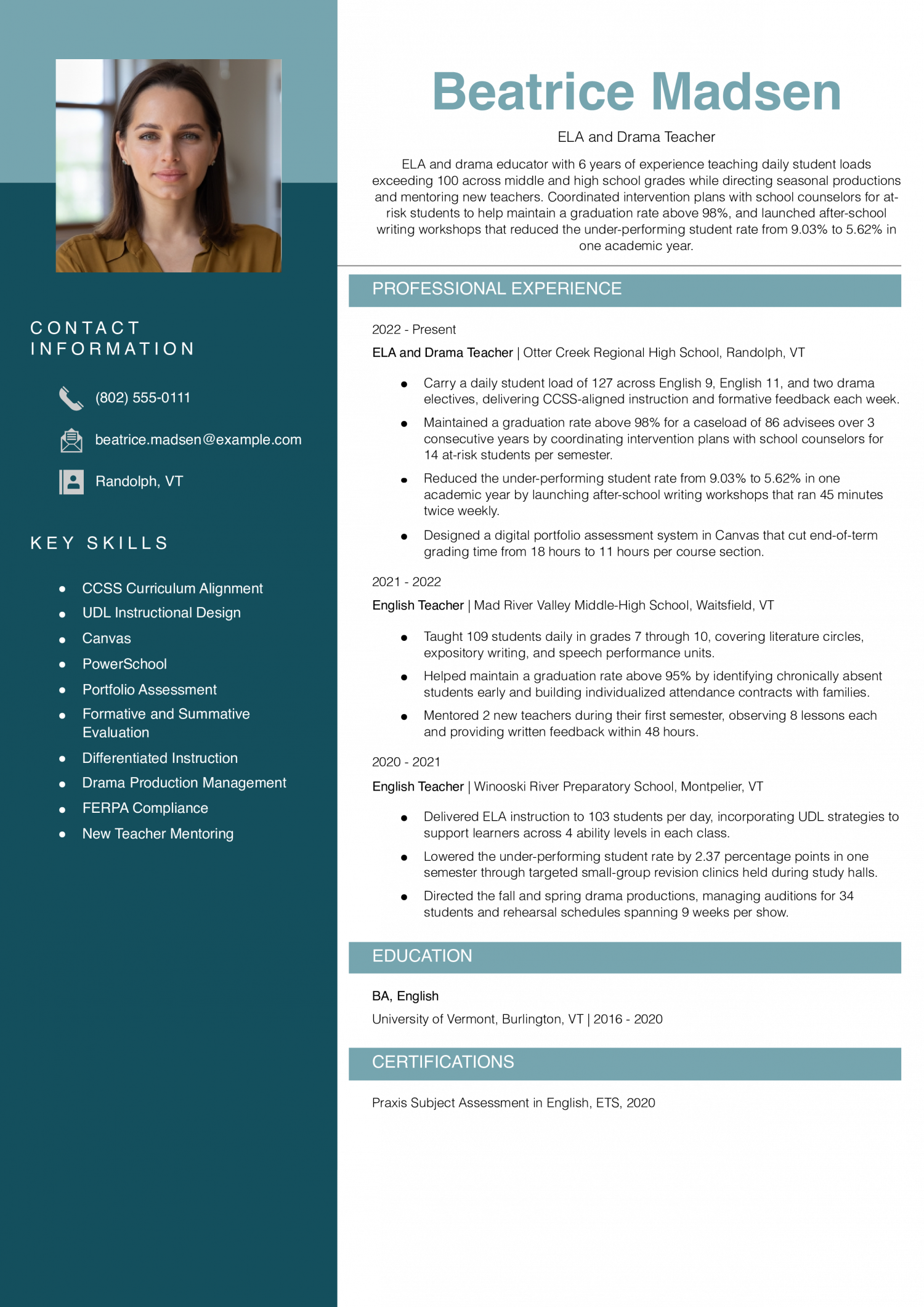
Pick this resume if you are a mid-level ELA and drama teacher carrying a full course load alongside advisory and production duties. Lead with under-performing rate reductions tied to specific interventions so reviewers see the classroom impact of your programming.
Principals hiring an English teacher look for students who improve, plus the extra duties a small school needs covered. This resume shows both: a drop in struggling students tied to after-school writing workshops, and drama productions on top of a full course load. On your own resume, name the program behind each result.
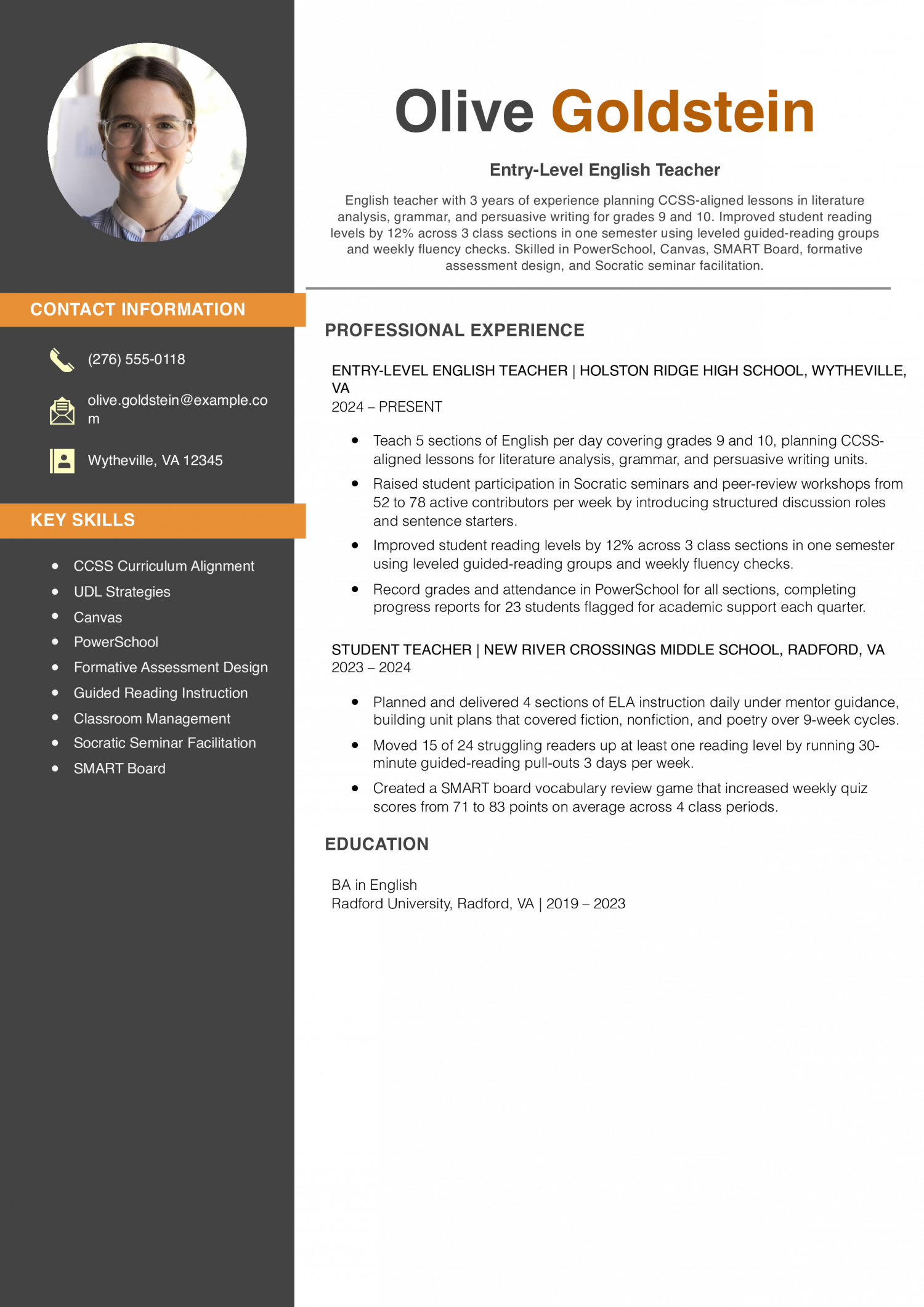
Pick this resume if you are new to the classroom and moving from student teaching to a first full-time English role. Lead with reading-level gains tied to a specific intervention method rather than listing general teaching duties.
Hiring managers looking for a first-year English teacher want to see that you can teach the basics and keep students talking. The seminar roles and sentence starters here show a new teacher who built a routine and watched who spoke. Describe the routines you used in student teaching, and say how you checked that students joined in.
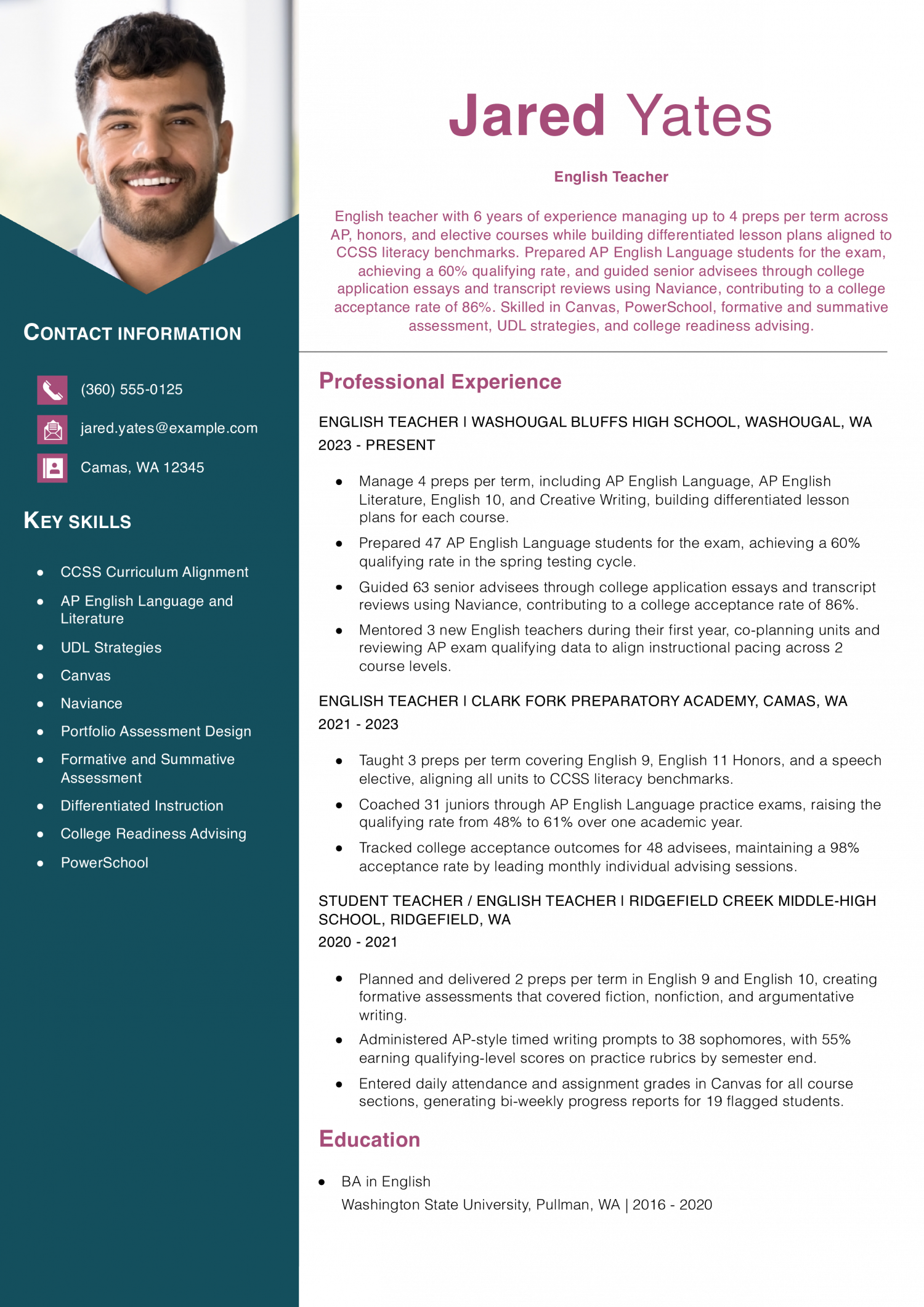
Try this resume if you are a mid-level English teacher handling multiple AP and general education preps across two or more school settings. Lead with AP qualifying rates and advisee acceptance outcomes to ground your teaching impact in specific numbers.
Department heads staffing AP courses look for exam results and college outcomes, not only course names. This resume pairs AP Language practice exams with a before-and-after qualifying rate, and advising with an acceptance rate. List the AP courses you teach, then add the exam results you can back up.
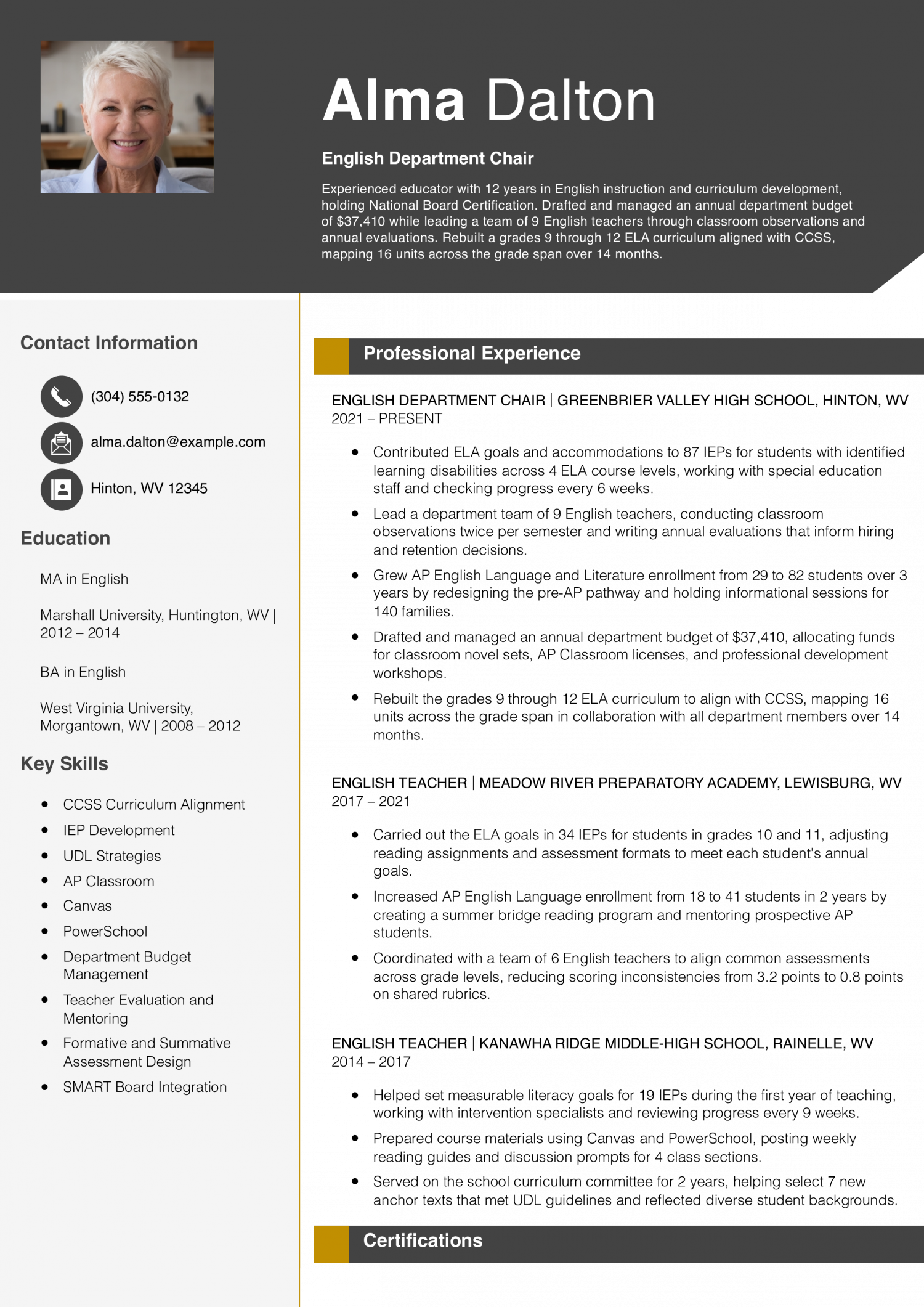
Lean on this resume if you are a senior English department chair with over a decade of teaching and leadership experience. Lead with enrollment growth figures stated as raw counts across a defined span to make program-building visible.
Schools hiring a department chair look for leadership past the classroom, such as teacher evaluations, a budget, and a curriculum built by the whole team. This resume names each one with its scope, including the size of the team and the length of the rebuild. Put the same scope on your own leadership work.
Dedicated to designing CCSS-aligned reading and writing units across 4 ESL course levels while applying UDL principles to serve students from beginner to advanced English proficiency. Over 6 years of classroom experience spanning middle-high and high school settings, coordinating up to 3 parent-teacher conference cycles per term and documenting outcomes for families of up to 74 students. Built and expanded student newspaper programs at three schools, growing contributor counts through targeted recruitment and structured writing workshops.
School principals and department heads scan your summary for scale first. Lead with how many students you teach per year or per semester. A line like “ELA teacher serving 140 students across four grade 9 sections” sets your scope in one read.
Follow it with your strongest outcome, such as a percentage gain on state reading scores. Then name the grade band you cover. This opener works better than a vague phrase about passion for literacy.
Principals want to know your caseload before they read anything else. A number in the first line signals that you track your own results. It also helps them picture you inside their building’s class sizes and bell schedule.
Teaching does not produce sales totals, but it does produce measurable shifts. Report the percentage of students who met or exceeded grade-level benchmarks. Note how many IEP or ELL accommodations you managed each term.
You can also cite gains on standardized reading assessments. If your school shared growth data, name the percentile shift your classes earned. Pair each result with the tool or method behind it.
For example, state that you used guided reading groups and raised proficiency rates by 12 points. Scope details matter too. Name how many preps you carry each day.
List how many parent conferences you hold per grading period. These numbers help principals compare your load to their open seat.
Curriculum and instruction covers lesson planning, unit design, and standards alignment. Assessment and data includes grading, test prep, and progress monitoring.
Student support covers IEP meetings, tutoring sessions, and parent outreach. Extracurricular involvement includes clubs, publications, or coaching you lead. A fifth group, professional development, holds committee work and training.
Use the same category labels across every position you list. This structure lets a principal jump to the area that matters most for the open role.
Give the state license, with its English endorsement, a line of its own. Include the state that issued it and confirm it is in good standing.
If your state required the Praxis Subject Assessment, name it on the next line with your passing status. National Board Certification from NBPTS belongs here too, if you hold it. Do not bury these items inside your education section.
Principals often verify licensure before they read your work history. Below your credentials, add a short tools line for platforms you use daily. Name your learning management system and any curriculum software.
Write your degree and school first, with the graduation year. Add your major and any English or education concentration beneath it.
Student teaching belongs here if you are early in your career. Name the school, the grade level, and the semester you completed it. If you earned honors or held a relevant campus role, include one line for it.
Career changers moving into teaching should note any alternative certification pathway they completed. Former journalists or writers can list published work in a short portfolio line. Keep this section at the bottom of page one so your classroom results stay on top.
School principals and department heads review dozens of English Teacher resumes each hiring cycle. They shortlist the ones that name specific skills and student outcomes. Hard skills tell them what you can teach and which tools you use.
Curriculum design and close reading are common hard skills for this role. Soft skills carry weight in a different way. Principals look for patience and collaboration in your work history bullets.
A label like “strong communicator” means little without proof. Back it up with a result, such as a rise in student pass rates. The two tables below list the most common skills for this role.
Weave hard skills into your experience section word for word.
| Soft Skills | AI-estimated % |
|---|---|
| Classroom management | 80% |
| Student engagement | 55% |
| Parent communication | 47% |
| Patience with adolescents | 40% |
| Constructive feedback delivery | 32% |
And here are the top hard skills showing up most often.
| Hard Skills | AI-estimated % |
|---|---|
| Lesson plan development | 70% |
| Literary analysis instruction | 58% |
| Writing curriculum design | 42% |
| Standardized test prep | 37% |
| Student progress assessment | 33% |
Skill names and rankings come from an AI model grounded in U.S. Department of Labor occupation data for English teachers, not from a count of English teachers’ resumes built on ResumeTemplates.com.
School principals and department heads check for lesson plan development and literary analysis instruction before they read an English teacher resume closely, and the items below show how to prove them.
Your teaching license is the first thing reviewers check. Requirements vary by state, so name your exact endorsement. Add the state and current status of each credential.
Vermont, for example, requires most candidates to take the Praxis Core and Praxis II exams.
Use the exact wording your state and the job posting use for each one.
School principals and department heads look for proof you lead a classroom. They want to see how you handle varied learners. Show that you adapt lessons for students with IEPs.
School principals and department heads scan for teaching focus terms. Curriculum design terms show you can build unit plans. Literacy instruction terms cover reading and writing methods. Assessment terms prove you track student growth with data. Classroom culture terms show you manage behavior and engagement. Technology terms tell reviewers which platforms you use daily. Pick the group that fits each role you target. Then weave those terms into your experience bullets. Match the language in the job posting when possible. Each group below covers a distinct part of English teaching.
| Niche | Keywords ATS scans for |
|---|---|
| Curriculum Design | backward design, Common Core alignment, unit planning |
| Literacy Instruction | guided reading, writing workshop, close reading |
| Student Assessment | formative assessment, rubric development, data-driven instruction |
| Classroom Culture | restorative practices, culturally responsive teaching, differentiated instruction |
| EdTech Platforms | Google Classroom, Turnitin, Canvas |
English teachers face a unique tension around AI. Students use these tools daily. Your resume has to address that reality. You can brand yourself as an AI curriculum expert. You can skip AI entirely. Or you can name the tools you use and the checks you apply. School principals and department heads can validate that third option. Describe how you draft rubrics or feedback with a tool. Then explain the human review step. This shows you teach responsible use. It also shows you model it yourself. Keep the claim narrow and honest.
AI drafts initial comments on student writing, freeing you to focus on revision conferences.
Generative tools outline unit plans faster, but you still align them to state standards.
AI detection flags possible misuse, though you interpret results and make the final call.
AI helps generate reading passages at varied levels for mixed-ability classrooms.
Students use AI grammar checkers, so you now teach when and why to override suggestions.
A valid state license keeps you in the pool. School principals and department heads scan your credentials block to gauge how far your training goes past the baseline.
They want to see proof of subject depth and ongoing growth. A strong list tells them you invest in your craft. A weak one blends in with every other file on the desk.
Add the issuing body and the year you earned or renewed it. This format lets a reviewer confirm each item in seconds.
The Bureau of Labor Statistics does not publish a wage code for English Teacher specifically. The numbers below are a proxy: the closest published match is Secondary School Teachers, Except Special and Career/Technical Education (SOC 25-2031), so use them as an estimate for this role, not an exact figure.
Pay at the 10th percentile runs roughly a third under the median.
At the high end, pay is about one and a half times the median. That gap reflects differences in geography, degree level, and years in the classroom. Endorsements, advanced degrees, and district pay scales all vary by state.
The states that pay the most are not always the ones with the most open positions. High-employment states often sit closer to the median. Place your state license, endorsement area, and any advanced credential near the top of your resume so principals spot them first.
| # | State | Median Annual |
|---|---|---|
| 1 | Washington | $102,670 |
| 2 | California | $101,370 |
| 3 | New York | $97,070 |
| 4 | Massachusetts | $95,260 |
| 5 | Rhode Island | $92,610 |
| 6 | District of Columbia | $82,750 |
| 7 | New Jersey | $82,200 |
| 8 | Connecticut | $80,970 |
| 9 | Illinois | $79,990 |
| 10 | Alaska | $79,650 |
| # | State | Workers | Median |
|---|---|---|---|
| 1 | Texas | 111,660 | $63,590 |
| 2 | California | 99,230 | $101,370 |
| 3 | New York | 70,660 | $97,070 |
| 4 | Pennsylvania | 52,240 | $78,800 |
| 5 | Florida | 49,810 | $60,410 |
Resume Templates offers HR approved resume templates to help you create a professional resume in minutes. Choose from several template options and even pre-populate a resume from your profile.
Lead each bullet with a strong verb and a measurable outcome tied to student learning. For example, write "Raised passing rates on the state writing assessment by 18% across three sections." Pair the result with the method you used, such as literature circles.
Name the grade band you teach, one signature strength, and the school you are applying to. A line like "Secondary English teacher with six years of AP Literature instruction seeking a role at Lincoln High School" gives principals the context they need. Keep the objective to two sentences so it does not crowd your experience section.
Treat it like any teaching role by listing the institution name, the country, and your dates. Highlight cross-cultural curriculum design or English proficiency gains your students achieved. If the school is not well known in the United States, add a short note about its enrollment or accreditation body.
Use the school's full registered name followed by the city and country. If it operates under a local-language name, include the English translation in parentheses. This helps school principals and department heads verify your employment without extra research.
List the platform or virtual school as your employer and note the time zones you covered. Include metrics such as student retention rates or end-of-course assessment scores. Mention the tools you used for instruction, such as Google Classroom or Zoom breakout rooms.
Open with the exact job title and posting number from the listing. State your current grade band and your state teaching license status in the first two lines. Close by noting that your resume and any requested documents are attached as PDF files.
Yes, list it with the school name, your major, and the credit hours you completed. Write "Coursework completed" with the number of credits instead of a graduation date. If you are still enrolled, add your expected graduation term so principals can see a clear timeline.
Many employers run resumes through software, so an ATS-friendly template helps your English teacher resume get read. A basic template helps too. Give sections plain names, pick one standard font, and skip graphics.
English Teacher Resume
4.3/5 stars with 175 reviews

Executive Resume Writer and Career Coach
Andrew Stoner is an executive career coach and resume writer with 17 years of experience as a hiring manager and operations leader at two Fortune 500 Financial Services companies, and as the career services director at two major university business schools.
© 2026 Resumetemplates.com All rights reserved.