Software Engineer Resume Examples and Templates for 2026



Heads of platform engineering look for the cloud platform, the IaC tool, and a reliability number on the first page, because it signals whether the candidate has owned production systems and not just touched them.

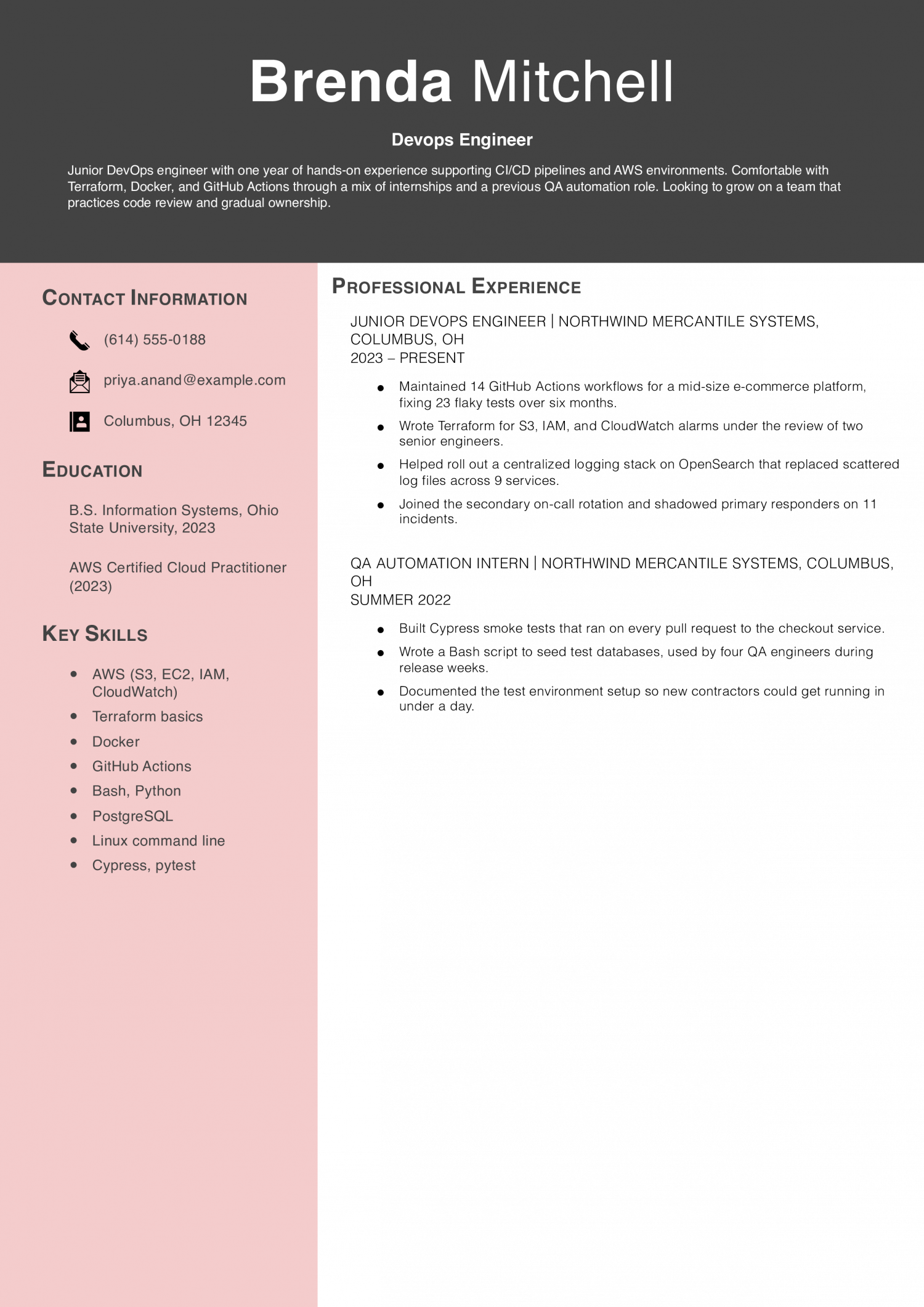
Junior devops engineers are usually one to three years in, often coming from software development, systems administration, or a cloud bootcamp. The resume needs to prove hands-on pipeline work, one cloud platform, and scripting fluency in Python or Bash.
Senior devops engineers own production systems end-to-end and carry on-call rotations across multiple services. The resume needs to prove infrastructure as code at scale, incident response leadership, and measurable reliability gains in uptime, MTTR, or deploy frequency.
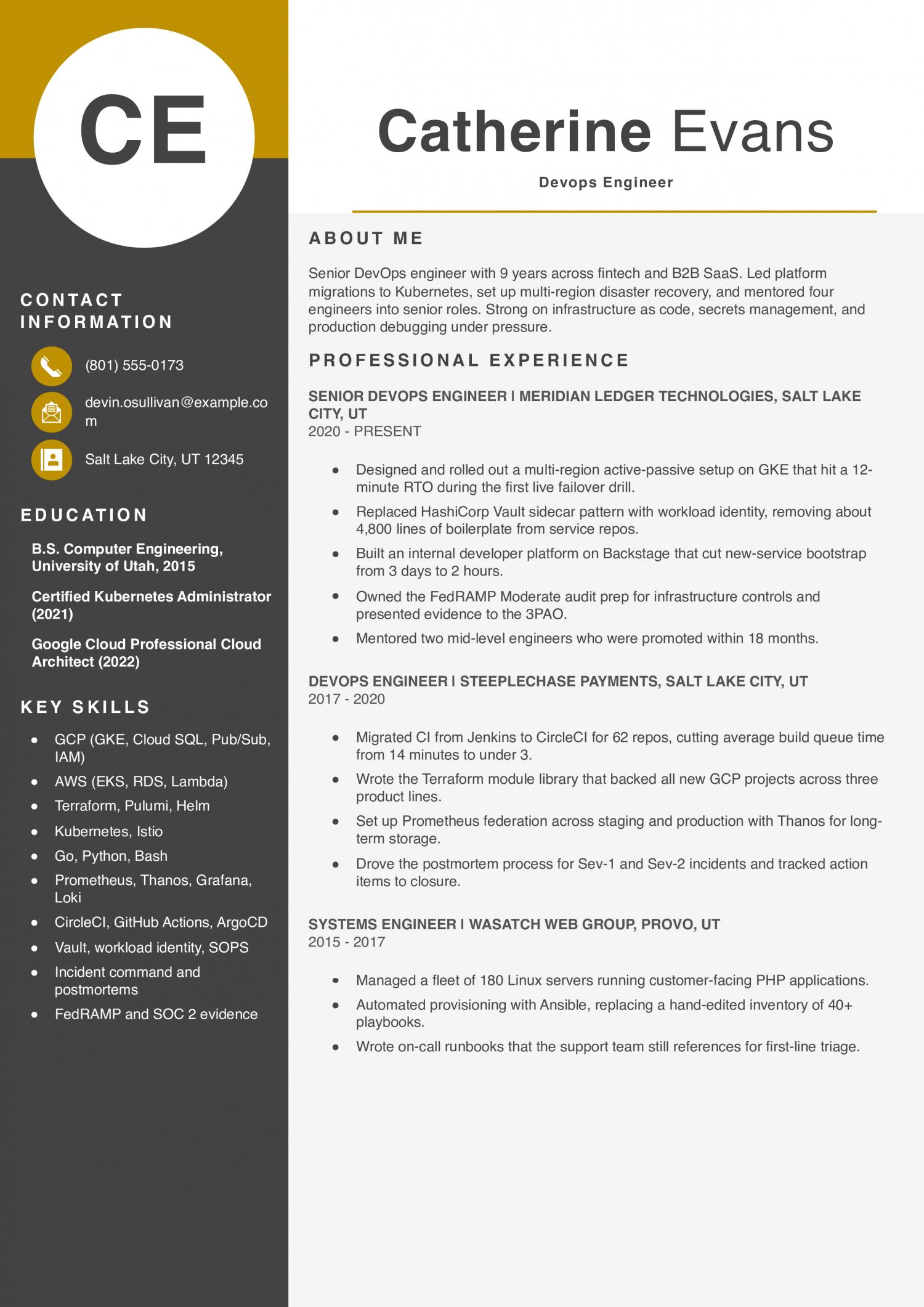
Staff devops engineers set platform direction and influence engineering org-wide standards for CI/CD, observability, and cost. The resume needs to prove platform architecture decisions, cross-team rollouts, and the business outcomes those platforms drove.
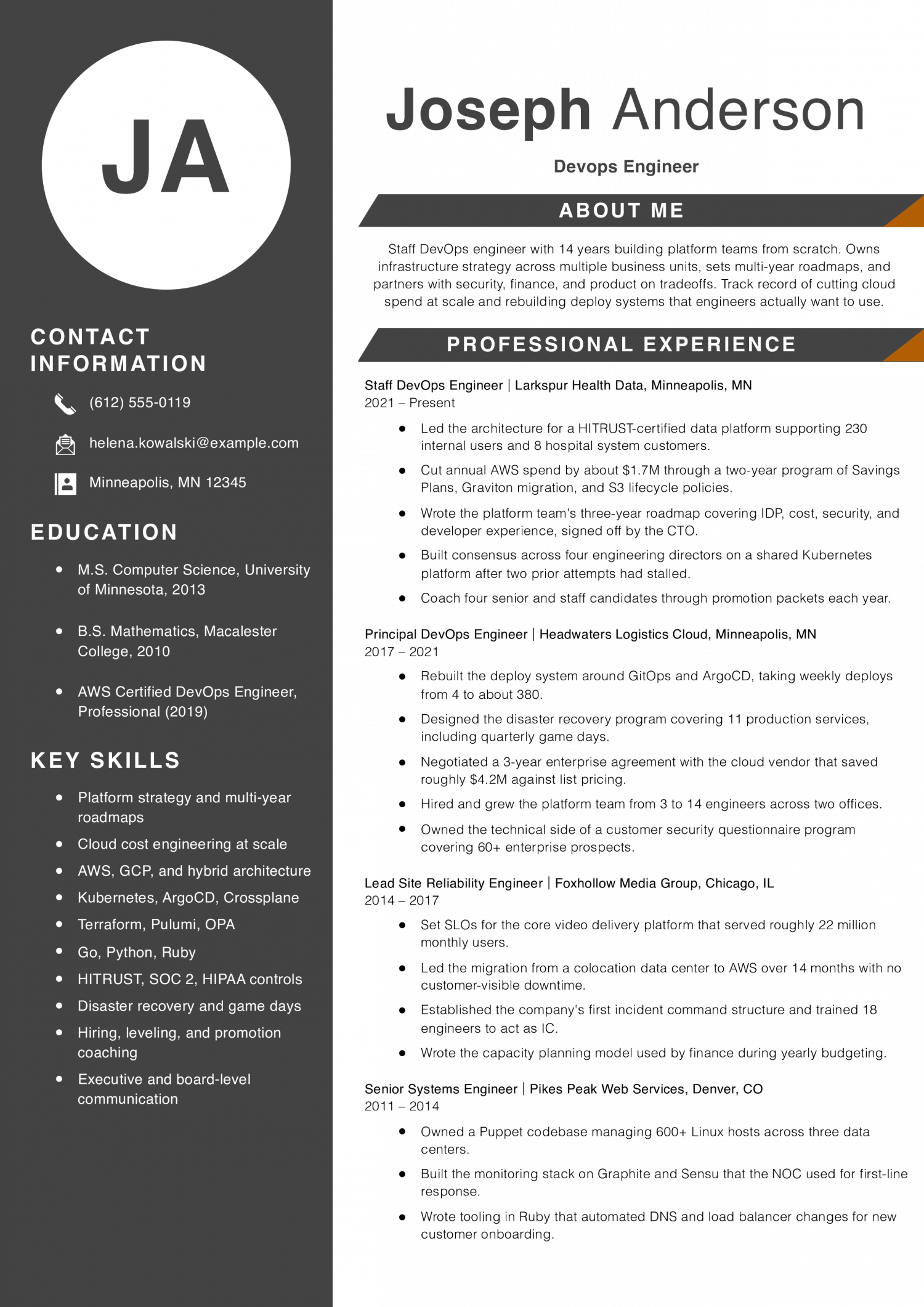
DevOps engineer with 8 years across consumer mobile, healthcare APIs, and developer tools. Builds and operates Kubernetes platforms, designs CI/CD that engineers want to use, and owns production reliability through clear SLOs and a calm incident process. Comfortable working with security, finance, and product leadership on tradeoffs.
Your profile should state your years in devops or SRE work, your primary cloud platform, and the orchestration and IaC tools you own daily.
Heads of platform engineering scan the top of page one for a stack match before they read further. A profile that reads “six years building CI/CD on AWS with Terraform, Kubernetes, and GitLab CI” gets a second pass; “experienced devops professional passionate about automation” does not. Name the production scale you operate at, whether that is a single product team or a multi-region platform serving internal engineering.
Bullets without a number tend to read as duties, not impact. Most strong devops resumes anchor on three metric families: deploy frequency or lead time, reliability numbers like uptime and MTTR, and infrastructure cost.
Pick two or three per role and stay honest. “Cut deploy time from 45 minutes to 7 by migrating Jenkins jobs to GitHub Actions” beats “improved CI/CD efficiency.” If you reduced AWS spend, name the workload and the percentage. Recruiters scan for these numbers first, then read the verb that earned them.
Cluster bullets so the reader can find the work without hunting. Four categories cover most devops resumes: CI/CD and release engineering, infrastructure as code and cloud, observability and incident response, and security and compliance automation.
Under each, name the tools and the outcome. CI/CD bullets reference Jenkins, GitLab CI, GitHub Actions, or Argo CD. IaC bullets reference Terraform, Pulumi, or CloudFormation with the AWS, Azure, or GCP services managed.
Observability bullets name Datadog, Prometheus, or Grafana and the SLOs you set.
Heads of platform engineering need to see cloud certifications and your core stack before they reach your experience bullets. Put a credentials line under your profile listing AWS, Azure, or GCP certifications with the level and year earned.
Add a technical skills block on page one grouped by category: cloud, IaC, CI/CD, containers and orchestration, observability, languages. This doubles as your ATS keyword surface for parsers scanning for Terraform, Kubernetes, and Python. Save deep tool detail for the bullets.
Senior devops resumes get longer than they should because the writer keeps every tool they touched. Trim anything that does not signal current production ownership.
Cut bootcamp projects, generic “wrote Bash scripts” lines, and tools you have not used in three years like Chef or Puppet unless the target role still runs them. Drop Microsoft Office from skills. Replace lab-only Kubernetes experience with the production cluster size you ran.
The resume should read as a current operator, not a tool collector.
The skills below come from devops engineer resumes our users built on ResumeTemplates.com. Heads of platform engineering and SRE managers scan dozens of resumes a week, and these are the skills that show up most often. Hard skills carry the screen for this role.
Terraform, Kubernetes, and a named cloud platform get you past the parser; soft skills like incident communication earn the offer. Match the hard-skill list against your target job posting and use the soft skills as the evidence frame behind your bullets, not as standalone claims.
| Soft Skills | % of resumes with this skill |
|---|---|
| Cross-functional collaboration | 68% |
| Problem solving | 51% |
| Communication | 49% |
| Adaptability | 40% |
| Incident response | 32% |
And here are the top hard skills showing up most often.
| Hard Skills | % of resumes with this skill |
|---|---|
| CI/CD pipelines | 67% |
| Infrastructure as code | 56% |
| Docker and Kubernetes | 49% |
| Cloud platforms (AWS) | 37% |
| Linux administration | 28% |
Based on data from thousands of DevOps engineers’ resumes built on ResumeTemplates.com, May 2026.
These are the must-haves hiring teams look for when scanning a devops engineer resume.
Heads of platform engineering expect to see the sub-specialty named in the resume, not just “devops.” The keywords below cluster by the niches most postings hire against.
| Niche | Keywords ATS scans for |
|---|---|
| Cloud platform engineering | aws devops engineer, azure devops engineer, gcp devops, multi-cloud architecture |
| CI/CD and release engineering | ci/cd pipelines, jenkins, gitlab ci, github actions, argo cd |
| Infrastructure as code | terraform, pulumi, cloudformation, ansible, helm |
| Site reliability and observability | sre, slo/sli, prometheus, grafana, datadog, mttr |
| Containers and orchestration | kubernetes, docker, eks, aks, gke, service mesh |
What Heads of platform engineering expect on a devops engineer resume has shifted. “Automated repetitive tasks with scripting” now reads as table stakes; bullets that name how you use Copilot or ChatGPT to draft Terraform, review pipeline YAML, or generate runbook drafts read as current. The list below names what to add.
Engineers use Copilot to scaffold Terraform modules and Kubernetes manifests, then review and harden them before commit.
ChatGPT and Copilot draft GitHub Actions and GitLab CI YAML faster than hand-writing, with humans handling secrets and approvals.
Teams pipe logs and traces through AI assistants to summarize incidents and suggest first-response steps during on-call.
AI drafts first-pass runbooks and postmortems from incident timelines, which engineers edit before publishing to the team wiki.
GitHub Copilot: Used to scaffold Terraform, Helm charts, and pipeline YAML, with human review for security and state.
ChatGPT: Used to draft runbooks, parse stack traces, and translate legacy Bash into Python or Go.
Devops engineers are hired on evidence of production-style work, not coursework. A small portfolio of public repos and a write-up of one real system carries more weight than a long list of tools.
Pinned repos showing Terraform modules, a CI/CD pipeline, and a Kubernetes deployment with README context.
One or two long-form posts on an incident, a migration, or a platform decision you owned.
Mirrors your resume and surfaces certifications, but is not the portfolio itself.
Pin three to five repos at most. Each should have a clear README stating the problem, the architecture, the tools used, and what you would do differently at production scale.
If you have signed an NDA on prior work, build a sanitized reference architecture in your own GitHub showing the same pattern. Hiring teams care about the design and your reasoning, not the employer’s data.
Group your tools by category so Heads of platform engineering can find the stack match in one pass. The list below covers what 2026 postings reference most.
Cloud: AWS, Azure, GCP
IaC: Terraform, Pulumi, CloudFormation, Ansible
CI/CD: Jenkins, GitLab CI, GitHub Actions, Argo CD
Containers and orchestration: Docker, Kubernetes, EKS, AKS, GKE, Helm
Observability: Datadog, Prometheus, Grafana, New Relic, Splunk
Languages: Python, Bash, Go, YAML
Source control and collaboration: Git, GitHub, GitLab, Bitbucket
Security and secrets: HashiCorp Vault, AWS Secrets Manager, Snyk, Trivy
A cloud platform credential and Linux fluency keep you eligible. The certifications below are what move a devops engineer resume from the qualified-but-typical stack into the shortlist that Heads of platform engineering interview. List the issuing body, level, and year earned next to each name.
AWS Certified DevOps Engineer Professional: Signals senior-level pipeline and IaC work on AWS, which is the platform most postings name first for devops and SRE roles.
Certified Kubernetes Administrator (CKA): Proves hands-on cluster operation, which separates resumes that ran production Kubernetes from those that only deployed to it.
HashiCorp Certified: Terraform Associate: Names the IaC tool most postings list, and gives a credential anchor when your bullets reference Terraform modules and state management.
Google Cloud Professional DevOps Engineer: Lift for resumes targeting GCP shops or hybrid roles, where employers want explicit GCP credentials rather than transferred AWS experience.
The 90th-percentile devops engineer out-earns the median by a wide margin, which tells you the market rewards production platform ownership and reliability outcomes more than years on a team. Cloud depth, IaC scope, and incident leadership move pay further than tenure. Lead the resume with the platforms you architected and the reliability or cost numbers they produced, not a chronology of tools touched.
The bullets that earn the top of the band name a service, a scale, and an outcome.
| # | State | Avg. Annual |
|---|---|---|
| 1 | California | $170,910 |
| 2 | Washington | $166,910 |
| 3 | Virgin Islands | $162,820 |
| 4 | New York | $161,260 |
| 5 | Massachusetts | $150,520 |
| 6 | Maryland | $137,890 |
| 7 | District of Columbia | $136,040 |
| 8 | Oregon | $135,260 |
| 9 | Delaware | $135,160 |
| 10 | Colorado | $134,540 |
| # | State | Workers | Median |
|---|---|---|---|
| 1 | California | 292,630 | $170,910 |
| 2 | Texas | 151,460 | $130,500 |
| 3 | New York | 104,130 | $161,260 |
| 4 | Washington | 91,470 | $166,910 |
| 5 | Virginia | 83,290 | $134,470 |
Resume Templates offers HR approved resume templates to help you create a professional resume in minutes. Choose from several template options and even pre-populate a resume from your profile.
Yes, but the resume has to show production-grade project work, not tutorials. Most devops engineers come from software development, systems administration, or network engineering.
If you are transitioning, lead the resume with one cloud certification, a public GitHub repo showing Terraform and a CI/CD pipeline, and any homelab or open-source contributions. Name the services and the outcome, not the course.
Frame prior IT or developer experience around the work that overlaps: scripting, on-call, deployments, and incident response.
Lead with the Azure services by name and the Microsoft-stack tooling that signals platform depth. Generic "cloud experience" does not parse well for Azure-specific postings.
Name AKS, Azure DevOps Pipelines, ARM or Bicep templates, Azure Monitor, and Entra ID where they apply. Add the AZ-400 certification near the top if you hold it.
If you also work in AWS or GCP, list them in skills but keep the bullet evidence weighted toward Azure for Azure-targeted applications.
Open with years of experience, primary cloud, and the two or three tools that anchor your stack. Skip adjectives like "passionate" or "results-driven."
A working pattern: "Devops engineer with seven years building CI/CD and IaC on AWS using Terraform, Kubernetes, and GitHub Actions. Owned production reliability for a 40-service platform serving 200 engineers."
Three to four lines is plenty. The bullets carry the proof.
No. A long tool list reads as resume padding and dilutes the stack you actually own. Heads of platform engineering want to see depth, not surface area.
Keep the skills block to tools you have used in production in the last two to three years. Group by category so the parser and the reader both find what they need.
If a tool only appears in one old project, leave it in that role's bullets and out of the top-line skills section.
For a DevOps engineer, a tech template is the safest pick, because it keeps your stack, tools, and impact easy to scan. An ATS-friendly template is a solid alternative. Whichever you choose, keep the formatting clean and easy to parse: clear section headings, a standard font, and no graphics a parser can choke on.
Executive Resume Writer and Career Coach
Andrew Stoner is an executive career coach and resume writer with 17 years of experience as a hiring manager and operations leader at two Fortune 500 Financial Services companies, and as the career services director at two major university business schools.
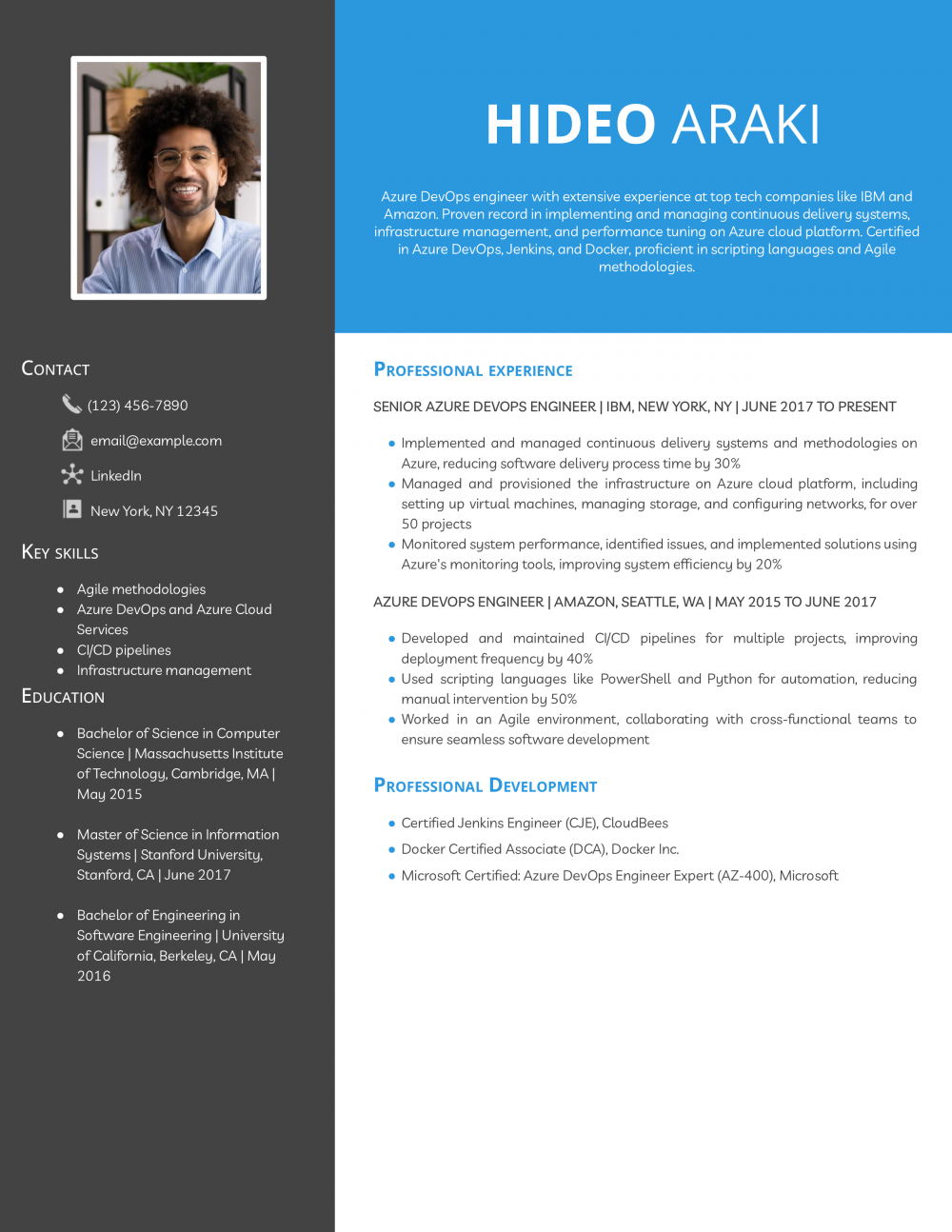
Customize this template in our builder in under 10 minutes.