
Tip !

Directors of nursing decide whether to pass an LVN resume to the nurse manager by the credentials line on page one; if active license, IV certification, and BLS aren't visible there, the resume gets cut from the stack.

Andrew Stoner , Executive Resume Writer and Career Coach

Why this resume works

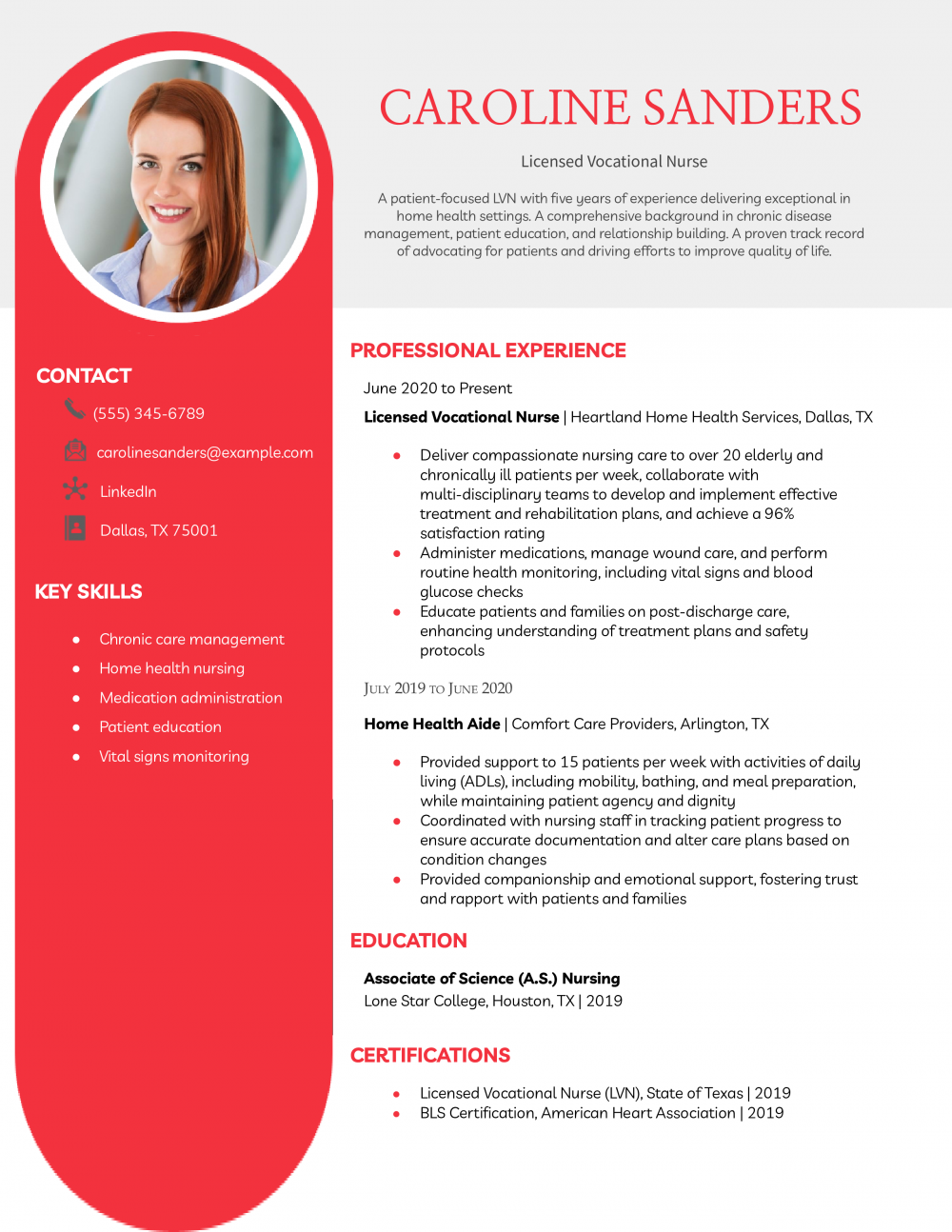
  • Shows safe medication numbers: The 180-meds-per-shift bullet with zero errors over 14 months is exactly the kind of patient-safety proof hiring managers look for.
  • Covers two care settings: Skilled nursing plus outpatient clinic experience signals she can step into either environment without a long ramp-up.
  • Bilingual skill tied to patients: Calling out Spanish teaching for 40% of the panel makes the language skill concrete instead of a generic line in the skills list.

New LVN Example

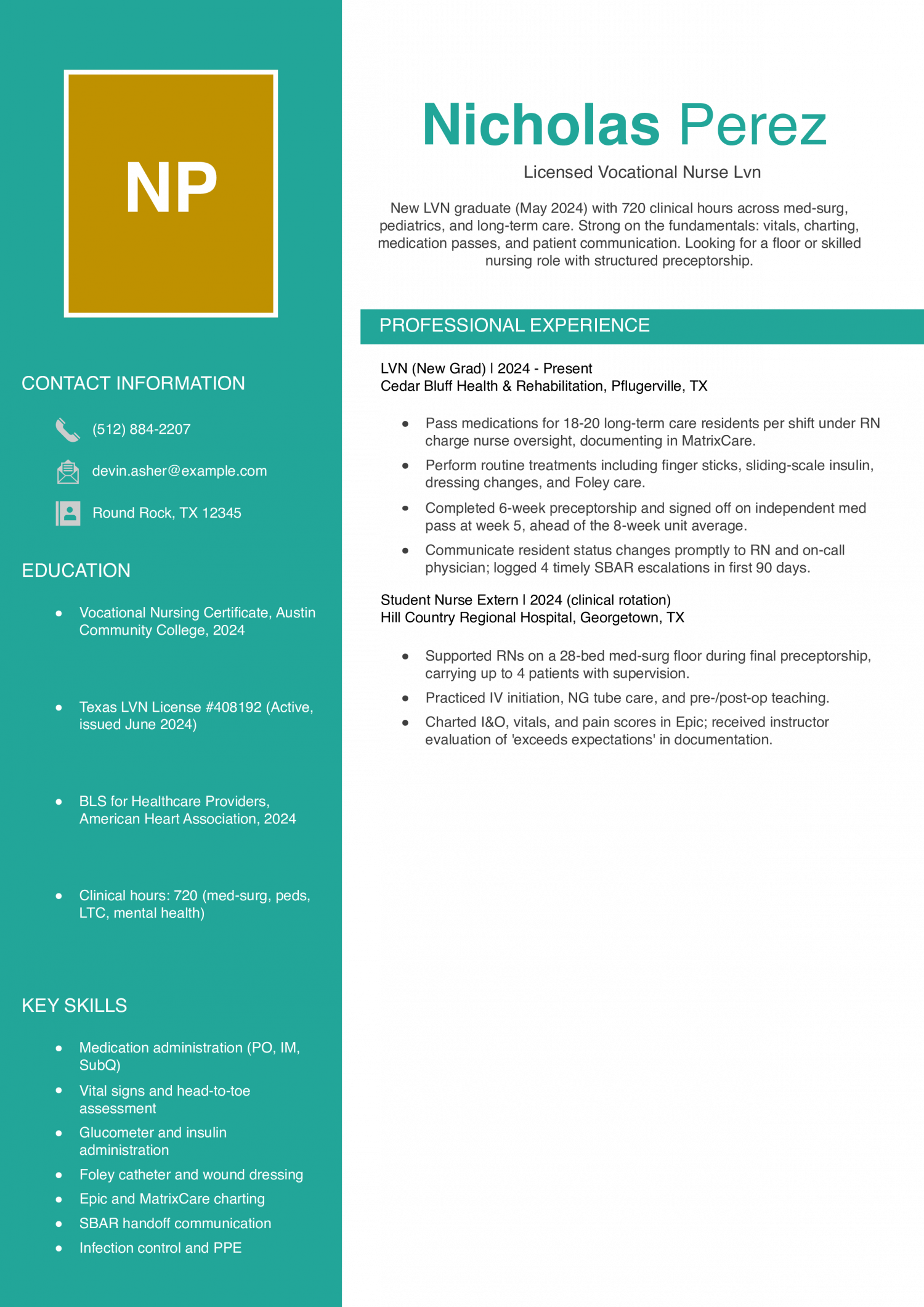
The new LVN archetype is finishing a vocational nursing program or within the first year of licensure, often with clinical rotations as the strongest evidence. This resume needs to prove license status, clinical hours by setting, and the procedures you performed under preceptor supervision.

Why this resume works

  • Names exact clinical hours: Listing 720 hours across specific rotations gives recruiters a concrete picture of what the new grad has actually done.
  • Shows fast preceptor sign-off: Clearing independent med pass at week 5 vs. the 8-week unit average is a real, measurable signal of readiness.
  • Honest about supervision level: Phrases like ‘under RN charge nurse oversight’ read as accurate for a new grad and build trust with hiring managers.

Experienced LVN Example

The experienced LVN archetype carries two or more years of bedside work, typically with a specialty population and EMR fluency. This resume needs to prove patient load per shift, the acuity you handled, and the charting systems and certifications you bring to the floor.

Why this resume works

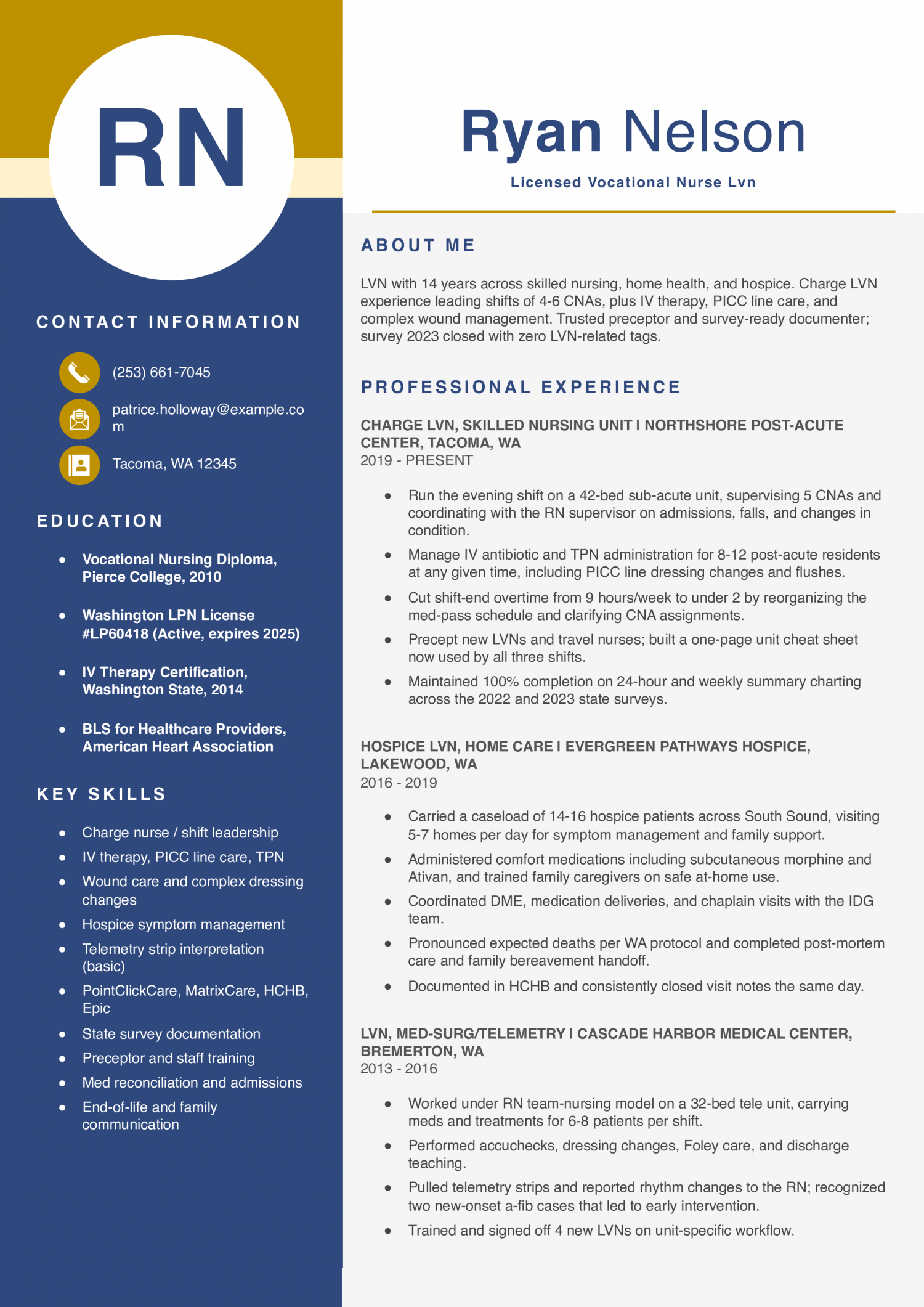
  • Clear charge nurse scope: Running an evening shift on a 42-bed unit with 5 CNAs tells the reader exactly how much she supervises.
  • Survey-ready documentation: Citing zero LVN-related tags and 100% charting completion across two state surveys is a strong proof point for SNF employers.
  • Range across care settings: SNF, hospice, telemetry, and long-term care show she can move between acuity levels without retraining from scratch.

How to Write a Licensed Vocational Nurse LVN Resume

01 Open with the metric a nurse manager would size you up by

The first line of your summary should name the patient load you carry per shift, the care setting, and the acuity range you work.

Nurse managers and directors of nursing read this as your readiness for their floor. A line like “LVN with three years in skilled nursing, managing 18 to 22 residents per shift on a sub-acute rehab unit” tells them more than five lines of soft-skill prose. Name the EMR, the IV certification, and the population in the same opener if you can fit it.

Save the personality traits for the cover letter.

02 Quantify patient load, throughput, and outcomes

Most strong LVN bullets carry a number. Lead with patient ratios, shift volume, charting throughput, or fall and pressure injury rates on your unit.

Write “Managed care for 20 to 24 long-term care residents per 12-hour shift, including med pass for high-acuity diabetics” rather than “Provided patient care.” Realistic metrics to mine: residents per shift, admissions processed per week, wound care cases tracked, med pass accuracy from QA audits, and call light response times. Bullets without a number tend to read as job descriptions. Pull two or three numbers per role from your shift reports or chart audits.

03 Group bullets by clinical scope

Cluster your work into three or four buckets so a nurse manager can scan your scope in seconds.

Useful groupings: medication administration and IV therapy, wound and ostomy care, charting and care plan documentation, and patient and family education. Under each, name the procedures you owned: subcutaneous and IM injections, PICC line dressing changes, glucometer checks, Foley insertions, G-tube feedings, and tracheostomy care. Add the populations: geriatric, post-surgical, pediatric, or hospice.

Avoid stacking acronyms without context. A reader scanning for sub-acute rehab experience should land on that bucket in the first pass.

04 Put license and certifications in a page-one block

Build a credentials block in the top third of page one with your state LVN license (state and “in good standing,” not the number), BLS, and any specialty certifications.

Directors of nursing verify license status before reading anything else. Include IV and blood withdrawal certification, ACLS if you carry it, wound care certification, and CPR with the issuing body and expiration month and year. Name the EMRs you have charted in: Epic, PointClickCare, Cerner, MatrixCare, or Meditech.

Place this block under your summary, above your work history. Do not list the license number on the resume itself.

05 Close with education and clinical hours

End the resume with your vocational nursing program, graduation month and year, and any clinical rotation hours that map to your target setting.

For new grads, expand this section: name the preceptor sites, the unit type, and the procedures you performed under supervision. List NCLEX-PN pass date if recent. Add continuing education hours by topic, since most state boards require renewal CEs and many directors of nursing screen for current CE on chronic disease, pain management, or dementia care.

Keep this section to six lines or fewer once you have two years of work history.

The skills below come from LVN resumes our users built on ResumeTemplates.com. Directors of nursing scan dozens of resumes a week, and these are the skills that show up most often. Nurse managers weigh hard skills first: IV therapy, wound care, and EMR fluency get sorted before any soft signal.

Soft skills like patient education read as evidence backing your bullets. Match this list against the posting you’re targeting and pull the exact phrasing the posting uses into your resume.

Soft Skills % of resumes with this skill
Patient communication 74%
Compassion and empathy 64%
Attention to detail 50%
Time management 39%
Teamwork 30%

And here are the top hard skills showing up most often.

Hard Skills % of resumes with this skill
Medication administration 69%
Wound care 59%
Vital signs monitoring 46%
IV therapy 35%
Electronic health records 27%

Based on data from thousands of LVNs’ resumes built on ResumeTemplates.com, May 2026.

Must Have on a Licensed Vocational Nurse LVN Resume

Before a licensed vocational nurse lvn resume gets a closer read, hiring teams check for a short list of essentials.

Licensure Requirements

Every LVN resume needs a credentials block above the work history. List the state, the license type, the status, and the expiration. Skip the license number itself.

Each state board of vocational or practical nursing sets its own renewal cycle, CE hour requirement, and scope of practice. California, Texas, and New York each handle IV certification and blood withdrawal as separate add-ons to the base license.

  • Active LVN or LPN license, state and “in good standing” with expiration month and year
  • IV therapy and blood withdrawal certification where required by state scope
  • Basic Life Support (BLS) from the American Heart Association, with expiration
  • NCLEX-PN pass date if within the last two years
  • Continuing education hours completed in the current renewal cycle

Continuing Education That Strengthens an LVN Resume

State boards set the minimum CE clock. Directors of nursing look beyond the minimum for evidence that you’re current on the populations and procedures their facility serves.

List CE hours by topic, not as a single hour count. Group them under a “Continuing Education” subhead below your certifications, with the provider and month and year completed for each.

  • Dementia and Alzheimer’s care (required CE in several states)
  • Pain management and end-of-life care
  • Wound staging and pressure injury prevention
  • Diabetes management and insulin administration
  • IV therapy refresher and central line care
  • Infection control and bloodborne pathogens

EMR Systems

Nurse managers screen for the EMR their facility uses before they read your bullets. Name every system you’ve charted in, by brand, in a single line under your skills section.

  • Epic (acute care, ambulatory)
  • Cerner (acute care, ED)
  • PointClickCare (skilled nursing, long-term care)
  • MatrixCare (skilled nursing, senior living)
  • Meditech (community hospitals)
  • HCHB or Kinnser (home health)

HIPAA and OSHA Compliance

Do not name patients, room numbers, or any detail that could identify a person you cared for. HIPAA applies to your resume, your LinkedIn, and your interview answers.

Quick rule of thumb

Describe scope in aggregate terms: “managed care for 20 to 24 residents per shift” rather than naming a specific resident. Reference facility types and unit names, but skip identifying details about the people you treated. Directors of nursing read patient-identifying detail as a red flag, since it suggests the same loose handling on the floor.

Vocational Nursing Credentials That Get You the Job

Beyond your state LVN license and BLS, the certifications below tell a director of nursing which procedures you can perform unsupervised and which populations you’ve trained for. List the certifying body, the issue date, and the expiration month and year for each item.

  • IV Therapy and Blood Withdrawal Certification: Required in California and most states for LVNs starting IVs or drawing blood, and the single most common credential nurse managers screen for.
  • Wound Care Certified (WCC): Signals you can manage stage three and four pressure injuries independently, which is heavily weighted in skilled nursing and home health hiring.
  • Advanced Cardiac Life Support (ACLS): Opens doors at acute care, dialysis, and step-down units that staff LVNs alongside RNs on higher-acuity floors.
  • Certified Hospice and Palliative Licensed Nurse (CHPLN): Tells hospice and palliative employers you've trained in end-of-life symptom management and family support beyond bedside basics.

Latest BLS Statistics for LVNs

For LVNs, the 10th-percentile floor reads as the new-grad long-term care wage, and the top-decile ceiling reads as the IV-certified, EMR-fluent LVN working acute care, dialysis, or home health in a high-cost metro.

That spread tells you specialty certification, geography, and shift type move you from floor to ceiling faster than tenure alone. Lead your resume with the certifications, the EMR, and the acuity setting that map to the ceiling you’re targeting.

$62,340 National median annual
$64,150 National mean annual
$47,960 Entry-tier floor (10th percentile)
$80,510 Top-decile ceiling (90th percentile)
632,430 LVNs in the U.S.
Where you stand

Entry tier

$47,960 to $62,340 At this tier, your resume needs to show your active license and clinical rotation hours, and lead with NCLEX-PN pass date and care settings.

Mid band

$62,340 to $80,510 At this tier, your resume needs to show patient load per shift and EMR fluency, and lead with IV certification and specialty population.

Top decile

$80,510+ At this tier, your resume needs to show charge or preceptor duties and acute or home health acuity, and lead with WCC, ACLS, and shift differential roles.

Top-paying states

# State Avg. Annual
1 Washington $79,700
2 Rhode Island $77,940
3 Alaska $77,670
4 California $77,170
5 Oregon $76,570
6 Massachusetts $76,560
7 New Hampshire $74,660
8 Arizona $74,020
9 Nevada $73,820
10 New Jersey $71,180

Highest-employment states

# State Workers Median
1 California 79,610 $77,170
2 Texas 59,060 $60,150
3 New York 40,720 $64,030
4 Florida 36,470 $60,080
5 Ohio 36,440 $60,990
Source: U.S. Bureau of Labor Statistics, OEWS 2024 release (SOC 29-2061).
Written by professional resume writers and loved by hiring managers

Resume Templates offers HR approved resume templates to help you create a professional resume in minutes. Choose from several template options and even pre-populate a resume from your profile.

Frequently Asked Questions

Should I put my LVN license number on my resume?

No. List your state and "license in good standing" with the expiration month and year.

Provide the actual license number on the application form when the employer requests it. Most state boards of vocational nursing warn against publishing the number on documents that get emailed or posted.

How do I write an LVN resume with no clinical experience yet?

Lead with your vocational nursing program, NCLEX-PN pass date, and clinical rotation hours by setting.

Name the preceptor sites, the unit types, and the procedures you performed under supervision.

Add any CNA or medical assistant work as a separate section, since nurse managers count that as patient-facing time.

How should I handle an LVN license that's in a different state than the job?

Name both states on the credentials line: your current active license and the target state with "endorsement pending" or "endorsement application submitted."

Nurse managers and HR screen out resumes that show only an out-of-state license without a path to local licensure.

Add the date you expect the new license to issue.

How do I show an employment gap on an LVN resume?

Name the gap on the timeline with one short line: caregiving, education, or health, with the months it spanned.

Then show how you kept your license current: CE hours completed, refresher courses, or per diem shifts.

Directors of nursing care more about your CE clock and clinical currency than the gap itself.

Which resume template works best for an LVN?

For an LVN, an ATS-friendly template is the safest pick, because it puts your certifications and experience where a hiring manager scans first. A basic template is a solid alternative. Whichever you choose, keep the formatting clean and easy to parse: clear section headings, a standard font, and no graphics a parser can choke on.

Rate this article

Licensed Vocational Nurse Resume

Average Rating

4.5/5 stars with 189 reviews

You have given 0 Star(s)
4.5/5 stars with 189 reviews
Andrew Stoner

Executive Resume Writer and Career Coach

Andrew Stoner is an executive career coach and resume writer with 17 years of experience as a hiring manager and operations leader at two Fortune 500 Financial Services companies, and as the career services director at two major university business schools.