Labor and Delivery Resume Examples and Templates for 2026



An active RN license and current BLS, ACLS, and CCRN status are what get ICU nurse resumes past the credentialing screen; specific drip lists, vent settings, and patient ratios are what make them readable enough to advance.
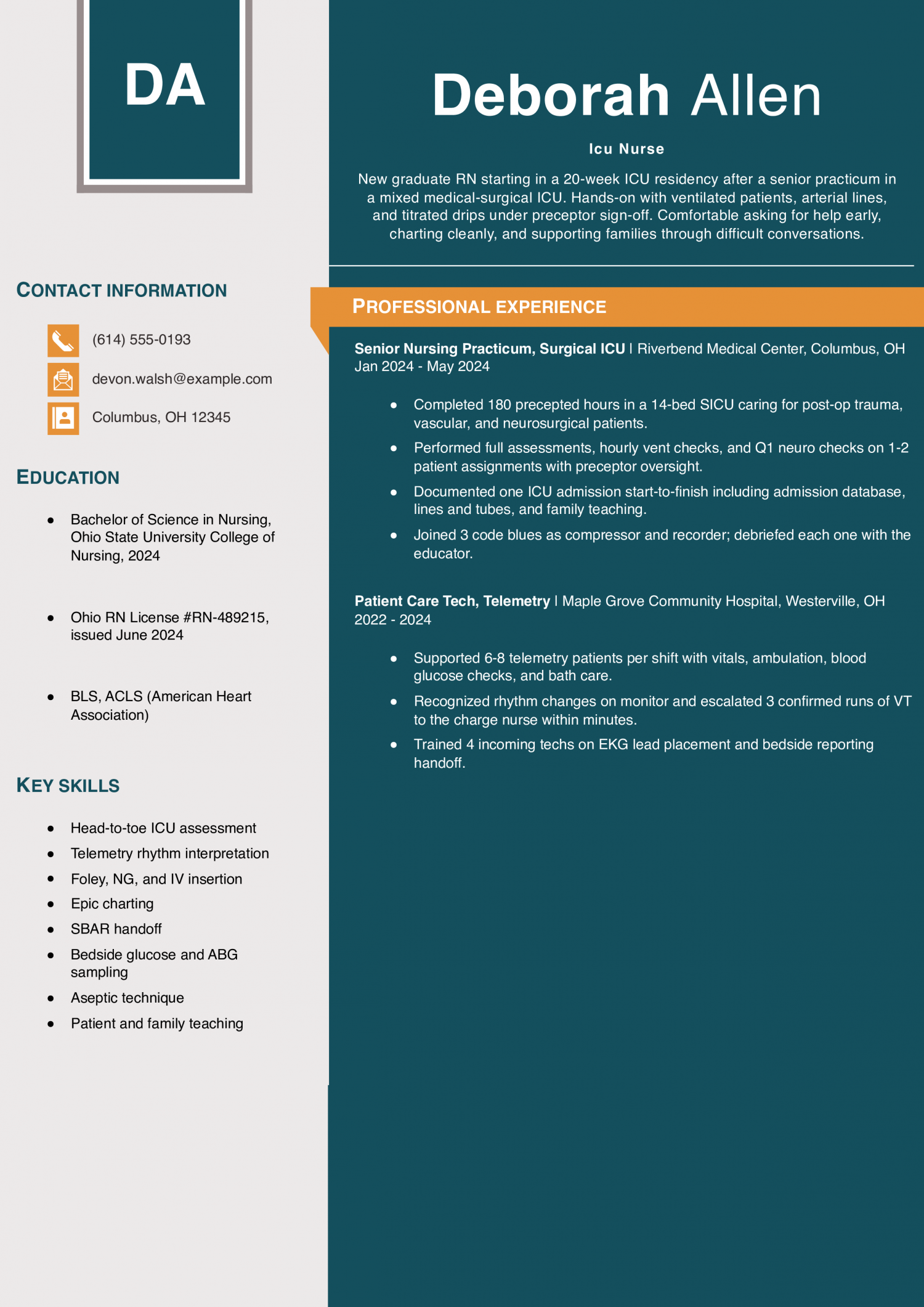
The new grad RN coming out of a critical care residency or capstone with ICU placement. Your resume needs to prove clinical rotations, simulation hours, and the acuity level you handled under preceptor sign-off.
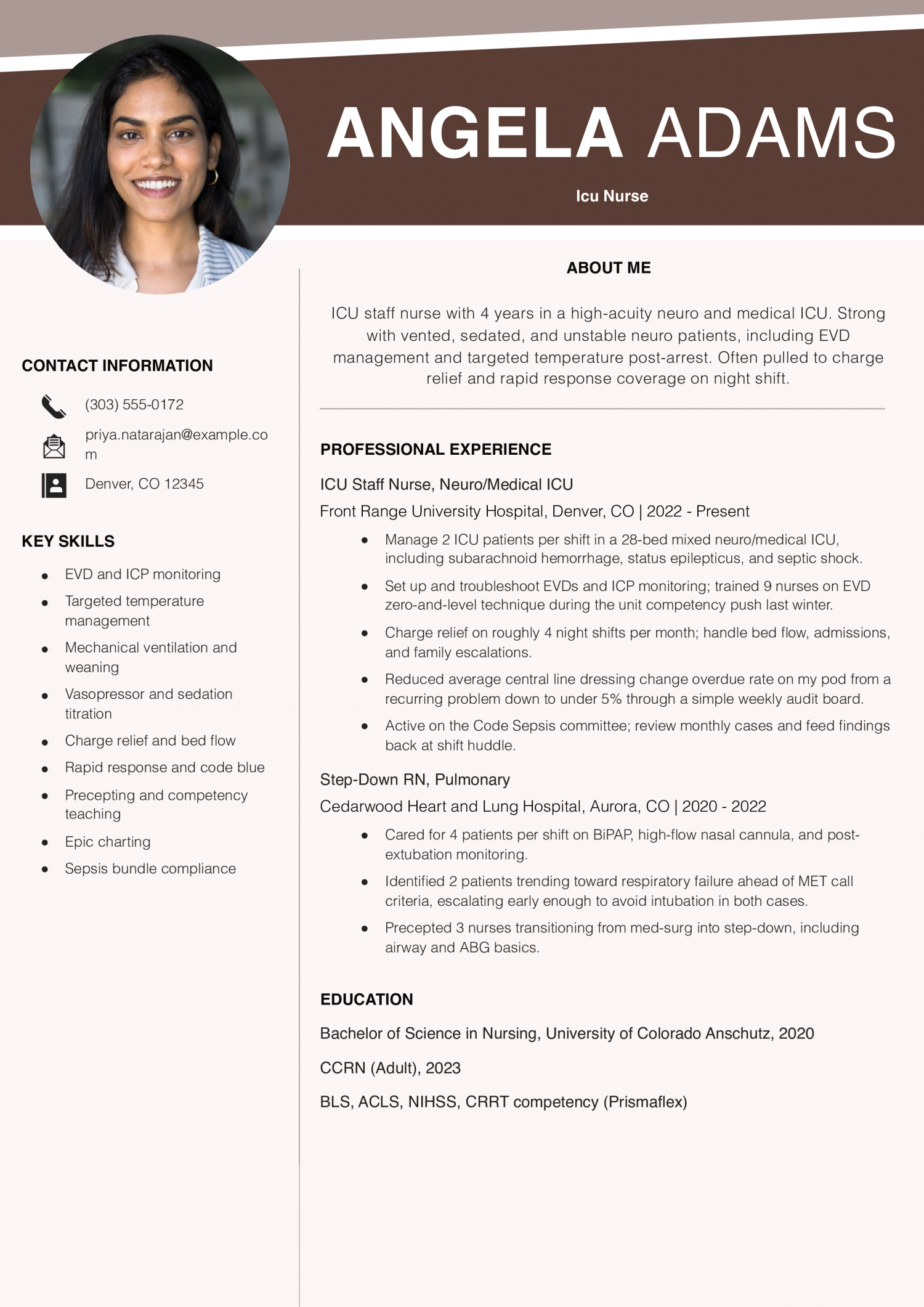
The bedside ICU nurse with two to seven years on a unit, owning two-patient assignments and full drip lists. Your resume needs to prove unit type, patient ratios, and the specific interventions you run independently.
The charge nurse running shift assignments, rapid response, and code teams across an ICU pod. Your resume needs to prove staffing decisions, preceptor load, and unit metrics you moved during your shifts.
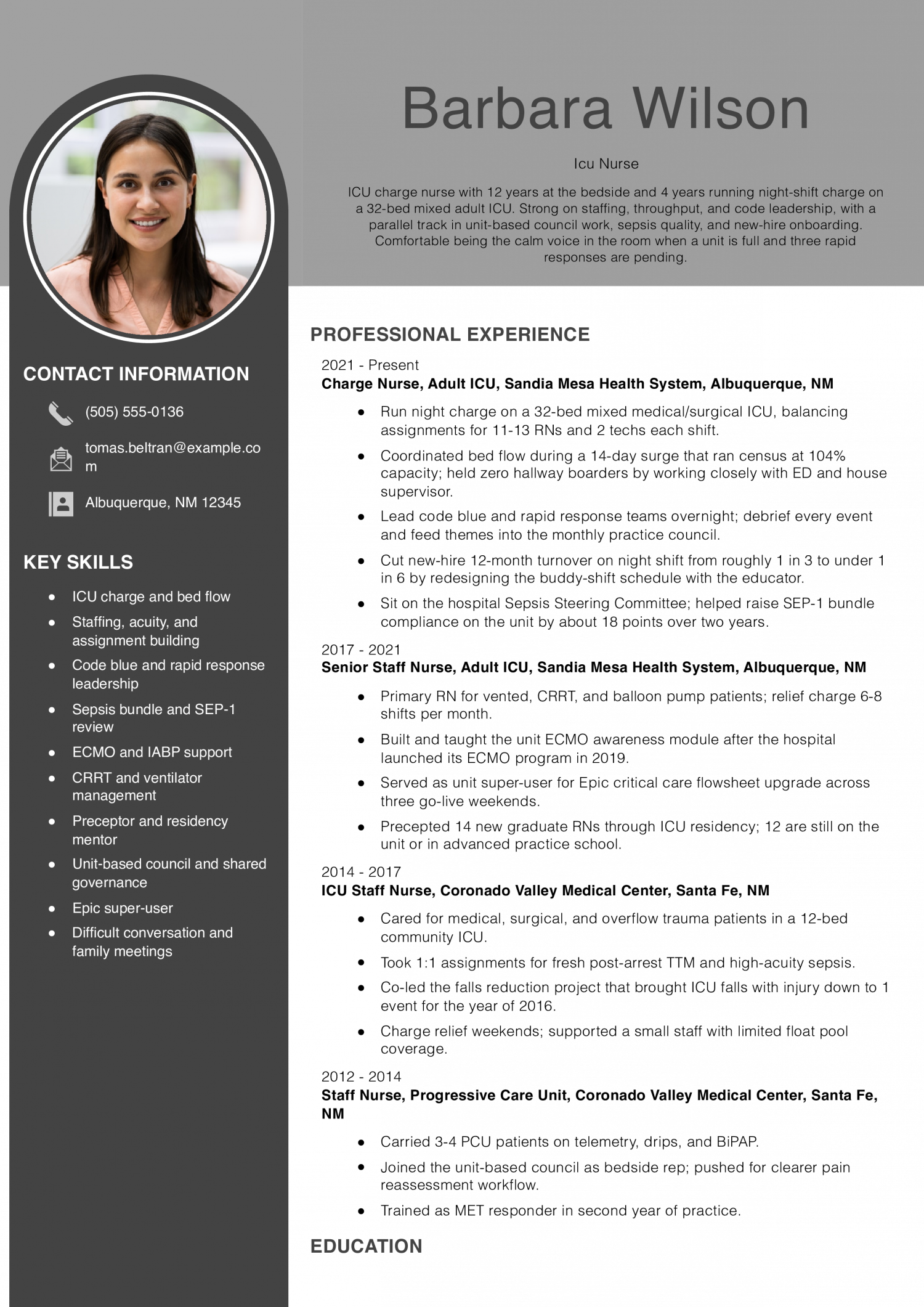
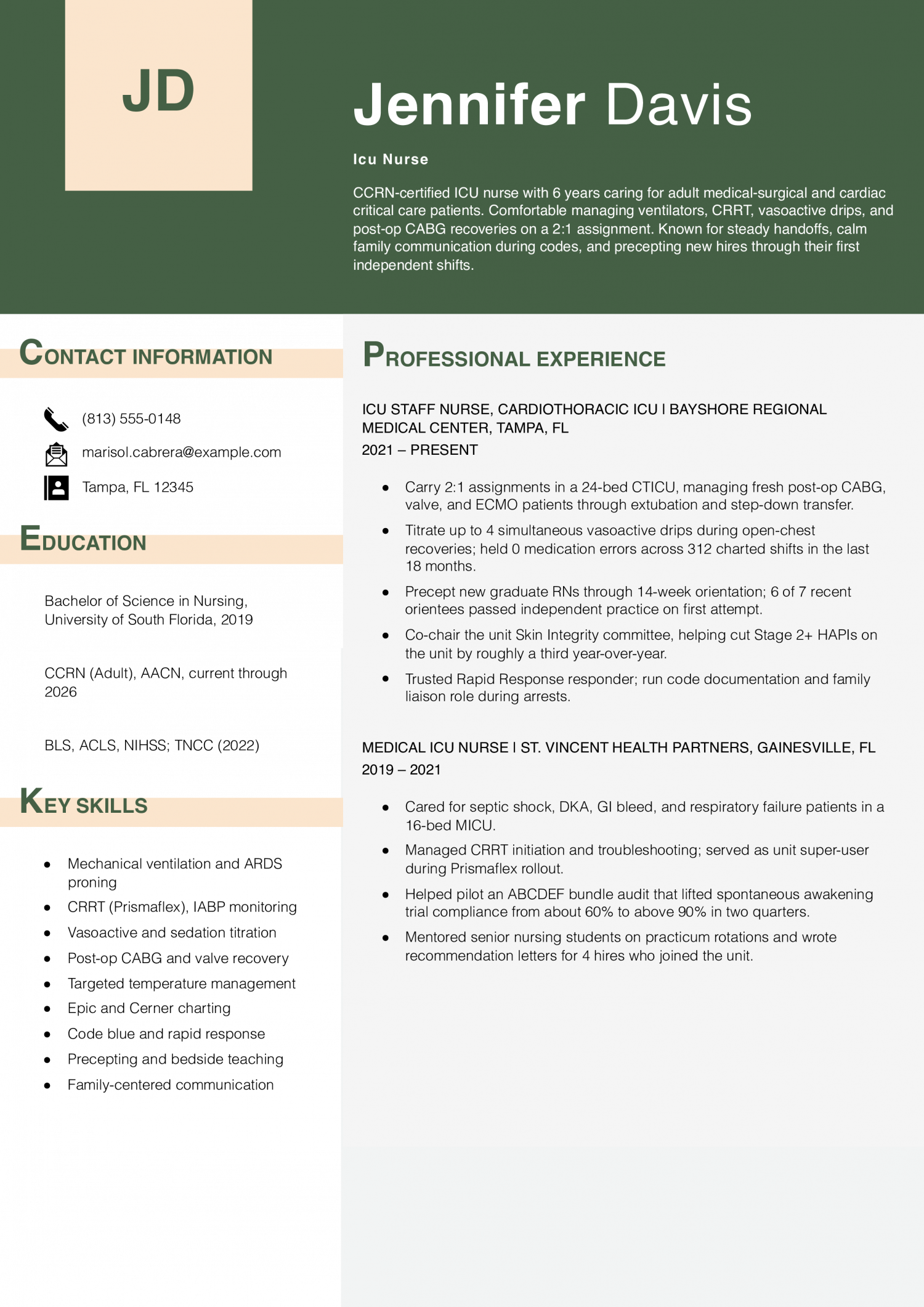
ICU nurse with 8 years across medical, surgical, and cardiac critical care, including 2 years as a clinical lead on day shift. CCRN-certified, comfortable with vented and unstable patients on multiple drips, CRRT, and post-arrest TTM. Known for clean handoffs, strong preceptor work, and steady leadership during codes and family meetings.
Your profile should state your years of bedside ICU experience and the unit type you have worked. Name MICU, SICU, CVICU, neuro ICU, or trauma ICU directly.
Add the bed count and patient ratio you carry, then the highest-acuity interventions you run. A nurse manager scanning page one wants to see ventilated patients, multi-drip assignments, and CRRT or balloon pump experience inside the first four lines. Skip the generic compassion language.
ICU nurse managers and hospital recruiters already assume that part.
Bullets without numbers read as duties. Most strong ICU resumes tie work to acuity, ratio, and throughput.
Name your patient-to-nurse ratio (1:1 or 1:2), the unit’s bed count, and the share of ventilated or vasoactive patients you managed. Add volume figures where you have them: rapid responses attended per month, codes run as primary nurse, or CRRT setups per quarter. If your unit tracks central line days or VAP rates, name your contribution to those metrics.
Numbers move you from staff bullet to charge candidate.
Cluster your work into three or four buckets that nurse managers scan for. A clean grouping reads faster than a long mixed list.
Use categories like hemodynamic monitoring (arterial lines, Swan-Ganz, CVP), ventilator and airway management (vent settings, ABG interpretation, extubation), vasoactive and sedation drips (titration of norepinephrine, propofol, fentanyl), and renal or cardiac support (CRRT, IABP, post-CABG management). Under each, name the specific equipment or protocol. This shows your unit type without forcing the reader to guess from your employer name.
Build a credentials block under your contact info. List your RN license by state with “in good standing,” plus BLS, ACLS, CCRN, and any unit-specific cards like PALS, TNCC, or NIH Stroke Scale.
Do not print license or certification numbers on your resume. Add your EMR systems on the same block: Epic, Cerner, or Meditech with the modules you use. ICU nurse managers and hospital recruiters need credentials visible early because credentialing verifies them before your resume reaches the unit.
Buried certifications often get the file kicked back for a second pass.
End with your BSN or ADN, school, and graduation year. Add an MSN or DNP above the BSN if you hold one.
Under education, list a short continuing education block: critical care courses (ECCO, essentials of critical care orientation), sepsis or stroke certifications, and any preceptor or charge nurse training. Two to four entries is enough. This signals you keep current with unit protocols and tells the manager you are tracking toward charge or specialty roles.
The skills below come from ICU nurse resumes our users built on ResumeTemplates.com. Nurse managers scan dozens of resumes a week, and these are the skills that show up most often. Hard skills like CRRT and vent management get you past the credential filter.
Soft skills like rapid clinical judgment back up the bullets where you ran a code. Match this list against the target posting, and use the soft skills as evidence anchors for your strongest bullets.
| Soft Skills | % of resumes with this skill |
|---|---|
| Critical thinking | 75% |
| Communication | 53% |
| Attention to detail | 43% |
| Stress resilience | 36% |
| Teamwork | 30% |
And here are the top hard skills showing up most often.
| Hard Skills | % of resumes with this skill |
|---|---|
| Hemodynamic monitoring | 72% |
| Ventilator management | 51% |
| Advanced cardiac life support | 41% |
| Electronic health records | 36% |
| Medication titration | 35% |
Based on data from thousands of ICU nurses’ resumes built on ResumeTemplates.com, May 2026.
These are the must-haves hiring teams look for when scanning an icu nurse resume.
Credentialing verifies your license before your resume reaches the unit. Make the license block clean and current so it clears that gate without follow-up.
List your active RN license by issuing state, with “in good standing” and the expiration month and year. If you hold a multistate license under the Nurse Licensure Compact, name it as “compact (multistate)” so recruiters across states see it.
Do not print license numbers on a public resume. Provide them on the application form when asked.
CE hours signal that you track unit protocol changes and stay current on drips, vents, and devices. List recent coursework under education or in a short standalone block.
Most state boards require a set CE clock-hour count per renewal cycle. Meet your state board’s requirement and list two to four courses tied to ICU work.
ICU postings often filter on EMR experience because charting throughput drives unit workflow. Name the system and the modules you use, not just the vendor.
Epic (ICU flowsheet, MAR, Rover, Stork if applicable)
Cerner PowerChart (CareCompass, IView)
Meditech Expanse
Philips IntelliVue and ICCA hemodynamic charting
GE Centricity Critical Care
Pyxis or Omnicell medication dispensing
HIPAA rules apply to your resume the same way they apply to your charting. Strip identifying details from every bullet before you send the file.
Describe acuity, volume, and intervention without naming patients, room numbers, or case specifics. Use ranges and ratios: “managed two-patient assignments on a 24-bed CVICU” reads cleaner and safer than a case anecdote.
If you led a quality improvement project, name the protocol and the metric you moved, not the patient population in identifiable terms.
Beyond your RN license and BLS, the certifications below tell nurse managers which acuity level you can take and how prepared you are for codes, trauma, and specialty units. List the certifying body and current expiration month and year for each.
CCRN (Critical Care Registered Nurse): Issued by AACN. The standard signal that you have logged the direct-care hours and passed the critical care knowledge exam.
ACLS (Advanced Cardiovascular Life Support): AHA certification that confirms you can run or assist a code. Nearly every ICU posting requires it as a minimum.
CSC or CMC (Cardiac Surgery or Cardiac Medicine Subspecialty): AACN subspecialty add-ons for CVICU and cardiac ICU nurses. Strong signal for post-CABG, LVAD, or transplant units.
TNCC (Trauma Nursing Core Course): Useful for trauma ICU and SICU candidates. Shows you handle penetrating trauma, multisystem injury, and primary survey under pressure.
For ICU nurses, the 10th-percentile floor reads as the new-grad and rural medical-surgical entry tier, and the top-decile ceiling reads as the metro academic, travel contract, or charge tier. That spread tells you unit acuity, geography, and specialty certifications move a candidate from floor to ceiling more than raw years on the job.
Lead the resume with the unit type (CVICU, neuro ICU, trauma), patient ratios, and the AACN credentials that map to the ceiling you are targeting.
| # | State | Avg. Annual |
|---|---|---|
| 1 | California | $140,330 |
| 2 | Hawaii | $136,320 |
| 3 | Oregon | $123,990 |
| 4 | Washington | $112,180 |
| 5 | Alaska | $110,690 |
| 6 | New York | $105,600 |
| 7 | District of Columbia | $104,550 |
| 8 | New Jersey | $102,730 |
| 9 | Nevada | $101,990 |
| 10 | Massachusetts | $101,970 |
| # | State | Workers | Median |
|---|---|---|---|
| 1 | California | 326,720 | $96,360 |
| 2 | Texas | 261,050 | $90,010 |
| 3 | Florida | 218,100 | $82,850 |
| 4 | New York | 204,120 | $105,600 |
| 5 | Pennsylvania | 146,840 | $87,610 |
Resume Templates offers HR approved resume templates to help you create a professional resume in minutes. Choose from several template options and even pre-populate a resume from your profile.
List the unit type (MICU, SICU, CVICU, neuro ICU, or trauma ICU), the bed count, and your patient ratio.
Then name the interventions you run independently: ventilator management, vasoactive drips, CRRT, arterial and central lines, and code response. This tells a nurse manager your acuity level in three lines.
Name the trauma center level (Level I, II, or III) and the volume your unit handled.
Add bullets for primary survey, massive transfusion protocol activations, post-op management of multisystem injury, and any TNCC or ATCN certification. If you floated to the OR or ED for trauma activations, name that scope.
Lead with telemetry experience, step-down or PCU rotations, and any rapid response calls you joined. Name the highest-acuity patients you managed: post-op, sepsis, DKA, or stroke alerts.
List ACLS, any critical care course (like AACN's ECCO), and shadow shifts you completed in the ICU. Frame the application as targeted, not exploratory.
No. List your state, the credential (RN), and "license in good standing" with the expiration month and year. State boards of nursing warn against publishing the license number on a public document.
The credentialing office will request the number on the application form. The same rule applies to certification ID numbers from AACN, AHA, or ENA.
For an ICU nurse, an ATS-friendly template is the safest pick, because it puts your certifications and experience where a hiring manager scans first. A basic template is a solid alternative. Whichever you choose, keep the formatting clean and easy to parse: clear section headings, a standard font, and no graphics a parser can choke on.
Executive Resume Writer and Career Coach
Andrew Stoner is an executive career coach and resume writer with 17 years of experience as a hiring manager and operations leader at two Fortune 500 Financial Services companies, and as the career services director at two major university business schools.