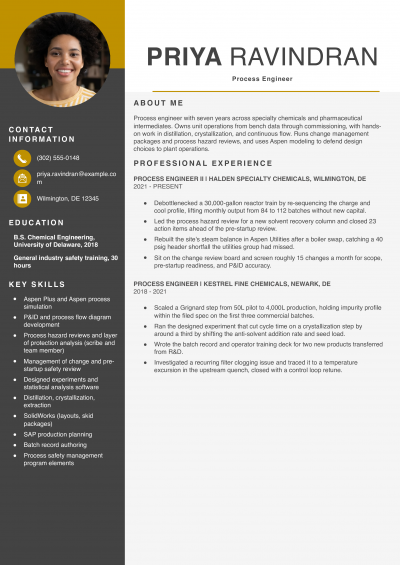
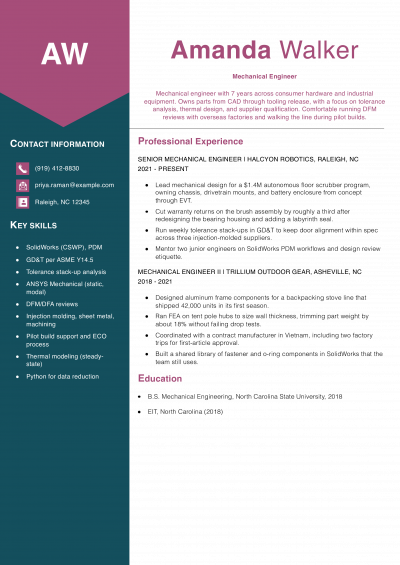
Process Engineer Resume Examples
Lead with the one signal an engineering manager cannot pull from a title search. Name the specific process you own: a continuous polymer line, a sterile fill-finish suite, a semiconductor etch bay, or a high-volume…
Every resume example is written and reviewed by our team of Certified Professional Resume Writers to ensure top-quality content and formatting.
Your resume has to prove you cut cycle time, scrap, and cost on real production lines. Engineering managers and plant managers want to see process wins tied to lean tools or fixture redesigns. In industrial engineering, the BLS group that includes this job, the top tenth earn above $159,000 a year.
Lead with the metric that moved most, such as first-pass yield or scrap reduction. A Certified Manufacturing Engineer (CMfgE) or Six Sigma Green Belt shows you have training in structured problem solving. To compare layouts before you start, browse our resume templates.
A specific Cpk shift or scrap-rate figure near the top of page one gives a plant manager something to remember. Metrics buried in paragraph form are easy to miss.
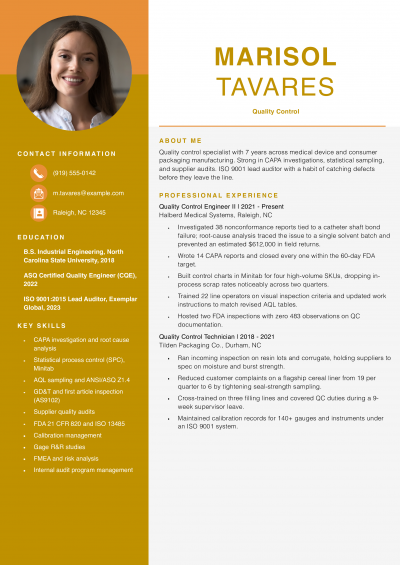
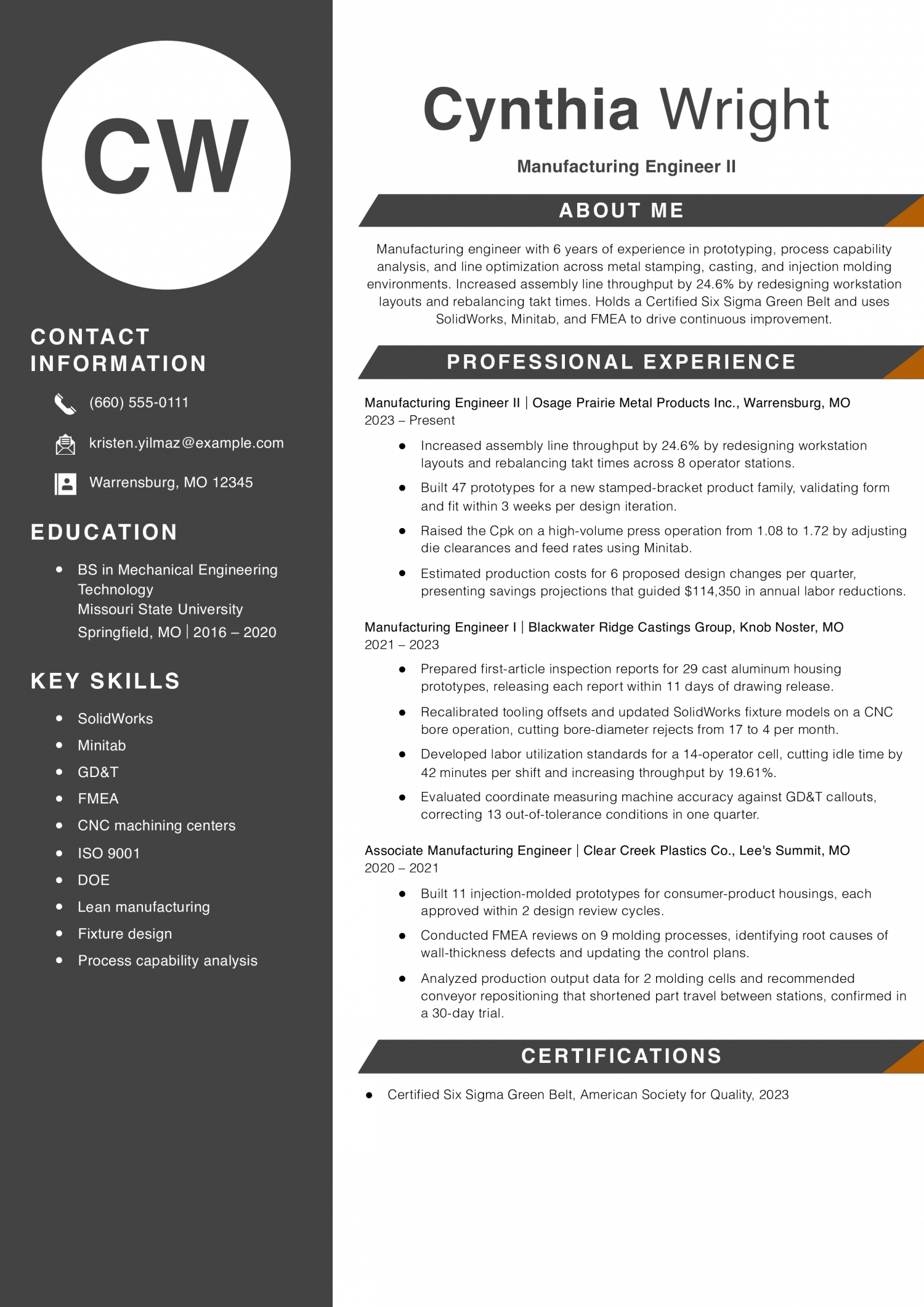
Consider this resume if you are a mid-level manufacturing engineer with cross-material experience looking to highlight process capability gains. Put the Cpk shift or throughput change your work produced at the front of each bullet.
Engineering managers want engineers whose analysis leads to measurable cost savings. The cost bullet links the estimates to a yearly labor savings figure the plant could count. When you describe cost estimates, give the dollar amount your projections supported and the period it covers.
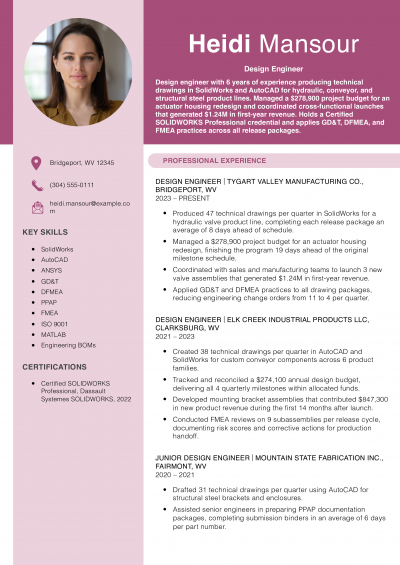
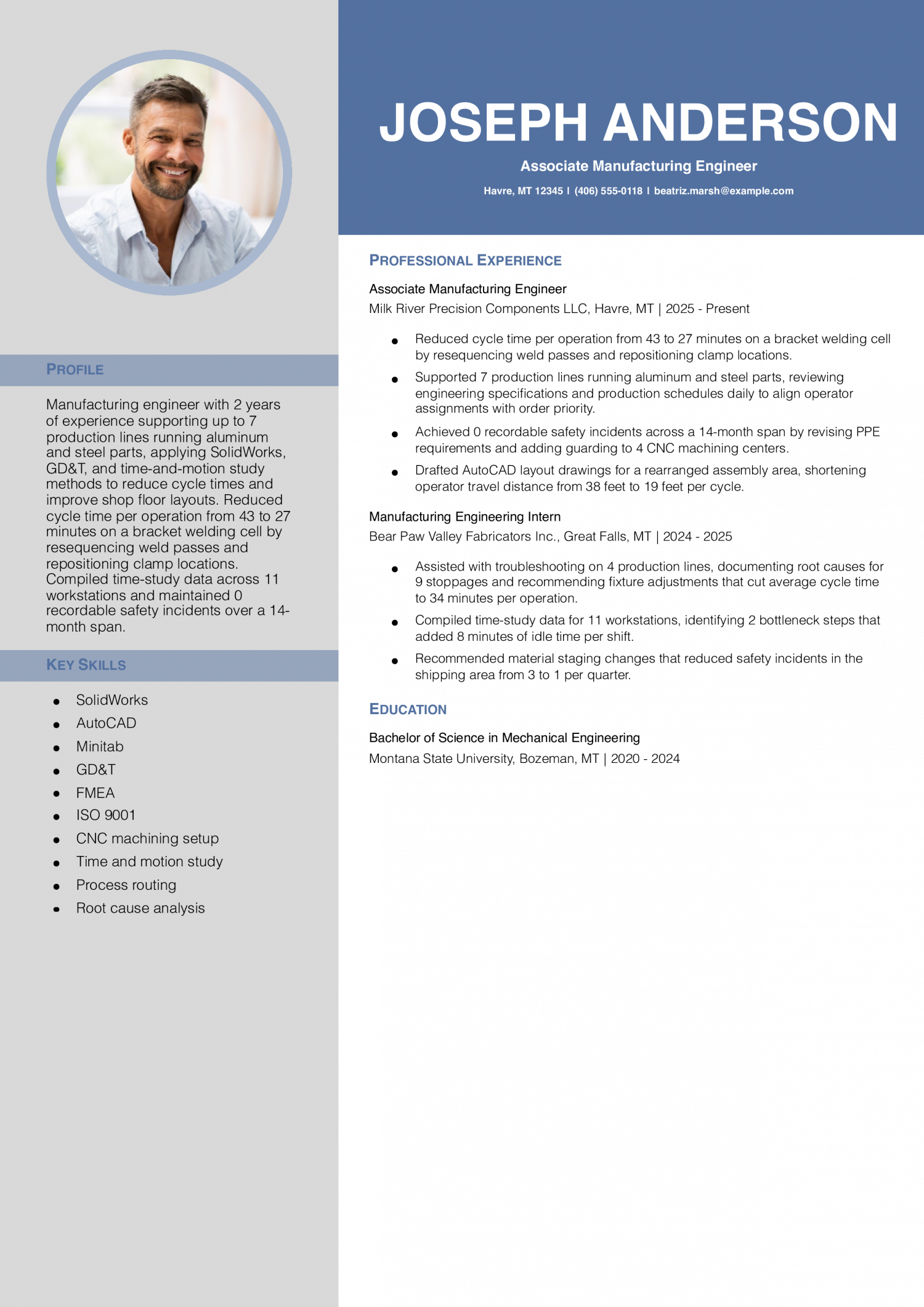
This resume helps an entry-level manufacturing engineer make the jump from internship to a full-time floor role. Show cycle time before and after, tied to the process change you made.
For an entry-level role, plant managers look for small, measurable floor changes. The layout bullet gives the walking distance before and after the rearrangement, which anyone can picture. When you describe a layout or cell change, measure the distance or motion saved and show the old and new figures together.
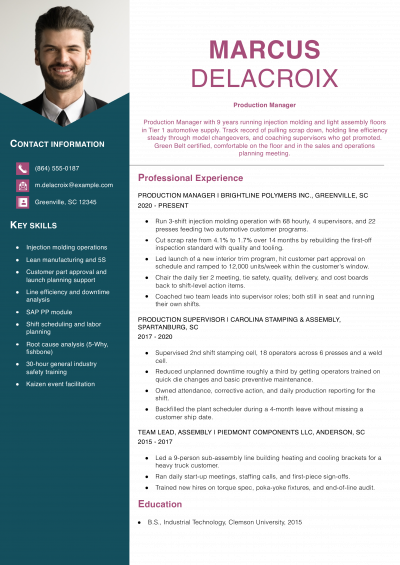
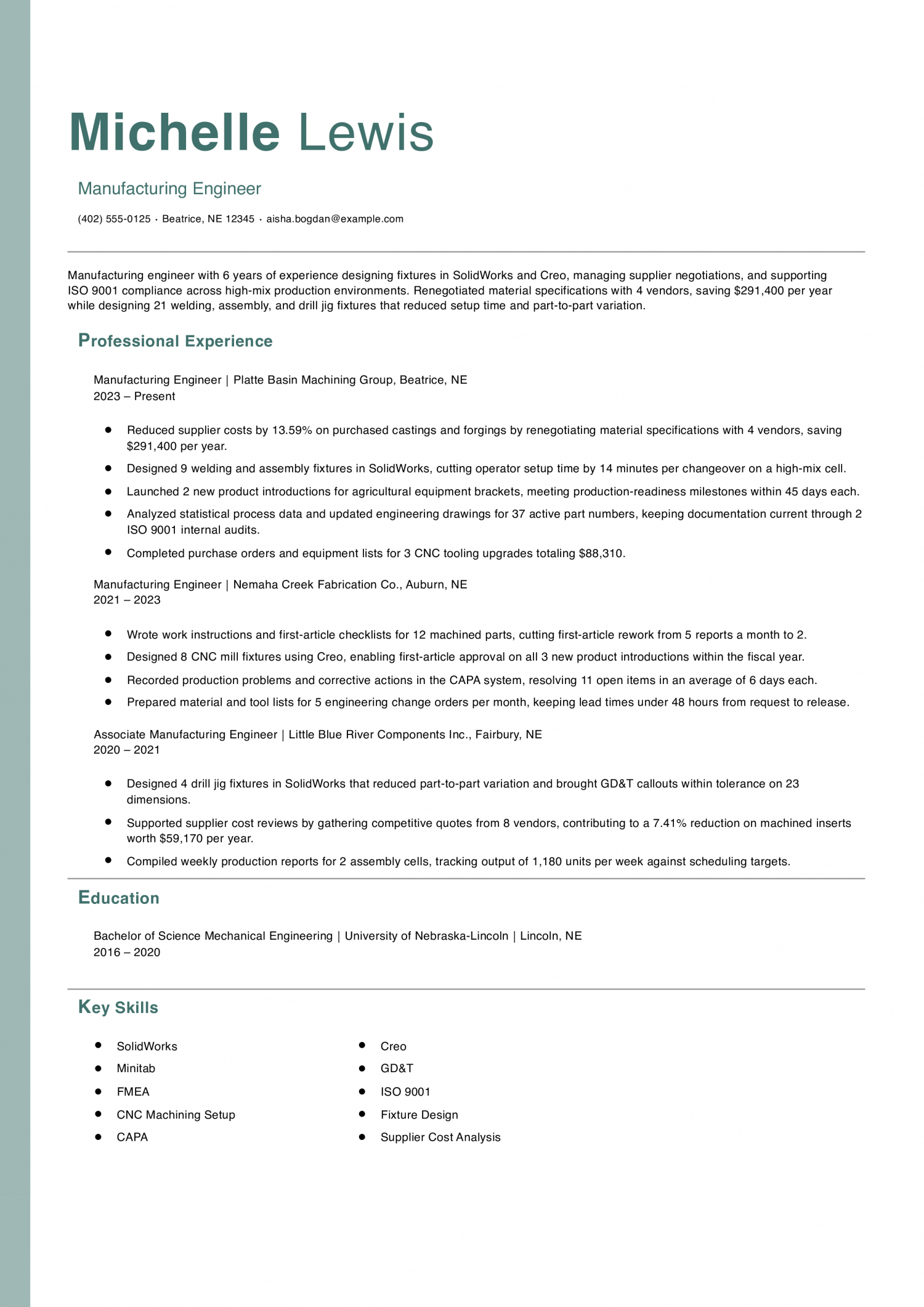
Try this resume if you are a mid-level manufacturing engineer with fixture design and supplier negotiation responsibilities across multiple facilities. Open each bullet with the vendor count or fixture count behind your cost and cycle-time results.
Plant managers hiring for fixtures look for time saved on the floor, not only designs completed. The fixture bullet names the type of cell and the minutes cut from each changeover. Do the same with your fixture projects by stating the minutes saved per changeover and the kind of cell.
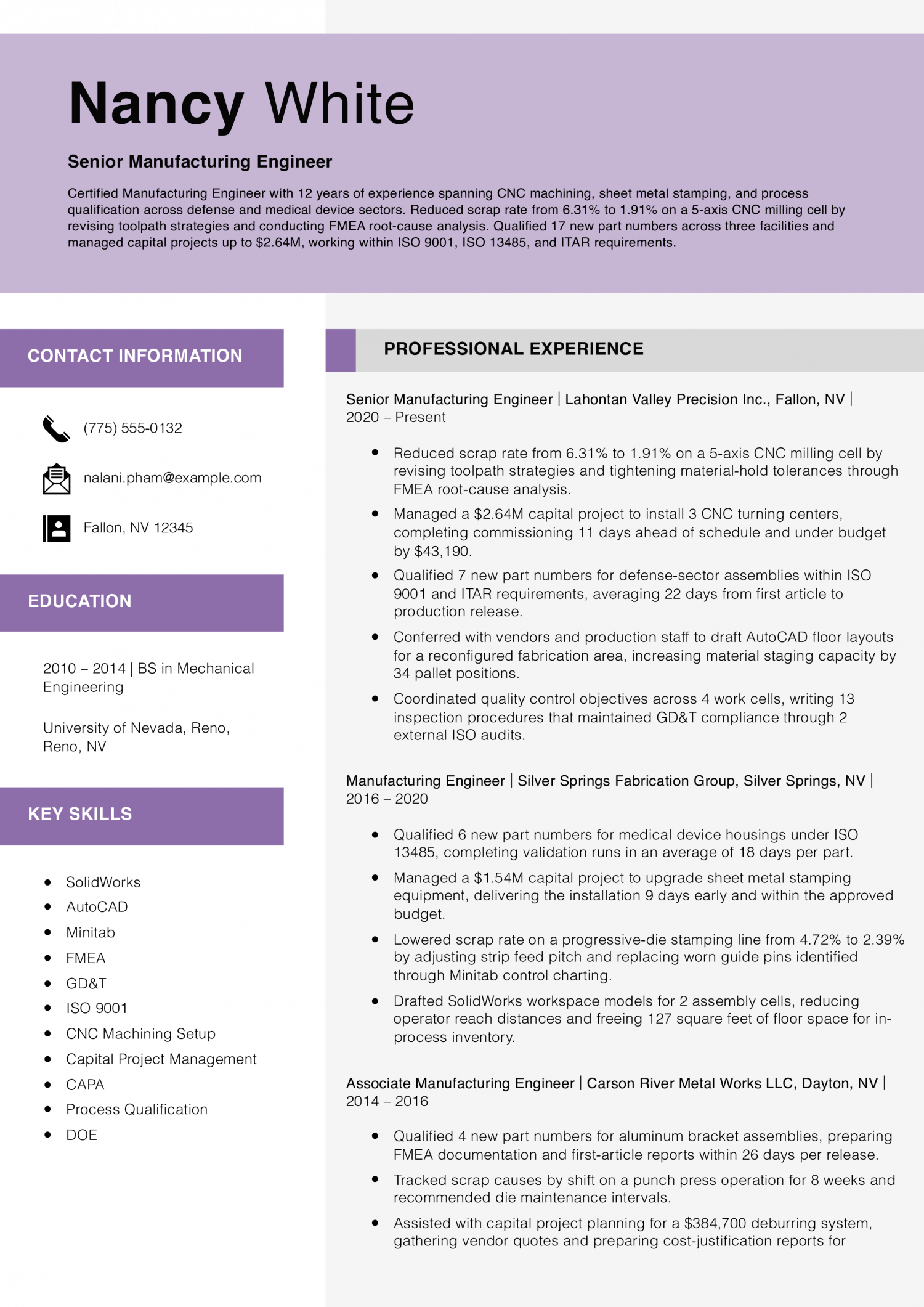
Lean on this resume if you are a senior manufacturing engineer with about a decade of capital project and process qualification work. Give a before-and-after scrap or schedule figure in place of a general process duty.
Senior hires are judged on whether big projects land on time and on budget. The capital project bullet gives days ahead of schedule and dollars under budget in one line. When you describe an installation, say how many days early or late you finished and whether you came in over or under budget.
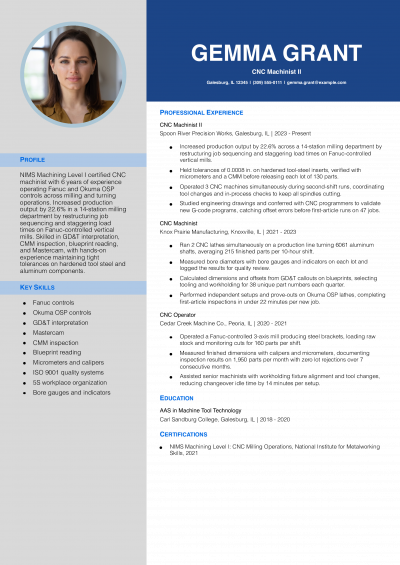
Manufacturing process engineer with 6 years of experience reducing downtime, streamlining changeovers, and resolving nonconformance issues across CNC machining and assembly environments. Reduced unplanned downtime by 17.41% on a CNC turning cell by programming Allen-Bradley PLC fault alerts and establishing a preventive maintenance calendar. Skilled in SolidWorks, FMEA, GD&T, SCADA monitoring, and ISO 9001 audit preparation.
Lead your profile with a detail that sets you apart from other applicants. That could be a niche process like laser welding or injection molding. Or it could be a second language your shop floor speaks.
A Certified Manufacturing Engineer credential from SME also works here. Pick the single trait that no other applicant on the short list is likely to share, and state it in one line at the top of your summary. The line that names a rare skill is the one that slows them down, so make sure it matches a need mentioned in the posting.
If it does not appear in the job ad, swap it for one that does.
Manufacturing is built on measurable output. Name the metric in each bullet, then state the result. Strong picks include scrap rate reduction, cycle time savings, and OEE gains.
A bullet like “Cut scrap rate from 4.2% to 1.8% across three press lines” tells a plant manager exactly what you delivered. Percentage improvements, dollar savings, and unit counts all communicate scope fast. Pair each action verb with a figure so the scope is clear.
If you redesigned a fixture, note how many parts per hour it added. If you led a kaizen event, state the labor hours saved per week. Bullets that carry no quantifiable figure tend to blur together in a stack of comparable resumes.
Sort your bullets under the types of work you own. Process design covers new line layouts, tooling selection, and time studies. Quality and continuous improvement covers root cause analysis and CAPA closures.
Automation and controls covers PLC programming and robotic cell integration. Capital projects covers equipment selection and vendor qualification.
This organizational structure helps engineering managers see your range at a glance and prevents a wall of ten or twelve bullets with no discernible logic. If a particular category has only one bullet, consolidate it into the closest group. Keep the labels short and consistent across every role on the page.
List your Certified Manufacturing Engineer credential from SME on its own line. A Certified Six Sigma Green Belt from ASQ belongs on its own line too.
If you hold a Professional Engineer license, note your state and that it is in good standing. Below that block, add a tools line for the software you use daily.
Name your CAD platform, such as SolidWorks or AutoCAD. Name your ERP system, such as SAP or Oracle. Engineering managers and plant managers look for these entries in the top third of the page, and burying them on page two means they may never be seen.
At the senior level, page space is tight. Remove full descriptions for roles older than fifteen years. A single line with the title, company, and dates is enough.
Drop skills that the target posting does not mention. Delete an objective statement if you still carry one. Strip out references or a “References available” line.
Shrink your education entry to one line: degree, school, and year. If you hold a PE license and a CMfgE, those credentials carry more weight than coursework details. A two-page resume is fine when every line adds new proof, but if your second page holds fewer than eight substantive lines, consolidate the content back to one page.
Every sentence on the page should answer one question: what did you improve?
Use the job posting’s wording for skills you actually have.
Check the tools and methods below against the posting you want. Engineering managers and plant managers weigh hard skills first. They want proof you can cut waste and hold tolerances.
Soft skills such as problem solving count as well. Pull each term from the tables that matches your target posting.
Frame soft skills as short, measurable wins in your work history. A line about cross-functional teamwork works best when it cites a real outcome.
| Soft Skills | AI-estimated % |
|---|---|
| Cross-functional collaboration | 66% |
| Technical communication | 50% |
| Problem-solving under constraints | 41% |
| Attention to detail | 35% |
| Stakeholder management | 27% |
And here are the top hard skills showing up most often.
| Hard Skills | AI-estimated % |
|---|---|
| Production cost estimation | 69% |
| Manufacturing process sequencing | 68% |
| Quality standards analysis | 46% |
| Engineering drawing review | 37% |
| Lean process improvement | 27% |
Skill names and rankings come from an AI model grounded in U.S. Department of Labor occupation data for manufacturing engineers, not from a count of manufacturing engineers’ resumes built on ResumeTemplates.com.
Engineering managers and plant managers sort manufacturing engineer resumes by production cost estimation and manufacturing process sequencing, which is why the items below put them where a reader finds them.
Engineering managers and plant managers scan for process-specific terms. Generic skills like “problem solving” rarely set you apart. Process improvement terms show you can cut waste. They also show you can reduce cycle time. Tooling and fixtures terms cover hands-on design work. Quality keywords prove you can hold tolerances well. They also show you can reduce scrap rates. Automation terms signal you can integrate production cells. Credentials tell reviewers you hold verified expertise. Pick terms that match your own project history. Then weave them into bullets with measurable results.
| Niche | Keywords ATS scans for |
|---|---|
| Process Improvement | Lean Manufacturing, Kaizen Events, Value Stream Mapping |
| Tooling Design | Fixture Design, GD&T, SolidWorks |
| Quality Systems | FMEA, PPAP, ISO 9001 |
| Automation Integration | PLC Programming, Robotic Welding, SCADA |
| Credentials | CMfgE, CSSGB, Professional Engineer License |
Plant floors now generate data that AI tools sort fast. That puts manufacturing engineers in a tight spot on resumes. You can overstate AI fluency with buzzwords. Engineering managers will question those claims in a technical interview. You can leave AI off and address it only if asked. Or you can name each tool you used with a result. Describe the human judgment you applied to its output. That third option is what engineering managers and plant managers validate. List the tool and the task it handled. Then state the decision you made with the result. Pair each tool with a clear metric.
Machine learning models flag cycle time bottlenecks so you can test fixes before changing a live line.
Computer vision systems detect surface defects at speeds that exceed manual inspection on high volume runs.
AI sensors forecast bearing and motor failures, letting you schedule downtime instead of reacting to breakdowns.
Demand forecasting models adjust production schedules weekly, reducing overstock and raw material waste.
Minitab Predictive Analytics Module: Runs predictive models on process control data to isolate root causes of defects.
Siemens Insights Hub (formerly MindSphere): Connects shop floor sensors and applies AI analytics to equipment performance data.
Beyond your PE license or degree, the credentials below tell engineering managers and plant managers how deep your process skills run. They signal whether you can lead lean projects or own a full production line. A PE shows legal authority to stamp drawings.
These credentials show you chose to go further. They set you apart from peers who stopped at the degree. Add each one on its own line near the top of page one.
Note the renewal date if the credential expires. This helps a plant manager verify your status at a glance.
BLS tracks manufacturing engineers inside the broader Industrial Engineers group. That group is a large occupation, so the median reflects a wide mix of experience levels and industry settings. A 90th percentile salary is about 56 percent larger than the median.
The low end, at the 10th percentile, runs roughly 27 percent under it. Employers in this group range from small job shops to global OEMs, and your resume needs to signal which tier you belong in.
Lead with the production volume you own, the process gains you drove, and the systems you run daily.
| # | State | Median Annual |
|---|---|---|
| 1 | Alaska | $156,510 |
| 2 | Washington | $129,050 |
| 3 | Oregon | $128,290 |
| 4 | New Mexico | $128,090 |
| 5 | California | $124,600 |
| 6 | Hawaii | $123,800 |
| 7 | Louisiana | $122,920 |
| 8 | Wyoming | $122,070 |
| 9 | Delaware | $120,190 |
| 10 | Maryland | $119,930 |
| # | State | Workers | Median |
|---|---|---|---|
| 1 | California | 32,680 | $124,600 |
| 2 | Michigan | 30,990 | $101,680 |
| 3 | Texas | 30,980 | $104,560 |
| 4 | Ohio | 23,480 | $100,060 |
| 5 | Illinois | 18,640 | $100,540 |
Resume Templates offers HR approved resume templates to help you create a professional resume in minutes. Choose from several template options and even pre-populate a resume from your profile.
One page covers most manufacturing engineers who have under ten years of experience. If you have more than ten years of process work and leadership roles, a second page is fine. Keep every line tied to a result that matters to the role.
Yes, a short summary helps engineering managers see your fit right away. State your years of experience and the production settings you know best. Add one standout metric, such as a scrap reduction or cycle time gain.
Lead each bullet with the lean tool you applied and follow it with the measured result. Write something like "Led 5S rollout across three assembly cells, cutting changeover time by 22%." That format gives plant managers both the method and the proof in one line.
Focus on transferable skills like root cause analysis, fixture design, and statistical process control. Use the language in the target job posting rather than your old industry's jargon. Engineering managers care about methods and results, not the product itself.
Name the company where you did the work first, then note the staffing agency in parentheses. Write quantified bullets the same way you would for a full-time role. Short contracts at the same site can be grouped under a single heading.
No, most manufacturing engineer postings do not require a PE license. Some senior or public-sector roles do ask for it, and requirements vary by state. If you hold one, list the issuing state and note that the license is in good standing.
List the gap period honestly and add a short note if you did anything relevant during it. Completing a certification or doing freelance process consulting both count. Engineering managers notice gaps but care more about whether your skills stayed current.
For your manufacturing engineer resume, a basic template or an ATS-friendly template will do the job. Whichever you pick, clear headings, an ordinary font and a layout without graphics make it easier for software to read.
Manufacturing Engineer Resume
4.8/5 stars with 188 reviews

Executive Resume Writer and Career Coach
Andrew Stoner is an executive career coach and resume writer with 17 years of experience as a hiring manager and operations leader at two Fortune 500 Financial Services companies, and as the career services director at two major university business schools.
© 2026 Resumetemplates.com All rights reserved.