Auditor Resume Examples and Templates



A named standard and a defect PPM number are what get quality control resumes past the ATS screen at most manufacturers; specific gauges, sampling plans, and audit roles are what make them readable enough for the quality manager to advance.
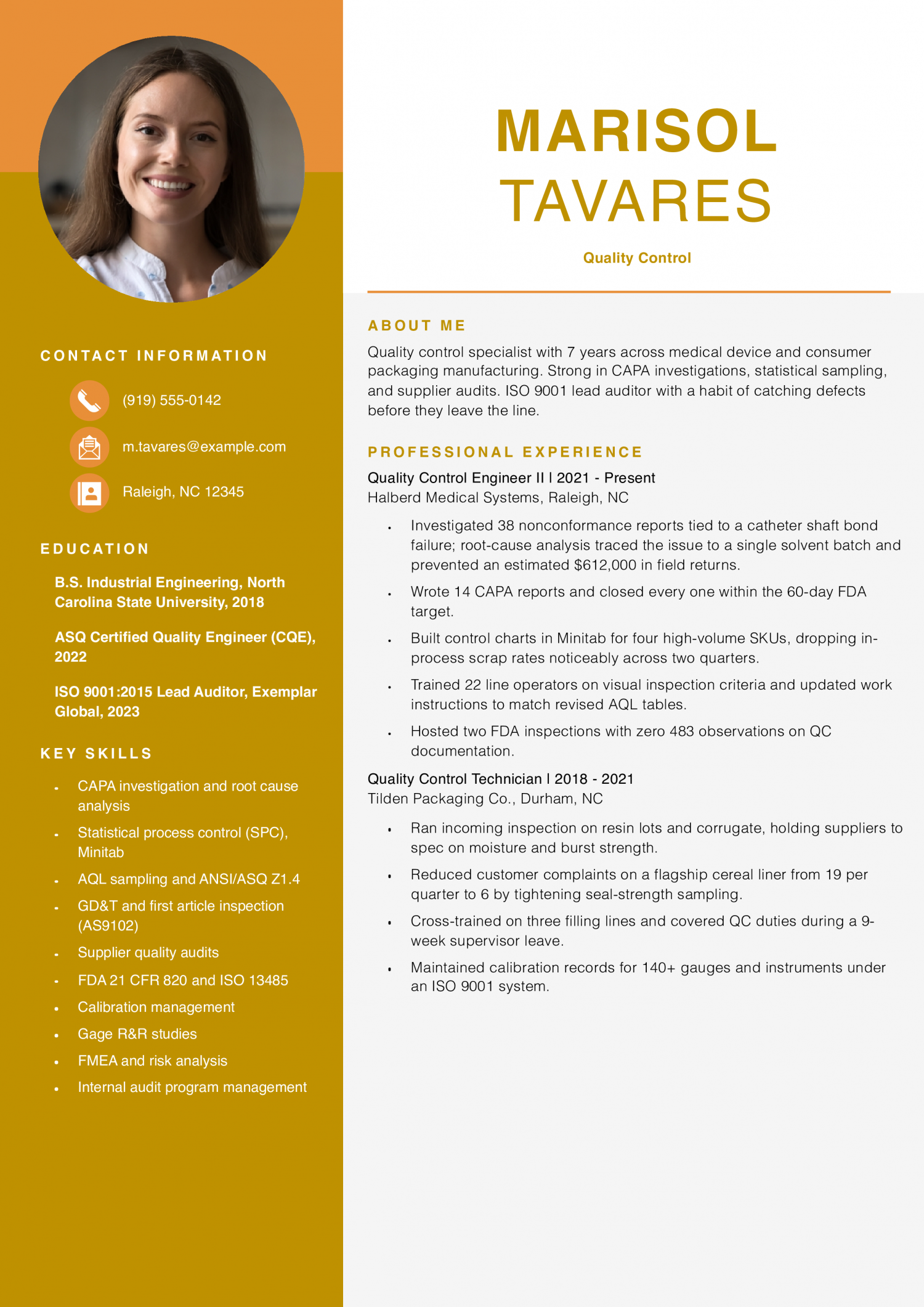
This profile fits inspectors and technicians with one to three years on the floor or a recent technical certificate. The entry-level resume needs to prove gauge fluency, sampling literacy, and clean documentation habits under a named standard.
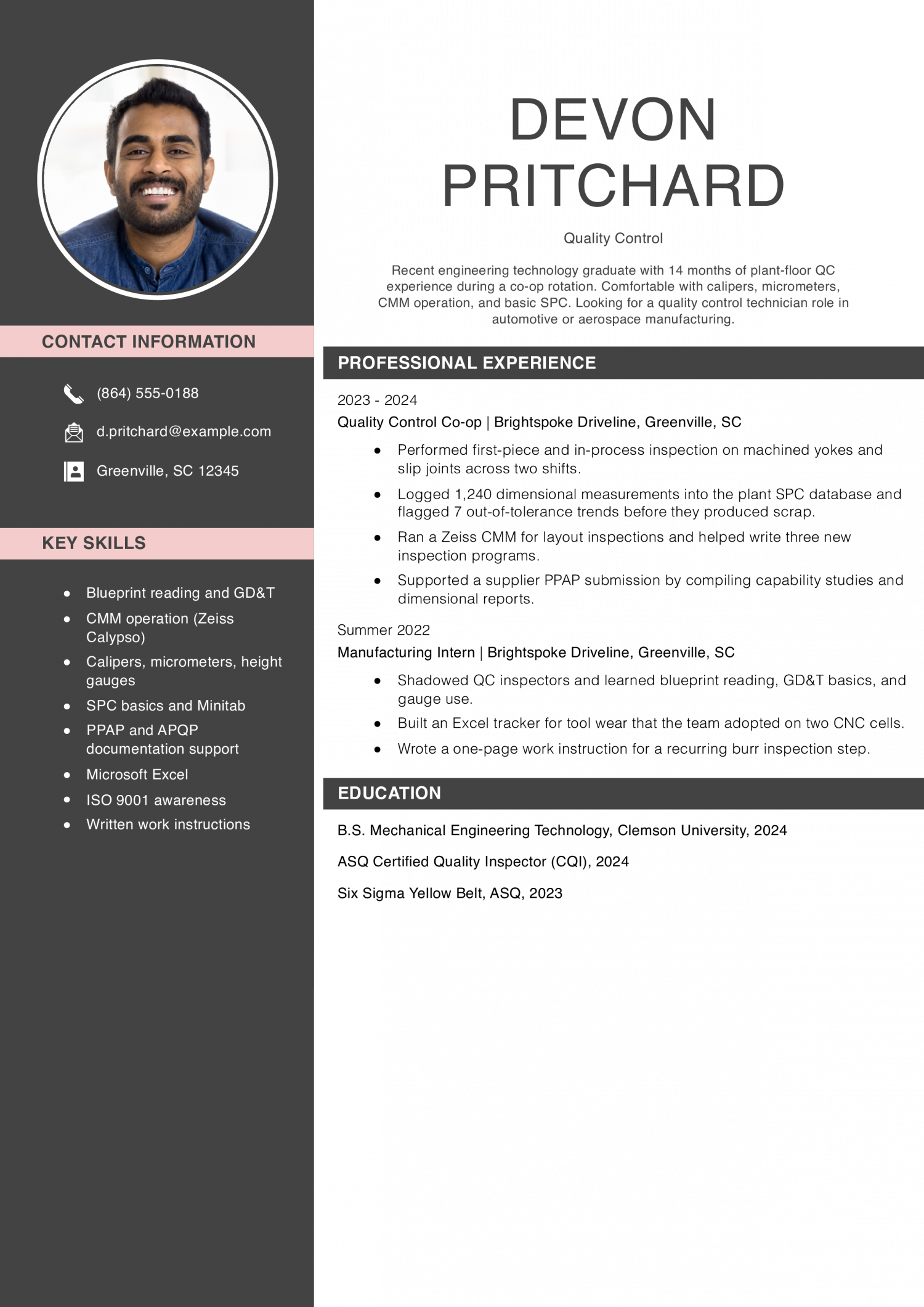
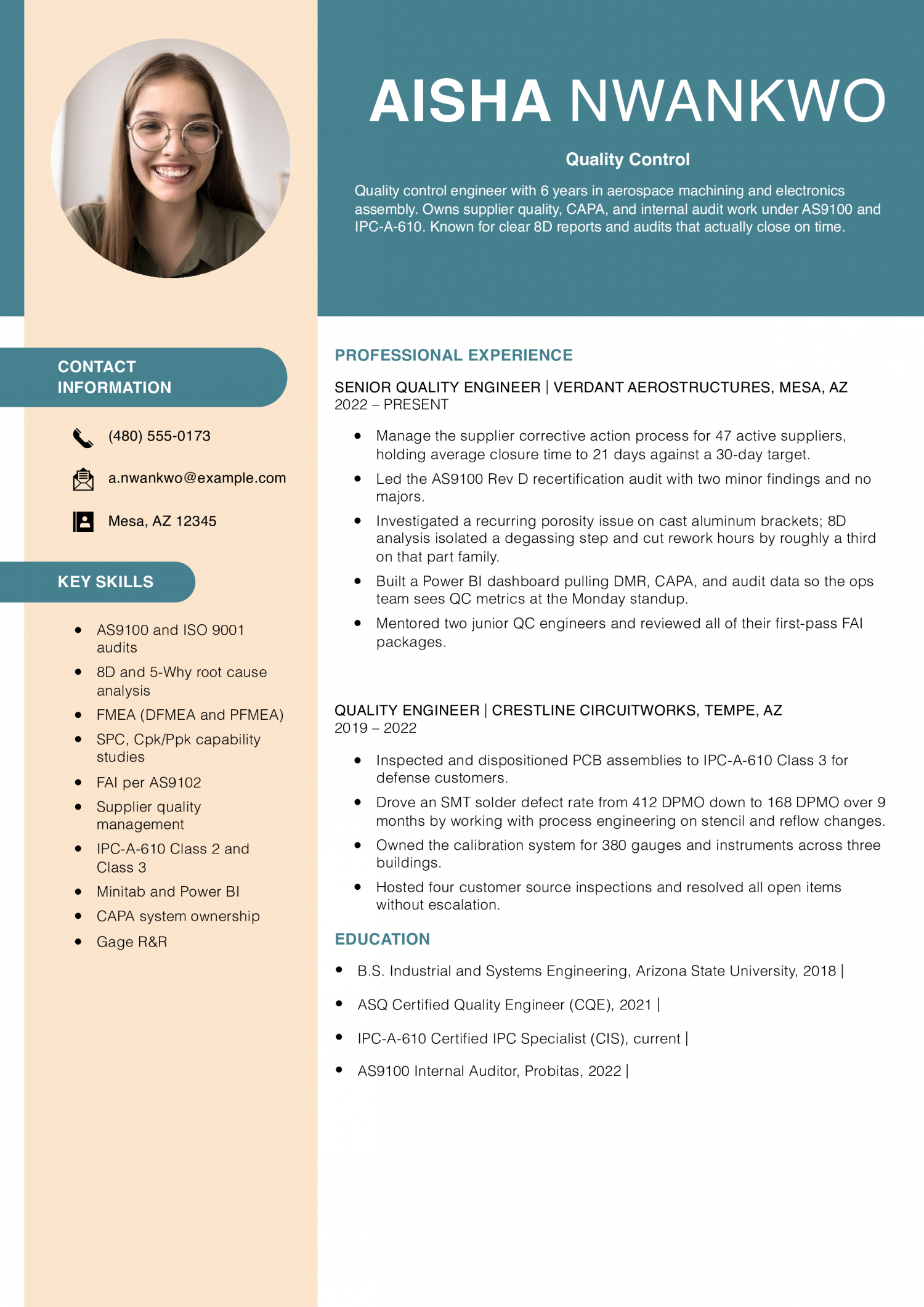
This profile fits QC specialists and senior inspectors running SPC charts, CAPAs, and supplier audits across multiple lines. The experienced resume needs to prove measurable scrap or PPM reduction, audit ownership, and cross-functional work with engineering and production.
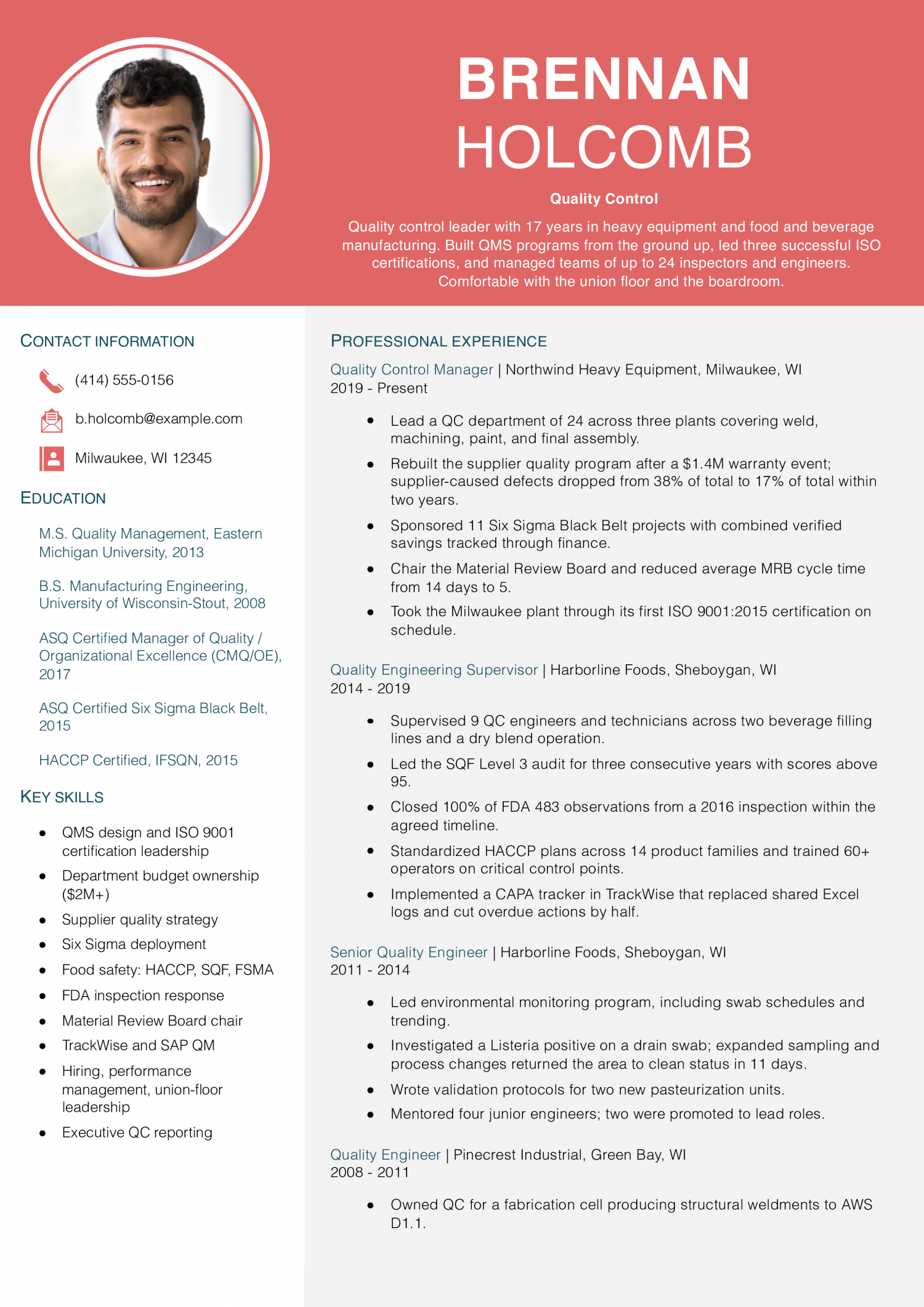
This profile fits QC leads and quality supervisors managing inspectors, audit calendars, and customer complaints. The lead resume needs to prove team scope, ISO or IATF certification maintenance, and dollar-weighted impact on rework, returns, or warranty cost.
Priya Ramaswamy
Columbus, OH | (614) 555-0119 | [email protected] | linkedin.com/in/priyaramaswamy
Quality control engineer with 9 years across automotive Tier 1 supply, plastics injection molding, and pharmaceutical packaging. Lead auditor for ISO 9001 and IATF 16949, with hands-on CAPA, PPAP, and SPC ownership. Strong record of closing audit findings and standing up QMS documentation from scratch.
Quality Engineering Lead
Auburn Polymer Solutions | Columbus, OH | 2022-Present
Quality Engineer
Harlow Pharma Packaging | Cincinnati, OH | 2019-2022
Quality Engineer
Keystone Drivetrain | Dayton, OH | 2017-2019
Quality Control Inspector
Keystone Drivetrain | Dayton, OH | 2015-2017
The first line of your summary should name the defect PPM, scrap percentage, or audit pass rate you own.
Quality managers and production supervisors read those numbers as your readiness to hold their line accountable. A generic ‘detail-oriented inspector’ line gets skimmed past in seconds.
Pair the headline metric with the governing standard you’ve worked under: ISO 9001, IATF 16949, AS9100, or 21 CFR 820. That tells them which floor you can step onto without retraining.
Quality work is one of the most measurable jobs on a resume, so most strong bullets carry a number.
Name two or three of these per role: defect PPM reduction, first-pass yield, scrap as a percent of output, CAPA closure rate, or audit findings closed.
Bullets without a number tend to read as duties. ‘Performed final inspection per AQL 1.0’ is weaker than ‘Ran AQL 1.0 final inspection on 8,000 units monthly, holding defect PPM under 350.’
Cluster your bullets into the categories quality managers actually staff for: incoming inspection, in-process SPC, final release, and supplier or audit work.
Under incoming, name the gauges and CMM work. Under in-process, name the control charts and Cpk studies you ran.
Under final release, name the sampling plan (ANSI Z1.4, AQL level) and the documentation system. Under supplier and audit, name the standard, the audit type (layered process, internal, customer), and findings you closed.
Quality managers want to confirm standard fluency in the top third of page one, before they scroll.
Build a short credentials line under your summary listing ASQ certifications (CQI, CQT, CQA), Six Sigma belts, and standard exposure (ISO 9001, IATF 16949, GMP, AS9100). Add a tools line for SPC software (Minitab, InfinityQS), ERP (SAP QM, Oracle), and measurement equipment (CMM, optical comparators, calipers).
This placement matters because keyword parsers weight the top of the resume heavier. It also saves the quality manager a scroll.
Quality control hires often come up through technical certificates and on-the-job training rather than four-year degrees, and that path is fully credible.
List your highest credential first: associate degree, technical diploma, or relevant coursework in metrology, statistics, or manufacturing technology.
Add a short continuing-training block for GD&T courses, blueprint reading, internal auditor training, and any OSHA or GMP refreshers. This signals to quality managers that you keep current as standards revise.
ATS filters catch more quality control resumes than ever in 2026. The skills below come from our user-built QC resumes. Standard names and gauge terms clear the first cut, and audit-floor language decides whether the resume advances.
QC managers weight hard skills first because they map to the floor and the standard. Soft skills like cross-functional communication carry weight only when a bullet shows them in action. Match this list against the posting, then back each soft skill with a bullet that names a specific CAPA, supplier issue, or line stoppage you handled.
| Soft Skills | % of resumes with this skill |
|---|---|
| Attention to detail | 73% |
| Problem solving | 69% |
| Communication | 41% |
| Time management | 40% |
| Teamwork | 30% |
And here are the top hard skills showing up most often.
| Hard Skills | % of resumes with this skill |
|---|---|
| Quality inspection and testing | 67% |
| Statistical process control | 55% |
| Root cause analysis | 41% |
| ISO 9001 standards | 36% |
| Six Sigma methods | 33% |
Based on data from thousands of quality control inspectors’ resumes built on ResumeTemplates.com, May 2026.
The items below are what separate a quality control resume from one that gets put back in the pile.
Group your keywords by the QC niche you actually work in, not in one long block. Quality managers expect to see the standard, the method, and the tool grouped together.
| Niche | Keywords ATS scans for |
|---|---|
| Incoming and final inspection | incoming inspection, final inspection, AQL sampling, ANSI Z1.4 |
| In-process SPC and metrology | SPC, control charts, Cpk, GD&T, CMM operation |
| Standards and compliance | ISO 9001, IATF 16949, AS9100, 21 CFR 820, GMP |
| CAPA and supplier quality | CAPA, root cause analysis, supplier audits, 8D, nonconformance reports |
| Tools and software | Minitab, InfinityQS, SAP QM, calipers, optical comparator |
What QC managers expect on a quality control resume has shifted. A pure manual-inspection bullet list now reads as dated on automated lines; naming the vision systems, SPC dashboards, and defect-classification tools you’ve worked alongside reads as current. The list below names what to add.
Cognex and Keyence systems now flag surface defects on the line, so QC roles shift toward tuning thresholds and reviewing false positives.
Modern SPC platforms predict drift before parts fall out of spec, and resumes that name this work signal data fluency.
CAPA tools suggest probable root causes from defect history, but the inspector still owns verification and corrective action sign-off.
First-article reports and PPAP packages now auto-populate from measurement data, freeing inspectors to focus on judgment calls.
Quality managers want to see the measurement equipment, the SPC software, and the ERP module you’ve used. List them in a short tools block under your summary, not buried in bullets.
Quality managers read this list as a map of where your work is heading. The certifications below tell them which track you’ve invested in: inspection depth, statistical analysis, auditing, or process improvement. List the issuing body and the year earned next to each credential.
The 90th-percentile quality control inspector out-earns the median by a wide margin, which tells you the market rewards standard specialization and audit scope more than years on the floor. A CQI with five years in general manufacturing earns less than a CQA running IATF 16949 audits at a tier-one automotive supplier.
Lead your resume with the standards you’ve worked under, the audits you’ve owned, and the defect PPM you’ve moved, not with a chronological work history.
| # | State | Avg. Annual |
|---|---|---|
| 1 | Alaska | $98,800 |
| 2 | District of Columbia | $70,030 |
| 3 | Wyoming | $59,930 |
| 4 | Maryland | $58,710 |
| 5 | Washington | $58,450 |
| 6 | Montana | $57,520 |
| 7 | Colorado | $56,370 |
| 8 | Kansas | $55,930 |
| 9 | Hawaii | $54,800 |
| 10 | Connecticut | $54,230 |
| # | State | Workers | Median |
|---|---|---|---|
| 1 | California | 60,280 | $50,430 |
| 2 | Texas | 55,320 | $43,790 |
| 3 | Ohio | 31,010 | $46,220 |
| 4 | Illinois | 30,740 | $47,040 |
| 5 | Michigan | 29,370 | $42,440 |
Resume Templates offers HR approved resume templates to help you create a professional resume in minutes. Choose from several template options and even pre-populate a resume from your profile.
Quality control on its own is too broad for a skills section and reads as filler to a QC manager. Break it into the specific work you actually did.
List the standard (ISO 9001, IATF 16949), the methods (SPC, AQL sampling, CAPA), and the tools (Minitab, CMM, calipers). Those are the terms ATS parsers and quality managers both search for.
Reverse-chronological works for most QC resumes because quality managers want to see standard exposure and tenure at each plant.
Use a short summary, a credentials line, a tools line, then work history grouped under each employer by inspection category.
Save functional formats for career changers crossing into QC from production or engineering, and even then add dates to each role.
Pull the quality-adjacent work out of your production bullets and give it its own block.
Name the times you ran first-piece inspection, filled out SPC charts, escalated a nonconformance, or sat on a layered process audit.
Add any internal auditor training or GD&T courses your employer paid for. That reframes production tenure as quality readiness.
Use ranges or scope language instead of inventing precise numbers.
Write 'inspected roughly 6,000 units per week across three lines' or 'reduced rework on the assembly cell by a noticeable margin after CAPA closure.'
Quality managers respect honest scope more than suspiciously precise PPM numbers you can't defend in an interview.
For a quality control inspector, a professional template is the safest pick, because it signals the polish hiring managers in this field expect. An ATS-friendly template is a solid alternative. Whichever you choose, keep the formatting clean and easy to parse: clear section headings, a standard font, and no graphics a parser can choke on.
Executive Resume Writer and Career Coach
Andrew Stoner is an executive career coach and resume writer with 17 years of experience as a hiring manager and operations leader at two Fortune 500 Financial Services companies, and as the career services director at two major university business schools.
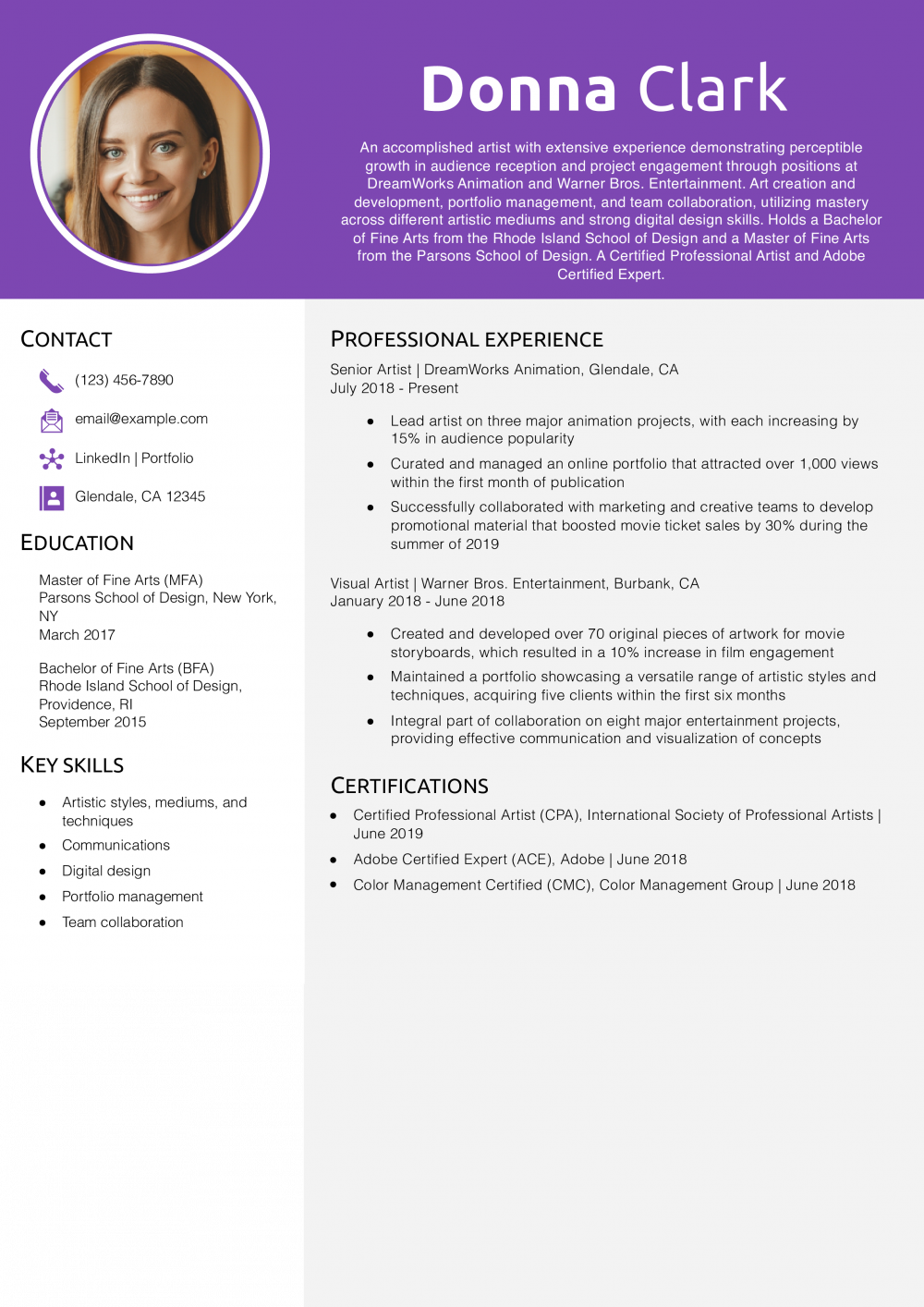
Customize this template in our builder in under 10 minutes.