Process Engineer Resume Examples

Featured Example

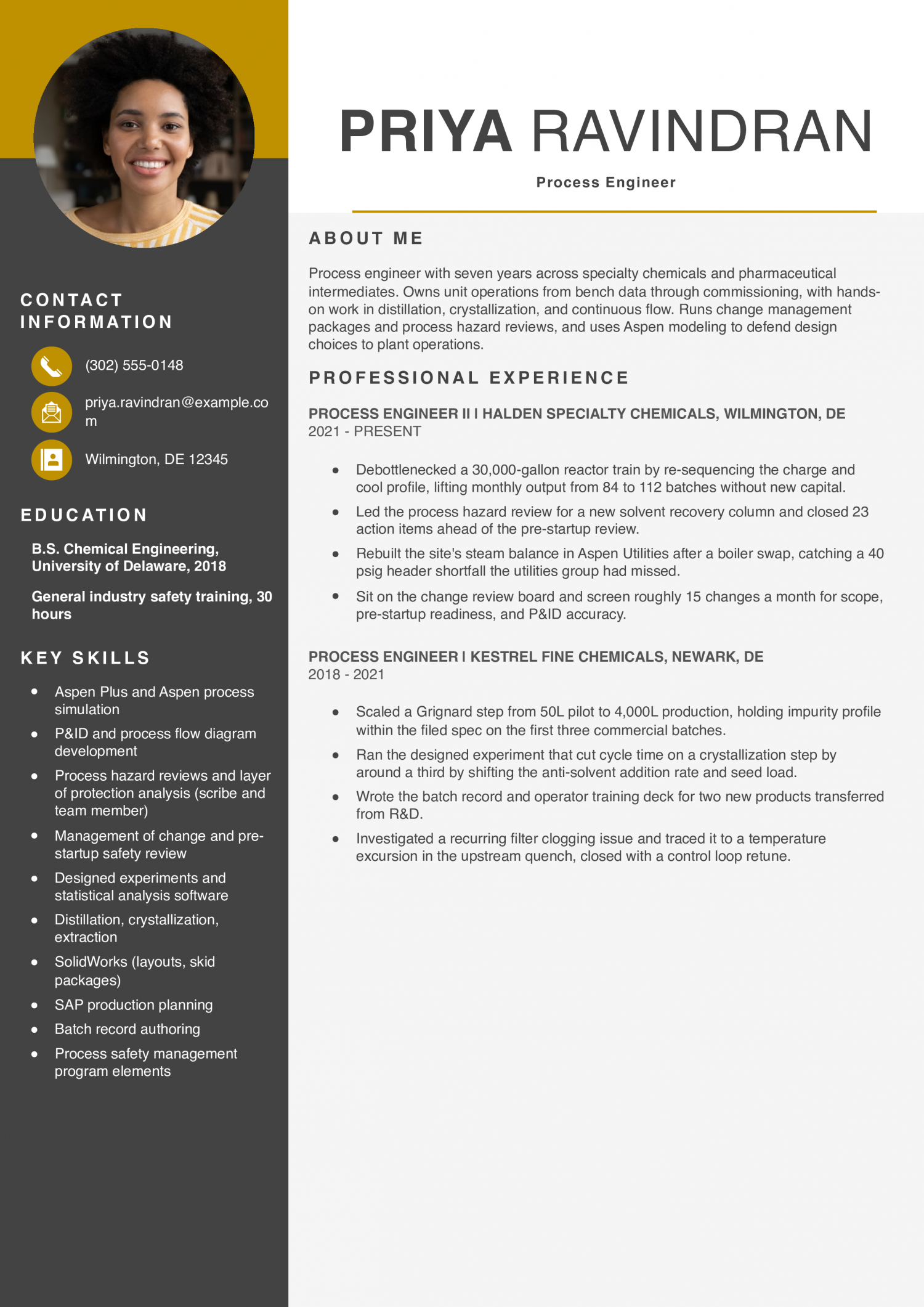
Why this resume works
  • Real capacity gain without new capital: The reactor debottleneck bullet leads with a specific throughput jump tied to a design change, which is what plant managers actually care about.
  • Process safety experience is concrete and credible: Hazard reviews, layer of protection analysis, change management, and pre-startup safety reviews are described as they actually function on site, not as buzzwords, which signals real process safety experience.
  • Bench-to-plant story is clear: The scale-up from 50L pilot to 4,000L with impurity profile held on first batches shows the candidate can carry a process across the fence, not just model it.

Process Engineer Example

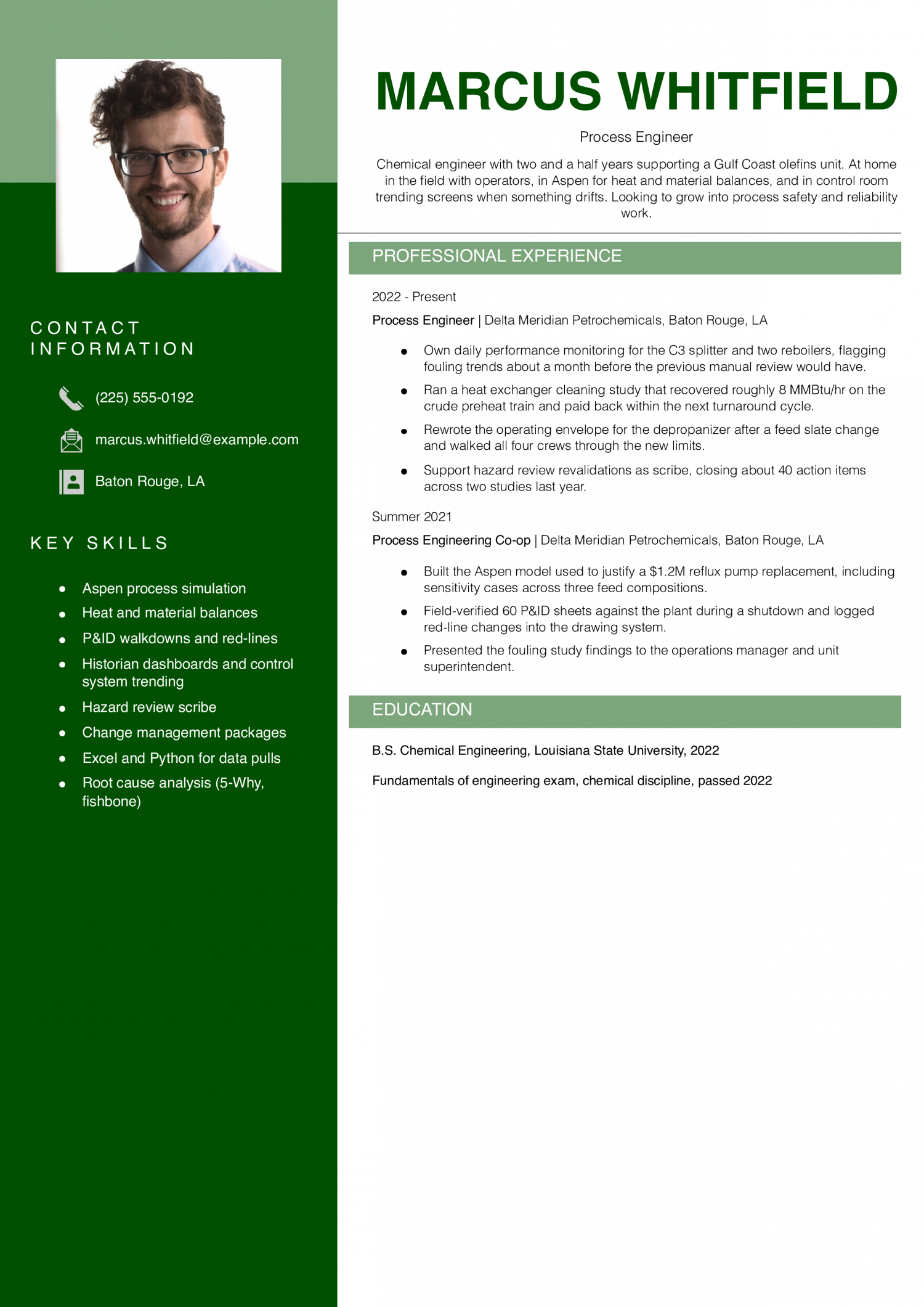
This resume fits an early-career Process Engineer who runs unit operations and daily output. Show yield gains, downtime cuts, and root cause work you led on the floor with operators and quality staff.

Why this resume works
  • Field time shows up in the bullets: P&ID walkdowns, control system trending, and talking to all four crews are concrete tasks a real early-career process engineer does, not generic filler.
  • One number carries the resume: The 8 MMBtu/hr heat recovery is a specific, defensible metric anchored to a real project, and the rest of the bullets stay honestly qualitative.
  • Co-op is used the right way: Keeping the co-op as a separate short entry lets the candidate show the Aspen justification work without inflating it into a full role.

Senior Process Engineer Example

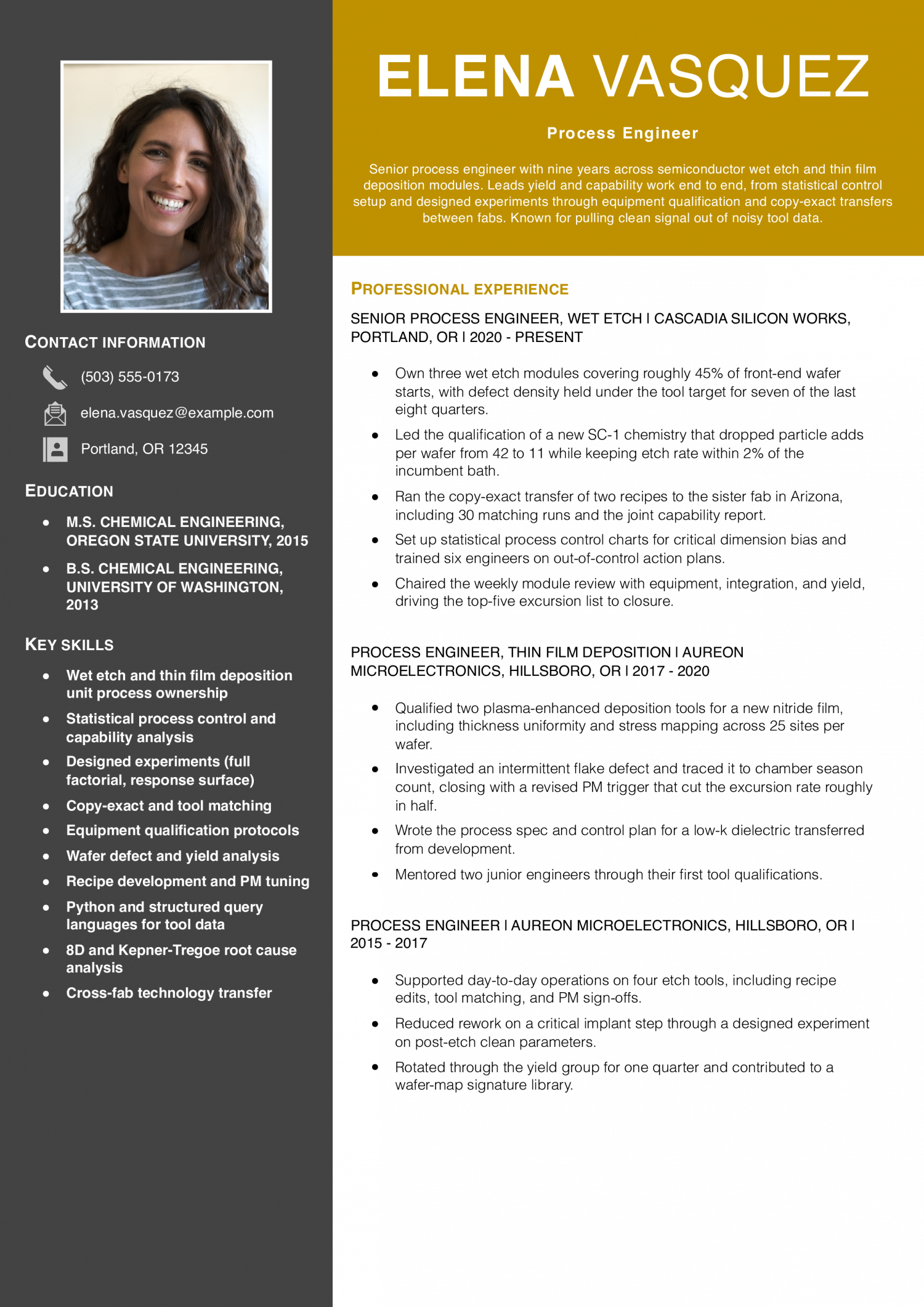
A Senior Process Engineer resume should prove you run capital projects and coach junior engineers across shifts. Show scale-up work, control strategy changes, and cost or throughput results tied to plant books.

Why this resume works
  • Owns a real slice of the fab: Naming the exact modules and the roughly 45% of wafer starts they cover gives the reader a concrete sense of scope instead of vague ownership language.
  • Defect numbers are specific and honest: The particle drop from 42 to 11 per wafer with etch rate held within 2% is the kind of paired metric that survives a technical interview.
  • Career arc reads like a real fab engineer: Moving from day-to-day tool support to qualifications to a senior module role with cross-site transfers matches how process engineers actually grow.

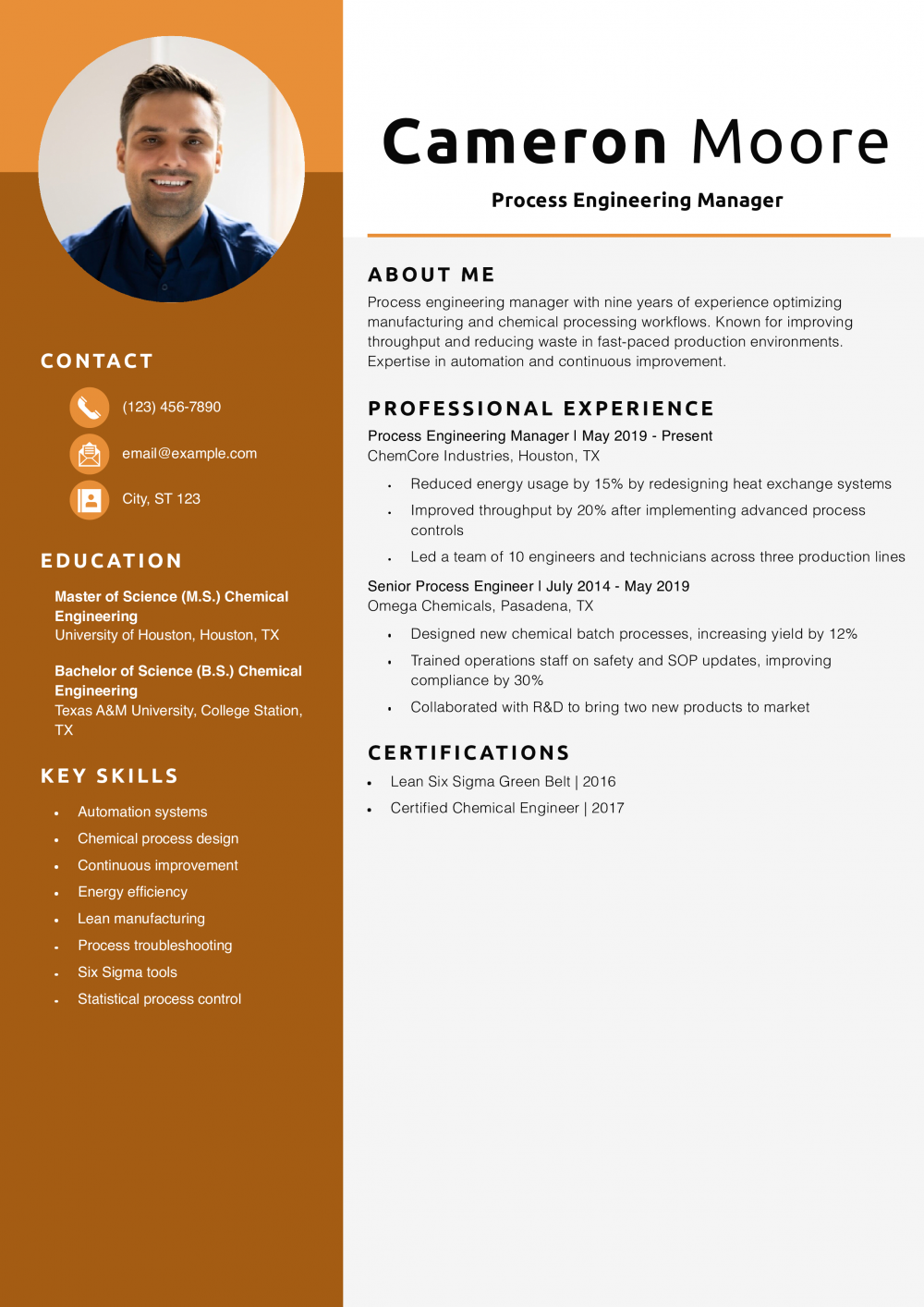
Principal Process Engineer / Process Engineering Manager Example

This resume fits a Principal Process Engineer or Process Engineering Manager who sets tech direction across sites. Show budget ownership, hiring calls, and roadmaps that moved safety, yield, or capacity at the plant level.

Why this resume works
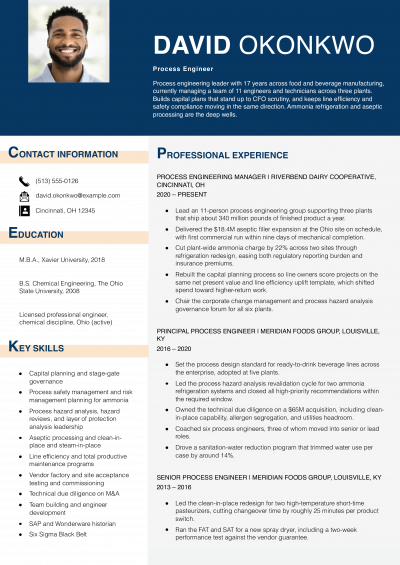
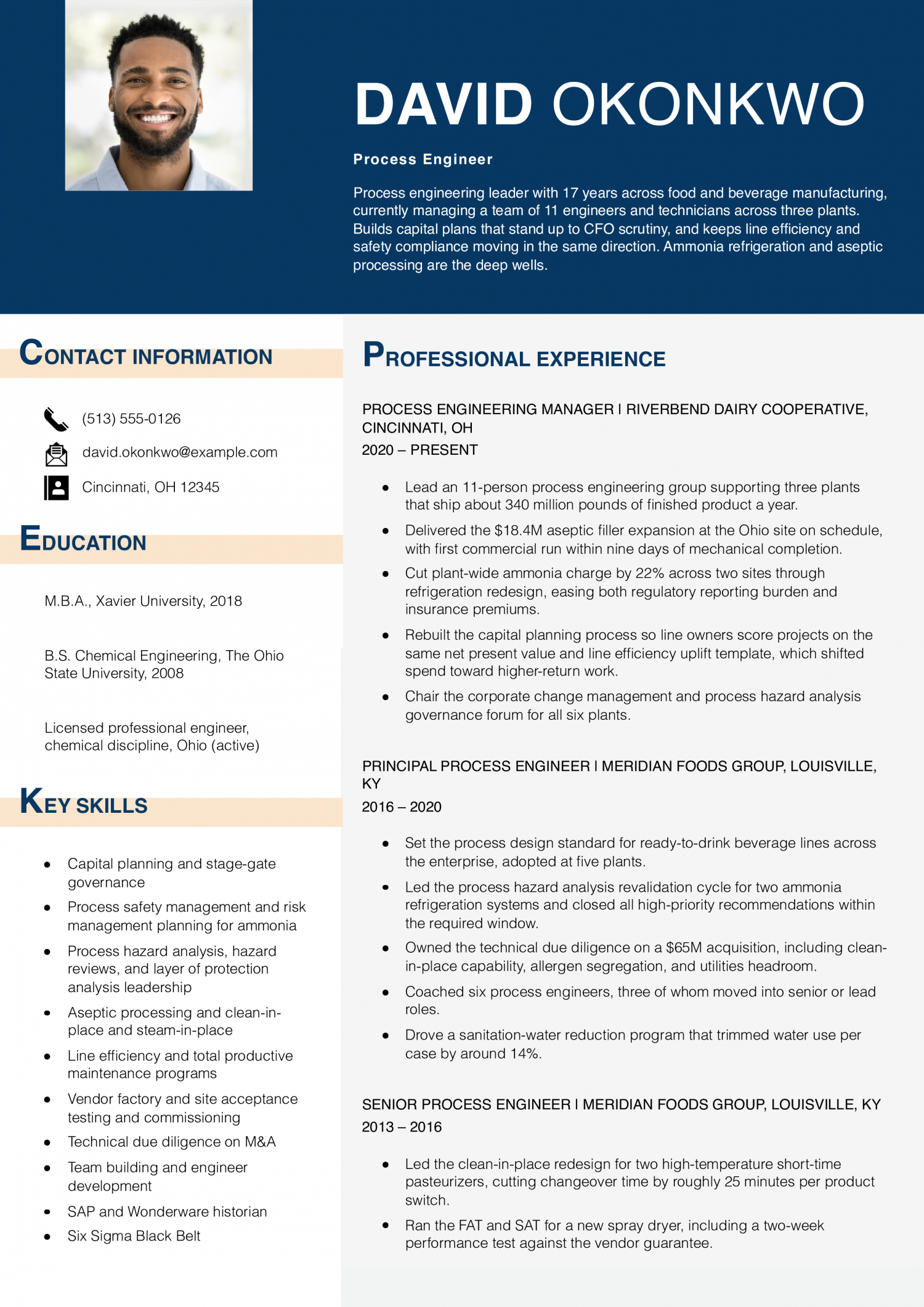
  • Scope is stated in dollars and volume: Managing 11 engineers across three plants shipping 340 million pounds a year gives an executive reader an instant read on the level of the role.
  • Safety and cost move together: The 22% ammonia charge reduction lands as both a safety and an insurance win, which is how senior operations leaders actually frame these projects.
  • Career progression is intact: Four roles from plant process engineer through principal to manager show the reader the candidate earned the leadership seat rather than jumping into it.

How to Write a Process Engineer Resume

01 Open with what a resume database cannot show

Lead with the one signal an engineering manager cannot pull from a title search. Name the specific process you own: a continuous polymer line, a sterile fill-finish suite, a semiconductor etch bay, or a high-volume stamping cell. Add the framework you run inside it, such as Six Sigma Black Belt work, Lean line design, or design of experiments yield studies.

Name the simulation or historian tool you use daily, whether Aspen Plus, AutoCAD, or SAP. This one line sorts you from generalists who list only ISO 9001 and Minitab. Plant directors read the summary for fit to their line first.

Give them the fit in the first two sentences of your resume.

02 Quantify yield, throughput, and cost

Bullets without a number tend to read as job duties, not engineering wins. Engineering managers scan first for yield lift, cycle time cut, and dollars saved per year. A strong bullet reads like: raised first-pass yield from 82 to 94 percent on a 40,000-unit line.

Or: cut changeover time by 35 minutes across three SKUs, freeing 210 production hours a year. Or: removed 1.2 million dollars in scrap through a designed experiment on injection pressure. Pair each number with the method and the scope, not the number alone.

If a project is under a confidentiality agreement, give the percent change and the unit type. Two or three quantified bullets per role tend to advance further than a page of verbs.

03 Sort your work into four plant-floor buckets

Sort your bullets so a reader can scan the shape of your work in ten seconds. Use four buckets that map to how plants are run. Process design and scale-up covers process flow diagrams, mass and energy balances, pilot runs, and tech transfer to production.

Continuous improvement covers Kaizen events, changeover reduction, root cause analysis, and corrective action closure. Validation and control covers qualification protocols, statistical process charting, and control plan updates. Capital and commissioning covers equipment specs, vendor selection, factory and site acceptance testing, and startup support.

Under each bucket, lead with the outcome and follow with the tool. This structure lets a reader match your history to an open req without hunting.

04 Lead your credentials block with the tools you run

Engineering managers and plant directors screen for credentials before they read prose. Put a short block under your summary with degree, professional engineer status by state if you hold it, and Six Sigma belt level. Add good manufacturing practice or safety training on the same line when the posting calls for regulated work.

Below that, list your working tool stack in three groups: simulation such as Aspen or SolidWorks, data such as Minitab or historian platforms, and enterprise such as SAP or Veeva. Keep the block to four lines so it stays scannable. Repeat the two or three tools that match the posting inside your bullets, with the outcome they produced.

This gives both the recruiter screen and the hiring engineer what they need up front.

05 Cut what a senior engineer no longer needs

A senior resume gets stronger when you delete, not when you add. Cut coursework and lab classes once you have five years in industry. Cut your first co-op or intern role unless it introduced a tool you still use.

Drop soft skill lines like team player and detail oriented, since managers read those as filler. Trim early roles to two or three bullets that show scope, dollars, or headcount. Remove tools you have not touched in five years, such as legacy control platforms you no longer support.

Keep the resume to two pages, and give page one to your last two roles and your credentials block. A tight two pages reads as senior. A dense three pages reads as unsorted.

Process engineer resumes now run through tougher ATS filters than they did a couple of years ago. Weigh the two tables below against the posting you’re chasing. Unit operations and control terms clear the first cut.

Evidence of yield gains decides whether the resume advances to a human reader. Engineering managers and plant or operations directors read hard skills as a fitness test. They want the software and the process types they run in their plant.

Soft skills carry less weight on the first pass but matter in the interview loop. A line like cross functional work only helps when a bullet under it proves it. Pull the terms from the posting first, then borrow from the tables to fill gaps.

Mirror the exact wording the posting uses for tools like Aspen or Six Sigma. Put hard skills in a dedicated block near the top of page one. Use soft skills as framing words inside your bullets, backed by a number or an outcome.

Soft Skills AI-estimated %
Cross-functional collaboration 66%
Analytical problem-solving 64%
Stakeholder communication 46%
Attention to detail 36%
Adaptability under constraints 30%

And here are the top hard skills showing up most often.

Hard Skills AI-estimated %
Process optimization 75%
Production cost estimation 60%
Quality standards development 47%
Manufacturing sequence planning 36%
Engineering documentation control 32%

Skill names and rankings come from an AI model grounded in U.S. Department of Labor occupation data for process engineers, not from a count of process engineers’ resumes built on ResumeTemplates.com.

Must Have on a Process Engineer Resume

A process engineer resume has to clear a short checklist before an engineering manager reads past the first section.

Niche Keywords for ATS Checkers

Engineering managers and plant directors scan for the work you have actually run. They want the unit ops, the tools and the standards you touched. Match the terms the trade uses, and keep the capitals right. The rows below cover five common lanes of process engineer work. Batch and continuous chemical work runs on mass and energy balances. Semiconductor fabs run on yield, defect rates and clean process control. Oil, gas and refining lean on safety reviews and relief sizing. Pharma and biotech run on cGMP, validation and tech transfer. Lean and Six Sigma cover the improvement side across all of them. Pick the lanes that fit your history, then drop the exact terms into your bullets.

Niche Keywords ATS scans for
Chemical Process Design process simulation, P&ID markups, mass balance
Semiconductor Fab yield improvement, process control, wafer defect
Refining and Petrochem safety reviews, hazard analysis, relief valve sizing
Pharma and Biotech cGMP, equipment validation, tech transfer
Continuous Improvement Lean Six Sigma, root cause analysis, Kaizen events

AI Skills to Add

Plants are split between sites piloting AI for yield prediction and sites that block cloud tools over trade secret and safety concerns. Engineering managers and plant/operations directors want to know which tools you have actually run and how you validate the output. Name the software you use by name and the data you feed it. Describe who signs off on the model before it changes a setpoint or a control limit. Do not claim you deploy machine learning models in production if your real work is pulling historian data and building regressions in Python.

What AI is actually changing for this role
Yield and defect analysis

Models on historian data flag drift in real time, but a process engineer still owns the root cause.

Drawing markups and revisions

Copilots speed up markups and revision notes, though signed drawings still go through your controls and safety review.

Standard work and SOPs

Generative tools draft first-pass procedures from your notes, and you edit for accuracy against the actual equipment.

Six Sigma and experiment support

AI suggests factor screens and regression fits, but you confirm assumptions before the experiment runs on the line.

AI tools to name
  • Python with pandas and scikit-learn: Pull historian data, fit regressions, and flag process drift for review.
  • Microsoft Copilot in Excel: Summarize batch records and draft first-pass Pareto and trend charts.
How to phrase AI on your resume
Do
  • Name the historian system you pulled from
  • Say who validated the model output
Skip
  • AI-powered process optimization
  • Revolutionized plant performance with AI

Latest BLS Statistics for Process Engineers

About These Numbers

The Bureau of Labor Statistics does not publish a wage code for Process Engineer specifically. The numbers below are a proxy: the closest published match is Industrial Engineers (SOC 17-2112), so use them as an estimate for this role, not an exact figure.

The Process Engineer wage curve stretches wide at the top and stays tight at the bottom. The 90th-percentile earner pulls in more than half again what the median engineer makes. The 10th-percentile floor sits only about a quarter below the median, so entry pay clusters close to the middle.

That shape tells you the market pays a premium for scope and industry, not for another year on the job. National employment in the role runs large, which means the tables below reflect a deep labor pool. Write your resume around the plant scale, process type, and yield or throughput gains you own, not a timeline of titles.

$102,440 National median annual
$109,900 National mean annual
$74,370 10th percentile
$159,860 90th percentile
365,740 Process Engineers in the U.S.
Where you stand

Below median

$74,370 to $102,440 Show your BS in chemical or industrial engineering and the unit operations you ran.

Above median

$102,440 to $159,860 Above the median, show yield gains, cycle-time cuts, and the CapEx budget you managed on named projects.

Top 10%

$159,860+ In the top 10%, lead with plant startups, Six Sigma Black Belt, and the P&L scope you carried.

Top-paying states

# State Avg. Annual
1 Alaska $156,510
2 Washington $129,050
3 Oregon $128,290
4 New Mexico $128,090
5 California $124,600
6 Hawaii $123,800
7 Louisiana $122,920
8 Wyoming $122,070
9 Delaware $120,190
10 Maryland $119,930

Highest-employment states

# State Workers Median
1 California 32,680 $124,600
2 Michigan 30,990 $101,680
3 Texas 30,980 $104,560
4 Ohio 23,480 $100,060
5 Illinois 18,640 $100,540
Source: U.S. Bureau of Labor Statistics, OEWS 2024 release (SOC 13-2011).
Written by professional resume writers and loved by hiring managers

Resume Templates offers HR approved resume templates to help you create a professional resume in minutes. Choose from several template options and even pre-populate a resume from your profile.

Frequently Asked Questions

How do you write a process engineer resume with no direct title?

Lead with the process work you already did under another title, such as manufacturing or production engineer.

Name the units you owned, the yield or throughput you moved, and the cost you took out. Engineering managers care about the work, not the label on your last badge.

Should a chemical engineering graduate use the same resume for process engineer roles?

No, rewrite the summary and bullets to name unit operations, batch records, and scale-up work.

A generic chemical engineering resume reads as academic and hides the plant experience a hiring manager wants. Move coursework down and put internship or co-op process work at the top of experience.

How long should a process engineer resume be?

One page through about eight years of experience, and two pages once you have led capital projects or owned a full production line.

Plant directors will read a second page when it carries yield, uptime, or capex numbers they can verify. Do not stretch to two pages to list every tool you have touched.

What is the best file format for a process engineer resume?

Send a PDF unless the posting or recruiter asks for a Word file. PDF holds your layout across the applicant tracking system, the recruiter's inbox, and the hiring manager's phone. Name the file with your full name and the role, not resume_final_v4.

Where do Six Sigma and Lean belong on a process engineer resume?

Put the belt level in a short credentials line under your name, then prove it inside experience bullets.

A Green Belt line means little without a project that names the defect rate you cut and the dollars saved. Engineering managers read the bullet, not the badge.

How do you show capital project work without breaking confidentiality?

Name the unit type, the scope, and the budget band rather than the product, client, or exact site.

Write "led $4M debottleneck of a distillation train" instead of naming the customer molecule. Plant directors know the shape of the work and will not press for what you cannot share.

Do you need a professional engineering license on a process engineer resume?

No for most in-house plant roles, and yes for consulting or work that seals drawings for a client.

List the state and status on one line if you hold it. Requirements vary by employer and by the work the role signs off on.

Which resume template works best for a process engineer?

Go with an ATS-friendly template for a process engineer resume. It keeps your credentials and plant experience in the spot an engineering manager checks first. A basic template is a solid alternative. Whichever you choose, keep the formatting clean and easy to parse: clear section headings, a standard font, and no graphics a parser can choke on.

Rate this article

Process Engineer Resume

Average Rating

4.8/5 stars with 238 reviews

You have given 0 Star(s)
4.8/5 stars with 238 reviews
Andrew Stoner

Executive Resume Writer and Career Coach

Andrew Stoner is an executive career coach and resume writer with 17 years of experience as a hiring manager and operations leader at two Fortune 500 Financial Services companies, and as the career services director at two major university business schools.