Medical Billing and Coding Resume Examples

Revenue cycle managers and practice managers want a number in your first line. Lead your summary with your coding volume per day or your clean claim rate. A line like “CPC coder averaging 85 charts…
Every resume example is written and reviewed by our team of Certified Professional Resume Writers to ensure top-quality content and formatting.
Your claim denial rate and days in accounts receivable tell a billing story fast. Billing managers and practice managers scan for proof you can post payments, work payer rejections, and keep A/R aging low. They want to see the systems you know, such as Epic or eClinicalWorks.
A strong medical billing resume pairs those tools with real results. Show clean claim rates, reduced denial percentages, or faster reimbursement cycles. To compare layouts before you start, browse our resume templates.
Billing managers decide whether to keep reading based on your summary and skills. A credential such as a CPB or CBCS can help, but the job postings we read did not require one, so lead with the claims you handled and the systems you used.
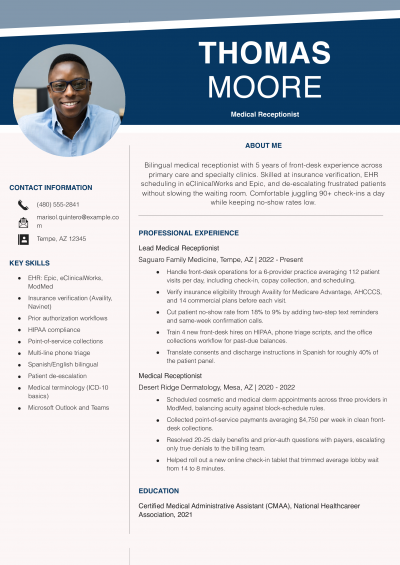
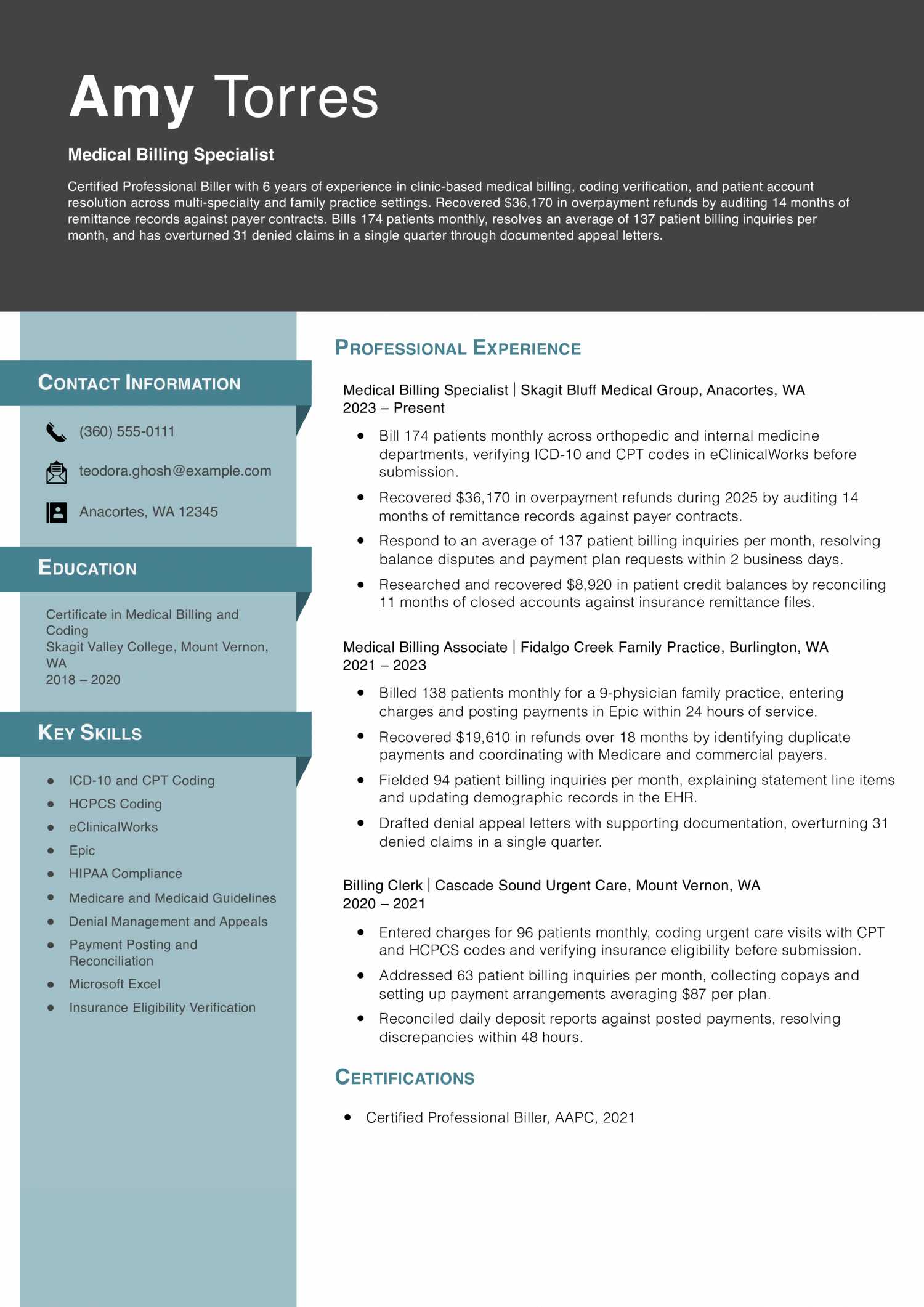
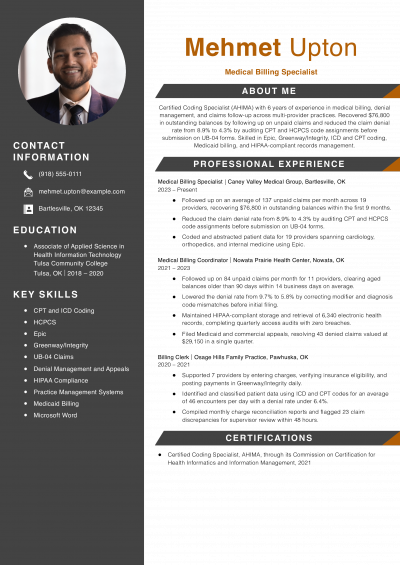
Consider this resume if you are a mid-level medical billing specialist with several years of experience across medical offices and growing recovery responsibilities. Lead with overpayment audit recoveries and denial overturn counts to prove financial impact beyond routine charge entry.
Billing managers look for a biller who finds money that was missed. This resume names the dollars recovered from overpayment audits and the denials overturned through appeal letters. If you have chased refunds or appeals, put the dollar amount, the time it covered and the number of claims on your own resume.
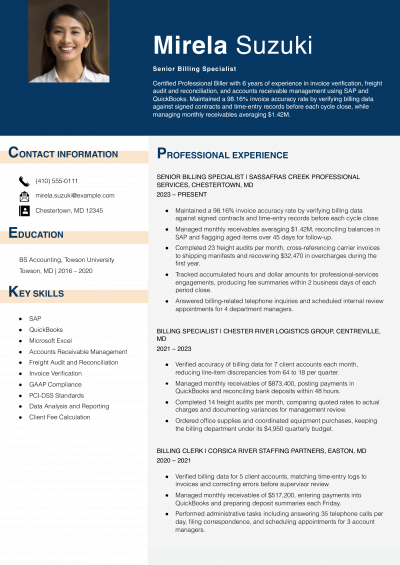
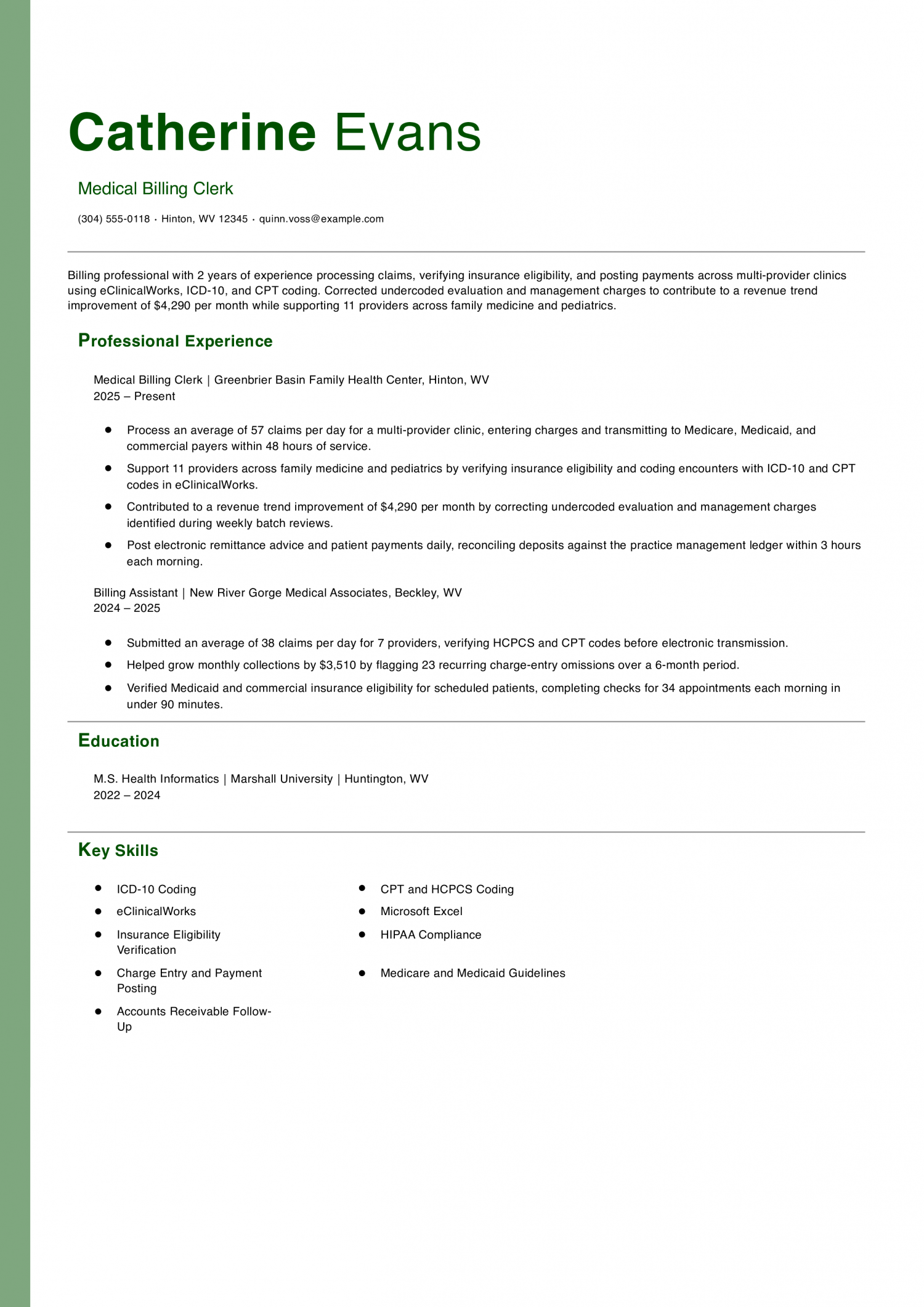
Start with this resume if you are an entry-level medical billing clerk moving into your first or second clinical billing position. Lead with daily claim volume and monthly dollar recoveries tied to the specific coding corrections you made.
For a first or second billing job, a practice manager wants clean claims sent on time. This resume gives the number of claims handled each day and the window between the visit and the claim going out. On your own resume, name the payers you send to and how soon claims leave after the date of service.
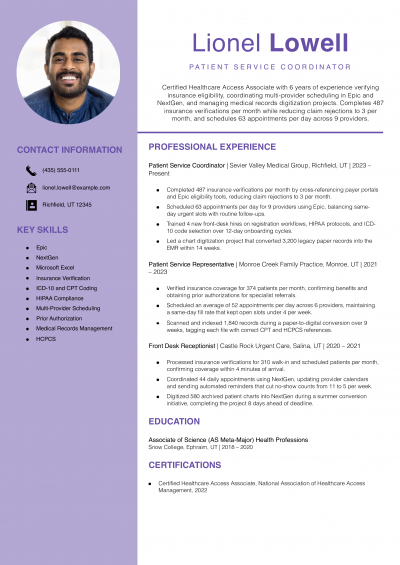
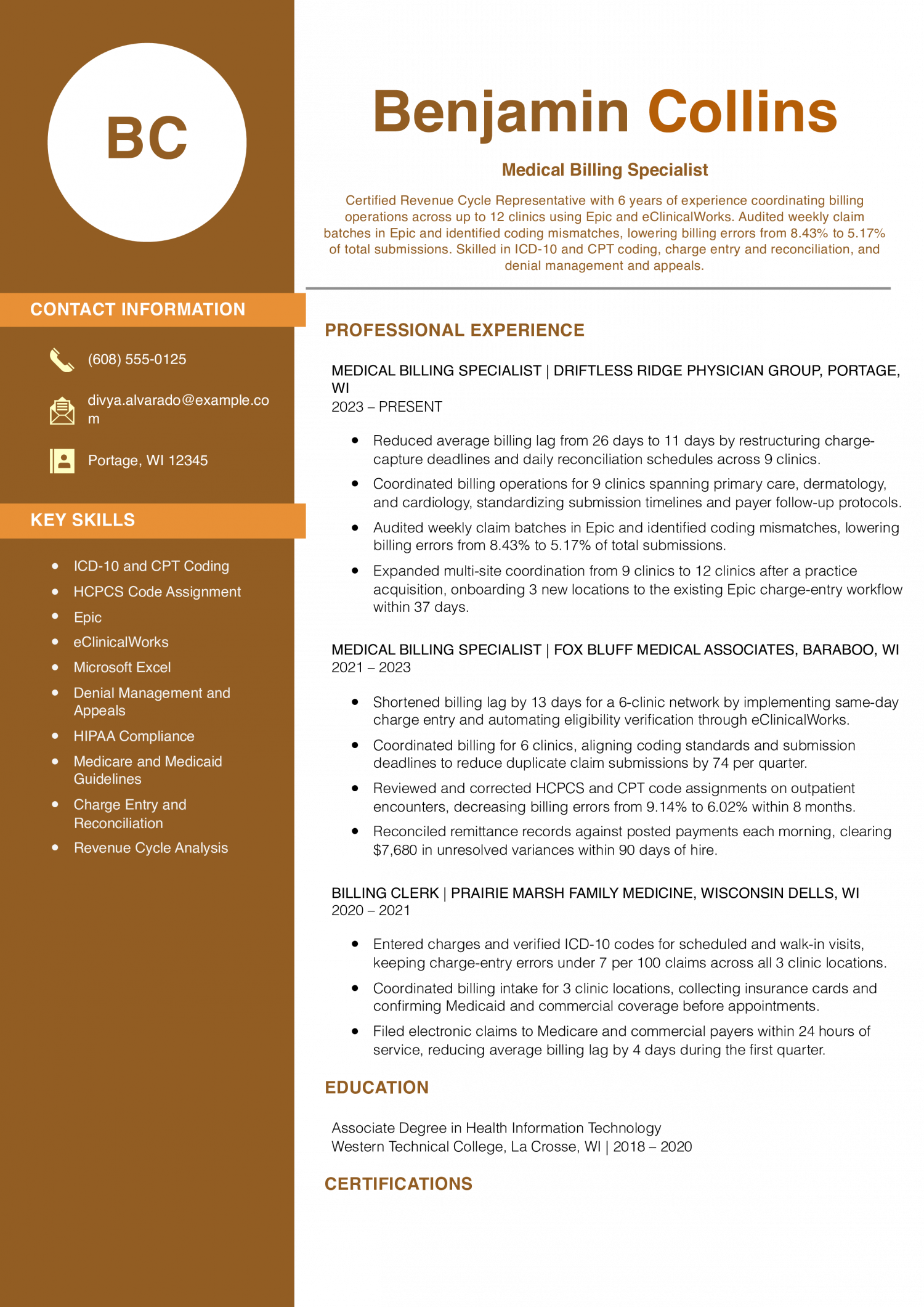
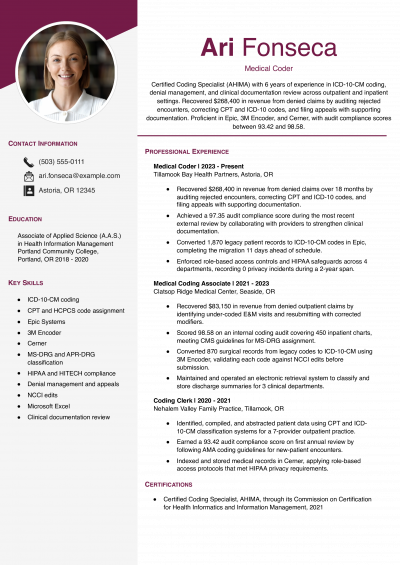
Try this resume if you are a mid-level medical billing specialist who has managed charge capture and claims across multiple clinic locations. Lead with billing-lag reductions and error-rate improvements that prove you tightened revenue cycle timelines.
Revenue cycle managers hire billers who shorten the wait for payment across many offices. This resume shows the days between a visit and the bill going out, before and after a new charge deadline, across several clinics. When you describe process changes, give the starting lag, the new lag and how many sites it covered.
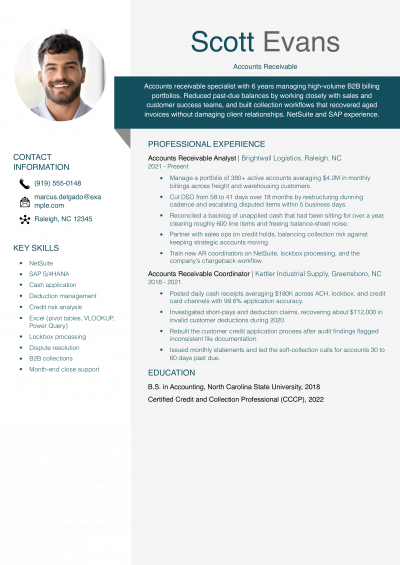
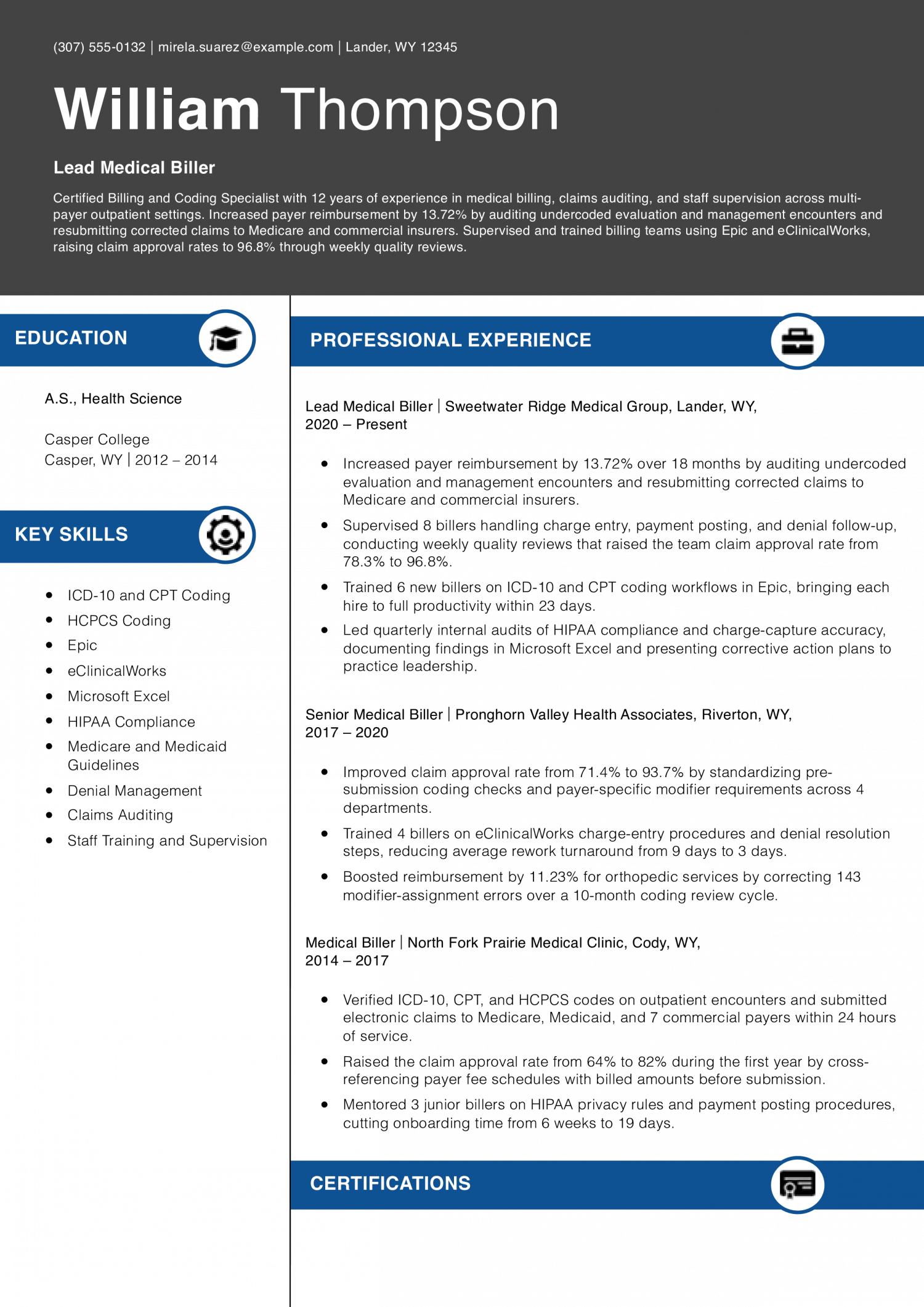
Lean on this resume if you are a senior-level lead medical biller ready to show a record of team oversight and revenue recovery. Lead with the audit methods and training structures behind your claim approval gains.
A lead biller is hired to keep a team accurate and to find underpaid claims. This resume shows regular audits of coded visits, the number of billers supervised and the days new hires needed to reach full speed. On your own resume, give the team size, how often you audit and how long training takes.
Billing specialist with 6 years of experience in clinic-based revenue cycle operations, from charge entry and claim submission to denial management and accounts receivable follow-up. Saved $41,910 annually by finding two overlapping claim-scrubbing subscriptions and moving the practice to a single platform. Proficient in Epic, eClinicalWorks, and Microsoft Excel, with working knowledge of ICD-10, CPT, HCPCS coding, and Medicare and Medicaid guidelines.
Billing managers and practice managers can read your job titles at a glance. They cannot see your payer mix, your denial turnaround rate, or your EHR depth. Start your profile with the one detail that sets you apart from other billers at your level.
That could be a specialty focus like oncology or orthopedic claims. It could be fluency in a second language your patient base speaks. A CPB from AAPC or a CRCR from HFMA belongs in this opening line too.
Pair the credential with a scope detail, such as the monthly claim volume you handle. This combination tells a reviewer what you do and how well you do it. One sentence can carry both facts if you keep the words short.
Revenue cycle work produces clear data, so use it in your bullets. State the number of claims you process each month. Note your first-pass acceptance rate as a percentage.
Show the dollar value of denied claims you recovered in a set period. Aging A/R days and the percentage you reduced them by are strong additions too. Billing managers and practice managers scan for these figures first.
A bullet that says you filed insurance claims reads as a task list. A bullet that says you filed 1,200 claims per month with a 96% clean rate reads as proof. Tie every line to a metric you can verify if asked.
Sort your bullets so each job tells a clear story. Charge entry and claim submission form one group. Denial management and appeals form another.
Payment posting and account reconciliation fit together as a third. Patient collections and statement follow-up can share a fourth group. Two to four bullets per group keep a section tight.
This structure helps practice managers spot the parts of the cycle you own. It also prevents a long block of bullets that all sound alike. Label each group with a bold subheading when the role covered multiple areas.
If a group held only one task, fold that bullet into the closest related group instead. Skip any group the job posting does not mention.
List your CBCS from the National Healthcareer Association on its own line. Do the same for a CPB from AAPC or a CRCR from HFMA.
Name your practice management system and your clearinghouse. Name your EHR platform on the same line. Billing managers and practice managers want these details visible before they scroll.
Education goes after your work history. A health information technology or business program strengthens your positioning.
If you completed coursework in medical terminology or anatomy, add a single line for it. Relevant workshops count too, such as payer-specific training or coding updates. Keep this section short so your experience stays the focus.
A resume covering fewer than ten years of billing work fits on one page. For longer careers, a second page is fine if every line shows a result. Remove older roles that repeat skills your recent jobs already prove.
Check the claims processing and denial management terms below against each posting you read.
Billing managers and practice managers weigh hard skills first during the screen. They want proof you can process claims using assigned CPT codes and post payments accurately. Soft skills like attention to detail then show up in your work history bullets. A strong bullet pairs a soft skill with a metric.
Pull each skill from the tables that matches words in your target job posting. Build your bullet points around those terms. Drop any term the job ad does not ask for.
| Soft Skills | AI-estimated % |
|---|---|
| Attention to detail | 66% |
| Payer communication | 60% |
| Deadline management | 41% |
| Problem-solving under pressure | 37% |
| Cross-department collaboration | 31% |
And here are the top hard skills showing up most often.
| Hard Skills | AI-estimated % |
|---|---|
| Medical claims processing | 80% |
| Insurance verification | 65% |
| Denial and appeals follow-up | 45% |
| Payment posting | 35% |
| Patient account reconciliation | 31% |
Skill names and rankings come from an AI model grounded in U.S. Department of Labor occupation data for medical billers, not from a count of medical billers’ resumes built on ResumeTemplates.com.
Billing managers and practice managers check for medical claims processing and insurance verification before they read a medical billing resume closely, and the items below show how to prove them.
Billing managers scan for specific software names first. List every EMR system you have used. Place them in a skills section or work entries.
Every billing role involves protected health data. Practice managers expect proof you follow privacy rules. A short compliance line removes doubt about training.
Add a line noting your most recent HIPAA training date. Mention audits you helped pass or privacy reviews you led. Concrete details beat a vague claim of awareness.
A CPB credential from AAPC covers HIPAA rules in its exam. A CBCS from the NHA also includes compliance content. Listing either one strengthens this section of your resume.
Billing managers and practice managers are split on AI right now. Some want billers who use AI to scrub claims faster. Others worry that AI tools will flag the wrong codes and raise audit risk. Describe how you checked the output before claims went out. Do not claim you automate full revenue cycles if you only verify AI suggestions. Show the step where you caught errors the tool missed. That detail tells a reviewer you understand the liability.
AI flags common denial triggers before submission, but billers still review each edit for payer rules.
Machine learning tools suggest CPT and ICD codes from clinical notes, yet coders must confirm accuracy.
Predictive models rank denials by recovery odds so billers can prioritize high-value appeals first.
Automated tools verify patient coverage in seconds, though staff still confirm plan details with payers.
AI can match remittance line items to open charges, but billers reconcile any mismatches manually.
Waystar: Runs AI-driven claims scrubbing to catch errors before submission to payers.
Experian Health: Uses predictive analytics to flag claims likely to be denied before submission.
Each credential line shows which part of the revenue cycle you have invested in. Some roles call for a coding focus.
Others want proof you can handle payer follow-up or denial management. The right mix shifts by employer and setting. A hospital billing department may favor one credential.
A small practice may look for another. Put each one on its own line with the issuer and the year. That format keeps the section short and clear for a quick review.
About These Numbers
The Bureau of Labor Statistics does not publish a wage code for Medical Billing specifically. The numbers below are a proxy: the closest published match is Billing and Posting Clerks (SOC 43-3021), so use them as an estimate for this role, not an exact figure.
The District of Columbia, California and Massachusetts pay the most.
A biller at the 90th percentile earns about 40 percent more than the median, while the floor sits roughly 23 percent lower. If you can relocate to a higher-paying state, say so near the top of your resume.
| # | State | Median Annual |
|---|---|---|
| 1 | District of Columbia | $64,330 |
| 2 | California | $56,260 |
| 3 | Massachusetts | $56,110 |
| 4 | Washington | $56,090 |
| 5 | Minnesota | $55,810 |
| 6 | New York | $53,320 |
| 7 | Rhode Island | $52,910 |
| 8 | Colorado | $52,670 |
| 9 | Maryland | $52,210 |
| 10 | Alaska | $52,170 |
| # | State | Workers | Median |
|---|---|---|---|
| 1 | California | 41,290 | $56,260 |
| 2 | New York | 32,770 | $53,320 |
| 3 | Texas | 31,150 | $45,910 |
| 4 | Florida | 28,560 | $46,540 |
| 5 | Illinois | 21,010 | $49,730 |
Resume Templates offers HR approved resume templates to help you create a professional resume in minutes. Choose from several template options and even pre-populate a resume from your profile.
Create a work experience section with your job title, employer name, and dates. Give each role bullets that tie a billing task to a result. Show the number of claims processed per month or the percentage reduction in denials.
This format lets billing managers and practice managers scan your impact in seconds.
Yes, a two-sentence summary at the top of the page can frame your specialty. Mention your years of billing experience and the payer types you have worked with. Keep it under 40 words so it reads as a headline, not a paragraph.
A reverse-chronological format works well for most medical billing job seekers. It lists your most recent role first, so billing managers see current duties right away.
If you are switching careers, a combination format can highlight transferable skills above your work history.
List each title you held at the same employer as its own entry with matching dates. For example, show a move from billing clerk to senior billing specialist under one heading.
Include a metric in each entry that reflects the larger scope of each new role.
Fewer than ten years of billing work calls for one page. A second page is reasonable when you need room for additional roles or training.
Practice managers often spend under a minute on a first review, so put your strongest results on page one.
Start each bullet with a verb that names a billing activity, such as submitted, reconciled, or verified. Avoid vague words like handled or assisted, because they hide your actual contribution.
Strong verbs paired with a number give billing managers a clear picture of your daily output.
Note the gap briefly in your work history with a short explanation, such as family leave or continued education. If you completed any billing coursework or earned a credential during that time, list it with dates.
Billing managers care more about current knowledge of payer rules than an unbroken timeline.
Try an ATS-friendly template to begin with. It keeps your medical biller resume simple for hiring software. A basic template gives you the same simple layout. Avoid graphics, pick a standard font, and name sections plainly.
Medical Billing Resume
4.5/5 stars with 140 reviews

Executive Resume Writer and Career Coach
Andrew Stoner is an executive career coach and resume writer with 17 years of experience as a hiring manager and operations leader at two Fortune 500 Financial Services companies, and as the career services director at two major university business schools.
© 2026 Resumetemplates.com All rights reserved.