Accounts Receivable Resume Examples
Lead with a single line a controller cannot pull from your LinkedIn or a credit reference. Name the ERP you run daily, the portfolio size in dollars, and the industry vertical you collect in. A…
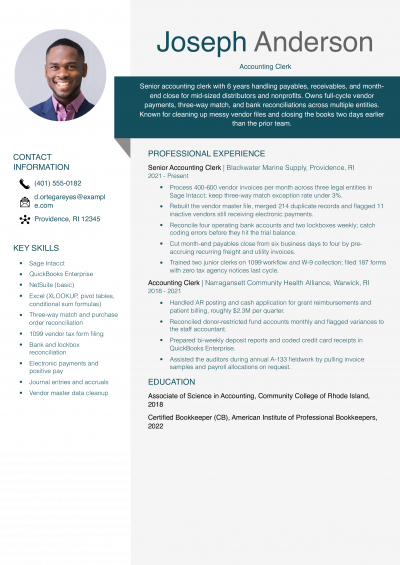
Every resume example is written and reviewed by our team of Certified Professional Resume Writers to ensure top-quality content and formatting.
Clean claim rates and fast payment cycles set strong billing specialists apart. Your resume should prove you can reduce denials and post payments on time. Billing managers and accounting supervisors look for hands-on work with CPT and ICD-10 codes, plus fluency in systems like Epic or Medisoft.
Show the dollar volume you handled and how you cut aging accounts receivable. A Certified Professional Biller (CPB) credential from AAPC can strengthen your profile in a field of over 404,000 workers. The examples below show how to frame these details on your own resume. To compare layouts before you start, browse our resume templates.
Billing managers decide whether to keep reading by the skills and certifications block on page one; if software proficiency and a credential like the CPB aren't visible there, the resume moves to the rejection pile.
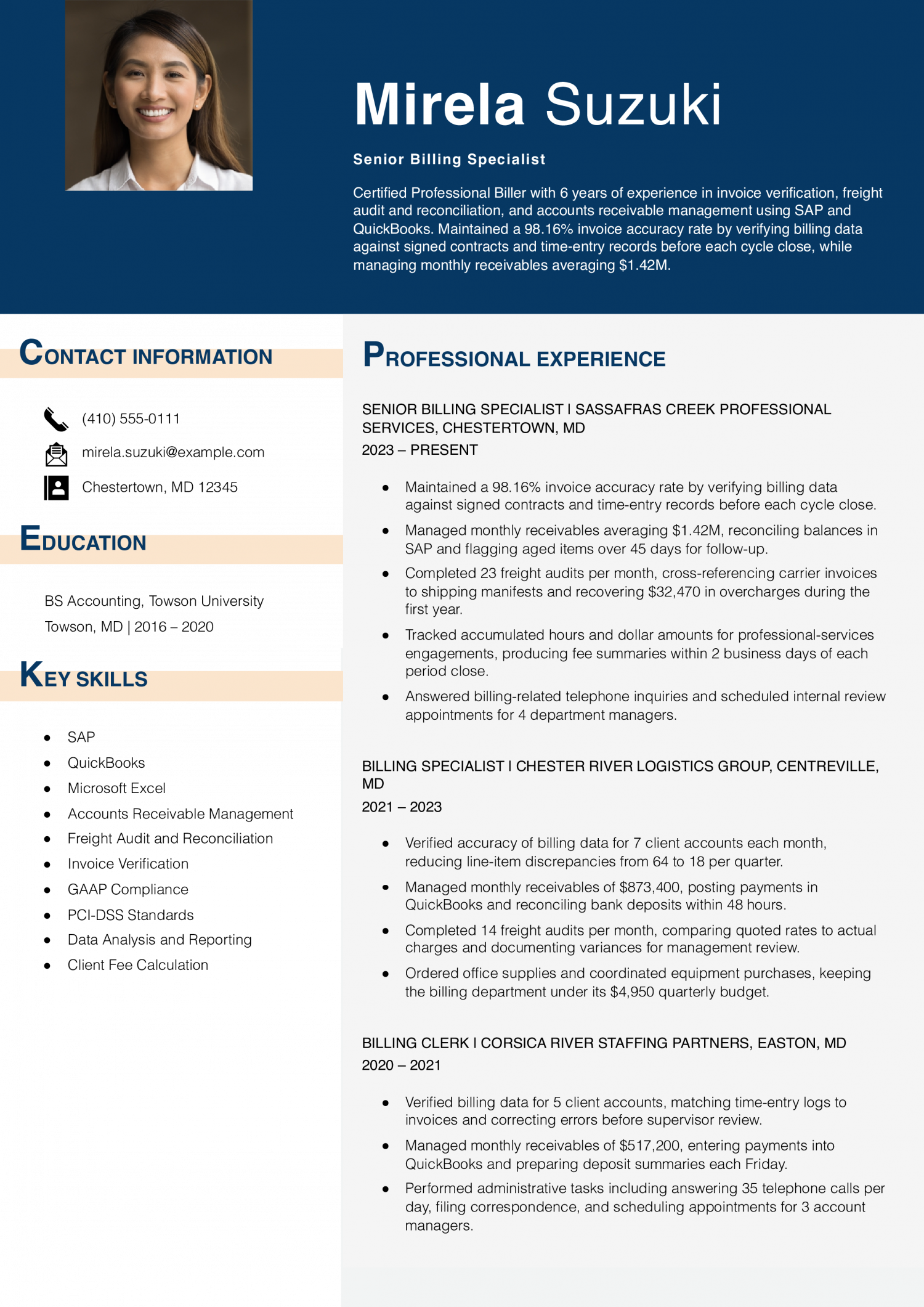
Pick this resume if you are a mid-level billing specialist with about six years of receivables and freight audit experience. Lead each bullet with the verification method and source documents checked, the way this candidate does across all three roles.
Cross-referencing carrier invoices against shipping manifests recovered a specific dollar amount in overcharges during the first year. A controller reading that sees both the method and the payoff. Name what you compare, how often, and what you recovered.
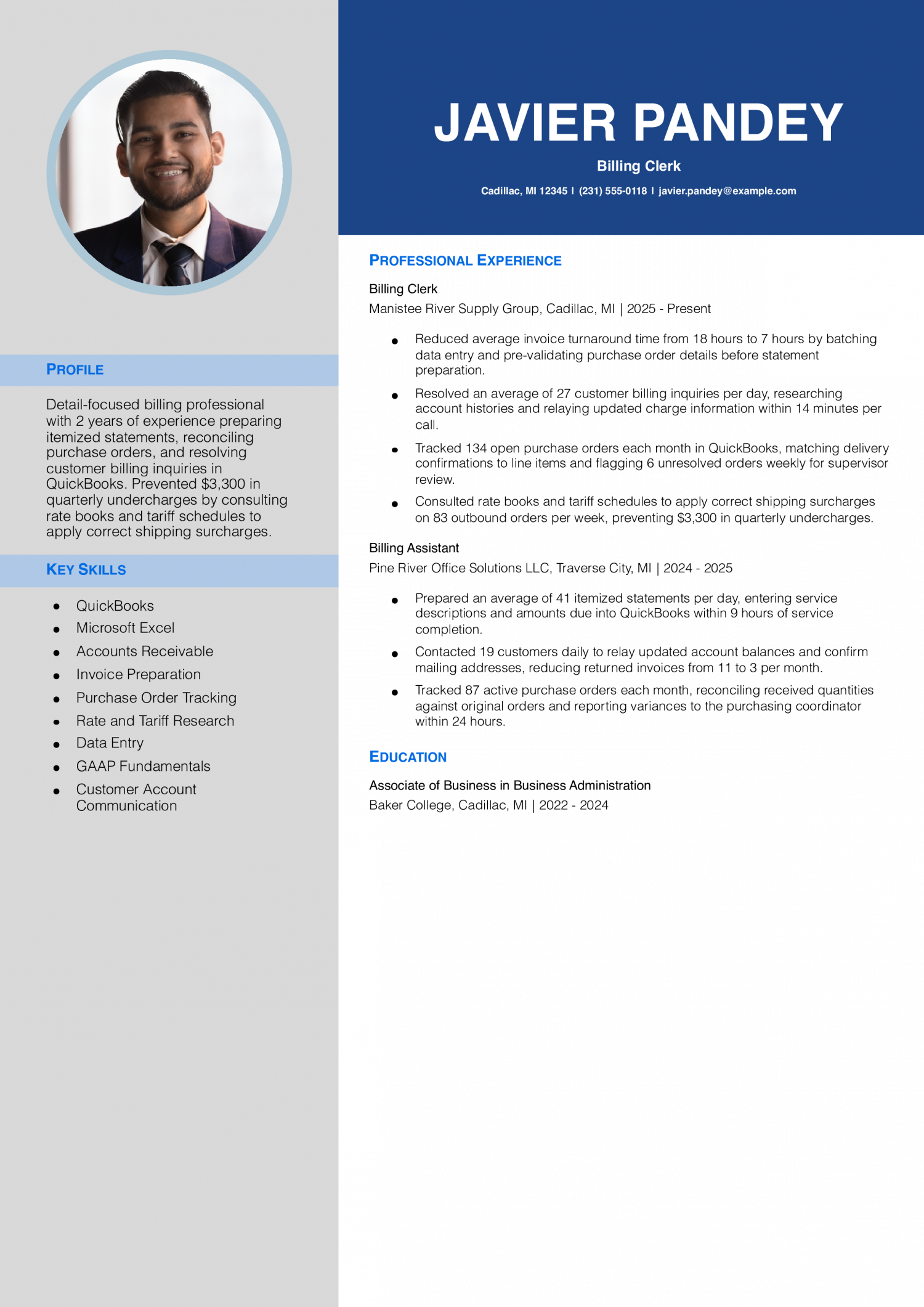
Start with this resume if you are entering a billing clerk role with up to two years of experience. State before-and-after turnaround times the way this candidate does to prove process improvement on day one.
Invoice turnaround shrank because data entry was batched and purchase orders were validated up front. A supervisor who sees how long invoices used to take and how long they take now can feel the speed gain. Show the before and after times and the step you changed.
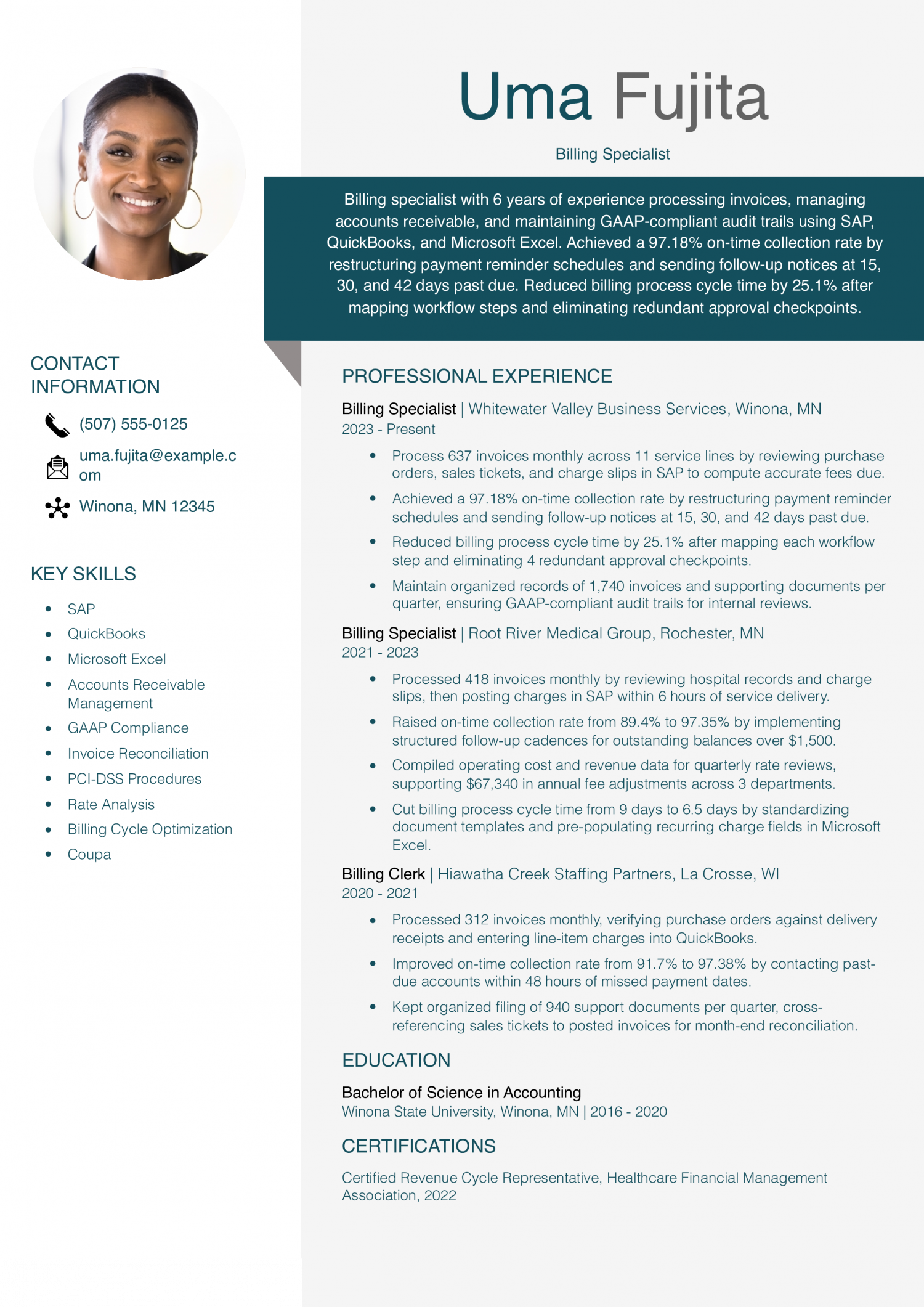
Try this resume if you are a mid-level billing specialist with about six years of invoice processing and collections experience across multiple industries. Trace how each bullet names the exact number of invoices handled monthly alongside the process change that improved collection rates.
A quarterly invoice count tied to a named compliance standard tells a reviewer both the workload and the rules it follows. An auditor scanning that line knows the records are organized for review. State how many documents you file per period and which standard you follow.
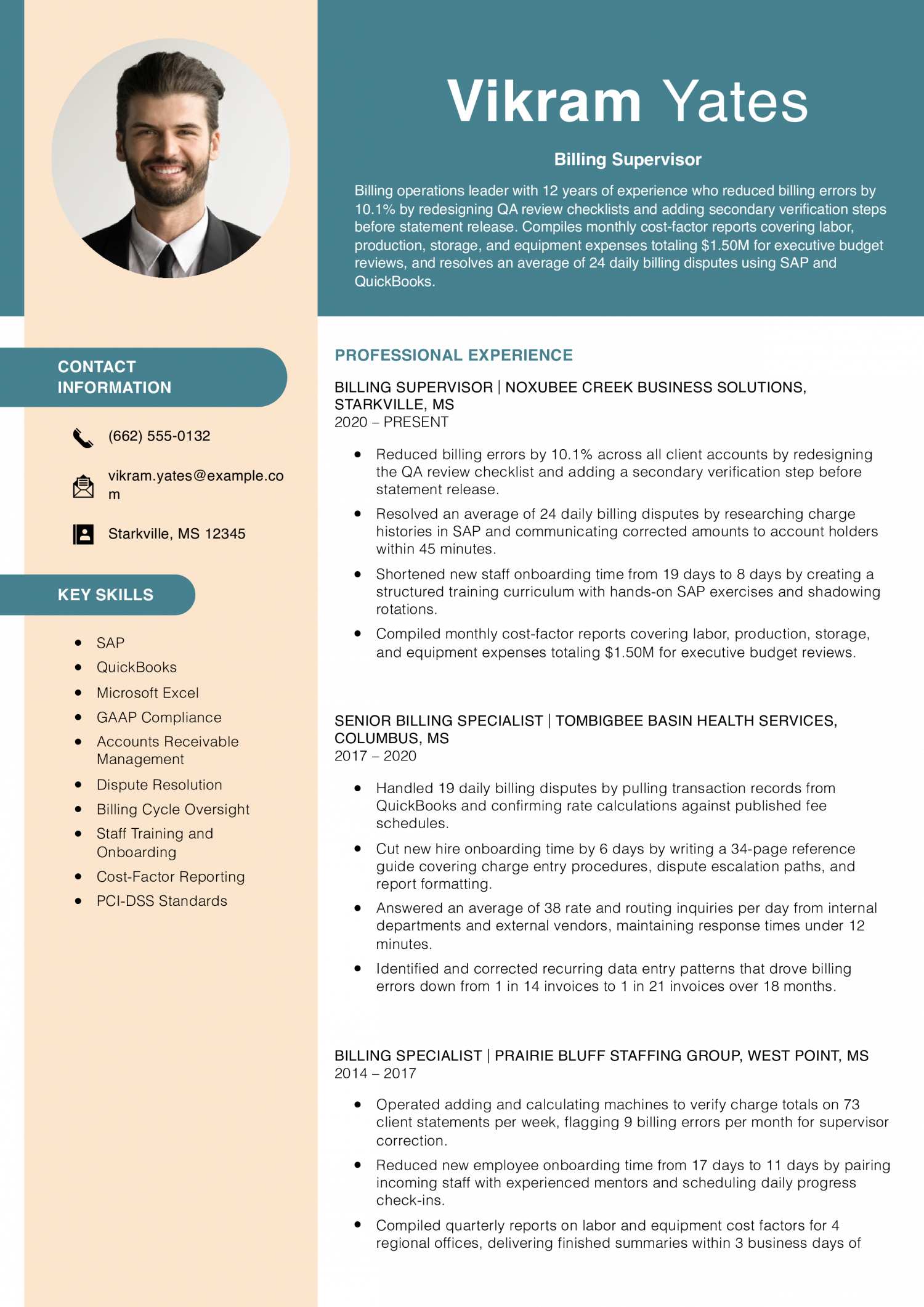
Lean on this resume if you are a senior billing supervisor with over a decade of experience spanning healthcare and business services billing. Update your onboarding bullets to show before-and-after day counts the way each role here does across three consecutive positions.
Charge disputes resolved in SAP within a set number of minutes show both the system and the speed. An accounts receivable manager reading the tool name and the response window can picture that process in their own department. Name your platform and your resolution time.
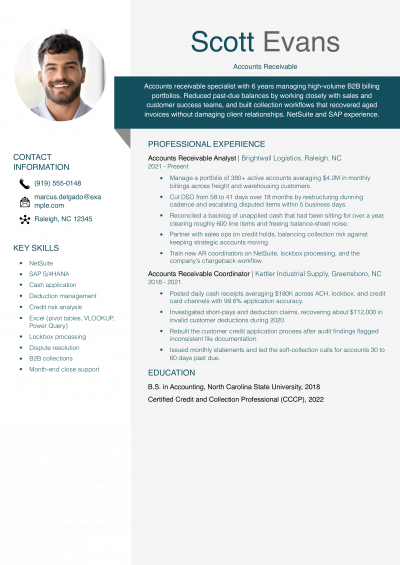
Accounts receivable coordinator with 6 years of experience resolving billing discrepancies, preparing credit memorandums, and reconciling accounts using QuickBooks, SAP, and Microsoft Excel. Designed Excel reconciliation templates that reduced manual processing time by 24.7% and recovered $43,270 in missed credits annually by comparing SAP charge entries to purchase receipts and shipping manifests. Skilled in PCI-DSS-compliant data handling, GAAP compliance, and high-volume billing document creation.
Billing managers and accounting supervisors can verify your degree in seconds. They cannot verify the niche skill that sets you apart. Lead your summary with one detail a peer is unlikely to share.
That could be a Certified Professional Biller credential. It could be fluency in dental or durable medical equipment billing. A specialty in high-volume workers’ compensation claims also works.
Pick the single trait that fits the posting best. State it in your first line, before your years of experience. A specific opener about payer mix or denial turnaround stands out.
Most strong billing resumes carry at least one number per bullet. A line without a figure tends to read as a task, not an outcome. Start with the volume you touched, such as claims per month.
Then add an outcome tied to money or time. You might note a drop in denial rates by a percentage. You might cite the dollar value of accounts receivable you managed.
Write that you cut aging over 90 days by 18% in one quarter. Two metrics per bullet is a good ceiling. Three or more can crowd the line and slow the reader.
Organize your experience around the core tasks billing teams perform. Claim submission and follow-up is one natural group. Payment posting and reconciliation form a second group.
A third group is denial management and appeals. Patient billing and collections make a fourth group. Keep each group to two or three bullets to prevent long blocks.
Label each group with a bold subheading if the posting names those functions. This structure helps billing managers scan for the tasks they need filled.
Place your certifications near the top of page one. List any active certification here, such as the Certified Professional Biller. The Certified Revenue Cycle Representative also belongs in this section.
Billing managers and accounting supervisors often filter by certification first. Placing it below the fold risks having it missed entirely. Below the credentials, add a short tools line.
Name billing platforms you have used, such as Epic or Medisoft. Include any clearinghouse experience like Availity or Change Healthcare.
Write your degree, school name, and when you graduated. An associate or bachelor’s degree in health information or accounting is common. If you lack a degree, list your diploma and any completed coursework.
Below education, add a section for professional development. Continuing education credits in ICD-10 or CPT updates fit here. If you are new to billing, a short volunteer or internship line can fill the gap.
Keep this section to four or five lines total. End with a brief skills list that mirrors keywords from the job posting.
Both tables apply to your billing specialist resume.
Hard skills like CPT coding and claims processing prove you can do the daily work. Soft skills like attention to detail show you can do it well. Both types carry weight, but hard skills filter you in or out first.
Weave soft skills into your bullet points as proof, not as standalone labels. A bullet that pairs a soft skill with a number is stronger than a list entry alone.
| Soft Skills | AI-estimated % |
|---|---|
| Attention to detail | 69% |
| Client communication | 52% |
| Deadline management | 48% |
| Cross-department collaboration | 36% |
| Problem-solving | 29% |
And here are the top hard skills showing up most often.
| Hard Skills | AI-estimated % |
|---|---|
| Invoice preparation | 79% |
| Billing data verification | 54% |
| Accounts receivable posting | 50% |
| Discrepancy resolution | 35% |
| Records management | 27% |
Skill names and rankings come from an AI model grounded in U.S. Department of Labor occupation data for billing specialists, not from a count of billing specialists’ resumes built on ResumeTemplates.com.
Run through this list before you send your resume.
Billing managers and accounting supervisors scan for task-specific terms. Group your keywords by the type of billing work. Claims processing terms show you handle the full cycle. Coding keywords prove you speak payer rule language. Accounts receivable phrases signal you chase open balances. Compliance terms show you follow federal billing regulations. Software names tell reviewers which platforms you know. Place each term in the skills or experience section. Match the exact phrasing from the job posting. Spelling a system name correctly matters more than extras. These groups cover the core areas most postings mention.
Billing managers are split on AI in billing workflows. Some want staff who use AI to speed up claim scrubbing. Others worry that auto-coded charges create compliance risk.
Name the tools you have used in real work. Describe the step where you review AI output before submission. Do not claim you automate the full billing cycle.
Your actual practice may be running a draft and fixing errors. That is worth stating clearly. Billing managers and accounting supervisors check whether you verify AI results.
They also look for proof that you caught errors the tool missed. Honest detail beats a long list of tools you tried once.
What AI is actually changing for this role
Charge capture: AI flags missing or mismatched charges before you review them, cutting manual lookup time.
Claim scrubbing: Automated scrubbers catch common denial triggers, but you still verify payer-specific rules.
Payment posting: Machine learning tools match EOBs to open balances faster than manual line-by-line posting allows.
Denial management: AI sorts denied claims by root cause so you can prioritize high-dollar appeals first.
Reporting: AI dashboards surface aging trends and underpayment patterns that manual spreadsheets often miss.
AI tools to name
How to phrase AI on your resume
Do
Skip
A solid work history keeps you in the running. The credentials below are what move a Billing Specialist resume from the qualified stack into the shortlist. Billing managers and accounting supervisors scan them to gauge your coding scope and revenue cycle depth.
Many job posts name one or both as a plus. Some list them as a firm ask. The weight each one carries varies by employer and by field.
Add each credential on its own line with the issuing body, year earned, and status.
Billing Specialist falls under the broader BLS category of Billing and Posting Clerks, a large occupation. That size means the median pulls in a long tail of entry-tier and lower-credentialed workers. The 90th percentile out-earns the median by about 40 percent, which tells you the spread rewards something beyond basic posting.
At the bottom, the 10th percentile sits roughly 23 percent below the median. Geographic and industry differences shape where you land in that range. To stand out, lead your resume with the billing platforms you have run and the claim or invoice volume you have processed each month.
| # | State | Median Annual |
|---|---|---|
| 1 | District of Columbia | $64,330 |
| 2 | California | $56,260 |
| 3 | Massachusetts | $56,110 |
| 4 | Washington | $56,090 |
| 5 | Minnesota | $55,810 |
| 6 | New York | $53,320 |
| 7 | Rhode Island | $52,910 |
| 8 | Colorado | $52,670 |
| 9 | Maryland | $52,210 |
| 10 | Alaska | $52,170 |
| # | State | Workers | Median |
|---|---|---|---|
| 1 | California | 41,290 | $56,260 |
| 2 | New York | 32,770 | $53,320 |
| 3 | Texas | 31,150 | $45,910 |
| 4 | Florida | 28,560 | $46,540 |
| 5 | Illinois | 21,010 | $49,730 |
Resume Templates offers HR approved resume templates to help you create a professional resume in minutes. Choose from several template options and even pre-populate a resume from your profile.
Start with a summary that names your billing software and your claim volume. Then build each bullet in your experience section around a metric. Examples include accounts processed per month or days in accounts receivable reduced.
Close with your certifications and the EHR platforms you have used.
Focus on the tasks that show accuracy and speed, such as charge entry and payment posting. Denial management is another strong area to feature.
Billing managers and accounting supervisors look for proof that you reduced errors or shortened collection cycles. Attach a figure to each task, like claims processed weekly.
No, tailor each version to match the job posting. A medical billing resume should stress claim submission and reimbursement totals.
A coding resume should lead with the code sets you use, like ICD-10 or CPT. Include your coding accuracy rate as a percentage to make it concrete.
Create a dedicated skills section and split it into technical skills and software. Under technical skills, list items like insurance verification and appeals writing.
Under software, name each platform by its version, such as Epic 2024 or AdvancedMD. Matching the exact terms in the job posting helps your resume clear applicant tracking filters.
A summary works better once you have at least one year of billing experience. State your specialty area, your average claim volume, and one measurable result.
An objective is more useful for career changers who need to explain a shift into billing. Keep it to two or three lines either way.
Lead with transferable duties from your previous role, such as data entry volume or invoice processing. Account reconciliation also translates well to billing work.
Place your CPB or CRCR credential directly below your contact information. A brief summary line should name the industry you are leaving and the billing focus you are pursuing.
For most billing specialists with fewer than 10 years of experience, one page is enough. If you have worked across multiple payer types or held supervisory roles, a second page is acceptable.
Keep each position to four or five bullet points so every line earns its space.
An ATS-friendly template puts your certifications and work history under separate headings. A basic template is another good pick.
Billing Specialist Resume
4/5 stars with 123 reviews

Executive Resume Writer and Career Coach
Andrew Stoner is an executive career coach and resume writer with 17 years of experience as a hiring manager and operations leader at two Fortune 500 Financial Services companies, and as the career services director at two major university business schools.
© 2026 Resumetemplates.com All rights reserved.