Tip !

An EHR system name in the top third is what gets medical receptionist resumes past the office administrator's first scan; specific daily patient volume is what makes them readable enough to advance to a phone screen.

Andrew Stoner , Executive Resume Writer and Career Coach

Why this resume works

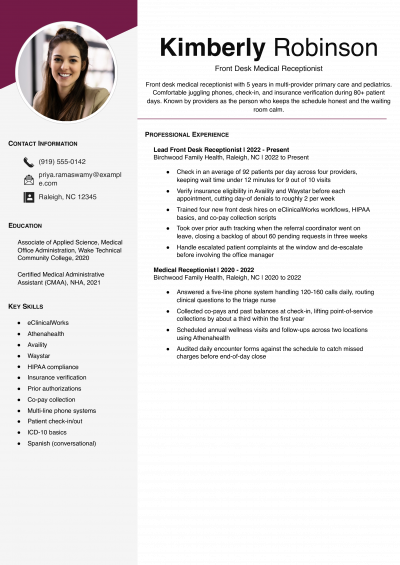
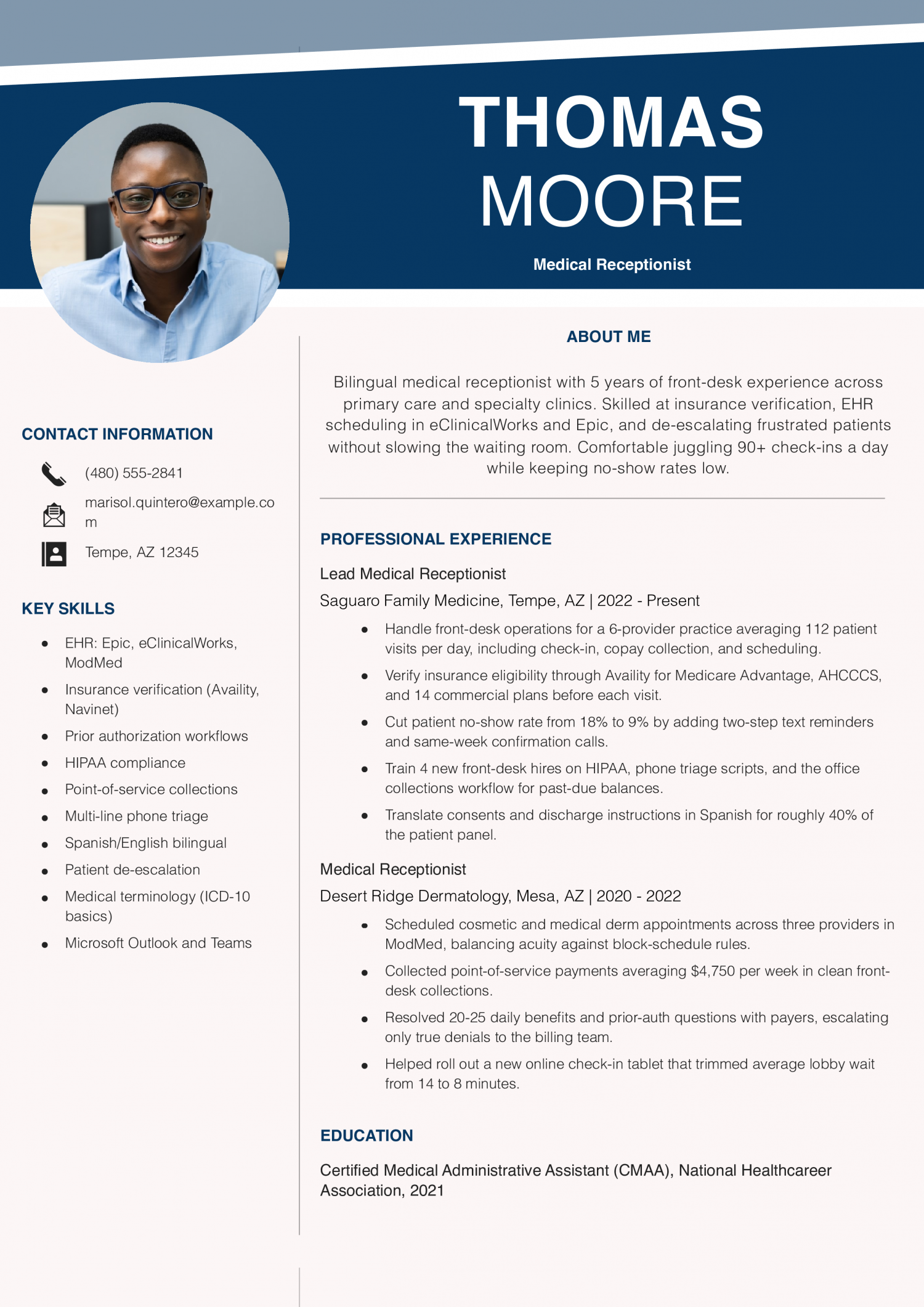
  • Numbers tied to clinic flow: Specific daily visit counts and a no-show drop from 18% to 9% show direct impact on revenue and access.
  • Named the tools she actually uses: Listing Epic, eClinicalWorks, ModMed, and Availity helps her resume clear EHR keyword screens at most clinics.
  • Bilingual skill framed as patient value: Tying Spanish fluency to 40% of the panel makes it a concrete asset, not a generic line in the skills box.

Entry Level Example

You are stepping into your first front desk role, often after a customer service job or a medical office certificate. The Entry Level resume needs to prove you can handle multi-line phones, basic insurance verification, and an EHR with light training.

Why this resume works

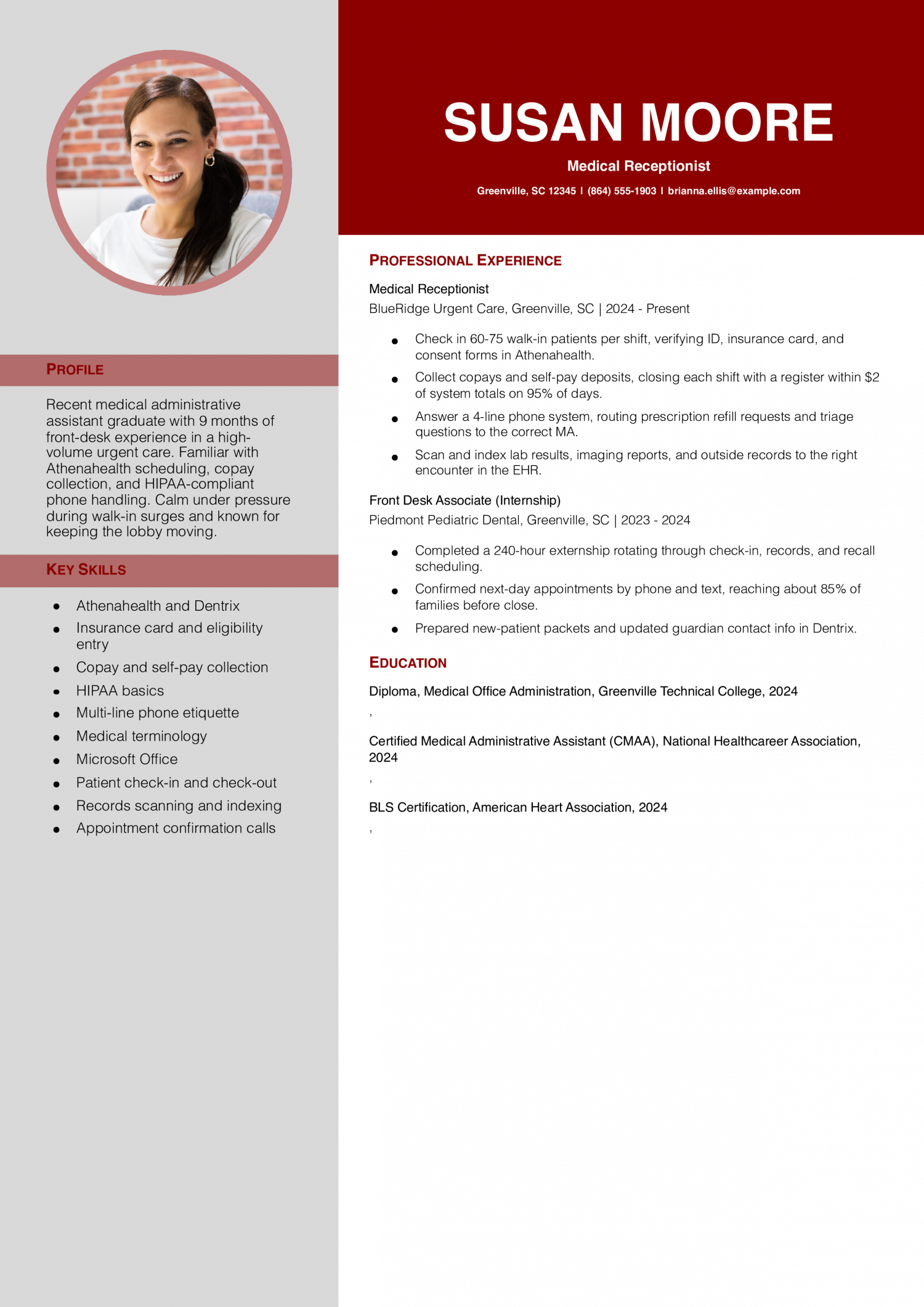
  • Externship counted as real experience: Listing the 240-hour rotation with specific duties shows clinics she has hands-on time, not just a classroom credential.
  • Cash handling accuracy is concrete: A register that balances within $2 on 95% of days is the kind of detail office managers actually screen for.
  • Credentials listed up top: CMAA and BLS appear in EDUCATION so they show without having to read past the experience block.

Experienced Example

You have two or more years at a front desk and have handled scheduling, copays, and prior authorizations across a full provider schedule. The Experienced resume needs to prove daily patient volume, Epic or eClinicalWorks fluency, and a clean HIPAA record.

Why this resume works

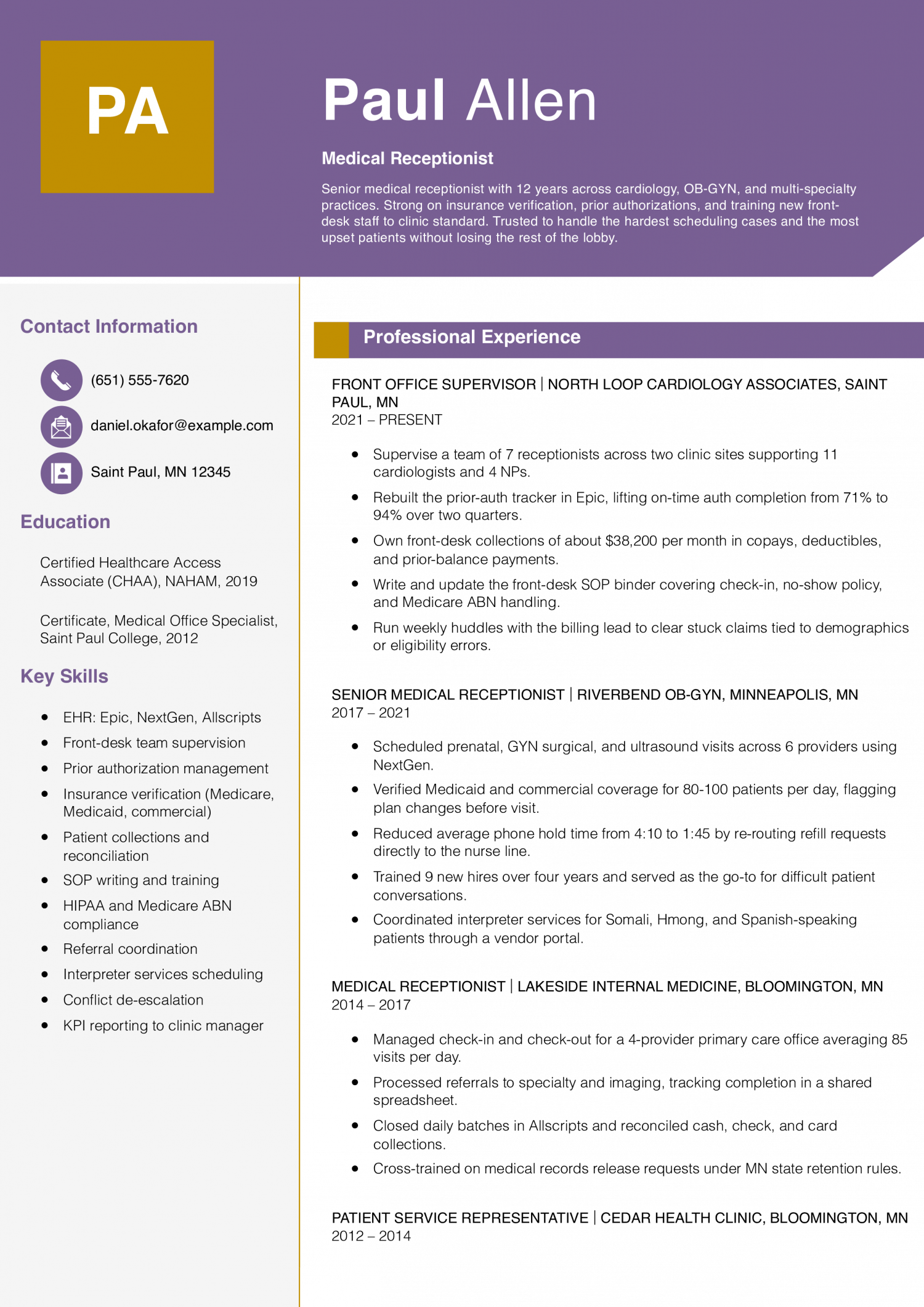
  • Shows he leads a team, not just a desk: Supervising 7 receptionists across two sites tells hiring managers he is ready for lead or supervisor titles.
  • Connects front desk to billing dollars: Tracking $38,200 monthly collections and a 71% to 94% prior-auth jump frames the role as revenue work.
  • Career path reads cleanly: Patient service rep, receptionist, senior, then supervisor shows steady growth without gaps to explain.

How to Write a Medical Receptionist Resume

01 Open with a profile that names your practice setting

Your profile belongs at the top of page one and should name the practice setting you have worked in. List family practice, pediatrics, orthopedics, dental, urgent care, or a multi-specialty group.

State your years at the front desk, the EHR systems you know by name, and the daily patient volume you covered. A practice manager scanning the top six lines wants to see Epic or eClinicalWorks, phone-line count, and insurance verification in plain words. Skip the soft-skill adjectives and lead with the scope a hiring office can match against the posting.

02 Quantify patient volume and call load

Bullets without a number tend to read as job duties. Office administrators scan for daily patient check-ins, calls fielded per shift, and the provider count you supported.

Name two or three real metrics in your bullets. Patients checked in per day, calls routed across a four-line phone system, and copays collected per week are the three that tend to advance further. If your office tracked no-show rates or insurance verification accuracy, those numbers carry weight too.

A strong bullet reads as ‘checked in 80 patients daily across six providers,’ not ‘managed front desk.’

03 Group bullets by front desk function

Sort your work into four buckets so a scanner can locate each skill. Patient intake covers check-in, demographic updates, and consent forms.

Phone and scheduling covers multi-line coverage, appointment booking, and recall lists. Insurance and billing covers eligibility checks, prior authorizations, copay collection, and claim corrections. Records and compliance covers chart prep, release of information requests, and HIPAA-compliant handling of messages.

Naming the buckets inside the experience section keeps the resume readable and matches the language most job postings use.

04 Place EHR and HIPAA proof on page one

EHR fluency and HIPAA training are the two credentials practice managers look for first. Put them in a skills strip near the top, not buried at the bottom.

List the specific systems by name: Epic, eClinicalWorks, Athenahealth, NextGen, Kareo, or Cerner. Add CPR or BLS if your last office required it, and note HIPAA training with the year completed. A Certified Medical Administrative Assistant credential from NHA or AAMA belongs in the same strip.

These signals let the office administrator clear the credential check before reading bullets.

05 Close with education and front-facing experience

Your education section should list a high school diploma and any medical office, billing, or EHR coursework from a community college or vocational program. Name the program by title.

If you came in from retail, hospitality, or a call center, keep one or two of those roles below your medical work to show a track record of customer-facing volume. Limit early roles to two bullets each and translate the language: ‘handled 150 customer calls daily’ reads as transferable phone skill. Cut anything older than ten years unless the office was a clinic.

ATS filters catch more medical receptionist resumes than ever in 2026. The skills below come from our user-built medical receptionist resumes. EHR system names clear the first cut, and patient-facing language decides whether the resume advances.

Practice managers weigh hard skills first because credential and software fit are the gates. Soft skills back the bullets, showing how you handled an anxious patient or a stacked phone queue. Match the list against your target posting and use the soft skills as evidence inside your work bullets, not as a floating list.

Soft Skills % of resumes with this skill
Customer service 79%
Communication 57%
Multitasking 42%
Organization 39%
Attention to detail 26%

And here are the top hard skills showing up most often.

Hard Skills % of resumes with this skill
Appointment scheduling 74%
Electronic health records 59%
Insurance verification 42%
Medical terminology 38%
Patient intake 29%

Based on data from thousands of medical receptionists’ resumes built on ResumeTemplates.com, May 2026.

Must Have on a Medical Receptionist Resume

Before a medical receptionist resume gets a closer read, hiring teams check for a short list of essentials.

EHR and Practice Management Systems

EHR fluency is the first hard skill an office administrator checks. Name every system you have used by its real product name so the keyword scan and the human scan both catch it.

  • Epic (used at large hospital systems and many primary care groups)
  • eClinicalWorks (common across independent practices and small groups)
  • Athenahealth (used in primary care, specialty, and behavioral health)
  • NextGen Healthcare (ambulatory and specialty practices)
  • Cerner, now Oracle Health (hospital outpatient clinics)
  • Kareo and DrChrono (small practice and solo provider settings)
  • Practice Fusion (small primary care offices)

HIPAA and OSHA Compliance

HIPAA is a credential signal and a behavior signal. Show both without ever referencing a real patient.

Signal the Training, Protect the Patient

List HIPAA training as a credential with the year you last completed it. Annual refresher training is the norm at most clinics.

Use HIPAA language in your bullets to show how you handled records, messages, and release of information. Skip patient names, diagnoses, and case specifics.

  • Add ‘HIPAA-compliant patient communication’ to your skills strip with the training year
  • Reference release of information volume by count, not by patient or diagnosis
  • Describe records handling by function: chart prep, scanning, portal messaging
  • Do not name the patient, the provider’s note content, or the clinical detail
  • Note any role you played in a HIPAA audit or compliance walk-through at the office level

Medical Reception Credentials That Get You the Job

Beyond a high school diploma and HIPAA training, the certifications below tell a practice manager which front desk functions you can run on day one and how light the onboarding will be. List the certifying body and the year earned for each item.

  • Certified Medical Administrative Assistant (CMAA): Issued by the National Healthcareer Association, this is the most recognized front desk credential and signals scheduling, billing, and records readiness.
  • Certified Electronic Health Records Specialist (CEHRS): Also from NHA, this signals you can navigate EHR charting, order entry, and release of information without weeks of training.
  • Basic Life Support (BLS) from the American Heart Association: Many clinics now require front desk staff to hold current BLS so the lobby has a trained responder during a patient emergency.
  • Certified Medical Office Manager (CMOM): Issued by PMI, this carries weight when you are moving from front desk into a senior medical office specialist or office coordinator role.

Latest BLS Statistics for Medical Receptionists

Medical receptionist is one of the larger occupations in BLS, which means the median pulls in a long tail of part-time and entry-tier variants across small practices. The spread between the tenth and ninetieth percentile widens with EHR fluency, specialty setting, and bilingual coverage.

To position above the median, lead your resume with the EHR systems you have run, the daily patient volume you carried, and any insurance verification or prior authorization work, not the soft skills.

$37,230 National median annual
$38,480 National mean annual
$28,280 Entry-tier floor (10th percentile)
$48,870 Top-decile ceiling (90th percentile)
964,530 Medical Receptionists in the U.S.
Where you stand

Entry tier

$28,280 to $37,230 At the entry tier, lead with your CMAA or medical office certificate, the EHR you trained on, and any customer-facing call volume.

Mid band

$37,230 to $48,870 At the mid band, your resume needs to show daily patient check-ins, insurance verification accuracy, and the EHR you run without supervision.

Top decile

$48,870+ At the top decile, lead with multi-provider scheduling, prior authorization volume, CMOM credentials, and any office coordinator or supervisory scope.

Top-paying states

# State Avg. Annual
1 Alaska $44,380
2 District of Columbia $43,900
3 Washington $43,760
4 California $43,360
5 Massachusetts $42,650
6 New York $41,570
7 Colorado $40,560
8 Maine $40,360
9 Rhode Island $40,360
10 Oregon $39,800

Highest-employment states

# State Workers Median
1 Texas 81,110 $34,480
2 California 80,400 $43,360
3 New York 76,590 $41,570
4 Florida 70,960 $36,070
5 New Jersey 48,710 $39,060
Source: U.S. Bureau of Labor Statistics, OEWS 2024 release (SOC 43-4171).
Written by professional resume writers and loved by hiring managers

Resume Templates offers HR approved resume templates to help you create a professional resume in minutes. Choose from several template options and even pre-populate a resume from your profile.

Frequently Asked Questions

How do I write a medical receptionist resume with no healthcare experience?

Translate your last job into front desk language. Retail, hospitality, and call center work all carry over as phone volume, payment handling, and de-escalation.

Pair that with a CMAA from NHA or a community college medical office certificate. List the EHR you trained on by name, even if it was a classroom version.

Open your profile with the transferable scope, not an objective. 'Customer service professional with 150 daily calls and CMAA training' reads stronger than a goal statement.

Should I list specific EHR systems even if the posting does not name one?

List every EHR you have used by name: Epic, eClinicalWorks, Athenahealth, NextGen, Kareo, or Cerner. Put them in a skills strip near the top.

If the posting names a system you have not used, add a line noting which EHRs you have worked in and how fast you ramped on the last one. Office administrators read that as low training cost.

How should I handle HIPAA on a resume without sharing protected information?

Add 'HIPAA-compliant patient communication' to your skills strip and note the year of your last training. That is enough for the credential scan.

In your bullets, describe the volume and the function, not the patient. 'Processed 40 release of information requests weekly' is safe. Naming a diagnosis or patient situation is not.

How do I prepare for a medical receptionist interview after the resume gets a callback?

Pick three bullets from your resume and turn each into a 90-second story. A stacked phone day, an angry patient, and an insurance verification fix cover most interview prompts.

Check the practice's website for the EHR they use and the patient portal vendor. Naming the system in the interview signals you can step in with light training.

What resume template should a medical receptionist use?

For a medical receptionist, an ATS-friendly template is the safest pick, because it puts your certifications and experience where a hiring manager scans first. A basic template is a solid alternative. Whichever you choose, keep the formatting clean and easy to parse: clear section headings, a standard font, and no graphics a parser can choke on.

Rate this article

Medical Receptionist Resume

Average Rating

4.7/5 stars with 231 reviews

You have given 0 Star(s)
4.7/5 stars with 231 reviews
Andrew Stoner

Executive Resume Writer and Career Coach

Andrew Stoner is an executive career coach and resume writer with 17 years of experience as a hiring manager and operations leader at two Fortune 500 Financial Services companies, and as the career services director at two major university business schools.