An active CNA card and current BLS are what get nursing assistant resumes past the credentialing screen at most facilities; patient load and acuity numbers are what make them readable enough for a unit manager to call.
Featured Example
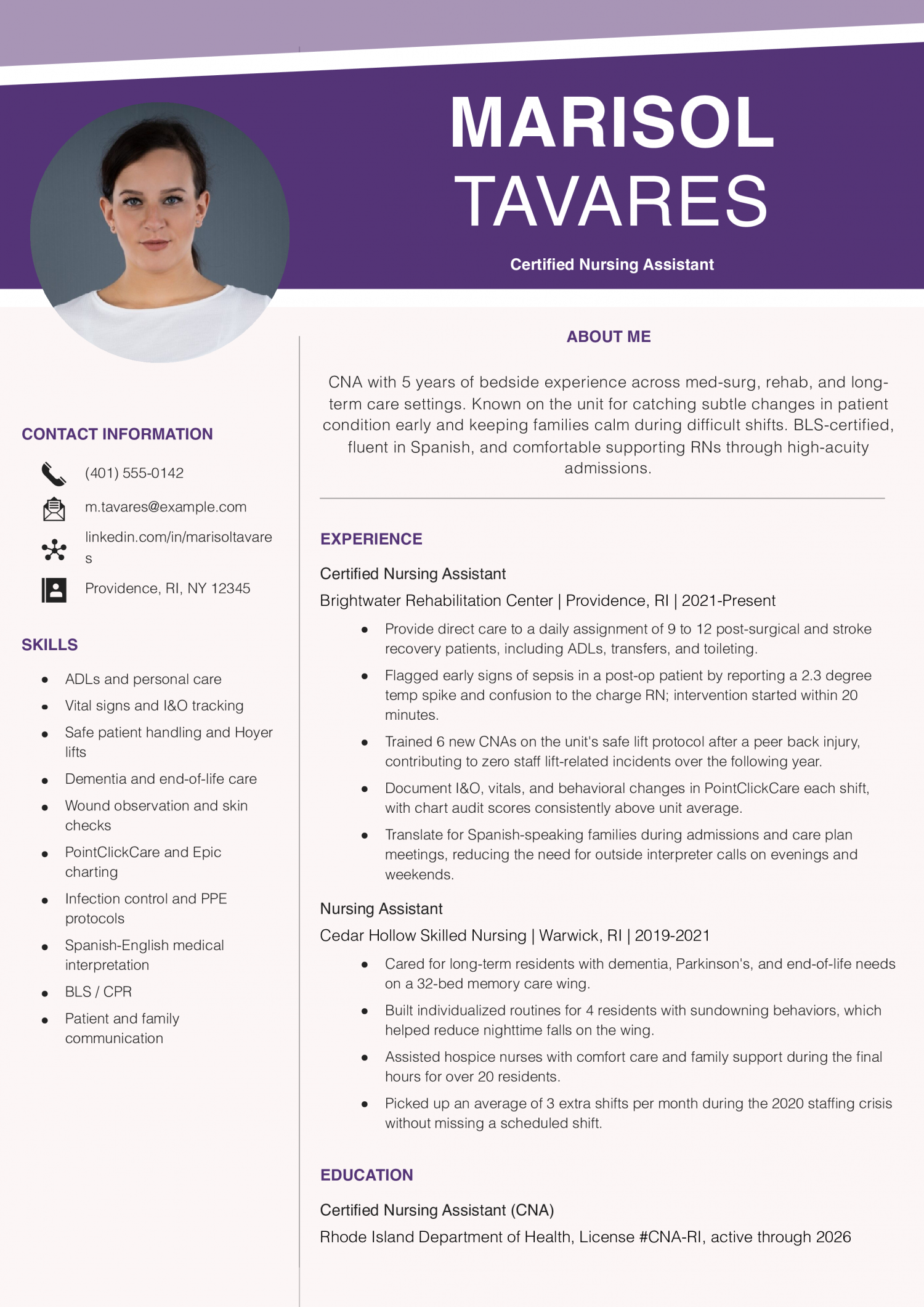
Why this resume works
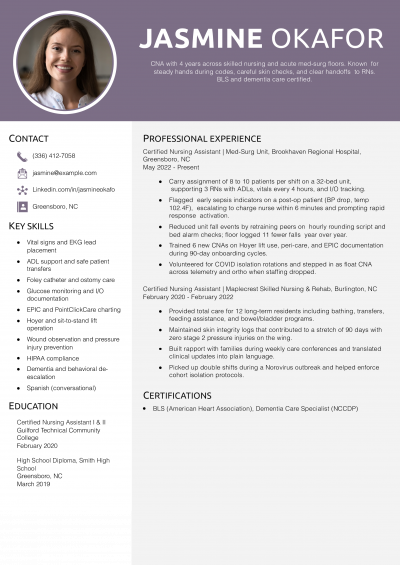
- Caught a serious change early: The sepsis-spotting bullet shows clinical judgment that goes beyond routine task work, which is what charge nurses and hiring managers look for.
- Real workload numbers: Listing 9 to 12 patients per shift and a 32-bed wing tells a recruiter the actual scale of care, not just a job title.
- Bilingual care is named, not buried: Spanish interpretation appears in a bullet tied to admissions and care meetings, which is more useful than a single word under skills.
Entry Level Example
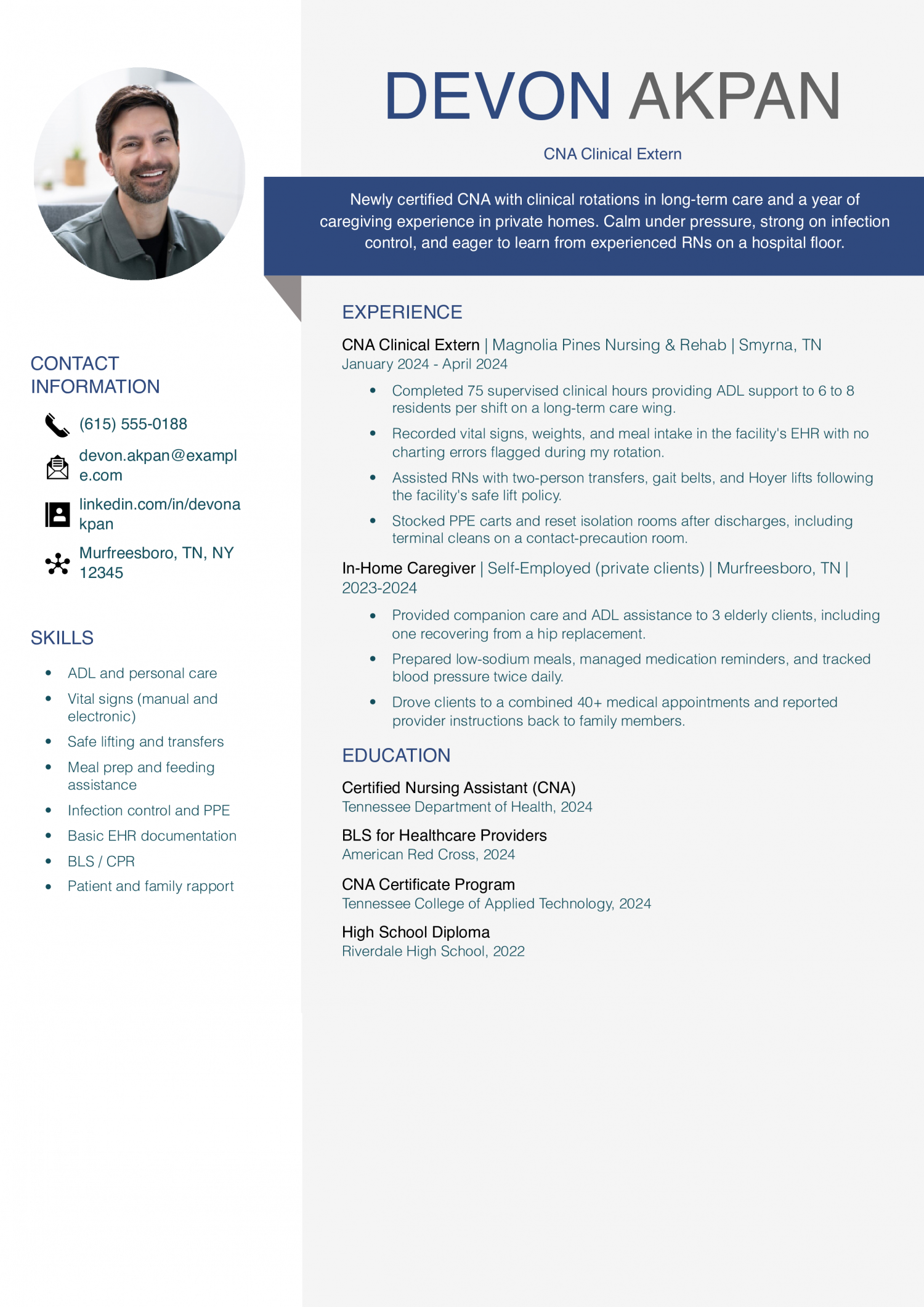
You finished your state-approved CNA program in the last year or two and are working your first long-term care or hospital shifts. The entry-level resume needs to prove an active CNA card, clinical hours logged, and the patient loads you handled during clinicals.
Why this resume works
- Clinical hours stated up front: Listing 75 supervised hours and the type of unit gives a recruiter proof the candidate has been on a real floor, not just in a classroom.
- Caregiving counts as care experience: Framing private-client work with concrete tasks like BP tracking and post-op recovery turns informal work into relevant CNA experience.
- Certifications are easy to verify: License, BLS issuer, and program are all named, so a credentialing office can confirm everything in one pass.
Experienced Example
You have three or more years on the floor, often across long-term care, med-surg, or hospice. The experienced resume needs to prove higher acuity, charge-CNA or preceptor work, and steady EHR charting on platforms like Epic or PointClickCare.
Why this resume works
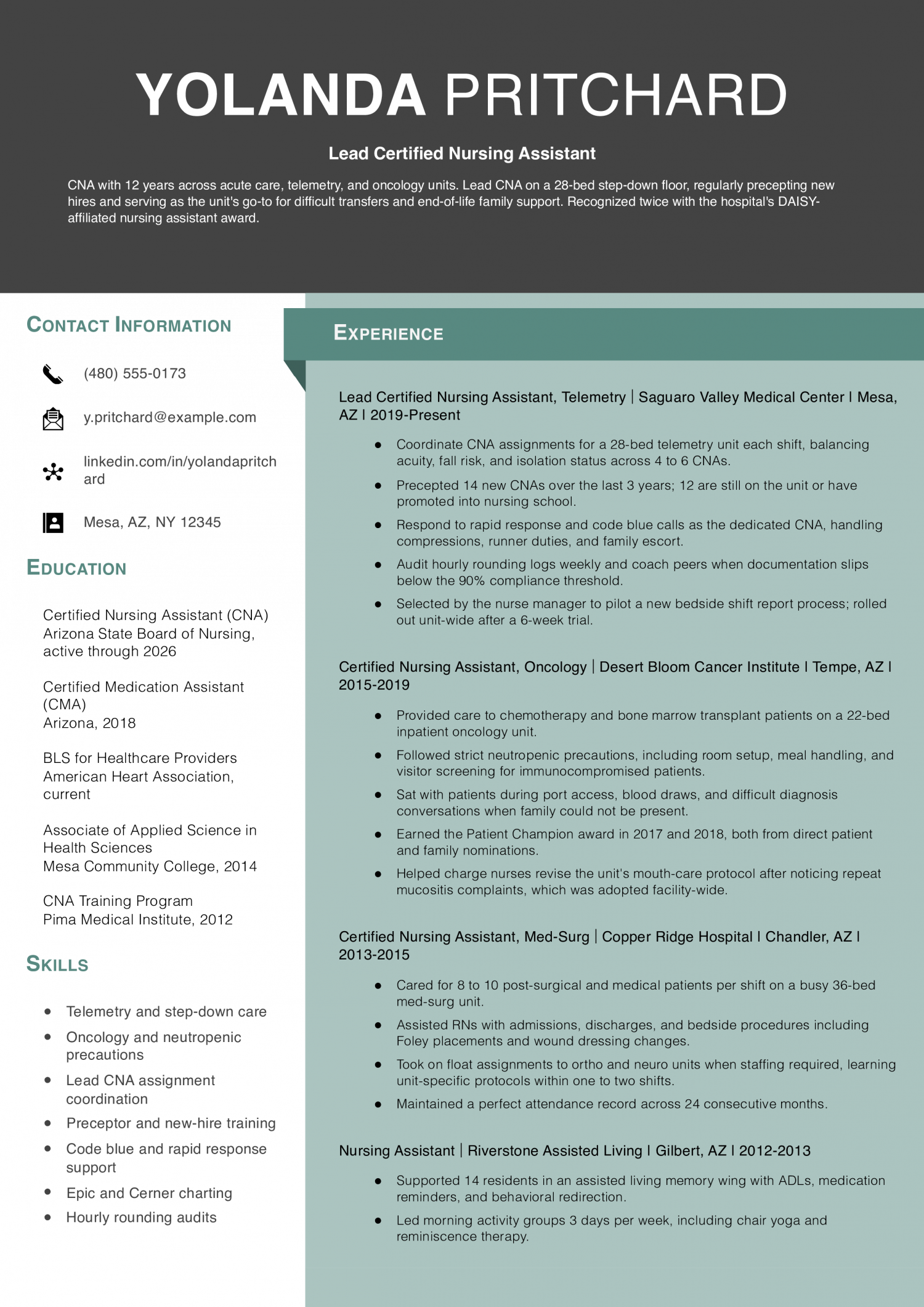
- Shows leadership without a manager title: Lead CNA duties, preceptor work, and a piloted shift report process all signal someone trusted by management to run the floor.
- Career path stays in one lane: Four CNA jobs across med-surg, oncology, and telemetry tell a consistent story of growing acuity, not job hopping.
- Awards come with a source: Patient Champion nominations and DAISY-affiliated recognition are tied to specific years and units, which makes them feel real rather than padded.
Text Version Nursing Assistant
Marisol Tavares
Providence, RI | (401) 555-0142 | [email protected] | linkedin.com/in/marisoltavares
PROFESSIONAL SUMMARY
Bilingual CNA with 7 years of bedside experience across med-surg, rehab, long-term care, and home health. Trusted by RNs to manage high-acuity assignments, mentor new CNAs, and translate during care plan conversations. BLS-certified with active CNA licensure in Rhode Island.
EXPERIENCE
Senior Certified Nursing Assistant
Brightwater Rehabilitation Center | Providence, RI | 2021-Present
- Care for 9 to 12 post-surgical and stroke recovery patients per shift, including ADLs, ambulation, and transfer assistance.
- Reported early signs of sepsis on a post-op patient (2.3 degree temp spike, new confusion), triggering RN intervention within 20 minutes.
- Trained 6 new CNAs on the unit’s safe lift policy; zero staff lift injuries on the team over the following year.
- Translate Spanish for families during admissions and care plan meetings, cutting evening interpreter line use.
- Maintained chart audit scores above unit average across 8 consecutive quarters in PointClickCare.
Certified Nursing Assistant, Memory Care
Cedar Hollow Skilled Nursing | Warwick, RI | 2019-2021
- Cared for long-term residents with dementia, Parkinson’s, and end-of-life needs on a 32-bed memory care wing.
- Built individualized evening routines for 4 residents with sundowning, reducing nighttime falls on the wing.
- Supported hospice nurses and families through comfort care for over 20 residents.
- Picked up an average of 3 extra shifts per month during the 2020 staffing crisis with zero call-outs.
Home Health Aide / CNA
Northeast Home Health Partners | Pawtucket, RI | 2018-2019
- Visited a daily case load of 5 to 7 clients across Providence County for ADLs, meal prep, and vitals.
- Charted from a tablet in the field, with documentation submitted by end of shift on 100% of visits.
- Coordinated with case managers to flag two clients whose home conditions required social work follow-up.
- Drove personal vehicle approximately 180 miles per week between client homes.
CNA, Med-Surg Float Pool
Bayside Regional Hospital | East Providence, RI | 2017-2018
- Floated across med-surg, ortho, and observation units, adapting to each unit’s workflow within a shift.
- Assisted RNs with admissions, discharges, and bedside procedures including catheter care and wound checks.
- Recognized in monthly huddles three times for picking up critical changes in patient status.
EDUCATION
- Certified Nursing Assistant (CNA), Rhode Island Department of Health, License #CNA-RI, active through 2026
- BLS for Healthcare Providers, American Heart Association, current
- CNA Training Program, Community College of Rhode Island, 2017
- Pursuing Associate of Science in Nursing, Community College of Rhode Island, expected 2026
SKILLS
- ADLs and personal care
- Vital signs and I&O documentation
- Safe patient handling and Hoyer lifts
- Dementia, hospice, and end-of-life care
- Wound observation and skin integrity checks
- PointClickCare, Epic, and Cerner charting
- Infection control and isolation precautions
- Spanish-English medical interpretation
- New-hire CNA mentoring
- Home health visit documentation
- BLS / CPR
- Patient and family communication
How to Write a Nursing Assistant Resume
01 Open with the metric a nurse manager would use to size you up
Lead your summary with patient load per shift, the care setting, and your credential status. A unit manager reads that first line to gauge whether you can handle the floor.
Write something like: CNA with three years in a 42-bed skilled nursing unit, handling 12 to 15 residents per shift on day and evening rotations. Name the acuity (post-acute rehab, memory care, hospice), the EHR you chart in, and your active CNA and BLS status. Skip generic openers about being compassionate; the credential line and the patient load tell that story faster.
02 Turn shift work into numbers
Most strong CNA bullets carry a number. Recruiters scan for patient load, vitals frequency, transfer counts, and call-light response times before they read the verbs around them.
Name two or three concrete metrics: residents per shift, ADL rounds completed, weight and intake-output logs charted, or Hoyer transfers performed safely. Bullets without a number tend to read as a duty list, not a track record. If exact figures escape you, give a range (8 to 12 residents) or a scope (entire south wing, 28 beds) so the unit manager can size the work.
03 Group your clinical work by category
Sort your bullets into clusters a nurse manager already thinks in. Four categories cover most CNA roles cleanly.
Direct patient care: ADLs, bathing, feeding, ambulation, repositioning per the two-hour schedule. Vitals and monitoring: blood pressure, pulse, oxygen saturation, blood glucose checks, intake and output. Mobility and safety: gait belts, Hoyer and sit-to-stand lifts, fall-risk rounding.
Charting and communication: EHR documentation in PointClickCare or Epic, SBAR handoffs to the RN. Grouping bullets this way lets a charge nurse skim the resume and place you on the schedule.
04 Put credentials and EHR tools high on page one
Nurse managers verify your CNA registry status before reading bullets, so credentials belong in a block right under your summary. List your state and CNA status (in good standing), BLS provider through the AHA, and any add-ons like CPR for healthcare providers, dementia care training, or phlebotomy.
Do not list your actual CNA registry number or BLS card number on the resume; provide those on the application. Add an EHR line for PointClickCare, Epic, MatrixCare, or Cerner so the screener can match your charting experience to the floor you would work.
05 Close with education, clinical hours, and CE
End with your state-approved CNA program, completion date, and clinical hours logged. For entry-level resumes, this section carries more weight than work history, so name the facility where you completed your clinical rotation.
Add continuing education that maps to the unit you want: Alzheimer’s and dementia care, restorative nursing, wound care basics, or hospice and palliative training. List your high school diploma or GED only if you have no postsecondary coursework, and keep this whole section to four or five lines.
Most Popular Skills on Nursing Assistant Resumes for 2026
Pulled from the resumes our users built in 2026, the lists below show what nursing assistant postings actually screen for. Five years ago, a CNA resume read like a generic duty list of bathing, feeding, and vitals. The mix has shifted toward EHR charting tools, acuity-specific patient loads, and named training like dementia care.
Nurse managers weigh hard skills first because they map to credential checks and floor coverage. Soft skills carry weight, but only when a bullet shows the behavior. Match the items below against the job posting line by line, and use soft skills as the framing around evidence in your bullets.
| Soft Skills | % of resumes with this skill |
|---|---|
| Compassion | 74% |
| Communication | 56% |
| Attention to detail | 49% |
| Patience | 40% |
| Teamwork | 25% |
And here are the top hard skills showing up most often.
| Hard Skills | % of resumes with this skill |
|---|---|
| Vital signs monitoring | 66% |
| Activities of daily living care | 54% |
| Infection control | 50% |
| Patient mobility and transfers | 37% |
| Electronic medical records charting | 28% |
Based on data from thousands of nursing assistants’ resumes built on ResumeTemplates.com, May 2026.
Must Have on a Nursing Assistant Resume
The items below are what separates a nursing assistant resume that advances from one that gets put back in the pile.
Continuing Education That Moves Your Resume
State boards set CE clock-hour requirements for CNA renewal, and most fall in the 12 to 24 hour range per renewal cycle. Use CE strategically to signal the units you want next, not just to clear the renewal bar.
List CE on the resume only when it maps to the role you’re targeting. A wound care basics course belongs on a skilled nursing application; a pediatric vitals course belongs on a children’s hospital application.
Format each CE line with the course title, the provider, the contact hours, and the completion date. Skip generic in-service hours unless the topic is specific (fall prevention, infection control updates, dementia behavioral interventions).
- Dementia and Alzheimer’s care (CE provider and hours)
- Wound care basics for the nursing assistant
- Restorative nursing and ROM protocols
- Infection prevention and PPE updates
- Hospice and palliative care fundamentals
EHR and Charting Systems to Name
Nurse managers match your charting experience to the system on their floor, so naming the EHR is one of the highest-leverage keywords on a CNA resume. List the platforms you’ve used and the setting where you used each one.
- PointClickCare (long-term care and skilled nursing)
- MatrixCare (long-term care)
- Epic (hospital med-surg, telemetry, ED)
- Cerner / Oracle Health (hospital)
- Meditech (hospital and clinic)
- HCHB or Netsmart (home health and hospice)
HIPAA and OSHA Compliance
Every CNA handles protected health information, so HIPAA fluency is assumed. The risk is on the resume itself: a bullet that names a patient, room number, or identifiable detail crosses the line.
Keep PHI Off the Page
Write bullets in aggregate terms. Say 12 to 15 residents per shift, not Mrs. Johnson in 204B.
Say 28-bed memory care unit, not the facility’s full census or any identifying mix.
List HIPAA training as a one-line item under credentials or CE with the year completed. Most employers require annual refresher training, so a recent date carries weight.
- Keep patient names, room numbers, and dates off bullets
- Use aggregate scope (residents per shift, beds per unit)
- List annual HIPAA training with the completion year
- Do not name former patients in summary or work history
Nursing Credentials That Get You the Job
Beyond your state CNA registration and BLS, the certifications below tell a nurse manager which units you can cover and how prepared you are for higher-acuity work. List the certifying body and current expiration month and year for each, and keep the actual card numbers off the resume.
- Certified Medication Aide (CMA): Signals you can pass routine meds under RN supervision in states that allow it, which widens the units a long-term care facility can place you on.
- Alzheimer's and Dementia Care Training: Tells memory care and skilled nursing managers you have formal training in behavioral interventions and redirection, not just on-the-floor exposure.
- Restorative Nursing Assistant (RNA): Maps you to post-acute rehab and skilled nursing facilities that bill restorative programs, which is a clear pay-band lift in many markets.
- Phlebotomy Technician (CPT): Useful for hospital-based CNA and patient care tech roles where draws and specimen handling sit inside the floor workflow.
Allied Health Credentials That Stack Well With CNA
Allied health add-ons widen the floors and shifts a unit manager can schedule you for. Pick credentials that match the setting you want, and list each with the certifying body and current expiration month and year.
- Phlebotomy Technician (CPT) through ASCP or NHA
- EKG Technician (CET) through NHA
- Restorative Nursing Assistant (RNA) through state-approved programs
- Certified Patient Care Technician (CPCT) through NHA
- Home Health Aide (HHA) certification per state requirements
Latest BLS Statistics for Nursing Assistants
For nursing assistants, the 10th-percentile floor reflects entry-tier long-term care work in lower-cost markets, while the top-decile ceiling clusters in hospital systems, government facilities, and high-acuity specialty units. That spread tells you setting and acuity move a candidate from floor to ceiling more than tenure does. Geographic concentration matters too: states with strong union density and metro hospital networks sit well above the national mean.
Lead your resume with the care setting, the acuity, and the certifications that map to where you want to land.
Entry tier
$31,390 to $39,530 At the entry tier, lead with your active CNA status, BLS, clinical hours, and the patient load you handled during rotations.Mid band
$39,530 to $50,140 At the mid band, your resume needs to show steady patient loads, EHR fluency in PointClickCare or Epic, and one specialty add-on like RNA or dementia care.Top decile
$50,140+ At the top decile, lead with hospital or specialty unit experience, charge-CNA or preceptor work, and stacked credentials like CMA, phlebotomy, or telemetry tech.Top-paying states
| # | State | Avg. Annual |
|---|---|---|
| 1 | Oregon | $48,390 |
| 2 | Washington | $48,260 |
| 3 | New York | $47,390 |
| 4 | District of Columbia | $46,860 |
| 5 | California | $46,420 |
| 6 | New Hampshire | $46,050 |
| 7 | Alaska | $45,840 |
| 8 | Maine | $45,640 |
| 9 | Minnesota | $45,580 |
| 10 | Massachusetts | $45,410 |
Highest-employment states
| # | State | Workers | Median |
|---|---|---|---|
| 1 | California | 102,380 | $46,420 |
| 2 | Florida | 91,280 | $36,850 |
| 3 | Texas | 87,050 | $36,390 |
| 4 | New York | 85,310 | $47,390 |
| 5 | Pennsylvania | 65,410 | $41,110 |
Resume Templates offers HR approved resume templates to help you create a professional resume in minutes. Choose from several template options and even pre-populate a resume from your profile.
Frequently Asked Questions
Put it in a credentials block right under your summary, not at the bottom. Write the credential, the state, the status, and the expiration month and year.
Format it like this: Certified Nursing Assistant, Ohio (Active, exp. 09/2027). Do not print your CNA registry number on the resume; provide it on the application when the employer asks.
Lead with your clinical rotation. Name the facility, the unit, the hours logged, and the patient load you handled under your instructor.
Add volunteer hours, caregiver work for a family member, or home health aide shifts if you have them. Keep unrelated retail or food service jobs short, but list them to show work history.
Pull out the transferable patterns: handling people under stress, working a shift schedule, documenting carefully, and staying on your feet.
A retail bullet about de-escalating an upset customer maps to family communication on the unit. A warehouse bullet about lifting and safety maps to transfers and body mechanics. Keep these to two or three lines per job.
List the state where you hold the active license, and add a line noting reciprocity or pending transfer in the target state.
Write it like: CNA, Texas (Active, exp. 04/2027); Florida reciprocity application submitted 02/2026. This tells the nurse manager you have already started the paperwork, which most state registries process in two to six weeks.
For a nursing assistant, an ATS-friendly template is the safest pick, because it puts your certifications and experience where a hiring manager scans first. A basic template is a solid alternative. Whichever you choose, keep the formatting clean and easy to parse: clear section headings, a standard font, and no graphics a parser can choke on.