

Tip !

Security supervisors decide whether to keep reading by the top third of page one; if the guard card status, state, and CPR certification aren't visible by then, the resume gets sorted out before the work history is ever read.

Andrew Stoner , Executive Resume Writer and Career Coach

Why this resume works

  • Real numbers on safety outcomes: The 47% drop in trespassing tells a hiring manager this officer changes outcomes, not just fills a post.
  • Range of settings covered: Healthcare, logistics, and corporate work shows he can handle behavioral health crises and warehouse theft alike.
  • Grew into leading a shift: Moving from staff officer to leading a 4-person night shift shows trust from supervisors and the ability to train others.

Entry Level Example

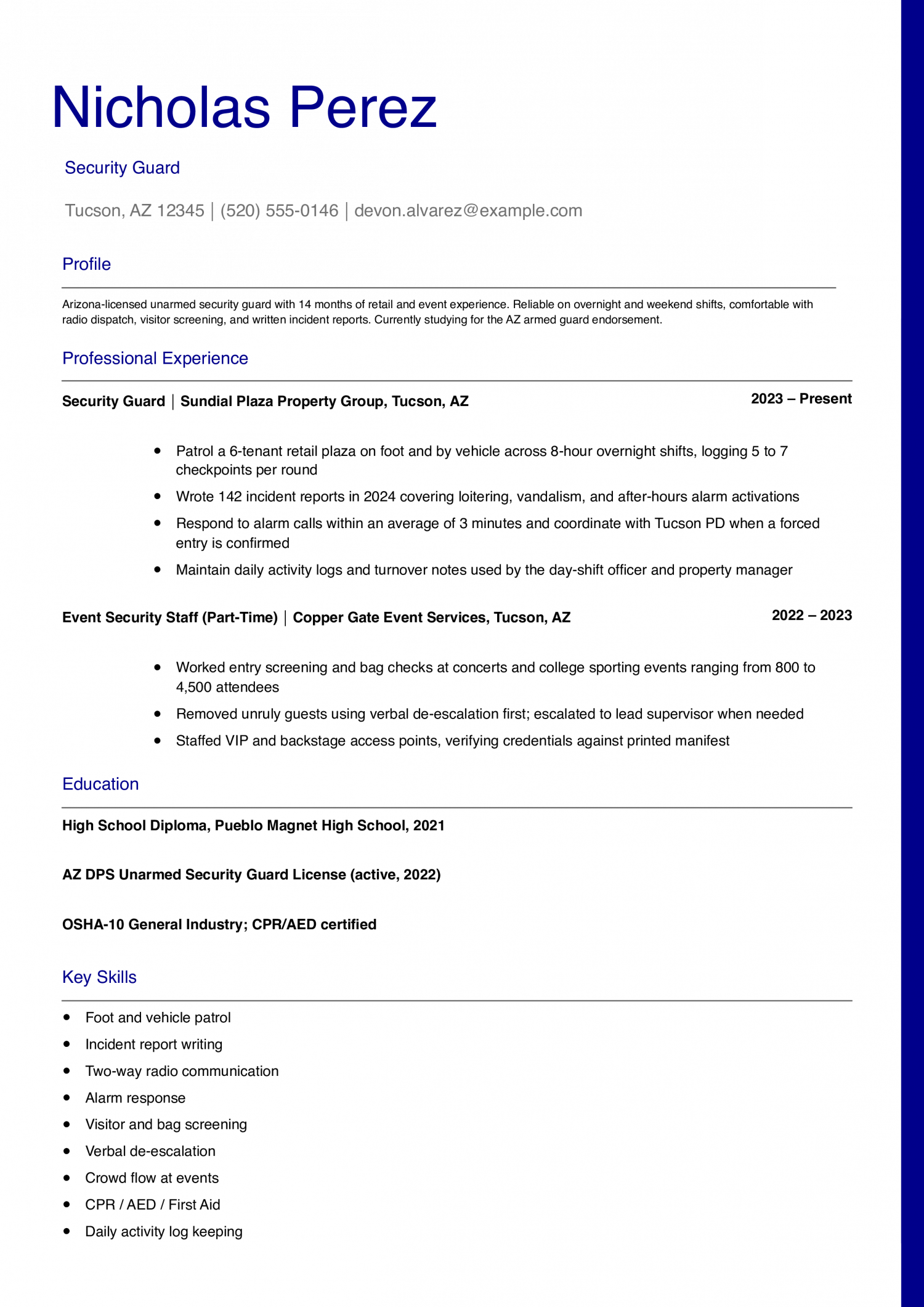
Entry-level guards are working their first or second post after earning a state guard card. The resume needs to prove license currency, CPR and First Aid status, and reliable shift coverage during training.

Why this resume works

  • Shows up for the hard shifts: Calling out overnight and weekend availability tells employers he will work the posts most candidates avoid.
  • Concrete report volume: 142 reports in a year proves the writing skill claim instead of just listing it.
  • Working toward more credentials: Noting he is studying for the armed endorsement signals growth without overstating current qualifications.

Experienced Example

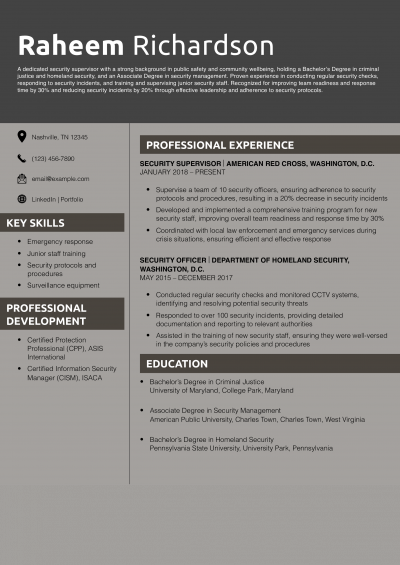
Experienced guards hold multiple years on post with a record of incident reports, radio dispatch use, and CCTV monitoring. The resume needs to prove site complexity, escalation judgment, and supervisor-track readiness.

Why this resume works

  • Cut turnover in half: Going from 38% to 19% turnover is the kind of operational win that separates supervisors from senior officers.
  • Caught a real theft on the job: The $18,400 copper-scrap catch shows hands-on investigation skill, not just policy knowledge.
  • Career across site types: Corporate HQ, manufacturing, high-rise, and port work shows a supervisor who has seen most post environments.

How to Write a Security Guard Resume

01 Open with what a license lookup won't show

A state guard card check tells a supervisor you can stand a post. It does not tell them what kind of post you can hold.

Add one line at the top that names a real differentiator. Armed endorsement, hospital watch experience, executive protection training, bilingual radio use, or a clean record on a high-traffic retail site all qualify.

Lead with the signal another comparable guard is unlikely to carry. That line is the reason a facility manager reads sentence two instead of moving to the next resume.

02 Translate post work into scope numbers

Security work reads as duties without scope language. Patrol bullets need volume, square footage, or post type attached.

Strong bullets name the site size, shift length, and incident report count. Examples: square footage patrolled, posts covered per week, radio calls handled per shift, or visitors screened at access control.

Bullets without a scope marker tend to read as a job description. Resumes that name patrol miles, badge volume, or incident report counts tend to advance further in the screening pass.

03 Group your post duties into categories

Lump-sum bullets bury what you actually did. Group the work into three or four clear buckets so a supervisor can scan fast.

Use access control, patrol and post coverage, incident response and reporting, and CCTV and dispatch monitoring as headers in your bullets.

Under each, name the system or tool: Lenel or AMAG badge readers, Milestone or Avigilon video, Motorola radios, and the incident report platform you used. That vocabulary mirrors the posting and the ATS picks it up.

04 Put credentials on page one

Facility managers screen for guard card status before they read a single bullet. Put a credentials block in the top third of page one.

List your state guard card with status and expiration date, your CPR and First Aid certifications, any armed endorsement with state, and OSHA or AED training.

Do not print your guard card number on the resume. Carry it to the application form. The credentials block clears the compliance gate; the bullets win the interview.

05 Close with training and clearances

Entry and mid-tier security resumes close with training, not a thin education section. Name the academy or pre-assignment training, hours completed, and the state that approved it.

Add any federal or site clearances you hold, defensive tactics or use-of-force training, and continuing education hours logged in the current year.

If you carried a military police or corrections background, list it here with dates and post type. That closing block tells a supervisor you keep your training current between shifts.

Pulled from the resumes our users build, the lists below show the terms security supervisors and facility managers screen for first. Hard skills clear the compliance gate; soft skills get tested in the interview. Match the hard-skill terms against the exact wording in the posting, especially the access control and CCTV platforms named.

Treat the soft skills as evidence to back specific bullets, not as a standalone list.

Soft Skills % of resumes with this skill
Communication 75%
Attention to Detail 68%
Teamwork 47%
Critical Thinking 38%
Situational Awareness 33%

And here are the top hard skills showing up most often.

Hard Skills % of resumes with this skill
Surveillance and CCTV 68%
Access Control Systems 65%
Report Writing 45%
Emergency Response 40%
Alarm Systems 30%

Based on data from thousands of security guards’ resumes built on ResumeTemplates.com, May 2026.

Licenses and Credentials to List on a Security Guard Resume

Security guard hiring is gated on credentials before bullets. Put the items below in a credentials block in the top third of page one so a facility manager can clear you in the first scan.

  • State guard card or security officer license with status and expiration
  • Armed endorsement with state and firearm qualification date (if applicable)
  • CPR, First Aid, and AED certifications with certifying body and expiration
  • Pre-assignment training hours and the academy or provider that delivered them
  • Federal or site clearances held (Public Trust, Secret) with current status
  • OSHA 10 or 30 General Industry completion for industrial or construction posts
  • IAHSS Basic Officer Certification for hospital and healthcare posts
  • Defensive tactics, use-of-force, or pepper spray and baton certifications

Security Credentials That Get You the Job

Beyond the state guard card and CPR card every post requires, the certifications below tell a facility manager which sites you can cover and how prepared you are for an active incident. List the certifying body and the current expiration date for each item.

  • ASIS Certified Protection Officer (CPO): Signals a supervisor-track foundation in patrol, access control, and incident response that few guards on the open market carry.
  • IAHSS Basic Officer Certification: Required by most hospital security programs; list this if you're targeting healthcare watch or emergency department posts.
  • OSHA 10-Hour General Industry: Tells site managers you can cover construction, warehouse, and industrial posts without a separate safety orientation.
  • FEMA ICS-100 and IS-700: Shows you can plug into the incident command system during a fire, evacuation, or active threat without retraining.

Latest BLS Statistics for Security Guards

The top-paying states for security guards cluster around high-cost coastal metros and energy or federal-facility markets, not the Sun Belt cities most guards search first. Pay tracks site risk, union density, and the cost of living the employer has to match.

If you’re geographically flexible, the resume should foreground armed endorsement portability, federal clearance status, and the site types you’ve covered, so a multi-state contractor can place you fast.

$38,370 National median annual
$42,890 National mean annual
$29,800 Entry-tier floor (10th percentile)
$59,580 Top-decile ceiling (90th percentile)
1,241,770 Security Guards in the U.S.
Where you stand

Entry tier

$29,800 to $38,370 At the entry tier, your resume needs to show a current guard card, CPR status, and reliable post coverage through training.

Mid band

$38,370 to $59,580 At the mid band, lead with site complexity, access control platforms used, incident report volume, and any armed endorsement you carry.

Top decile

$59,580+ At the top decile, lead with supervisor or shift-lead scope, federal clearance, IAHSS or CPO credentials, and the post types you've owned.

Top-paying states

# State Avg. Annual
1 District of Columbia $63,130
2 Alaska $48,620
3 Washington $48,010
4 Colorado $46,080
5 Minnesota $46,020
6 Massachusetts $44,950
7 New Hampshire $44,510
8 California $43,930
9 Oregon $43,680
10 Virginia $43,440

Highest-employment states

# State Workers Median
1 California 185,510 $43,930
2 New York 132,140 $42,680
3 Texas 99,370 $33,390
4 Florida 95,350 $36,090
5 Illinois 53,560 $38,630
Source: U.S. Bureau of Labor Statistics, OEWS 2024 release (SOC 33-9032).
Written by professional resume writers and loved by hiring managers

Resume Templates offers HR approved resume templates to help you create a professional resume in minutes. Choose from several template options and even pre-populate a resume from your profile.

Frequently Asked Questions

Should I write a resume objective for a security guard job?

Use a short summary instead of an objective. Three lines that name your guard card state, years on post, and the site type you've covered do more work.

Objectives tend to read as filler to a facility manager. A summary that opens with armed endorsement, hospital experience, or CCTV system fluency clears the first scan faster.

What duties should I list on a security guard resume?

Group duties into four buckets: access control, patrol coverage, incident response and reporting, and CCTV monitoring. Each bullet should name the platform used.

Attach a scope marker to every bullet. Square footage patrolled, posts covered, radio calls handled, badges issued, and incident reports filed all read as concrete work.

Should I put my guard card number on the resume?

No. List the state, license type, status, and expiration date on the resume itself. Carry the actual card number to the application form when the employer requests it.

Most state licensing boards advise against publishing the number. The status and expiration date are what a facility manager scans for during the compliance pass.

How do I show experience if I'm new to security work?

Lead with the guard card, pre-assignment training hours, and CPR certification. Those three items clear the compliance screen.

Then translate prior work. Military police, corrections, retail loss prevention, bouncer shifts, or front-desk customer service roles all map to access control, de-escalation, and incident reporting.

What resume template should a security guard use?

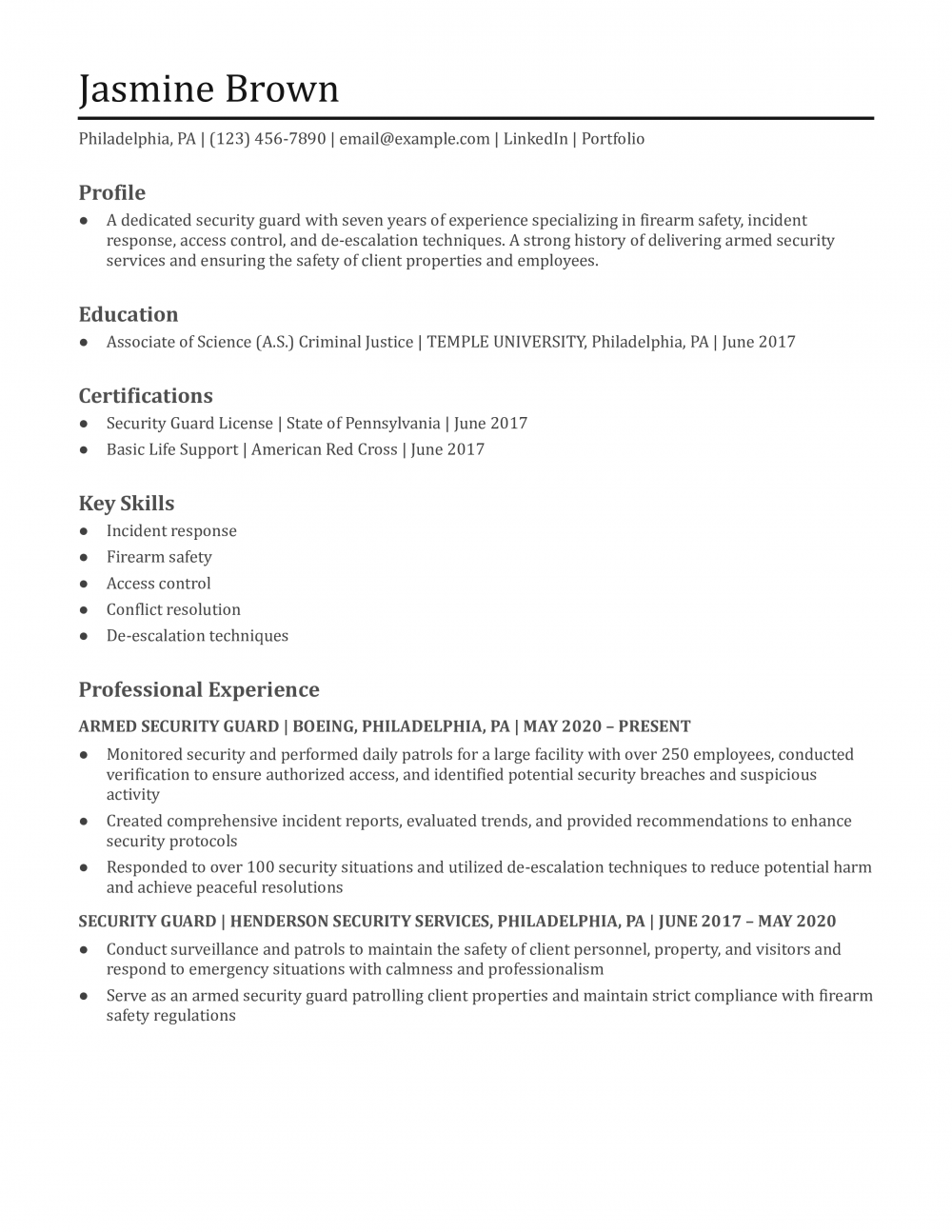
For a security guard, an ATS-friendly template is the safest pick, because it puts your certifications and experience where a hiring manager scans first. A basic template is a solid alternative. Whichever you choose, keep the formatting clean and easy to parse: clear section headings, a standard font, and no graphics a parser can choke on.

Rate this article

Security Guard Resume

Average Rating

4.9/5 stars with 199 reviews

You have given 0 Star(s)
4.9/5 stars with 199 reviews
Andrew Stoner

Executive Resume Writer and Career Coach

Andrew Stoner is an executive career coach and resume writer with 17 years of experience as a hiring manager and operations leader at two Fortune 500 Financial Services companies, and as the career services director at two major university business schools.