

Tip !

A current guard license listed in the top third is what gets security officer resumes past the contract-compliance screen; specific patrol scope and incident counts are what make them readable enough for a site supervisor to call.

Andrew Stoner , Executive Resume Writer and Career Coach

Why this resume works

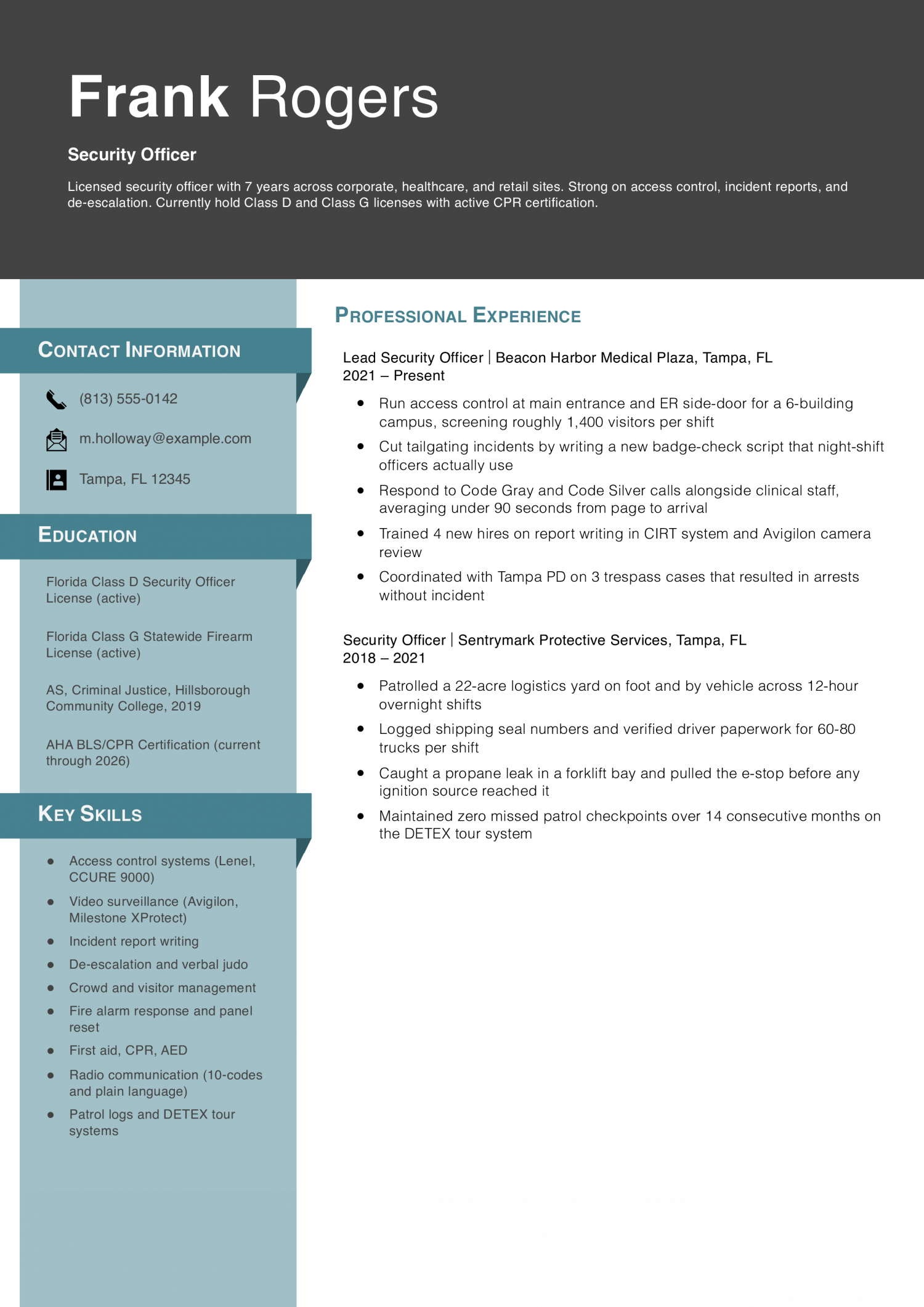
  • Licenses up top: State-specific Class D and G licenses are listed in the summary so hiring managers know the candidate is post-permits and ready to work.
  • Real response times: Code Gray response time and tour-system checkpoint completion are the exact metrics security supervisors look for.
  • Caught a real safety risk: Spotting a propane leak before ignition is a concrete win that proves the candidate actually pays attention on patrol.

Entry Level Example

You're new to licensed security work, often coming from retail, military, or a fresh guard-card class. The entry-level resume needs to prove your license is current, your post-order training is logged, and you can write a clean incident report.

Why this resume works

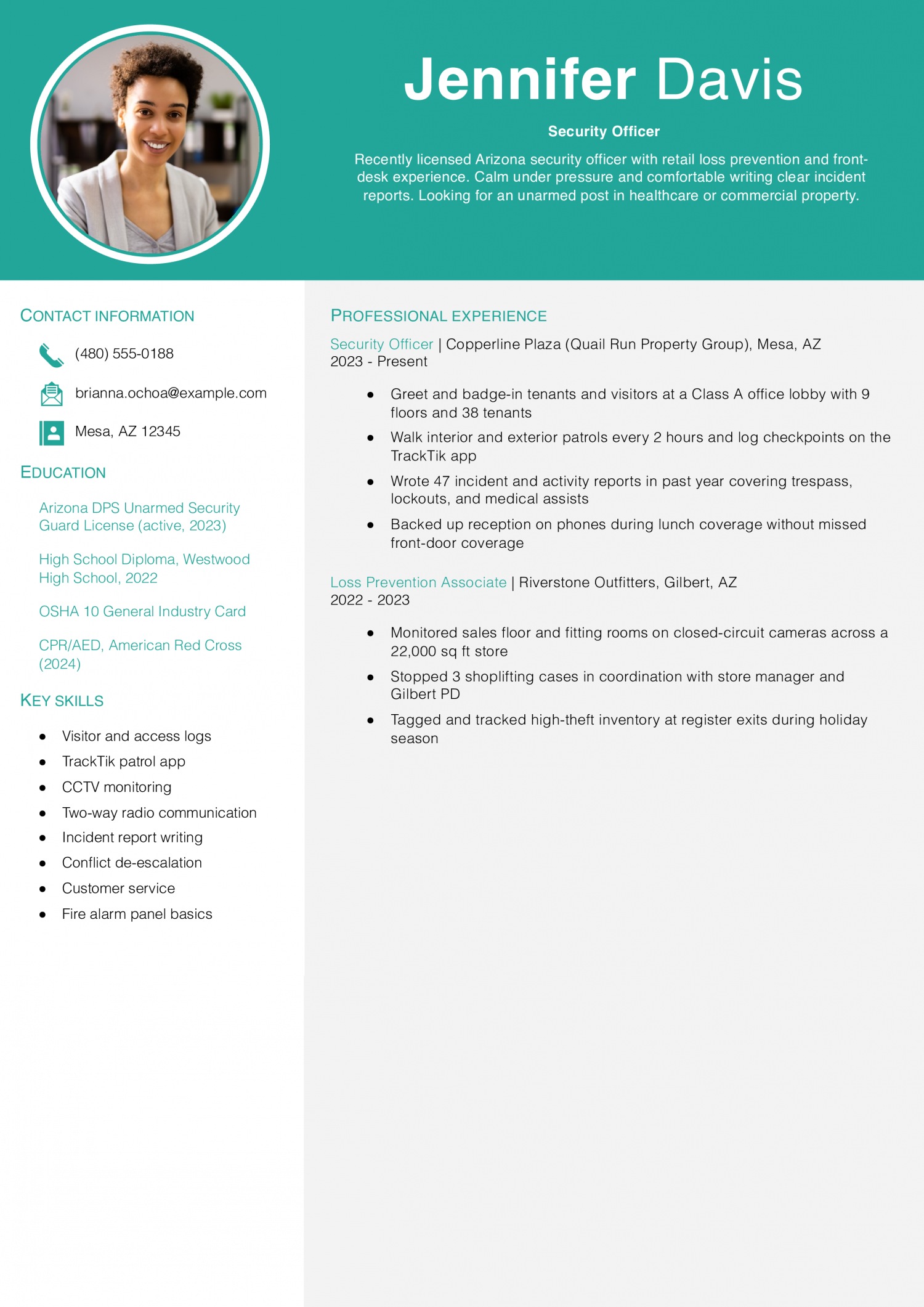
  • Shows the license is current: Arizona DPS license year is right in education so employers see she can start a post tomorrow.
  • Counts the reports written: 47 incident reports tells a hiring manager she can actually document an event, not just stand at a door.
  • Connects past job to this one: Loss prevention experience gives her real CCTV and theft-stop reps that translate straight into a guard post.

Experienced Example

You've worked 3 to 7 years across patrol, access control, or armed posts and have a stack of incident reports to point to. The experienced resume needs to prove patrol scope, system fluency, and a clean compliance record.

Why this resume works

  • Armed credentials front and center: OPOTA and CCW are spelled out in the summary so an armed-post recruiter does not have to guess.
  • Counts real screening volume: 30 prohibited-item findings a month proves he handles screening posts, not just stands at one.
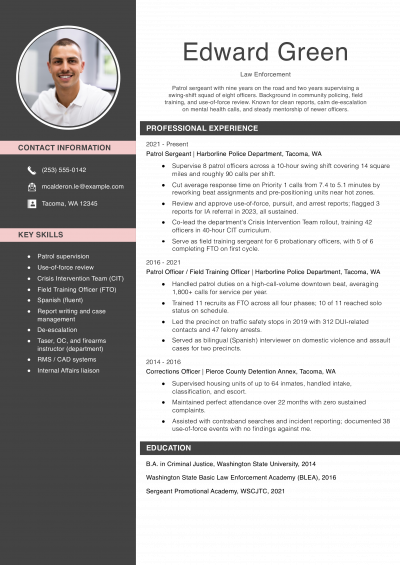
  • Career moves toward harder posts: Industrial yard, then bank branch, then federal courthouse shows steady progression to higher-trust sites.

Supervisor Example

You're running a shift, a site, or a multi-post account as a lead, sergeant, or site supervisor. The supervisor resume needs to prove headcount managed, post-order authorship, and measurable drops in incidents or turnover.

Why this resume works

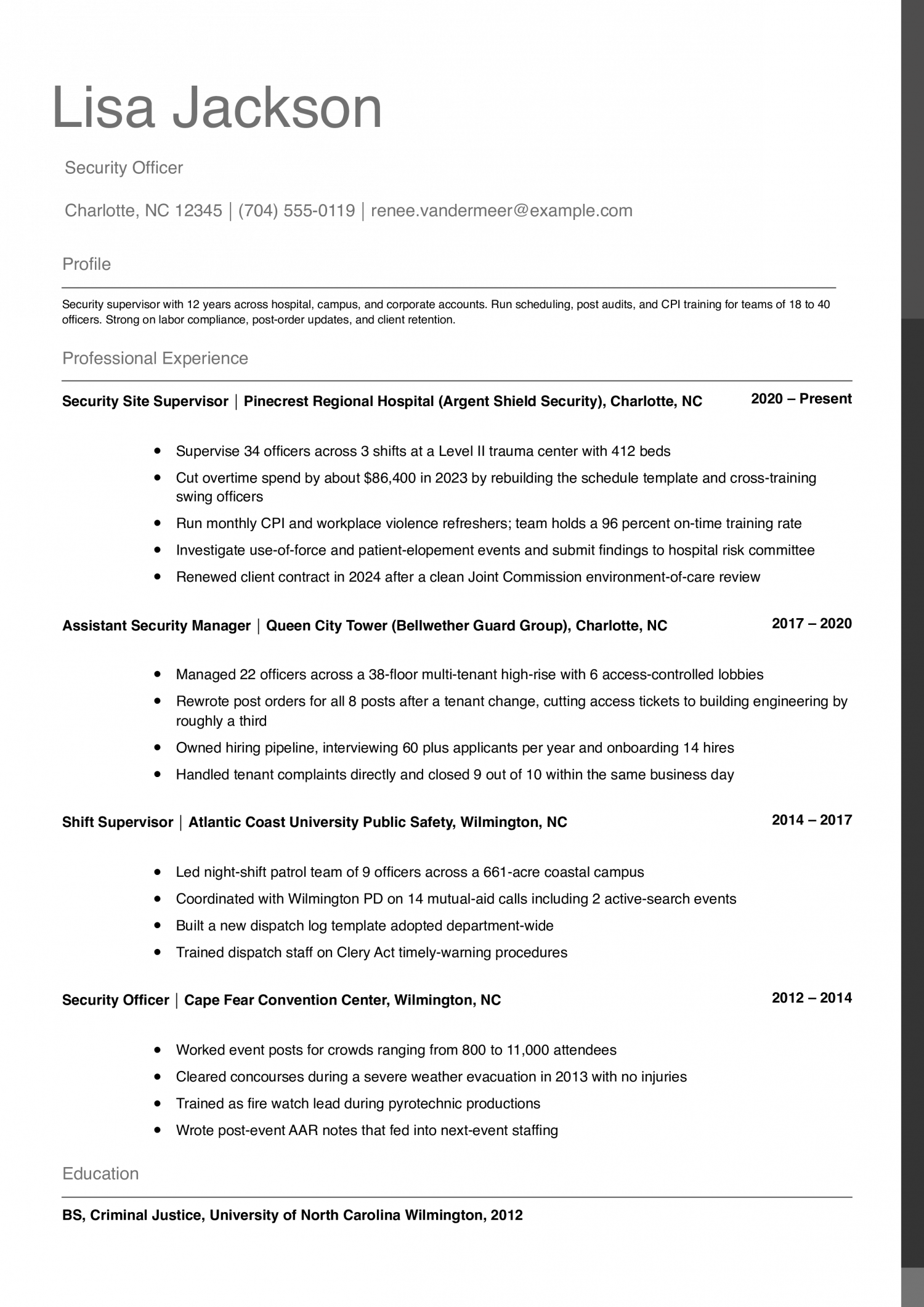
  • Dollar savings on overtime: $86,400 in overtime cuts is the kind of number account managers and clients care about at renewal time.
  • Compliance languages by setting: Joint Commission for hospital, Clery for campus, and post orders for high-rise show she speaks each client’s language.
  • Trainer credentials shown: CPI instructor and IAHSS Advanced put her above officers who just hold a guard card.

How to Write a Security Officer Resume

01 Open with a profile that names your post type

Your profile should state your years of licensed security work and the post environment you’ve covered. Name the setting clearly: retail, corporate lobby, healthcare, K-12, industrial, or special event.

Then name your license tier (unarmed, armed, or commissioned) and the state you’re licensed in. Close with the systems you’ve operated, such as Lenel, CCURE, Genetec, or Milestone.

Site supervisors and account managers read this block to confirm you match the post order before reading further. A profile that names retail loss-prevention work will not get screened for a hospital behavioral-health post.

02 Quantify patrol scope and incident volume

Bullets without a number tend to read as a duty list. Most strong security resumes name the scale of the post: square footage patrolled, posts covered per shift, or access points monitored.

Useful numbers include incidents logged per month, reports filed per shift, and badge holders managed. For armed or healthcare posts, add response times to alarms or codes.

Recruiters scan for these figures before reading the verbs. A bullet that reads ‘patrolled 1.2 million square feet across 3 buildings and logged 40 to 60 incident reports per month’ beats ‘conducted patrols and wrote reports.’

03 Group duties into four work categories

Cluster your bullets so a site supervisor can find what they need fast. Use four buckets: patrol and post coverage, access control and visitor management, incident response and reporting, and customer or tenant service.

Under patrol, name the post types and the rounds tools used (Deggy, Detex, TrackTik). Under access control, name the badge system and visitor platform (Envoy, Sine).

Under incident response, name the report platform and escalation chain. Under service, name the population you interacted with: tenants, patients, students, or shoppers.

04 Place license and training above experience

Build a credentials block on page one, directly under your contact line. List your state guard card with status ‘in good standing’ and the expiration month and year. Do not publish the license number itself.

Add CPR/AED/First Aid, any armed or firearms endorsement, OSHA 10 or 30, ICS 100/200, IAHSS for healthcare posts, and de-escalation training such as CPI or MOAB.

Security directors and operations managers need these visible early because contract compliance and client audits depend on them. A buried CPR card looks like an expired one.

05 Close with the right education and extras

End the resume with education, military service, and language skills. Name your high school diploma or GED, plus any associate or bachelor’s coursework in criminal justice, homeland security, or emergency management.

Veterans should list MOS or rate, clearance level if active, and any MP, master-at-arms, or security forces experience. Active clearances (Secret, Top Secret) belong on page one for federal contract posts.

Languages matter for healthcare, hospitality, and transit posts. Name the language and fluency level rather than writing ‘bilingual.’ Skip hobbies, photos, and personal data such as date of birth.

ATS filters catch more security officer resumes than ever in 2026. The skills below come from our user-built security officer resumes. License names and access-control systems clear the first cut, and de-escalation language decides whether the resume advances.

Site supervisors weigh hard skills for contract compliance and soft skills for tenant-facing posts. A Lenel line earns the screen; calm under pressure earns the call. Match the items below against the job posting and use the soft skills as evidence behind your incident-report bullets.

Soft Skills % of resumes with this skill
Communication skills 78%
Situational awareness 68%
Critical thinking 40%
Conflict resolution 37%
Attention to detail 30%

And here are the top hard skills showing up most often.

Hard Skills % of resumes with this skill
CCTV and surveillance systems 68%
Access control systems 53%
Incident reporting and documentation 48%
First aid and CPR certification 35%
Alarm systems and monitoring 30%

Based on data from thousands of security officers’ resumes built on ResumeTemplates.com, May 2026.

Public Safety Credentials for Security Officer Resumes

Site supervisors and contract account managers audit credentials before they read patrol bullets. Group them in a single block on page one so a screener can clear you for the post in seconds.

  • State guard card or security license (name the state and licensing board, status, expiration)
  • Armed permit or firearms endorsement (state board, expiration; omit the permit number)
  • CPR, AED, and First Aid (American Red Cross or American Heart Association, expiration)
  • De-escalation training (CPI, MOAB, or Verbal Judo, completion date)
  • Healthcare security (IAHSS Basic Officer, expiration) where relevant
  • Incident command (FEMA ICS 100, 200, 700, 800) for federal-contract or large-venue posts
  • Active security clearance (Secret or Top Secret) with granting agency and date

Security Credentials That Get You the Job

Beyond your state guard card and CPR, the certifications below tell site supervisors and account managers which post types you can cover and how prepared you are for medical, behavioral, or armed incidents. List the certifying body and current expiration month and year for each item.

  • ASIS Certified Protection Professional (CPP): Signals supervisor-track depth and management knowledge; weighted heavily for site supervisor and account manager roles.
  • IAHSS Basic Officer Certification: Required by most hospital systems for healthcare security posts; pairs with behavioral-health de-escalation training.
  • CPI or MOAB De-escalation Training: Expected for healthcare, K-12, and behavioral-health posts where physical intervention is a last resort.
  • FEMA ICS 100 and 200: Free and quick to complete; shows you can work inside an incident command structure during emergencies or large events.

Latest BLS Statistics for Security Officers

The 90th-percentile security officer out-earns the median by a wide margin, which tells you the market rewards license tier and post setting more than years on patrol. Armed, healthcare, and federal-contract posts pay above unarmed retail and lobby work. Geographic concentration matters too: a handful of metro areas employ the bulk of officers but do not always pay the top rates.

Lead your resume with the post types and license endorsements the high-percentile band hires for, not total years in uniform.

$38,370 National median annual
$42,890 National mean annual
$29,800 Entry-tier floor (10th percentile)
$59,580 Top-decile ceiling (90th percentile)
1,241,770 Security Officers in the U.S.
Where you stand

Entry tier

$29,800 to $38,370 At this tier, your resume needs to show a current guard card, CPR, and post-order familiarity, and lead with any military or LP background.

Mid band

$38,370 to $59,580 At this tier, your resume needs to show patrol scope, access-control systems operated, and incident counts, and lead with armed or healthcare endorsements.

Top decile

$59,580+ At this tier, your resume needs to show headcount supervised, post-order authorship, and CPP credentials, and lead with site or account management scope.

Top-paying states

# State Avg. Annual
1 District of Columbia $63,130
2 Alaska $48,620
3 Washington $48,010
4 Colorado $46,080
5 Minnesota $46,020
6 Massachusetts $44,950
7 New Hampshire $44,510
8 California $43,930
9 Oregon $43,680
10 Virginia $43,440

Highest-employment states

# State Workers Median
1 California 185,510 $43,930
2 New York 132,140 $42,680
3 Texas 99,370 $33,390
4 Florida 95,350 $36,090
5 Illinois 53,560 $38,630
Source: U.S. Bureau of Labor Statistics, OEWS 2024 release (SOC 33-9032).
Written by professional resume writers and loved by hiring managers

Resume Templates offers HR approved resume templates to help you create a professional resume in minutes. Choose from several template options and even pre-populate a resume from your profile.

Frequently Asked Questions

How should I list my guard license on a security officer resume?

Put a one-line entry in your credentials block on page one. Write it as 'California Guard Card (BSIS), in good standing, expires 09/2027.'

Do not publish the actual license number. State licensing boards warn against it, and you'll provide the number on the application form when asked.

If you hold an armed permit or firearms endorsement, list it on a separate line with its own expiration date.

What job duties should I put on a security officer resume?

Name the post type (retail, corporate, healthcare, industrial) and the scope: square footage, posts per shift, or badge holders managed.

Pair every duty with a number or a system. 'Monitored 64 cameras across 3 buildings on Milestone XProtect' beats 'monitored CCTV.'

Close each role with one bullet on incidents handled and reports filed per month.

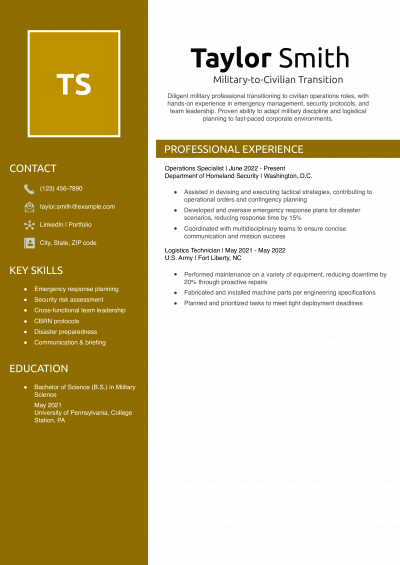
I'm switching from military or law enforcement to civilian security. How do I frame that?

Open the profile with civilian terms: 'armed security officer with 6 years of military police experience.' Avoid acronyms a contract recruiter won't recognize.

Keep active clearances (Secret, Top Secret) on page one for federal-contract posts. Note the granting agency and date.

Convert duties into civilian equivalents: gate guard becomes access control, base patrol becomes mobile patrol, and DD-1408 becomes incident reporting.

My guard card is for a different state than the job I'm applying to. What do I do?

List the active license honestly: 'Texas Level II Commissioned, in good standing, expires 03/2027.' Then add a second line: 'Florida Class D application in progress, expected 06/2026.'

Most account managers will pass over a resume that hides the mismatch but consider one that names a clear timeline.

If the new state offers reciprocity (some recognize military or out-of-state hours), name the program by name.

Which resume template works best for a security officer?

For a security officer, an ATS-friendly template is the safest pick, because it puts your certifications and experience where a hiring manager scans first. A basic template is a solid alternative. Whichever you choose, keep the formatting clean and easy to parse: clear section headings, a standard font, and no graphics a parser can choke on.

Rate this article

Security Officer Resume

Average Rating

4.2/5 stars with 159 reviews

You have given 0 Star(s)
4.2/5 stars with 159 reviews
Andrew Stoner

Executive Resume Writer and Career Coach

Andrew Stoner is an executive career coach and resume writer with 17 years of experience as a hiring manager and operations leader at two Fortune 500 Financial Services companies, and as the career services director at two major university business schools.