Why this resume works

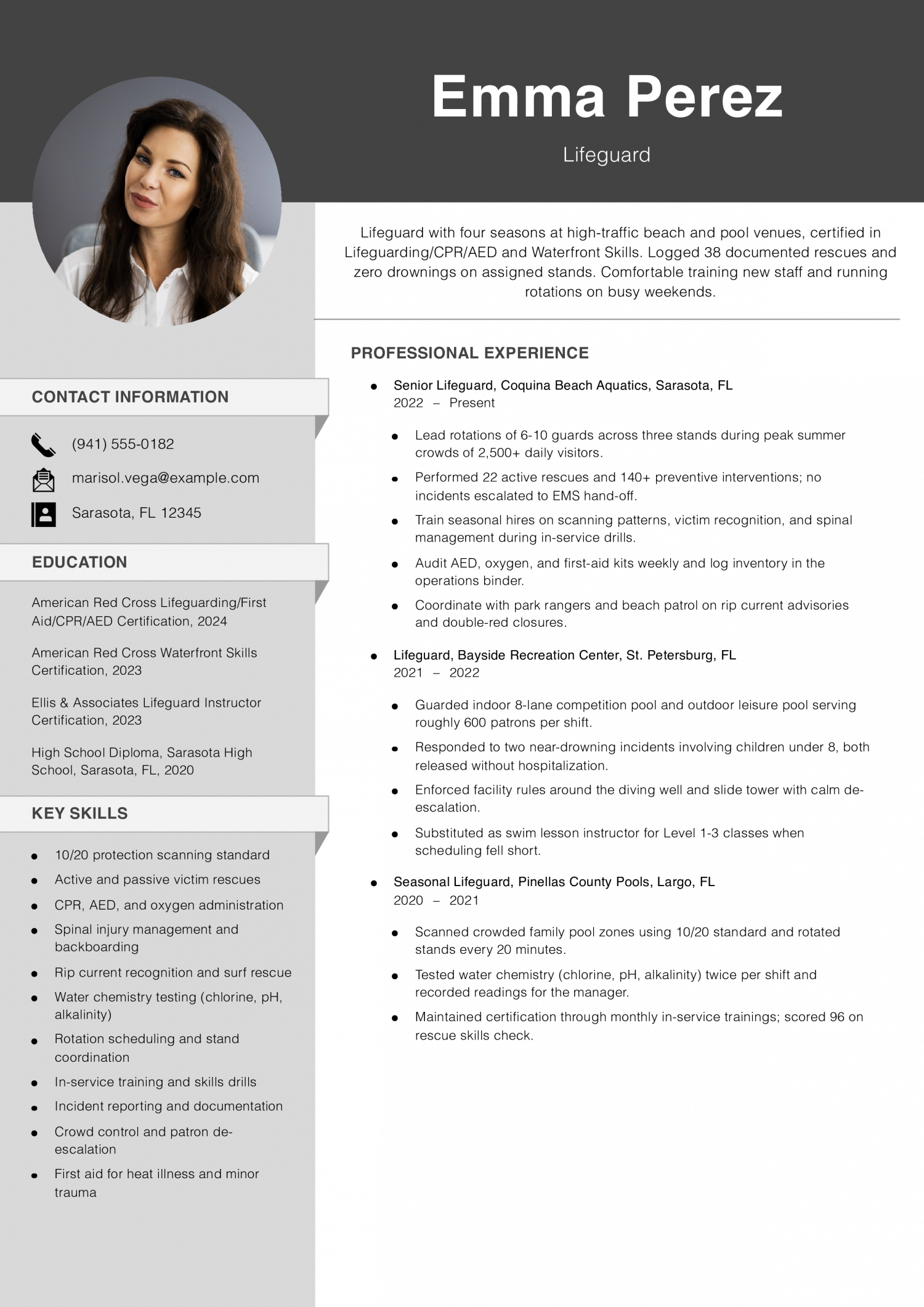
  • Quantified rescue and intervention counts: Counts rescues and preventive interventions instead of using vague phrases like ‘kept swimmers safe.’
  • Clear career progression from seasonal to lead guard: Three roles trace a clean path from rotating stands to running rotations and training new hires.
  • Speaks the language of aquatics ops: Uses terms hiring managers know, like 10/20 scanning, in-service drills, and AED checks.

Entry Level Example

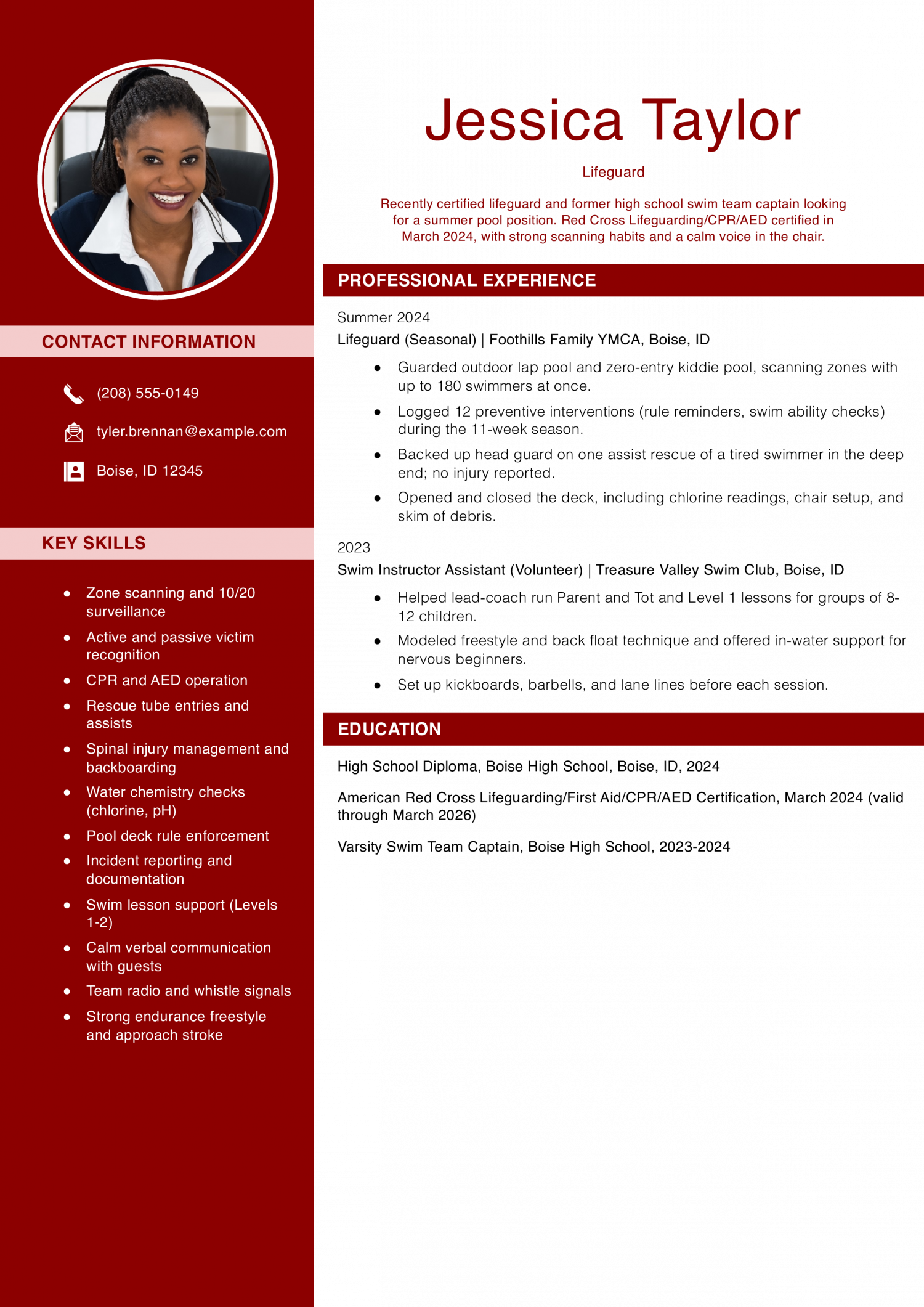
Entry-level lifeguards are high school students, college guards, and first-season hires whose resume rests on current certifications, swim background, and customer-facing work. This resume needs to prove rescue readiness, reliable shift coverage, and the certification dates that let you start training week one.

Why this resume works

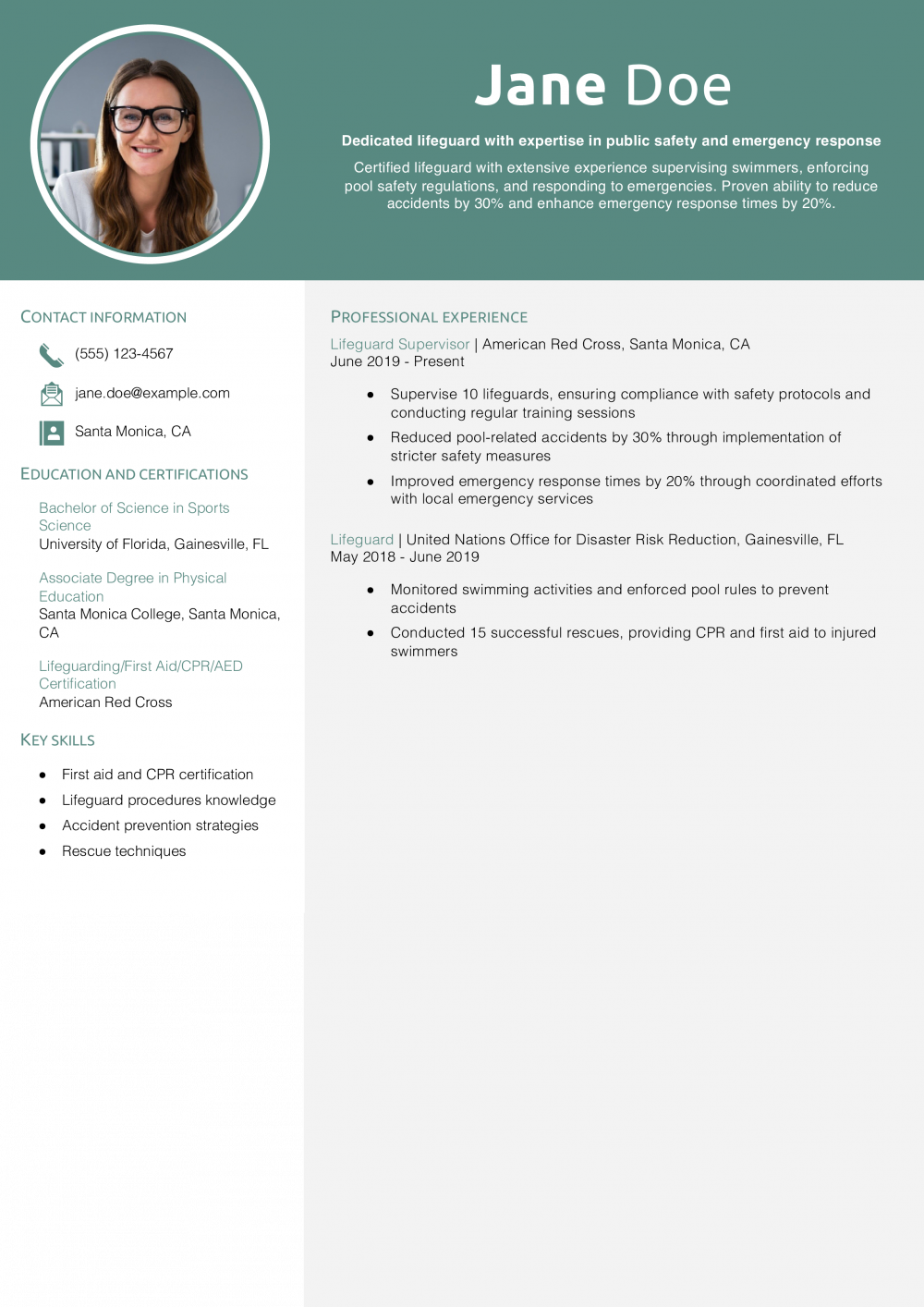
  • Recent certification dated clearly: Lists the month and year of the Red Cross cert so hiring managers know it is current.
  • One real rescue, honestly described: Notes the assist without overclaiming, which reads as trustworthy for an entry-level guard.
  • Volunteer hours count too: Adds a swim club assistant role to show pool comfort even before the first paid summer.

Experienced Example

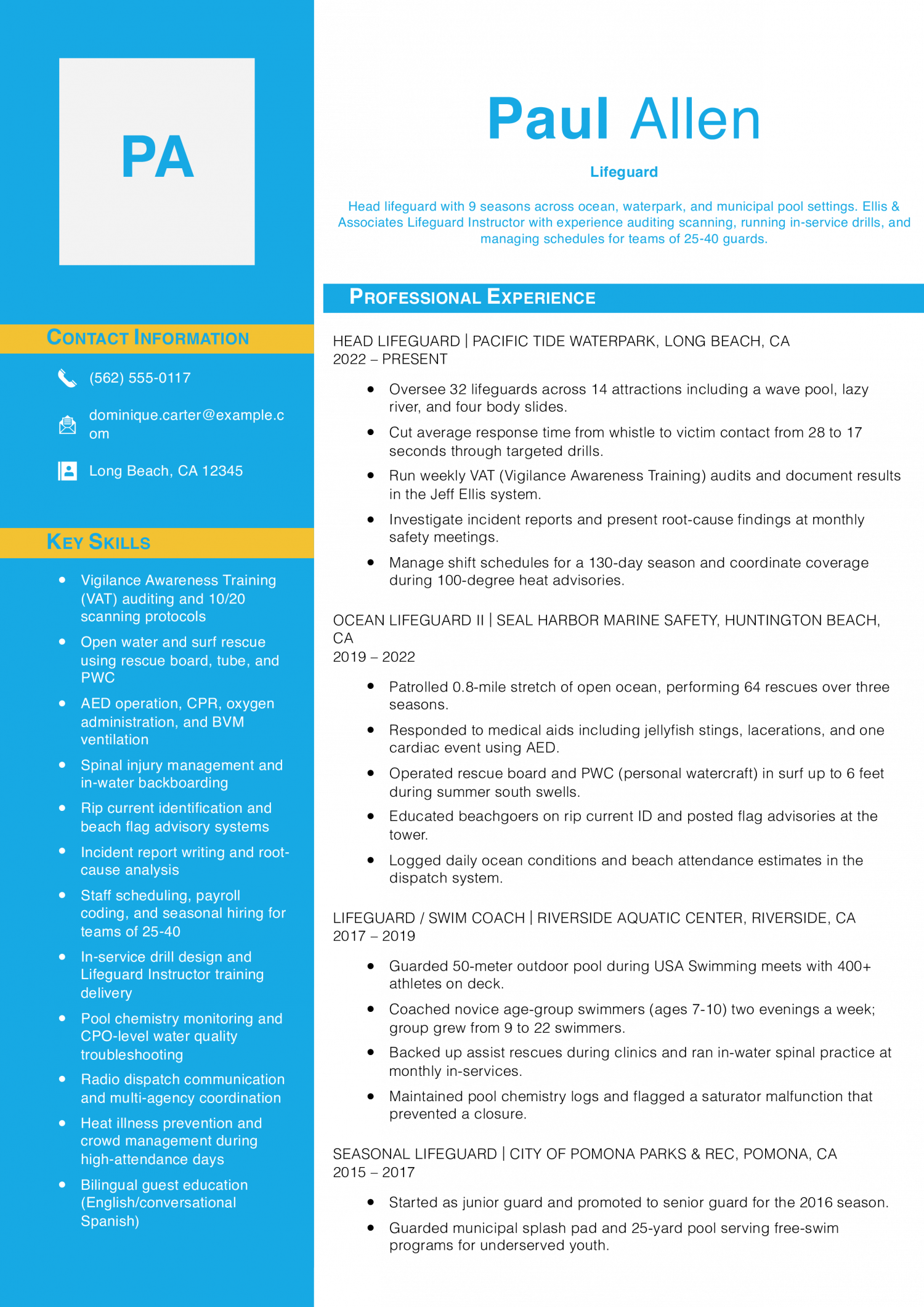
Experienced lifeguards have two or more seasons on stand, often as head guards, swim instructors, or shift leads at pools, beaches, or water parks. This resume needs to prove documented rescues, in-service training hours, and the supervisory or instructional scope that justifies a senior rate.

Why this resume works

  • A response-time number that matters: Cutting whistle-to-contact from 28 to 17 seconds is the kind of metric an aquatics director wants to see.
  • Three different water settings: Waterpark, ocean, and lap pool experience shows range without job-hopping.
  • Instructor credential at the top: Ellis & Associates LGI status signals readiness to train and audit, not just sit a chair.

How to Write a Lifeguard Resume

01 Open with the metric an aquatics director uses to size you up

Lead your summary with a verifiable number, not a scope line. Name the patron volume you supervised, the seasons you’ve worked, and your active certifications with expiration year.

Aquatics directors and pool managers read that first line as your readiness to take a zone. A guard who opens with “three seasons supervising 400-patron weekend pool deck, Red Cross Lifeguard current through 2027” reads as ready. A guard who opens with “hardworking team player passionate about water safety” gets skimmed past.

Put rescues, saves, or documented incidents in the same opening block when you have them.

02 Translate stand time into numbers

Lifeguarding is a scope role, so lean on volume language: patrons per shift, pool surface area, hours scanned, and incidents handled.

Strong bullets read like “Held primary surveillance over 6-lane competition pool and adjacent splash pad, averaging 350 patrons per weekend shift” or “Logged 12 documented assists and 2 active rescues across the 2025 season, all with full incident reports.” Bullets without a number tend to read as duties. Recruiters scan for shift size, depth of water, and whether you guarded waterfront, water park, or pool first. Name the environment in the bullet so they don’t have to guess.

03 Group your work by deck role

Sort your bullets into three or four categories so a head guard reading fast can find what they need. Use Surveillance and Rescue, Patron Safety and Rule Enforcement, In-Service Training, and Opening and Closing Duties as working buckets.

Under surveillance, name the scanning pattern you used and the zone size. Under enforcement, show how you handled rule violations without escalating. Under training, log the in-service hours, mock rescues, and spinal backboarding drills you completed each season.

Opening and closing covers chemical testing, pump room checks, and AED inspections. Three to five bullets per role, ordered with rescue work first.

04 Put certifications in a page-one credentials block

Aquatics directors and pool managers need your credentials visible before they read your work history. Build a Certifications block directly under your summary with each credential, the issuing body, and the expiration month and year.

Include Red Cross Lifeguarding, CPR/AED for the Professional Rescuer, First Aid, and any of Waterfront, Waterpark, or Shallow Water modules you carry. Add Lifeguard Instructor, Water Safety Instructor, or Pool Operator if you have them. Do not list any certification numbers on the resume itself, those go on the application form.

An expired cert in the header is worse than no cert, so renew before you apply.

05 Close with education and swim background

For entry and mid-tier lifeguards, the closing section carries weight because it shows swim foundation and reliability. List your high school or college, expected graduation, and any competitive swim, water polo, or swim team coaching history.

Add languages spoken at native or conversational level, since bilingual guards get prioritized at busy public pools and resorts. If you have a swim instructor, junior guard alumnus, or scuba background, put it here in two lines. Keep this section tight: school, swim experience, languages, availability.

The credentials block already did the heavy lifting up top, so the close just confirms the swim-and-water identity behind the certifications.

The skills below come from lifeguard resumes our users built on ResumeTemplates.com. Aquatics directors and pool managers scan dozens of resumes a week during hiring season, and these are the skills that show up most often. Hard skills like rescue technique and CPR/AED get filtered first by ATS keyword match.

Soft skills like vigilance and patron de-escalation earn the interview once the hard skills clear. Match the hard list against the posting language, and use the soft list as evidence behind your rescue and surveillance bullets.

Soft Skills % of resumes with this skill
Situational awareness 79%
Communication 70%
Calm under pressure 41%
Attention to detail 35%
Customer service 32%

And here are the top hard skills showing up most often.

Hard Skills % of resumes with this skill
CPR and AED certification 66%
First aid certification 64%
Water rescue techniques 41%
Swimming proficiency 39%
Pool safety and surveillance 34%

Based on data from thousands of lifeguards’ resumes built on ResumeTemplates.com, May 2026.

Show Your Shift Availability Up Front

Aquatics directors and pool managers schedule by coverage gap, not by candidate preference. The resumes that get called first say exactly when they can work.

Sample Availability Lines

Add a one-line Availability block under your contact info or at the bottom of your summary. Be specific about days, times, and the season window so the schedule builder can place you fast.

If you can cover the slots most guards avoid, early morning lap swim, late evening close, or holiday weekends, name those explicitly. That single line moves your resume up the stack.

  • Available weekday mornings 5:30 a.m. to 11 a.m., Memorial Day through Labor Day
  • Open weekends and holidays, including July 4 and Labor Day weekend
  • Year-round availability for indoor pool shifts, evenings and Sundays preferred
  • Available for opening or closing shifts, plus on-call coverage with 2-hour notice

Lifeguarding Credentials That Get You the Job

Beyond your baseline Red Cross Lifeguarding and CPR/AED credentials, the certifications below tell aquatics directors and pool managers you can train other guards, teach swim lessons, or run pool operations. List each credential with the issuing body and the expiration month and year, no certification numbers on the resume.

  • Lifeguard Instructor (LGI): Signals you can teach and recertify other guards, which moves you onto the head guard track at most facilities.
  • Water Safety Instructor (WSI): Lets you teach Learn-to-Swim programs and stretches your hours into the off-season at YMCAs and rec centers.
  • Certified Pool Operator (CPO): Shows you can handle chemistry, filtration, and code compliance, which qualifies you for assistant manager openings.
  • Emergency Medical Responder (EMR): Strengthens your medical scope for waterfront, water park, and university aquatic center roles where response times stretch longer.

Latest BLS Statistics for Lifeguards

For lifeguards, the 10th-percentile floor sits at seasonal minimum-wage territory and the top-decile ceiling reaches year-round head guard and aquatics coordinator pay. That spread tells you supervisory credentials, year-round indoor pool work, and instructor add-ons like LGI and WSI move you from floor to ceiling more than tenure does. Geography also matters, since coastal water parks and dense metro rec systems pay above inland seasonal pools.

Lead your resume with the certifications, the environment you’ve guarded, and any supervisory or instructional hours that map to the ceiling.

$33,720 National median annual
$34,700 National mean annual
$24,860 Entry-tier floor (10th percentile)
$44,600 Top-decile ceiling (90th percentile)
143,590 Lifeguards in the U.S.
Where you stand

Entry tier

$24,860 to $33,720 At the entry tier, lead with current Red Cross Lifeguarding and CPR/AED dates, your swim background, and the pool size you've worked.

Mid band

$33,720 to $44,600 At the mid band, your resume needs to show two or more seasons, documented rescues, and either LGI or head guard shift coverage.

Top decile

$44,600+ At the top decile, lead with CPO, supervisory hours, in-service training you led, and year-round aquatics coordinator scope.

Top-paying states

# State Avg. Annual
1 District of Columbia $58,640
2 Hawaii $55,540
3 California $42,520
4 Washington $38,510
5 Massachusetts $36,830
6 Colorado $36,290
7 Rhode Island $36,090
8 New York $35,890
9 Vermont $35,850
10 Alaska $35,650

Highest-employment states

# State Workers Median
1 California 21,730 $42,520
2 Texas 11,600 $29,240
3 Florida 10,010 $35,010
4 New York 7,730 $35,890
5 Virginia 6,700 $31,610
Source: U.S. Bureau of Labor Statistics, OEWS 2024 release (SOC 33-9092).
Written by professional resume writers and loved by hiring managers

Resume Templates offers HR approved resume templates to help you create a professional resume in minutes. Choose from several template options and even pre-populate a resume from your profile.

Frequently Asked Questions

How do I describe lifeguarding on a resume so it sounds like real work?

Describe lifeguarding as surveillance, rescue, and safety enforcement, not pool sitting. Name the zone size, the patron volume per shift, and the water environment.

Use bullets like "Held primary surveillance on 25-meter lap pool, 250 patrons per shift" or "Completed 8 assists and 1 active rescue during 2025 season, all documented with incident reports."

Numbers and environment turn generic duty language into stand-time proof aquatics directors recognize.

Should I put lifeguarding on my resume if I'm applying for a non-aquatic job?

Yes, lifeguarding signals reliability, vigilance, and emergency response under pressure. Hiring managers in office, medical, and service roles read those as evidence of judgment.

Frame bullets around the transferable angle: "Held continuous patron surveillance for 8-hour shifts" or "Led emergency response and incident documentation." Keep CPR/AED current in your credentials block since many employers value it.

What if my Red Cross Lifeguarding certification expired between seasons?

Renew before you apply. An expired Red Cross Lifeguarding or CPR/AED date in your header is worse than no cert listed.

Most aquatics directors will not interview a guard who needs to recert before training week. Sign up for a recert class, add the new expiration to your credentials block, and apply the same week.

How do I write a lifeguard resume with no experience?

Lead with your current Red Cross Lifeguarding, CPR/AED, and First Aid dates in a page-one credentials block. Add your swim background underneath.

Then list swim team, junior guard programs, camp counselor, babysitting, or any role that shows reliability and working with the public. Aquatics directors hiring first-season guards weight current certs and swim history over years on stand.

Which resume template works best for a lifeguard?

For a lifeguard, an ATS-friendly template is the safest pick, because it puts your certifications and experience where a hiring manager scans first. A basic template is a solid alternative. Whichever you choose, keep the formatting clean and easy to parse: clear section headings, a standard font, and no graphics a parser can choke on.

Rate this article

Lifeguard Resume

Average Rating

4.3/5 stars with 175 reviews

You have given 0 Star(s)
4.3/5 stars with 175 reviews
Andrew Stoner

Executive Resume Writer and Career Coach

Andrew Stoner is an executive career coach and resume writer with 17 years of experience as a hiring manager and operations leader at two Fortune 500 Financial Services companies, and as the career services director at two major university business schools.