
Tip !

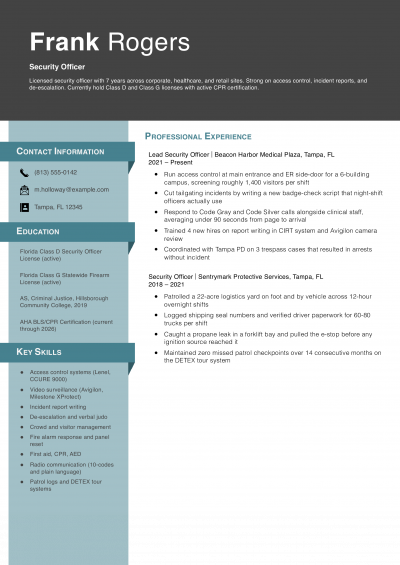
A current POST line and a clean background summary are what get law enforcement resumes past the recruiter's eligibility screen; specific arrest, case, and response-time numbers are what make them readable enough to advance to the oral board.

Andrew Stoner , Executive Resume Writer and Career Coach

Why this resume works

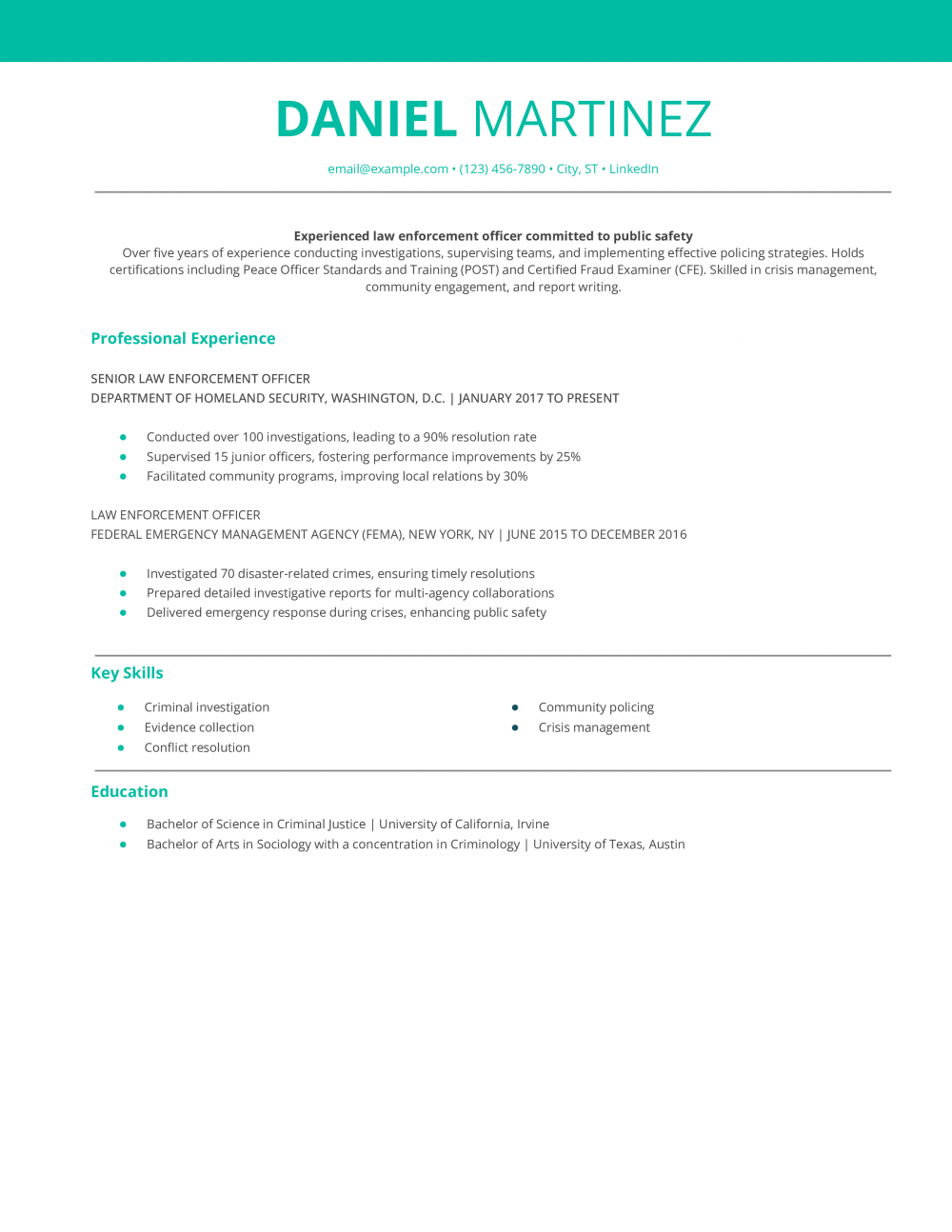
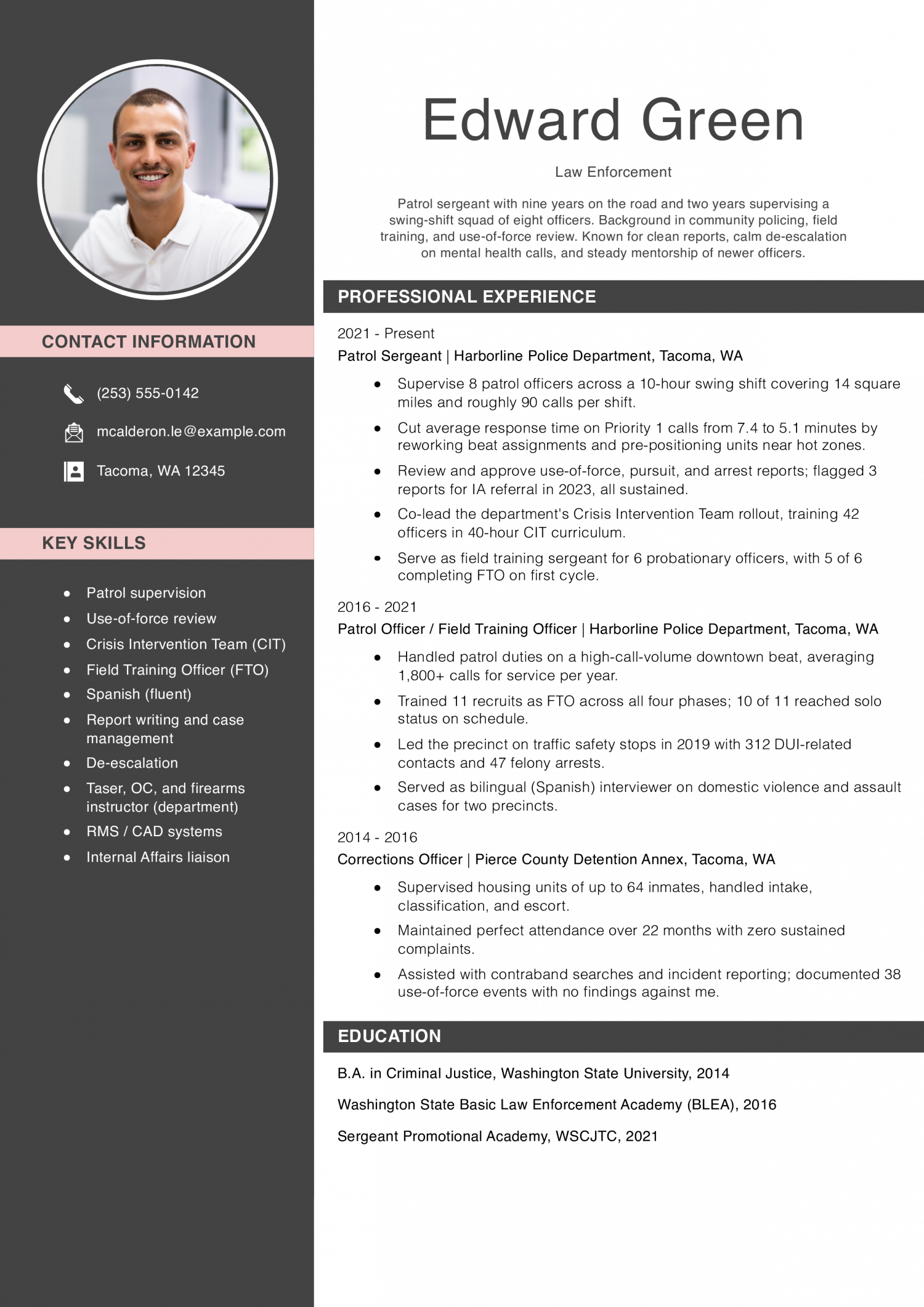
  • Numbers tied to real police work: Response-time drop, CIT class size, and FTO pass rate are the kind of figures a chief or commander actually tracks.
  • Clear move from line officer to supervisor: The job order shows a natural climb from corrections to patrol to FTO to sergeant without gaps.
  • Bilingual skill is called out plainly: Fluent Spanish is listed both in experience and in the skills section, which matters for hiring panels in mixed-language communities.

Officer Example

The officer tab fits sworn patrol with one to seven years on the road, including recent academy graduates and lateral transfers. This resume needs to prove POST status, firearms and defensive tactics currency, and a clean arrest and use-of-force record with citation and case volume.

Why this resume works

  • Honest scope for an early-career officer: The bullets stay inside what a patrol officer with three years on actually does, no inflated claims.
  • One sharp number per job: DUI count and FTO score give the reader something concrete without padding every line with stats.
  • Shows where they want to go next: Naming FTO or K-9 as a goal helps a recruiter route the application to the right unit.

Sergeant Example

The sergeant tab fits a first-line supervisor running a patrol shift, squad, or specialty unit. This resume needs to prove squad-level results, FTO or instructor credentials, and clear examples of officer coaching, scheduling, and review of reports and use-of-force paperwork.

Why this resume works

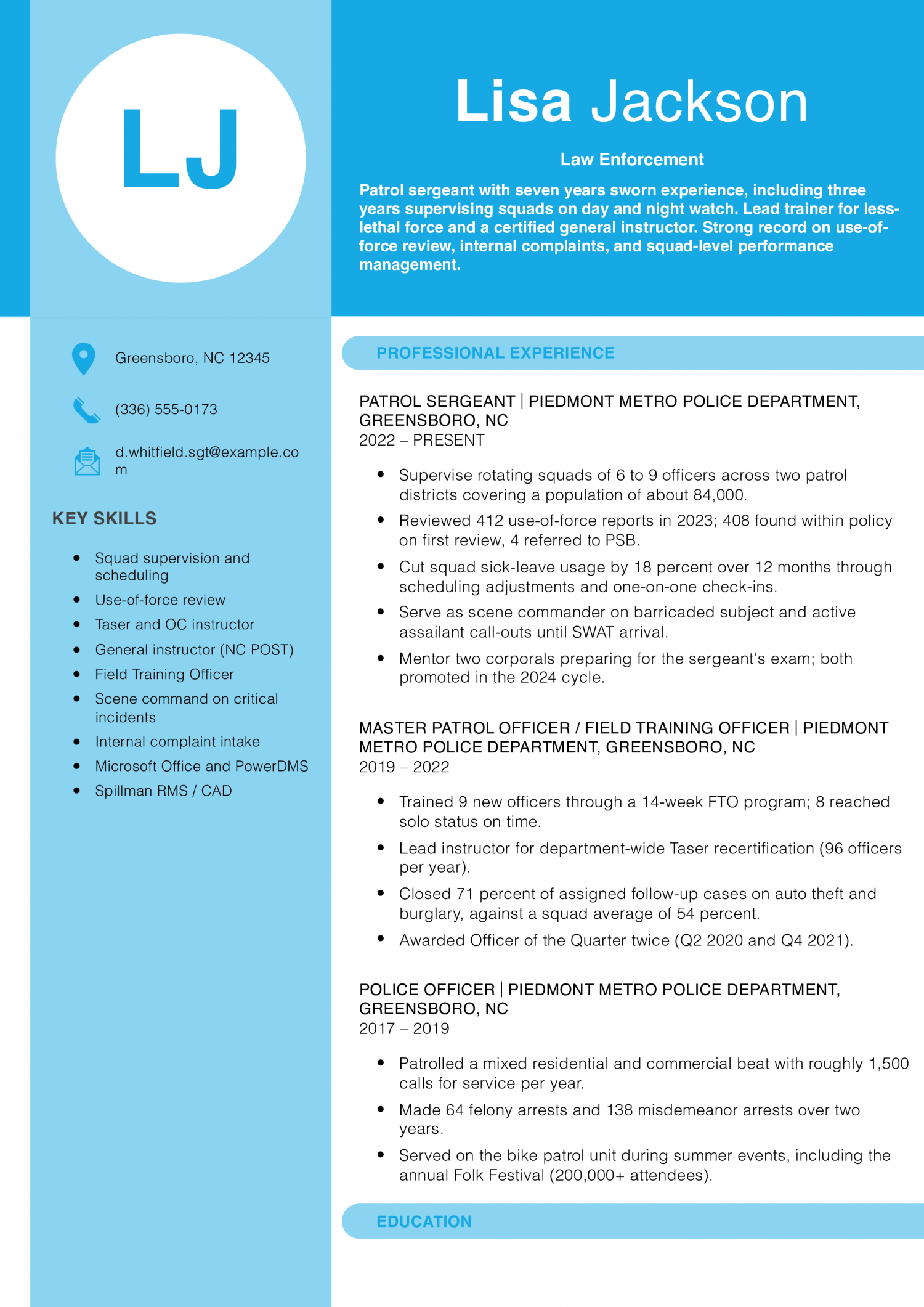
  • Supervisor work is front and center: Squad size, review volume, and sick-leave change are the kind of supervisory facts a promotion board looks for.
  • Builds the case for promotion: Mentoring two corporals who were then promoted is direct evidence of leadership, not just claim.
  • Mixes hard numbers with steady work: The 412 use-of-force reviews give one anchor, while other bullets show consistent day-to-day output.

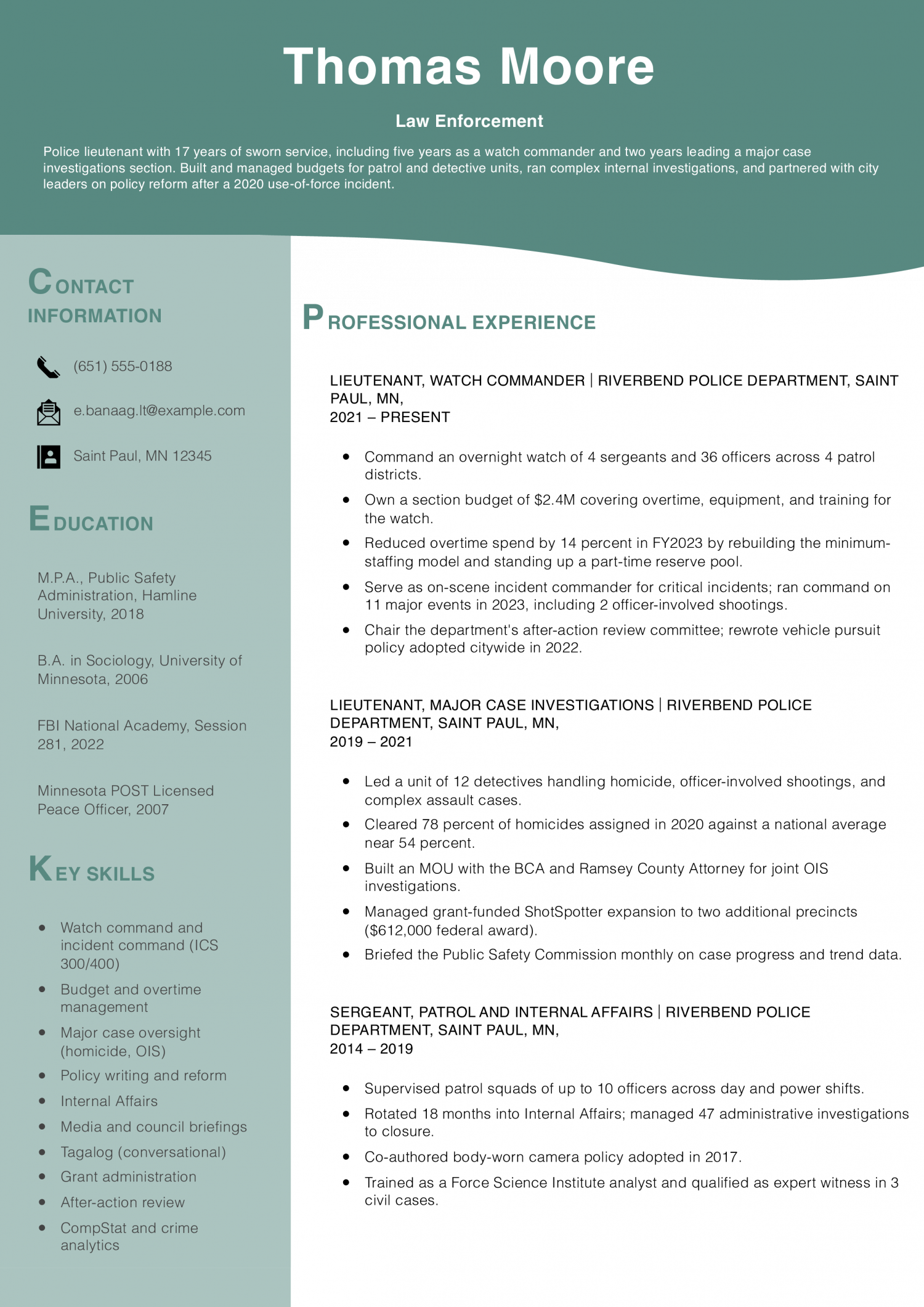
Lieutenant Example

The lieutenant tab fits a watch commander or division head answering for a precinct, shift, or unit. This resume needs to prove command presence across multiple squads, budget and staffing decisions, critical incident command, and measurable shifts in clearance rates or response times.

Why this resume works

  • Commander-level work is clear: Watch size, budget figure, and incident command count tell a chief exactly what this lieutenant has actually run.
  • Policy impact is named, not implied: Rewriting pursuit policy and co-authoring BWC policy show citywide reach beyond the badge.
  • Career arc supports the rank: Officer to sergeant to two lieutenant roles reads as a steady climb earned through varied assignments, not a fast jump.

How to Write a Law Enforcement Resume

01 Open with what a background check won't show

A recruiter can pull your POST status and academy date in seconds. Lead with the signal a database lookup misses.

Open the summary with a specialty assignment, a language, or a credential that sets you apart. Examples: bilingual Spanish patrol in a high-call-volume sector, K9 handler with a dual-purpose dog, FTO with twelve trainees signed off, or crisis intervention team certified.

Pair that line with your sworn status, years on the road, and the size of the agency you serve. That gives the chief a profile before they reach your bullets.

02 Quantify the patrol and case work

Bullets without numbers read as duty statements. Strong law enforcement resumes attach scope to the work.

Name two or three metrics per role: arrests per year, cases cleared, citations issued, calls for service handled, or average response time on priority one calls. Add closure rates for detectives and training hours delivered for FTOs.

When exact counts are restricted, use volume language the agency reports publicly. A phrase like “top quartile in DUI arrests across a 180-officer department” lands harder than “made many arrests.”

03 Group the work into clear duty categories

Walls of mixed bullets blur the record. Sort each role into three or four buckets a panel board can scan.

Useful categories for patrol: calls and enforcement, investigations and case work, community policing and problem-oriented projects, and training or field supervision. For detectives, swap in case intake, search warrants, interviews, and court testimony.

Lead each bucket with the highest-stakes example. A felony arrest holding up at trial, a homicide cleared, or a use-of-force review with no policy violation tells more than a list of routine stops.

04 Front-load credentials and clearances

Recruiters screen for POST status, academy completion, and weapons currency before reading bullets. Put those in a page-one credentials block, not buried under education.

List your POST or state certification with the issuing state, academy name and graduation year, firearms qualification date, and defensive tactics or Taser currency. Add FTO, CIT, ARIDE, DRE, breath test operator, or instructor ratings on their own lines.

List state license status as active and in good standing. Do not publish your POST ID or badge number on a public resume; agencies request those on the application.

05 Close with academy, education, and awards

Most patrol resumes do not need a separate skills wall. Close instead with the academy, degree, and recognition that back the record above.

List the academy with its POST region or sponsoring agency and your class standing if it was top quartile. Add a criminal justice degree, military service with discharge type, and any reserve or auxiliary time.

End with commendations the agency awarded: lifesaving award, medal of valor, unit citations, and chief’s letters of commendation. Name the issuing department and the year.

The skills below come from law enforcement resumes our users built on ResumeTemplates.com. Police chiefs and department recruiters scan hundreds of resumes per posting, and these are the terms that show up most often. Hard skills like report writing and use of force get matched against the posting and the POST job task analysis.

Soft skills like de-escalation and community engagement only count when a bullet shows them in action. Match your hard skills to the exact wording in the target agency’s job announcement, then use the soft skills as evidence anchors inside your patrol and case bullets.

Soft Skills % of resumes with this skill
Communication 77%
De-escalation 50%
Decision-making under pressure 43%
Integrity 37%
Community engagement 28%

And here are the top hard skills showing up most often.

Hard Skills % of resumes with this skill
Report writing 79%
Criminal investigation 56%
Patrol operations 42%
Firearms and defensive tactics 39%
Emergency response 32%

Based on data from thousands of law enforcement officers’ resumes built on ResumeTemplates.com, May 2026.

Public Safety Credentials to List on a Law Enforcement Resume

Recruiters screen the credentials block before they read a single bullet. List sworn status, academy, weapons currency, and specialty ratings in a clean stack on page one so the eligibility check clears in seconds.

  • POST or state peace officer certification, with state and status (active, in good standing)
  • Basic law enforcement academy, with sponsoring agency or POST region and graduation date
  • Firearms qualification, with most recent qualification date and weapons systems
  • Defensive tactics, Taser, and OC currency, with recertification dates
  • Field Training Officer (FTO), Crisis Intervention Team (CIT), ARIDE, and DRE certifications
  • Specialty unit credentials: K9 handler, SWAT operator, motor officer, bike patrol, marine unit
  • Instructor ratings: firearms, defensive tactics, EVOC, general instructor
  • Security clearance level and date of last background investigation, if applicable

Law Enforcement Credentials That Get You the Job

Police chiefs and department recruiters read this list as a map of where your career is heading. The certifications below tell them which track you’ve invested in: patrol specialty, investigations, training, or command. List each item with the issuing body and the year of completion, and note instructor ratings on a separate line.

  • Field Training Officer (FTO) Certification: Signals you can take new officers through the program and review their daily observation reports, a prerequisite for many sergeant promotions.
  • Crisis Intervention Team (CIT) Certification: Shows you can handle mental health calls within department policy, which agencies weigh heavily after the past decade of use-of-force scrutiny.
  • ARIDE or Drug Recognition Expert (DRE): Marks you as the officer the watch calls for impaired driving stops, and supports DUI case bullets that hold up in court.
  • Basic or Advanced Police Instructor: Opens academy, in-service, and range instructor roles, and supports lateral moves into training divisions or POST staff positions.

Latest BLS Statistics for Law Enforcement Officers

The 90th-percentile patrol officer out-earns the median by a wide margin, which tells you the market rewards specialty assignments, overtime-heavy units, and agency size more than years on the job alone. Detectives, K9 handlers, motors, and SWAT operators sit higher in the band than general patrol with the same tenure.

Lead the resume with the specialty unit, instructor ratings, and command experience the high-percentile band actually pays for, not a chronological recap of patrol shifts.

$76,290 National median annual
$79,320 National mean annual
$47,640 Entry-tier floor (10th percentile)
$115,280 Top-decile ceiling (90th percentile)
666,990 Law Enforcement Officers in the U.S.
Where you stand

Entry tier

$47,640 to $76,290 At the entry tier, lead with your POST certification, academy class standing, and FTO program completion with months on solo patrol.

Mid band

$76,290 to $115,280 At the mid band, your resume needs to show specialty assignments, arrest and clearance numbers, and instructor or FTO credentials.

Top decile

$115,280+ At the top decile, lead with command roles, budget and staffing scope, critical incident command, and measurable changes in clearance or response times.

Top-paying states

# State Avg. Annual
1 California $115,400
2 Washington $102,640
3 Illinois $101,530
4 Alaska $100,300
5 Colorado $96,100
6 New York $93,050
7 Hawaii $89,390
8 New Jersey $89,030
9 District of Columbia $88,330
10 Oregon $88,140

Highest-employment states

# State Workers Median
1 California 65,170 $115,400
2 Texas 62,230 $76,350
3 New York 54,360 $93,050
4 Florida 48,340 $76,190
5 Illinois 29,790 $101,530
Source: U.S. Bureau of Labor Statistics, OEWS 2024 release (SOC 33-3051).
Written by professional resume writers and loved by hiring managers

Resume Templates offers HR approved resume templates to help you create a professional resume in minutes. Choose from several template options and even pre-populate a resume from your profile.

Frequently Asked Questions

Where should I list the police academy on my resume?

Put the academy in a credentials block on page one, above or beside your education section. Include the academy name, sponsoring agency or POST region, and graduation date.

Add class standing if you ranked in the top quartile or earned a class award. List your POST or state peace officer certification on its own line with the issuing state.

Note the certification as active and in good standing. Do not publish the certificate number on a public resume.

How do I write a federal law enforcement resume differently from a municipal one?

Federal agencies score resumes against the announcement using the USAJOBS format. That format runs longer and demands month-and-year dates, hours per week, and GS-level duties.

Write in full sentences, not tight bullets, and address every specialized experience statement in the announcement by name. Skipping one can drop you below the cutoff score.

Municipal and county resumes stay closer to a one or two page private-sector format with quantified bullets and a page-one credentials block.

How do I handle use-of-force incidents and internal affairs history on a resume?

Do not list specific use-of-force incidents or internal affairs cases on the resume. Those belong in the background packet, not a public document.

Include a one-line note that your record is in good standing and that a personnel file or POST history is available on request.

Save the detail for the background investigation and polygraph, where the agency expects full disclosure and context.

I'm transitioning from military to law enforcement. How should I frame my experience?

Translate military police, security forces, or combat arms duties into civilian patrol and investigations language. Convert MOS or rate codes into plain English.

Quantify deployments, training cycles, personnel led, and weapons or tactics qualifications. Recruiters read scope, not jargon.

List your DD-214 discharge type, security clearance level, and any civilian POST waiver or academy you have already completed.

What resume template should a law enforcement officer use?

For a law enforcement officer, an ATS-friendly template is the safest pick, because it puts your certifications and experience where a hiring manager scans first. A basic template is a solid alternative. Whichever you choose, keep the formatting clean and easy to parse: clear section headings, a standard font, and no graphics a parser can choke on.

Rate this article

Law Enforcement Resume

Average Rating

4.5/5 stars with 181 reviews

You have given 0 Star(s)
4.5/5 stars with 181 reviews
Andrew Stoner

Executive Resume Writer and Career Coach

Andrew Stoner is an executive career coach and resume writer with 17 years of experience as a hiring manager and operations leader at two Fortune 500 Financial Services companies, and as the career services director at two major university business schools.