College Resume Examples
Your profile should sit at the top of page one. Name your school, your major or intended major, and your expected graduation month and year. Add your GPA if it is 3.3 or higher. State…

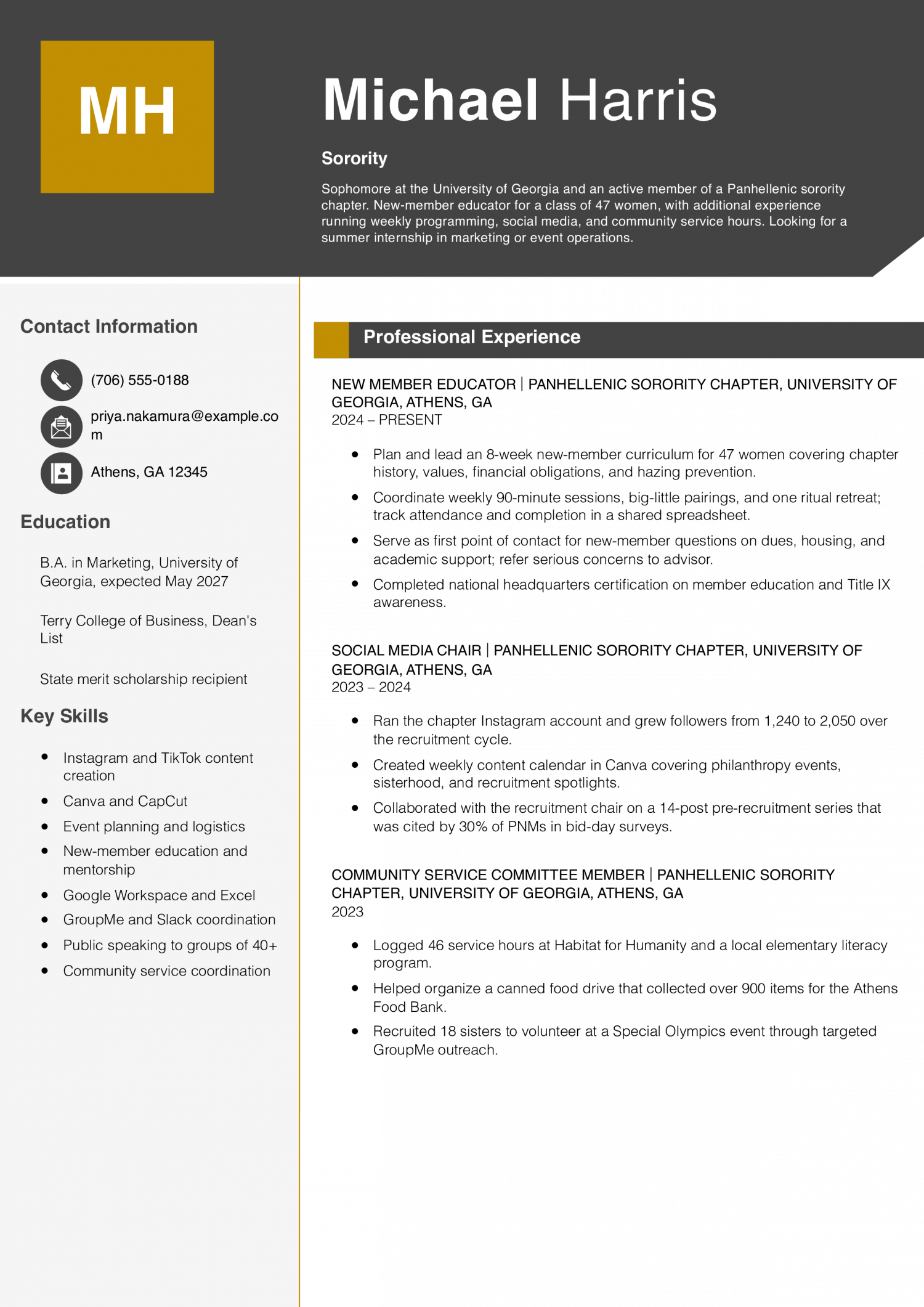
Early-career recruiters and entry-level hiring managers scan the first page of a sorority resume for chapter roles, budgets managed, and philanthropy hours logged, because those markers show whether a new hire can own a project without hand-holding.
This resume is for the college student applying to join a sorority chapter through formal or informal recruitment. It has to show your grades, campus involvement, service hours, and the values you would bring to sisterhood.
Senior at UT Austin and outgoing Chapter President of Delta Beta Phi. Four years of progressive leadership across recruitment, standards, finance, and executive roles. Led a 168-member chapter through a national policy transition and grew formal recruitment retention from 71% to 89%. Strong track record with budgets, event operations, and stakeholder communication.
The first line of your rush resume should lead with a countable fact, not a mission statement. Name your grade average, your class rank band, or the hours you logged in service last year. Recruitment chairs and chapter advisors read dozens of packets in one sitting.
A number at the top tells them where you sit before they read a single bullet. Skip lines like passionate student seeking sisterhood. Write something closer to 3.7 grade average, 120 service hours, and two years on student council.
That opener frames the rest of the page. Every bullet below should back up the number you led with, so pick one you can defend in conversation during a rush round.
Sorority recruitment sits on the lighter end of the numbers scale, so lean on volume and scope more than dollar figures. Strong resumes name three or four countable things: service hours, funds raised, members led, events planned. Bullets without a number tend to read as duties rather than contributions.
Instead of helped plan the fall food drive, write coordinated a food drive that collected 400 pounds across two weekends. Instead of member of debate club, write competed in eight tournaments and placed in three. Recruiters scan for scale first.
A bullet with one number tends to land harder than three bullets of adjectives. Pick the metric you know cold, then move on.
Sort your activities into three or four buckets so a reader can scan the page in under a minute. Common groupings work: academics, leadership, service and philanthropy, and work or internships. Under leadership, list club officer roles, team captain spots, and any committee you chaired.
Under service, list the organization, your role, and the hours or funds tied to it. Under work, list part-time jobs, tutoring gigs, and campus employment. Keep each entry to two or three bullets.
A rush resume that sprawls past one page reads as padded. If an activity does not fit a bucket or add a new fact, cut it. Depth in two areas beats a thin list of ten.
Chapter advisors and recruitment counselors want to spot your credentials without hunting. Put a short honors block on page one, right under your education entry. List things like dean’s list semesters, National Honor Society, and scholarships by name.
Add a small skills line for languages, event planning software, or social media platforms you actually use. Keep it factual. Do not list soft traits like teamwork or leadership as skills.
Those belong in your bullets, shown through what you did. If you hold a certification like lifeguard training or a first aid card, add it here too. Early-career recruiters and entry-level hiring managers reading rush packets glance at this block to place you within seconds, so keep it tight and readable.
End the page with your school, expected graduation month and year, and your intended major or minor. If you are still in high school, list your school, graduation date, and grade average on the same line. Add relevant coursework only if it ties to your intended chapter involvement, like nonprofit management or public speaking.
Skip a references line. Chapters ask for references separately when they want them. Leave your address off if you are worried about privacy.
City and state work fine. Double-check that your contact email sounds professional and that your phone number is current. A clean footer signals that you take the process seriously, which tends to matter as much as the content above it.
ATS filters catch more sorority resumes than ever in 2026. Set both tables side by side with the exact posting you’re going for. Leadership roles and event work clear the first cut. Service hours decide whether the resume advances to a human reader. Early-career recruiters and entry-level hiring managers scan hard skills first. They want to confirm you held real chapter positions. Soft skills like teamwork then show you can work inside a group. Both lists matter, but the hard skills carry more weight in the first pass. Pull two or three items from each table into your resume. Back every soft skill with a bullet that names the outcome. A skill with no proof reads as filler to a trained reviewer. Mirror the posting wording when your chapter work fits the exact term.
Resume Templates offers HR approved resume templates to help you create a professional resume in minutes. Choose from several template options and even pre-populate a resume from your profile.
Yes, list your sorority when it shows leadership, service hours, or event work a recruiter can measure.
Skip it when the only thing you can say is that you were a member. Early-career recruiters read the chapter line for what you did, not the letters themselves.
Write the full chapter name, the Greek letters, the school, and the years you were active.
Put it under Leadership, Activities, or Involvement, not under paid work. Add your officer title on the same line when you held one.
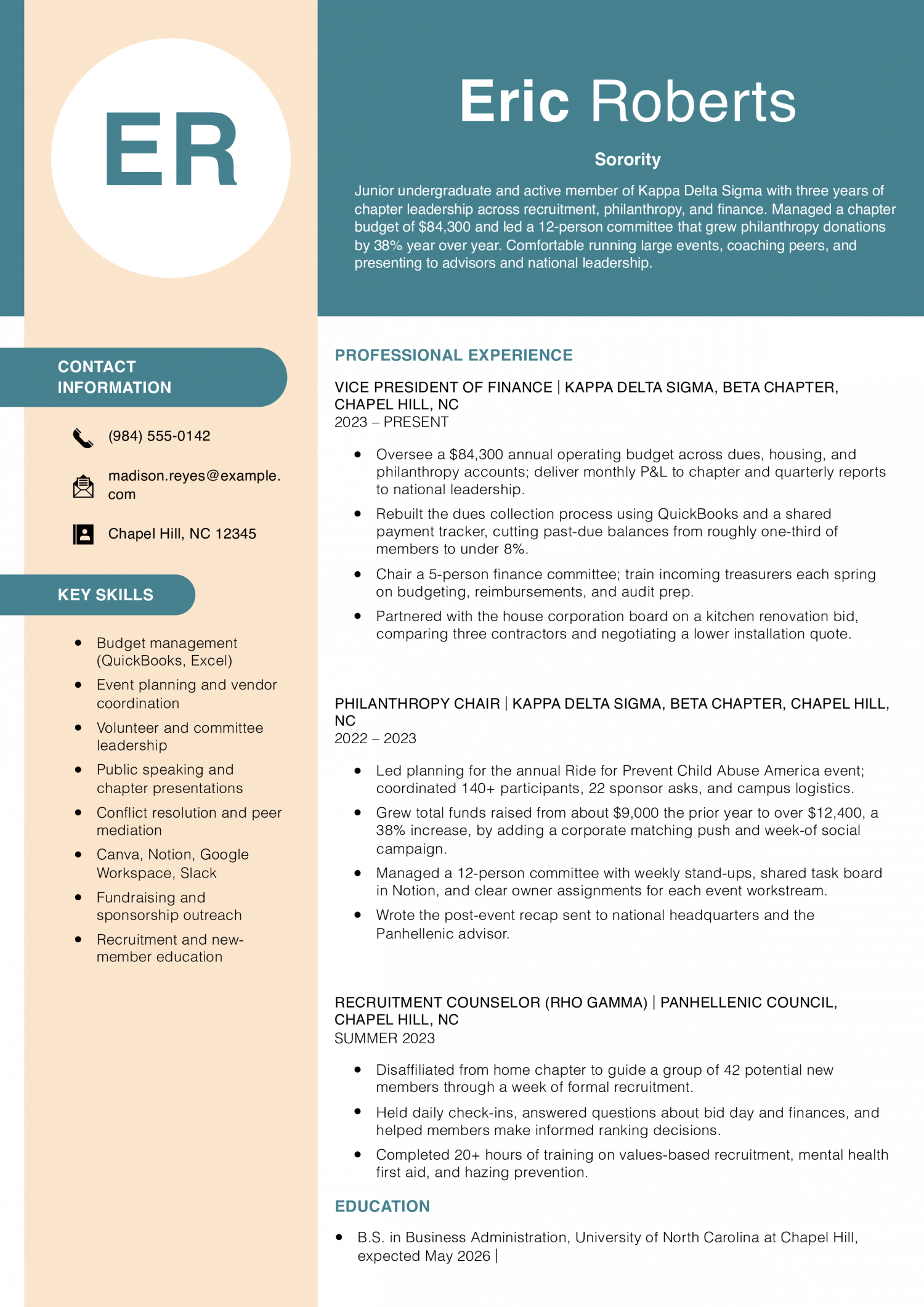
Treat the president role as its own entry, with the title, the chapter, and the dates you served.
Under it, write two or three bullets that name budget size, chapter headcount, or events you ran. Numbers turn a title a recruiter has seen many times into work they can compare.
Describe the work, not the sisterhood. Lead each bullet with a verb like planned, raised, trained, or led, and pair it with a figure a reader can picture.
"Raised $8,400 for the local food bank across two events" reads as work; "active member" reads as filler.
It looks good when the entry proves leadership, budget work, or steady service hours over more than a term.
It reads as neutral when the line only names the chapter and a range of years. Recruiters weigh what you did in the chapter, not the chapter itself.
A recruitment resume runs one page, uses your school email, and puts academics, honors, and leadership above paid work.
Recruitment chairs want to see your high school and college activities and any officer or committee role you have held. Use the same clean layout you would send to an employer, and keep photos and chapter crests off it.
Keep it for the first two or three years out, especially when you held an officer role or ran a large event.
Move it below your work history once you have full-time roles that speak to the job. Drop it when the bullets under it no longer add anything a recruiter cannot see in your work experience.
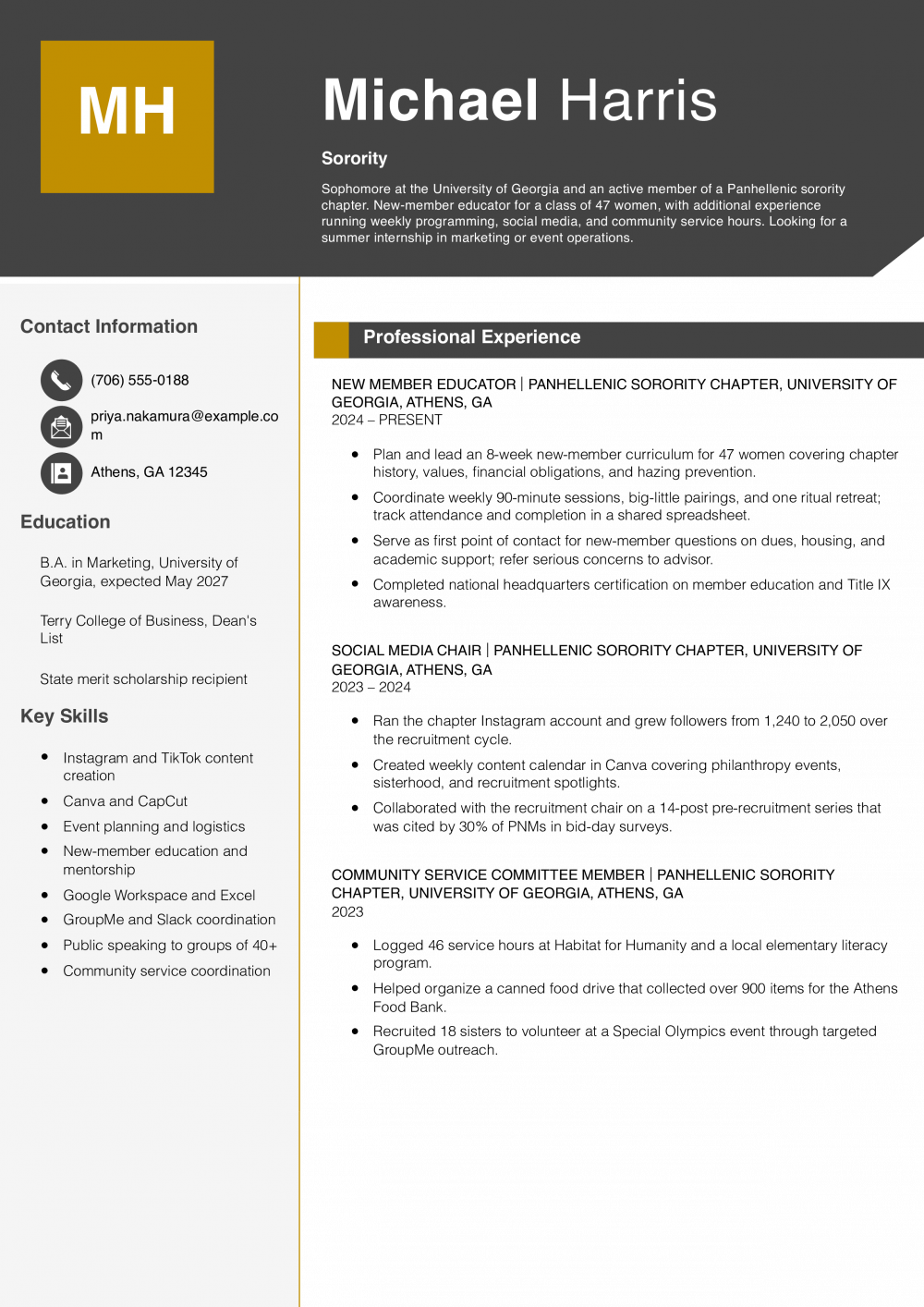
A sorority resume reads best in an ATS-friendly template, since it puts your leadership roles and service hours where a recruiter or chapter advisor looks first. A basic template is a solid alternative. Whichever you choose, keep the formatting clean and easy to parse: clear section headings, a standard font, and no graphics a parser can choke on.