Graduate School Resume Examples
The first line of your summary should name a research output, a major grade average, or a teaching load that fits the program you want. Admissions committees and program directors read this line to decide…
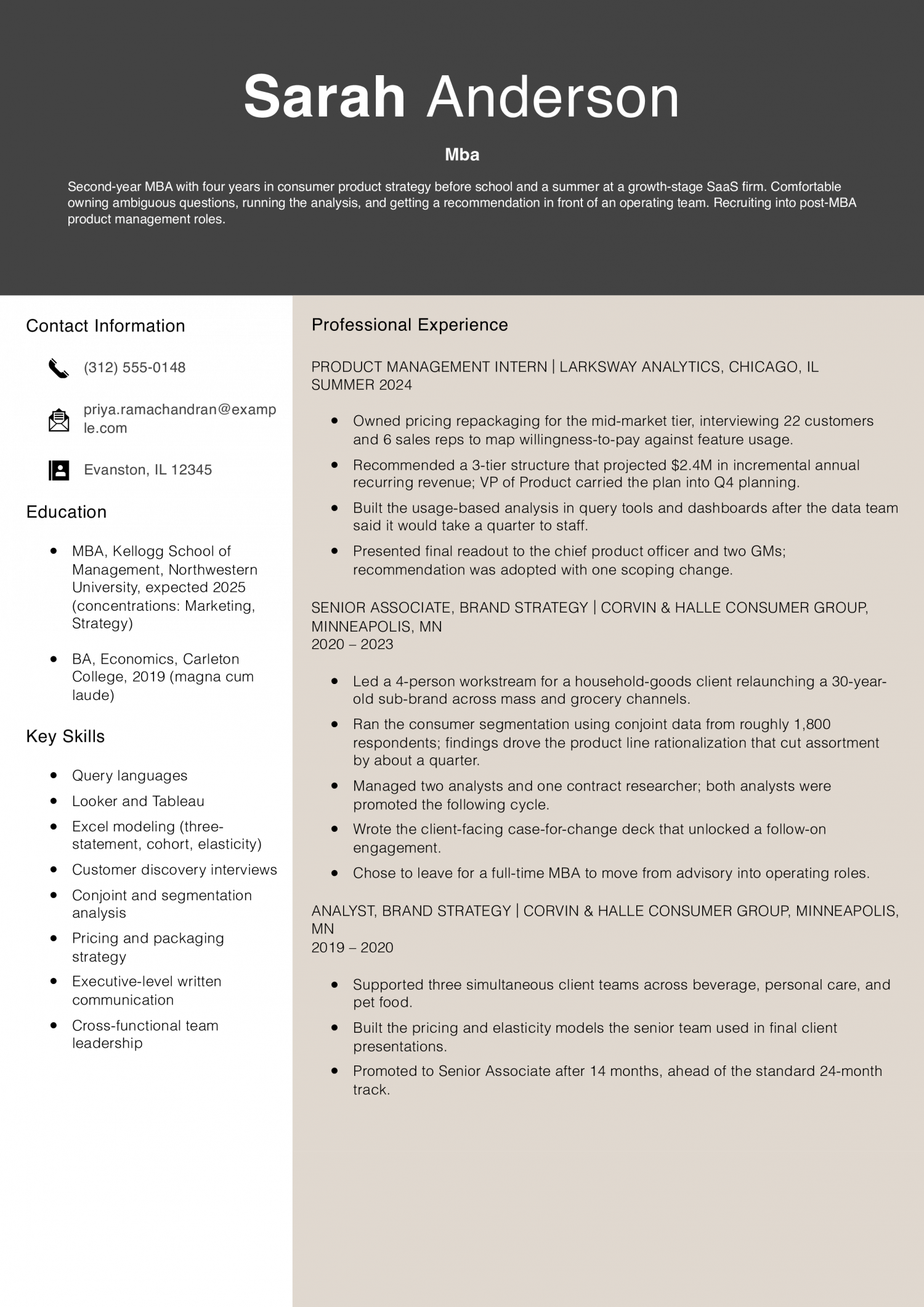
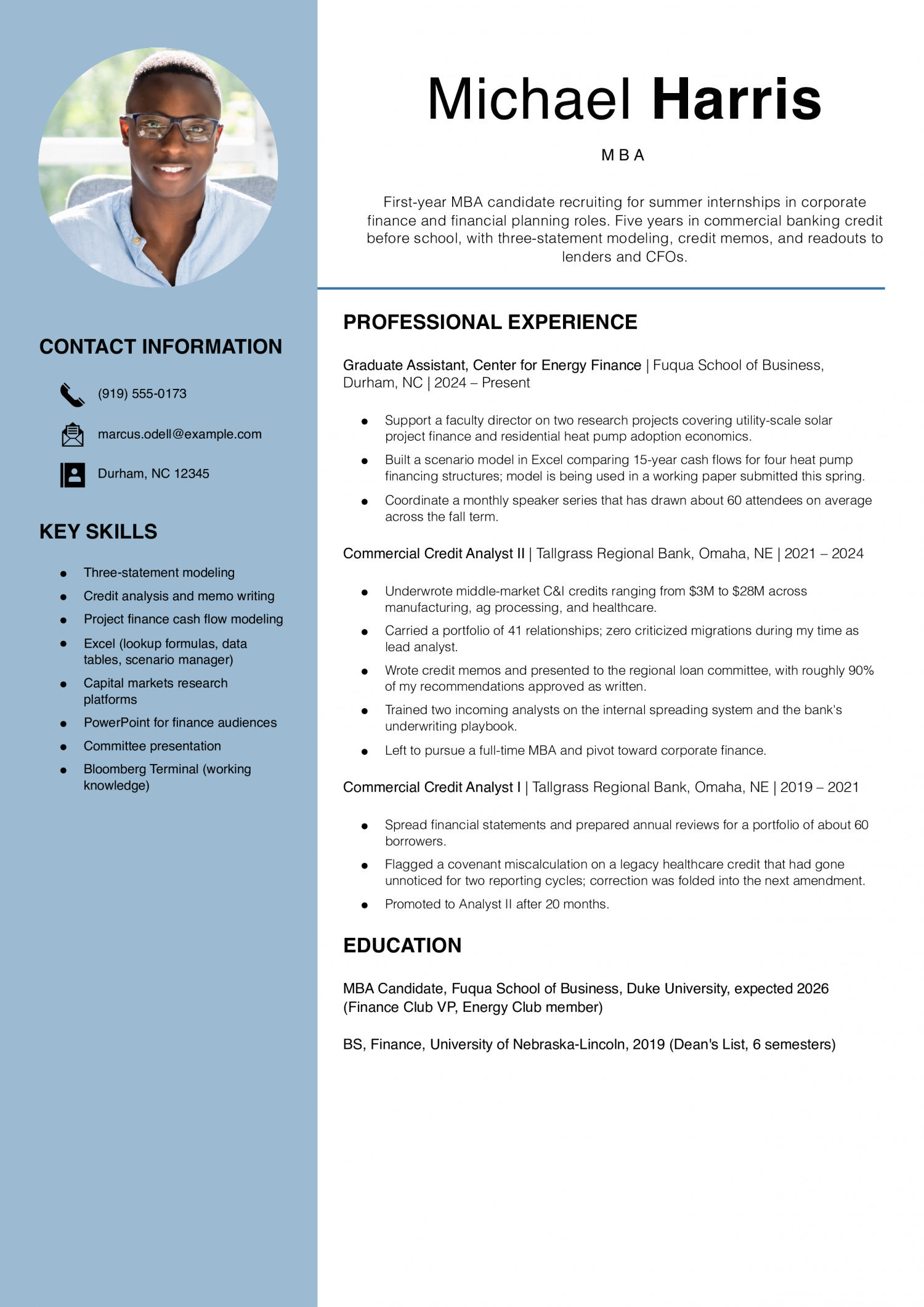
MBA recruiters decide whether to keep reading by the top third of page one; if the program name, concentration, and a quantified pre-MBA result aren't visible by then, the resume moves to the reject pile.
You are an MBA candidate applying for internships or post-graduation roles while your degree is in progress or freshly earned. Your resume must prove business impact from prior work and show why the MBA fits now.
Second-year MBA with a background in healthcare operations and a summer at a biotech services firm. Recruiting for post-MBA strategy and operations roles in healthcare and life sciences. Comfortable running the analysis, staffing the project, and standing in front of a clinical or executive audience with the recommendation.
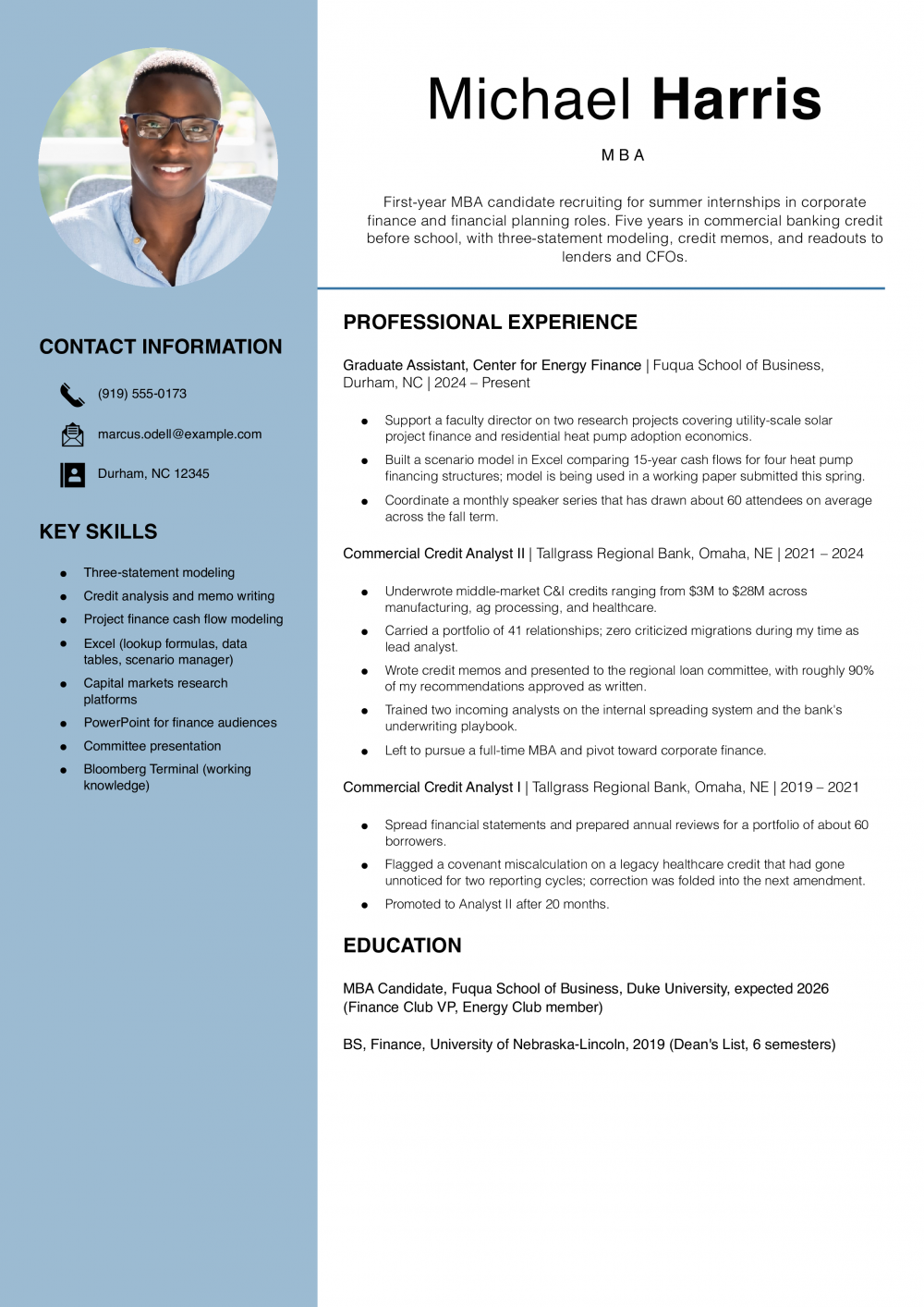
Your profile should state your MBA program, concentration, and expected graduation term at the top of page one. Name the pre-MBA function you came from, such as consulting, banking, product, or engineering. Then name the post-MBA target function or industry you are recruiting into.
MBA recruiters and program hiring partners scan for this fit signal within seconds. A profile that reads ‘second-year MBA, finance concentration, three years in credit risk, targeting corporate development’ beats a generic summary. Add one line on scope, such as deal size, team size led, or budget owned.
Keep the block to four lines. Save the narrative for cover letters and behavioral interviews. Give recruiters the placement math right at the top.
Strong MBA resumes carry numbers on most bullets, and recruiters scan for them first. Name deal sizes, revenue managed, cost saved, headcount led, or accounts owned. A bullet that reads ‘led pricing analysis for $40M product line, lifted margin 3 points’ beats ‘supported pricing initiatives.’ Pull two or three metrics per role from your pre-MBA work.
If your function was less numeric, use volume and scope language. Try ‘managed 12-person cross-functional team across three markets’ or ‘owned client portfolio spanning 40 mid-market accounts.’ Skip the dollar figure or headcount and a bullet reads as a duty, not a result. Round to clean figures and confirm you can defend each one in an interview.
Consistency across roles matters more than one hero stat.
Sort your pre-MBA and internship work into clear categories recruiters recognize. Common groupings are quantitative analysis, client or stakeholder management, project leadership, and strategic initiatives. Under quantitative work, list financial modeling, market sizing, pricing analysis, or forecasting.
Under client work, name pitches led, executive presentations delivered, or negotiations closed. Under project leadership, name teams led, cross-functional workstreams owned, and timelines managed. Under strategy, name market entry studies, competitive teardowns, or new product launches supported.
Three to five bullets per role is the norm. Lead each bullet with a strong verb, then the action, then the result. Keep the vocabulary close to what your target industry uses in job postings.
Avoid stacking six adjectives before a noun.
Create a short credentials and skills band under your profile or at the top of page two. List your undergraduate degree, honors, and any prior graduate work. Add standardized test scores if they help your target function.
Name technical tools you use in the work: Excel, Python, Tableau, PowerPoint, Bloomberg, Capital IQ, or Salesforce. Add any pre-MBA certifications or training that map to your target role. MBA recruiters and program hiring partners screen on these signals early, since on-campus recruiting timelines are short.
Languages spoken at a working level belong here too. Keep the block scannable with clear labels. Reserve deeper detail for the experience bullets underneath.
End your MBA resume with a section for leadership, clubs, and community work. Name the MBA clubs you lead or hold board roles in, such as the consulting club or private equity club. Add case competitions you placed in and the sponsoring firm.
Include pre-MBA volunteer roles where you led a team or owned a budget. This section signals fit with cohort culture and gives interviewers conversation hooks. Add three or four personal interests at the bottom, kept specific rather than generic.
‘Trail marathons’ or ‘competitive chess’ reads better than ‘sports and reading.’ Keep the whole closing block to six or seven lines. The goal is a human signal that rounds out the analytical picture above.
MBA recruiters and program hiring partners scan hundreds of MBA resumes a week during on-campus recruiting. The ones they shortlist name concrete tools like financial modeling and the business outcome behind each project. Hard skills prove you can do the work on day one of the rotation. Soft skills like leadership tell them you can carry a team through a live client engagement. Recruiters weigh both, but hard skills clear the ATS filter first and earn the read. Soft skills then back up your bullets with proof from case competitions or internships. Pull the target job posting open next to your resume. Match the exact hard-skill phrasing the posting uses, and cut any skill the role does not name. Treat the soft skills below as claims you must back with a bullet showing the result. Do this once per application, not once per resume version.
Resume Templates offers HR approved resume templates to help you create a professional resume in minutes. Choose from several template options and even pre-populate a resume from your profile.
Include the score only if it sits at or above the target program's published median.
A strong score belongs on one line under education, with the test name and date. Leave it off if it undersells you, and let recommenders speak to the academic signal.
Stack the two titles under one company header with the full date range beside each title.
Write separate bullets under each title so the scope change is visible to MBA recruiters. This shows upward movement without inflating the length of the resume.
One page is the standard for MBA applications, and program hiring partners expect that length for on-campus recruiting.
Use a second page only if you have over ten years of experience and a military or research background. Most admissions readers stop after page one anyway.
Name the gap directly with a short line that says what you were doing during those months.
Admissions readers care more about honesty than about a clean timeline. A vague gap invites the interview question you least want to answer.
Rewrite your bullets around the skills the target industry actually buys, such as analysis, client management, or team leadership.
Keep the original job titles honest but pull the transferable work forward in each bullet. The resume should read as a bridge to the post-MBA role.
List an unfinished degree only if the coursework is directly relevant, and mark the dates attended with no graduation year.
Never imply a degree you did not earn, since MBA programs verify education through background checks. An honest line is safer than a fabricated one.
Yes, a short interests line at the bottom gives admissions readers a real conversation starter for the interview.
Name two or three specific pursuits, such as competitive triathlon or classical guitar, rather than broad categories. Vague interests waste the line and tell the reader nothing.
An MBA candidate does best with an ATS-friendly template, since it keeps your program name and pre-MBA numbers exactly where a recruiter looks first. A basic template is a solid alternative. Whichever you choose, keep the formatting clean and easy to parse: clear section headings, a standard font, and no graphics a parser can choke on.