College Resume Examples and Templates for 2026

Your profile should sit at the top of page one. Name your school, your major or intended major, and your expected graduation month and year. Add your GPA if it is 3.3 or higher. State…
Every resume example is written and reviewed by our team of Certified Professional Resume Writers to ensure top-quality content and formatting.
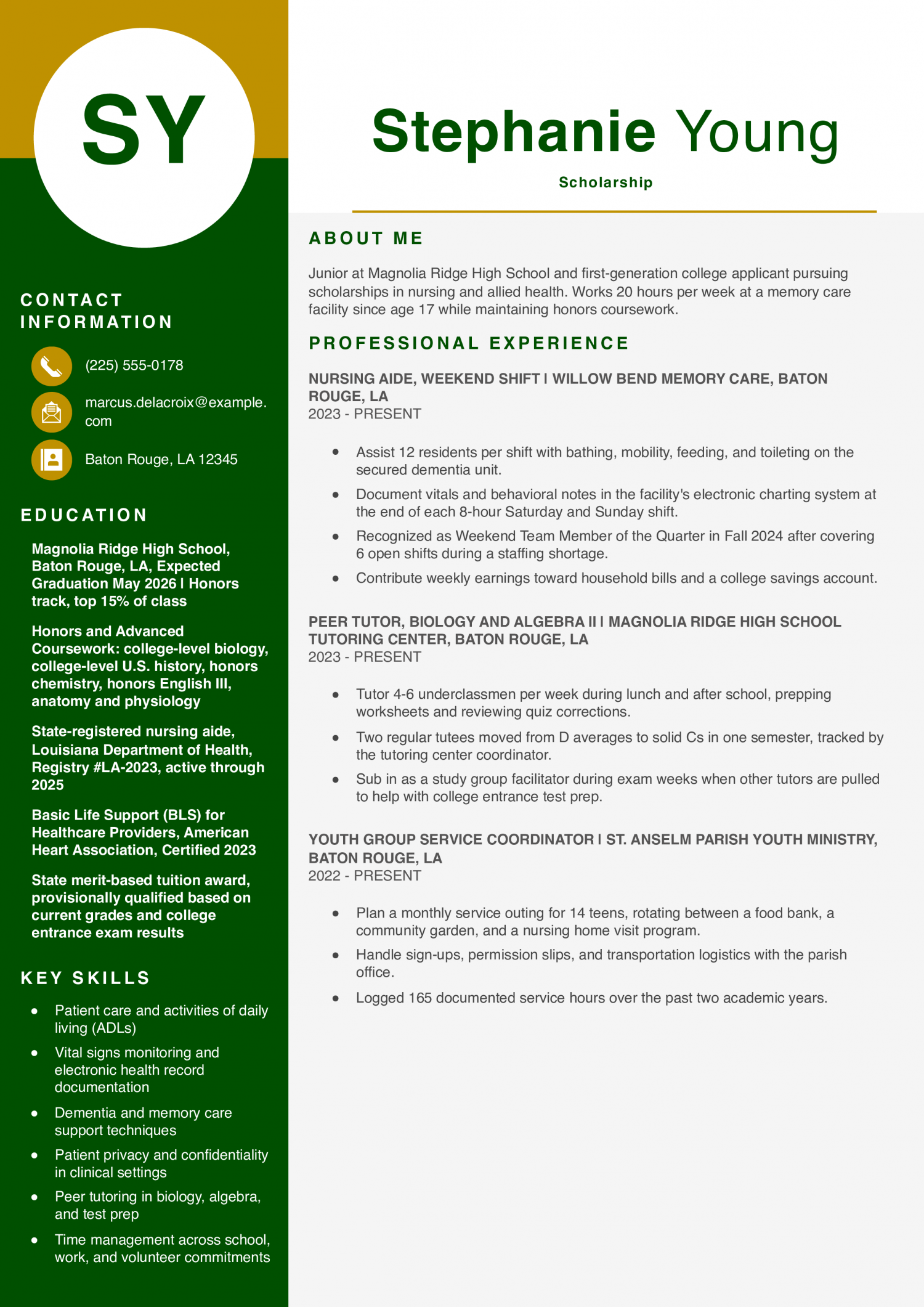
A scholarship resume works differently from a job resume. It has to prove academic promise, service, and fit with the donor's intent in one page. Leading with honors and a headline project gives readers a fast reason to keep going.
The strongest sections show measurable output: research posters, published work, tutoring hours, club roles you built from scratch. Scholarship committees and selection panels look for evidence that you finish what you start and lift the people around you.
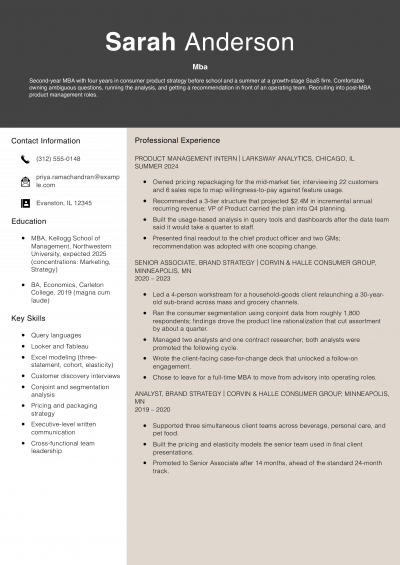
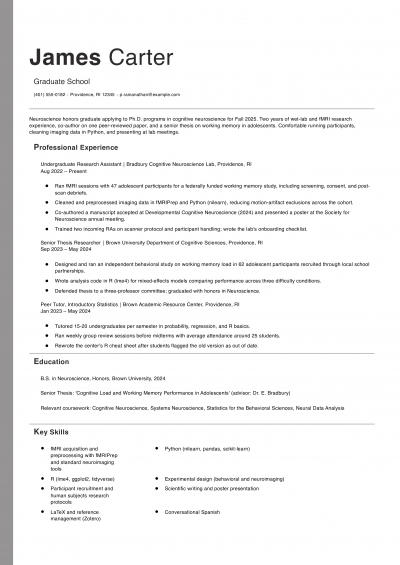
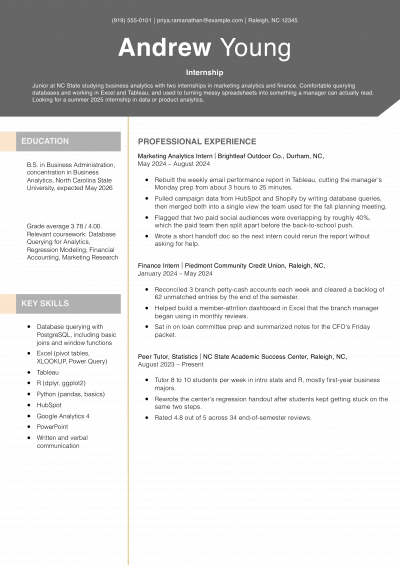
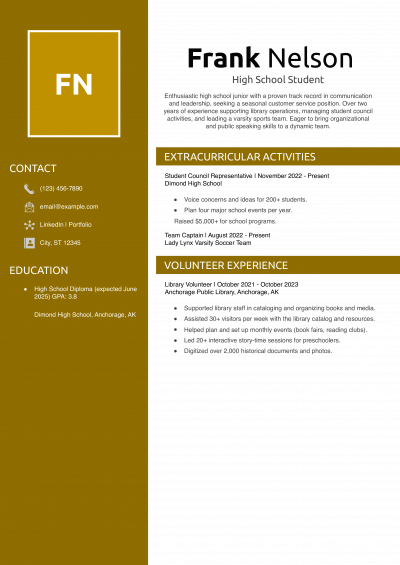
The examples below show how to frame coursework, awards, and volunteer work when your paid job history is thin. Use them to shape a resume that reads like a serious student, not a list of activities.
A clear eligibility block matching the award criteria is what gets scholarship resumes past the selection panel's first cut; specific evidence of impact, leadership hours, and measurable academic wins is what makes them readable enough to advance.
You are a scholarship applicant building a resume that shows academic strength, leadership and service in a single page. Scholarship committees and selection panels want proof you match the award's stated values and will represent them well.
Elena Vasquez-Moreno
Providence, RI | (401) 555-0193 | [email protected] | linkedin.com/in/elenavasquezmoreno
Senior at Roger Williams Charter High School applying to undergraduate programs in political science and public policy. Founder of a student-led voter registration initiative, four-year debate team member, and paid legislative intern in the office of a Rhode Island state representative.
Legislative Intern (Paid)
Office of State Representative Diane Alcantara | Providence, RI | 2024-Present
Founder and Lead Organizer, RI Youth Vote Project
Roger Williams Charter High School | Providence, RI | 2023-Present
Varsity Debate Team, Policy Division
Roger Williams Charter High School | Providence, RI | 2021-Present
Cashier and Shift Lead
Federal Hill Market | Providence, RI | 2022-2024
Volunteer English Language Tutor
Providence Public Library Adult Learning Program | Providence, RI | 2022-Present
Lead with the one thing a scholarship committee cannot pull from your transcript or application form. That might be a research project you led, a language you speak at home, or a nonprofit you founded in high school. It could be a national competition finish, a first-generation college status, or a specialty like robotics or public health.
Put this line at the very top of your summary, above your grades and school name. Committees read dozens of files that all list similar coursework and honors. A single specific line at the top gives readers a reason to keep reading.
Save the generic goals for your cover letter, not your resume.
Scholarship reviewers scan for scope before they read for meaning. A bullet without a number tends to read as a duty rather than an impact. Give each activity a figure: hours served, dollars raised, students tutored, or events organized.
Strong entries name the size of the group you led and the length of the commitment. If you ran a food drive, list the pounds collected and the families served. If you tutored, list the subjects, the grade levels, and the weekly hours.
Volume language works when exact counts are unavailable, such as “served roughly 200 patients per shift.” Reviewers weigh sustained roles more heavily than one-day events. Show the years, months, or terms next to every entry.
Sort your record into three to five sections a reviewer can skim in under a minute. Common groupings are academics and honors, research or creative work, leadership and service, employment, and skills. Under academics, list your grades, class rank if strong, test scores, and named awards.
Under research, name the lab, the principal investigator, and the question you worked on. Under leadership, name the office you held, the group size, and one concrete initiative you ran. Under employment, list part-time jobs and hours per week, since committees value students who work through school.
Keep each bullet to one line. Order sections by the criteria in the scholarship description, not by what you are proudest of.
Put your school, expected graduation date, grades, and major in a header block on page one. Add standardized test scores directly below if they strengthen your file. List honor societies, dean’s list terms, and named awards in a short honors block near the top.
Place technical tools, lab methods, and languages in a skills strip that a reviewer can scan in seconds. Software like R, Python, mapping tools, or Adobe Suite belongs here, along with lab techniques such as titration or cell culture. Language skills should show a level, such as conversational or fluent.
Selection panels often screen for a required major, grade floor, or residency status first. Making those facts visible early keeps your file in the read pile.
Your education block sits near the top for scholarships, not at the bottom as it would on a work resume. Include your high school or current college, expected graduation year, grades, and relevant coursework tied to the award. Add study abroad terms, dual enrollment, or advanced coursework that signals rigor.
Below education, add one section that maps to the scholarship’s stated purpose. For a science award, that is research and technical projects. For a service award, that is sustained volunteer roles with hours logged.
For a leadership award, that is offices held and initiatives launched. Cut generic hobbies, middle school awards, and one-time events older than three years. Every line on the page should support your case for this specific award.
Scholarship funding is tight in 2026. Committees and selection panels read more files per seat than they used to. The bar to clear a first cut is higher this cycle. Match the lists below against the posting you want to win. Read the scholarship criteria line by line before you open your resume. Circle every skill phrase the sponsor names in the call. Then check the two tables below to see which of those phrases you can honestly claim. Hard skills like research writing and GPA reporting prove you can carry the award. Soft skills like leadership and initiative back up what your bullets already claim about you. Pull the matching terms into your bullets as evidence, not as a list on their own. One matched phrase inside a bullet outweighs five phrases parked in a skills box. Refresh the match for each new scholarship, since sponsors weight different skills.
Hard skills (high ATS-scan rate)
Soft skills (a panel member reads for these after the scan)
Resume Templates offers HR approved resume templates to help you create a professional resume in minutes. Choose from several template options and even pre-populate a resume from your profile.
Yes, list every scholarship you have already won on the resume you send to a new committee.
Prior awards are peer review that a selection panel trusts, and they show your record is not a one-time result. Place them in an Honors and Awards section near the top, above general activities.
Write the award name first, then the sponsoring body, the year, and the dollar amount if the sponsor made it public.
A short second line tells the panel what the award recognized, such as writing, service, or a stated grade point average. Keep every scholarship formatted the same way so a reviewer can scan the section in one pass.
Yes, a competitive scholarship is an award and belongs in the Honors and Awards section rather than under Financial Aid.
Need-based grants attached to your admission packet are not awards and should stay off the resume. A merit scholarship judged against other applicants is the kind a selection panel wants to see.
Add one short line under the award that names the applicant pool and the selection basis.
Write something like "Awarded to 12 of 340 state applicants for demonstrated leadership in community service." That single line turns a name a panel does not know into a number a panel can compare.
Keep it to one page for high school and undergraduate applicants, and to two pages for graduate applicants with published work.
Panels read dozens of files in a sitting and reward a page they can scan in under a minute. Cut older activities before you shrink the font or the margins.
Include your grade point average when the sponsor sets a minimum or when your number is a clear strength for your grade level.
Write it on the same scale the sponsor uses, and note the scale after the figure so a reader outside your school reads it correctly. Leave it off when the sponsor has already collected an official transcript with the application.
Yes, list a nomination when the nomination itself was competitive and the sponsor names finalists in writing.
Write "Finalist" or "Nominee" in front of the award and keep the same year and sponsor format you use for wins. Do not list an award you were merely eligible to apply for, because a panel reads that as filler.
For a scholarship applicant, an ATS-friendly template is the safest pick, because it puts your certifications and experience where a hiring manager scans first. A basic template is a solid alternative. Whichever you choose, keep the formatting clean and easy to parse: clear section headings, a standard font, and no graphics a parser can choke on.
Scholarship Resume
4.8/5 stars with 211 reviews

Executive Resume Writer and Career Coach
Andrew Stoner is an executive career coach and resume writer with 17 years of experience as a hiring manager and operations leader at two Fortune 500 Financial Services companies, and as the career services director at two major university business schools.
© 2026 Resumetemplates.com All rights reserved.