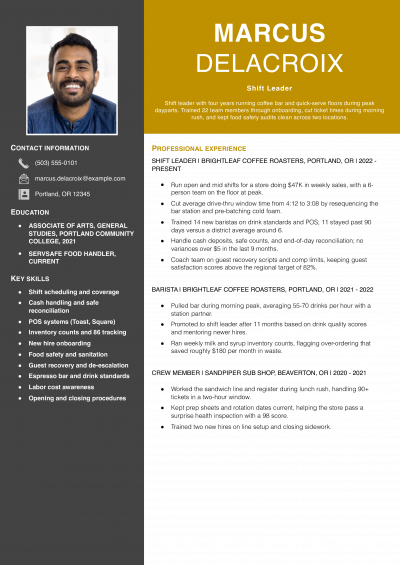
Shift Leader Resume Examples
Your summary should lead with a number a store manager or general manager already tracks. Name the average daily sales you ran a shift for, the crew size you led, and the daypart you owned.…
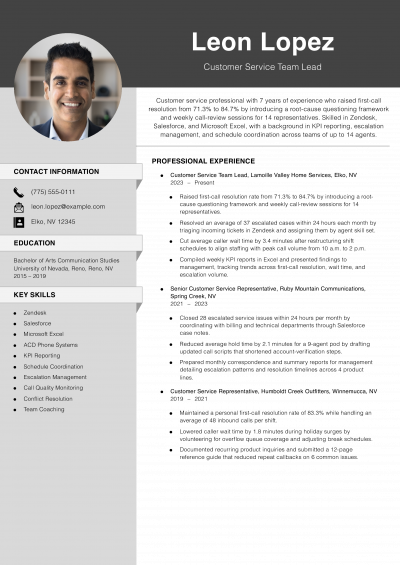
Every resume example is written and reviewed by our team of Certified Professional Resume Writers to ensure top-quality content and formatting.
Most team leader roles are filled by internal promotions or lateral hires. External candidates need a resume that proves they can run a team from day one. The strongest proof is a measurable gain you drove, like lower turnover, faster output, or higher team scores.
Operations managers and department heads look for evidence you coached people and hit targets. Show how many direct reports you led and what changed under your watch. To compare layouts before you start, browse our resume templates.
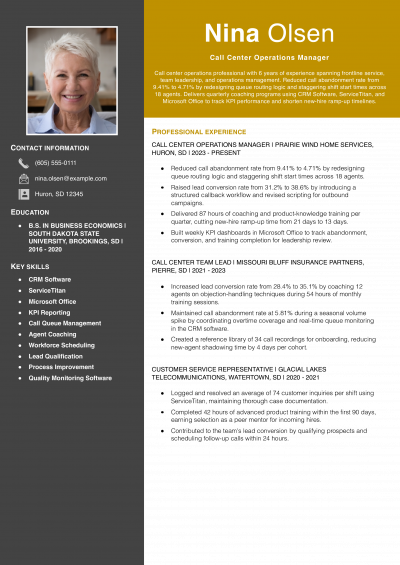
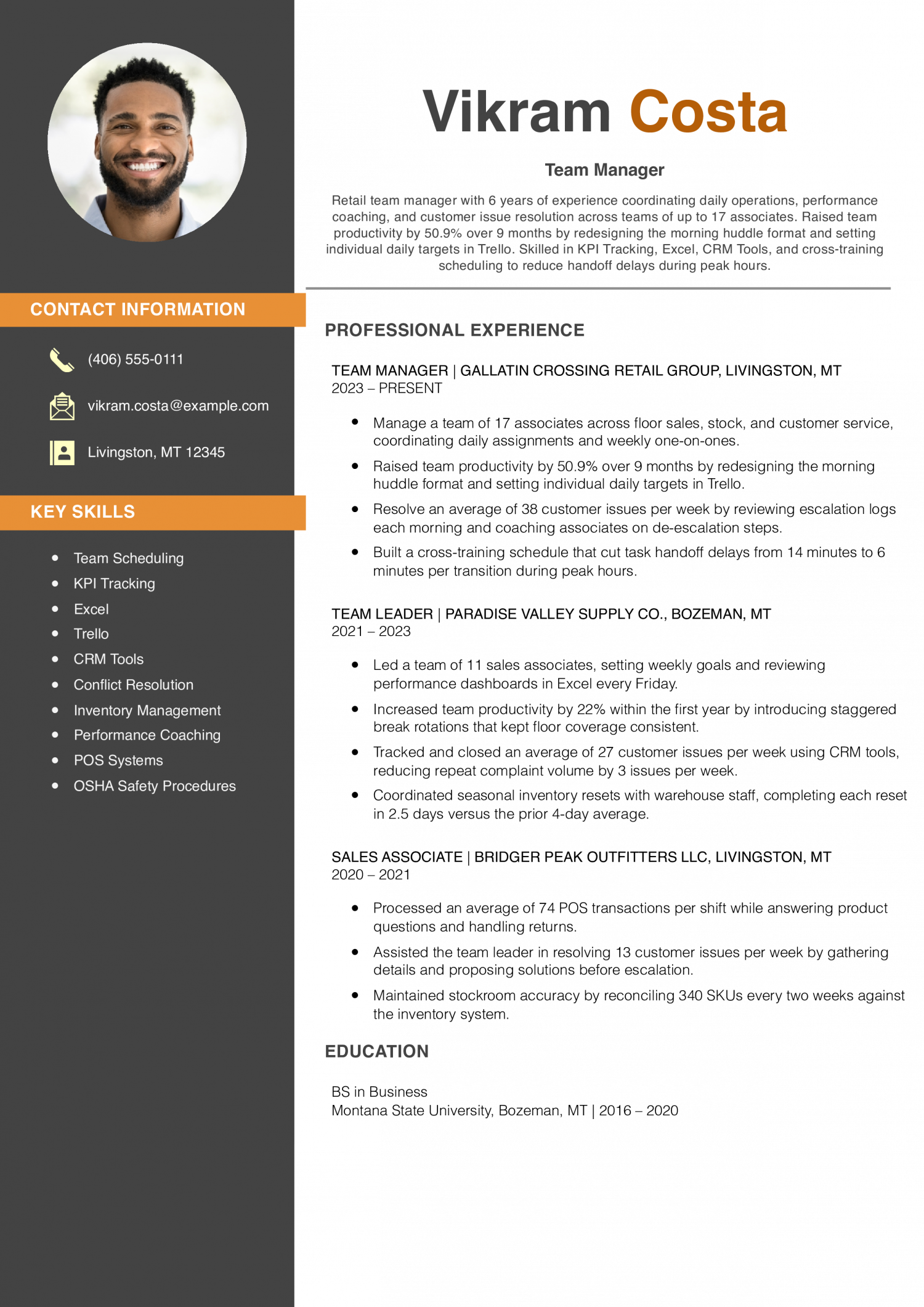
Pick this resume if you are a mid-level team manager moving from a smaller crew to a larger retail operation. Lead with process changes you designed and the before-and-after numbers they produced.
Retail operations managers want a team leader who keeps work moving from one person to the next during busy hours. This resume points to a cross-training schedule that cut the wait between tasks by more than half. On your own resume, name the old number, the new number, and when it changed.
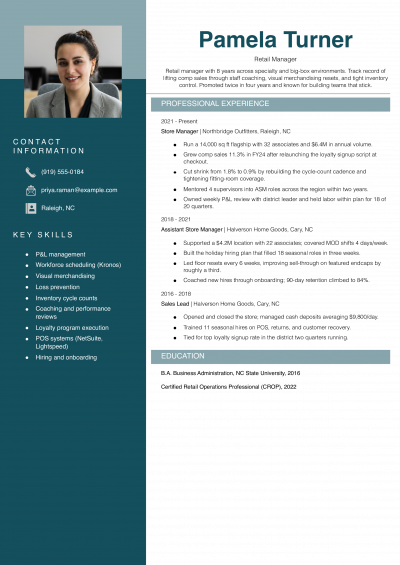
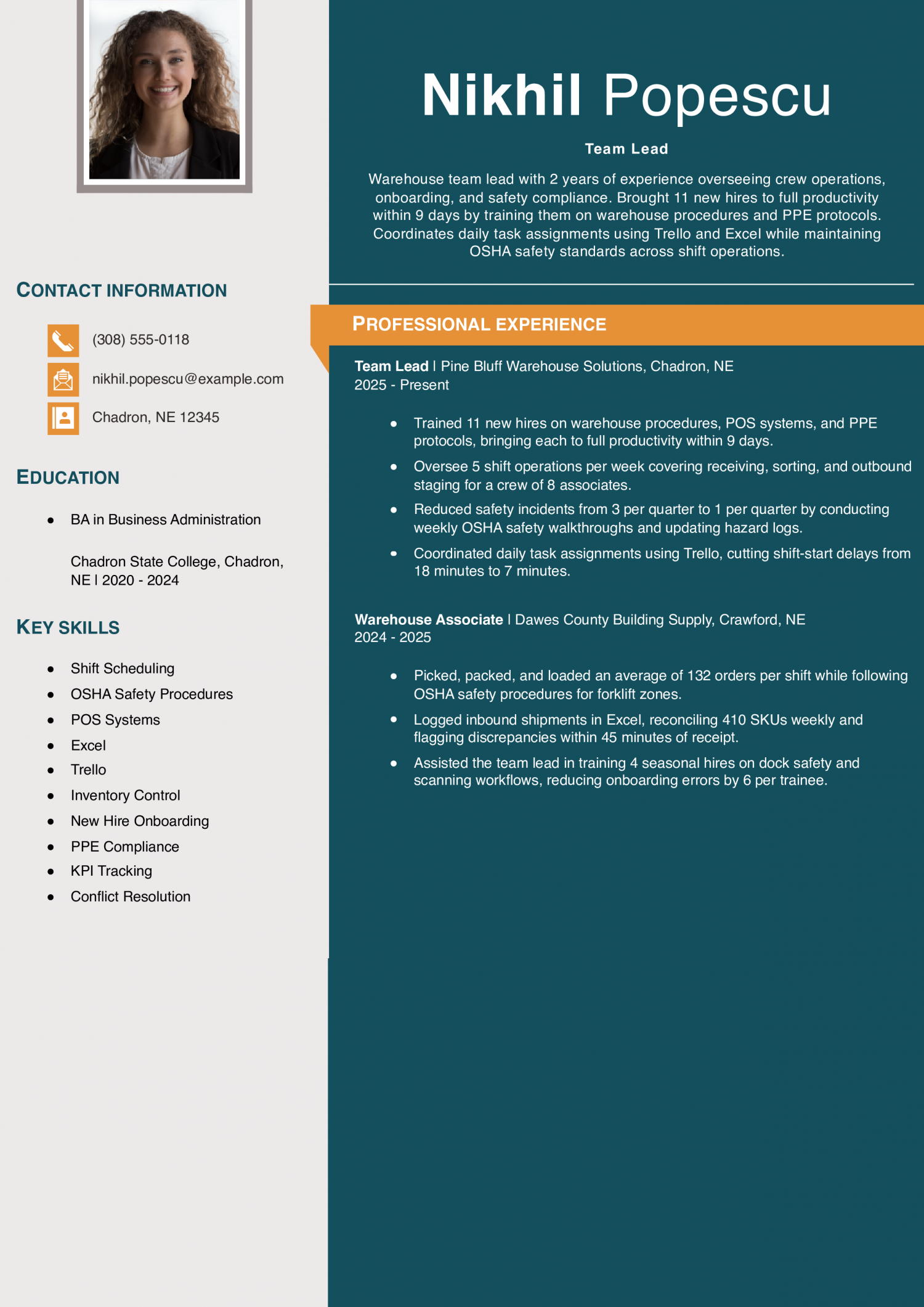
Start with this resume if you are an entry-level team lead stepping into your first formal supervisory role from a warehouse associate position. Lead with onboarding speed and safety reduction figures rather than listing routine shift duties.
A shift supervisor looking for a team lead wants a crew that works safely, so incident counts matter. This resume gives the old rate, the new rate, and the weekly walkthrough that closed the gap. If you have safety work to show, pair the before and after counts with the routine you started.
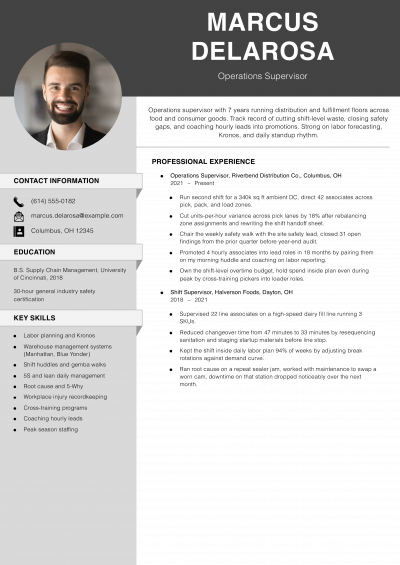
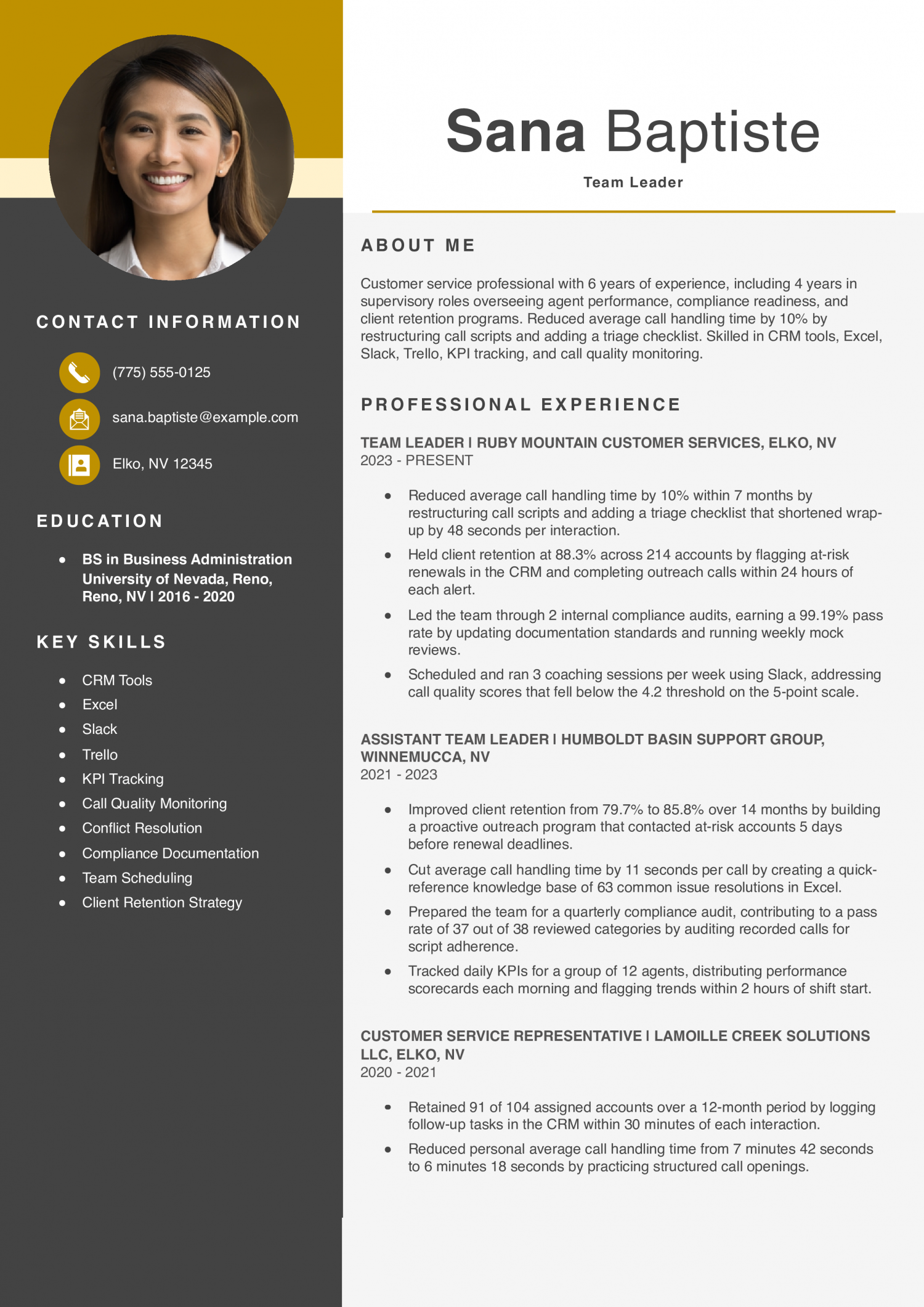
Try this resume if you are a mid-level team leader in customer service moving from an assistant role into full ownership of compliance and retention metrics. Lead with the audit pass rates and retention percentages that prove your coaching sessions changed outcomes.
Client retention is what customer service directors check first in a team leader. This resume names the rate held across hundreds of accounts and the outreach routine that protected each renewal. To do the same, state the rate you maintained and the one step you repeated every time.
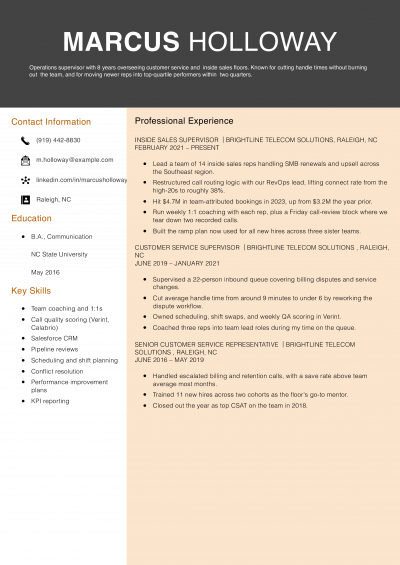
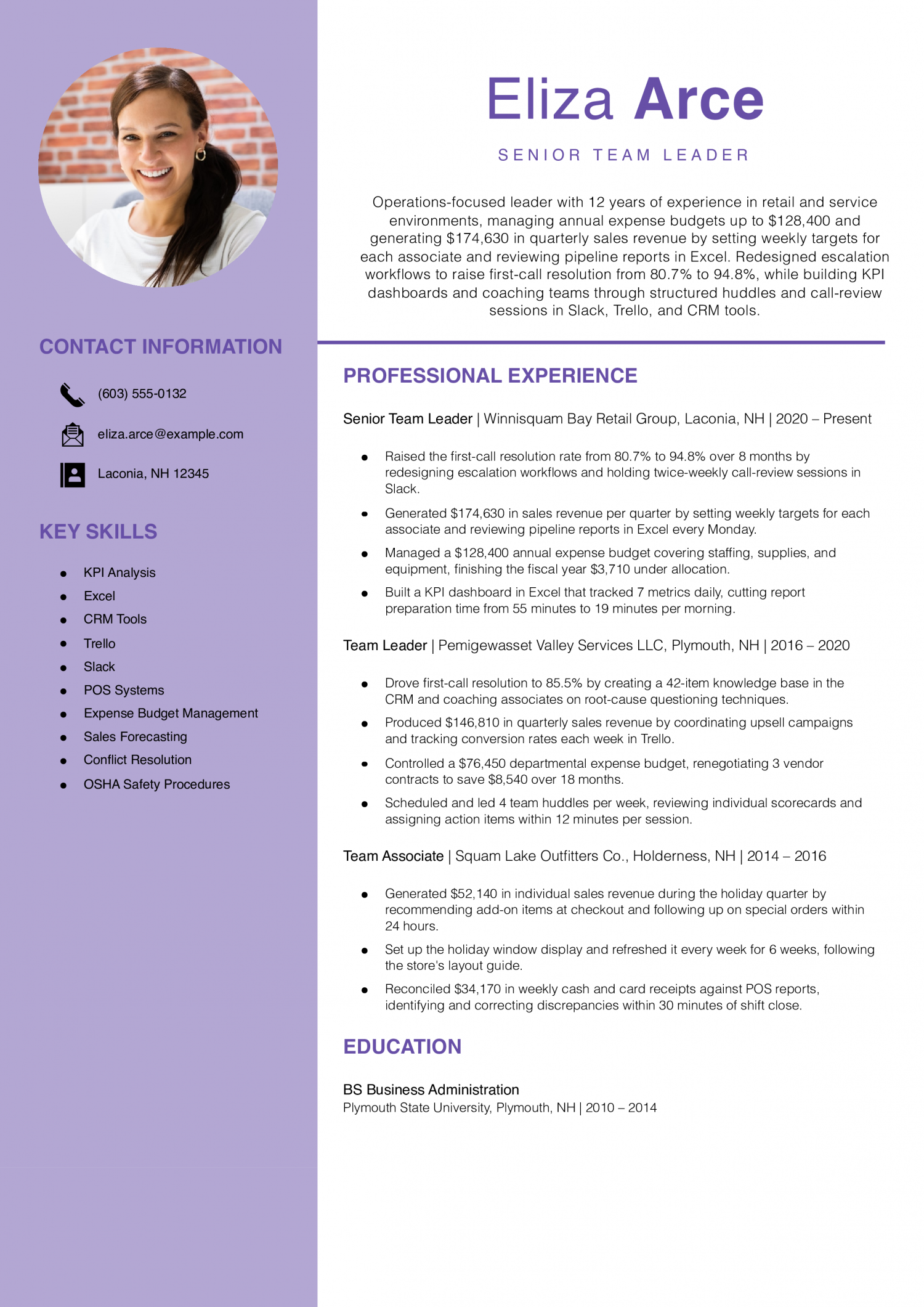
Lean on this resume if you are a senior team leader with a decade of budget ownership and sales accountability across retail or service teams. Open with the budget you managed and the dollars you saved or brought in, then the resolution-rate gains your coaching produced.
For a senior team leader, directors look for control of money and time: the budget you ran, the sales you brought in, and the hours you saved. This resume names a dashboard tool, the old prep time, and the shorter time it dropped to each morning. On your own resume, state the time before, the time after, and how often.
Retail customer service supervisor with 6 years of experience scheduling coverage for teams of up to 14 associates, restructuring queues, and coordinating inventory replenishment that maintained stock availability at 98.63% across 1,240 SKUs. Skilled in Excel, Asana, Trello, Slack, and CRM tools, with a record of delivering technology upgrades and loyalty program rollouts ahead of deadline.
Operations managers and department heads scan your summary for a number first. Lead with the size of the team you run. State headcount, then name a result tied to that group.
A line like “Team leader of 14 warehouse associates who cut order errors 22%” gives a clear read on scope. Pair it with the setting or shift type you manage. Night shift and rotating schedule roles each carry weight.
Skip vague lines about being a strong leader. The first sentence should prove it with a figure. Add your industry after the metric so the reader can place you fast.
Strong team leader bullets name a result you can count. Headcount managed is the starting point. Layer on throughput, error rates, or turnover figures.
For example, write “Reduced team turnover from 35% to 18% over 12 months.” Or write “Raised daily picks per associate from 140 to 175.” Each bullet should start with a verb and end near a metric. If you lack an exact figure, use a range or percent change. State the budget you control or the shifts you cover.
A dollar figure for cost savings stands out on a short list.
Use two to four groups per role. People management is one natural group covering hiring, coaching, and reviews.
Process improvement is a second group for cost savings and cycle time cuts. A third group could cover safety and compliance. Note incident rate drops or audit pass rates.
A fourth might address training and development. Label each group with a bold heading inside the role. This structure helps department heads find the skills they need.
Put your credentials on page one, below your summary, one on each line. Name the body that issued each one and the year you earned it.
Then give your software a line of its own. Name the platforms you use daily, such as SAP or Kronos. Add project tools like Jira or Monday.com if you use them.
Operations managers want to see these before they reach page two. A visible tools line cuts the time they spend guessing your tech fit. Keep each line to a few words so the section scans in seconds.
If you have fewer than ten years of leadership work, one page is the target. Cut bullets from roles older than eight years. Keep one or two lines for each early job.
Remove any bullet that repeats a skill shown in a recent role.
If you held individual contributor roles before leading a team, list the title, company, and dates. Skip the bullets unless a result still matters. Operations managers focus on your last two or three roles.
A second page is fine for ten or more years of experience. Fill at least half of that page so it does not look thin.
Check the tables below against each posting you apply to. Pull every hard skill the ad names. Drop terms the posting leaves out.
Hard skills like workflow scheduling signal that you can run daily tasks. They carry the most weight in an early screen. Soft skills like conflict resolution show how you lead people.
Hiring managers want proof of both types. Let your work history bullets carry the soft skills, each as a result. Match the tables to your target posting and cut any skill it skips.
| Soft Skills | AI-estimated % |
|---|---|
| Motivating team members | 65% |
| Conflict resolution | 63% |
| Clear communication | 47% |
| Decision-making under pressure | 40% |
| Accountability modeling | 34% |
And here are the top hard skills showing up most often.
| Hard Skills | AI-estimated % |
|---|---|
| Team performance management | 80% |
| Workflow coordination | 70% |
| KPI tracking | 46% |
| Staff scheduling | 39% |
| Operational reporting | 32% |
Skill names and rankings come from an AI model grounded in U.S. Department of Labor occupation data for team leaders, not from a count of team leaders’ resumes built on ResumeTemplates.com.
For a team leader resume, hiring managers look at team performance management and workflow coordination first, so the items below back those up with detail.
Operations managers now see AI tools named on team leader resumes. That raises a question about how to frame them. You could overstate your role as an AI-driven leader. You could say nothing about AI and respond only when someone asks. Or you could name the tool and your review steps. The third option is the one a hiring manager can check. Describe the actual workflow you follow with each tool. State what you check before acting on the output. Describing these checks also shows you understand the limits of the tool.
AI tools draft weekly schedules based on demand patterns, but team leaders still adjust for skill mix and preferences.
Dashboards flag attendance trends and output dips so you can coach individuals before problems grow.
AI transcription tools capture action items from standups, and you verify accuracy before sharing with the team.
Workflow platforms suggest task assignments by workload, though you override based on development goals.
Auto-generated reports pull KPIs into weekly updates, freeing you to focus on root-cause analysis instead.
Resume Templates offers HR approved resume templates to help you create a professional resume in minutes. Choose from several template options and even pre-populate a resume from your profile.
Use the exact title your employer gave you, such as Team Leader or Shift Team Lead. If your company used an unclear internal title, add a parenthetical with a recognized equivalent. That helps a hiring manager understand your level right away.
Common alternatives include Shift Supervisor, Floor Lead, and Section Coordinator. Choose the title that matches the scope you actually held. Avoid inflating your title to Manager if you did not own hiring or budget authority.
Start each bullet with a strong verb like coordinated or trained, then state the team size and a measurable outcome. For example, write "Trained 12 warehouse associates, reducing onboarding time by 30%." This format shows both scope and impact in one line.
List it in your experience section with the title Disaster Recovery Team Leader and the dates you served. Include bullets that name the response type, the team size, and the result. If the role was part-time or seasonal, note that next to the date range.
Focus on skills you can prove with a bullet in your experience section. Conflict resolution, shift scheduling, and quality auditing are strong picks. Add a soft skill like cross-functional communication only when a bullet elsewhere backs it up.
Pair each strength with a concrete outcome rather than listing traits on their own. Instead of writing "strong leader," write "Led daily standups for a 15-person crew, cutting missed deadlines by 20%." Hiring managers look for proof, not self-assessment.
Use the title your facility assigned, such as Clinical Team Leader or Charge Nurse Team Lead. In your bullets, name the unit type and the staff count you oversaw. Include patient safety or compliance outcomes that show you managed both people and protocols.
Choose an ATS-friendly template so your team leader resume stays easy to read, or go with a basic template instead. Name each section, use a regular font, and keep pictures and graphics off it.
Team Leader Resume
4.6/5 stars with 223 reviews

Executive Resume Writer and Career Coach
Andrew Stoner is an executive career coach and resume writer with 17 years of experience as a hiring manager and operations leader at two Fortune 500 Financial Services companies, and as the career services director at two major university business schools.
© 2026 Resumetemplates.com All rights reserved.