Customer Service Manager Resume Examples

The first line of your summary should name your team size, your CSAT or NPS number, and your CRM stack. Support directors read that as proof you have run a real queue, not shadowed one.…
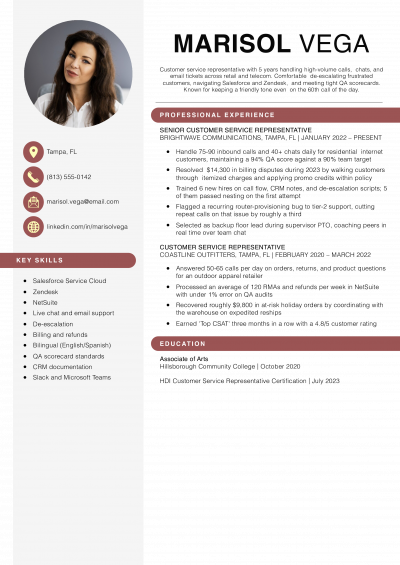
Every resume example is written and reviewed by our team of Certified Professional Resume Writers to ensure top-quality content and formatting.
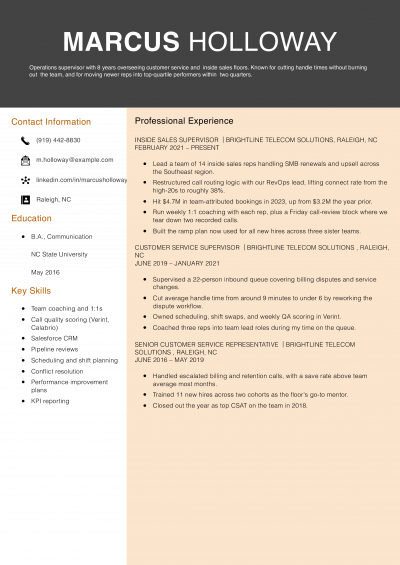
Most customer service supervisor roles are filled internally. When they open to outside hires, you compete against internal leads who already know the team. Your resume has to prove you can cut handle times, raise CSAT scores, and coach agents at scale.
Support managers and contact center directors look for proof you have run staffing plans and hit service level targets. Show the team size you led and the KPIs you moved, such as first-call resolution or attrition rate. The examples below show how to put those wins on the page. To compare layouts before you start, browse our resume templates.
Concrete team-size and KPI data is what gets Customer Service Supervisor resumes past the ATS screen; clear descriptions of escalation handling and retention results are what make them readable enough for contact center directors to advance.
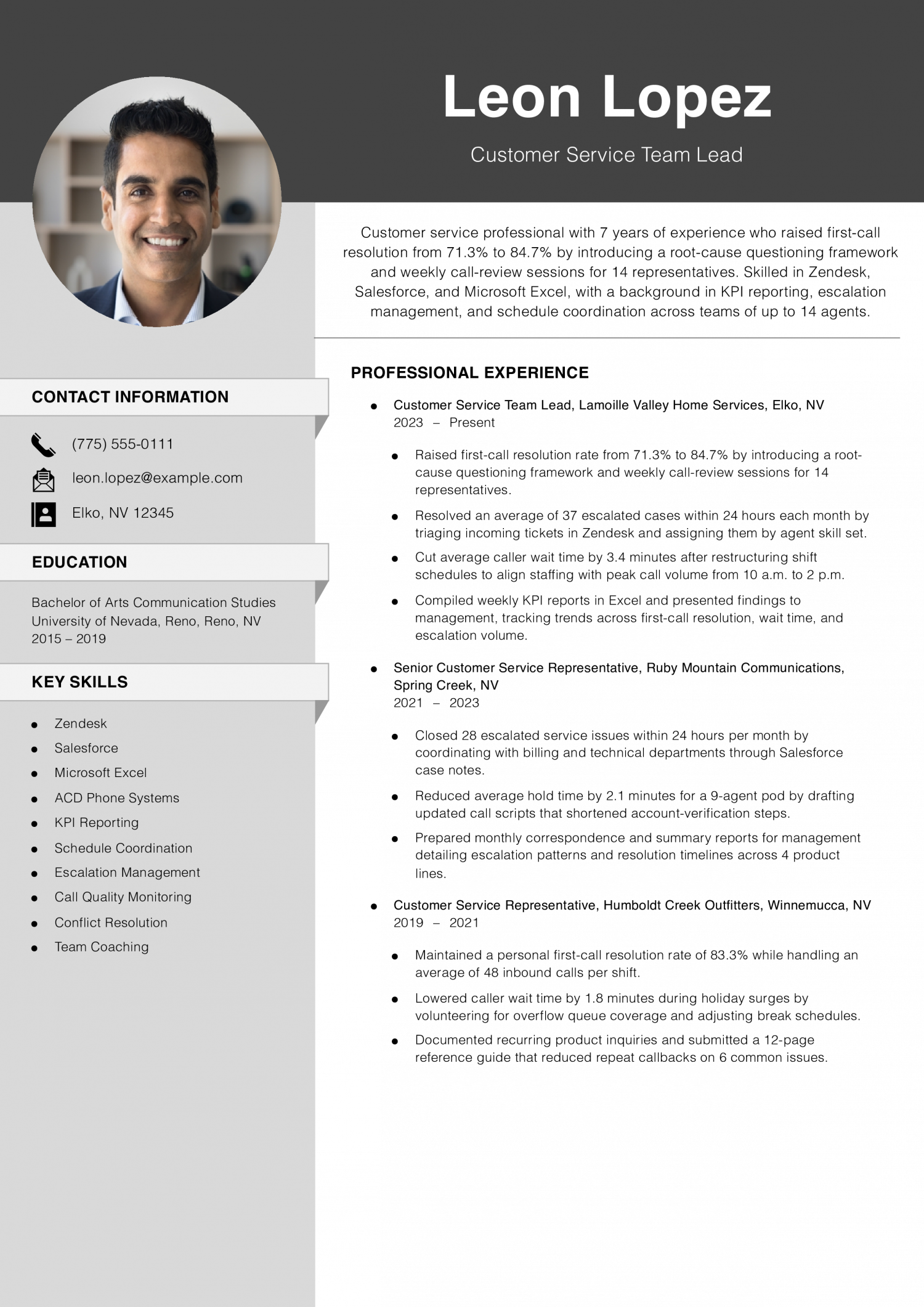
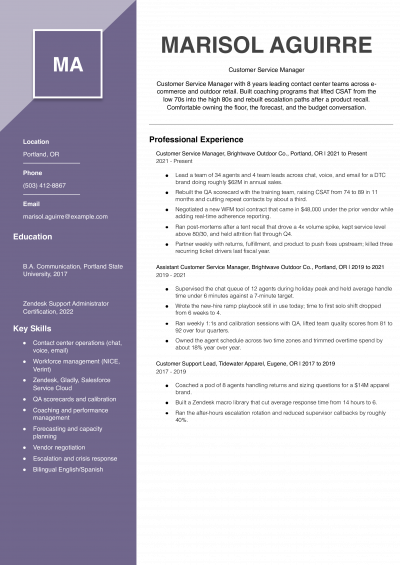
Pick this resume if you are a mid-level customer service professional who has led a small team and wants to highlight operational improvements alongside people management. Lead with wait-time and resolution-rate changes stated as before-and-after figures tied to the scheduling or process fix behind them.
Escalations here were triaged in Zendesk and routed by agent specialty, which is the method behind the fast resolution time. A director of support can see the system, not a claim about speed. Name your triage tool and routing logic when you describe escalation handling.
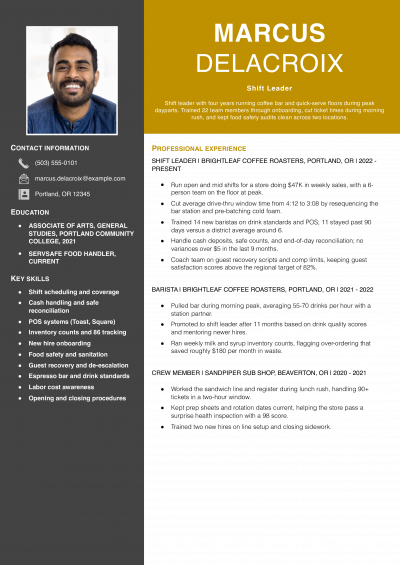
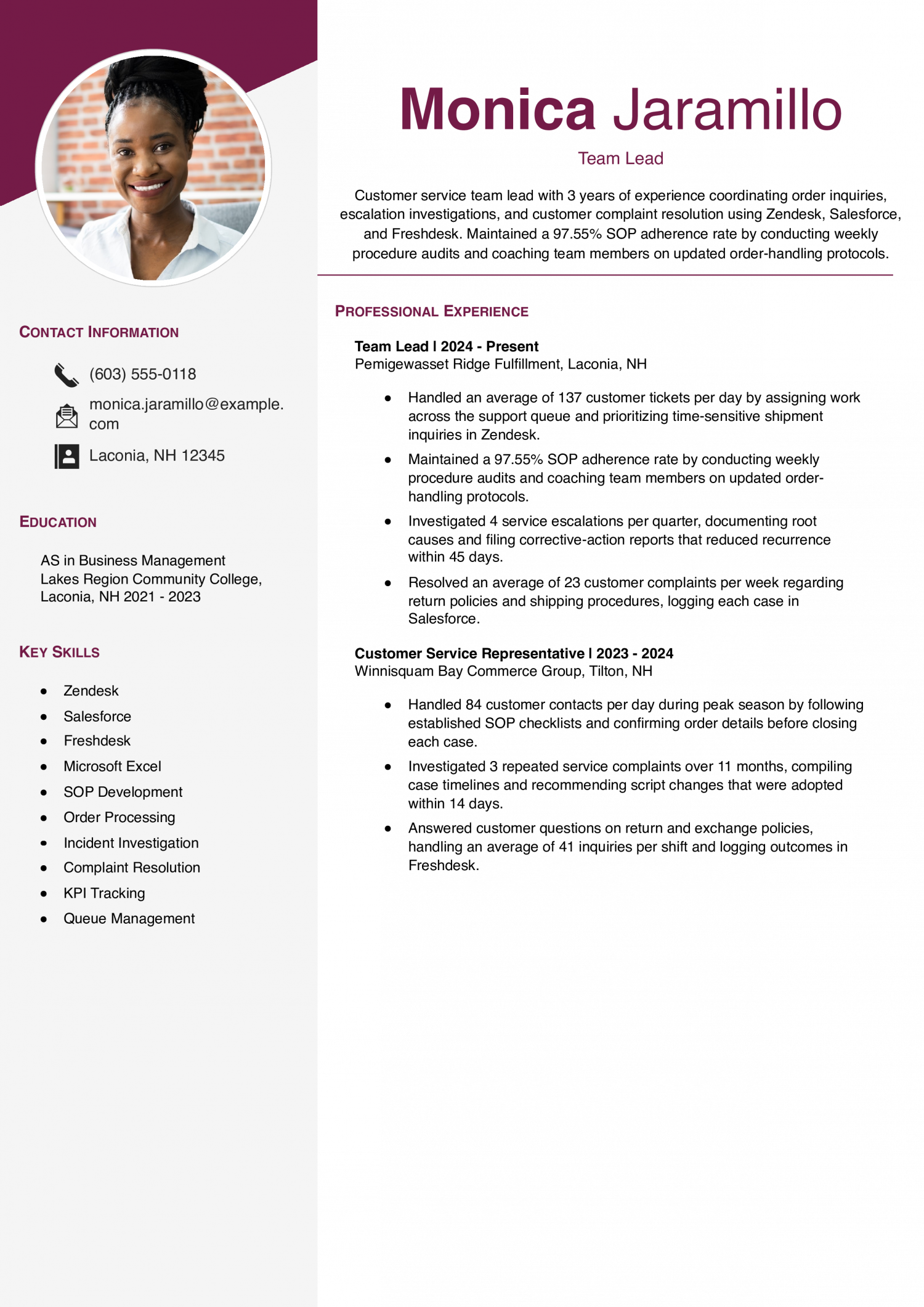
Start with this resume if you are moving from a customer service representative role into your first team lead position. Lead with incident investigation counts and SOP adherence rates rather than generic duty descriptions.
Investigation work here goes from root-cause documentation through a corrective-action report to a measurable drop in repeat incidents. A site manager sees a full loop, not “handled complaints.” When you describe incident investigation, walk through each step and say what changed afterward.
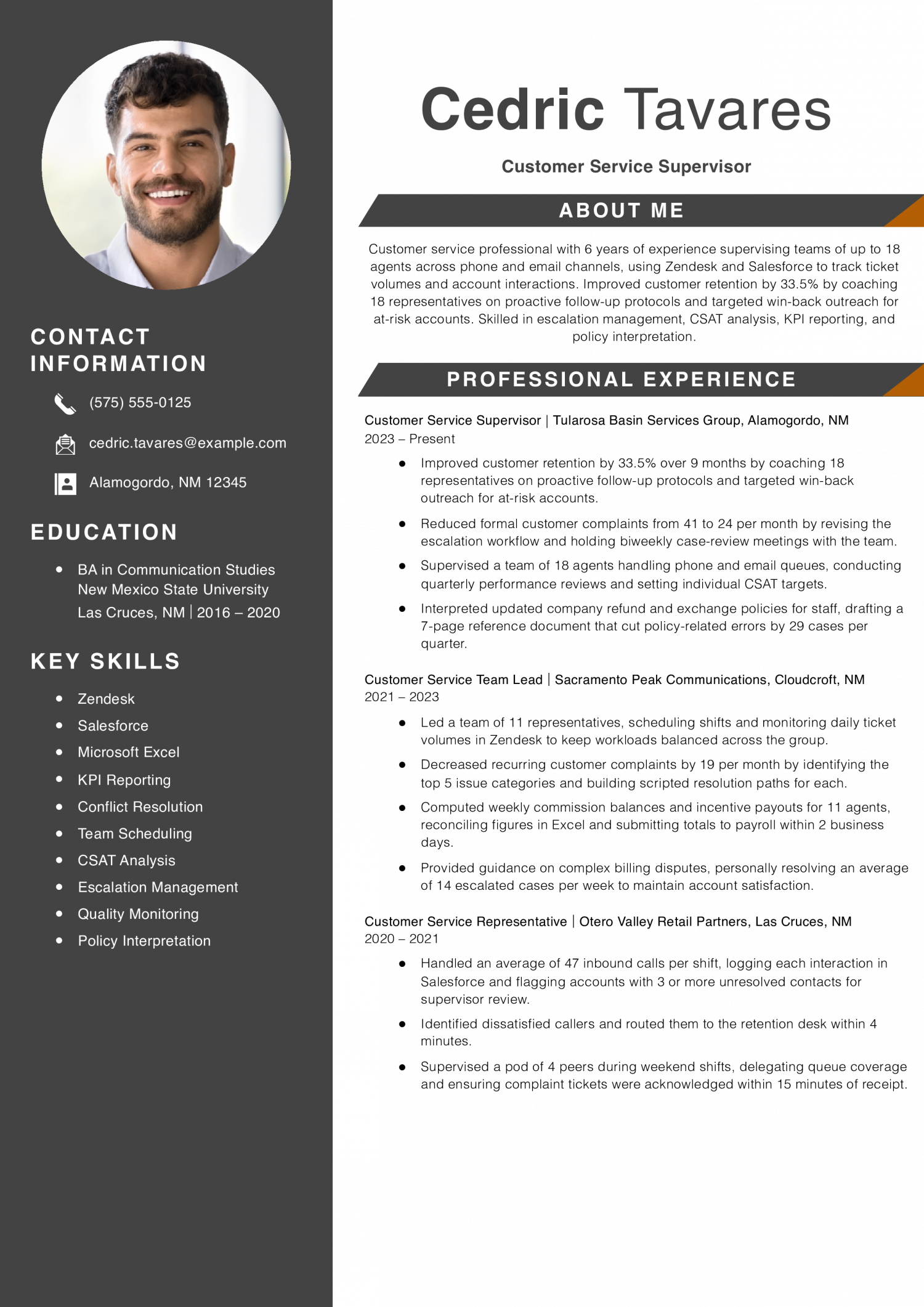
Try this resume if you are a mid-level customer service supervisor with a few years of formal team leadership and measurable retention wins. Lead with complaint-reduction counts stated as before-and-after monthly figures so readers see the gap you closed.
Biweekly case-review meetings are the recurring habit behind the complaint drop. A regional manager can see the improvement came from a steady process, not a sudden crackdown. If you hold regular reviews that drive results, name the schedule and connect it to the outcome.
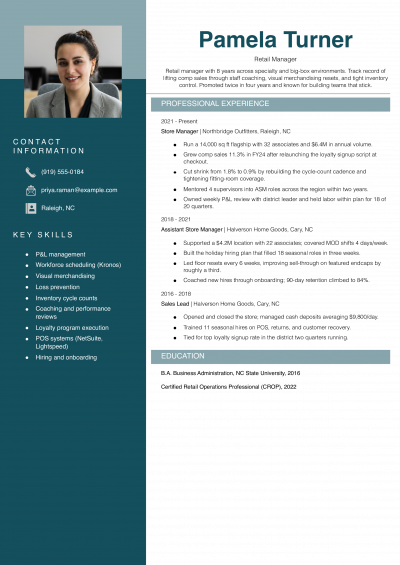
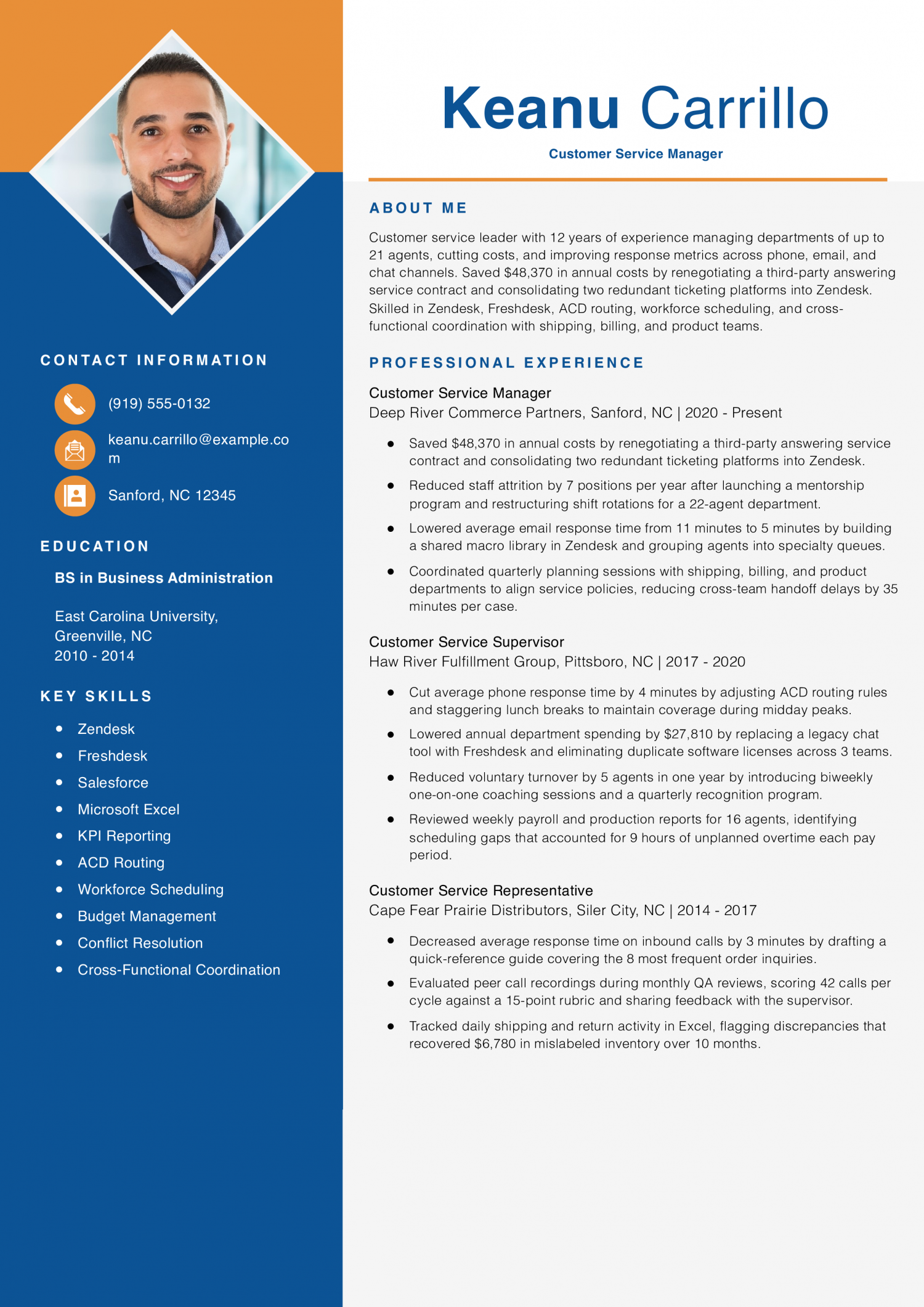
Lean on this resume if you are a senior customer service manager with multi-year leadership experience and a record of reducing costs and turnover. Lead with contract renegotiation savings and retention figures stated as headcount kept, not only percentages.
Attrition numbers before and after a mentorship launch tell a VP of operations exactly how much turnover changed. The program and the shift restructuring are named as the causes. Show your own retention results the same way: state what you started and what the headcount did next.
Experienced in training and mentoring customer service teams across three retail organizations over 6 years, with a focus on onboarding redesign, KPI coaching, and upselling strategy. Generated $89,740 in repeat-purchase revenue by coaching 9 agents on targeted product recommendations during service calls. Skilled in Zendesk, Salesforce, and conflict resolution, with a record of building individualized action plans that bring underperforming agents to target metrics.
Your work history shows your name and title. It does not show the edge you bring. Lead your summary with one detail that sets you apart from other supervisors.
That might be fluency in Spanish or Mandarin. It could be deep skill in a platform like Zendesk or Salesforce Service Cloud. A track record of building brand-new teams from scratch works too.
Support managers and contact center directors scan dozens of resumes per opening. They stop on the line that names a skill their current team lacks. Place that line in the first sentence of your summary.
Keep it to one clear, specific claim. Save the rest of your story for your bullets below.
Without a figure, your bullets tend to look like duties. Strong resumes show impact with real figures. Start with the size of the team you led.
Then add your average handle time or first-call resolution rate. Customer satisfaction scores measured by CSAT or NPS also carry weight. You can cite retention gains for both agents and customers.
Shrinking escalation volume by a percentage works well. Reduced average hold time tells a clear story too. Most strong resumes include at least three to four measured results.
Place the number near the front of the bullet so it stands out on a quick scan. Even rough figures, like ‘team of 12’ or ‘cut wait times 30%,’ give your work shape.
Organize your bullets into clusters that reflect the real scope of the role. Team leadership covers hiring, coaching, and scheduling. Quality assurance means call monitoring and scorecard reviews.
Process improvement includes workflow changes and policy updates. Escalation handling shows your judgment under pressure. Reporting and analytics cover the dashboards you built or maintained.
Pick three to five of these groups per job entry. Label them with a short header or arrange bullets so related items sit together. This structure helps support managers and contact center directors see your range fast.
It also stops your experience section from reading like one long list of tasks. Keep two to four bullets per group.
List the CRM and ticketing platforms you have used. Zendesk, Freshdesk, and Salesforce Service Cloud are common ones.
Add workforce management tools like NICE or Verint if you know them. Include any internal quality or chat platforms as well. Support managers and contact center directors look for tool fit early.
They often filter resumes by software before reading bullets. If you hold relevant training certificates, list them in this same section. Keep each entry short: name, issuing body, and year earned.
Do not bury tools in the middle of a bullet. A visible block saves the reader time and shows you match their tech stack.
For most mid-level supervisor roles, education takes up little space. Put down your degree, school, and the year you finished. If you finished college more than 10 years ago, drop the year.
You do not need to list coursework at this stage. Place education after your experience and skills sections. If you moved into supervision from a frontline agent role, add a short line about your promotion path.
That context helps support managers and contact center directors see your growth. One sentence is enough. Keep the section to three or four lines at most.
The space you save is better used for measured results and tool proficiency. Let your work history carry the weight of your story.
Hard skills prove you can run daily operations. Soft skills prove you can lead a team through tough calls. Most postings weight hard skills in the requirements section.
Support managers then check soft skills through your bullet results. Compare each table to the job ad you are targeting. Where you spot a match, build a bullet that shows that skill in action.
Treat soft skills like conflict resolution as evidence tied to a metric. Drop any skill you cannot back up with a real example. Add the exact phrasing the posting uses so the ATS flags it.
Place your strongest skill matches near the top of each section.
| Soft Skills | AI-estimated % |
|---|---|
| Team motivation | 73% |
| Composure under pressure | 67% |
| Clear policy communication | 49% |
| Conflict de-escalation | 40% |
| Coaching and mentorship | 26% |
And here are the top hard skills showing up most often.
| Hard Skills | AI-estimated % |
|---|---|
| Escalation complaint resolution | 75% |
| Staff scheduling coordination | 52% |
| Performance issue documentation | 46% |
| Customer service training | 40% |
| Quality standards monitoring | 25% |
Skill names and rankings come from an AI model grounded in U.S. Department of Labor occupation data for customer service supervisors, not from a count of customer service supervisors’ resumes built on ResumeTemplates.com.
POS systems lead the list, followed by AI tools and pay data.
Many supervisor roles sit near a retail counter. You may oversee cashiers who use POS terminals daily. Listing the systems you know signals readiness to train staff.
Describing AI on a Customer Service Supervisor resume can go three ways. You could lead with buzzwords like ‘AI-driven leader.’ Support managers screen those out. You could leave AI off the resume and mention it in your interview.
Or you could name the tool and explain how your team uses it. The third is what support managers and contact center directors can validate.
State what it changed in your team’s output. Then stop. That honest framing holds up when a director asks follow-up questions.
It also shows where AI helps and where your team still leads.
What AI is actually changing for this role
Ticket routing: AI auto-classifies incoming tickets by topic and urgency, so supervisors focus on escalation patterns instead of manual sorting.
Quality scoring: Automated scoring tools review agent interactions against set criteria, freeing supervisors to coach on flagged calls.
Workforce scheduling: Forecasting models predict volume spikes by channel, which helps supervisors adjust shift coverage before queues build.
Response drafting: Generative AI suggests reply templates for common issues, and supervisors approve or edit them before agents send.
Sentiment tracking: Real-time sentiment dashboards flag negative trends across channels so supervisors can intervene during a shift, not after.
AI tools to name
How to phrase AI on your resume
Do
Skip
Supervisors often cover evenings, weekends, and holidays. Stating your open availability removes doubt for the reader. It also sets you apart from rigid applicants.
Tip: State Your Availability Early
Support managers and contact center directors staff around peak hours. A short note on your resume can clarify your schedule. Place it near your contact details or summary section.
The top-paying states for customer service supervisors tend to cluster in smaller, high-cost markets. They are not the large metro hubs most people expect. These BLS figures cover first-line supervisors of office and admin support workers.
That broader group includes customer service supervisors. The gap between the lowest and highest earners is large. Workers at the top earn about half more than the median.
The bottom tier sits about a third below it. That range signals real room to grow without changing careers. If you are open to relocating, list that flexibility on your resume and name the regions where you hold relevant experience.
| # | State | Median Annual |
|---|---|---|
| 1 | Washington | $79,480 |
| 2 | District of Columbia | $79,200 |
| 3 | New York | $79,170 |
| 4 | Connecticut | $78,200 |
| 5 | California | $77,590 |
| 6 | Massachusetts | $76,770 |
| 7 | New Jersey | $76,640 |
| 8 | Colorado | $76,600 |
| 9 | Minnesota | $76,440 |
| 10 | Rhode Island | $76,030 |
| # | State | Workers | Median |
|---|---|---|---|
| 1 | Texas | 160,600 | $64,940 |
| 2 | California | 149,230 | $77,590 |
| 3 | Florida | 93,850 | $64,360 |
| 4 | New York | 83,110 | $79,170 |
| 5 | Pennsylvania | 56,600 | $65,270 |
Resume Templates offers HR approved resume templates to help you create a professional resume in minutes. Choose from several template options and even pre-populate a resume from your profile.
Large firms often use applicant tracking systems, so mirror the exact phrases from the job posting. Mention the team size and the tools you used, such as Zendesk or Salesforce Service Cloud. Add metrics that match what the posting asks for, like handle time or CSAT targets.
Start each bullet with a strong verb. Add a number that proves scale. For example, write 'Coached a 12-agent team to raise first-call resolution from 74% to 88% in six months.' Concrete results like these help contact center directors compare you to other candidates.
A two- to three-line summary helps hiring managers see your fit right away. State your years of experience, your team size, and one standout metric. Keep it short so the reader moves on to your work history fast.
The core format stays the same, but the keywords and metrics shift. A customer care role highlights ticket volume handled and average handle time. A customer experience role focuses more on satisfaction scores and retention rates.
A reverse time order format works best for most supervisors. Put your latest role first and list each job with clear bullet points. This lets hiring managers see your newest wins before anything else.
List the company once, then stack each title underneath with its own date range and bullets. This format shows your growth without making the reader guess whether you changed employers. Bold the supervisor title so support managers spot the promotion at a glance.
Swap the metrics to match each setting. A call center version should stress handle time and call quality scores. A retail version should highlight sales targets, shrink rates, and floor coverage instead.
An ATS-friendly template puts your team results and credentials under separate headings. A basic template is a fine choice too.
Customer Service Supervisor Resume
4.2/5 stars with 226 reviews

Executive Resume Writer and Career Coach
Andrew Stoner is an executive career coach and resume writer with 17 years of experience as a hiring manager and operations leader at two Fortune 500 Financial Services companies, and as the career services director at two major university business schools.
© 2026 Resumetemplates.com All rights reserved.