

Production Manager Resume Examples
Lead with the one signal a job title alone will not reveal. Name the process you run, the plant size you own, or the standard you hold. Write a single line at the top of…

A clean safety and headcount block is what gets Operations Supervisor resumes past the first cut with operations managers and plant managers; throughput and cost numbers tied to shifts are what make them readable enough to advance.
A shift supervisor resume proves you can run a crew for eight to twelve hours and hit output, safety, and quality targets. Show headcount led, lines or zones covered, and the daily metrics you owned.
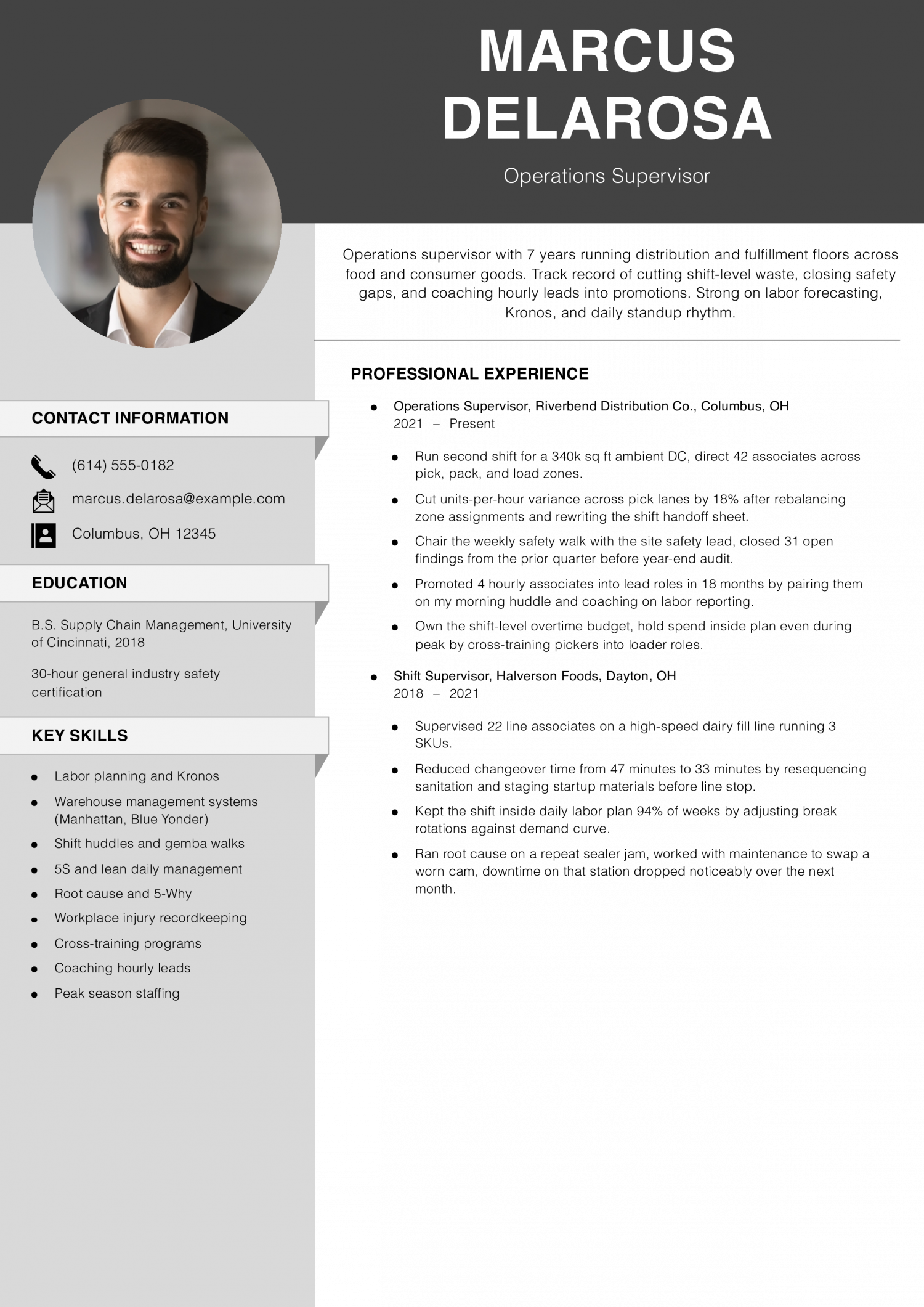
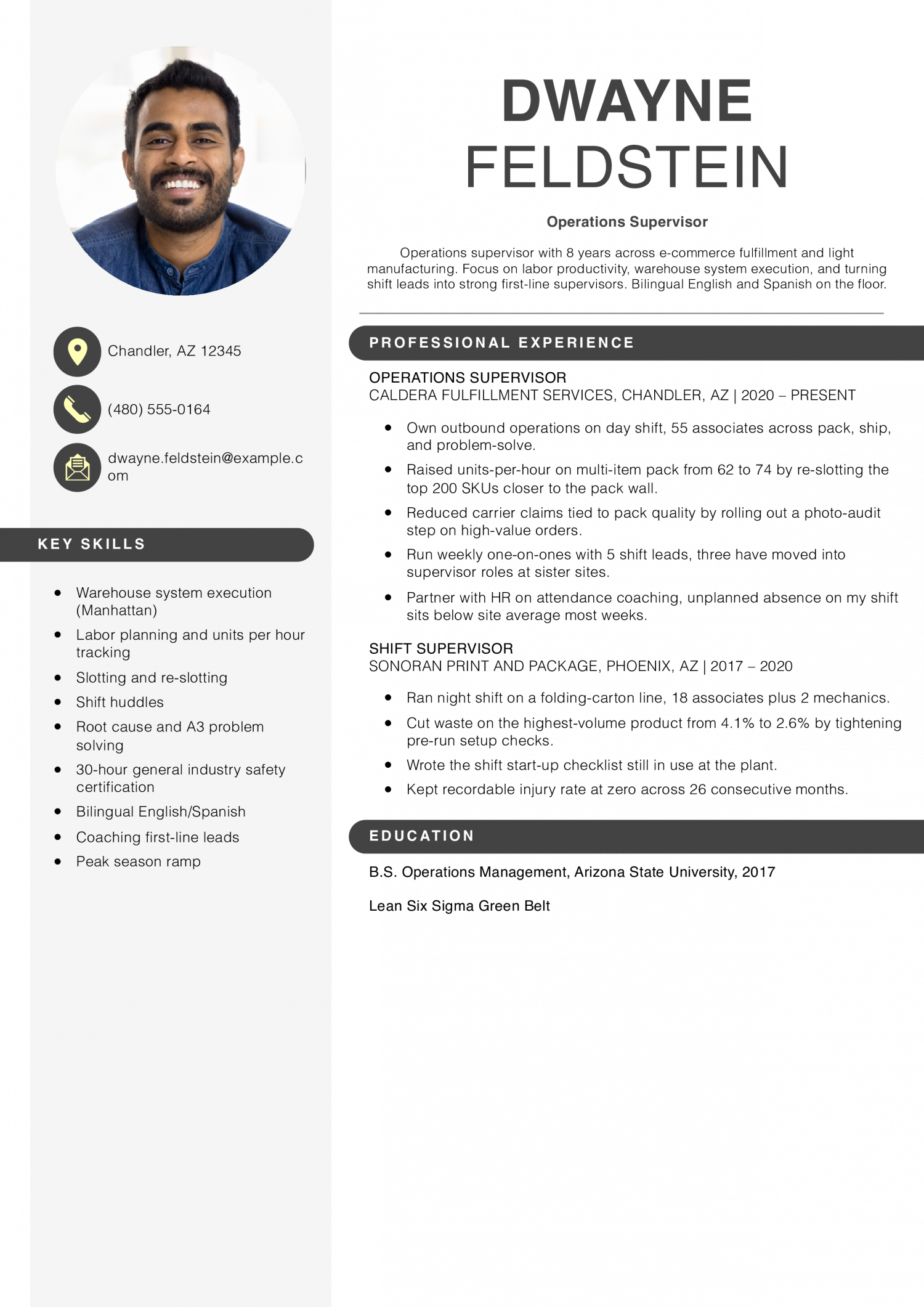
An operations supervisor resume proves you own a department across shifts and coach the lead workers under you. Show scope in people and volume, plus the throughput, scrap, or on-time numbers you moved for operations managers.
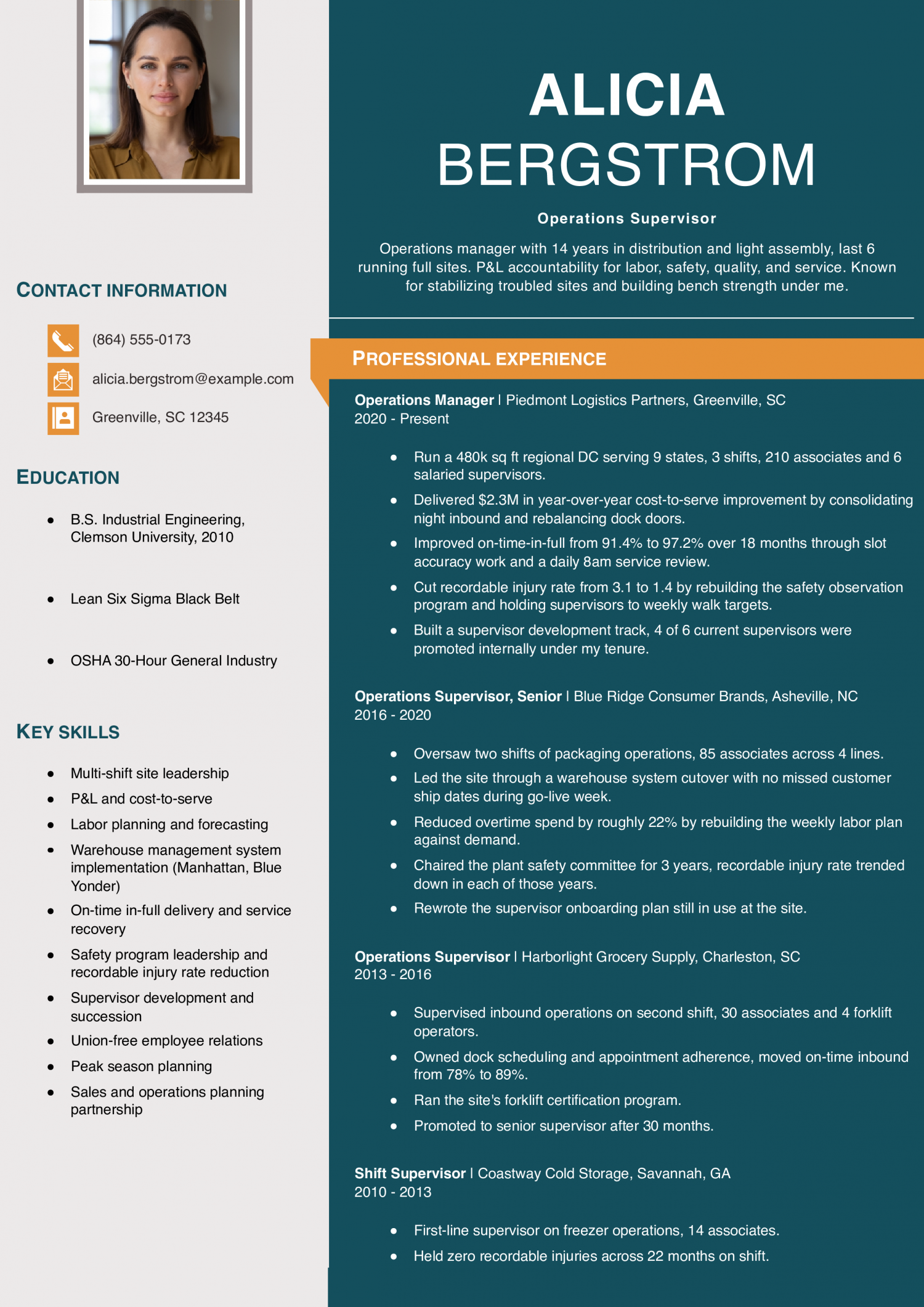
An operations manager resume proves you run a site or a large function and answer to plant managers on P&L. Show budget size, headcount, and the yearly gains you drove in safety, cost, and delivery.
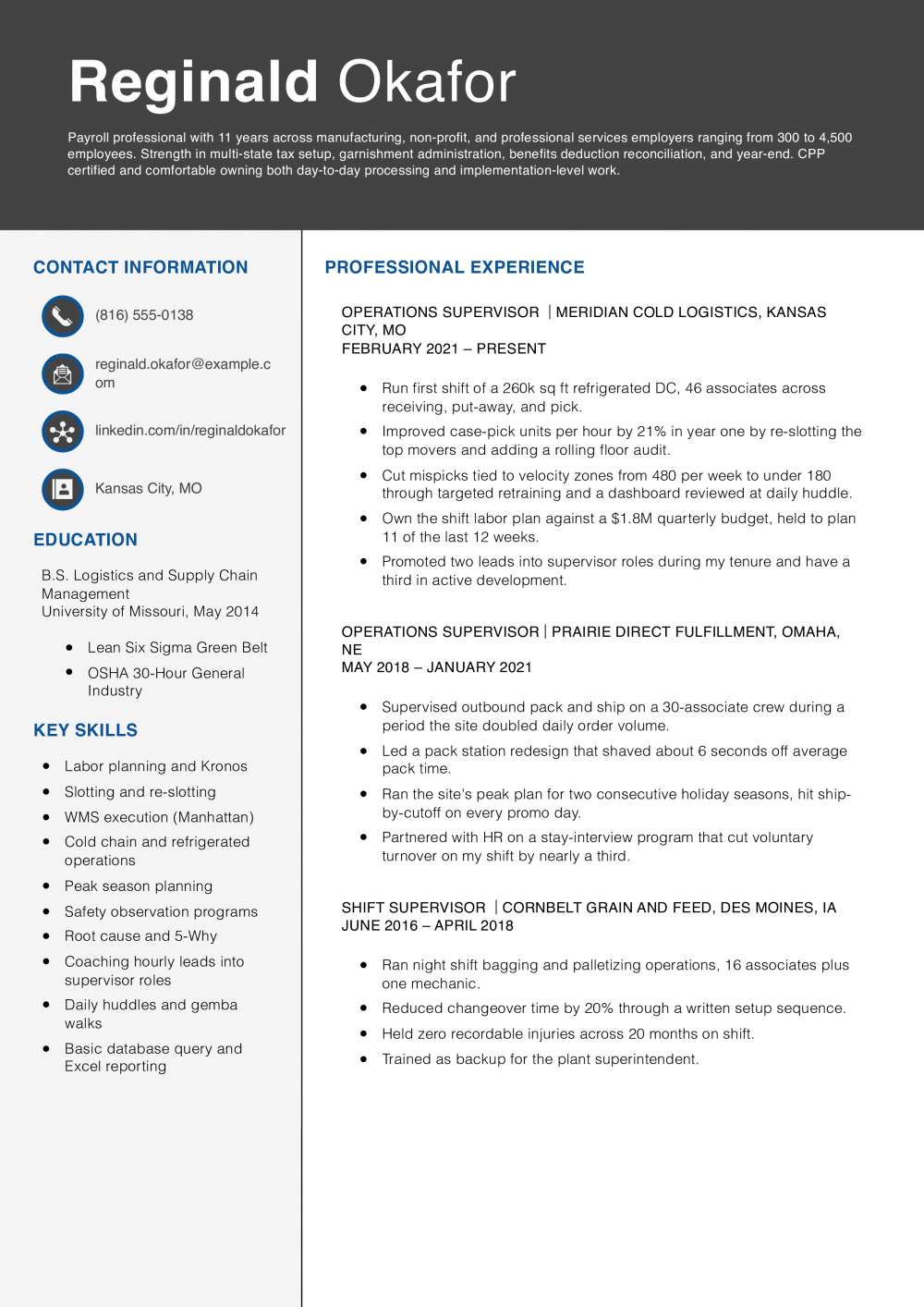
Reginald Okafor
Kansas City, MO | (816) 555-0138 | [email protected] | linkedin.com/in/reginaldokafor
Operations supervisor with 10 years across cold chain, e-commerce, and last-mile distribution. Comfortable running 40+ associate crews, owning labor plans, and holding safety and service KPIs. Consistent record of promoting hourly talent into salaried roles and stabilizing sites during peak.
Operations Supervisor
Meridian Cold Logistics | Kansas City, MO | 2021-Present
Operations Supervisor
Prairie Direct Fulfillment | Omaha, NE | 2018-2021
Shift Supervisor
Cornbelt Grain and Feed | Des Moines, IA | 2016-2018
Lead Associate
Cornbelt Grain and Feed | Des Moines, IA | 2014-2016
Your profile should sit at the top of page one. State your years supervising floor operations and the setting you have run: distribution center, manufacturing plant, third-party logistics site, or food processing facility. Name the shift structure you owned, whether that is one shift, two shifts, or a 24/7 rotation.
State the headcount you directed and the union or non-union status of that crew. Name the core function of the site, such as pick and pack, assembly, injection molding, or inbound receiving. Operations managers and plant managers read this block first to place you against the opening.
A profile that reads as generic gets sorted behind one that names the setting in the first two lines. If you run a warehouse or distribution center, see our warehouse supervisor resume examples for ways to present that setting.
A duty line with no rate, percentage, or headcount attached won’t separate you from the other supervisors in the stack. Give two or three metrics per role that match how the site was measured. Throughput reads well as units per hour, orders shipped per shift, or on-time ship rate against a target.
Safety reads well as recordable incident rate, days without a lost-time injury, or near-miss reporting volume. Labor reads well as overtime as a percent of straight time, attendance rate, or turnover on your crew. Name the baseline you inherited and the number you moved it to.
A strong bullet pairs the action with the delta, not the action alone.
Cluster your bullets so the reader can scan by function instead of hunting through prose. People leadership covers hiring, coaching, performance reviews, and progressive discipline on an hourly crew. Production execution covers shift starts, line balancing, order release, and hand-off to the next shift.
Continuous improvement covers Kaizen events, 5S audits, standard work updates, and root cause work on downtime. Compliance covers safety walk-throughs, lockout tagout audits, quality checks, and internal holds. Pick the three or four categories that match your site and stay consistent across roles.
Operations managers and plant managers looking at your resume want to place your daily work against their open shift within about 20 seconds.
Put a short credentials and systems block under your profile, above the first role. List the certifications you actually hold, such as forklift train-the-trainer or Six Sigma Green Belt, and note if any are expired. List the warehouse, ERP, or production systems you run in daily, such as SAP, Oracle, Manhattan, or Plex.
Add the labor and scheduling tool you use if you build the shift schedule. Operations managers and plant managers screen for system fit before they read your bullets, because a supervisor who already knows the system starts producing weeks sooner. State plus license in good standing is the standard format for any regulated credential.
Requirements vary by employer and posting.
A senior operations supervisor resume runs two pages, and every line has to earn the space. Cut roles older than 15 years unless they carry a certification or a plant you still reference. Drop the objective statement, the references line, and the hobbies block.
Trim early hourly roles down to a one-line entry with company, title, and dates. Cut soft-skill bullets that say you are a team player or a strong communicator, because Operations managers and plant managers read those as filler. Keep your degree, but drop the graduation year if it dates you past the 15-year cut.
Every bullet you remove lets a stronger bullet do more work on the page.
The Operations Supervisor resumes that get callbacks share a specific skill mix. Hold your resume next to the target posting and check both tables line by line. Operations managers and plant managers scan for these patterns first, not generic leadership platitudes about team building.
Hard skills carry the first pass because they map to the systems and metrics on the floor. Think Lean methods, safety compliance, KPI tracking, and shift planning down to the hour. Soft skills back the bullets that prove those hard skills paid off.
A line about coaching means little without a throughput number behind it. Pull the exact phrasing the posting uses for tools and standards. Mirror those words in your skills block and again inside two or three bullets.
Use the soft skill list to name what your best stories already show, not to pad. Trim any skill you cannot defend in a phone screen with a short example.
| Soft Skills | AI-estimated % |
|---|---|
| Team accountability | 76% |
| Conflict de-escalation | 66% |
| Floor-level communication | 49% |
| Decision-making under pressure | 40% |
| Cross-shift coordination | 27% |
And here are the top hard skills showing up most often.
| Hard Skills | AI-estimated % |
|---|---|
| Production scheduling | 80% |
| Quality control inspection | 52% |
| Workforce capacity planning | 48% |
| Safety compliance enforcement | 40% |
| Shift performance reporting | 25% |
Skill names and rankings come from an AI model grounded in U.S. Department of Labor occupation data for operations supervisors, not from a count of operations supervisors’ resumes built on ResumeTemplates.com.
The Bureau of Labor Statistics does not publish a wage code for Operations Supervisor specifically. The numbers below are a proxy: the closest published match is First-Line Supervisors of Production and Operating Workers (SOC 51-1011), so use them as an estimate for this role, not an exact figure.
For Operations Supervisors, the tenth-percentile floor sits well below the median. The top-decile ceiling runs about 46 percent above that middle mark. The spread is wide on both ends, and the field is large by national headcount.
That shape tells you the role covers a broad range of scopes, from a single shift on one line to multi-site production oversight. Two supervisors can share the same title and sit in very different pay bands. Read the ceiling as what specialization, scope and setting can add over time.
Read the floor as the entry rung for a first supervisor seat. Position the resume for the band you want by showing the scope, the setting and the systems that match it.
| # | State | Median Annual |
|---|---|---|
| 1 | Wyoming | $90,390 |
| 2 | Connecticut | $83,150 |
| 3 | Rhode Island | $81,650 |
| 4 | New Jersey | $81,110 |
| 5 | District of Columbia | $80,030 |
| 6 | Massachusetts | $79,920 |
| 7 | New Hampshire | $79,310 |
| 8 | Washington | $79,310 |
| 9 | Delaware | $79,100 |
| 10 | Maine | $78,970 |
| # | State | Workers | Median |
|---|---|---|---|
| 1 | Texas | 58,930 | $70,140 |
| 2 | California | 48,550 | $76,840 |
| 3 | Ohio | 31,980 | $72,160 |
| 4 | Illinois | 29,640 | $75,200 |
| 5 | Pennsylvania | 28,900 | $74,990 |
Resume Templates offers HR approved resume templates to help you create a professional resume in minutes. Choose from several template options and even pre-populate a resume from your profile.
Open with a profile that names your span of control, the shift pattern, and the site type.
Follow with bullets that quantify throughput, safety rate, and labor cost per unit. Close with a systems block that lists the warehouse, ERP, and reporting tools you run daily.
Point to a resume bullet where you covered a gap another leader left, such as a night shift handoff or a broken audit trail.
Say what you added in plain terms: a standup, a tracking board, or a cross-training plan. Interviewers use this to test whether your resume claims match how you actually work with peers.
No, list the systems you used in production for at least six months and can still run today.
Operations managers and plant managers read the systems block as a shortlist, not a survey of everything you saw. Group the tools by category: warehouse management, ERP, labor management, and reporting.
Report the metric the site actually tracks, such as the recordable injury rate, near-miss reporting rate, or days without a lost-time event.
Add the baseline you inherited and the number you held or improved over a stated period. That framing gives operations managers a number they can compare to their own site.
Name the closure on the role line, using a short phrase like "site closed, workforce reduced."
That reads as context, not a personal gap, since operations managers know closures move in waves. Use the months since then to note contract, interim, or consulting work you took at another site.
No, keep the title your employer used on payroll and describe the manager-level work in the bullets.
Write what you owned: the headcount, the budget line, and the shift or line you ran without a manager present. Operations managers verify titles in reference checks, so a stretched title costs you the role.
Shift the metrics toward store-level work: shrink rate, planogram compliance, and hours worked against forecast.
Name the point of sale system, the labor scheduling tool, and the inventory app the chain publishes in the posting. Keep the warehouse or plant bullets on the resume only when they show people leadership at similar headcount.
For an operations supervisor, an ATS-friendly template is the safest pick, because it puts your certifications and experience where a hiring manager scans first. A basic template is a solid alternative. Whichever you choose, keep the formatting clean and easy to parse: clear section headings, a standard font, and no graphics a parser can choke on.