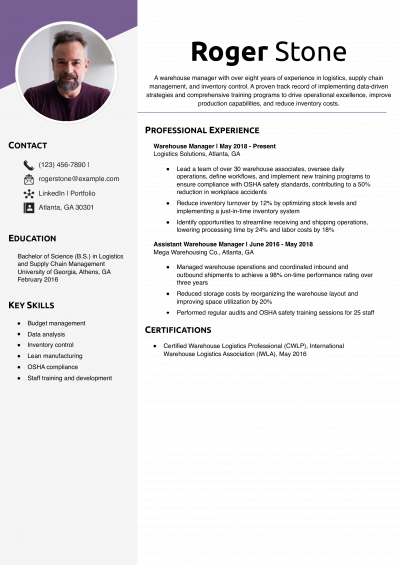
3 Best Warehouse Manager Resume Examples and Templates for 2026



A current forklift certification and a pick-accuracy number are what get warehouse worker resumes past the shift lead's first scan; specific WMS and scanner experience are what make them readable enough to advance to a floor interview.
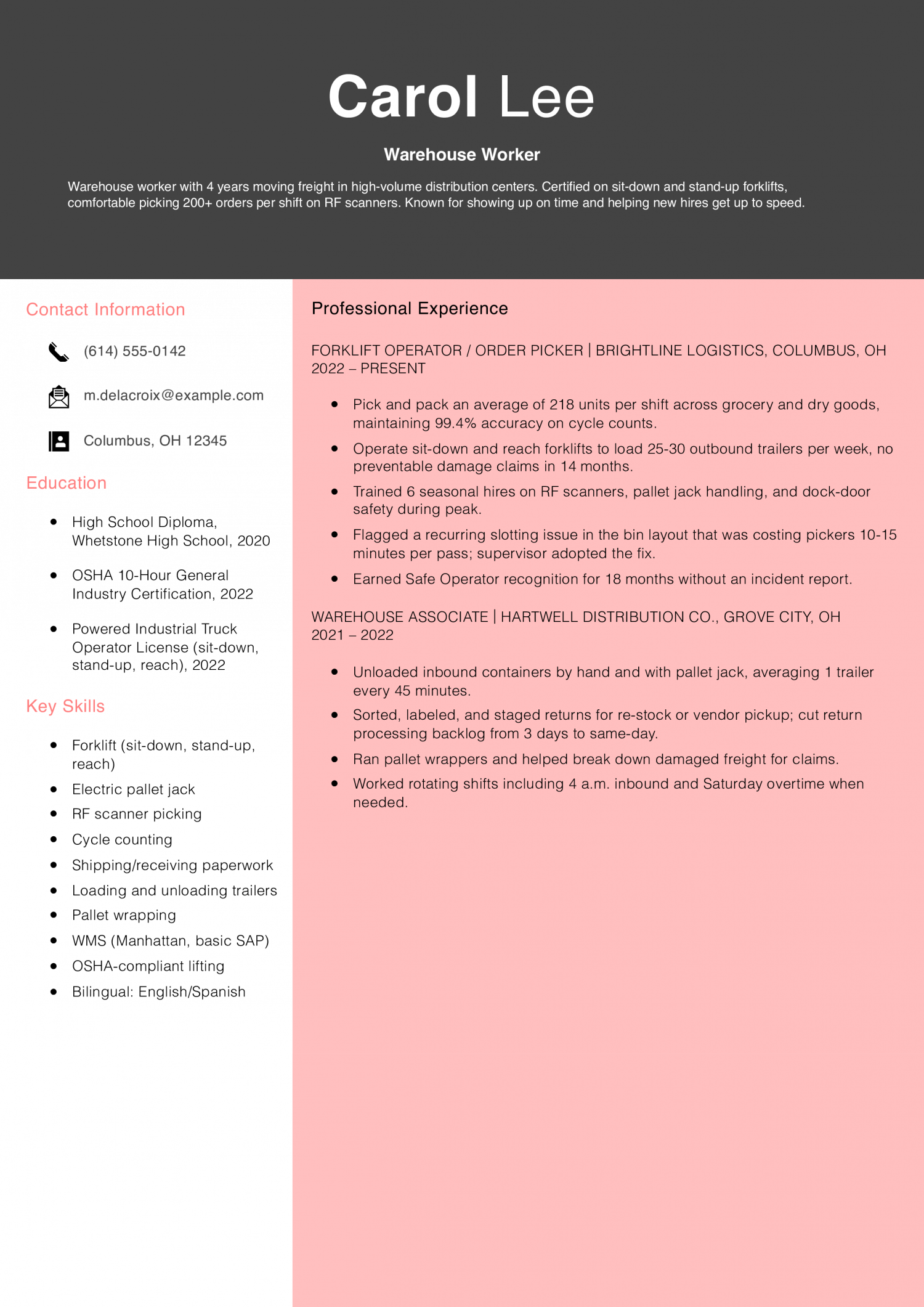
Entry-level warehouse workers are new to the floor or coming from stocking, retail, or general labor. The resume needs to prove you can show up on time, follow safety rules, and handle pace.
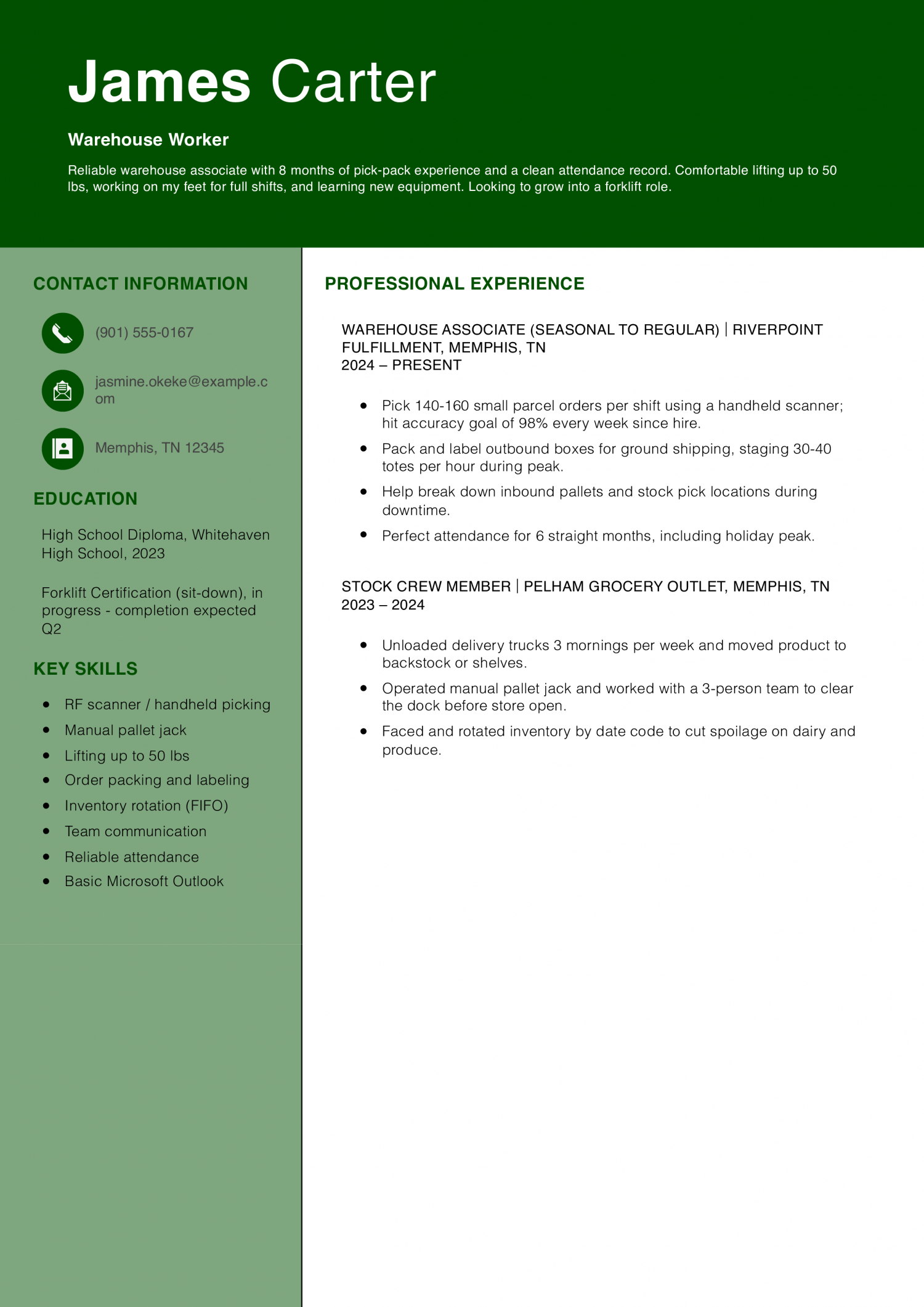
Experienced warehouse workers run a section, train new hires, or hold forklift and reach-truck certifications. The resume needs to prove pick accuracy, units per hour, and clean safety records over multiple years.
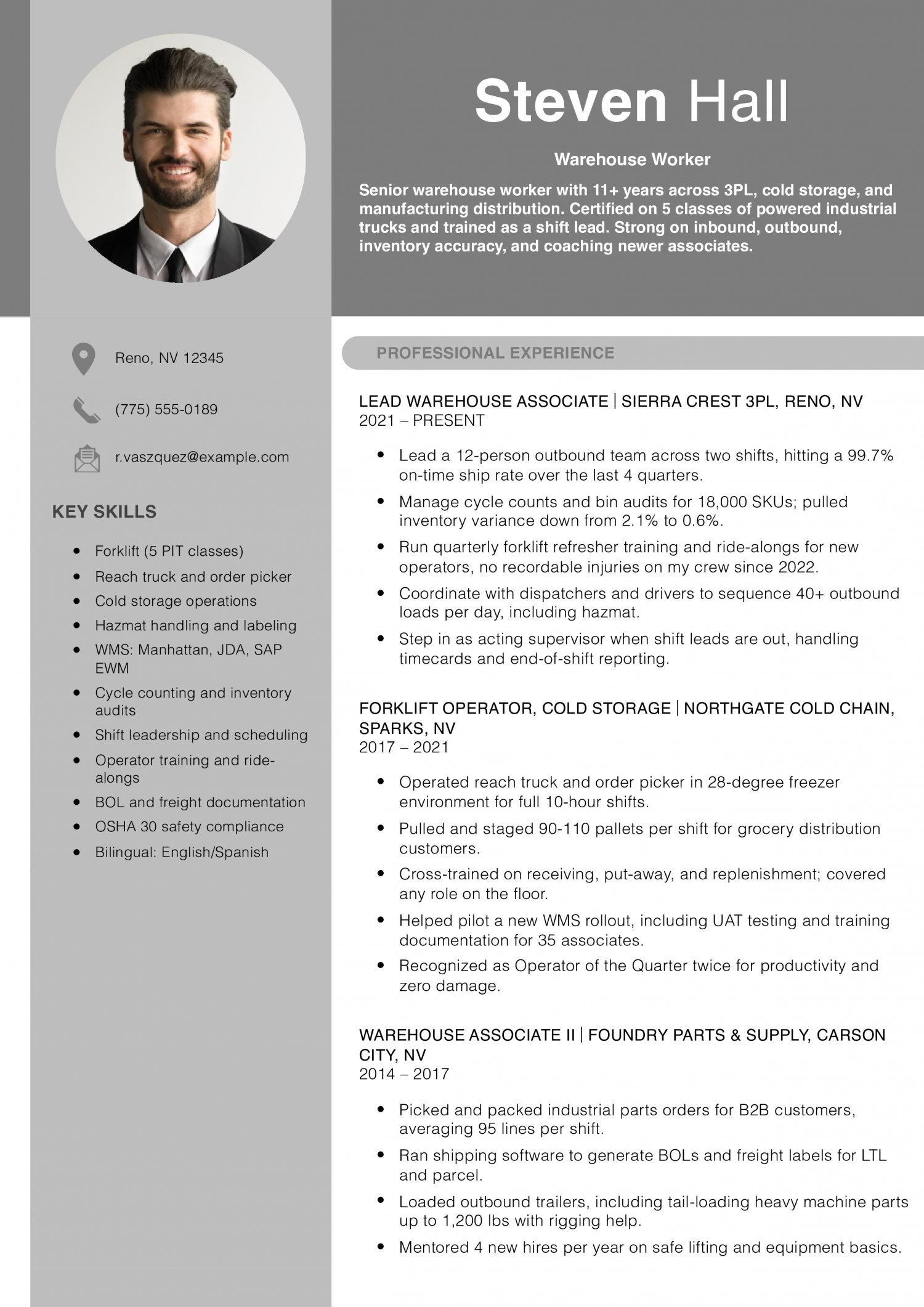
Devon Brathwaite
Kansas City, MO | (816) 555-0173 | [email protected] | linkedin.com/in/devonbrathwaite
Warehouse worker with 6 years across e-commerce fulfillment, automotive parts distribution, and food service. Forklift certified, comfortable on RF scanners and WMS systems, and used to fast-paced peak seasons. Looking for a stable role with room to move into a lead position.
Senior Warehouse Associate
Meadowlark Fulfillment Center | Kansas City, MO | 2022-Present
Forklift Operator
Tristate Auto Parts Distribution | Independence, MO | 2020-2022
Warehouse Associate
Heartland Food Service Supply | Lenexa, KS | 2019-2020
Package Handler
Crossroads Parcel Hub | Kansas City, KS | 2018-2019
Add a single line a shift lead cannot find on your OSHA card or forklift cert. That might be a reach-truck or order-picker class, cold-storage experience, or a hazmat endorsement.
Other strong differentiators: SAP EWM or Manhattan WMS time on the floor, bilingual communication with drivers, or experience running a cycle-count team. Put it in your summary line, not buried in bullet six. Warehouse supervisors and shift leads read top-down and stop reading fast.
Most strong warehouse resumes name volume, pace, or accuracy. Bullets without a number tend to read as duties, not results.
Pull two or three real metrics: units picked per hour, order accuracy percentage, pallets loaded per shift, or cases received per day. If you don’t have exact figures, use scope: SKUs handled, dock doors worked, shift size, or peak-season volume. A strong bullet reads, “Picked 140 units per hour at 99.6% accuracy on RF scanner across 4,000 SKUs.”
Sort your bullets into three or four buckets so a shift lead can scan in seconds. Common groups: receiving and put-away, picking and packing, shipping and loading, and inventory or cycle counts.
Under each group, name the equipment and the system. Pallet jack and sit-down forklift go under shipping; RF gun and WMS transactions go under picking; cycle counts and discrepancy reports go under inventory. This shape beats one long bullet list.
Build a credentials block under your name and contact line. List forklift class (Class I sit-down, Class II reach, Class III pallet jack), OSHA 10 or OSHA 30, hazmat handling, and any company-specific training like Powered Industrial Truck operator.
Warehouse supervisors and shift leads need to see tickets before bullets, because an expired forklift cert ends the read. Add the issue year. List CPR or first-aid if you held a safety captain role on prior shifts.
Keep education short: high school diploma or GED, plus any trade school or community college coursework in logistics, supply chain, or industrial safety. One or two lines.
Add a brief reliability signal below: years on shift work, perfect-attendance awards, peak-season retention, or willingness to work overnights and weekends. Warehouse supervisors hire for show-up rate as much as skill, so make the dependability proof visible without padding the resume.
Based on data from our user-built warehouse worker resumes, these are the skills that show up most on resumes that move to interviews. Match them against your target job posting before you finalize your draft.
| Soft Skills | % of resumes with this skill |
|---|---|
| Attention to detail | 74% |
| Teamwork and collaboration | 67% |
| Time management | 47% |
| Problem solving | 39% |
| Adaptability and flexibility | 32% |
And here are the top hard skills showing up most often.
| Hard Skills | % of resumes with this skill |
|---|---|
| Forklift operation | 77% |
| Warehouse Management Systems | 67% |
| Order picking and packing | 45% |
| Barcode scanning and inventory management | 35% |
| Shipping and receiving | 27% |
Based on data from thousands of warehouse workers’ resumes built on ResumeTemplates.com, May 2026.
These are the must-haves hiring teams look for when scanning a warehouse worker resume.
Safety certs are the fastest way to move from the general-labor pile to the equipment-operator pile. Warehouse supervisors check them before they read bullets.
Warehouse supervisors want to see the exact equipment you’ve run, not generic “material handling” language. Name the brand and class wherever you can.
Warehouse supervisors and shift leads read this list as a map of which equipment and safety tracks you’ve trained on. The certifications below tell them whether you can step on a forklift on day one or need 30 days of in-house training. List the issuing body and the year next to each entry.
Warehouse worker is one of the larger occupations in BLS, which means the median pulls in a long tail of general-labor and seasonal roles. The spread between entry and top decile is wider than it looks, because forklift, reach-truck, and WMS work pay above the floor.
To position above the median on your resume, lead with the equipment classes you’re certified on and the systems you’ve worked in, not just “warehouse experience.”
| # | State | Avg. Annual |
|---|---|---|
| 1 | Washington | $42,210 |
| 2 | Oregon | $41,430 |
| 3 | Colorado | $40,710 |
| 4 | Connecticut | $40,010 |
| 5 | Wyoming | $39,940 |
| 6 | Alaska | $39,560 |
| 7 | California | $39,450 |
| 8 | District of Columbia | $38,760 |
| 9 | Delaware | $38,630 |
| 10 | New York | $38,630 |
| # | State | Workers | Median |
|---|---|---|---|
| 1 | Texas | 283,120 | $36,120 |
| 2 | California | 267,340 | $39,450 |
| 3 | Florida | 201,770 | $36,490 |
| 4 | New York | 142,870 | $38,630 |
| 5 | Ohio | 136,090 | $37,090 |
Resume Templates offers HR approved resume templates to help you create a professional resume in minutes. Choose from several template options and even pre-populate a resume from your profile.
Pull keywords directly from the job posting. The terms that show up most across warehouse postings are forklift, RF scanner, WMS, pick and pack, pallet jack, OSHA, and cycle count.
Name the equipment class and the WMS by brand so the ATS catches the exact match.
Lead with transferable physical-work roles: stocking, construction labor, landscaping, restaurant back-of-house, or military logistics. Translate the work into warehouse language: lifting weight, hours on shift, and inventory or count duties.
Add any forklift or OSHA training, even if it was from a community college course or temp agency orientation.
Group short temp assignments under one staffing-agency header instead of listing each site separately. Write the agency as the employer, then list the client sites as sub-bullets with dates and roles.
This keeps the resume clean and explains gaps between full-time roles without looking like job-hopping.
Use two lines. Line one names your years on the floor, your forklift classes, and the WMS you've used.
Line two names your strongest metric: units per hour, pick accuracy, or peak-season throughput. Skip adjectives like "hard-working" and replace them with the certifications and numbers that prove it.
For a warehouse worker, an ATS-friendly template is the safest pick, because it puts your certifications and experience where a hiring manager scans first. A basic template is a solid alternative. Whichever you choose, keep the formatting clean and easy to parse: clear section headings, a standard font, and no graphics a parser can choke on.

Professional Resume Writer (MBA, CPRW, CDCS)
Mark Misiano is a Certified Professional Résumé Writer (CPRW), Certified Digital Career Strategist (CDCS) and the owner of RésuméReady. He has helped over 1,000 professionals find fulfilling jobs, transition to new industries, and land big promotions. In addition to writing impactful résumés, Mark crafts engaging cover letters, optimizes LinkedIn profiles, prepares clients for interviews, and provides individualized career coaching.
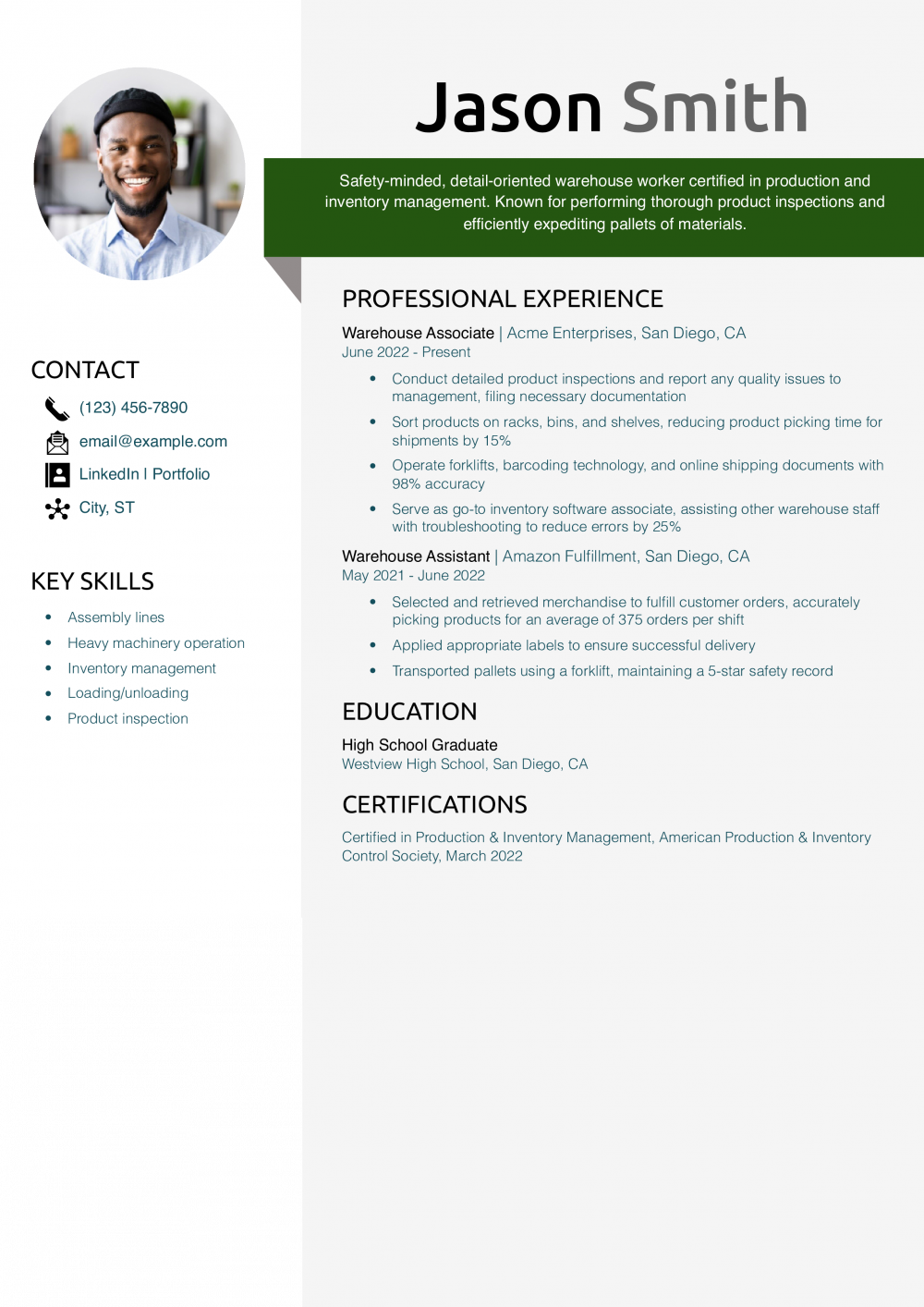
Customize this template in our builder in under 10 minutes.