
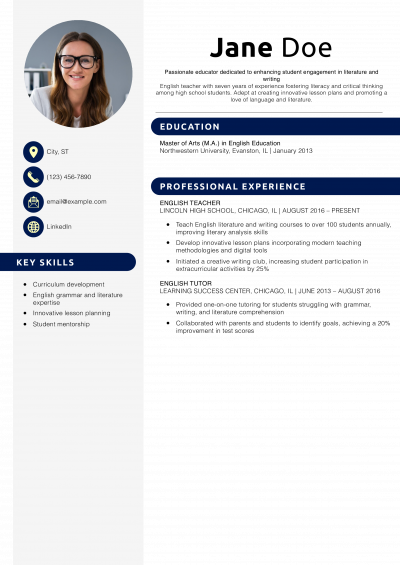
20 Best Teacher Resume Examples and Templates for 2026



A clean license and endorsement block is what gets education resumes past the district portal screen; specific student-outcome numbers tied to named schools are what make them readable enough to advance to a demo lesson.
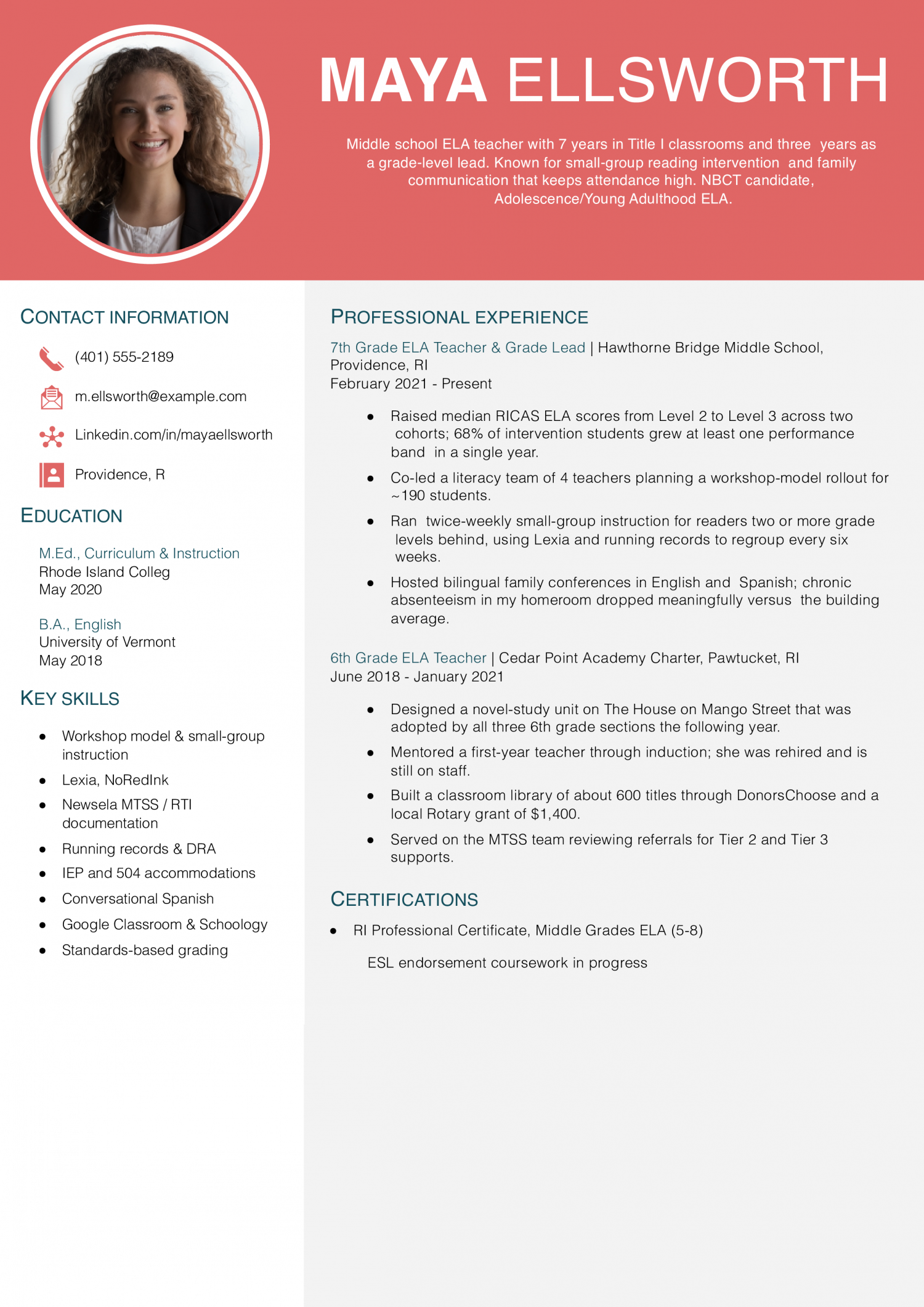
Entry-level education resumes belong to new graduates, student teachers, and career changers finishing licensure. This resume needs to prove your grade-band certification, student-teaching placements, and the cooperating-teacher feedback that signals classroom readiness.
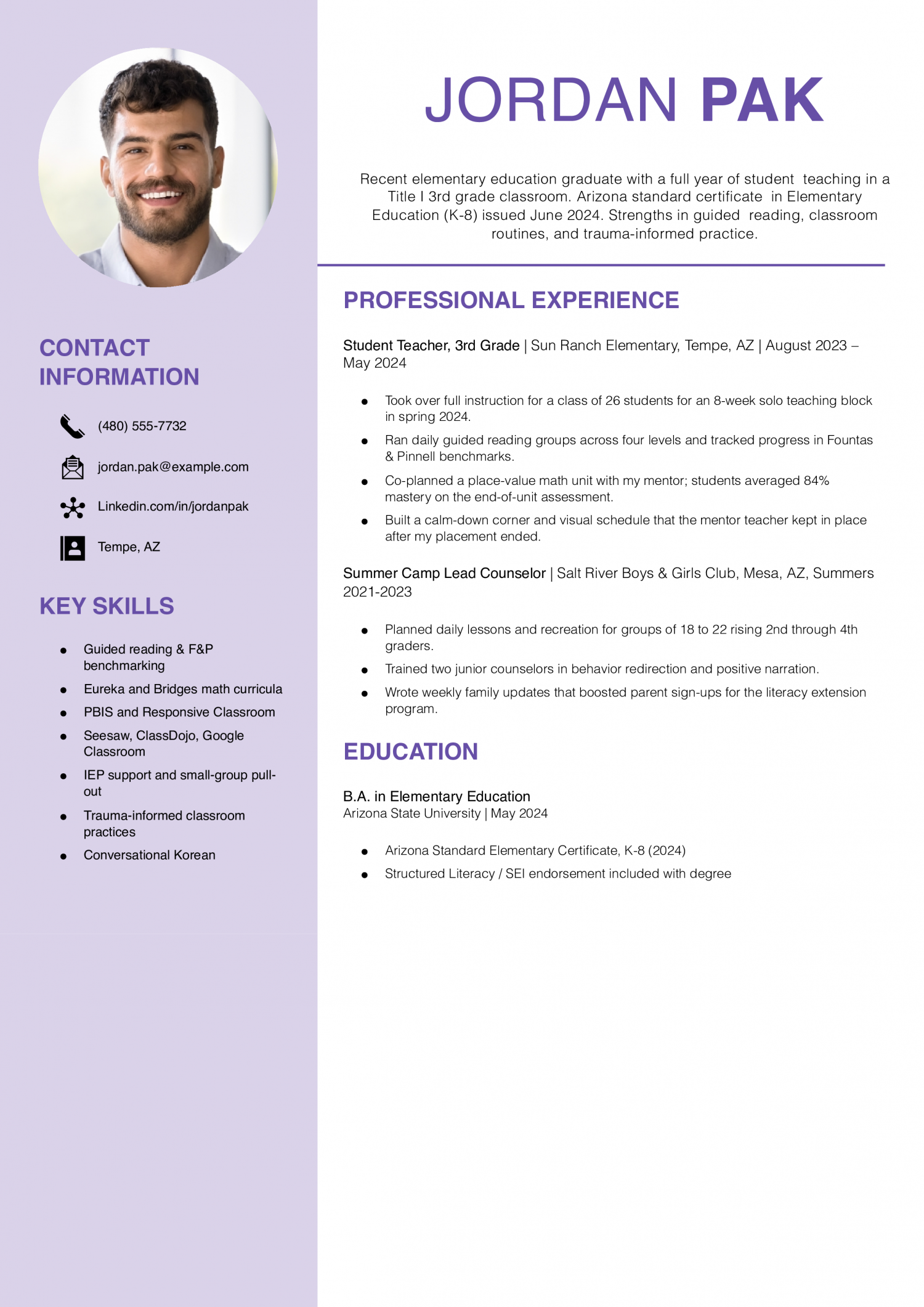
Mid-career education resumes belong to teachers with three to eight years in the same grade band or subject. This resume needs to prove sustained student growth data, curriculum work, and the lead-teacher or department roles that show you are ready for coaching or department chair.
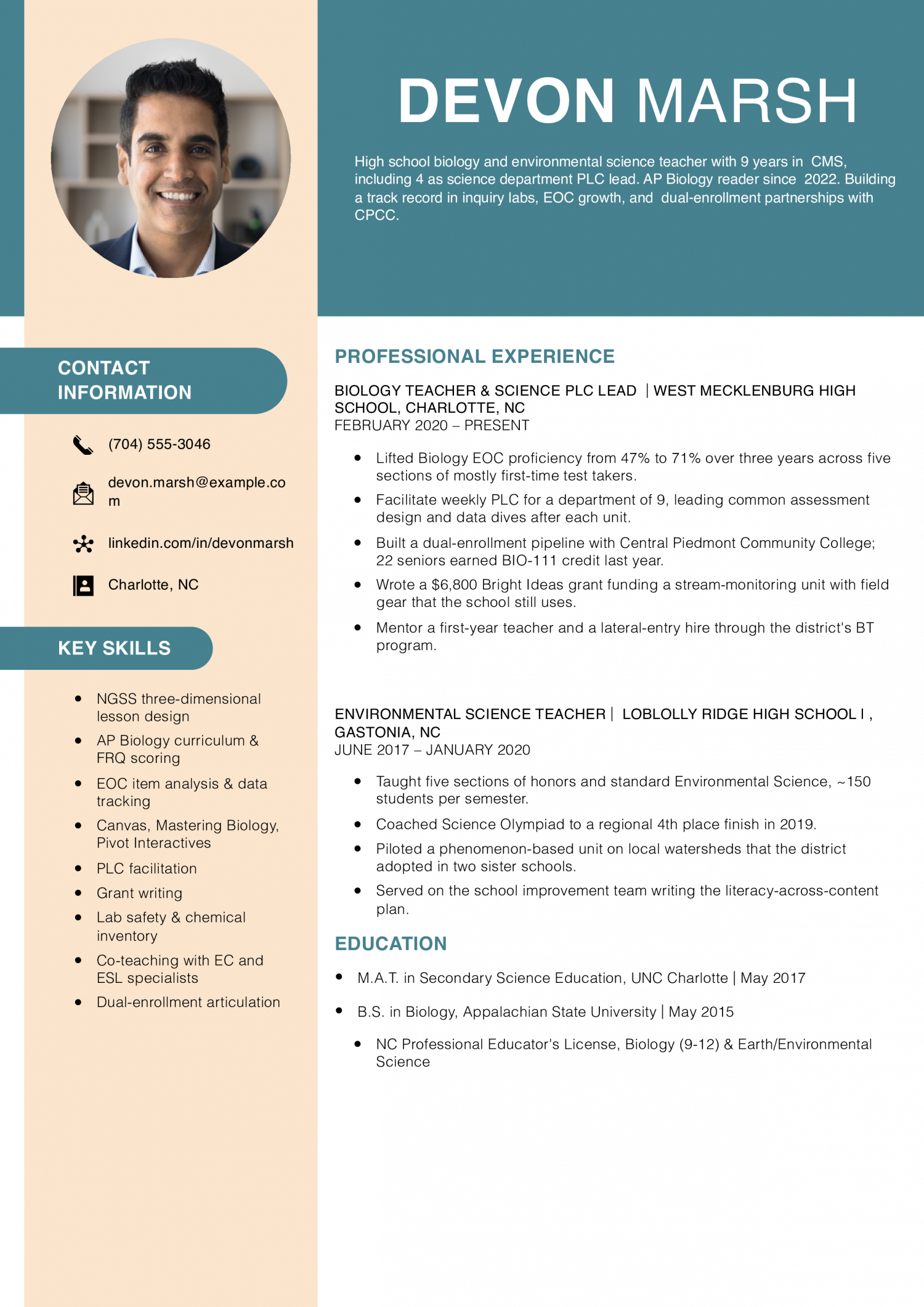
Senior education resumes belong to department chairs, instructional coaches, assistant principals, and principals. This resume needs to prove school-wide outcomes, the teachers and budgets you have supervised, and the accreditation or turnaround work that signals district-level readiness.
Aaron Whitfield
Columbus, OH | (614) 555-4471 | [email protected] | linkedin.com/in/aaronwhitfield
High school math teacher with 12 years in urban and suburban Ohio districts, including 4 as math department chair. Algebra I and AP Statistics specialist with a record of moving struggling students into passing ranges on the Ohio State Tests. Lead mentor for the district’s new-teacher induction program.
Math Department Chair & AP Statistics Teacher
Whetstone Crossing High School | Columbus, OH | 2021-Present
Algebra I & Geometry Teacher
Riverbank Heights High School | Dayton, OH | 2017-2021
Math Interventionist, Grades 9-10
Cardinal Point Academy | Cincinnati, OH | 2015-2017
Algebra I & Pre-Algebra Teacher
Maple Glen Junior-Senior High | Akron, OH | 2013-2015
Long-Term Substitute, 7th Grade Math
Holloway Park Middle School | Toledo, OH | 2012-2013
Your profile should state your years of teaching, the grade band and subject you are licensed for, and the school types you have worked in. Name district, charter, private, or independent settings so principals can place you fast.
Add the student population you have served, such as Title I, dual-language, or IB. Close with one signature outcome from your last two years, like a reading-level gain or a graduation-rate move. Keep the profile to three or four lines so it fits above the fold on page one.
Most strong education resumes pair each role with two or three numbers reviewers can read fast. Use class size, sections taught, reading or math growth percentages, attendance rates, and the share of students meeting state benchmarks.
Bullets without a number tend to read as duties, not impact. If your district restricts test data, pivot to volume and scope: students served per year, IEPs managed, parent conferences led, or after-school programs run. Name the assessment behind the gain, such as MAP, i-Ready, STAR, or your state exam, so the number reads as verified.
Sort each role into three or four categories instead of one long bullet list. Useful buckets include instruction and curriculum, assessment and data, student support and IEP work, and family or community engagement.
Under instruction, name the curriculum you taught, such as Wit and Wisdom, Eureka Math, or Amplify Science. Under data, name the tools you pulled from, such as PowerSchool, Infinite Campus, or Schoology. Reviewers skim these groupings to decide whether your work matches their opening before reading any bullet in full.
School principals and district HR directors need your license visible before they read experience. Put a credentials block under your profile that lists your state license, grade band like K-6 or 5-12, subject endorsements, and ESL, SPED, or gifted add-ons.
List the license as in good standing with the state; do not publish your license number on the resume. Add CPR and first aid if current. Below credentials, list your tech stack: Google Classroom, Canvas, Schoology, Seesaw, and the SIS your district uses.
These early signals get you through the portal screen.
End with degrees, ongoing professional development, and any leadership roles outside the classroom. Name your degree, institution, and any thesis or capstone tied to pedagogy or content area.
Add National Board candidacy, micro-credentials, and PD hours that match your target role, such as Orton-Gillingham, Reading Recovery, AVID, or AP institutes. List mentor teacher, team lead, or PLC facilitator roles here if they did not fit your main experience. New graduates can lead the resume with this section; experienced teachers keep it short and let outcomes carry the file.
The education resumes that get callbacks share a specific skill mix. The lists below come from our user-built education resumes. School principals and district HR directors scan for these patterns first, not leadership platitudes or passion language.
Hard skills get you through the district application portal and prove subject mastery. Soft skills back up your bullets when a principal or committee reads the file. Match the lists below against your target posting.
Treat each soft skill as a claim that needs a bullet with a number or a named outcome behind it.
| Soft Skills | % of resumes with this skill |
|---|---|
| Communication | 74% |
| Patience | 59% |
| Adaptability | 49% |
| Empathy | 39% |
| Organization | 33% |
And here are the top hard skills showing up most often.
| Hard Skills | % of resumes with this skill |
|---|---|
| Lesson planning | 68% |
| Classroom management | 63% |
| Curriculum development | 40% |
| Student assessment | 36% |
| Educational technology | 25% |
Based on data from thousands of educators’ resumes built on ResumeTemplates.com, May 2026.
These are the credentials, software, and compliance signals hiring teams look for when scanning an education resume.
District HR uses the license block as a first-pass filter. Put it under your profile on page one so the portal and the principal both see it before they read your experience.
Lead with the state, the license name, the grade band in the state’s own notation (K-6, 5-12, K-12), and the subject. Add the status line as in good standing rather than publishing your license number.
Below the main license, list endorsements that widen your caseload eligibility: ESL, bilingual, SPED, gifted and talented, reading specialist. Close with reciprocity notes if you are applying across state lines.
Principals and special education coordinators read for two signals fast: whether you can run the room, and whether you can carry the paperwork and meetings that come with IEP and 504 caseloads. Name both directly.
District application portals scan for narrow phrases tied to grade band, license, and the work itself. Group your keywords by niche so the portal reads your resume as a match before a human opens it.
| Niche | Keywords ATS scans for |
|---|---|
| Education summary and profile | education summary for resume, education description for resume, academic summary example, resume education description |
| Grade band and subject | k-6 generalist, 5-12 math, k-12 music, secondary english |
| Licensure and endorsements | state teaching license, esl endorsement, sped endorsement, reading specialist |
| Curriculum and instruction | lesson planning, differentiated instruction, common core alignment, formative assessment |
| Student support and data | iep implementation, 504 plan, mtss tier 2, powerschool data |
What principals expect on an education resume has shifted. A blanket no-AI stance now reads as out of step with district PD calendars, while an honest workflow naming tools and the teacher review step reads as current. The list below names what to add and how to phrase it.
Teachers draft units in MagicSchool or ChatGPT, then edit for standards alignment and student reading level before printing.
AI tools generate tiered versions of the same text or problem set, cutting prep time for multilingual learners and IEP students.
Teachers use AI to draft rubric-based feedback on writing, then review and adjust before returning work to students.
AI drafts translated parent updates that teachers verify with a bilingual colleague before sending through ParentSquare or Remind.
School principals and district HR directors read this list as a map of where your work is heading. The credentials below tell them which instructional track, student population, or leadership lane you have invested in beyond your base license. List the issuing body and the year of completion under each item.
Education pay clusters tightly around state salary schedules, so the geographic spread reads differently than in private-sector roles. The top-paying states are concentrated in high-cost coastal markets and a few unionized Northeast and Pacific states, not the Sun Belt districts hiring the largest volume of new teachers.
If you are geographically flexible, foreground your license portability, the states you hold or can transfer into, and any National Board status that travels across state lines on the top third of your resume.
| # | State | Avg. Annual |
|---|---|---|
| 1 | Washington | $99,110 |
| 2 | California | $98,190 |
| 3 | District of Columbia | $94,730 |
| 4 | Rhode Island | $86,900 |
| 5 | Massachusetts | $83,260 |
| 6 | New York | $82,480 |
| 7 | Connecticut | $78,740 |
| 8 | New Jersey | $77,150 |
| 9 | Alaska | $76,290 |
| 10 | Oregon | $75,800 |
| # | State | Workers | Median |
|---|---|---|---|
| 1 | California | 141,650 | $98,190 |
| 2 | Texas | 124,430 | $61,380 |
| 3 | New York | 103,920 | $82,480 |
| 4 | Florida | 78,630 | $55,550 |
| 5 | Illinois | 61,000 | $64,160 |
Resume Templates offers HR approved resume templates to help you create a professional resume in minutes. Choose from several template options and even pre-populate a resume from your profile.
Put your degree, institution, and graduation year in a dedicated Education section. Place it near the top if you are a new graduate, near the bottom once you have three or more years of classroom experience.
Name the degree fully, such as Bachelor of Science in Elementary Education. Include your licensure pathway if it was embedded in the program. New graduates should add GPA if 3.5 or higher, plus the cooperating teacher and school for student teaching.No. List the state, the grade band, and the subject endorsement, then note the license is in good standing.
The license number belongs on the district application form, not on a document you email or upload to public job boards.
Most state boards warn against publishing it because it can be used for credential fraud.
No. Once you hold a bachelor's degree, drop high school from the Education section.
The only exception is if your high school is directly tied to your target role, such as applying to teach at the school you graduated from.
Use that space instead for your degree, licensure, and any graduate coursework toward a master's or endorsement.
Name your current license, then add a one-line reciprocity note.
Write something like Indiana Initial Practitioner License, K-6 Generalist; reciprocity application filed with the Ohio Department of Education. This tells district HR you have started the transfer and saves them the call.
Add any Praxis or state-specific exams you have already passed below the line.
For an educator, a professional template is the safest pick, because it signals the polish hiring managers in this field expect. An ATS-friendly template is a solid alternative. Whichever you choose, keep the formatting clean and easy to parse: clear section headings, a standard font, and no graphics a parser can choke on.
Executive Resume Writer and Career Coach
Andrew Stoner is an executive career coach and resume writer with 17 years of experience as a hiring manager and operations leader at two Fortune 500 Financial Services companies, and as the career services director at two major university business schools.
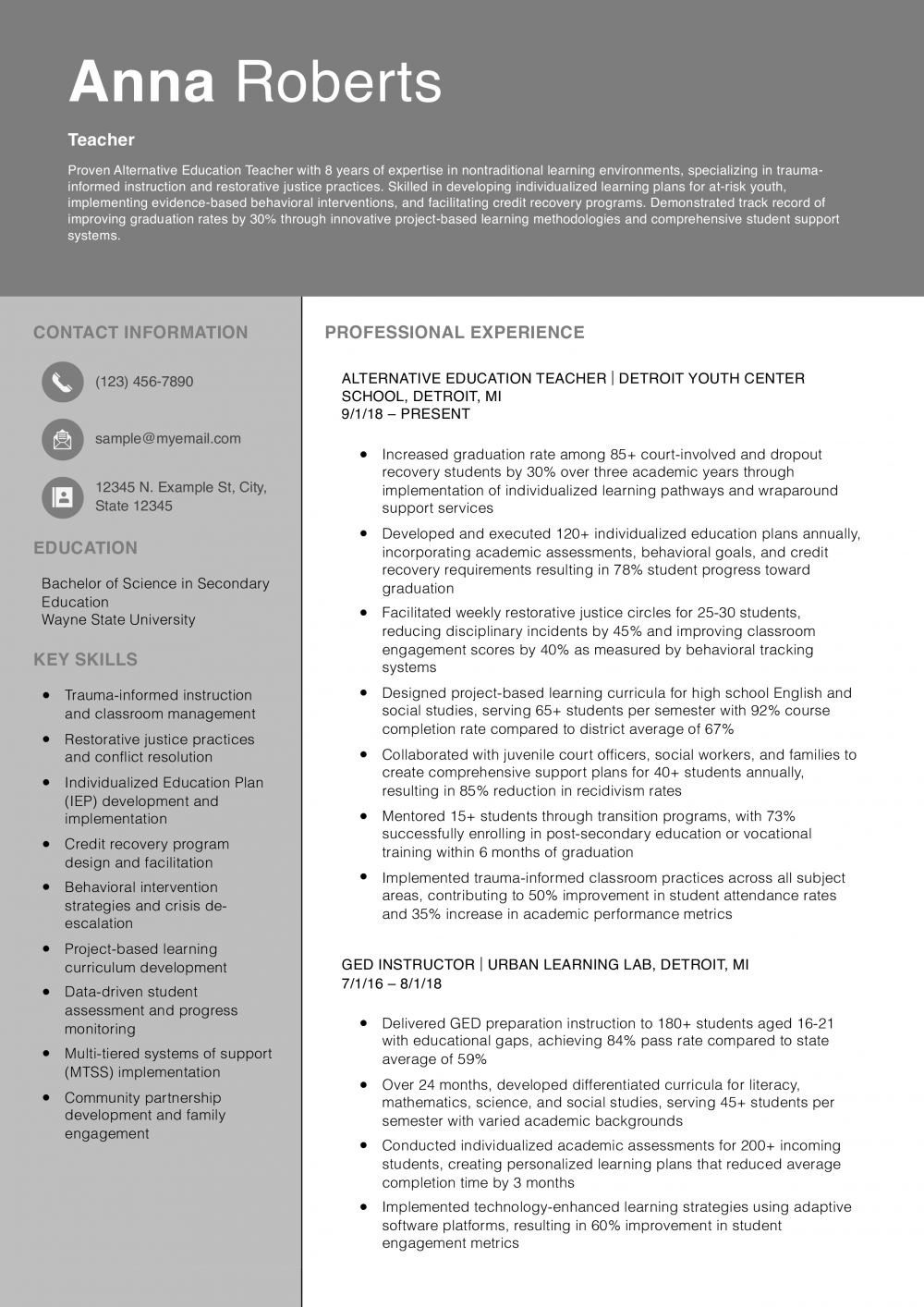
Customize this template in our builder in under 10 minutes.

![20 Best Psychology Resume Examples and Templates for [y]](/wp-content/uploads/2024/12/Director-of-Clinical-Operations-Resume-Example.x400.pdf.jpeg)